

Grande Dune du Pilat Visitor Centre Refurbishment by Aldebert Verdier Architectes
Sustainable refurbishment of the Grande Dune du Pilat Visitor Centre enhances accessibility, visitor flow, and environmental integration using local, bio-based materials.


The refurbishment of the Grande Dune du Pilat Visitor Centre by Aldebert Verdier Architectes (AVA) represents a careful architectural response to one of France’s most powerful yet fragile natural landscapes. Located at the foot of Europe’s highest sand dune, this cultural and visitor-oriented project is part of the “Grand Site de France” initiative, a designation that demands exemplary environmental stewardship, high-quality public reception, and long-term sustainable development.
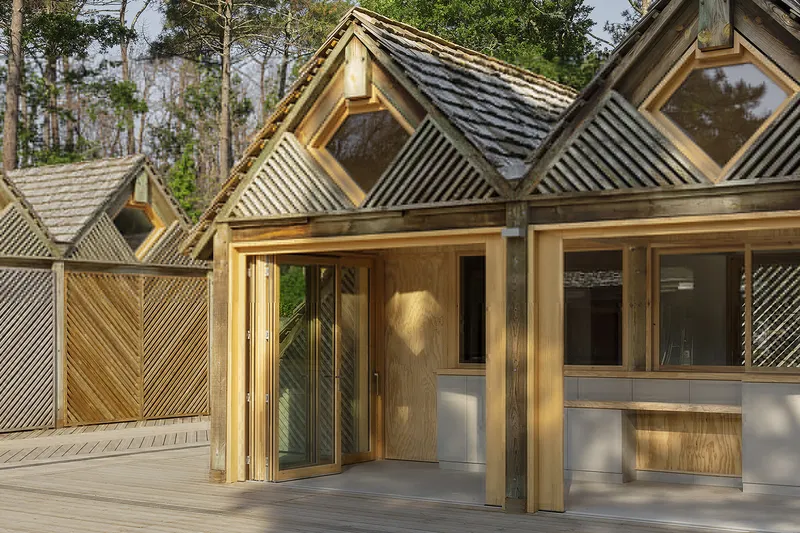
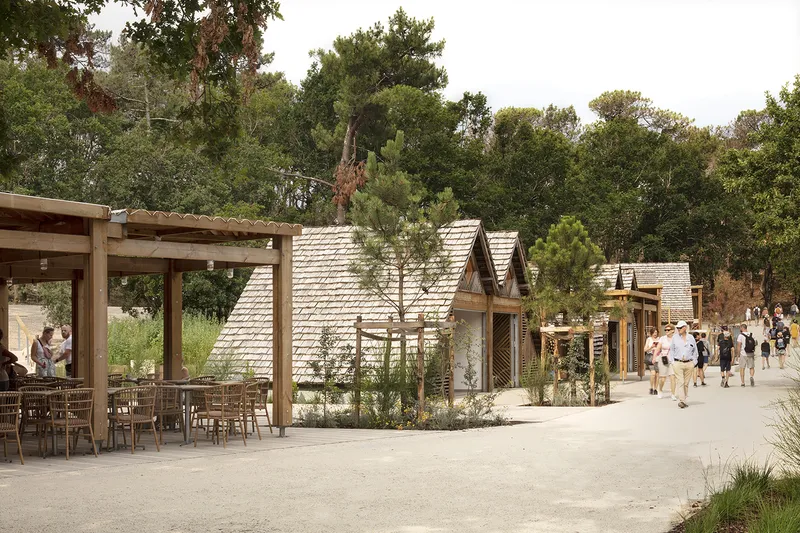
Completed in 2023, the 800-square-metre refurbishment reimagines the existing visitor infrastructure to improve accessibility, functionality, and spatial clarity while preserving the delicate ecological balance of the site. Rather than pursuing expansion, the project focuses on architectural rehabilitation, reuse, and subtle transformation, reinforcing the relationship between built form and the surrounding dune landscape.
Enhancing Visitor Experience Through Adaptive Reuse
The Dune du Pilat attracts a vast number of visitors each year, requiring infrastructure that can support educational, administrative, and commercial activities without compromising the site’s environmental integrity. AVA’s intervention began with a comprehensive diagnostic study, assessing the condition of the existing wooden huts and evaluating multiple planning scenarios under strict construction constraints.

The primary objective was to improve public reception conditions while ensuring compliance with contemporary accessibility standards, including PRM access. The natural slope of the terrain and the elevated thresholds of the existing huts posed significant challenges, requiring careful architectural adjustments to improve circulation and comfort without altering the land’s natural profile.
A Village-Like Spatial Organization Rooted in Context
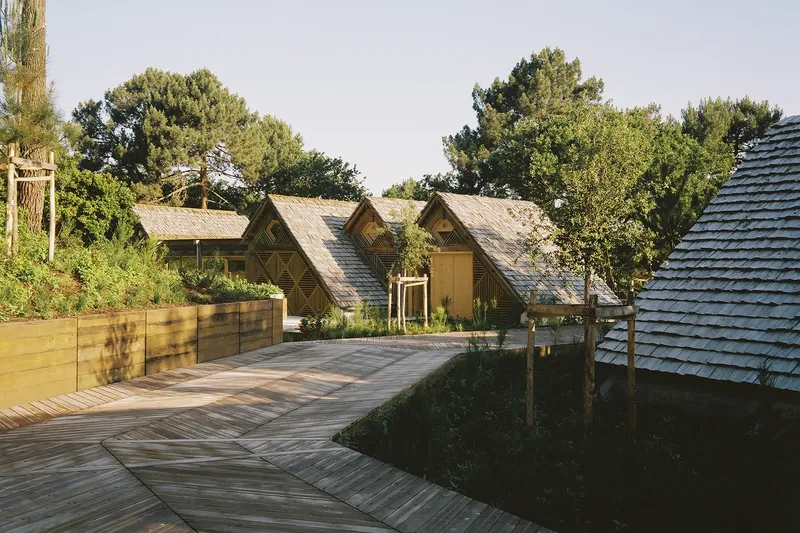
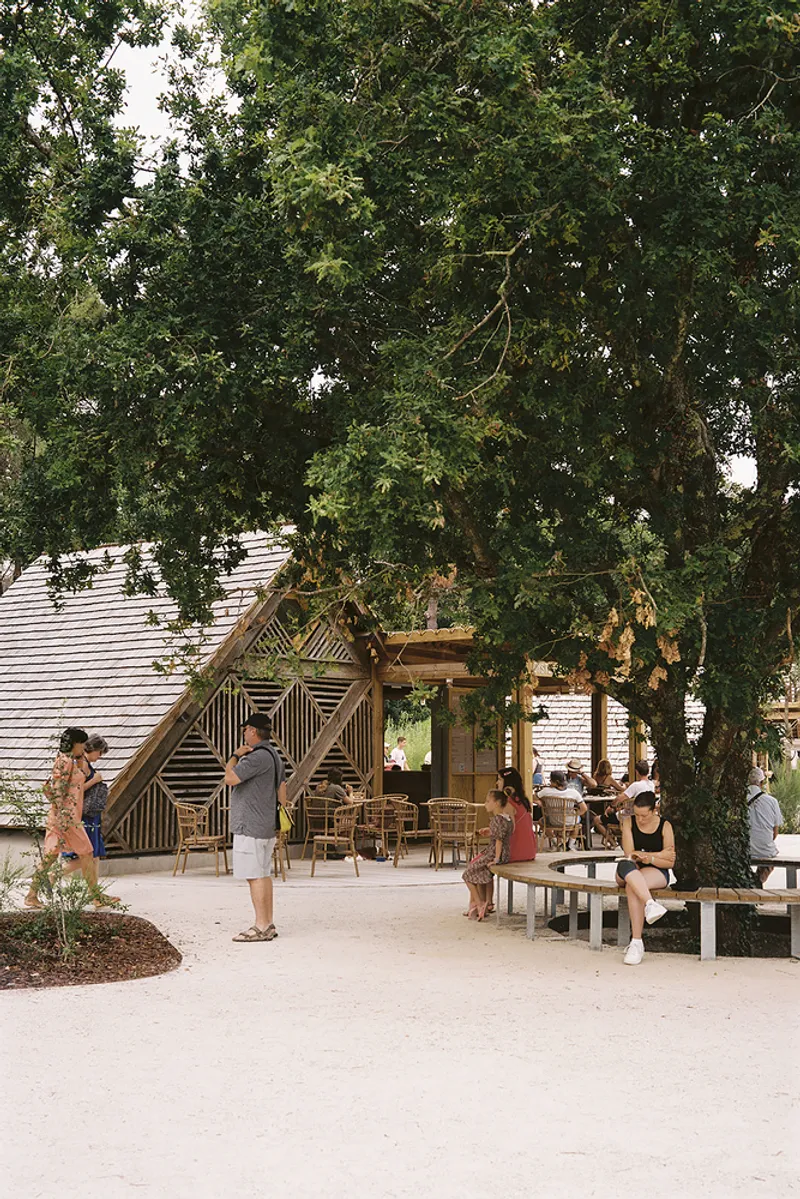
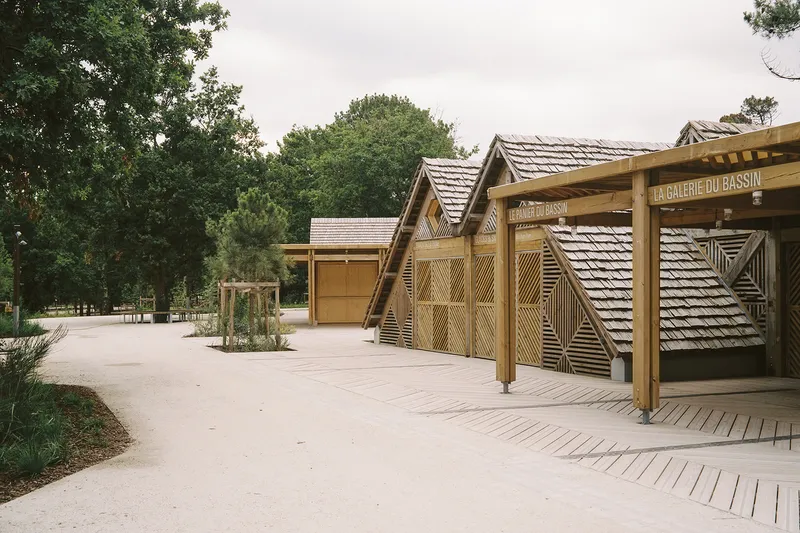
One of the defining architectural strategies of the refurbishment is the reorganization of the visitor centre into a coherent, village-like ensemble. Previously fragmented and visually chaotic, the site is now structured around a network of interconnected squares. The first square accommodates reception and educational functions, while subsequent spaces host catering and commercial activities, creating a clear and intuitive spatial hierarchy.
Unified paving connects these outdoor spaces, guiding visitors naturally through the site while reinforcing visual continuity. Former wooden huts have been repurposed as boutiques and service spaces, maintaining their original scale and material identity while giving them renewed purpose. This approach strengthens the dialogue between exterior and interior spaces, encouraging year-round use and enhancing daylight penetration through newly created openings and passages.
Material Reuse and Bio-Sourced Construction
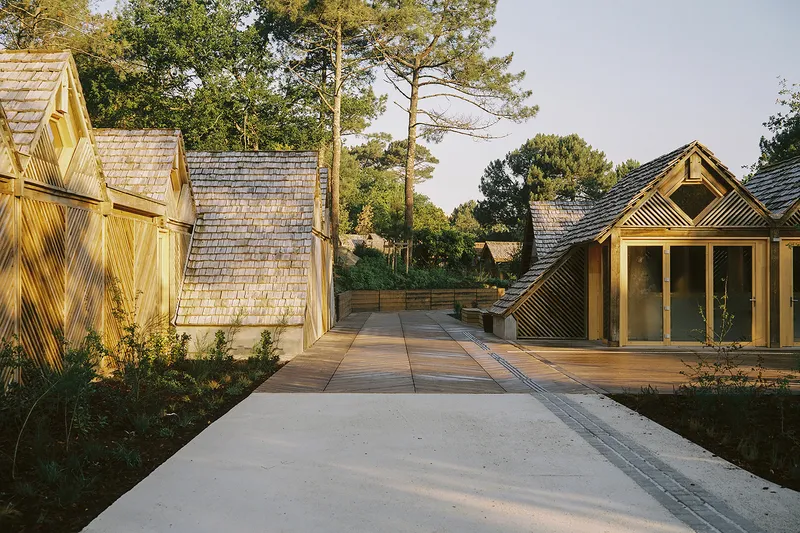
Materiality plays a central role in anchoring the refurbishment within its natural and cultural context. The original huts, primarily constructed from wood, informed the material palette of the project. AVA reused materials salvaged from demolished structures wherever possible, extending the lifecycle of existing resources and minimizing waste.

The refurbishment incorporates locally sourced and bio-based materials, including walls made from compressed raw earth and innovative concrete composed of recycled oyster shells from the Bay of Arcachon. These choices reflect a commitment to low-carbon construction and regional material culture, while subtly expressing innovation through craft and texture.
Throughout the project, particular attention was given to tree preservation, the optimization of open spaces, and the use of semi-permeable stabilized surfaces. These measures reduce soil sealing, improve water management, and ensure that the architectural intervention remains visually and environmentally integrated into the dune landscape.

Architecture in Service of Landscape Preservation
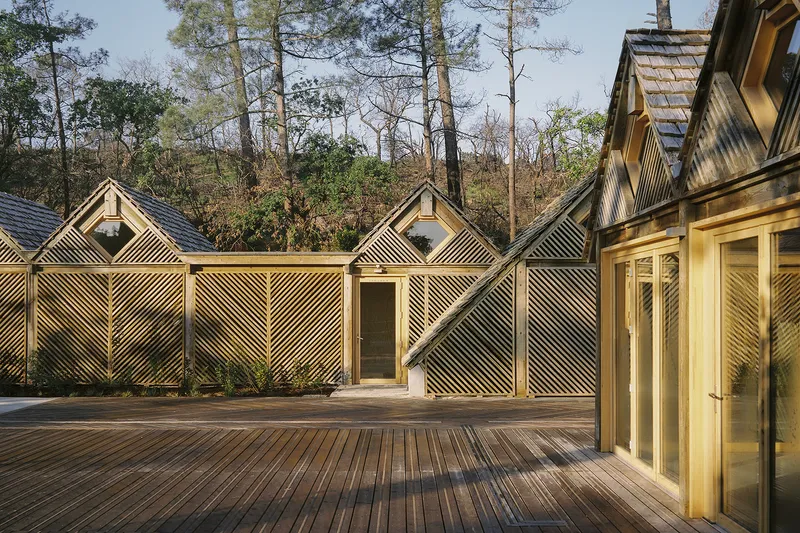
Rather than asserting itself as an architectural landmark, the Grande Dune du Pilat Visitor Centre refurbishment adopts a restrained and respectful posture. The project demonstrates how contemporary architectural rehabilitation can support tourism, education, and public comfort while preserving the integrity of a sensitive natural monument.
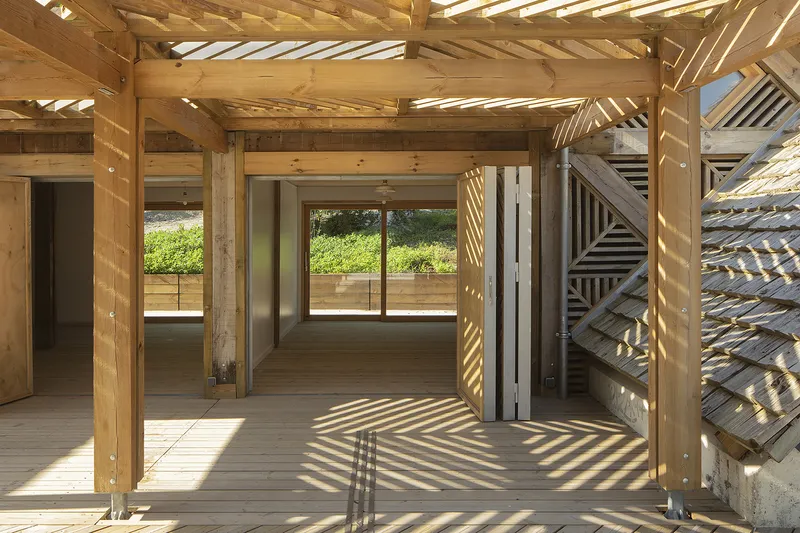

By reusing existing structures, limiting new construction, and prioritizing sustainable materials and accessibility, Aldebert Verdier Architectes have delivered a visitor centre that meets modern standards without compromising the dune’s symbolic and ecological value. The result is an architecture of discretion, coherence, and environmental responsibility, setting a benchmark for cultural and visitor architecture in protected landscapes.


All photographs are works of
Agnès Clotis
.


Popular Articles
Popular articles from the community


Juan García Correa, John González and Claudia Rueda Sink a Circular Amphitheater into a Manizales Engineering Building
On the La Nubia campus in Manizales, Colombia, the S1 Building folds labs and offices into a hillside of ramped lawns that double as a campus route.

David Macias Steps a Doorless Stone and Plaster House Down a Tropical Colombian Hillside
In the humid hills of Colombia, Threshold House replaces the front door with an open void and terraces its 850 m² down the slope instead of fighting it.

Jaramillo Van Sluys Arquitectura and Urbanismo Turn a Demolished Registry Lot in Quito into an Orchard Plaza
In Quito's Centro Histórico, a 2,800 m² plaza exposes the San Agustín convent wall and redraws its lost Augustinian orchard in volcanic stone.

Cube Design Draws an Ecological Corridor Between Two Shenzhen Hills with the Nankai Building
Beside Shenzhen's container docks, the Nankai Building pairs stacked balconies with a climbing green screen to connect two hillsides across its height.

Similar Reads
You might also enjoy these articles


Hodi-Mandai Geram
Project Function: Preservation and revitalization of the Intangible heritage and socio-spatial identity of the Hodi by Housing, Cultural Memory Center, Sacred Grove, landscape, local tourism economy


Olio Towers: A Mid-Rise for Performers That Fuses Housing, Rehearsal, and Stage
Located blocks from Houston's Theater District, this modular tower stacks living units around a central performance atrium.

Oasis: Modular Green Housing Carved into Dhaka's Urban Fabric
A shortlisted Plugin Housing entry reclaims unauthorized settlements in Dhaka with stepped concrete volumes, green roofs, and ventilation-driven design.

Black Hole: A Floating Megastructure for the Post-Physical Era
Emiliano Mazzarotto envisions a spherical, self-scaling arena where e-sports, digital hotels, and holographic stadiums replace traditional public space.

Explore Cultural Architecture Competitions
Discover active competitions in this discipline

Challenge to reimagine the Iron Throne

Photograph architecture without architects

Illustrate the lost glory of Angkor Wat - Render Challenge

Bring back Drive In's
Comments (0)
Please login or sign up to add comments
No comments yet. Be the first to comment!