
Grazzini Tonazzini and Giorgia Colombo Wrap a Forgotten Tuscan Ruin in Agricultural Fabric
A translucent pavilion in Camaiore, Italy, uses locally sourced non-woven textiles to reveal the quiet power of a neglected rural hut.


Somewhere in the agricultural lowlands near Camaiore, a small stone hut sat abandoned for years, ignored by the landscape that had slowly grown around it. Grazzini Tonazzini and Giorgia Colombo Architetto decided it was worth saving, not through restoration, but through a temporary act of framing. The Arginvecchio Pavilion is a 400 square meter enclosure built from translucent non-woven fabrics derived from local agricultural materials. It wraps the ruin in a triangular figure that forces visitors to approach, enter, and look again at something they had stopped seeing.
The intervention is deliberately light. No concrete footings, no steel frame, no permanent claim on the land. Instead, fabric screens undulate across the grass, creating walls that glow at dusk and ripple in the wind. Inside, the pavilion houses architectural models and three art pieces arranged around the existing stone structure, turning a forgotten corner of Tuscany into a temporary museum of rural construction knowledge. What makes the project genuinely compelling is its argument: that minor buildings deserve the same curatorial attention we lavish on monuments, and that the simplest materials can produce that attention when deployed with discipline.
A Fabric Boundary in the Landscape
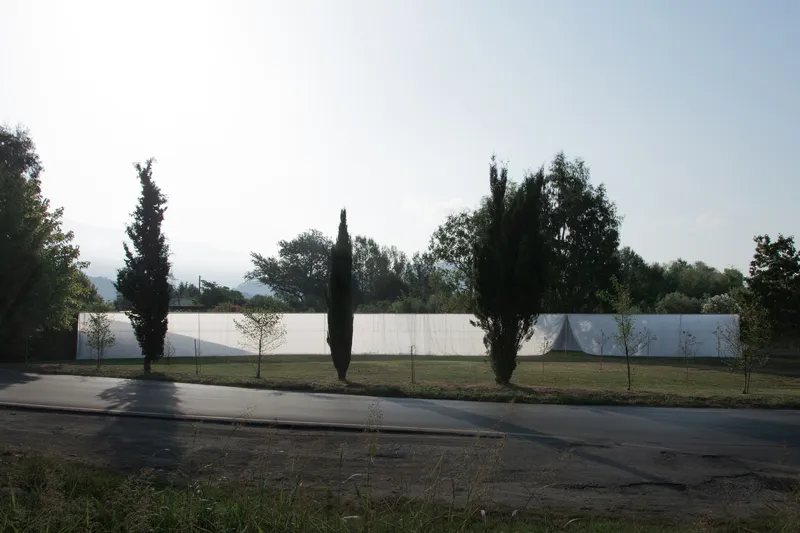
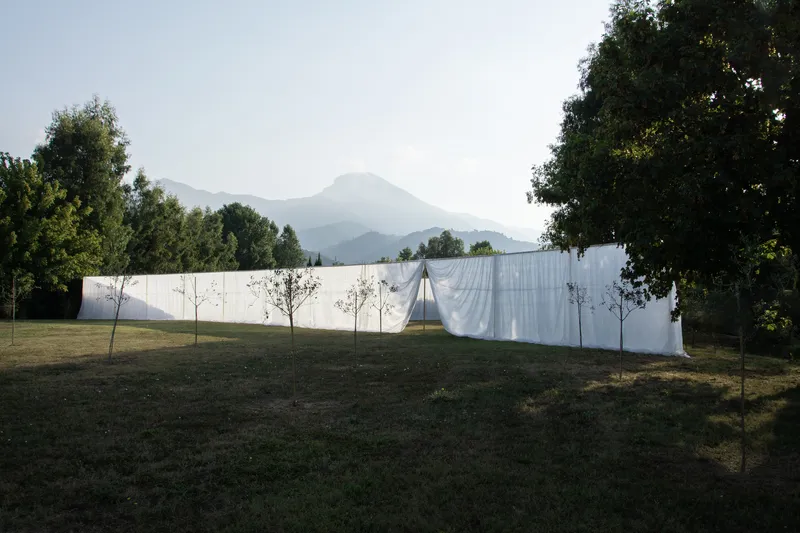
Seen from a distance, the pavilion reads as a long white line drawn across the green field, a boundary that is simultaneously assertive and insubstantial. The translucent fabric catches afternoon light and mountain backdrops with equal ease, oscillating between solid wall and luminous veil depending on the hour. Cypress and birch trees punctuate the edges, grounding the textile geometry in the specific botany of the Versilian plain.
The choice of material is not merely aesthetic. These non-woven fabrics descend from local agricultural production, meaning the pavilion is literally constructed from the same economic cycle that shaped the landscape it inhabits. It is a closed loop of meaning: land produces crop, crop produces textile, textile frames the land. That kind of material logic is rare in temporary architecture, where the convenience of industrial fabrics usually wins out over specificity.
Threshold and Entry
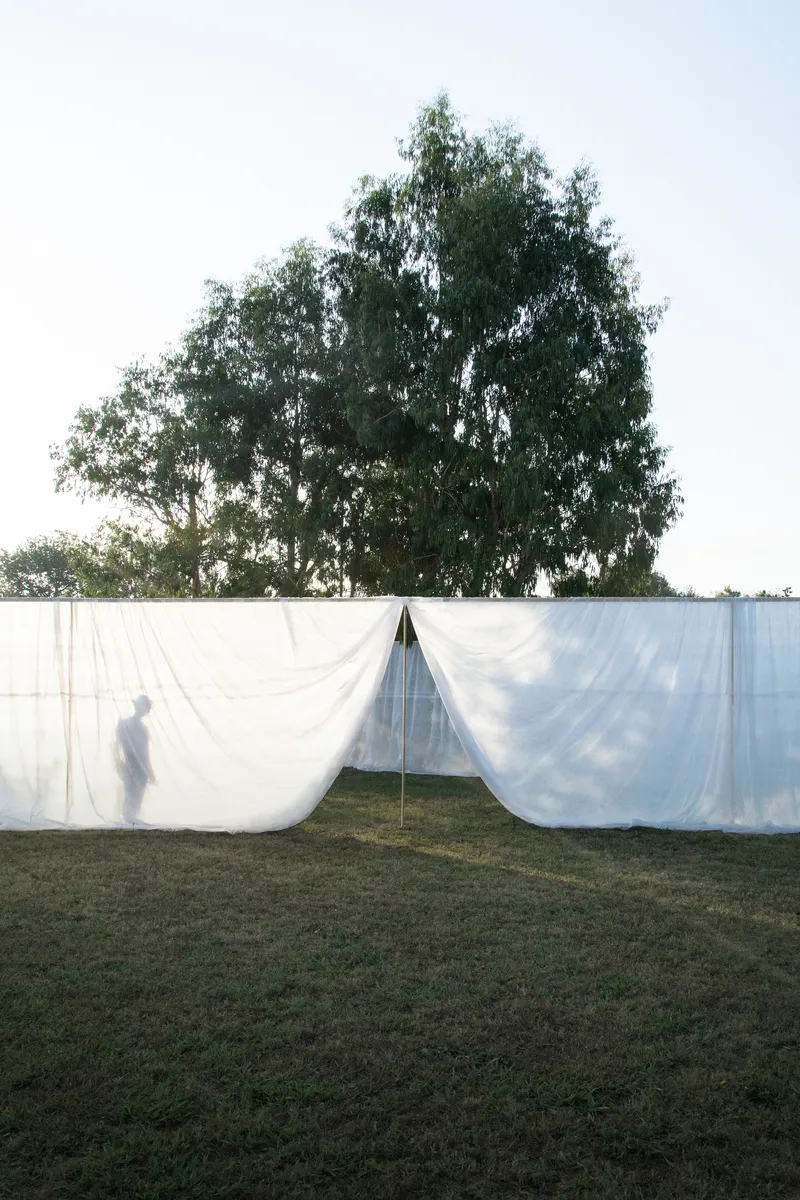
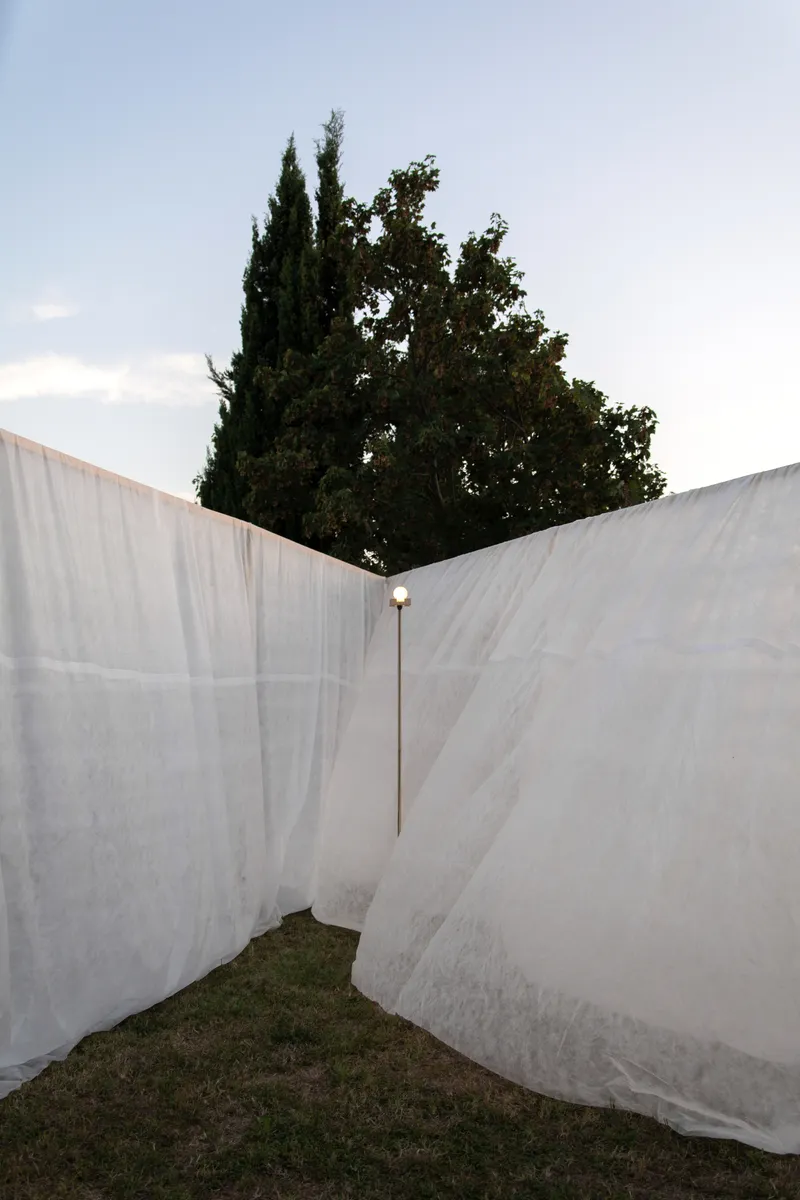
The pavilion has a single point of access, and the architects exploit that constraint fully. The triangular entrance is formed by two converging fabric walls that meet beneath a tree canopy, creating a compressed, almost ceremonial threshold. You do not wander into this space; you are channeled into it. The narrowing passage between translucent planes plays with peripheral vision, filtering daylight into a diffused glow that shifts your perception before you reach the interior.
The intersections of fabric walls create narrow pathways that feel both intimate and disorienting. Cypress trees appear overhead, visible through the translucency of the material, collapsing the distinction between inside and outside. It is a clever spatial trick: the fabric does not block the landscape so much as blur it, keeping the surroundings present as silhouettes and color fields while still defining a clear enclosure.
The Ruin Revealed

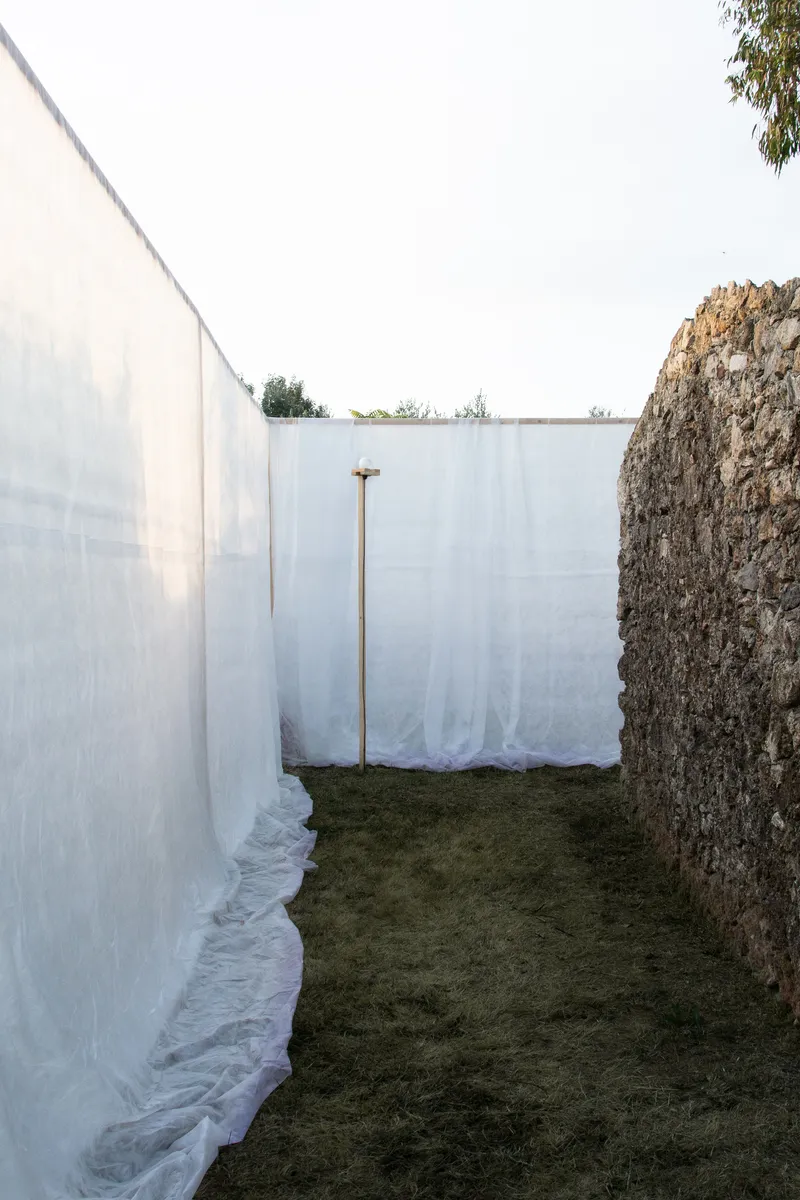
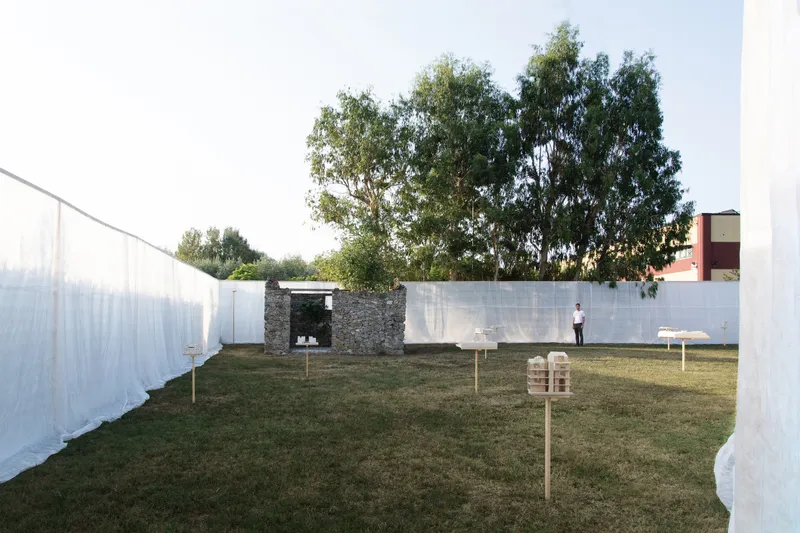
At the center of the pavilion sits the stone ruin itself, rough walls and a timber lintel framing views back toward the fabric screens. The juxtaposition is striking. Where the fabric is smooth, luminous, and ephemeral, the stone is coarse, shadowed, and stubbornly permanent. The architects use this contrast as their primary spatial argument: that the ruin's material authenticity becomes legible precisely because it is surrounded by something so clearly temporary.
The narrow passage between fabric screen and rough stone wall, propped by a single timber brace, is the project's most charged moment. The gap is barely wide enough for a person. You feel the weight of the stone on one side and the weightlessness of the textile on the other, and the difference between construction cultures separated by centuries becomes a physical sensation. A visitor standing in the courtyard at dusk, surrounded by glowing fabric and ancient masonry, is experiencing an argument about time that no exhibition panel could deliver as effectively.
Materiality at Close Range
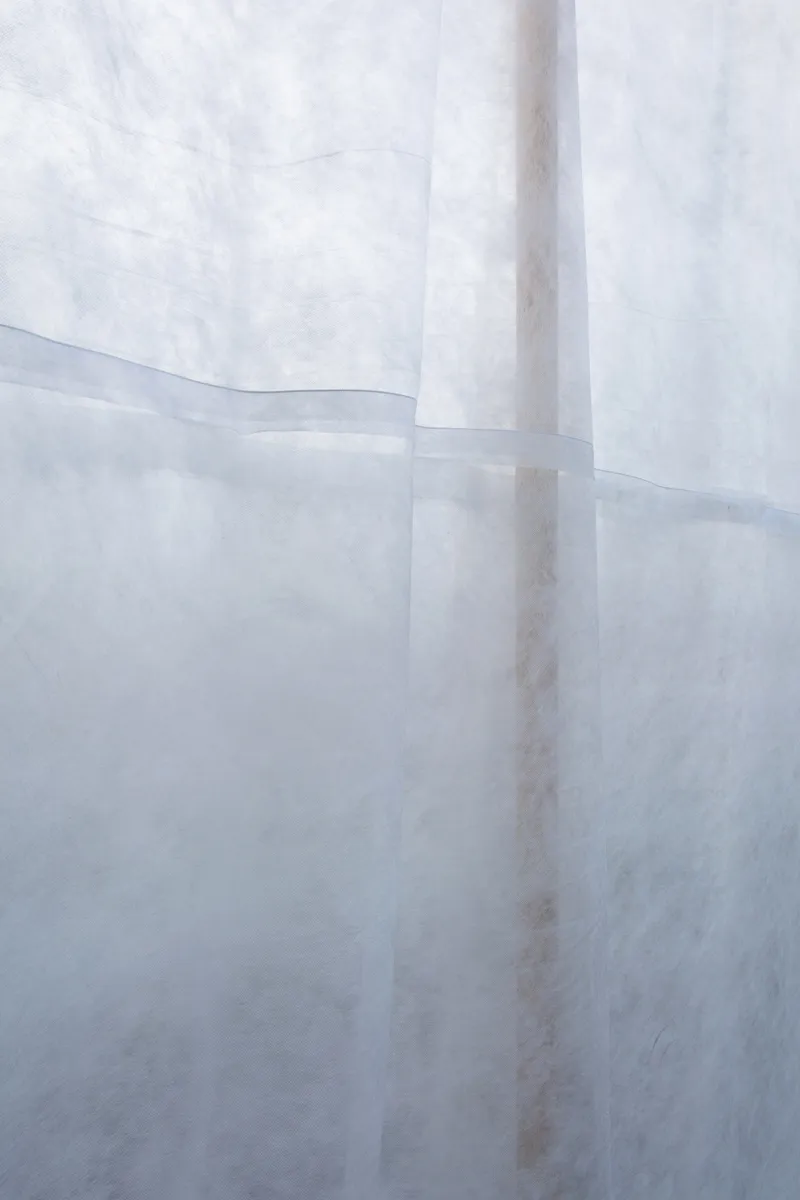
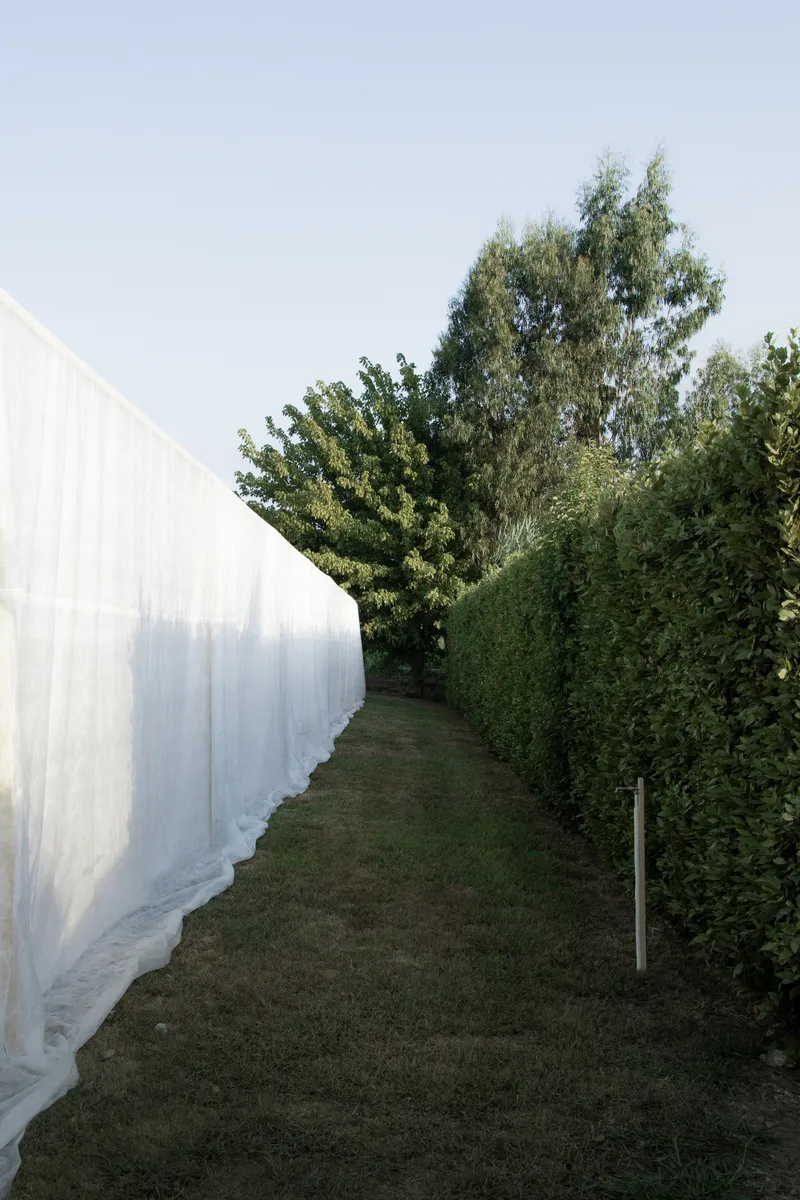
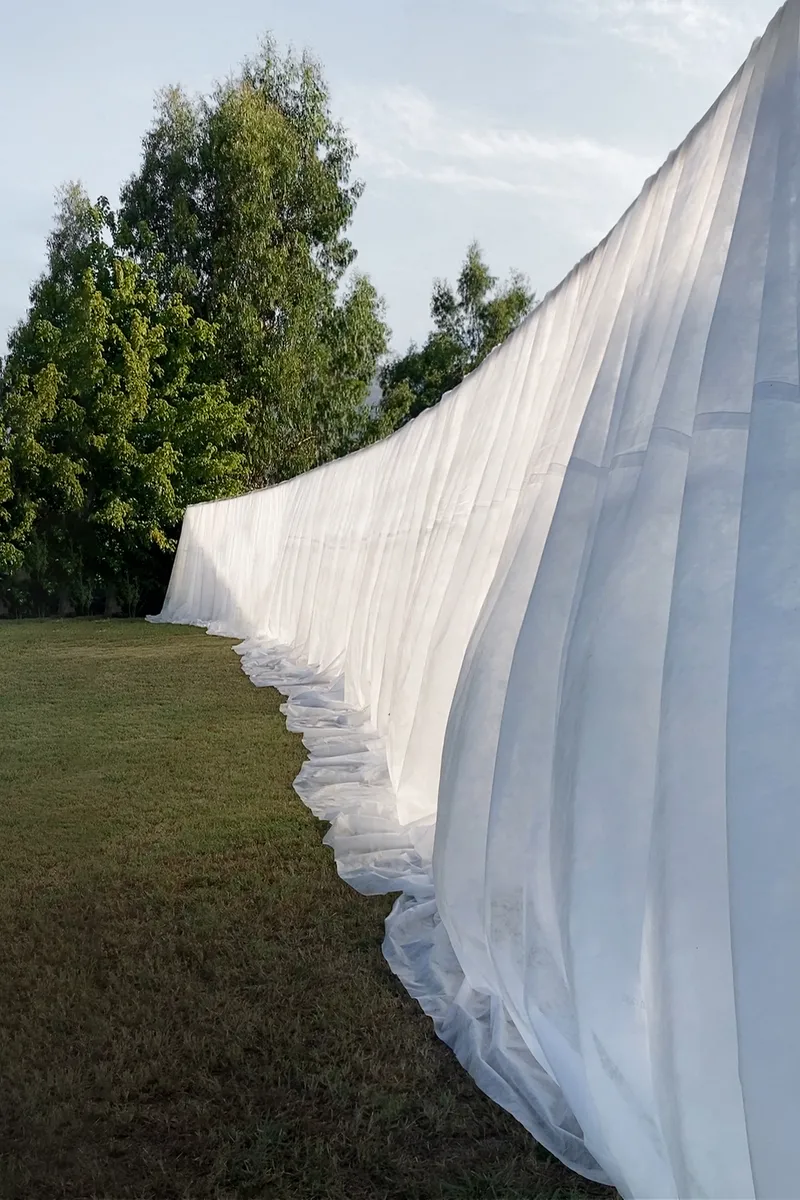
Up close, the fabric reveals its own character. Overlapping panels show seams, texture variations, and slight irregularities that betray their agricultural origin. The material is not pristine. It has a grain, a direction, a weave that shifts under different lighting conditions. The architects were clearly aware that this imperfection is an asset, not a liability. A perfect, industrial membrane would have produced a sterile container. These textiles produce a living one.
Where the fabric meets trimmed hedges and manicured grass, the pavilion engages in a quiet dialogue with the landscape's own maintenance rituals. The hedge is clipped; the fabric is draped. Both are acts of human shaping applied to natural materials, separated only by timescale. It is the kind of observation that emerges from spending time with the project rather than from reading about it.
The Pavilion at Night
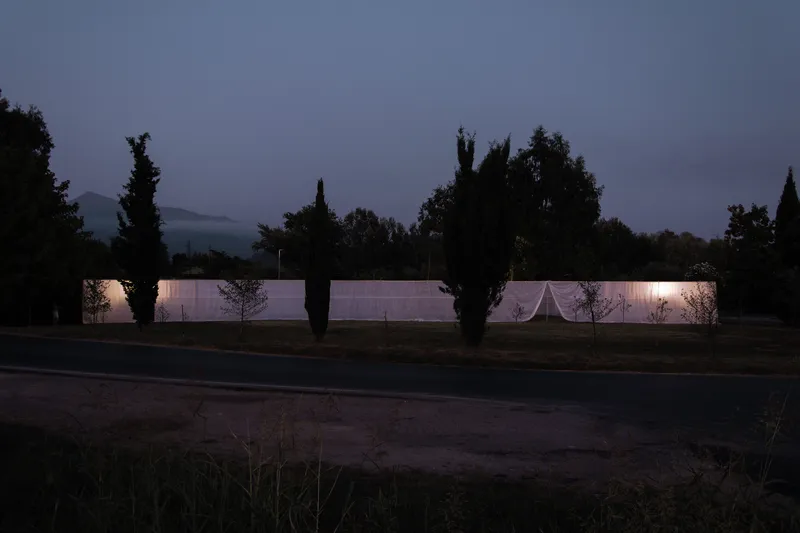
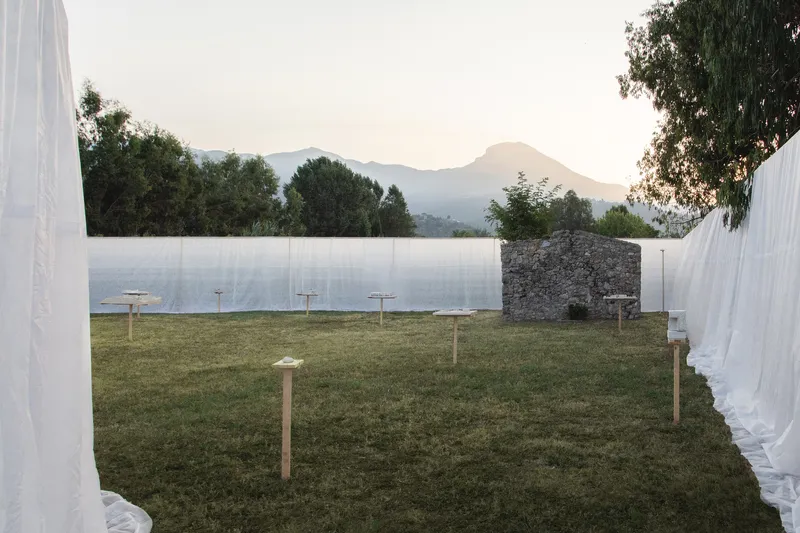
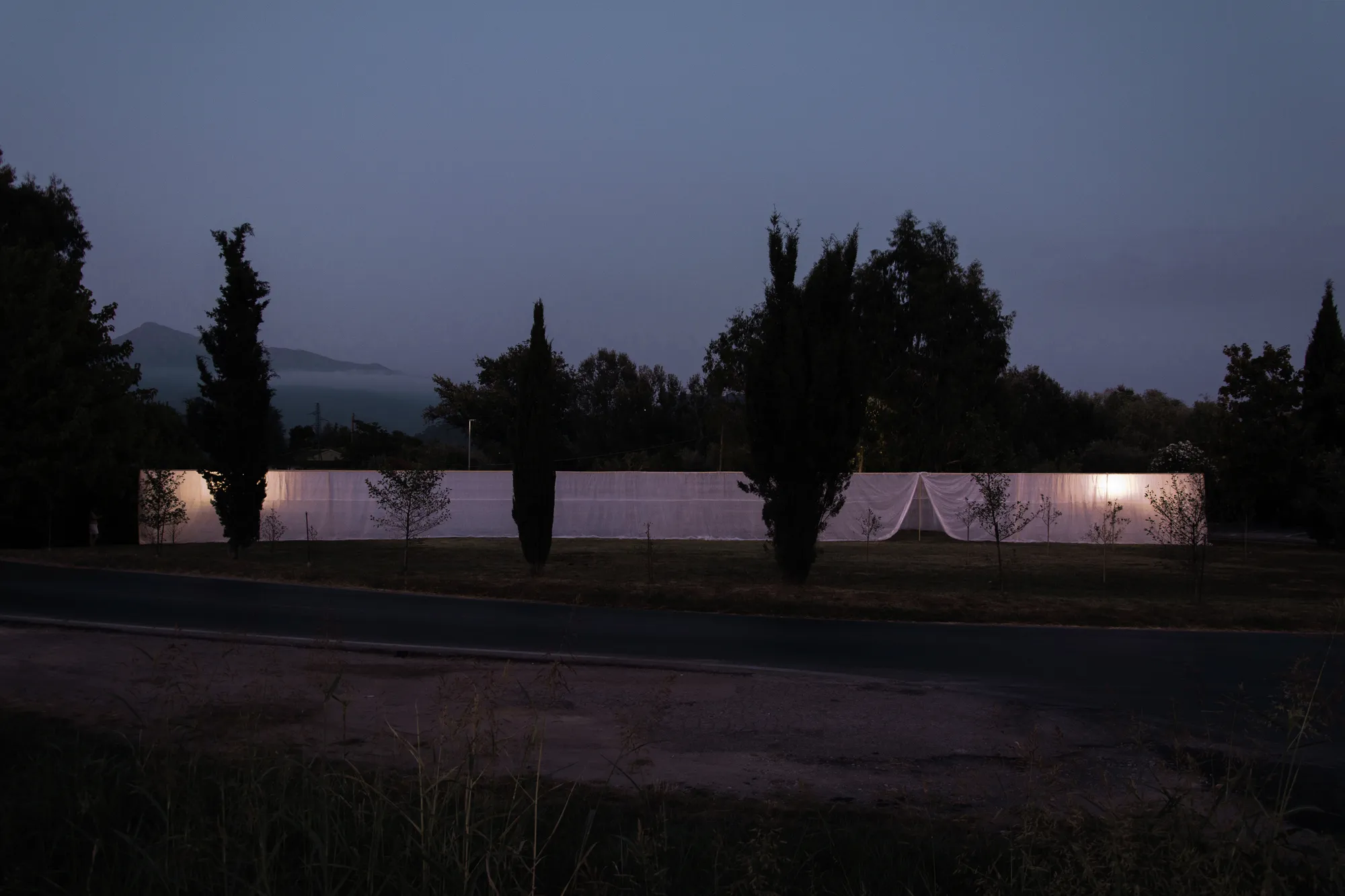
At dusk, the Arginvecchio Pavilion transforms entirely. Interior illumination turns the fabric enclosure into a glowing lantern visible across the road, framed by silhouetted cypress trees. The stone walls, distant mountains, and fabric curtains collapse into a single composition where depth is measured not in meters but in degrees of luminosity. The pavilion's triangular geometry, somewhat abstract during the day, becomes a clear figure against the darkening sky.
The dusk photographs reveal what is arguably the project's strongest quality: its capacity to operate at two completely different registers. By day, it is a quiet, almost invisible intervention that defers to the landscape. By night, it commands the field, broadcasting the presence of the ruin it protects to anyone passing on the road. That duality, a structure that is both humble and assertive depending on the hour, is difficult to achieve with heavier materials.
Plans and Drawings
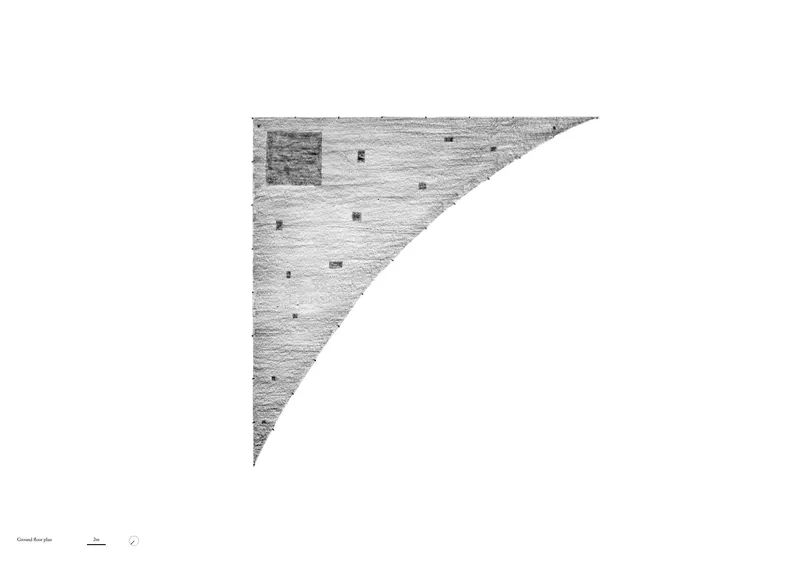
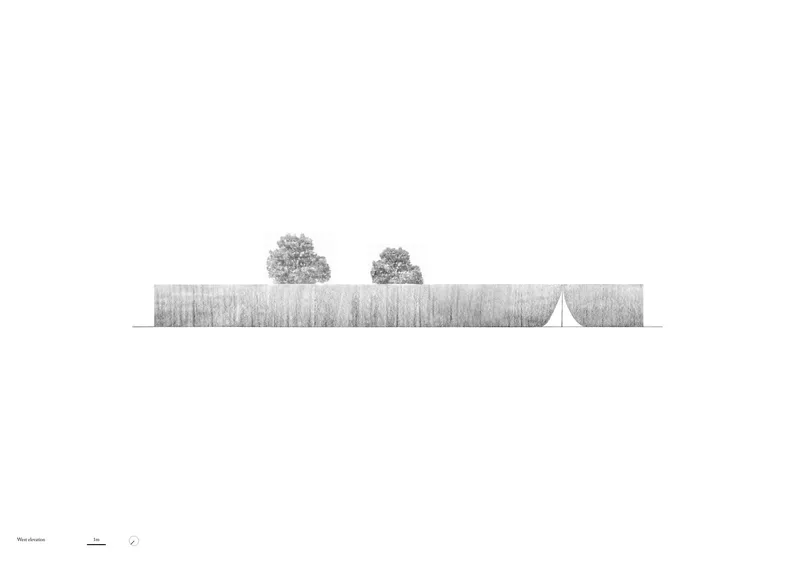
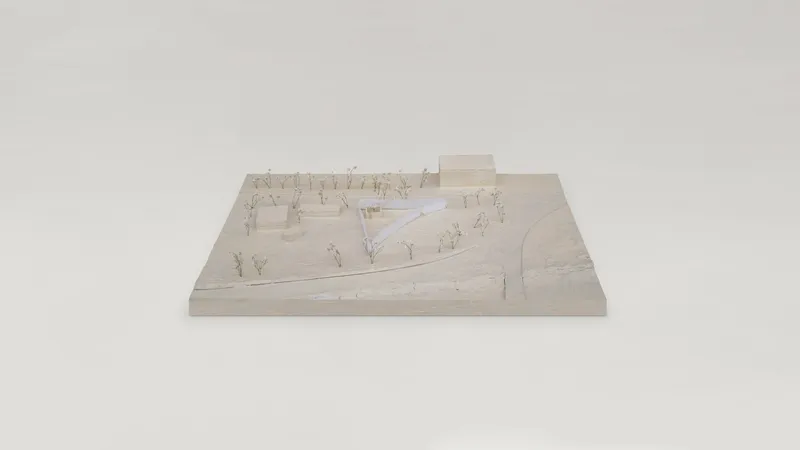
The floor plan confirms the triangular footprint and reveals how the existing stone walls sit asymmetrically within the fabric enclosure, creating zones of varying width and compression. Scattered window openings in the plan suggest that the fabric is not continuous but punctured, allowing controlled views out to the surrounding landscape. The west elevation drawing shows the pavilion's low, horizontal profile against the backdrop of two trees, with the pyramidal roof form barely rising above the stone wall of the ruin.
The physical model, rendered in white with miniature trees and pathways, strips the project down to its essential moves: a triangular figure placed over an existing footprint, with a single pathway leading in. Seen in miniature, the relationship between new enclosure and old ruin is almost diagrammatic in its clarity. The architects knew exactly what they were doing, and the economy of the gesture only reinforces its impact.
Why This Project Matters
The Arginvecchio Pavilion belongs to a growing body of work that takes minor architecture seriously. Across rural Europe, thousands of stone huts, drying sheds, and agricultural shelters are crumbling into irrelevance as the construction knowledge that produced them disappears. Most preservation efforts focus on buildings that are already famous. What Grazzini Tonazzini and Giorgia Colombo propose is something more radical: that an anonymous ruin in a Camaiore field deserves to be exhibited, studied, and experienced as architecture.
The means of that exhibition matter as much as the intent. By building with locally sourced agricultural textiles and refusing anything permanent, the architects demonstrate that architectural advocacy does not require monumental investment. A 400 square meter fabric enclosure, assembled with care and intelligence, can shift how an entire community perceives its built heritage. The pavilion will eventually come down. The ruin will remain. But the argument it staged, that the ordinary deserves the same spatial attention as the extraordinary, will persist long after the fabric is folded.
Arginvecchio Pavilion by Grazzini Tonazzini and Giorgia Colombo Architetto, Camaiore, Italy. 400 m², completed 2022. Photography by Grazzini Tonazzini and Giorgia Colombo Architetto.
About the Studio
Share Your Own Work on uni.xyz
If projects like this are the kind of work you want to make, uni.xyz is a place to publish your own, find collaborators, and enter design competitions.




Popular Articles
Popular articles from the community


Riyadh For All: Intergenerational Urban Design for Active Aging in Rabat
Riyadh For All reimagines urban design in Rabat with intergenerational co-living, adaptive courtyards, and Moroccan cultural exchange today.

AL-JANNAH: Sustainable Architecture and Permaculture for Afghan Widows
AL-JANNAH uses sustainable architecture and permaculture to create resilient oasis of housing, learning, work and renewal for Afghan widows.

The Musturak Paradise: Senior Living Architecture for a Connected Future in Temara, Morocco
The Musturak Paradise reimagines senior living architecture in Temara via private homes, social spaces, culture, community, and shared care.

Co-life: Sustainable Architecture for Age-Friendly Community Living
Co-life reimagines sustainable architecture for seniors through courtyards, rammed earth, shared gardens, and spaces designed for belonging.


Similar Reads
You might also enjoy these articles

Bao Huynh Watercolor Atelier: A Serene Art Retreat in Hội An
Bao Huynh Watercolor Atelier in Hội An blends multifunctional art spaces, sustainable design, local materials, and family-friendly living in a serene environment.

Atelier Macri Concept Store Interior Design by CASE-REAL
Atelier Macri store features a "ko" counter, walnut wood details, cork displays, blending retail, gallery, and seamless customer experiences.

Manuel Vargas Izquierdo Stadium and High-Performance Sports Center: Architectural Excellence in Jalpa de Méndez
The Manuel Vargas Izquierdo Stadium blends sustainable design, inclusive sports facilities, and cultural-inspired architecture, revitalizing Jalpa de Méndez’s public spaces.
KAKR Buluh Awar Hall: Revitalizing Community and Ecology Through Bamboo Architecture
Community built bamboo hall revitalizes Buluh Awar village, empowering youth, restoring ecology, celebrating vernacular craftsmanship through sustainable architecture and culture.


Explore Terrazzo Competitions
Discover active competitions in this discipline



Challenge to design a portable theatre


Challenge to design a portable music platform


Challenge to design an open learning module for the elderly
Comments (0)
Please login or sign up to add comments
No comments yet. Be the first to comment!