

Greater Bay Area Sports Center by Zaha Hadid Architects – A Landmark of Future Sports Architecture
Greater Bay Area Sports Center blends fluid architecture, sustainable design, and world-class sports venues to create a landmark civic destination in Guangzhou.


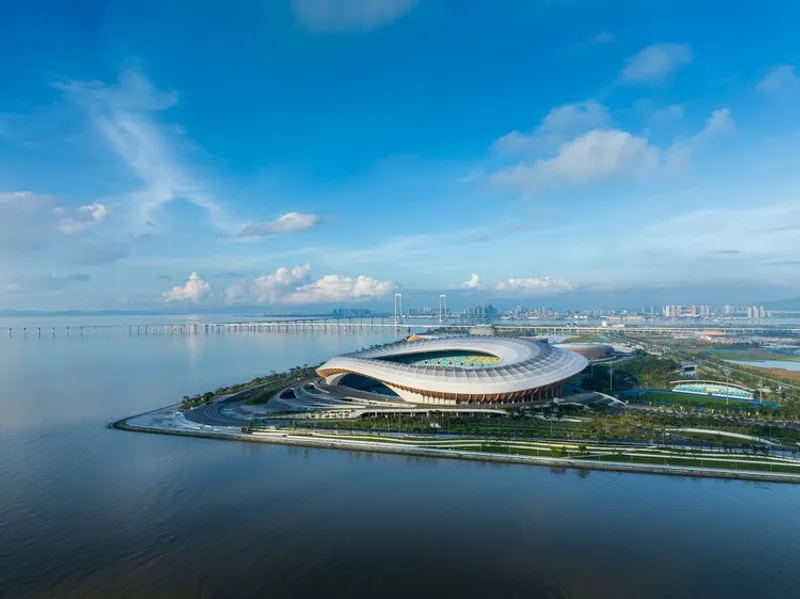
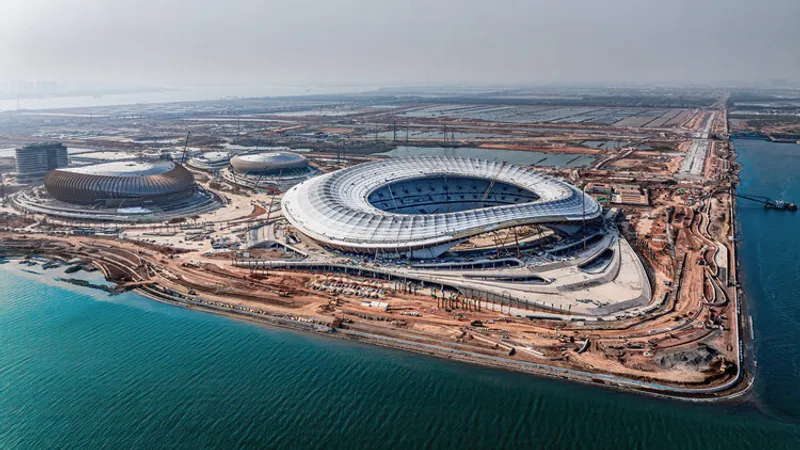
The Greater Bay Area Sports Center, designed by Zaha Hadid Architects (ZHA), stands as a groundbreaking achievement in contemporary sports architecture and urban development. Located in Guangzhou’s Nansha District on the western edge of the historic Pearl River, this iconic complex anchors a rapidly expanding civic, business, and residential district within the Guangdong-Hong Kong-Macau Greater Bay Area—the world’s largest urban megaregion, projected to reach 100 million residents by 2030.
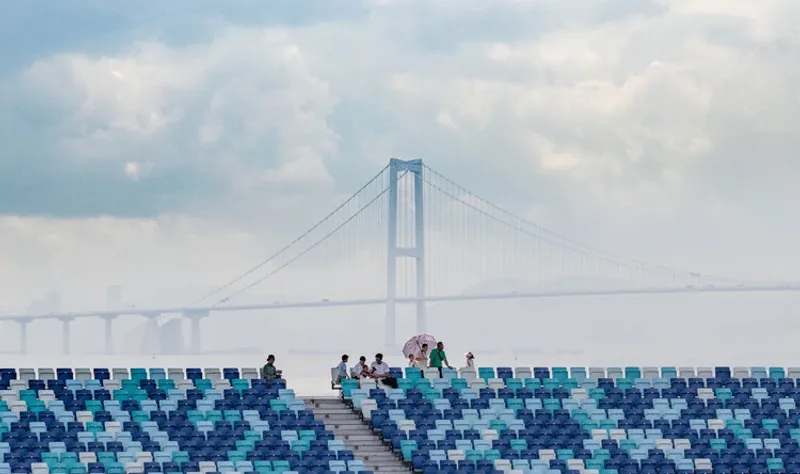
Designed to be an inclusive public destination, the sports center provides state-of-the-art facilities for residents while also hosting national and international sporting events and major cultural performances. With seamless access via Guangzhou Metro Line 18 and proximity to the transformative Shenzhen–Zhongshan Bridge, the complex is strategically positioned to serve the entire Greater Bay Area.

A Vision for Regional Sports Excellence
Beyond its role as an architectural showpiece, the Greater Bay Area Sports Center supports China’s ongoing sports development initiatives. It provides world-class training infrastructure for competitive athletes, especially those specializing in track, field, and aquatics. Nansha’s mild winters create ideal outdoor training conditions, making the site a potential hub for future sporting legacies.
The complex is situated within a 70-hectare riverfront park, offering residents vast green spaces for recreation, relaxation, and improved well-being. These public areas integrate walking paths, exercise zones, and landscaped wetlands that double as a resilient flood-control system—a crucial consideration given Guangdong’s subtropical monsoon climate.
A Multi-Venue Sports Complex Designed for Global Standards
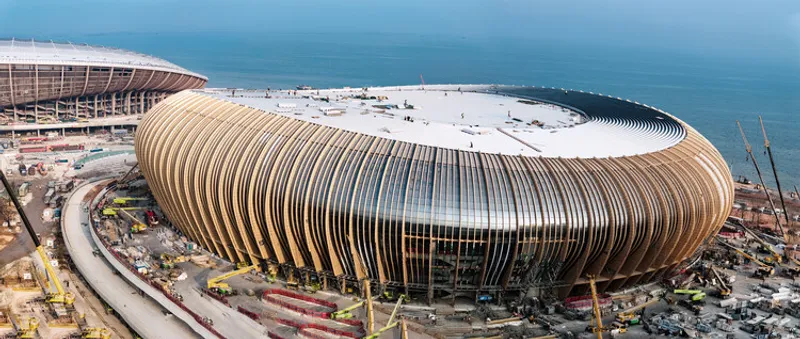
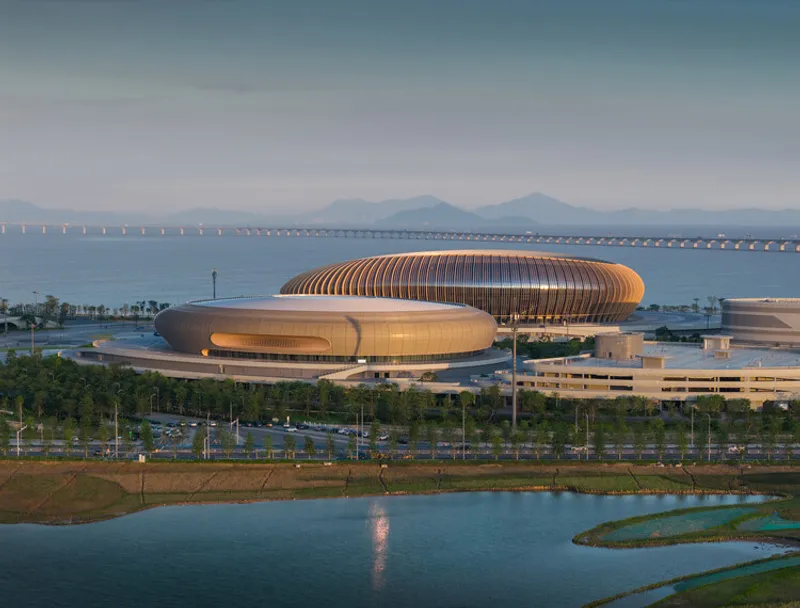
The Greater Bay Area Sports Center comprises three major stadiums and extensive supporting facilities:
✔ 60,000-seat Stadium
A monumental structure designed for large-scale sporting events such as football, athletics, and cultural performances. Its flexible seating bowl can be reconfigured to deliver optimal views and atmosphere for each event type.
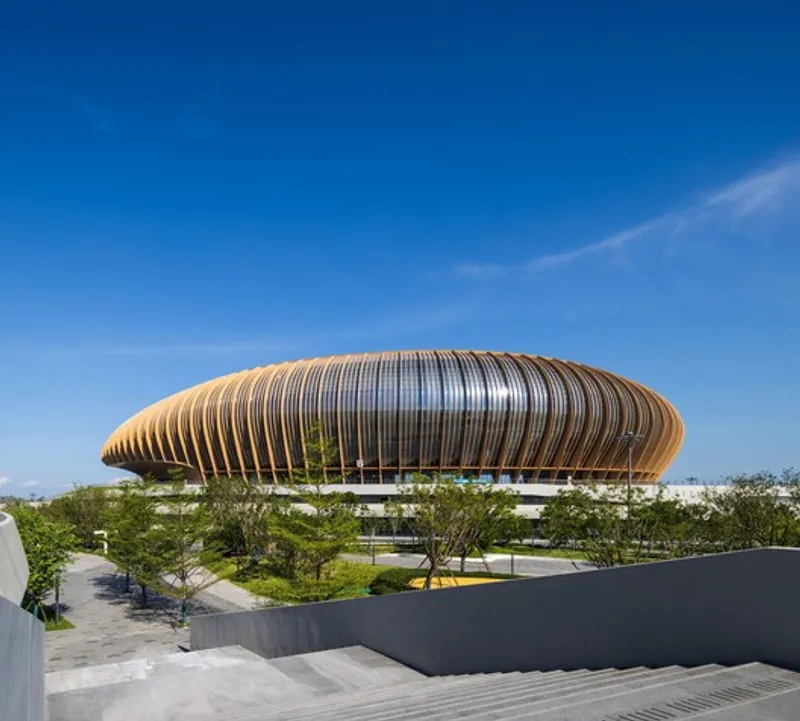
✔ 20,000-seat Indoor Arena
A modern venue for basketball, indoor sports, e-sports, concerts, and community gatherings, equipped with advanced lighting and acoustic systems.
✔ 4,000-seat Aquatics Center
Featuring a professional 50-meter pool and diving facilities designed for both competition and elite training.
✔ Supporting Facilities
- Athletes’ accommodation
- Outdoor training pitches
- Running tracks
- School sports facilities
- Landscaped recreational areas
This comprehensive programme allows the center to function as a multi-dimensional hub for sports, culture, community life, and education.

Design Inspired by History, Climate, and Local Culture
Zaha Hadid Architects drew inspiration from the region’s heritage, maritime culture, and architectural traditions:
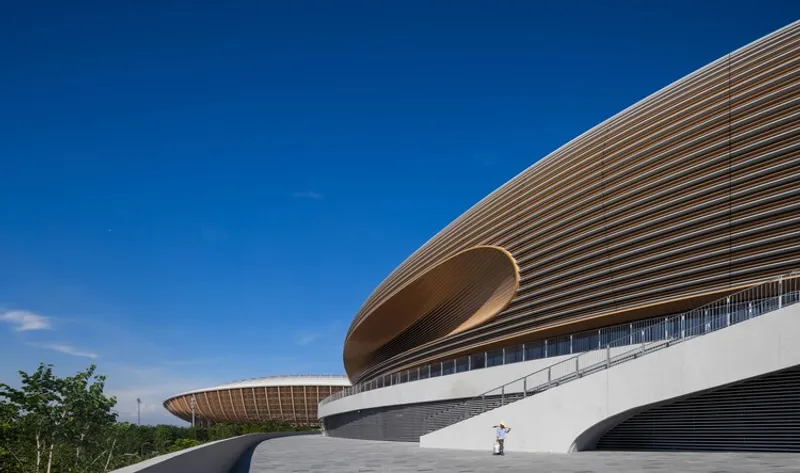
▪ Fluid forms inspired by historic Chinese sailing ships
The tapering geometries evoke the hulls of the Song Dynasty vessels that shaped the Pearl River’s global trading legacy.
▪ Climate-responsive design from Lingnan architecture
The buildings feature:
- Shaded open-air circulation spaces
- Generous canopies
- Naturally ventilated interiors These elements reduce energy consumption and provide comfort during humid summers.
▪ A stadium roof modeled after Chinese silk fans
The layered, pleated design protects 60,000 spectators from rain and sunlight while enabling hot air to escape through natural ventilation.


Advanced Environmental Engineering and Smart Cooling
Digital 3D modeling informed the aerodynamic shapes and vertical louvres that maximize cooling from prevailing ocean breezes. A sweeping arch on the southern side of the stadium draws cool air inside while creating a dramatic visual frame overlooking the Pearl River. This connection between architecture and environment turns the stadium into both a climatic machine and a cultural symbol.

A Gateway Landmark for the Northern Greater Bay Area
With its fluid, futuristic silhouette and powerful sense of movement, the sports center establishes a visual identity for Nansha’s transformation into a major urban gateway. Positioned near the Shenzhen–Zhongshan Bridge, the complex signals arrival into Guangzhou and strengthens regional integration across the Greater Bay Area.
Construction began on August 31, 2023, and by February 2025, the main structures of the stadium and arena had topped out. The project is now in its final phases, representing the culmination of collaboration between Zaha Hadid Architects and the Guangdong Architectural Design & Research Institute.
The Greater Bay Area Sports Center is more than a sports facility—it is a bold architectural statement and a long-term investment in public health, community life, and regional identity. Blending futuristic design with environmental resilience, cultural references, and world-class athletic standards, it is poised to become a landmark destination for millions of residents across China’s most dynamic megaregion.

All the photographs are works of SeilaoJiong Photography, CRLand




Popular Articles
Popular articles from the community


The Musturak Paradise: Senior Living Architecture for a Connected Future in Temara, Morocco
The Musturak Paradise reimagines senior living architecture in Temara via private homes, social spaces, culture, community, and shared care.
EW PARK: Sustainable Architecture Reimagines the Future of Urban Parking
EW PARK reimagines city parking as a modular wooden tower combining automation, solar energy, electric mobility, and adaptable urban design.

AL-JANNAH: Sustainable Architecture and Permaculture for Afghan Widows
AL-JANNAH uses sustainable architecture and permaculture to create resilient oasis of housing, learning, work and renewal for Afghan widows.

Co-life: Sustainable Architecture for Age-Friendly Community Living
Co-life reimagines sustainable architecture for seniors through courtyards, rammed earth, shared gardens, and spaces designed for belonging.


Similar Reads
You might also enjoy these articles


Hodi-Mandai Geram
Project Function: Preservation and revitalization of the Intangible heritage and socio-spatial identity of the Hodi by Housing, Cultural Memory Center, Sacred Grove, landscape, local tourism economy


Olio Towers: A Mid-Rise for Performers That Fuses Housing, Rehearsal, and Stage
Located blocks from Houston's Theater District, this modular tower stacks living units around a central performance atrium.

Oasis: Modular Green Housing Carved into Dhaka's Urban Fabric
A shortlisted Plugin Housing entry reclaims unauthorized settlements in Dhaka with stepped concrete volumes, green roofs, and ventilation-driven design.

Black Hole: A Floating Megastructure for the Post-Physical Era
Emiliano Mazzarotto envisions a spherical, self-scaling arena where e-sports, digital hotels, and holographic stadiums replace traditional public space.

Explore Sports Architecture Competitions
Discover active competitions in this discipline


Challenge to design a barrier free sports center


Challenge to design an outdoor ice-rink and park


Challenge to reimagine the Iron Throne


Photograph architecture without architects
Comments (0)
Please login or sign up to add comments
No comments yet. Be the first to comment!