

Green Experience Center in Luisenpark by Bez+Kock Architekten
Organic pavilion complex with curved roof, glass façades, aviary, penguin habitat, and aquarium spaces blending architecture seamlessly into Mannheim’s landscape park.


The Green Experience Center in Luisenpark is a remarkable example of contemporary landscape-integrated architecture designed byBez+Kock Architekten. Located in the lush setting of Luisenpark, this innovative pavilion complex reimagines the relationship between architecture, landscape, and ecological education. Completed in 2023 for the renowned Bundesgartenschau 2023, the project transforms the park with a fluid architectural language that dissolves boundaries between built form and nature.
Spanning approximately 4,125 square meters, the center is conceived not as a traditional building but as a series of organic, single-story pavilions embedded within the surrounding park landscape. Instead of dominating the environment, the architecture deliberately recedes, allowing the natural scenery of trees, water, and open green space to remain the primary visual experience for visitors.
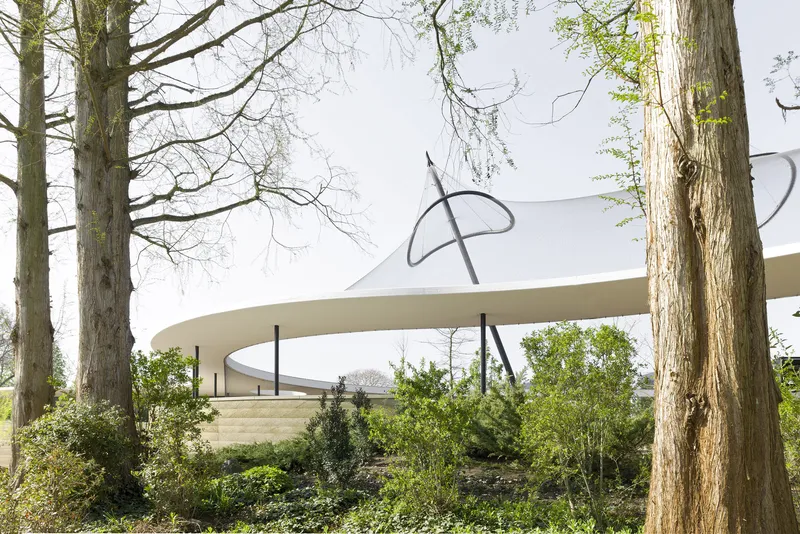
Landscape-Oriented Pavilion Architecture
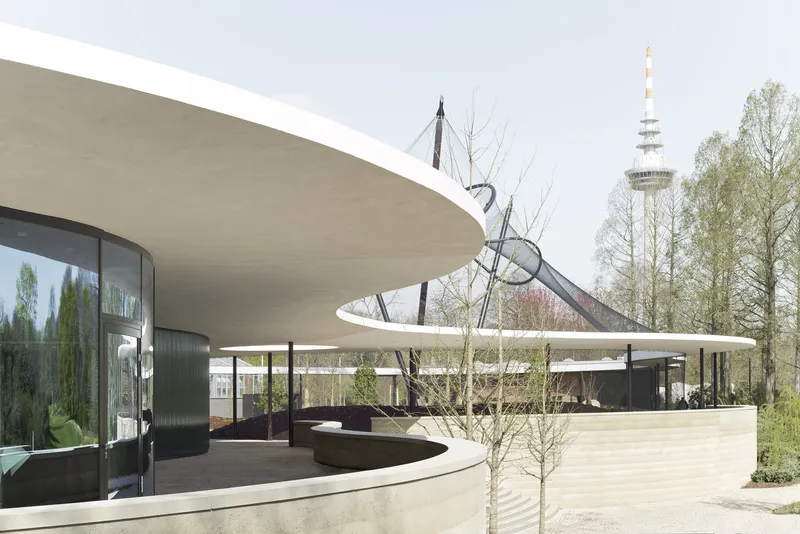
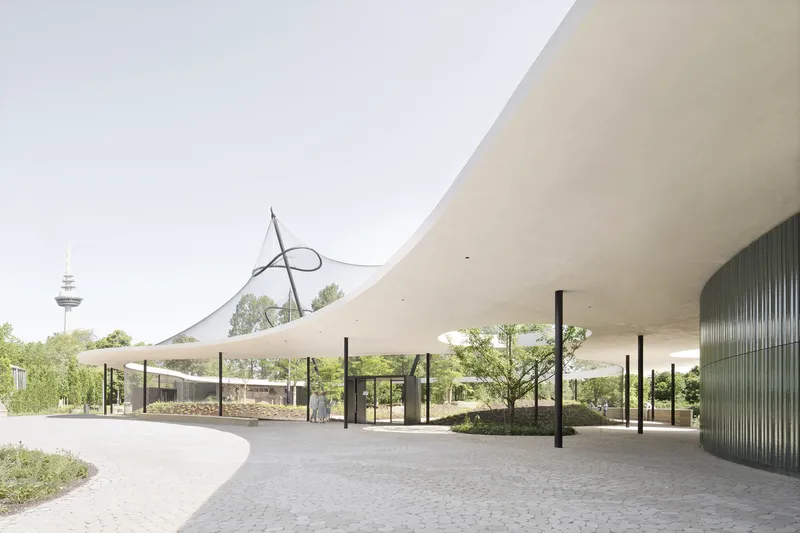
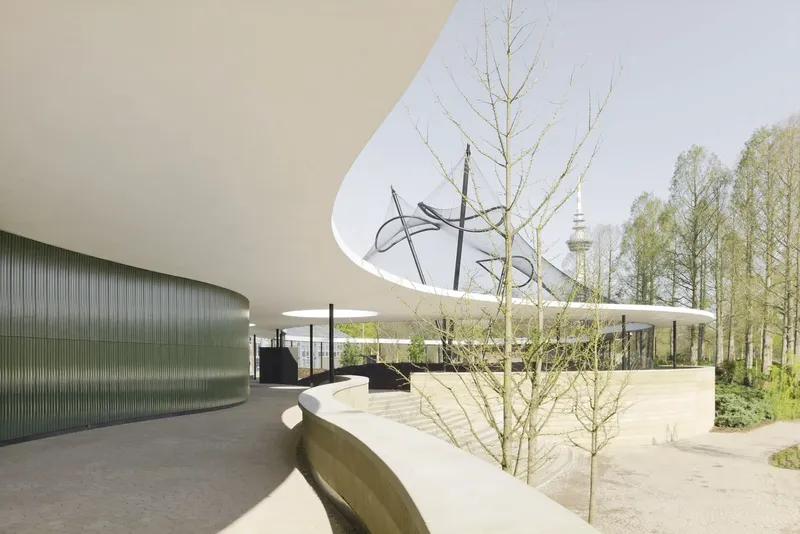
The design strategy led by architects Martin Bez and Thorsten Kock emphasizes a low, flowing architectural form that gently merges with the park. The pavilions are unified beneath an elegantly curved roof structure supported by slender, lightweight columns. This roof extends approximately 120 meters in length and up to 30 meters in width, creating a continuous canopy that links multiple programmatic areas.
Floor-to-ceiling glazing forms transparent interior spaces that open directly toward the landscape. This design approach allows natural light, park views, and outdoor movement to flow freely through the building, establishing a seamless transition between indoor and outdoor environments.
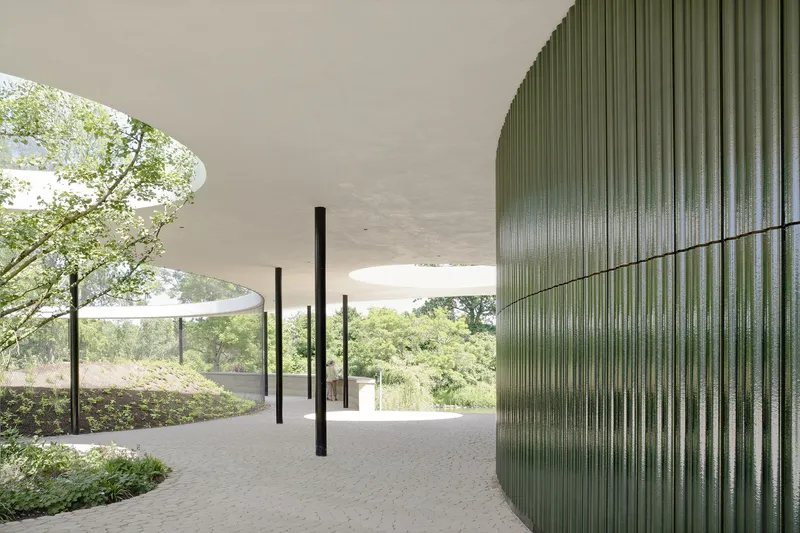
The exterior surfaces are clad with dark green glazed ceramic elements, which subtly reflect the surrounding foliage and enhance the building’s visual integration with the park. The slender roof edge appears to slide beneath the branches of nearby trees, reinforcing the idea that architecture here acts as a quiet extension of the natural landscape rather than a dominant object.
Circumferential canopies extend beyond the glazed interiors, providing shade and weather protection for park visitors while strengthening the building’s role as a public gathering space within the park environment.
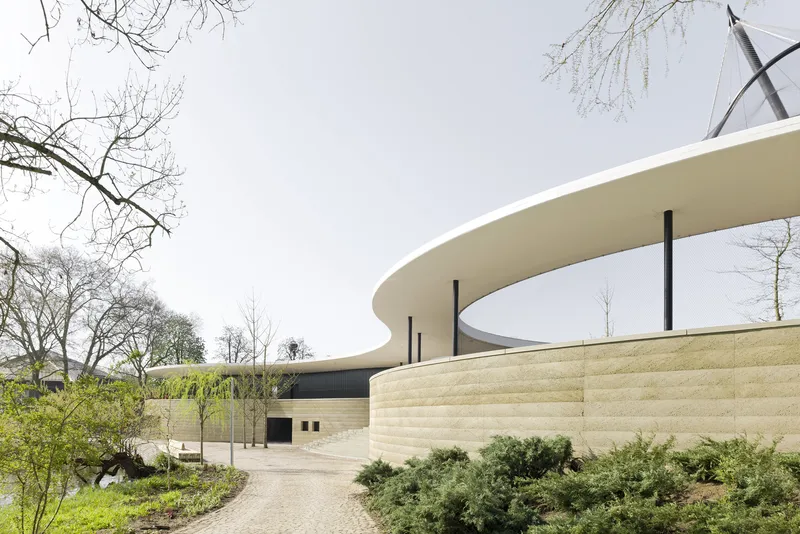
Park Restaurant with Panoramic Views
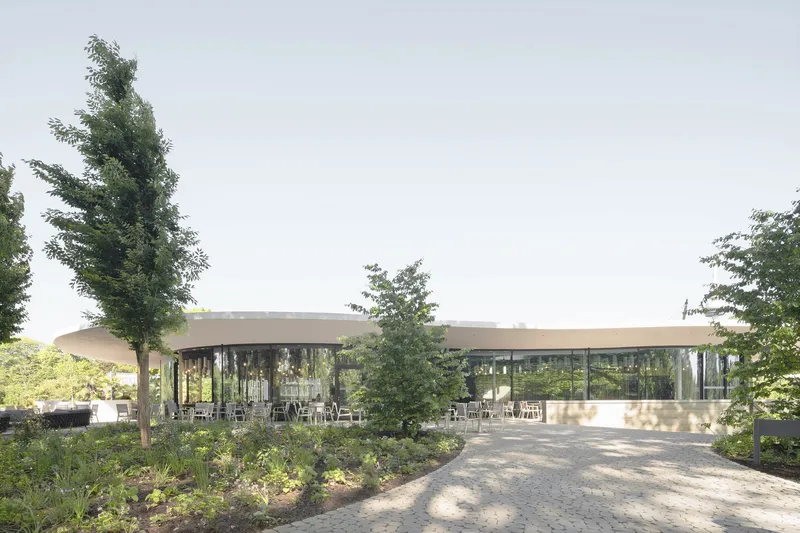
At the southern end of the complex, the project introduces a welcoming park restaurant designed to greet visitors entering the area. The restaurant is defined by a sweeping curved glass façade that frames views toward the nearby Kutzerweiher pond.
The dining area is designed with flexibility in mind. Large sliding glass doors allow the restaurant to expand outward beneath the cantilevered canopy during warmer months, transforming the space into an open-air dining terrace. This architectural gesture reinforces the building’s core idea of blending hospitality spaces with the surrounding natural landscape.
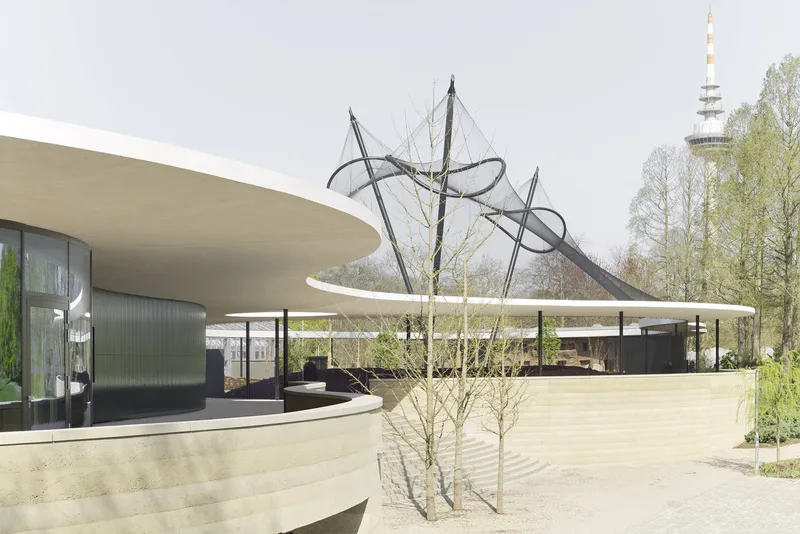
Immersive Aviary Experience
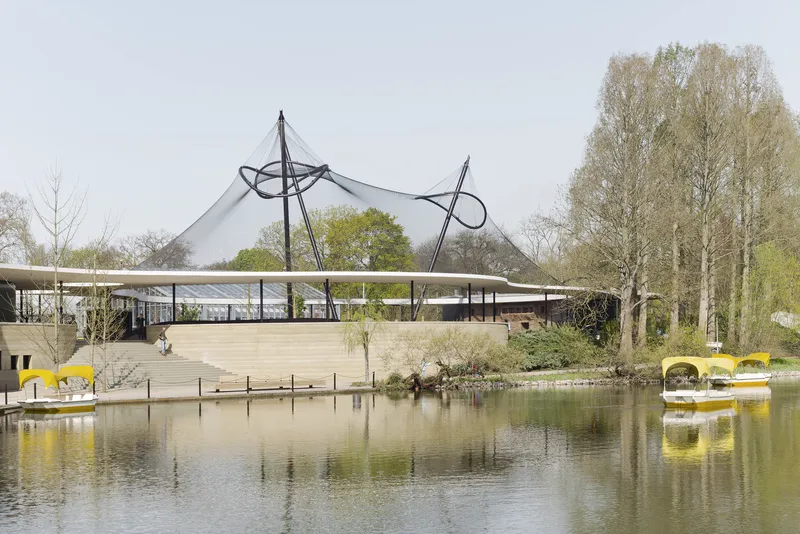
Moving north from the restaurant, visitors encounter one of the most distinctive features of the project: a walk-in free-flight aviary. To accommodate this immersive environment, a 1,300-square-meter opening was carved into the roof plane, creating a large vertical volume for birds and vegetation.
The aviary is enclosed by an 18-meter-high cable net structure supported by three pylons, allowing birds to move freely within a spacious enclosure while maintaining visual openness. Visitors walk along carefully designed paths through a modeled landscape featuring a flowing watercourse and two ponds, offering a close encounter with bird species within a naturalistic environment.
At the northern edge of the complex, a care and maintenance building supports the aviary and other ecological installations.
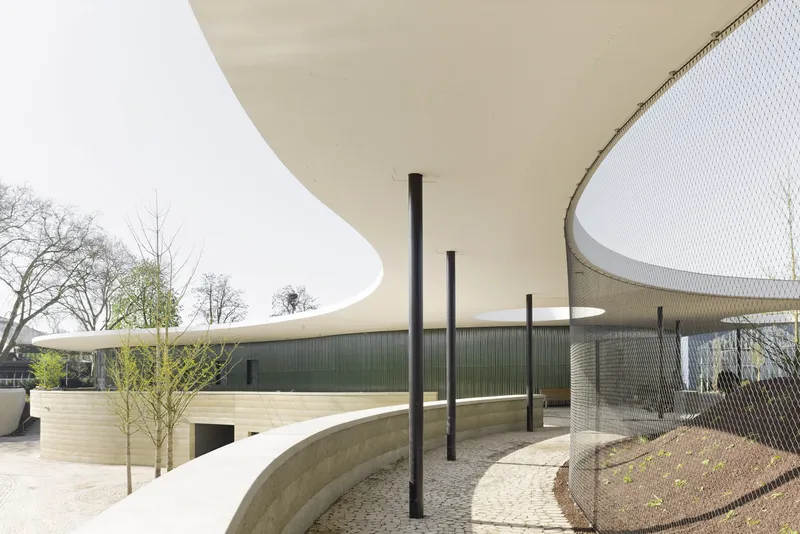
Penguin Habitat and Aquatic Observation
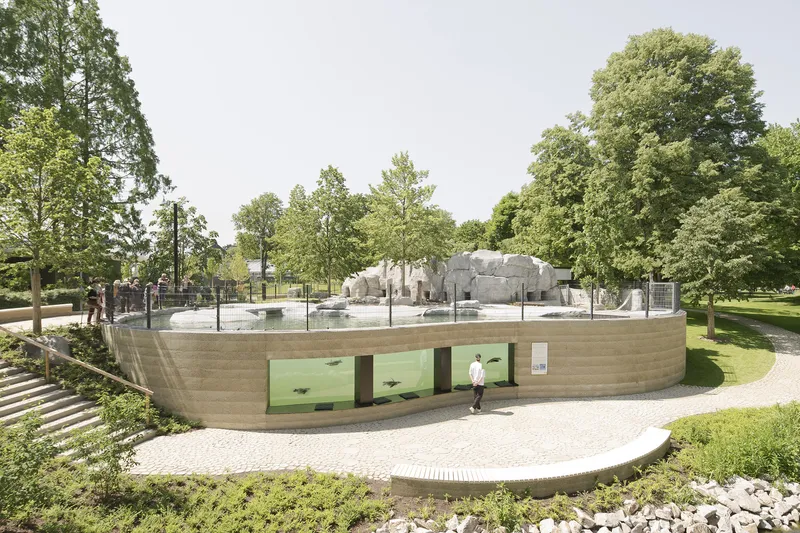
Another highlight of the Green Experience Center is the penguin habitat, a 580-square-meter installation slightly offset from the main roof structure. Continuing the project’s dynamic design language, the enclosure follows an organic, curved form that echoes the architectural rhythm of the surrounding pavilions.
The landscape of the penguin installation is constructed using a combination of natural granite and artificial rock formations, creating a terrain that resembles coastal habitats. A 250-cubic-meter pool enables visitors to observe penguins both above and below the water surface, providing an engaging educational experience.
This exhibit exemplifies how the project integrates wildlife habitats with architectural design, transforming the pavilion complex into an interactive environmental learning space.
Landscape Architecture and Rammed Concrete Wall
The site design also addresses a four-meter elevation drop between the pavilion area and the Kutzerweiher pond. This difference in height is resolved through a rammed concrete retaining wall that curves gently along the shoreline.
The wall’s textured surface reveals the layered construction technique, resembling natural sediment strata found in quarries or geological formations. This treatment transforms the structural element into a landscape feature that visually connects architecture with the surrounding terrain.
Rather than functioning solely as infrastructure, the wall becomes an expressive material element that contributes to the geological narrative of the park environment.
The Underwater World Exhibition
A dramatic spatial transition occurs through a deep opening cut into the rammed concrete wall. From the pond’s edge, visitors enter the Underwater World exhibition, a contemplative interior environment dedicated to aquatic ecosystems.
The interior design emphasizes a mineral-inspired atmosphere. Sand-colored screed floors, subtly textured walls, and a midnight-blue ceiling create a calm, immersive environment. Within this space, 21 aquarium tanks showcase fish species from across the globe, transforming the area into an educational exploration of aquatic biodiversity.
The contrast between the dark interior environment and the bright outdoor landscape enhances the visitor experience, guiding guests through a spatial narrative that moves from park landscape to underwater ecosystems.
Architecture for BUGA 2023
The amoeba-like pavilion ensemble forms a distinctive architectural identity for Luisenpark, particularly in the context of the Federal Horticultural Show 2023. The project was conceived as both an attraction and an educational platform, combining architecture, ecology, and public engagement.
The Green Experience Center represents a new typology for park architecture, where buildings function as integrated landscape elements while hosting restaurants, animal habitats, and environmental exhibitions.
Future development phases will further expand this architectural family with the addition of a Green School and Leisure House, strengthening the park’s role as a center for environmental education and recreation.
A New Identity for Luisenpark
Through its organic forms, ecological programming, and landscape-sensitive design, the Green Experience Center establishes a new architectural landmark for Mannheim’s Luisenpark. The project demonstrates how contemporary architecture can enhance natural environments while supporting biodiversity, education, and public interaction.
By prioritizing transparency, lightweight structures, and natural materials, Bez+Kock Architekten have created a pavilion complex that blends seamlessly into its surroundings while offering a memorable spatial experience for visitors.
The result is a forward-thinking model for sustainable park architecture, where architecture and nature exist not as separate entities but as a unified ecological and cultural landscape.
All photographs are works of
Brigida González


Popular Articles
Popular articles from the community


Tsunami Convergenics: Turning Catastrophic Ocean Forces into Underwater Housing Infrastructure
A speculative underwater settlement off the coast of Onagawa, Japan, treats tsunamis and typhoons as energy sources rather than threats.

Singing Woman: Contemporary Architecture Inspired by Estonia’s Voice and the Sea
Singing Woman turns Estonia’s song culture into flowing opera house architecture, blending public life, landscape, sea, and national memory.

The Amber Palace Opera: A Geological Fiction Surfaces on Tallinn's Baltic Waterfront
Pierre Brillard reimagines a Baltic legend as a public landscape, opera house, and waterfront promenade rooted in Tallinn's coastal identity.

Opera by the Sea Estonia: Three Shells Dissolving Architecture into Tallinn's Coastline
A winning opera house proposal replaces monumental form with interconnected shells that blur the boundary between building, park and Baltic Sea.

Similar Reads
You might also enjoy these articles

FAMM Arquitectura Organizes Ten Villas Around Courtyards and Jungle in Nosara, Costa Rica
El Molino pairs two elongated volumes with deep overhangs and timber louvers to build a compact coastal community five minutes from the beach.
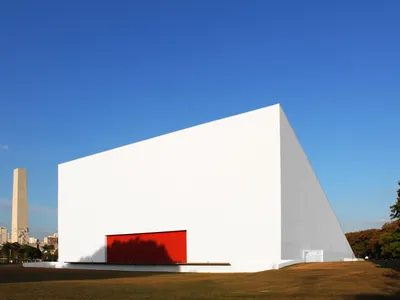
Oscar Niemeyer's Ibirapuera Park Pavilions Define São Paulo's Cultural Identity in Concrete and Curve
A constellation of modernist volumes set within São Paulo's most important urban park, conceived for the city's 400th anniversary in 1954.
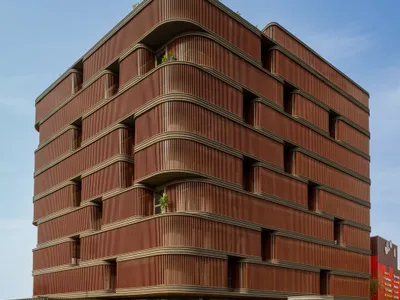
Sanjay Puri Architects Wraps a Jaipur Office Tower in Capsule-Shaped Green Buffers
A nine-level climate-responsive workplace near Jaipur Airport uses stacked planter terraces and aluminium screens to fight 40°C heat.
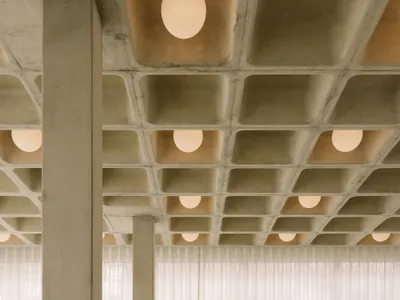
RHO Converts a Berlin Spree-Side Industrial Courtyard into Enkime's 1,000 m² Agency Headquarters
A social media agency's new home in Charlottenburg trades glossy branding for concrete waffle ceilings, glazed tile, and sheer curtains.

Explore Geurst & Schulze Architecten Competitions
Discover active competitions in this discipline

Challenge to design a portable theatre

Challenge to design a portable music platform

Challenge to design an open learning module for the elderly

Challenge to reimagine the Iron Throne
Comments (0)
Please login or sign up to add comments
No comments yet. Be the first to comment!