
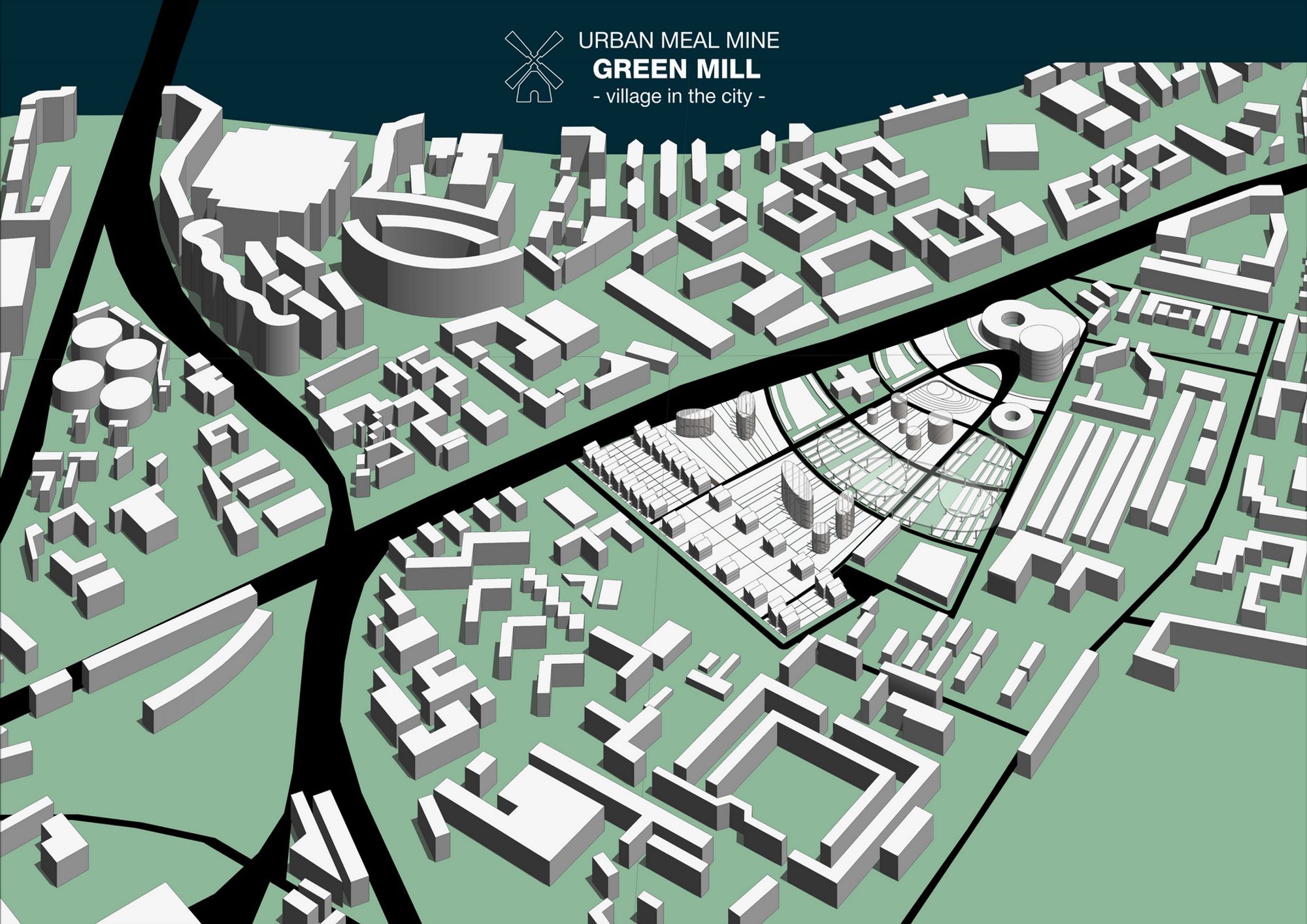
Green Mill: An Agrocluster That Weaves Food Production into the Urban Fabric
A shortlisted Urban Meal Mine entry reimagines city blocks as living ecosystems of cultivation, production, and community exchange.

What if a city block could harvest food, process it, sell it, and educate its residents about the entire cycle, all within the same architectural system? Green Mill proposes exactly that: an agrocluster where cultivation fields, vertical greenhouses, fabrication units, eco-product markets, and community amphitheaters share a single integrated framework. The result is not a building so much as a metabolic loop, one that replaces the passive consumption patterns of conventional urban living with active participation in food production.
Designed by Yana Kunitskay and Elis Gertsman, Green Mill is a shortlisted entry in the Urban Meal Mine competition. The project grounds itself in the classical theory of sustainable development, treating ecology, economy, and sociology as three inseparable pillars of architectural design. Rather than treating urban agriculture as an add-on, a rooftop garden here or a community plot there, the designers embed the full agricultural production cycle into the city's structural fabric.
From Centuries of Agricultural Labor to a New Urban Model
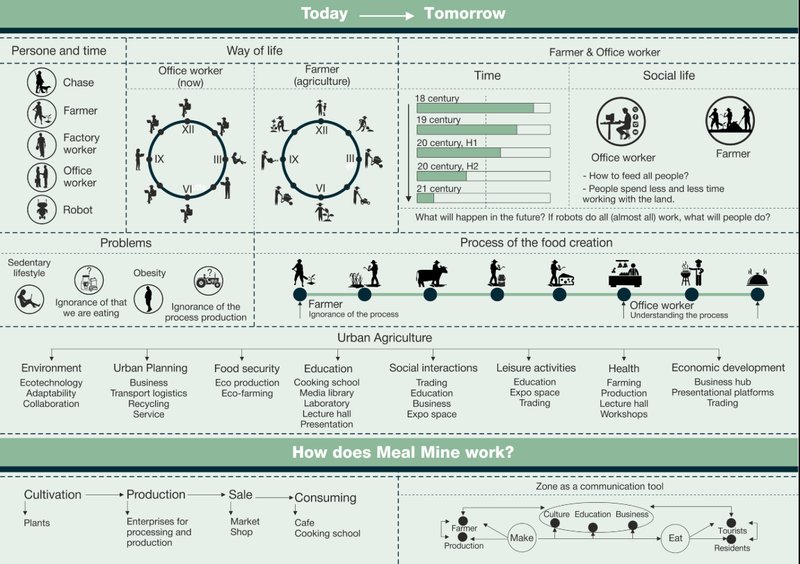
The project opens with a historical lens. An infographic diagram traces the evolution of agricultural labor and urban food systems across centuries, illustrating how industrialization gradually severed the connection between city dwellers and the land that feeds them. Kunitskay and Gertsman use this timeline to frame their intervention: Green Mill is not nostalgia for agrarian life but a deliberate architectural response to the sedentary lifestyles, food illiteracy, and ecological costs that define contemporary urbanism. The diagram establishes a clear argument that modern cities need mechanisms to re-integrate food production at scale, not as decoration but as infrastructure.
Seasonal Cycles as a Design Driver
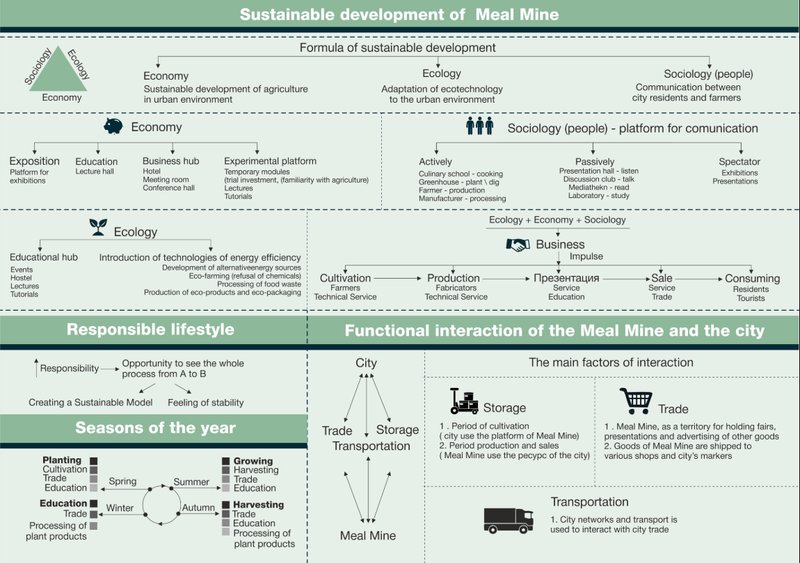
A process diagram lays out the sustainable development frameworks underpinning the project, with particular attention to how seasonal cycles shape the agrocluster's operation. Planting, growing, and harvesting rhythms are embedded directly into the architectural planning, meaning the building adapts its programme throughout the year rather than operating as a static container. Eco-technologies, alternative energy sources, and waste recycling systems form the ecological backbone, while trade networks, local business hubs, and eco-product manufacturing drive the economic layer. The sociological dimension comes through platforms for education, cultural exchange, and conferences that bring farmers, residents, and visitors into shared space.
What makes this framework compelling is its refusal to separate these domains. The ecology is not a sustainability checkbox; it feeds the economy, which in turn activates the social programme. The seasonal calendar ensures that no part of the system sits idle for long.
From Field to Market: Mapping the Functional Territory
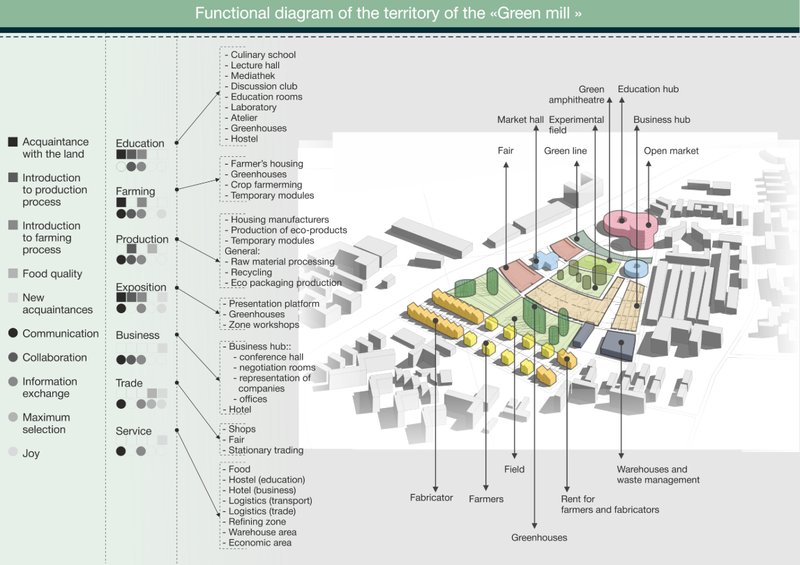
An axonometric diagram maps the agrocluster's functional zones, tracing the journey from open cultivation fields to market spaces. The zoning follows a clear logic: cultivation areas (fields, vertical greenhouses, and farmer housing) anchor one end, while fabrication units, recycling centers, and eco-product manufacturing occupy the middle ground. Exposition platforms, business hubs, coworking areas, and green amphitheaters complete the sequence, creating what the designers describe as a seamless interaction between city and agriculture. Trade, transportation, and storage are woven into the plan rather than relegated to separate logistics zones.
The spatial sequence matters because it makes the food production cycle legible. A resident walking through the agrocluster can witness every stage, from soil to shelf, and this visibility is a deliberate design strategy. It re-educates citizens about food security and responsible consumption not through signage or programming alone, but through spatial experience.
Modular Housing and Greenhouse Configurations
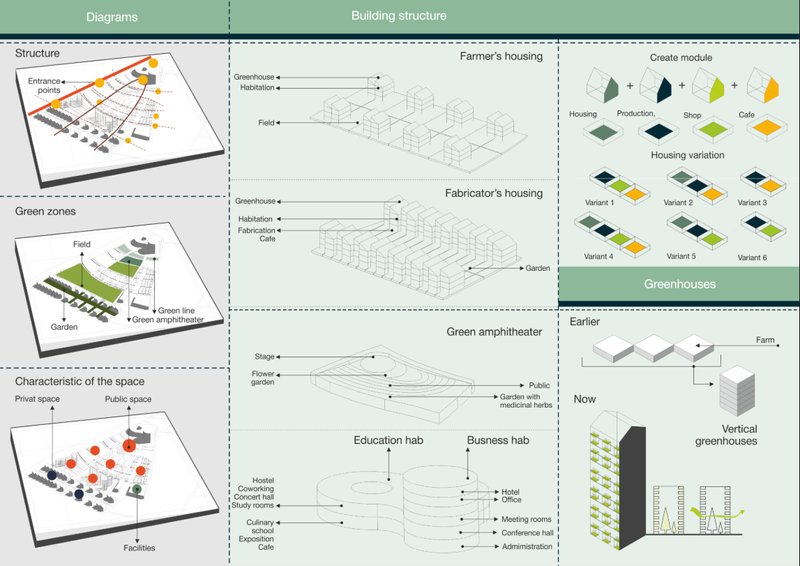
Building structure diagrams reveal the modular housing variations and greenhouse configurations that give Green Mill its architectural specificity. The housing modules accommodate farmers and residents within the agrocluster itself, collapsing the commute between dwelling and workplace. Greenhouse configurations integrate green zones that serve both productive and recreational purposes, reinforcing the project's core claim that buildings should function as platforms for cultivating resilience, not merely as shelters.
The modularity is key. It allows the system to scale and adapt to different urban contexts without requiring a single monolithic structure. Different combinations of housing, greenhouse, and communal modules can respond to local climate, crop type, and community size, making the agrocluster a replicable framework rather than a one-off design object.
Why This Project Matters
Green Mill's strength lies in its systemic thinking. Many urban agriculture proposals stop at the greenhouse or the rooftop farm. Kunitskay and Gertsman push further, designing an entire urban metabolism that encompasses cultivation, processing, trade, education, and community gathering in a single architectural ecosystem. The three-pillar framework of ecology, economy, and sociology is not novel in theory, but translating it into a spatial sequence with modular components and seasonal programming gives the concept real architectural traction.
As cities confront overlapping crises of food security, population growth, and ecological degradation, proposals like Green Mill offer a provocation worth taking seriously. The project argues that architecture can do more than house people; it can restructure their relationship with the land, the food system, and each other. Whether this particular agrocluster gets built matters less than the question it forces onto the table: why do we continue to design cities that treat food production as someone else's problem?
View the Full Project
About the Designers
Designers: Yana Kunitskay, Elis Gertsman
Enter a Design Competition on uni.xyz
uni.xyz runs architecture and design competitions year-round that reward proposals with spatial conviction and real site intelligence.
Project credits: Green Mill by Yana Kunitskay, Elis Gertsman Urban Meal Mine (uni.xyz).



Popular Articles
Popular articles from the community

IKC de Geluksvogel: Sustainable School Architecture Designed for Free Movement and Digital Learning
IKC de Geluksvogel turns sustainable school architecture into a flexible Maastricht campus for digital learning, nature, and free movement.
Milan Crossover: Sustainable Architecture for a New Fashion Culture in Milan
Milan Crossover transforms fashion culture through sustainable architecture, linking material libraries, remake studios, and public runways.

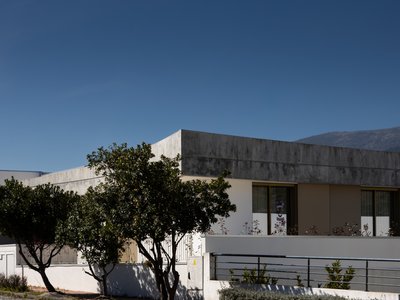
PLATAFORMArq Folds a Concrete Roof Over the Portuguese Mountains in House #474
A 220-square-meter residence in Teixoso, Portugal, wraps board-formed concrete into an angular canopy that frames the Serra da Estrela foothills.
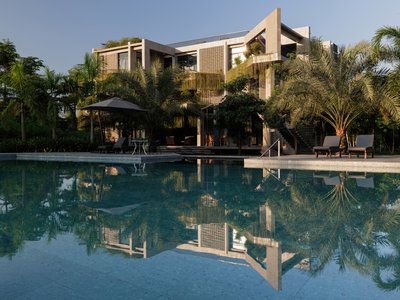
Reincarnation Weaves a Three-Story Retreat into the Green Landscape of Rural Bangladesh
Ara Manor in Narsingdi dissolves the line between domestic architecture and its lush surroundings through screens, courtyards, and planted rooftops.


Similar Reads
You might also enjoy these articles
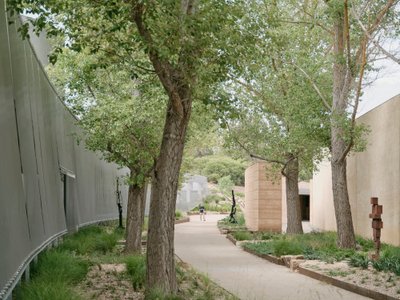
Kerstin Thompson Architects Buries a Cultural Center Beneath Its Own Car Park in the Yarra Valley
The Eva and Marc Besen Centre at TarraWarra hides 2,375 square metres of gallery and archive space under a reinstated landscape in Healesville, Australia.
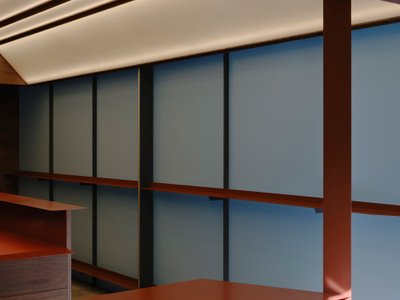
Kerry Kounnapis Packs 800 Daily Coffees into a 43-Square-Metre Melbourne Laneway Bar
Palace Coffee channels Pellegrini's and European standing bars through oxide-red steel and spotted gum timber in a Ridgway Place sliver.
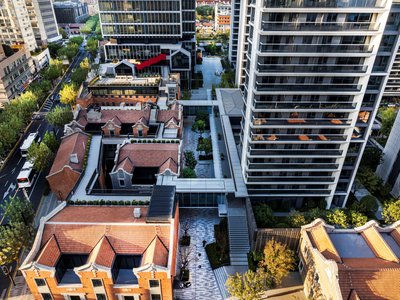
Nikken Sekkei Stacks a Three-Dimensional Lilong Atop Shanghai's Historic Alleyways
A 180-meter tower and restored heritage houses on Nanjing West Road reimagine communal lane life as a vertical mixed-use district.
PLATAFORMArq Folds a Concrete Roof Over the Portuguese Mountains in House #474
A 220-square-meter residence in Teixoso, Portugal, wraps board-formed concrete into an angular canopy that frames the Serra da Estrela foothills.






Comments (0)
Please login or sign up to add comments
No comments yet. Be the first to comment!