

3 Points Consultant Wraps a Netrakona Apartment Tower in Deep Verandahs and Red Brick Armor
A five-story residential building in rural Bangladesh uses layered facades, planter boxes, and passive cooling to redefine local housing.


In Netrakona, a small district town about 150 kilometers north of Dhaka, the residential skyline rarely exceeds three or four stories of anonymous concrete. So when a five-story brick tower appears on a west-facing plot beside the district bus stand, with staggered verandahs, vertical fins, and cascading greenery on every level, it registers as something closer to a civic building than a house. Green View Residence, designed by 3 Points Consultant, is both a rental apartment block on its lower three floors and a private home for the landowner above. The locals already have a name for it: Lalbari, the Red Building.
What makes the project genuinely worth studying is the discipline behind its climate strategy. A west-facing plot in Bangladesh's tropical zone is about the worst solar orientation you can draw. Rather than retreat behind sealed walls and air conditioning, the architects turned the constraint into the building's entire formal language: solid brick masses shield the west, deep repetitive verandahs wrap the south and west to cast long shadows, and planter boxes double as thermal buffers. Every move that shapes the exterior also solves a comfort problem on the interior. That coherence, executed in a rural context far from Dhaka's design infrastructure, is the real story here.
Red Brick as Climate Shield and Local Identity
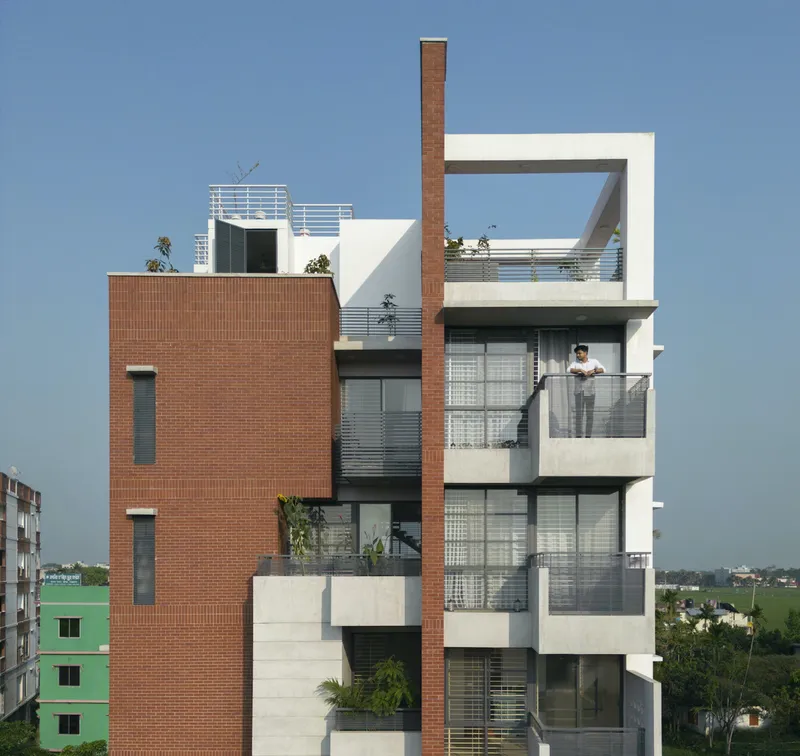
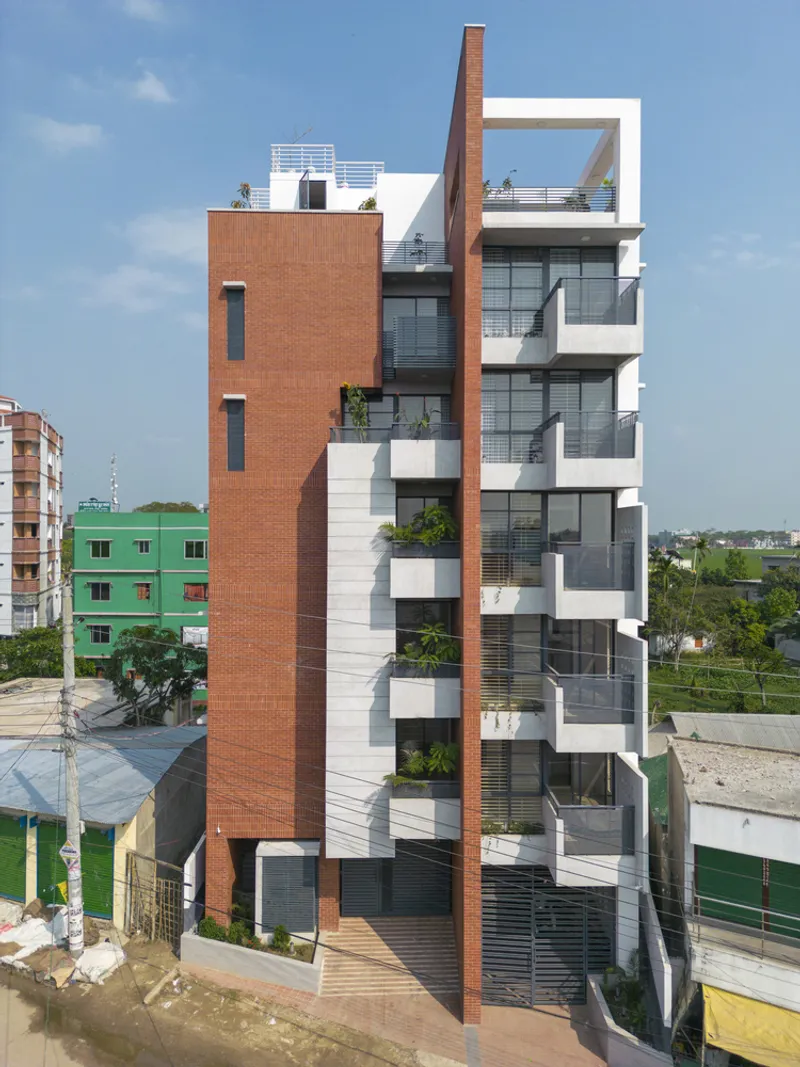
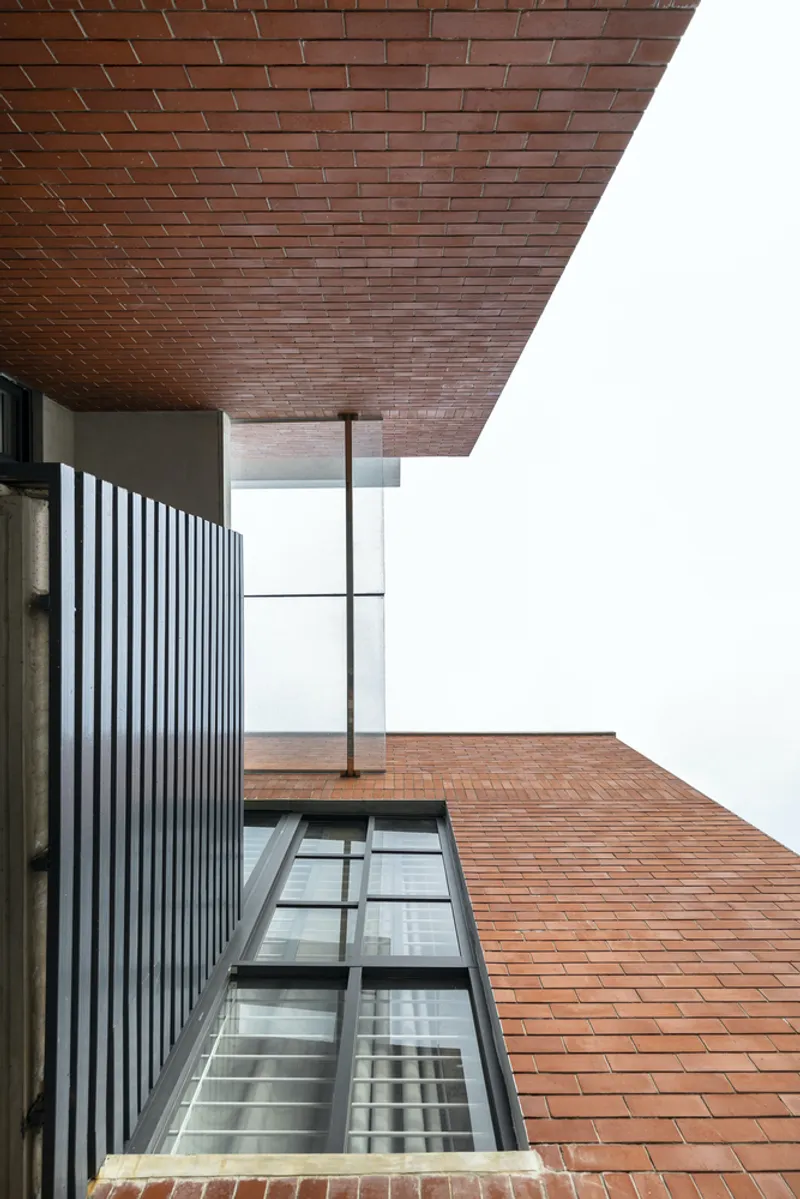
The facade reads as a composition of terracotta brick volumes punctuated by recessed white balconies and vertical louvered screens. Red tile brick was chosen not for nostalgia but for performance: its thermal mass absorbs and slowly releases heat, smoothing out the sharp temperature swings of a tropical day. On the critical west face, the architects closed the wall almost entirely, stacking service spaces like kitchens and bathrooms behind solid masonry to create a buffer zone between the afternoon sun and the living areas behind.
The material also roots the building in its context. Brick is the default construction medium across rural Bangladesh, but here it is handled with precision: fins project outward to create shadow lines, header courses create texture, and the brickwork is left unrendered so its color deepens with monsoon rains. In a neighborhood of painted concrete, the raw materiality is a quiet act of resistance against the generic.
Layered Verandahs as Passive Cooling Devices
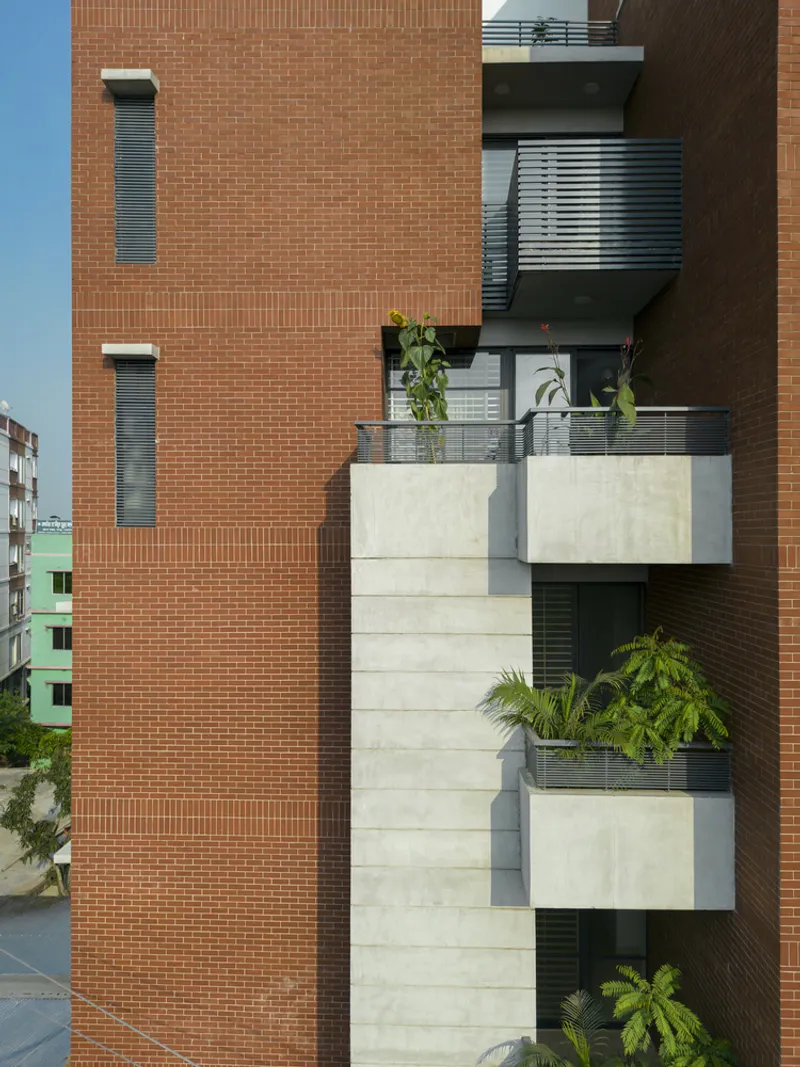

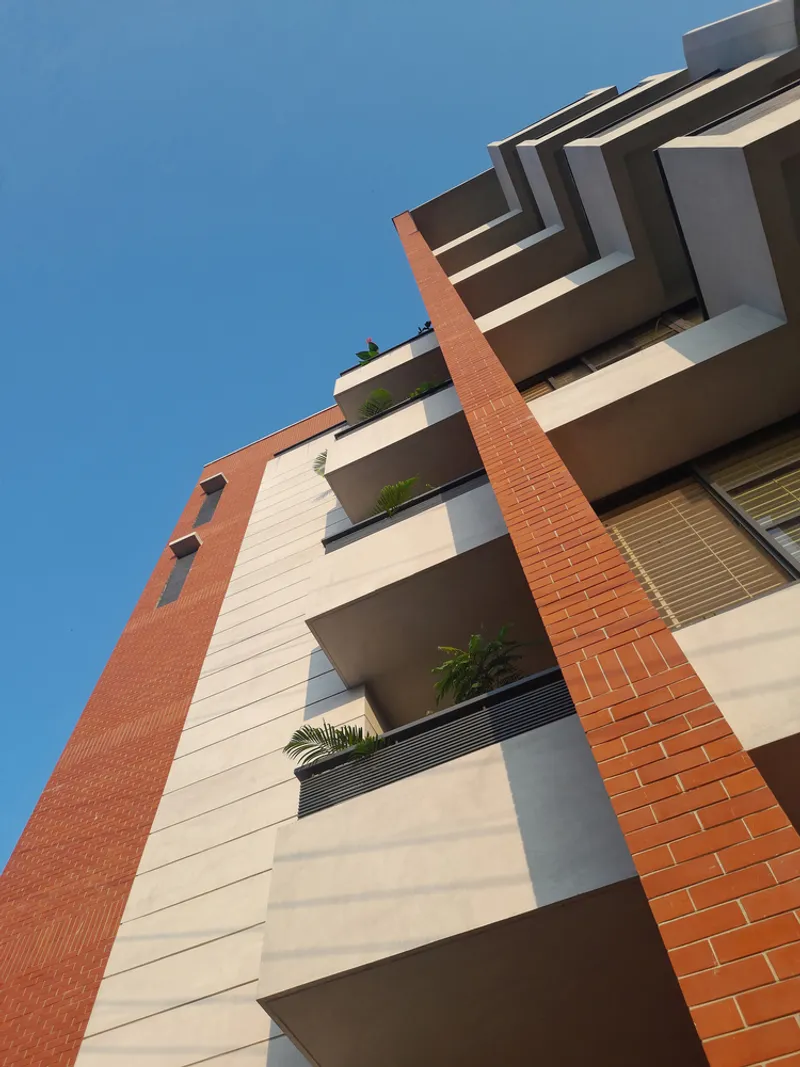
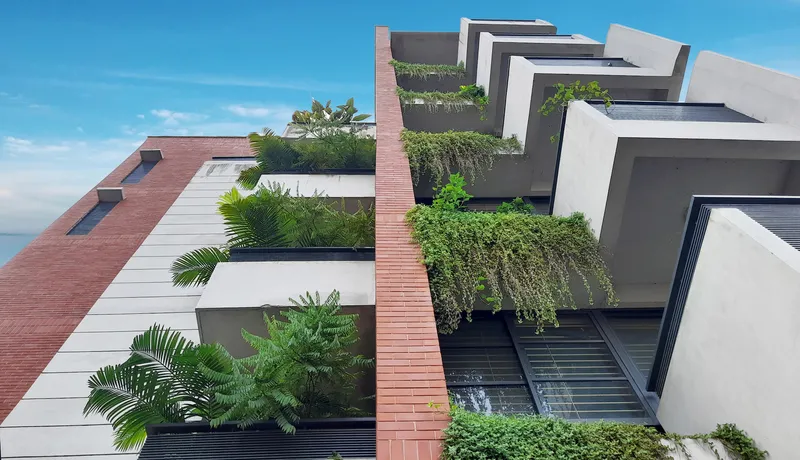
The staggered balconies are not decorative appendages. They are the primary environmental control system. Wrapping the south and west elevations, these deep verandahs cast shade across full-height glazed openings on every floor, blocking direct tropical sun while still admitting diffused light and cross-ventilation. During heavy monsoon rains, the overhanging concrete slabs keep water away from interior thresholds, an essential detail in a region that receives over 2,000 millimeters of rainfall annually.
Planter boxes are integrated into the balcony railings at every level. These are not afterthoughts: the greenery functions as a biological heat insulator, absorbing solar radiation that would otherwise warm the concrete, while evapotranspiration from the plants cools the air flowing into the apartments. The cascading vegetation also softens the building's mass, making it appear less imposing on the narrow street below.
Street Presence in a Dense Neighborhood


Netrakona's urban fabric is tight. Motorbikes crowd the lanes, low-rise shops press against lot lines, and pedestrians negotiate the gap between buildings and traffic. The drone and street-level views reveal how Green View Residence negotiates this density. At ground level, the building pulls back to create a drive-through parking zone and a small entry lobby, giving the street some breathing room. Above, the brick volumes step out and back, breaking up the tower's mass so it does not loom over its neighbors.
At dusk, the illuminated balconies glow against the otherwise dark streetscape, reinforcing the building's identity as a landmark. The architects clearly understood that in a town without many tall structures, a five-story building carries outsized visual responsibility. They responded not with spectacle but with legibility: you can read the logic of the facade, its solid and void rhythm, its material choices, from a motorbike passing at speed.
The Owner's Duplex: Double Heights and Open Terraces
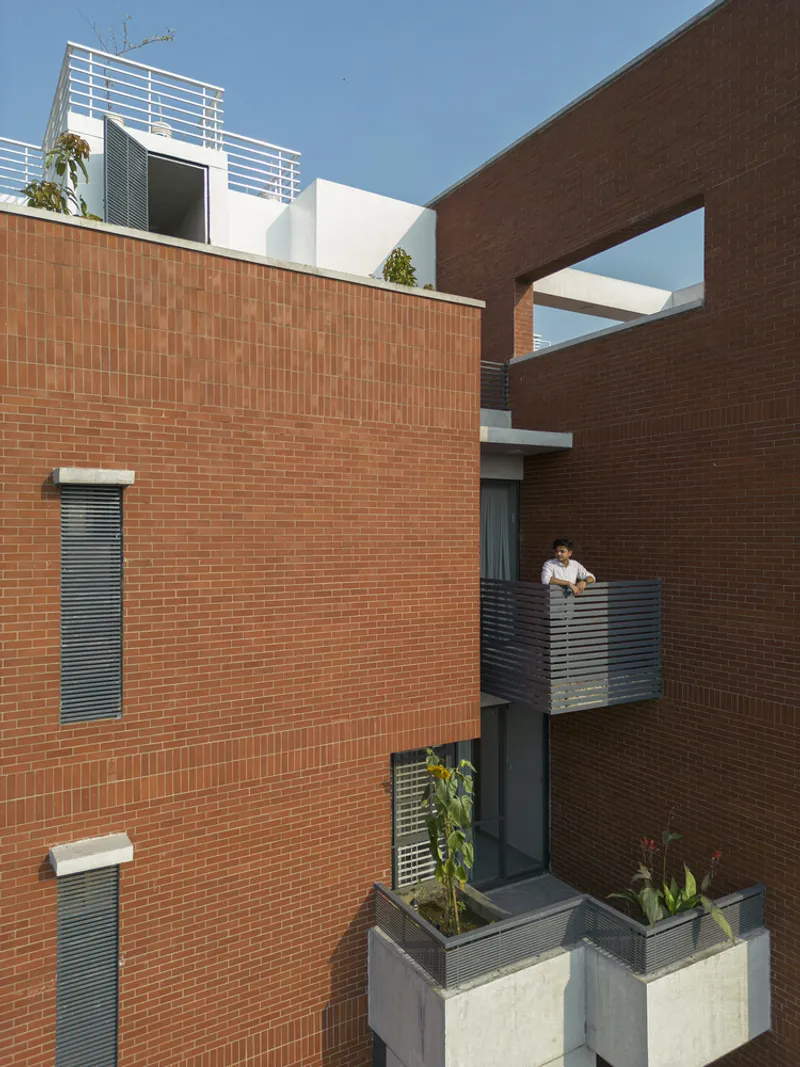
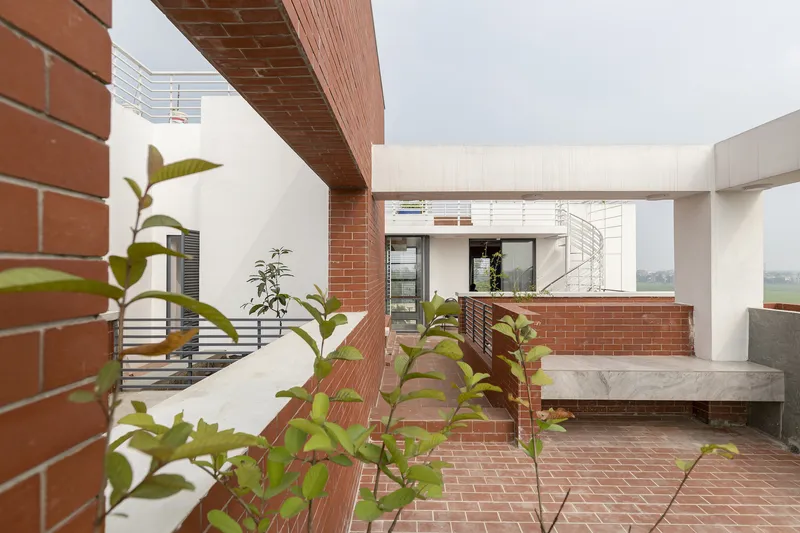

The fourth and fifth floors belong to the landowner, and here the spatial ambition shifts. Where the rental units below prioritize efficiency and cross-ventilation within compact plans, the owner's duplex opens up with double-height volumes, a glass roof that lets rain and light into the interior courtyard, and terraces that adjoin the living and dining areas. The interior courtyard, framed by brick walls with balconies overlooking it, functions as a vertical garden and social hub connecting the two levels.
The material palette inside is restrained: polished marble floors, timber louvered doors, and white plaster walls that bounce natural light deep into the plan. The double-height stairwell beneath the skylight is the spatial climax of the building, a luminous vertical shaft where angular shadows move across the walls throughout the day. It is a generous gesture in a building type that rarely gets one.
Stairwell and Skylight: Carving Light Through the Section
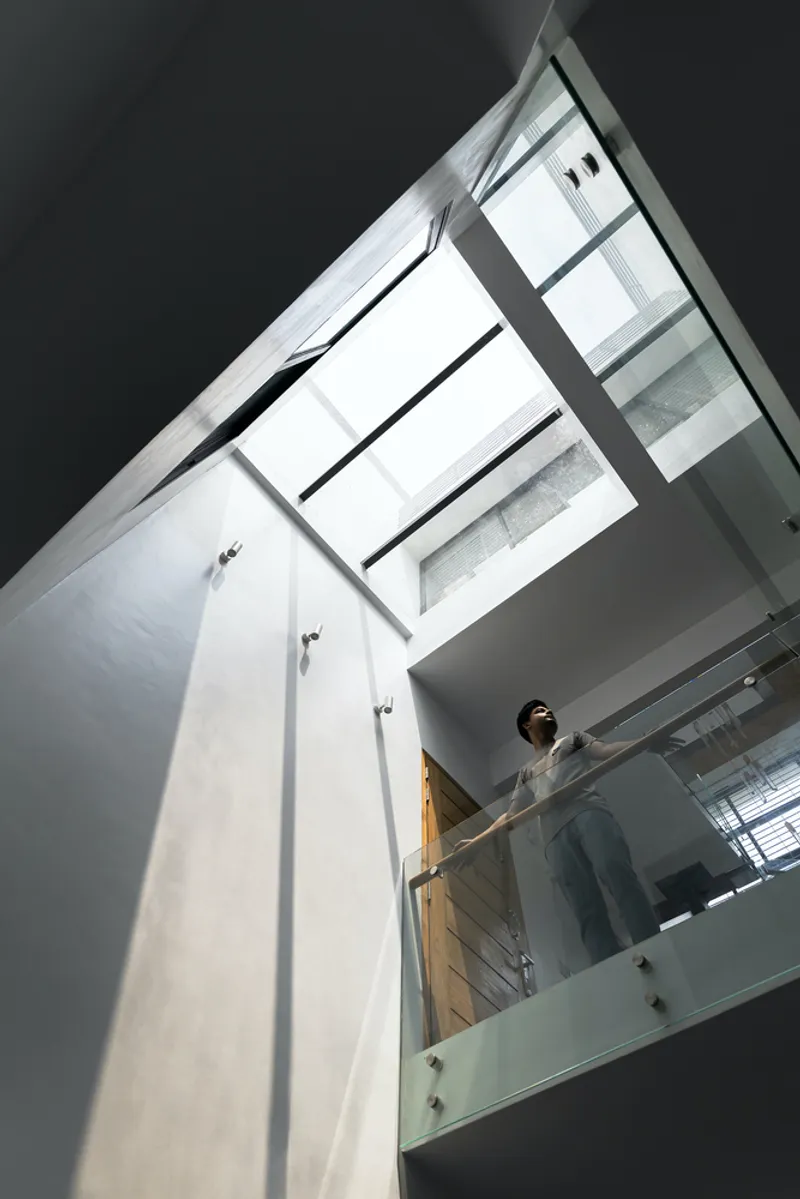
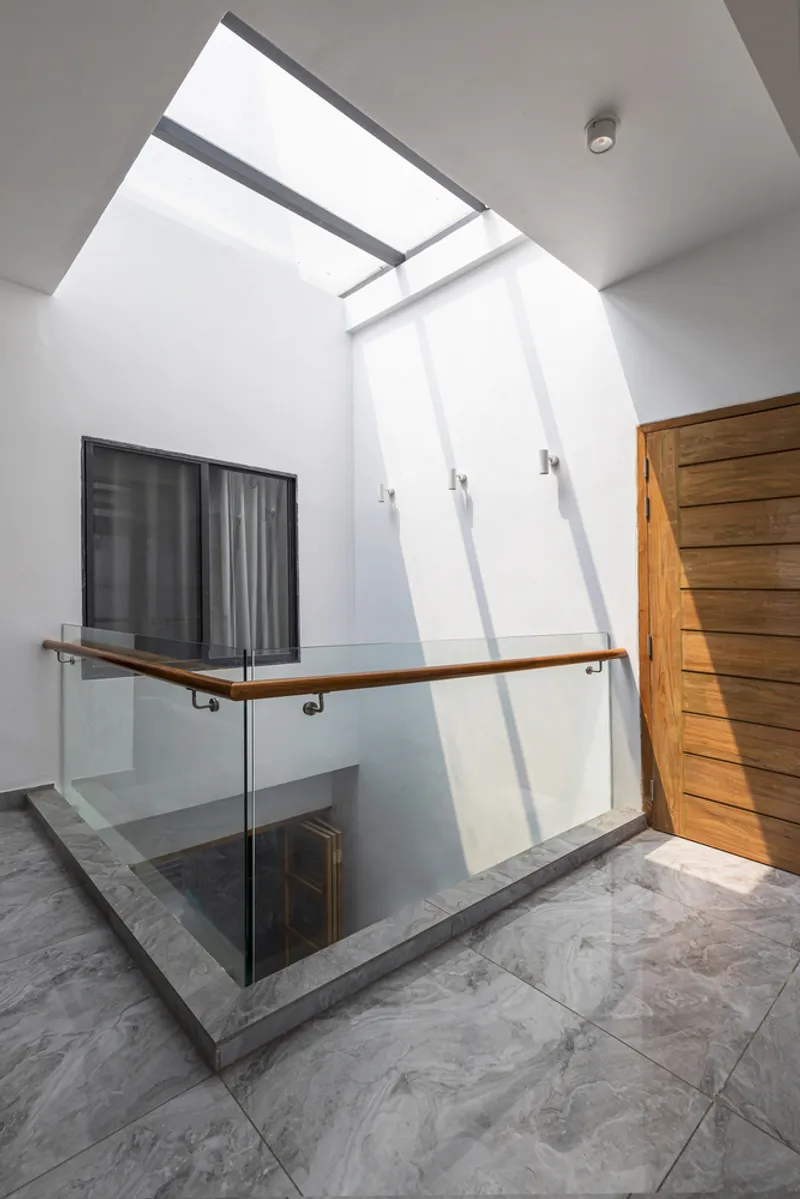

The central stairwell is more than circulation. Topped by a generous skylight, it channels daylight down through the building's core, reducing the need for artificial lighting in hallways and landings during daytime hours. Glass balustrades with timber handrails keep the vertical shaft visually open, so light from the roof penetrates multiple levels rather than being blocked at each landing.
The quality of detailing here is notable for a building outside Dhaka: the timber-clad landing, the floating staircase treads, and the precise geometry of the skylight's shadow patterns all suggest careful coordination between architect and contractor. In a context where projects rarely survive the translation from drawing to built form, this level of fidelity is an achievement in itself.
The Roof as Living Space
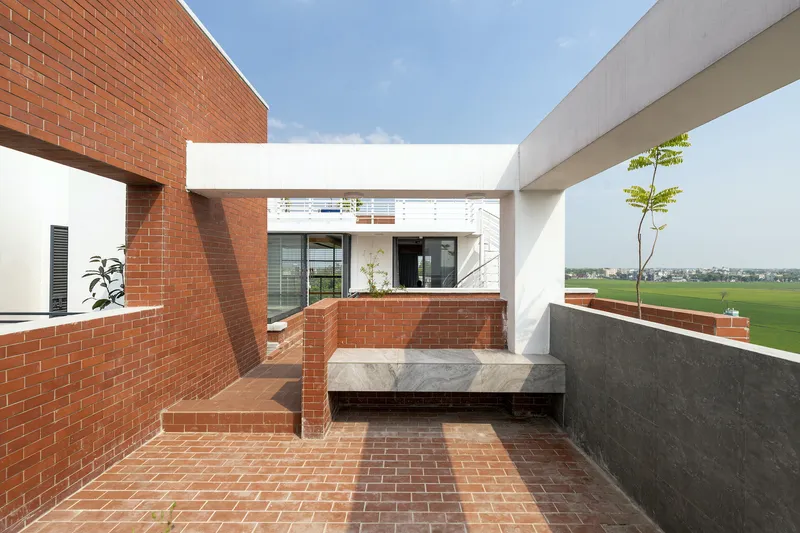
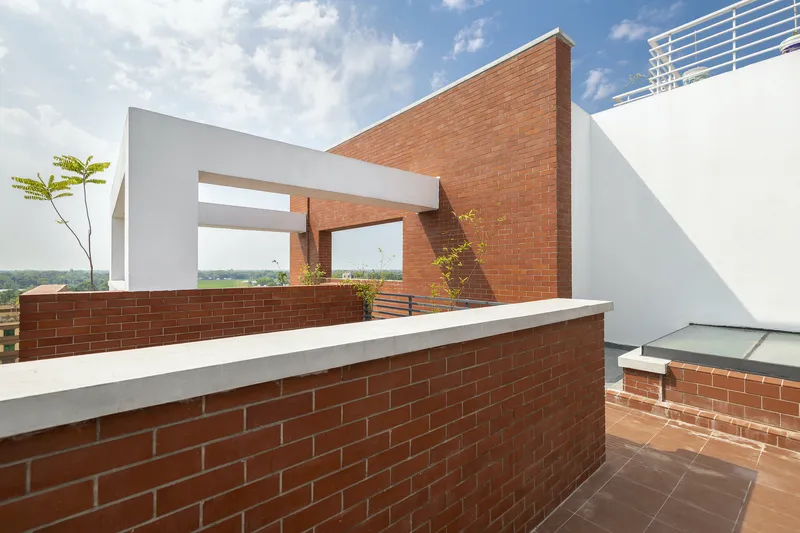
The roof is not wasted. A small study room sits at one corner, but the majority of the surface is given over to planted terraces, brick-paved gathering areas, and framed openings in the parapet walls that direct views toward the vast paddy fields of BADC to the south. The architects treated the roof as the building's most privileged living space, a retreat above the noise and density of the street, where residents can see the landscape that defines Netrakona's identity.
The planting strategy on the roof also serves the building's thermal performance. Vegetation and soil layers above the concrete slab insulate the top floor from direct solar gain, the single biggest source of cooling loads in a tropical building. It is a low-tech solution that costs almost nothing to maintain once established, and it transforms what would otherwise be a bare concrete deck into a functional garden.
Aerial Readings: Site, Context, and Green Edges
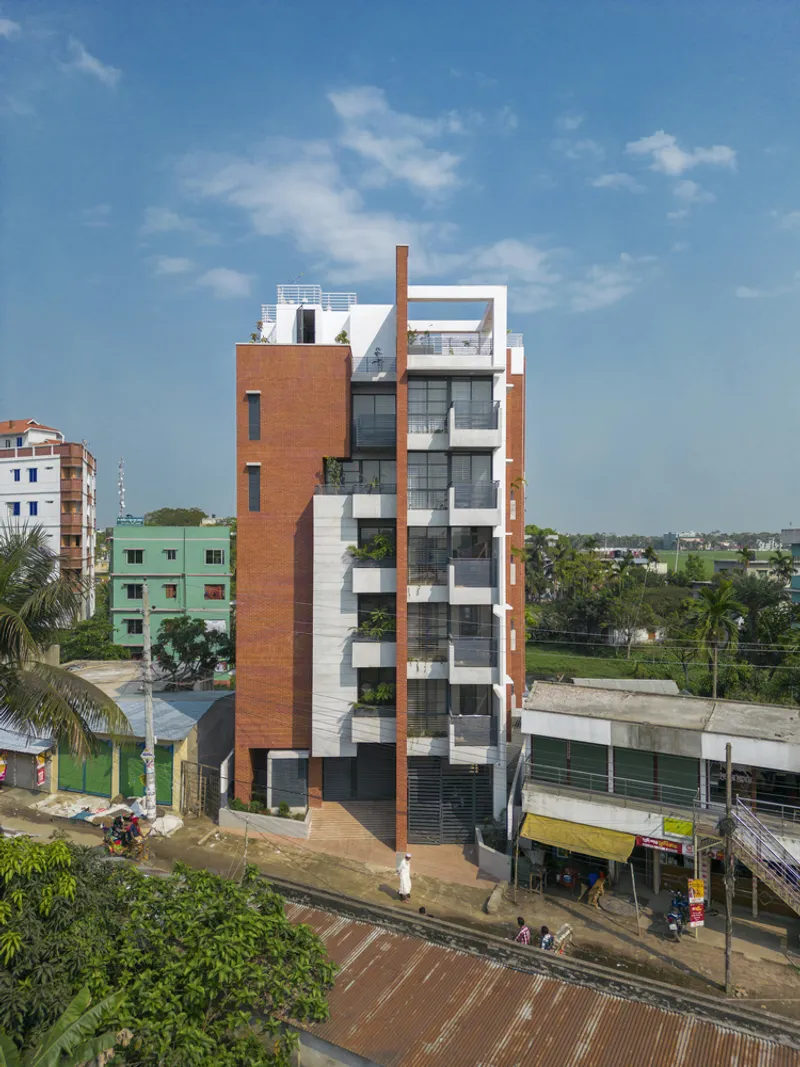


From above, the building's relationship to its context becomes clearer. The tower rises among palm trees and corrugated metal roofs, with agricultural land stretching to the south. The diagonal site lines that shaped the plan are visible in the oblique angles of the lot boundary, and you can see how the architects rotated the orthogonal grid of the apartments to align with these diagonals rather than fighting them. The parking area, the entry sequence, and the planted courtyard all respond to the irregular geometry of the site.
The overhead courtyard view reveals the intimacy of the planted voids between brick walls. A palm tree anchors the interior court, its canopy reaching up toward the owner's terrace levels. These pockets of green, visible from multiple floors, are the spatial heart of the project: they bring nature into the section of the building, not just its edges.
Plans and Drawings
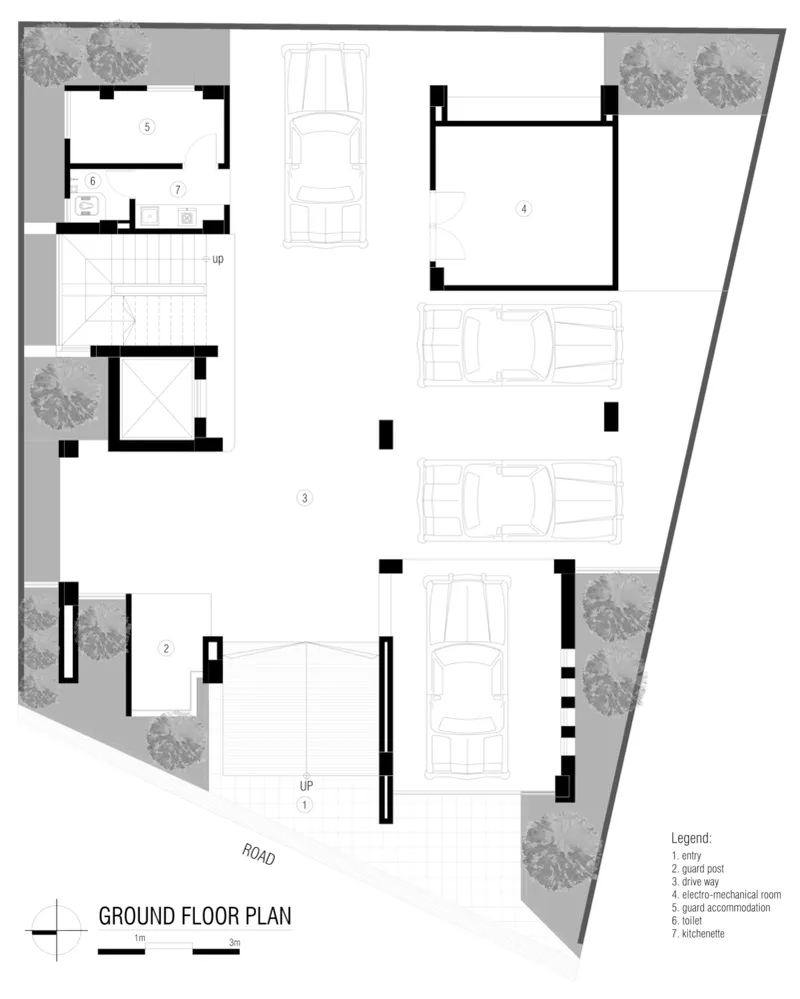


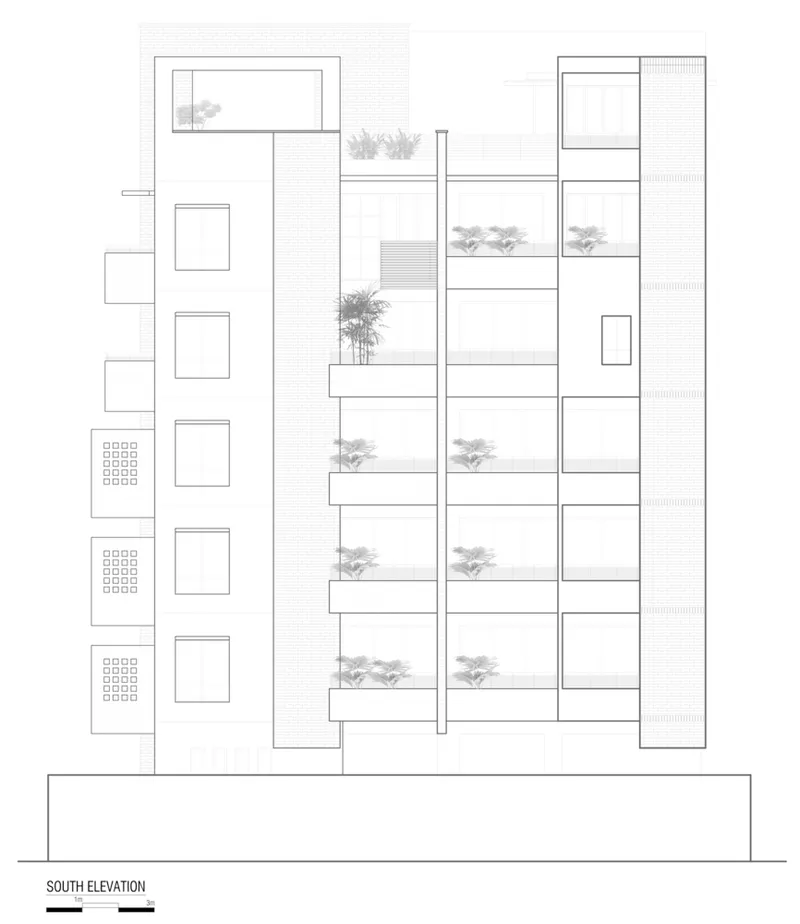
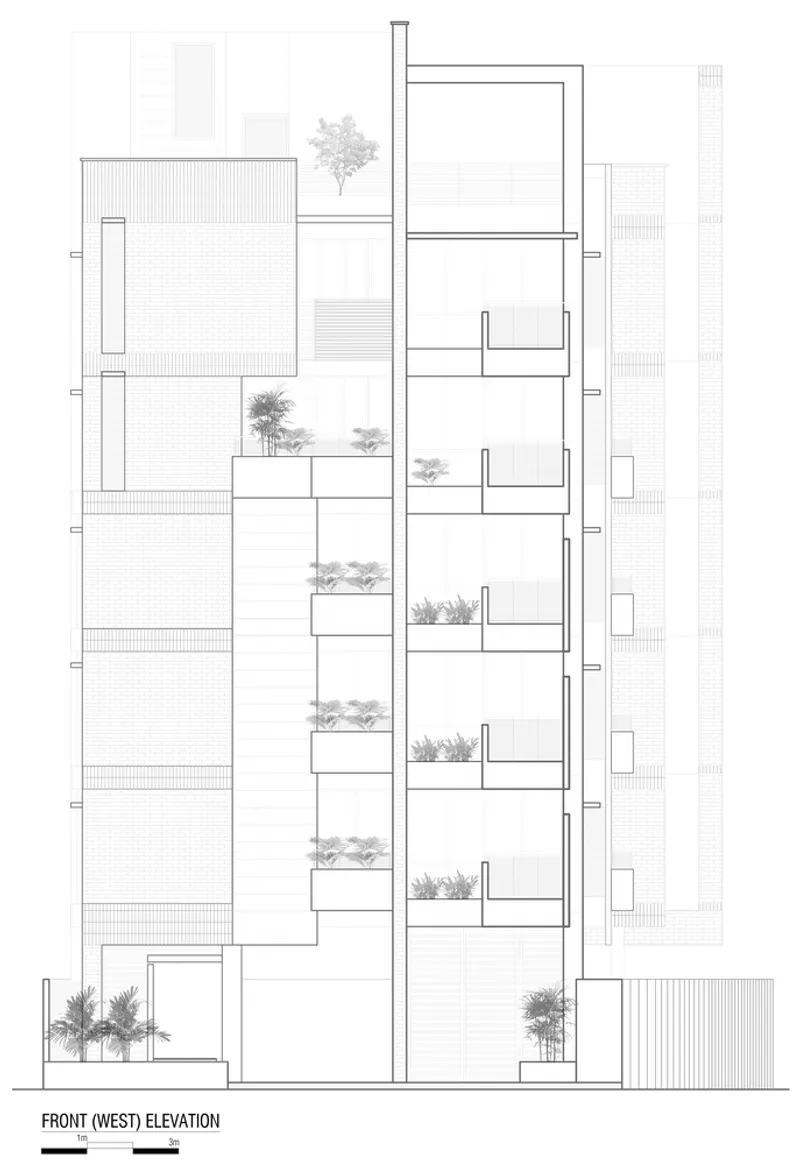
The ground floor plan shows the drive-through parking and entry lobby, with service cores pushed to the western edge. Typical floor plans on levels one through three organize three compact rental units per floor, each with bedrooms oriented away from the west wall and verandahs wrapping the south and west edges. The fourth and fifth floor plans open up dramatically for the owner's duplex, introducing terraces, planted courtyards, and the double-height void over the living area. The roof plan maps out the study room, spiral stair, glass roof element, and planted zones.
The south and west elevation drawings confirm what the photographs suggest: the facade is a carefully calibrated rhythm of solid brick, recessed voids, planted terraces, and perforated screening. The planted terraces are drawn with trees at every level, making the green strategy visible as an architectural commitment rather than a landscape afterthought. The section-like clarity of these elevations shows how the verandah depths vary to control solar exposure at different floor heights.
Why This Project Matters
Green View Residence matters because it demonstrates that serious climate-responsive design does not require a Dhaka address or an international budget. The passive strategies here, deep shading, thermal mass, cross-ventilation, rooftop planting, are not novel in theory. What is rare is seeing them executed with this level of formal coherence in a small district town, by a practice willing to treat a mixed-use apartment building as a genuine design problem rather than a speculative shell.
The building also offers a replicable model for Bangladesh's rapidly urbanizing secondary cities, where construction is booming but design quality is often an afterthought. By proving that red brick, planted verandahs, and intelligent orientation can produce a building that outperforms its air-conditioned neighbors while costing less to operate, 3 Points Consultant has built something more valuable than a single landmark. They have built an argument.
Green View Residence by 3 Points Consultant, Ananda Bazaar, Netrakona, Bangladesh. 1,105 m². Completed 2023. Photography by Junaid Hasan Pranto.
About the Studio
Share Your Own Work on uni.xyz
If projects like this are the kind of work you want to make, uni.xyz is a place to publish your own, find collaborators, and enter design competitions.


Popular Articles
Popular articles from the community


Jaramillo Van Sluys Arquitectura and Urbanismo Turn a Demolished Registry Lot in Quito into an Orchard Plaza
In Quito's Centro Histórico, a 2,800 m² plaza exposes the San Agustín convent wall and redraws its lost Augustinian orchard in volcanic stone.

David Ortega Stacks a Two-Story Mexico City Penthouse Around a Steel Stair and a Pergola-Shaded Roof Terrace
In Colonia Roma, a 300 m² penthouse uses oak joinery, a planted steel stair and a slatted roof pergola to make a new-build apartment feel like a house.

David Macias Steps a Doorless Stone and Plaster House Down a Tropical Colombian Hillside
In the humid hills of Colombia, Threshold House replaces the front door with an open void and terraces its 850 m² down the slope instead of fighting it.

Cube Design Draws an Ecological Corridor Between Two Shenzhen Hills with the Nankai Building
Beside Shenzhen's container docks, the Nankai Building pairs stacked balconies with a climbing green screen to connect two hillsides across its height.

Similar Reads
You might also enjoy these articles


Hodi-Mandai Geram
Project Function: Preservation and revitalization of the Intangible heritage and socio-spatial identity of the Hodi by Housing, Cultural Memory Center, Sacred Grove, landscape, local tourism economy


Olio Towers: A Mid-Rise for Performers That Fuses Housing, Rehearsal, and Stage
Located blocks from Houston's Theater District, this modular tower stacks living units around a central performance atrium.

Oasis: Modular Green Housing Carved into Dhaka's Urban Fabric
A shortlisted Plugin Housing entry reclaims unauthorized settlements in Dhaka with stepped concrete volumes, green roofs, and ventilation-driven design.

Black Hole: A Floating Megastructure for the Post-Physical Era
Emiliano Mazzarotto envisions a spherical, self-scaling arena where e-sports, digital hotels, and holographic stadiums replace traditional public space.

Explore Green Building Competitions
Discover active competitions in this discipline

Challenge to design mud housing for contemporary communities

Challenge to reimagine the Iron Throne

Photograph architecture without architects

Illustrate the lost glory of Angkor Wat - Render Challenge
Comments (0)
Please login or sign up to add comments
No comments yet. Be the first to comment!