
Archipelago Turns a Brussels Organ Factory into Greenpeace Belgium's Sufficiency-Driven Headquarters
A former organ atelier in Brussels' canal zone becomes a low-tech, activity-based headquarters guided by the principle of using just enough.


Most sustainable office renovations start with a checklist: solar panels, heat pumps, recycled insulation. Archipelago's transformation of a 2,300 square meter organ atelier on Brussels' Vergotedok canal into the new Greenpeace Belgium headquarters starts with a fundamentally different question: what if we simply use less? The guiding principle here is sufficiency, a word that sounds modest until you realize how radical it becomes when applied with discipline. Rather than layering new systems onto old bones, the architects inventoried what the existing buildings already offered, then matched those conditions to the specific ways Greenpeace staff actually work. The result is a headquarters that rejects air conditioning, shrinks its mechanical systems to a minimum, and still delivers a workspace tuned to nine distinct activities, from wall climbing to focused campaigning.
The site itself is a textbook piece of Brussels' inner-block archaeology: a street-facing row of cream brick townhouses concealing a deep, formerly industrial rear volume that once housed the Manufacture d'Orgues de Bruxelles. Archipelago's intervention stitches these typologies together through courtyards, patios, and carefully placed openings, creating a gradient of thermal conditions and social intensities that runs from the public street to the activist workshop at the back. The design process began not with plans but with camping, literally. The team embedded itself in the former Greenpeace offices and aboard the Rainbow Warrior in Ostend to understand how the organization actually functions before drawing a single line.
Two Typologies, One Block
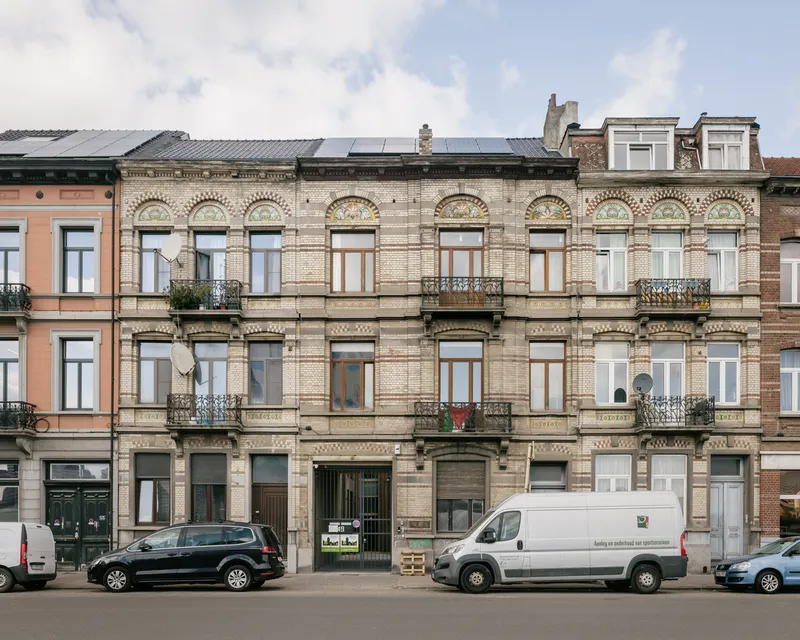
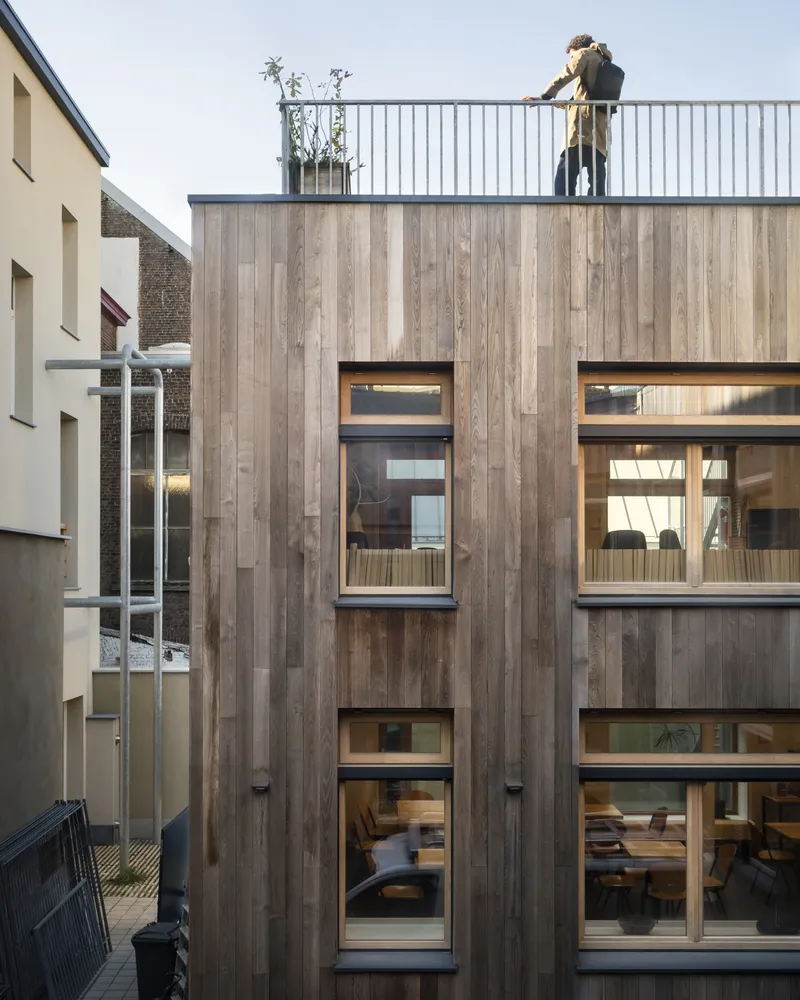
From the street, you see a conventional Brussels row house: cream brick, arched windows, solar panels on the ridge. Walk through to the rear and you encounter a tall, timber-clad volume with stacked horizontal windows and a rooftop deck. These are not two buildings pretending to be one. They are genuinely different structures, one domestic and one industrial, now woven into a single campus. The front houses accommodate guest rooms, while the former factory behind becomes the engine of Greenpeace's activist operations. The contrast is deliberate and productive: it gives the headquarters a range of spatial characters that a single new-build could never replicate.
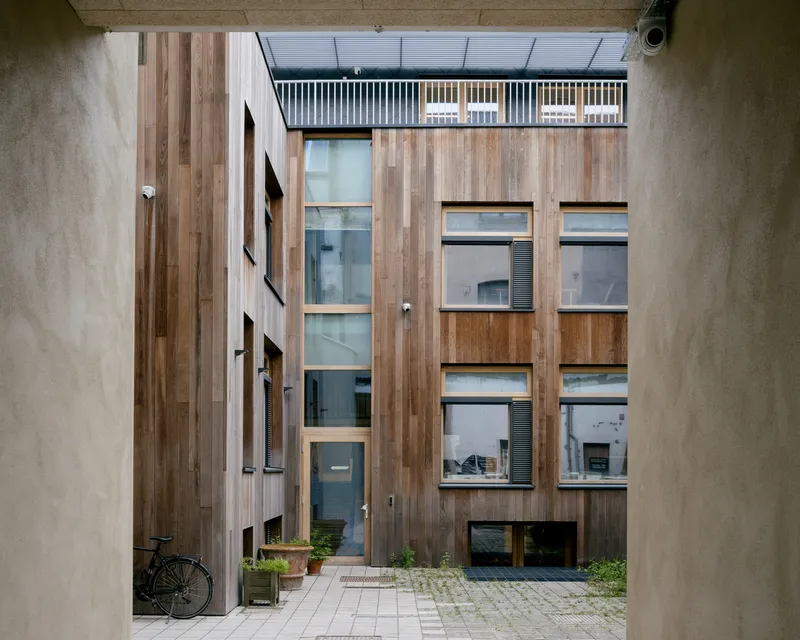
The narrow courtyard that separates the two volumes is not leftover space. It is the hinge of the whole project, providing daylight, ventilation, and visual connection between the domestic front and the industrial back. A galvanized steel stair threads through this gap, linking floors without consuming interior area. The architects preserved the existing load-bearing structure right to its design limits, accepting some bending in components rather than reinforcing everything to conventional norms. It is a structural corollary of the sufficiency ethos: safe, but not over-engineered.
The Courtyard as Climate Machine
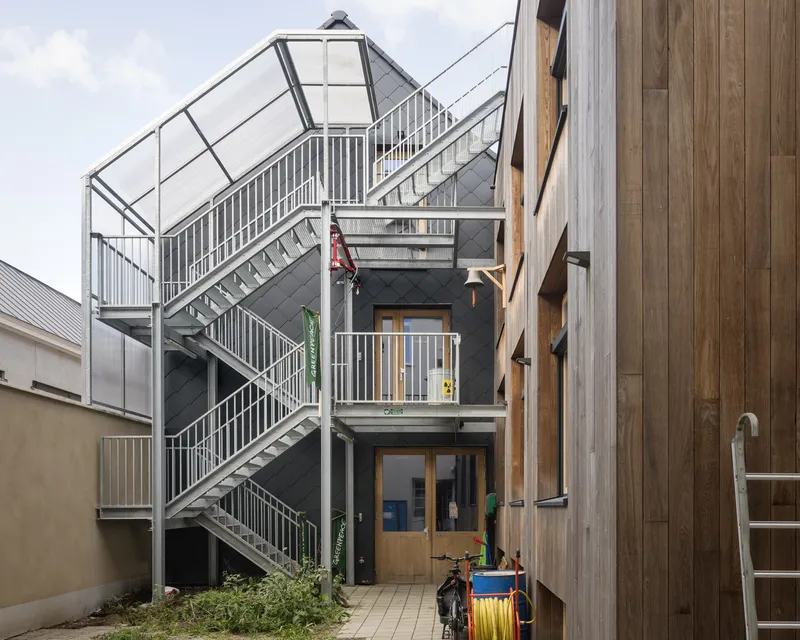
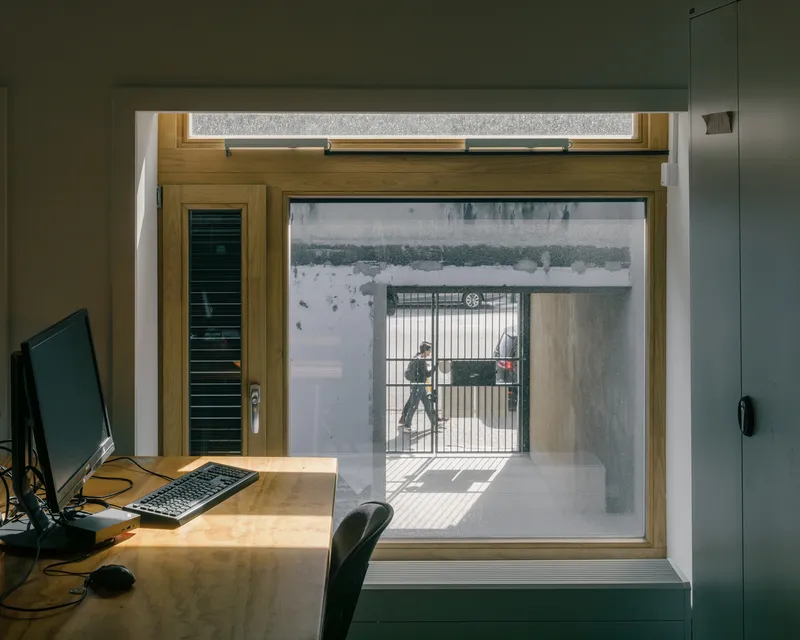
The central courtyard does more than organize circulation. It is the primary driver of the building's passive climate strategy. Windows, patios, and roof-mounted domes are placed to move air through the building without mechanical cooling. Ventilation is monitored independently for each space, allowing a workshop to breathe differently from a phone booth, and reducing the total number of ducts needed. The heat pump is deliberately undersized, specified for a 0°C outdoor temperature rather than the standard minus 8°C, with no backup boiler. In a conventional project that would be reckless. Here, it is a calibrated bet on an adaptive comfort model that allows interior temperatures to track outdoor conditions within acceptable limits.
A bicycle rests against a timber window frame in the afternoon sun, casting long shadows into the courtyard. That image captures something essential about this project: the willingness to let the building feel like weather rather than sealed from it. Peak temperatures are tolerated during brief summer periods because the alternative, full mechanical conditioning, would betray the entire logic of the design.
Activity-Based Spaces, Not Open Plan
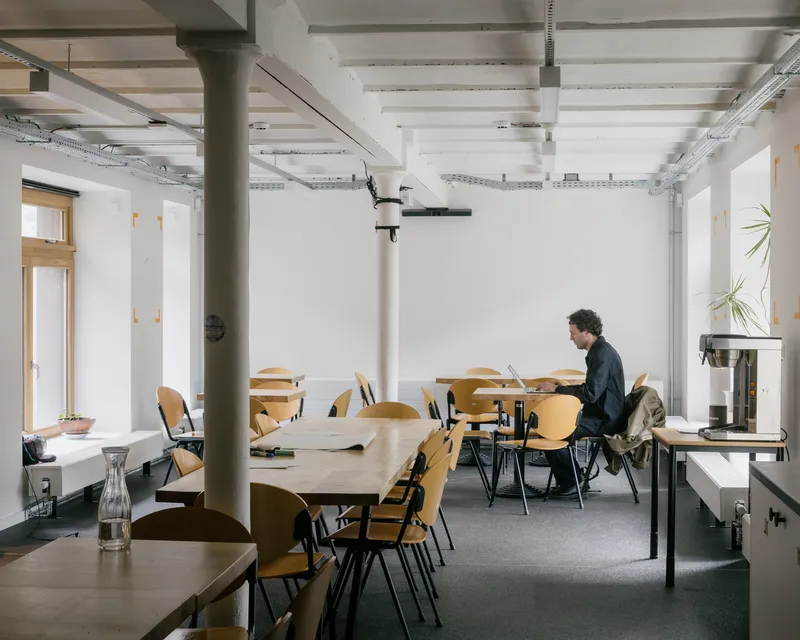
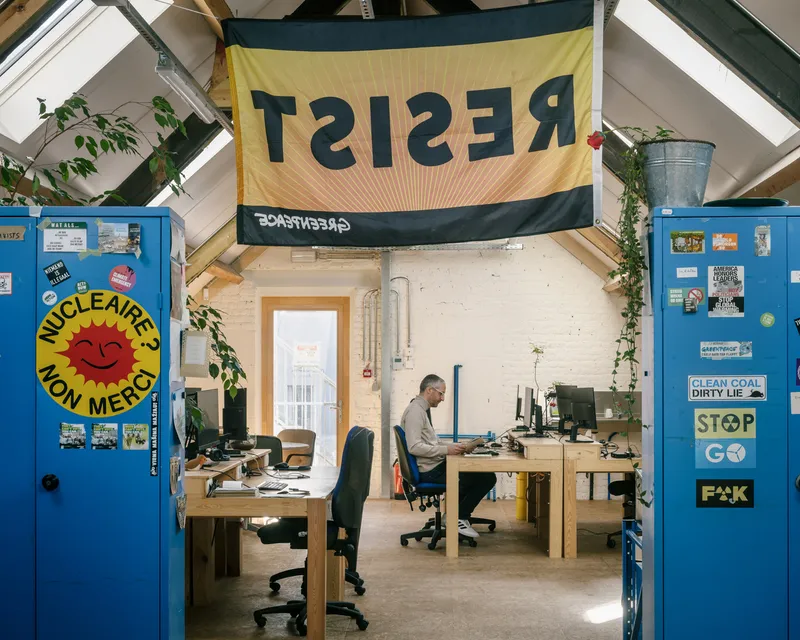
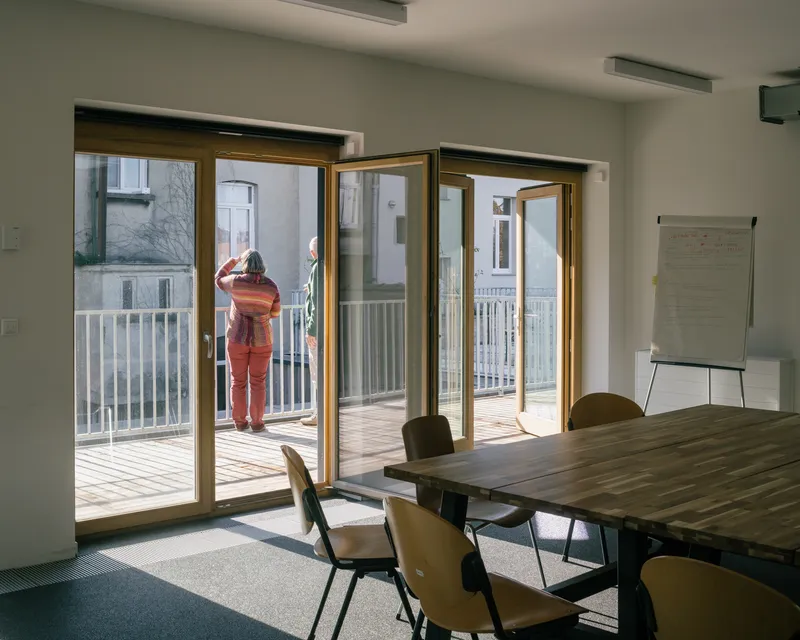
Archipelago's co-creation research distilled Greenpeace's work life into nine activities: large meetings, small meetings, informal meetings, focus work, phone calls, eating, making things, climbing, and resting. Each gets its own spatial register. The open workspace with exposed ceiling beams and painted steel columns is for collaborative moments. A quieter room with white brick walls and blue doors plastered with protest stickers offers focused concentration. Timber-framed folding doors open onto a sunlit balcony for the informal encounter that falls between a meeting and a break.
Acoustic zoning is the invisible architecture that makes this overlap possible. Rather than separating functions with walls, the design uses material changes, level shifts, and strategic placement to keep a campaign brainstorm from bleeding into someone's phone call. It is a more honest reading of how activist organizations actually work than any hot-desking diagram could provide.
The Rooftop as Shared Ground
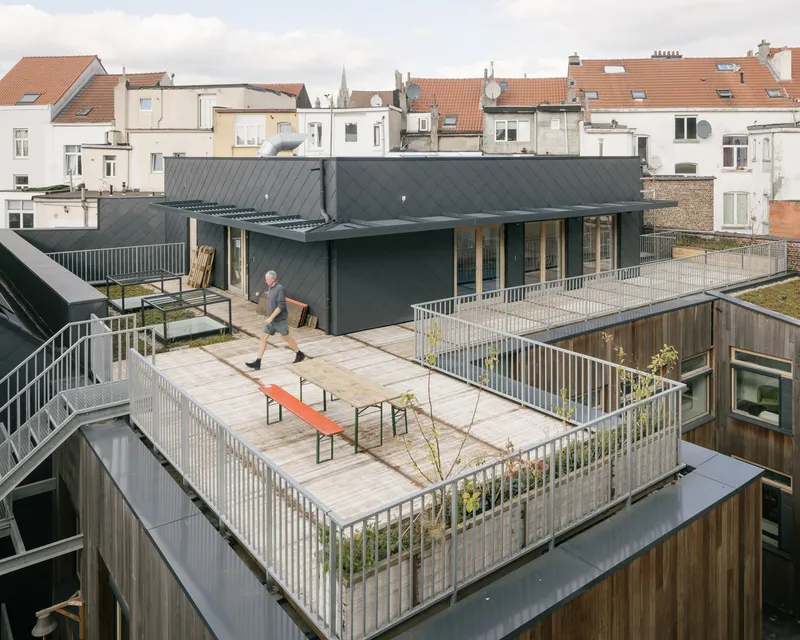
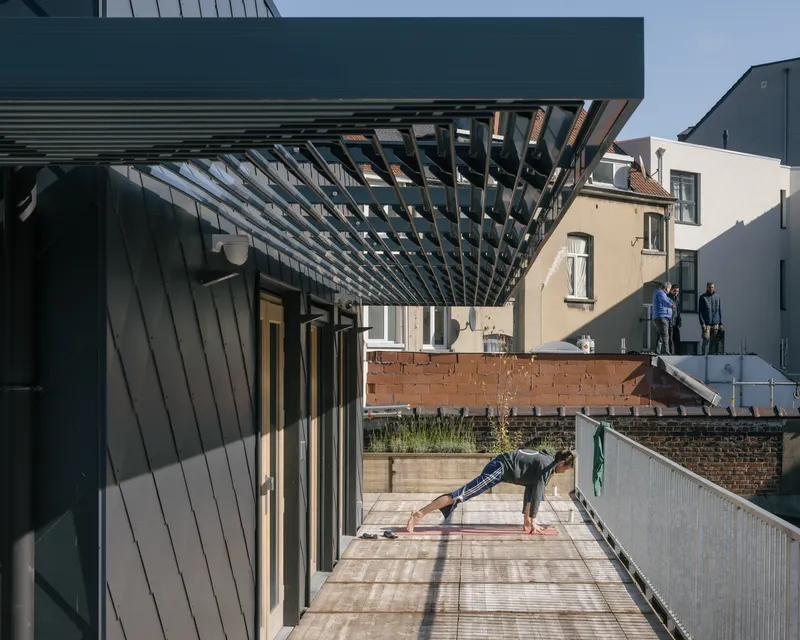
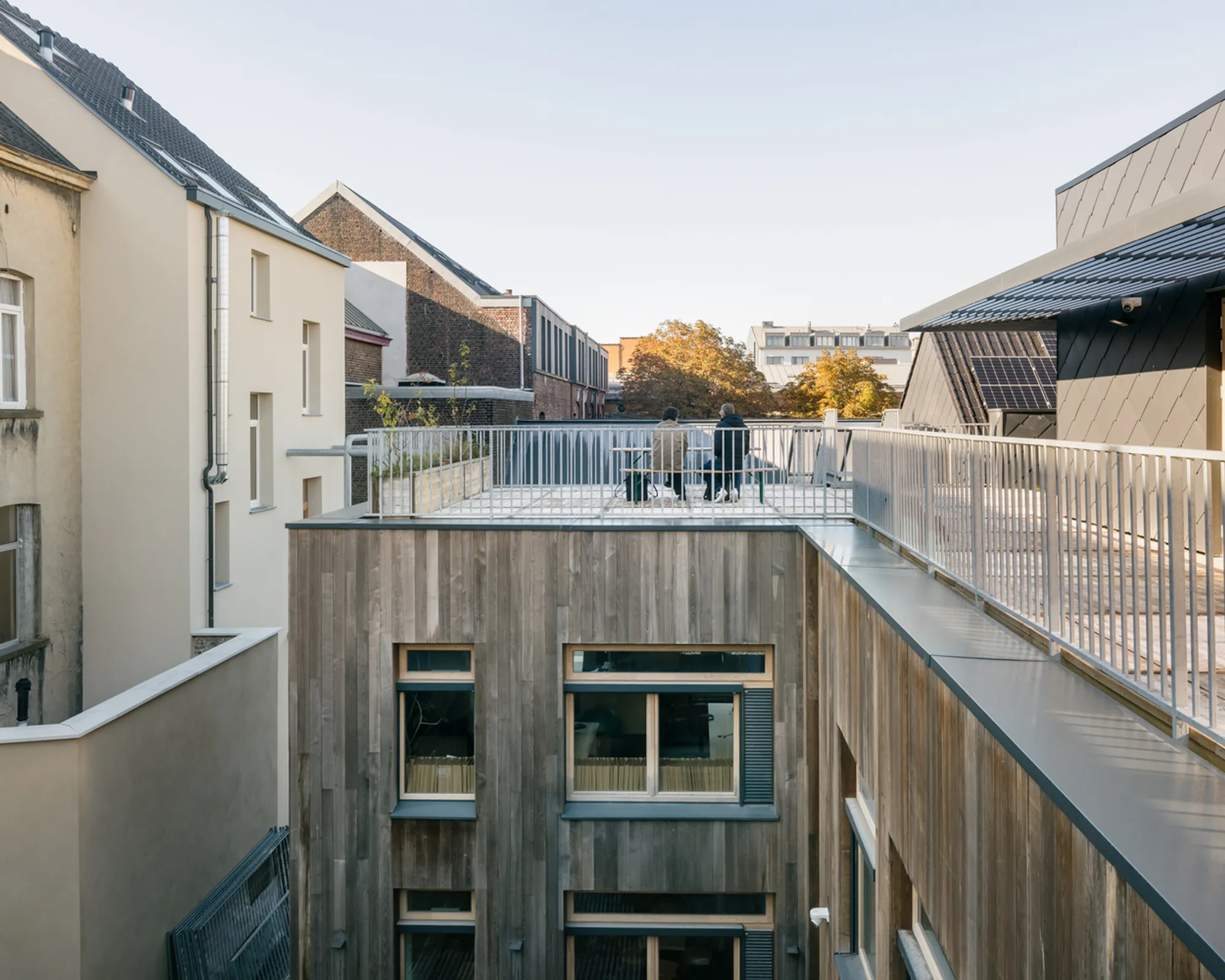
In a dense Brussels block where ground-level outdoor space is scarce, the rooftop becomes the communal landscape. A timber-decked terrace with steel railings gives panoramic views over tile roofs and neighboring chimneys. Elsewhere, a timber slat pergola filters morning light onto a surface where someone practices yoga. These are not corporate amenity flourishes. They are direct responses to one of the nine identified activities: resting. In a headquarters designed around what people actually do, rest earns its own architecture.
The rooftop also carries the building's green roof system, using Click 'n Go Light sedum trays over EPDM roofing to manage stormwater and reduce heat gain. It is a quiet, functional layer that you never notice from street level but that contributes meaningfully to the building's thermal performance.
Material Honesty and Incremental Bricolage
Archipelago describes the renovation method as incremental bricolage: a process of uncovering diversity rather than imposing uniformity. Timber cladding wraps the rear volume not as a decorative skin but as a practical, breathable layer over the retained factory shell. Early 20th-century architectural elements are preserved where they survive. New interventions, galvanized steel stairs, painted columns, blue doors, are legible as insertions, never pretending to be original. The palette is honest without being austere.
The strategy of minimizing demolition has a direct carbon payoff. Every ton of existing masonry left in place is a ton of embodied energy preserved. But it also produces richer spaces. A wall that has survived a century of organ making carries texture and memory that no specification sheet can replicate. Greenpeace's protest stickers on those blue doors are just the latest layer in a building that has always accumulated meaning.
Plans and Drawings
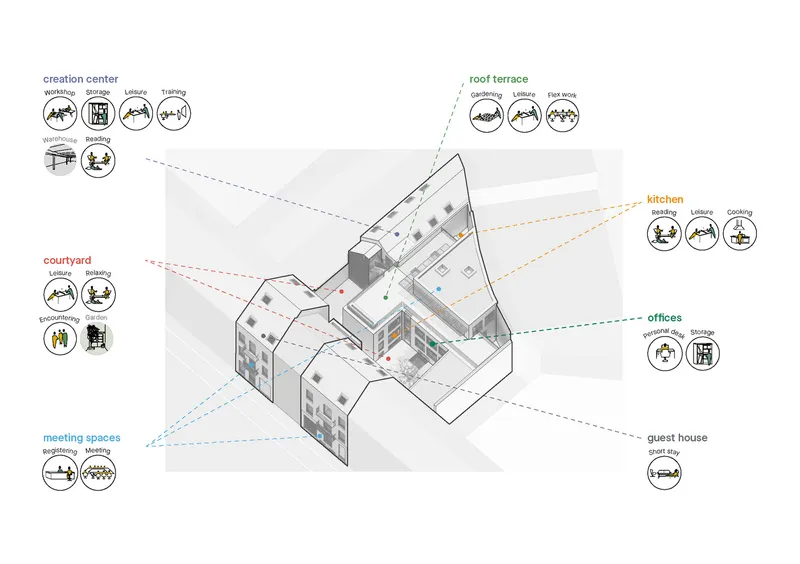
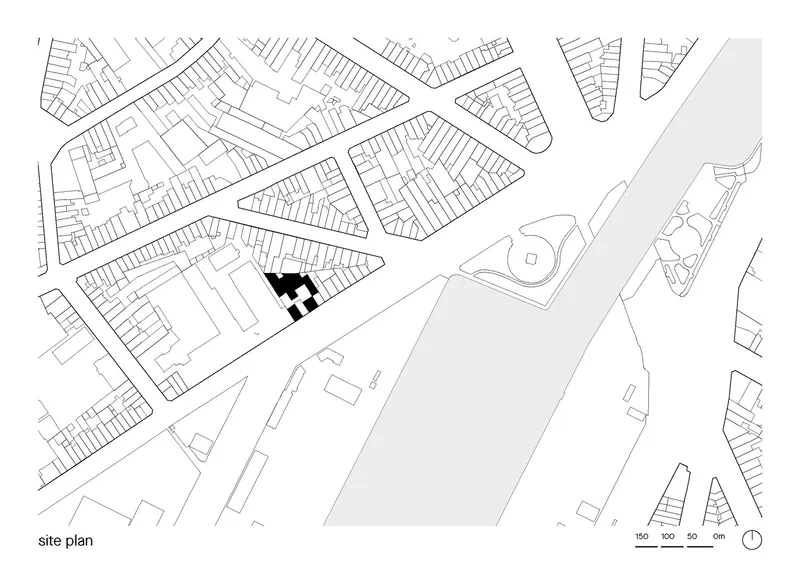
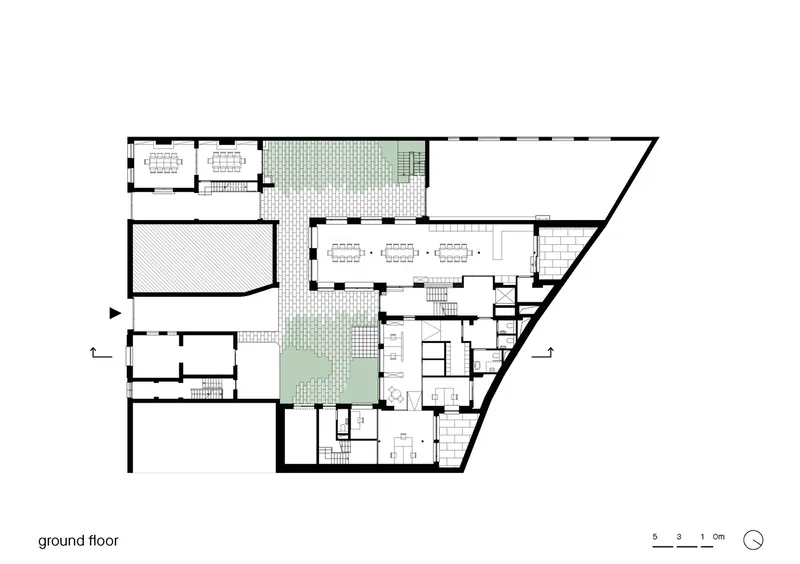
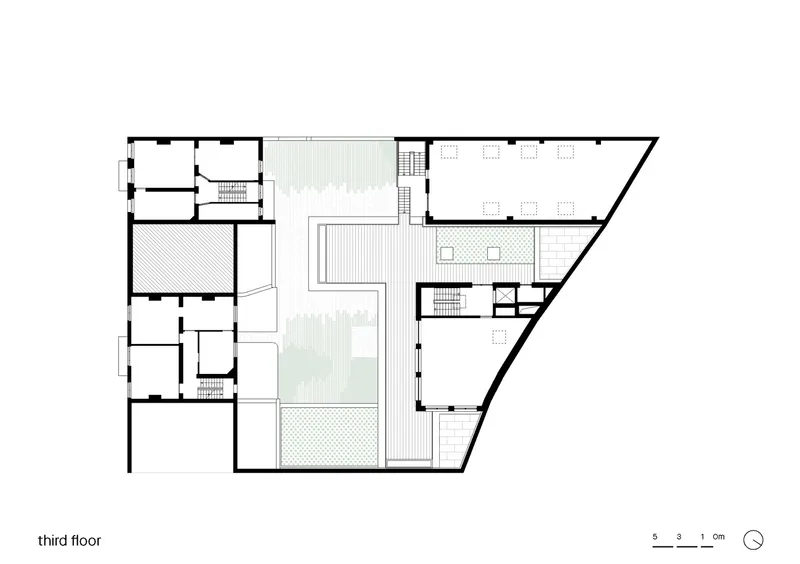
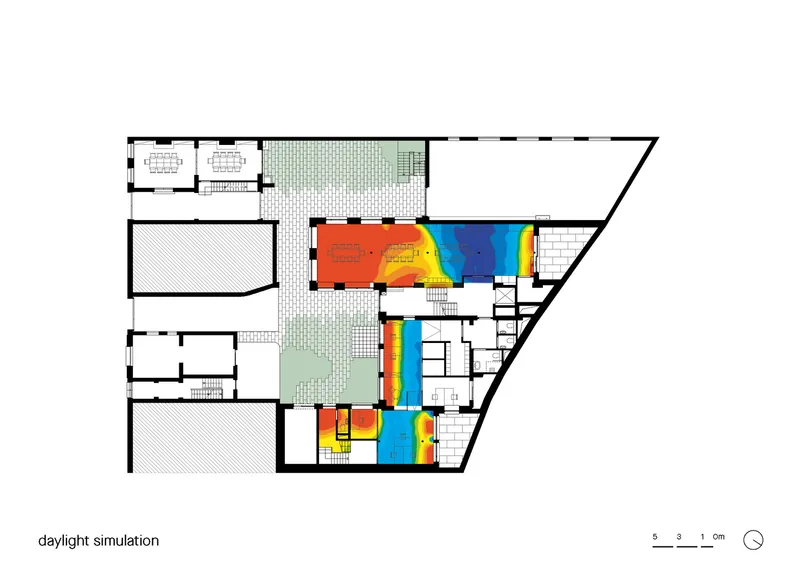
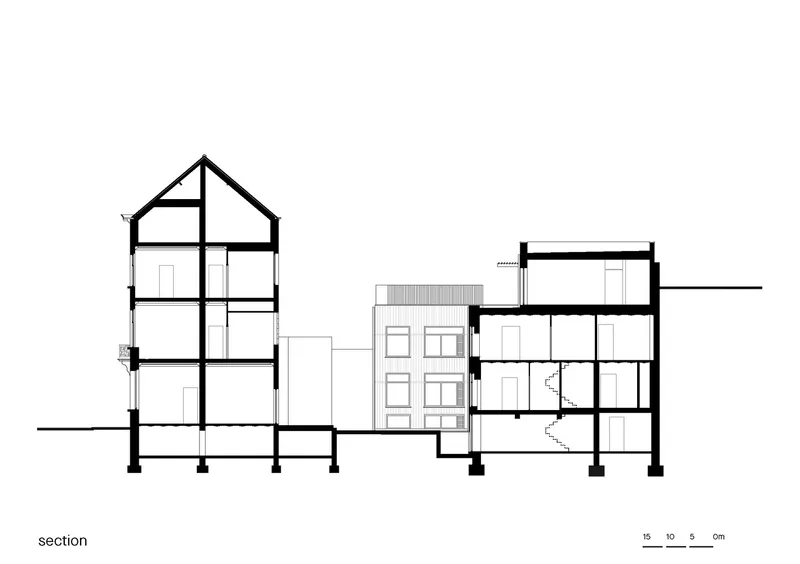
The axonometric diagram reveals the full complexity of the project: multiple interconnected volumes, each with a distinct programmatic identity, laced together by courtyards and stairs. The site plan confirms how deeply the building is embedded in its block, with almost no street presence hinting at the spatial richness behind. Floor plans at ground and third levels show how outdoor space, the central courtyard and rooftop terraces, is distributed across all levels rather than concentrated in one place. The daylight simulation heat map demonstrates the precision behind what appears to be an intuitive design: every window and dome placement was tested against light distribution targets. The section through the block is perhaps the most telling drawing, slicing through pitched roofs and flat factory ceilings to show how the existing floor plates were retained and reconnected.
Why This Project Matters
The Greenpeace Belgium HQ is not the most technologically advanced sustainable renovation in Europe. That is exactly the point. By refusing to compensate for inefficiency with more machinery, Archipelago forces every design decision to carry its own weight. The undersized heat pump, the absent air conditioning, the tolerated temperature peaks: these are not compromises but convictions. They represent a model of environmental responsibility that starts with needing less rather than producing more. In a construction industry addicted to complexity, sufficiency is genuinely subversive.
The project also demonstrates that adaptive reuse in a dense European block can produce spatial variety that new construction rarely achieves. The gradient from street-front guest room to rooftop yoga terrace to rear workshop for campaign banners gives this headquarters an experiential range perfectly suited to an organization that exists somewhere between office work and direct action. Archipelago, working with partners AAIA, MATRIciel, and VETO, has delivered a building that practices what its occupant preaches, and does so without a single note of piety.
Greenpeace Belgium HQ by Archipelago, with partners AAIA, MATRIciel, and VETO. Brussels, Belgium. 2,300 m². Completed 2024. Photography by Stijn Bollaert.
About the Studio
Share Your Own Work on uni.xyz
If projects like this are the kind of work you want to make, uni.xyz is a place to publish your own, find collaborators, and enter design competitions.




Popular Articles
Popular articles from the community


Lunar Spiral: Space Architecture Shaped by the Mathematics of the Universe
Lunar Spiral reimagines space architecture through Fibonacci geometry, lunar regolith, levitating habitats, and self-sustaining Moon living.

Co-Life: Senior Housing Design That Reconnects Older Adults With the City
Co-Life reimagines senior housing design through healing gardens, shared streets, workshops, and a sustainable community across generations.

Conexión: Biophilic Design Reimagines High-Rise Living in Hong Kong
Conexión reimagines high-rise living in Hong Kong through biophilic design, green facades, shared spaces, daylight, water and nature within.

Hill & Cross Opera: Sculptural Opera House Architecture Shaped by Tallinn’s Landscape and Identity
Hill & Cross Opera reimagines opera house architecture in Tallinn through its sculptural hill, civic plaza, glass wave and a luminous cross.

Similar Reads
You might also enjoy these articles

FAMM Arquitectura Organizes Ten Villas Around Courtyards and Jungle in Nosara, Costa Rica
El Molino pairs two elongated volumes with deep overhangs and timber louvers to build a compact coastal community five minutes from the beach.
Oscar Niemeyer's Ibirapuera Park Pavilions Define São Paulo's Cultural Identity in Concrete and Curve
A constellation of modernist volumes set within São Paulo's most important urban park, conceived for the city's 400th anniversary in 1954.
How Henri Picq's 1889 Paris Pavilion Traveled 11,000 Kilometers to Become Santiago's Artequín Museum
A prefabricated iron and glass pavilion built for the Paris Universal Exposition found a second life as a children's art museum in Chile.
Sanjay Puri Architects Wraps a Jaipur Office Tower in Capsule-Shaped Green Buffers
A nine-level climate-responsive workplace near Jaipur Airport uses stacked planter terraces and aluminium screens to fight 40°C heat.


Explore Environment Friendly Competitions
Discover active competitions in this discipline



Challenge to reimagine the Iron Throne


Photograph architecture without architects


Illustrate the lost glory of Angkor Wat - Render Challenge


Design challenge to reuse E-waste
Comments (0)
Please login or sign up to add comments
No comments yet. Be the first to comment!