

Growing Space: Merging Vertical Farms and Wholesale Markets in Nine Elms
A pentagonal market complex layers automated farming modules, research labs, and public plazas into a single sustainable hub for London's Nine Elms.


What happens when a wholesale food market stops pretending agriculture is something that occurs elsewhere? Growing Space takes that question literally, embedding vertical farming modules, controlled-environment grow labs, and public plazas into a single pentagonal complex in London's Nine Elms district. The result is a building that produces, distributes, and educates simultaneously, treating food not as a commodity that arrives by truck but as a visible, participatory process woven into the daily rhythm of urban life.
Designed by Sana Khadepaun, this shortlisted entry in the Urban Meal Mine competition proposes a multi-functional hub that merges wholesale and retail markets, research facilities, worker amenities, and community gathering spaces into a compact architectural framework. Situated within one of London's most rapidly densifying neighborhoods, the project positions agriculture as infrastructure, not afterthought.
A Pentagonal Footprint Organized Around Internal Courtyards
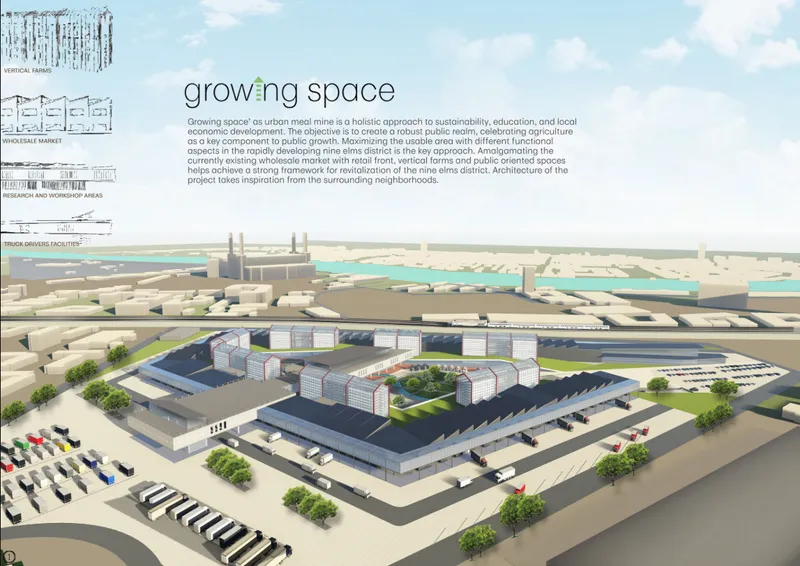
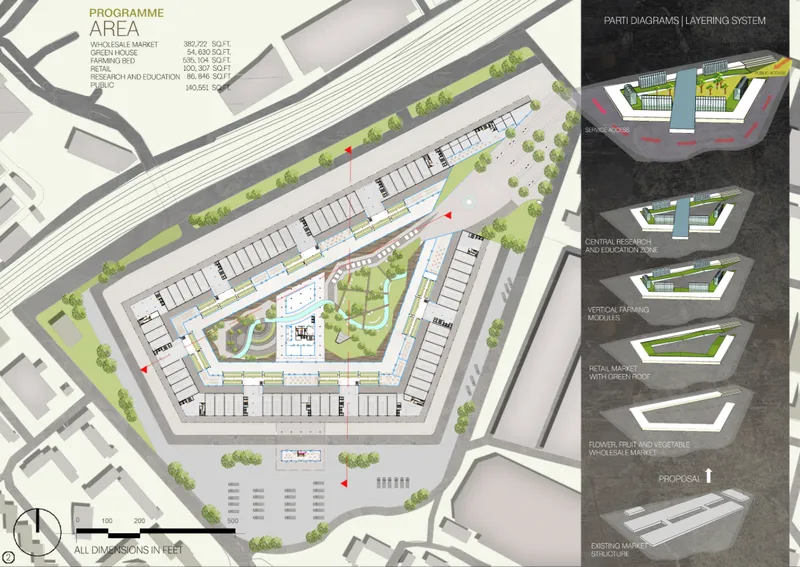
The aerial view reveals the project's distinctive pentagonal geometry, which organizes linear market stalls around a series of internal courtyards and rooftop green spaces. This configuration maximizes land use efficiency while generating sheltered outdoor zones that function as social gathering points. The site plan makes the layered programming legible: wholesale distribution along the perimeter edges, retail and restaurant spaces facing inward toward the courtyards, and research zones tucked into upper levels where they benefit from controlled daylight.
The pentagonal form is more than a formal gesture. By angling the building's edges rather than aligning them to a single axis, Khadepaun creates multiple entry thresholds and sightlines that draw the surrounding Nine Elms community into the complex. The courtyards become the connective tissue between commerce, education, and recreation, ensuring that no single function dominates the public experience of the building.
Vertical Farming Modules as Architecture, Not Equipment
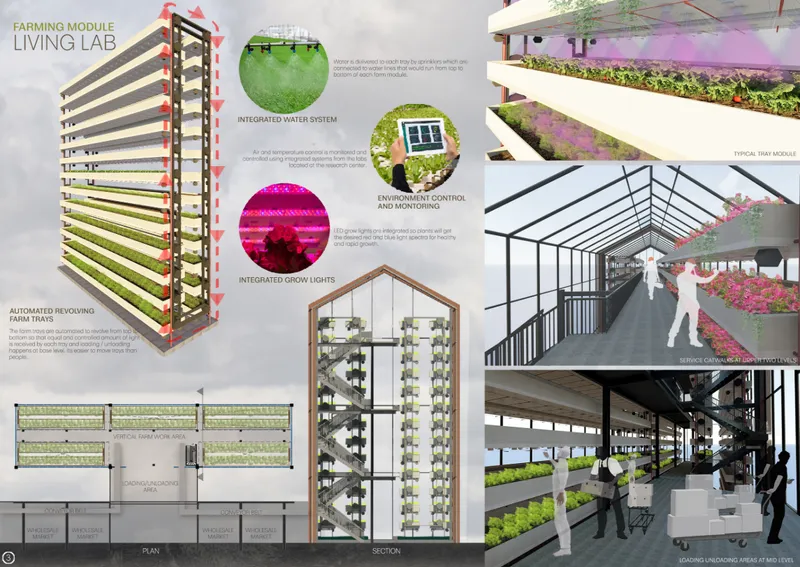
The exploded axonometric and section drawings are where Growing Space makes its strongest technical argument. Vertical farming modules feature automated revolving trays, integrated grow lights, and controlled irrigation systems, all detailed as integral parts of the building's section rather than mechanical add-ons. The farming infrastructure occupies dedicated floors that are visually accessible from public circulation routes, transforming food production into a visible, educational experience rather than concealing it behind service walls.
This transparency matters. By exposing the mechanics of growing, the architecture creates a feedback loop between producers and consumers. Visitors moving through market halls or research labs can observe crops at various growth stages. The section drawings show how environmentally controlled growing labs sit adjacent to knowledge-sharing workshops, so the distance between innovation and its public communication collapses to a corridor.
Greenhouse Structures Meet Wholesale Distribution
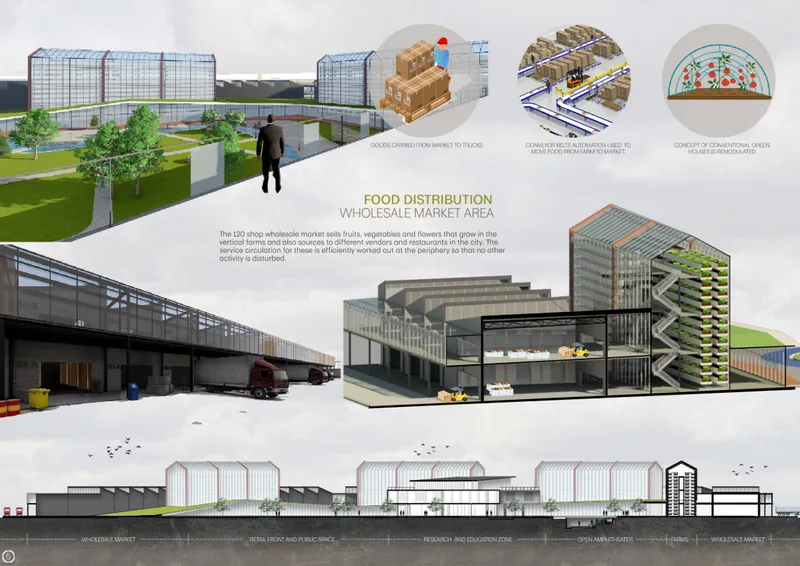
The section elevation reveals how the project reconciles two programs that rarely coexist: greenhouse cultivation and heavy logistics. Arched greenhouse roofs span above growing areas while loading docks and wholesale market distribution zones occupy the ground level directly below. Purpose-built facilities for workers and drivers, including rest areas and service-oriented amenities, are integrated into this base level, ensuring that the people who keep the supply chain moving are treated as primary users of the building rather than afterthoughts.
Green roofs and energy-efficient farming modules draw from the material language of surrounding neighborhoods while introducing a clearly contemporary environmental agenda. The design does not try to camouflage its agricultural function. Instead, it celebrates it, using the greenhouse silhouette as a legible marker of the building's purpose visible from the street and from adjacent developments in Nine Elms.
Public Plazas That Ground the Complex in Community Life
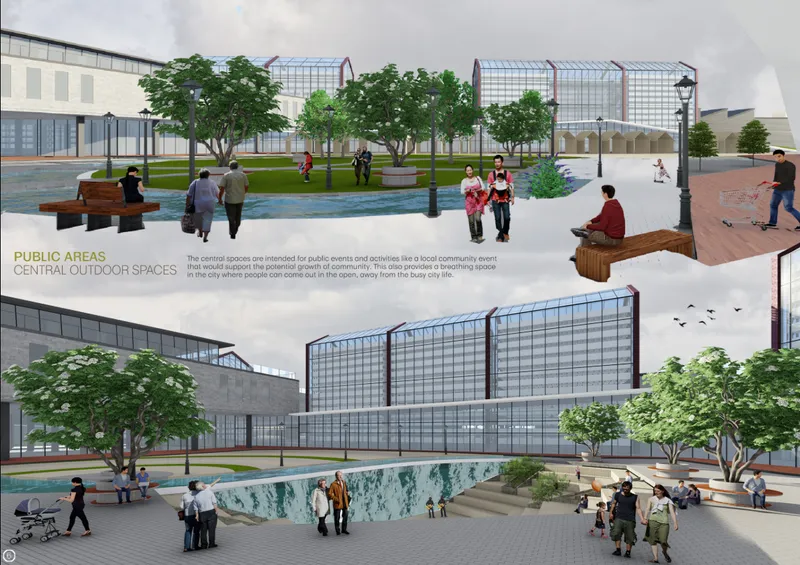
The final rendering shows what the project delivers at ground level: a generous public plaza where pedestrians gather beneath mature trees, with the arched greenhouse roofs rising behind them. Farming beds, water features, and shaded seating occupy these outdoor areas, giving residents a direct, tactile connection to the processes of growth and sustainability. Central plazas are designed for events, education, and everyday recreation, providing what Khadepaun describes as breathing space within the dense city.
The atmosphere here is deliberate. Rather than the polished blankness of a corporate plaza, the space reads as inhabited and productive. The farming beds are not ornamental; they are extensions of the vertical farming program brought to eye level. This continuity between interior growing environments and exterior public realm dissolves the barrier between agriculture and urban life, making the act of cultivation something communal rather than industrial.
Why This Project Matters
Growing Space succeeds because it refuses to treat urban farming as a standalone typology. By wrapping vertical agriculture into a wholesale market, research facility, and public park, the project demonstrates that food production gains social and economic traction only when it is embedded within existing patterns of commerce and community. The pentagonal complex does not ask Nine Elms residents to change their habits; it reorganizes the infrastructure they already depend on so that sustainability becomes a byproduct of daily life.
As a shortlisted entry in the Urban Meal Mine competition, Khadepaun's proposal offers a credible blueprint for how architecture can address food security without retreating into isolated techno-utopias. The strength lies in the sectional integration: farming modules above, distribution below, public life at grade, research threaded throughout. Each layer reinforces the others, creating a building that is productive in every sense of the word.
View the Full Project
About the Designers
Designer: Sana Khadepaun
Enter a Design Competition on uni.xyz
uni.xyz runs architecture and design competitions year-round that reward proposals with spatial conviction and real site intelligence.
Project credits: Growing Space by Sana Khadepaun Urban Meal Mine (uni.xyz).


Popular Articles
Popular articles from the community

Extended Shell: Retrofitting Kolkata's Balconies as Living Urban Thresholds
A modular retrofit system recovers the social and environmental intelligence of Kolkata's historic verandas for contemporary Park Street residents.
Manzana Morphosis: Stretching Barcelona's Grid into a Living Landscape for 2050
A radical reworking of the Eixample manzana turns density into a tool for generous public space, vertical ecology, and environmental performance.

Cloaked Colonization: A Mobile Underwater Habitat That Moves Like a Fish
Micah Abaya's shortlisted EHC Pacific entry reimagines ocean settlement as a dispersed network of self-sustaining architectural organisms.

Singing Woman: An Opera House That Performs Before the Curtain Rises
Ovidiu Cristian Pavel's conceptual opera house translates Estonia's choral identity into a sculpted waterfront landmark facing the Baltic Sea.

Similar Reads
You might also enjoy these articles

Play: Fragments of Their World: Remembered Architecture Rebuilt as a Modular Playground for Refugee Camps
Tom Gardner abstracts domes, arches and towers from the homelands of displaced families into a kit of child-scaled play parts for camp settlements.
REBIRTH: A Circular Settlement Where Afghan Widows and Their Children Rebuild Life Together
A shortlisted Resile entry turns the circle into a protective ring of timber and brick, gathering homes, classrooms and gardens around a shared landscape.
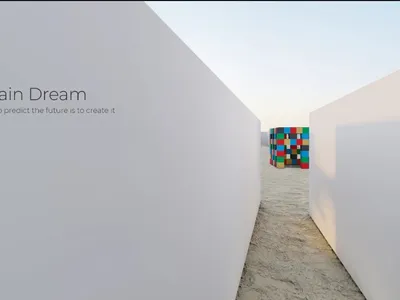
The Main Dream: A Recycled Plastic Kit That Lets Refugee Children Build Their Own Playground
Thirty-centimetre interlocking cubes that connect on three axes turn play into construction, letting children author the spaces they occupy.

Lunar Spiral: A Fibonacci-Driven Moon Settlement Rising from Shackleton Crater
Golden-spiral geometry organises buried infrastructure and orbiting habitable spheres into a lunar base designed to grow as life on the Moon expands.

Comments (0)
Please login or sign up to add comments
No comments yet. Be the first to comment!