
Guča arch Helicopters a CLT Cabin onto a Swiss Cliff above Lake Uri
A 71-square-meter reconstruction in Canton Schwyz hides contemporary ambition behind a vernacular facade on a roadless Alpine slope.


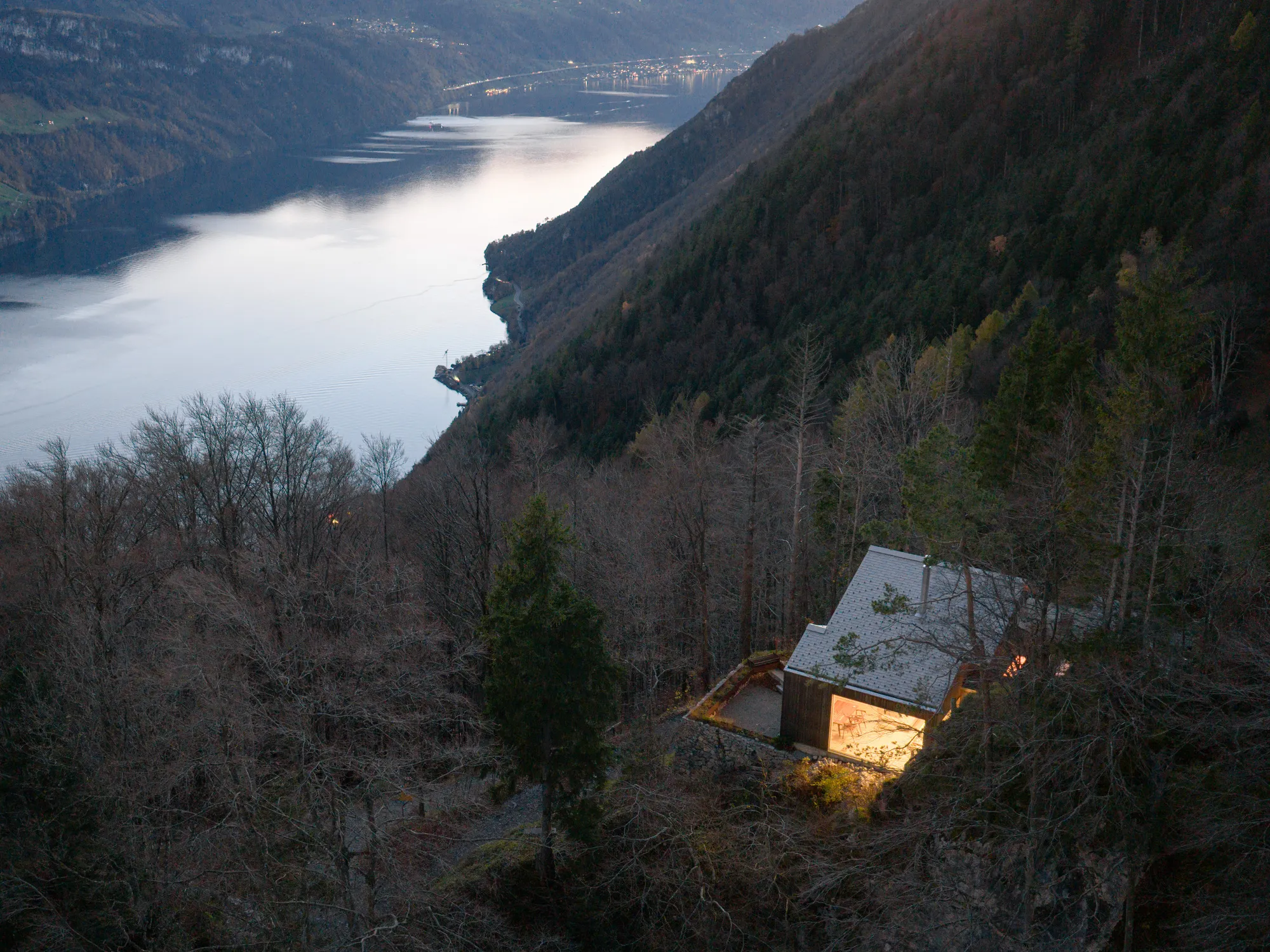
Some sites resist building altogether. The steep, roadless slope above the town of Brunnen in Canton Schwyz, overlooking Lake Uri and bordered by a protected bird sanctuary and the Stockflue climbing cliff, is one of them. When Bratislava-based Guča arch was brought in to renovate a deteriorating log and stone cabin here, the brief was modest: a light touch on an existing structure. Then the timber core was found to be structurally unsound, and the project became something far more complex. What emerged in 2025 is a full-scale reconstruction that had to obey the original footprint and height, satisfy rigorous heritage glazing ratios on publicly visible facades, and still deliver the open, landscape-immersed living space the clients wanted.
The answer is a building that performs two identities simultaneously. From the public hiking paths above and below, the cabin reads as unremarkable: stone, rough plaster, timber cladding, a pitched metal roof. Step inside, and the ruse collapses. Floor-to-ceiling glazing opens toward the inaccessible forest canopy where no one will ever walk, a freestanding concrete sculpture doubles as fireplace and staircase anchor, and sleeping quarters slide beneath grade, lit by walk-on skylights. Every CLT panel and steel component was prefabricated off-site and flown in by helicopter, because there is simply no road. The logistics alone make the project exceptional. The architecture makes it worth studying.
A Site That Demands Stealth

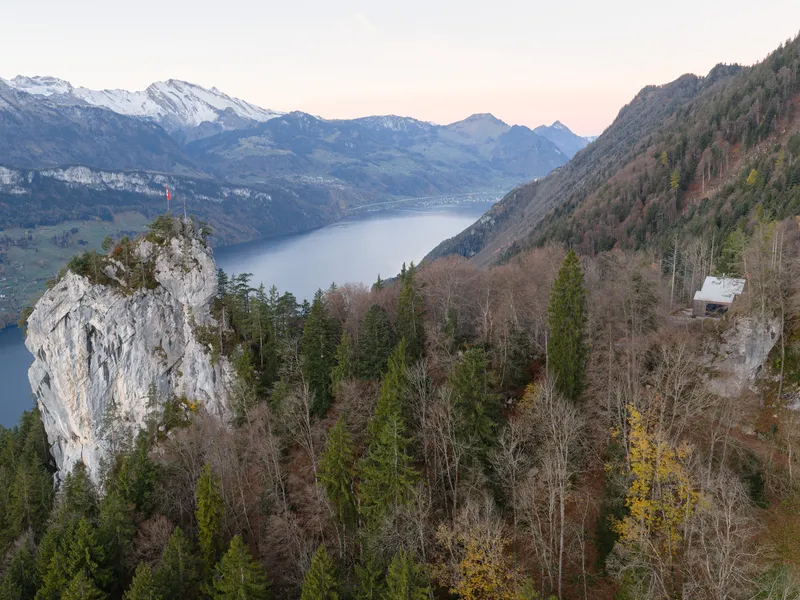

Seen from the air or from across the lake valley, the cabin barely registers. A gravel clearing among bare deciduous trees and dark conifers on a precipitous mountainside, a pitched roof catching the last light. That near-invisibility is the whole point. Canton Schwyz enforces strict controls on buildings within its Alpine heritage landscape, limiting glazing ratios on facades visible from public areas and requiring new construction to respect what the Swiss call genius loci: the spirit of the place.
Guča arch turned the constraint into a spatial strategy. The largest glass surfaces face the steep slope below, which is inaccessible to the public, while the elevations seen from hiking paths and the town present stone, timber, and restrained openings. The building appears ordinary from every angle that matters to the planning authority, and extraordinary from the only angle that matters to the occupants.
Stone, Concrete, and the Logic of the Terrain


The cabin's material palette follows a clear hierarchy tied to ground contact. Where the building meets the slope, reinforced concrete and dry stone retaining walls absorb the forces of the terrain. A gabion wall along the uphill edge and rough concrete steps negotiate the grade change between the entry and the main volume. Above this mineral base, the structure transitions to CLT panels and a wooden frame clad in vertical timber boards, capped by untreated Corten steel and corrugated metal roofing.
The transition from heavy to light is not just visual. It reflects the structural logic of building on a slope this steep: anchor hard at the base, keep the upper volume as light as possible. The Corten steel, left to weather naturally, will darken over time to match the bark of surrounding conifers. The stone base already looks as though it has been there for decades. The building is calibrated to age into its context rather than stand apart from it.
Three Zones Carved from the Slope

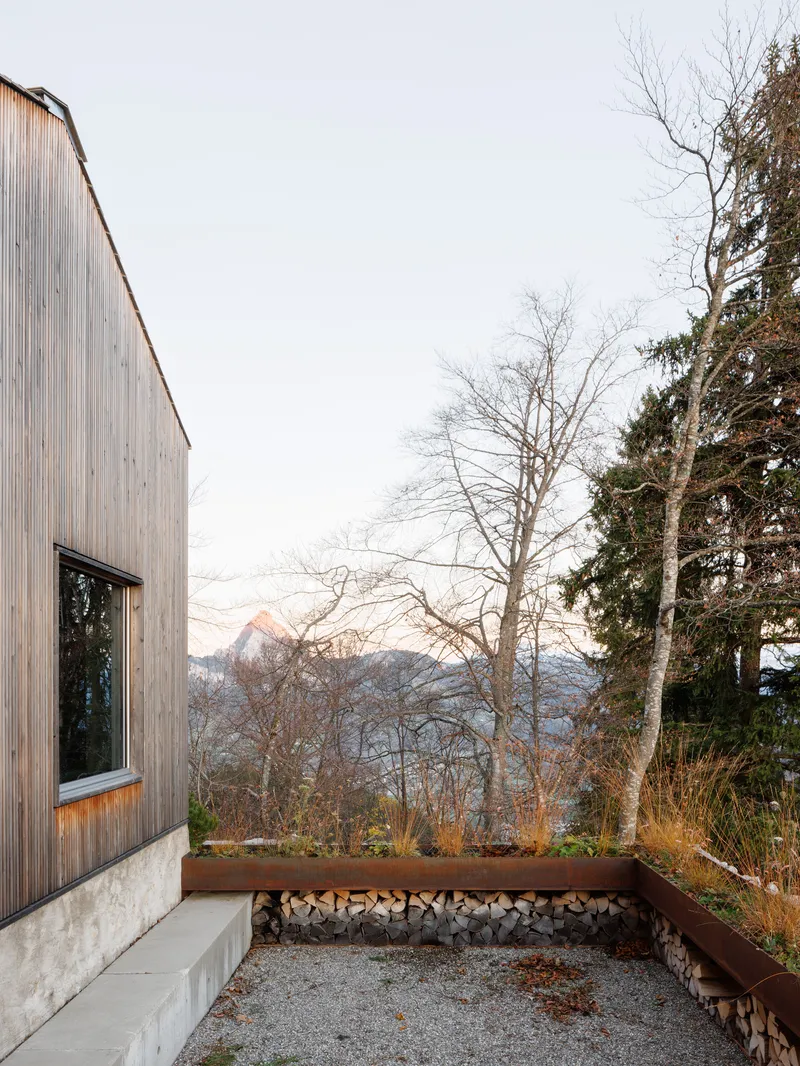

The terrain's natural morphology divides the program into three distinct zones. At the center sits the entry, where concrete steps arrive at a door set into a curved stone wall. To the south, a social area is recessed into the hillside, anchored by an exterior terrace with a raw concrete fireplace and a single chair facing the mountain ridges. To the north, a standalone exterior sauna volume mirrors the geometry of the main house, its corrugated metal roof emerging above the rocky outcrop like a geological echo.
The courtyard between these volumes, paved in gravel with a concrete bench and a Corten planter, acts as a decompression space. You arrive by foot, having climbed the slope without road or vehicle, and the courtyard slows you further before you enter. The architecture choreographs a transition from the exertion of the approach to the stillness of the interior.
The Concrete Sculpture at the Core
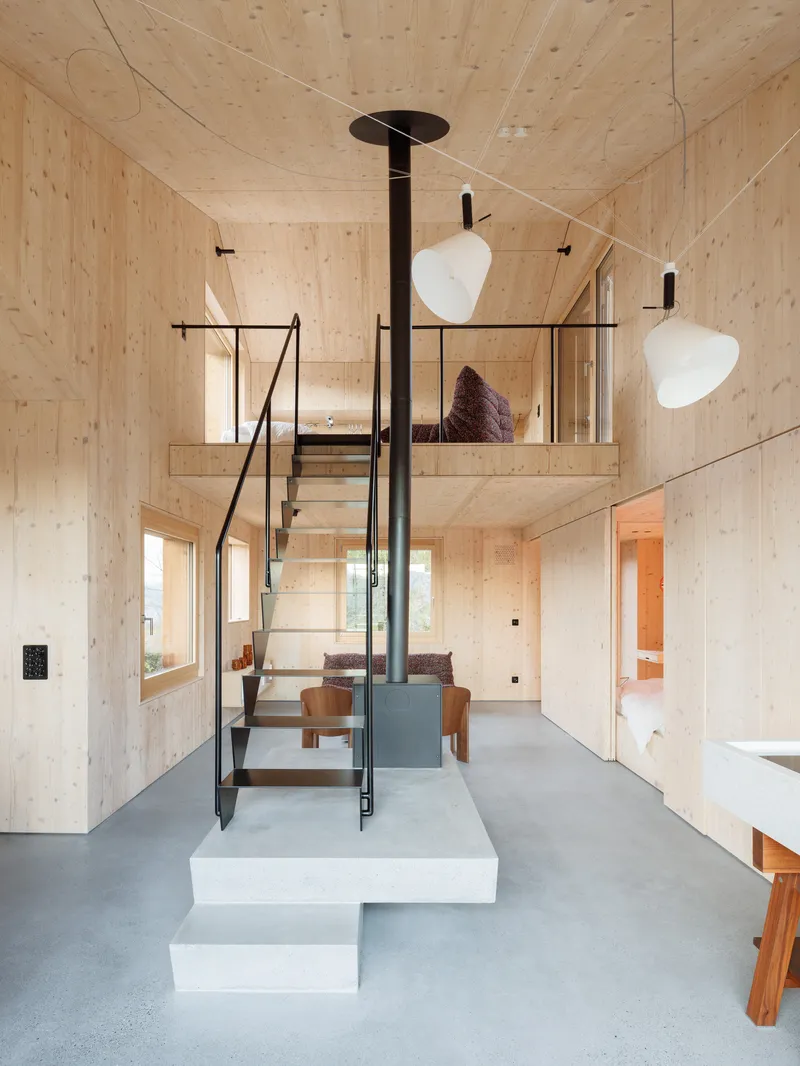
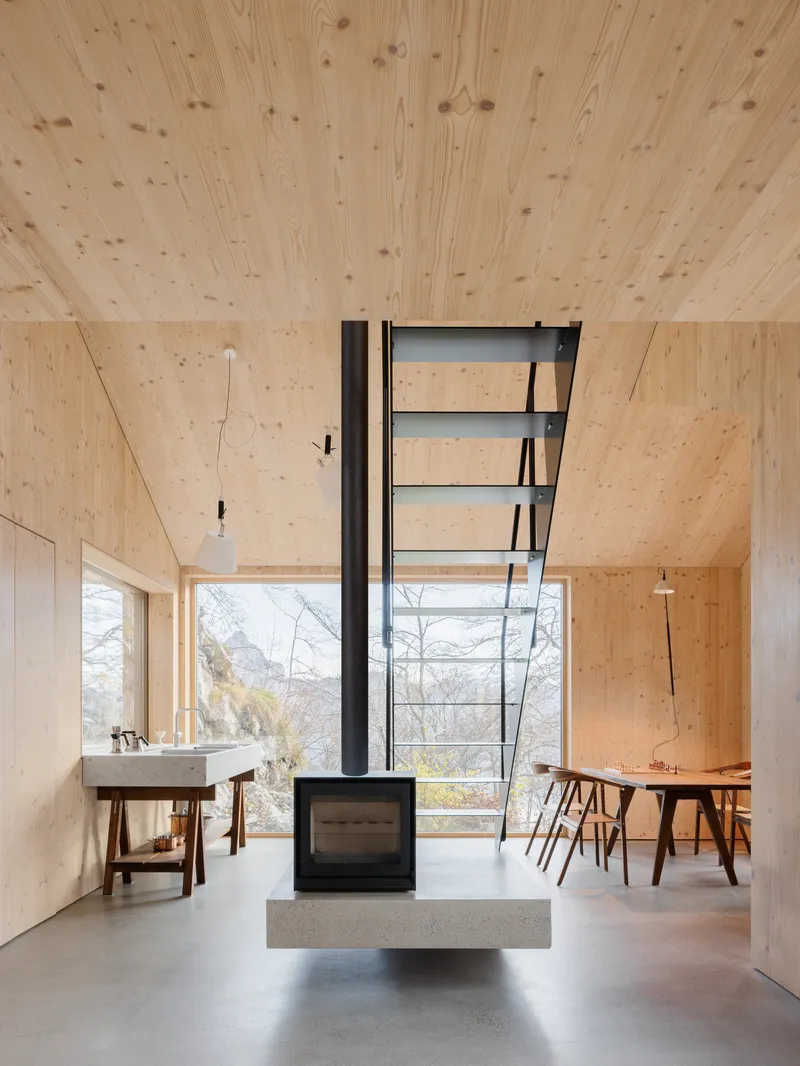
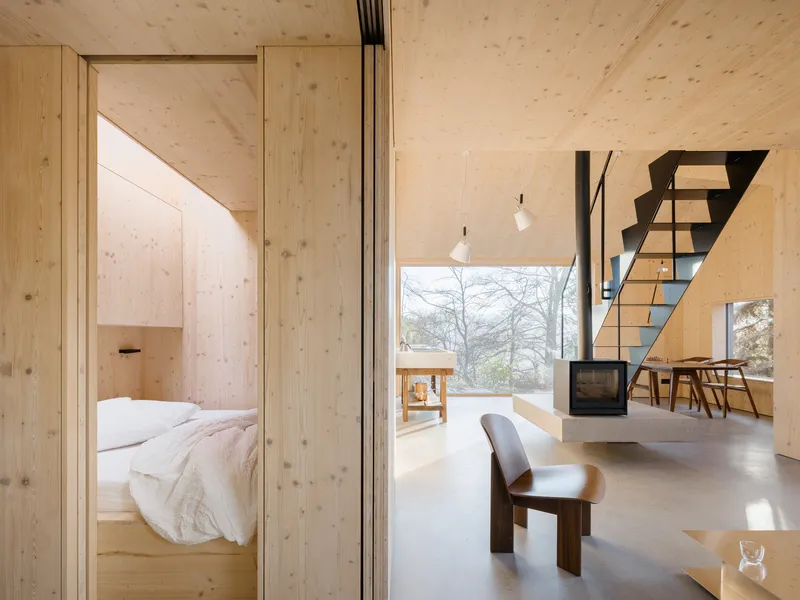
Inside, only one element is truly fixed: a central concrete sculpture that houses the fireplace and supports the steel staircase rising to the sleeping loft. Everything else in the 71-square-meter plan is open, flexible, and reconfigurable. The stove's black flue pipe runs vertically through the double-height space, marking the center of gravity around which living, cooking, and sleeping rotate.
Guča arch treats this element as both infrastructure and art object. It is structural (it carries the stair), mechanical (it heats the space), and spatial (it divides without enclosing). The folded steel staircase with its triangular cutout treads wraps around the flue in a compact spiral, its powder-coated black finish forming a graphic counterpoint to the pale plywood walls and ceiling. In a cabin this small, the stair cannot be a neutral connector. Here it is the building's spine.
Living with the Forest Canopy


The interior's real material is light filtered through bare winter branches. Floor-to-ceiling windows on the slope-facing elevation frame an exposed rock face, dense conifers, and distant ridgelines, turning the living room and kitchen into a continuous observation deck. The kitchen sink sits on timber trestles directly in front of the glass, so that the most mundane domestic act becomes a moment of contact with the landscape.
Pale timber paneling on walls and ceiling amplifies available daylight and gives the compact interior a sense of spatial generosity it does not technically possess. Suspended pendant lamps provide focused task lighting in the evening, but during the day, the cabin runs almost entirely on natural light. The glazing strategy, constrained by heritage rules on the public facades, concentrates all its ambition on the side facing the inaccessible forest. Privacy is guaranteed by topography, not by curtains.
Sleeping Below Grade
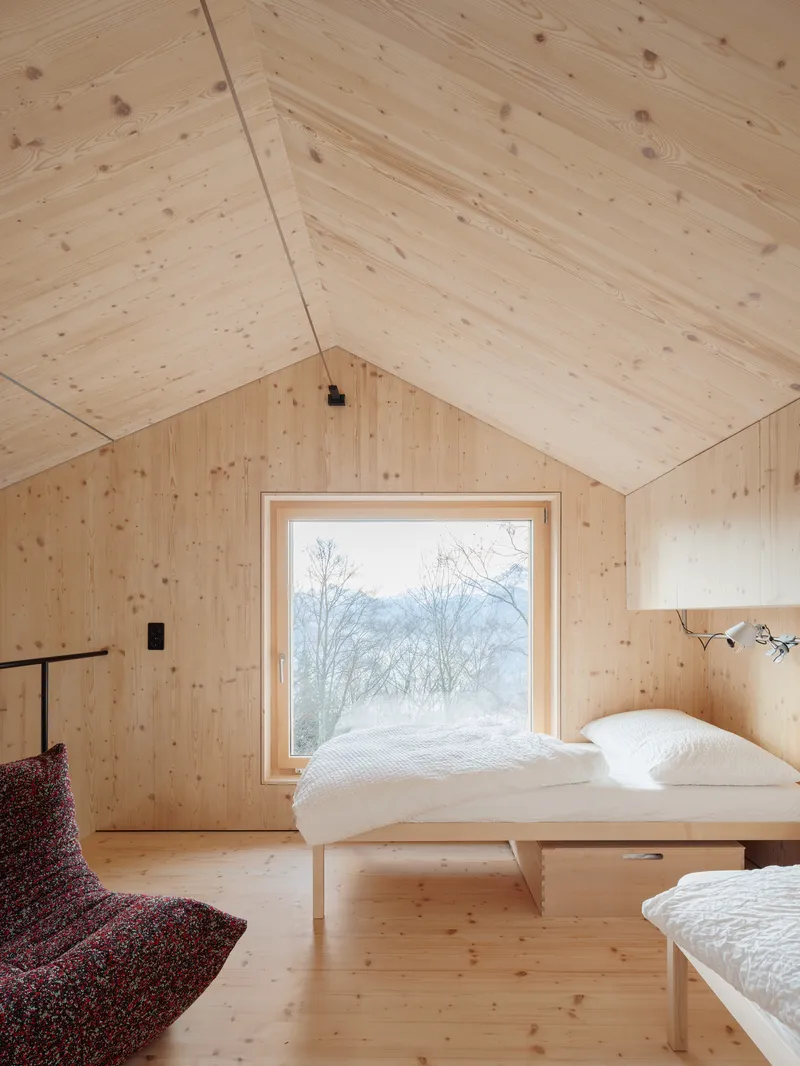
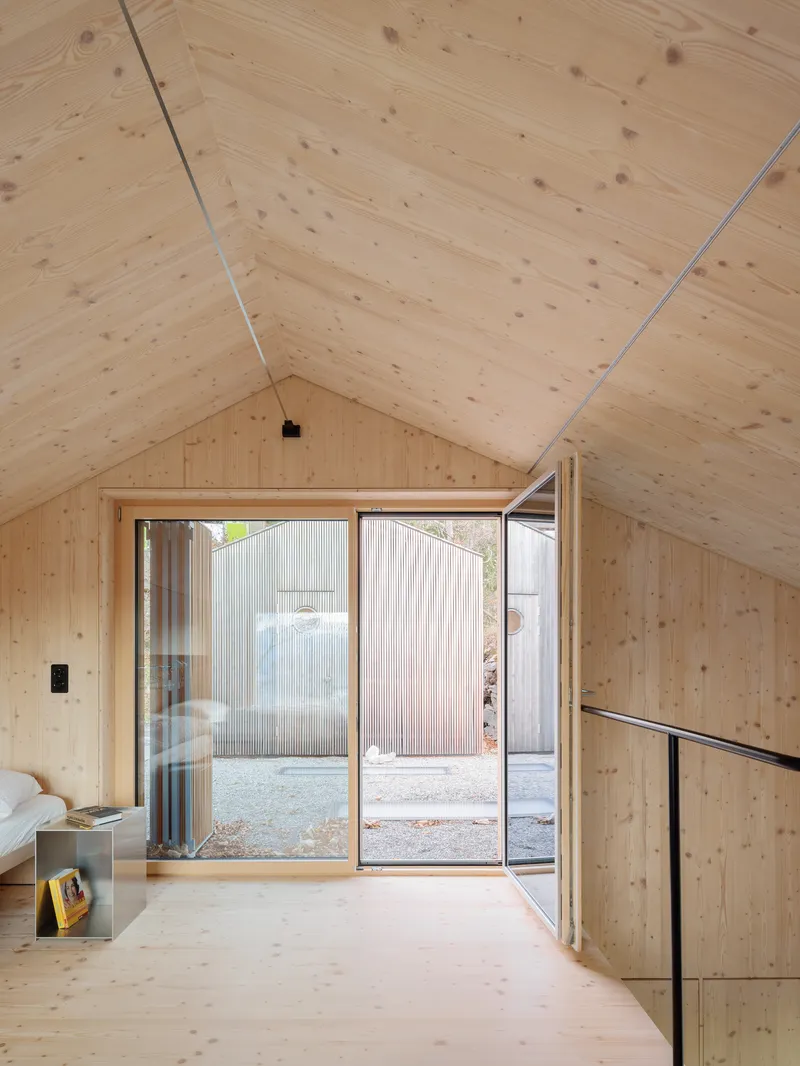
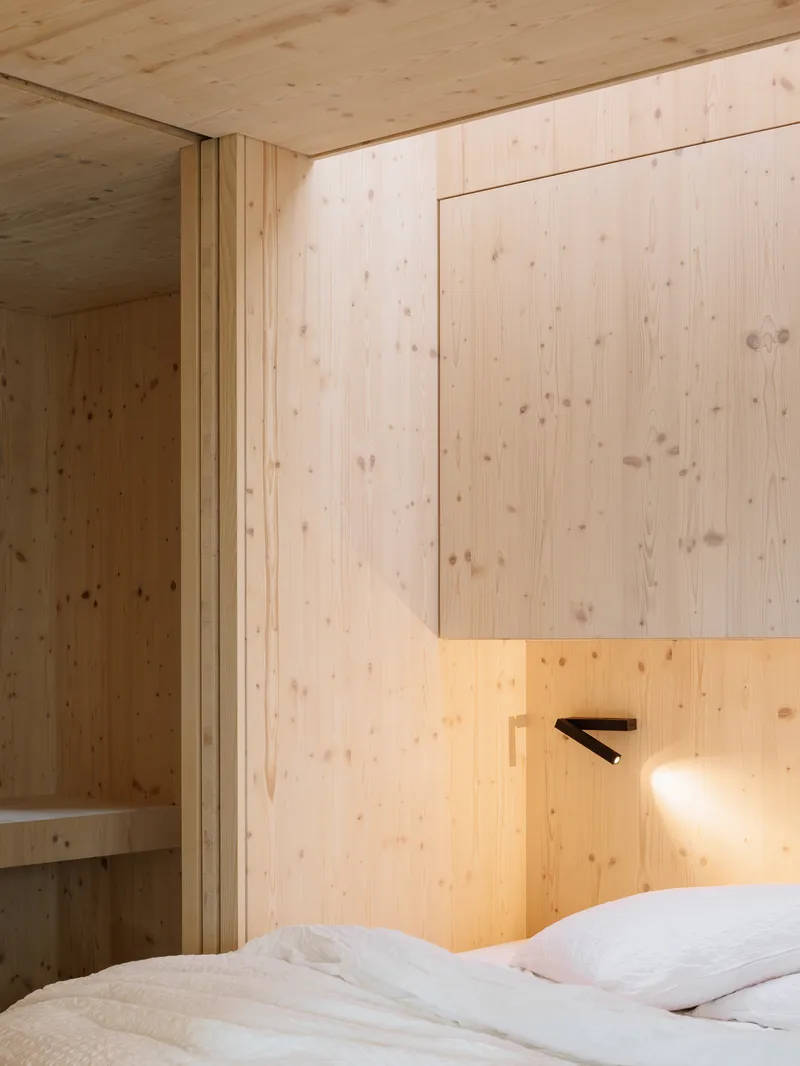
The sleeping quarters are partially recessed into the hillside, a decision that keeps the building within its mandated height while creating a quieter, more enclosed atmosphere for rest. A platform bed faces a single window that frames bare trees and snowy hills, reducing the panorama to a precise vignette. Sliding walls allow the bedroom to be isolated from or integrated with the living space above, giving the cabin a flexibility unusual for its size.
Walk-on skylights embedded in the upper terrace bring daylight into these lower rooms, so that even the most earth-sheltered spaces never feel subterranean. The loft level opens through sliding glass doors to a small courtyard enclosed by corrugated metal walls, a private outdoor room at sleeping level. The vertical timber paneling, recessed storage niches, and wall-mounted reading lights suggest that the architects spent as much time on the detailing of these intimate spaces as on the dramatic double-height living room.
Material Details and Craft


Throughout the cabin, a handful of materials recur with discipline: pale plywood, black powder-coated steel, terrazzo flooring, white plaster, and untreated timber. The stair treads, punched from folded steel plate, are a small piece of industrial sculpture. The sliding timber slat screens on the exterior operate on steel tracks, offering adjustable privacy and solar control without the visual weight of shutters.
The terrazzo floors in the bathroom and at the stair base provide a durable, easy-to-clean surface that reads as modern without feeling clinical. A compact bathroom with a skylight, round mirror, and exposed timber ceiling demonstrates that even the smallest rooms received considered spatial treatment. When every component must be fabricated in a distant workshop and flown to the site by helicopter, precision in detailing is not optional. It is the only way the building gets built.
Plans and Drawings
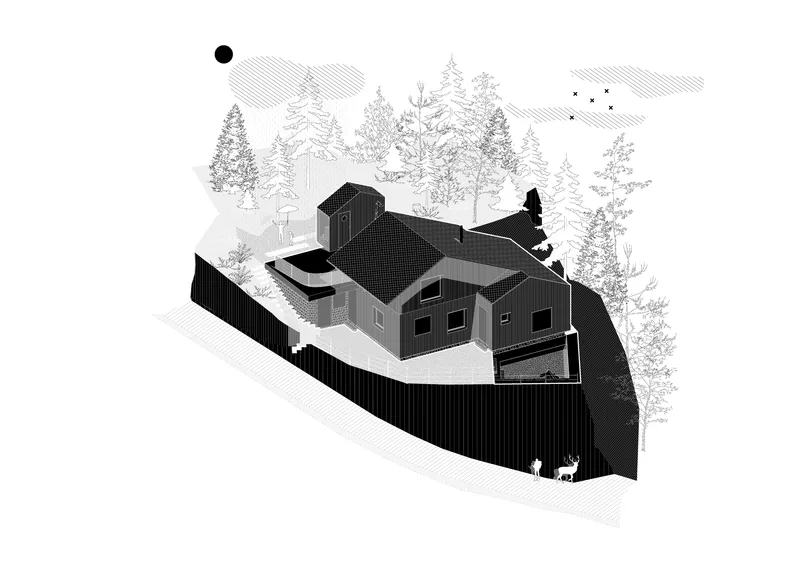
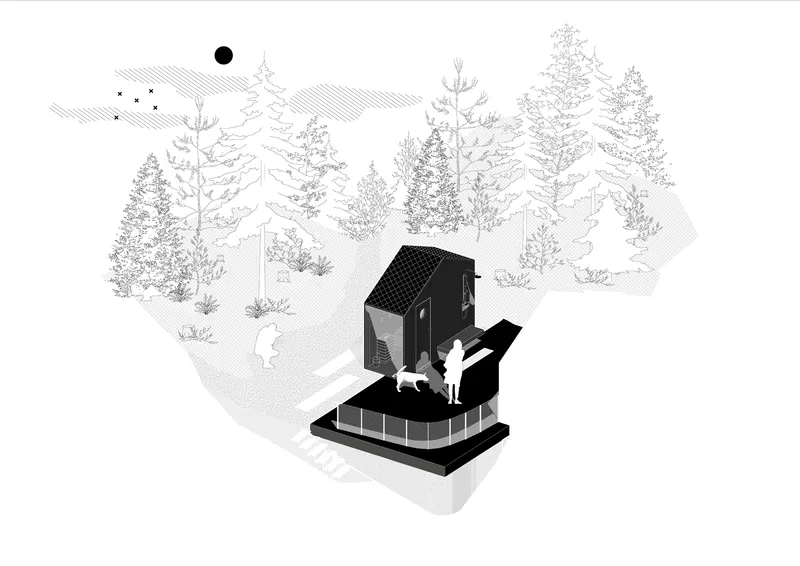
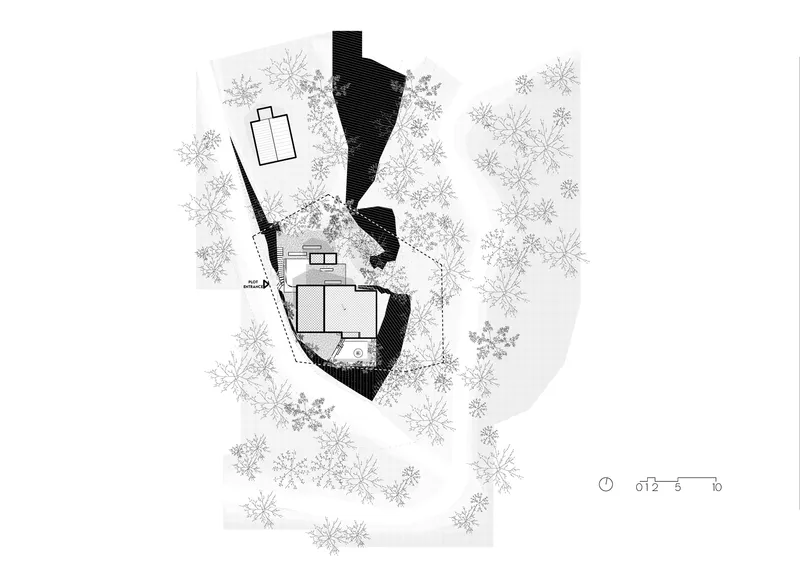

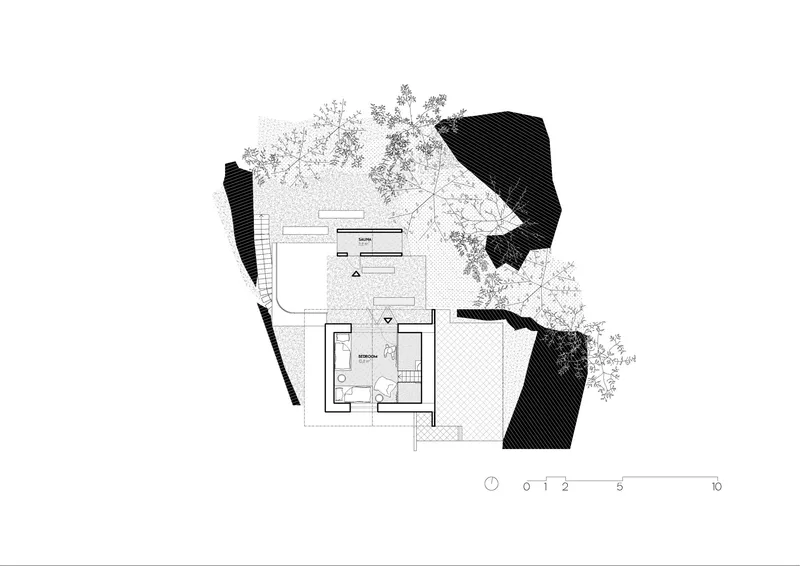
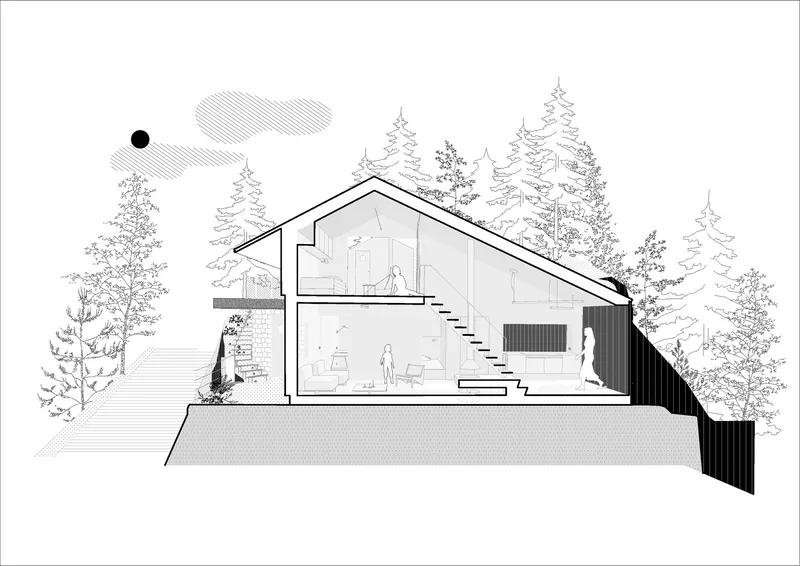
The axonometric drawing reveals how the clustered volumes sit on the slope like stones that rolled downhill and stopped, each rotated slightly to follow the terrain's contour. The site plan confirms the absence of any road or vehicular access, underscoring the logistical extremity of the project. Floor plans show the open living space on the main level and the bedroom wing above, both wrapped tightly around the central stair core, with the pool terrace extending into the landscape. The section drawing is perhaps the most telling: it exposes how deeply the building is embedded in the hillside, with the double-height living space opening outward while the sleeping quarters tuck into the earth.
Why This Project Matters
The Swiss Alpine Cabin Reconstruction demonstrates that heritage constraints and contemporary spatial ambition are not opposing forces. Guča arch accepted every limitation imposed by Canton Schwyz's building codes, the original footprint, the height restriction, the glazing ratios on public facades, and used each one as a design generator. The result is a building that satisfies regulators from the outside and surprises its occupants from within. That dual reading, vernacular shell over modern interior, is an old strategy, but the execution here is unusually rigorous and site-specific.
More broadly, the project is a case study in remote construction logistics. Helicopter-delivered prefabricated CLT panels, a reinforced concrete base poured in place on a roadless slope, Corten steel left to self-finish: every material and method was chosen to minimize on-site labor and maximize off-site precision. As climate and regulation push building into increasingly difficult terrain, the strategies tested here will become standard practice. This 71-square-meter cabin on a cliff above Lake Uri is a prototype for a kind of architecture we will need much more of.
Swiss Alpine Cabin Reconstruction by Guča arch. Ingenbohl, Canton Schwyz, Switzerland. 71 m². Completed 2025. Photography by Matej Hakár.
About the Studio
Share Your Own Work on uni.xyz
If projects like this are the kind of work you want to make, uni.xyz is a place to publish your own, find collaborators, and enter design competitions.


Popular Articles
Popular articles from the community


Hill & Cross Opera: Sculptural Opera House Architecture Shaped by Tallinn’s Landscape and Identity
Hill & Cross Opera reimagines opera house architecture in Tallinn through its sculptural hill, civic plaza, glass wave and a luminous cross.

AL-JANNAH: Sustainable Architecture and Permaculture for Afghan Widows
AL-JANNAH uses sustainable architecture and permaculture to create resilient oasis of housing, learning, work and renewal for Afghan widows.

Co-life: Sustainable Architecture for Age-Friendly Community Living
Co-life reimagines sustainable architecture for seniors through courtyards, rammed earth, shared gardens, and spaces designed for belonging.

Riyadh For All: Intergenerational Urban Design for Active Aging in Rabat
Riyadh For All reimagines urban design in Rabat with intergenerational co-living, adaptive courtyards, and Moroccan cultural exchange today.
Similar Reads
You might also enjoy these articles

Bao Huynh Watercolor Atelier: A Serene Art Retreat in Hội An
Bao Huynh Watercolor Atelier in Hội An blends multifunctional art spaces, sustainable design, local materials, and family-friendly living in a serene environment.

Atelier Macri Concept Store Interior Design by CASE-REAL
Atelier Macri store features a "ko" counter, walnut wood details, cork displays, blending retail, gallery, and seamless customer experiences.

Manuel Vargas Izquierdo Stadium and High-Performance Sports Center: Architectural Excellence in Jalpa de Méndez
The Manuel Vargas Izquierdo Stadium blends sustainable design, inclusive sports facilities, and cultural-inspired architecture, revitalizing Jalpa de Méndez’s public spaces.
KAKR Buluh Awar Hall: Revitalizing Community and Ecology Through Bamboo Architecture
Community built bamboo hall revitalizes Buluh Awar village, empowering youth, restoring ecology, celebrating vernacular craftsmanship through sustainable architecture and culture.


Explore Residential Building Competitions
Discover active competitions in this discipline


Challenge to design mud housing for contemporary communities


Design challenge to reuse E-waste
Comments (0)
Please login or sign up to add comments
No comments yet. Be the first to comment!