
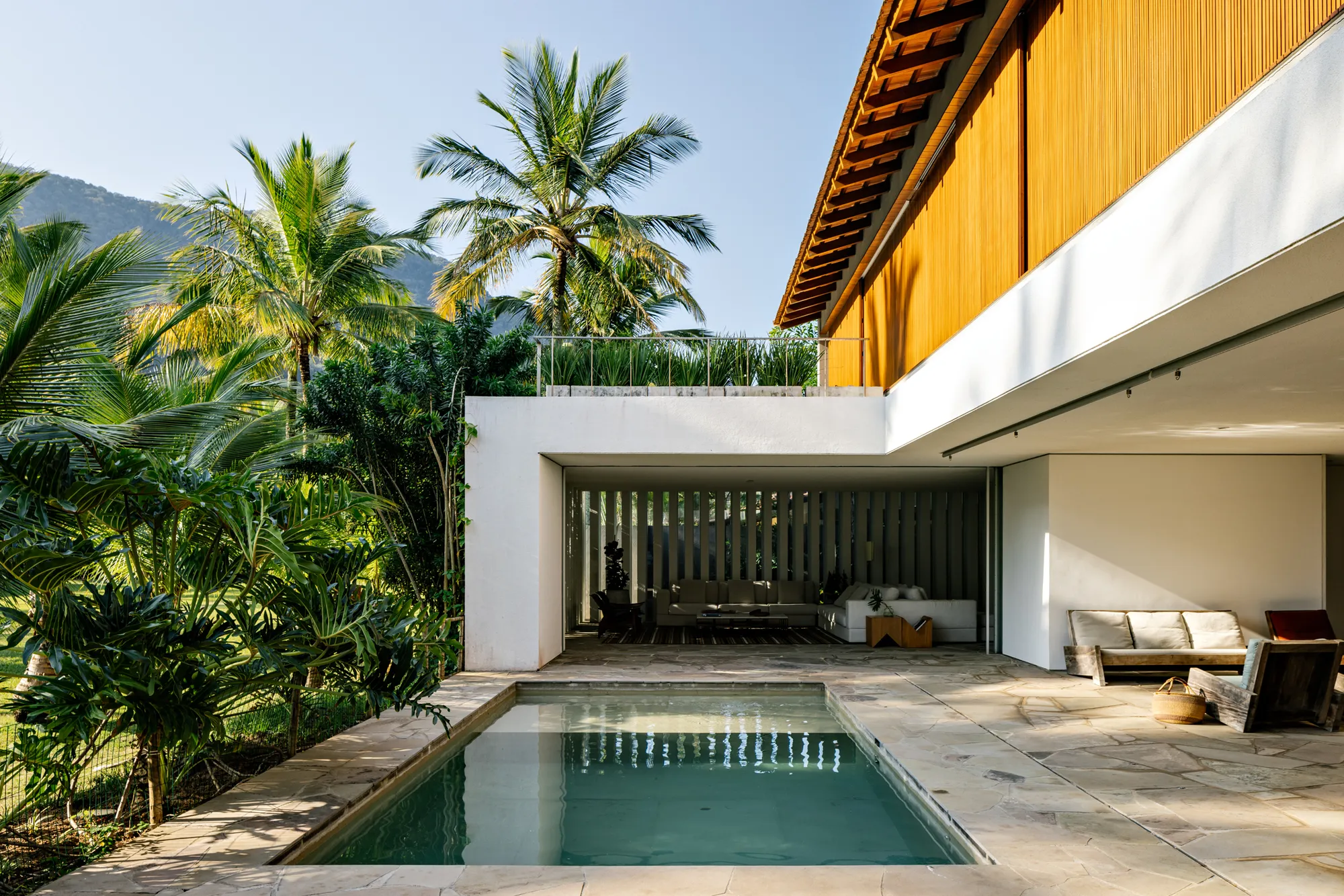
Gui Mattos Wraps a Coastal Family Home Around a Sunlit Pool Terrace in São Sebastião
A U-shaped concrete and timber house on the Brazilian coast uses tall vegetation and cantilevered volumes to balance openness with privacy.


Designing a beach house that feels both generous and private is a harder trick than it sounds. At Guaecá, a coastal strip backed by the Serra do Mar mountains near São Sebastião, Gui Mattos confronted a site pinched between two access roads, one vehicular and one pedestrian, inside a condominium with constant foot traffic. The response is a two-story house arranged in a U-shaped plan that opens toward the sea while screening its occupants from passersby with tall vegetation and carefully positioned walls. The result is a home that reads as generous and relaxed from the inside yet reveals almost nothing to the casual observer on the path.
What makes this project worth studying is less the formal gesture than the material palette and the way it handles climate. The ground floor is organized as a loose triangulation of living, dining, and kitchen spaces that merge into one continuous social zone, all paved in organic basalt and covered by timber ceilings that compress and release as the roof pitch changes. Upstairs, bedrooms occupy a cantilevered volume clad in timber slats on its north face, creating two private terraces that look inward rather than out. Lead architects Riccardo Buso, André Delmanto, Tiago Mestre, and Raquel Palmieri treated the house as two overlapping registers: one extroverted and collective, the other introspective and cozy, stitched together by material warmth.
A Timber Screen Against the Landscape
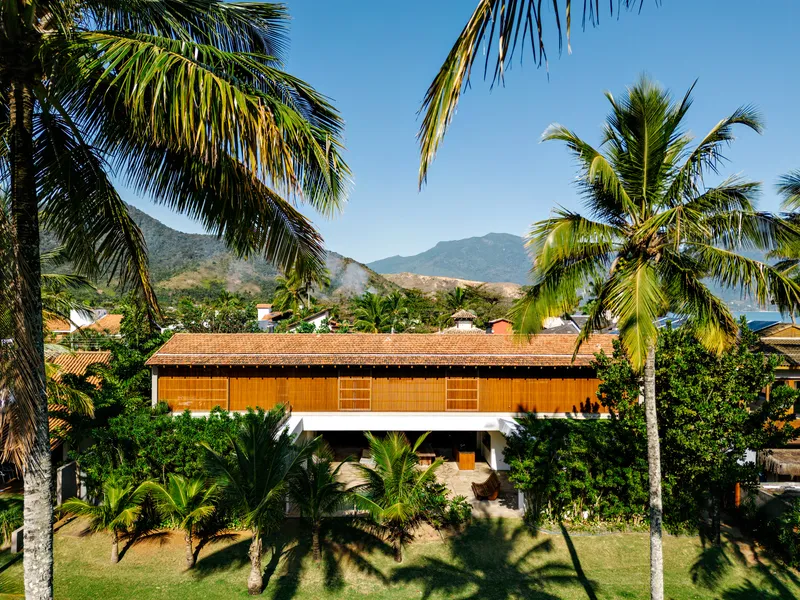
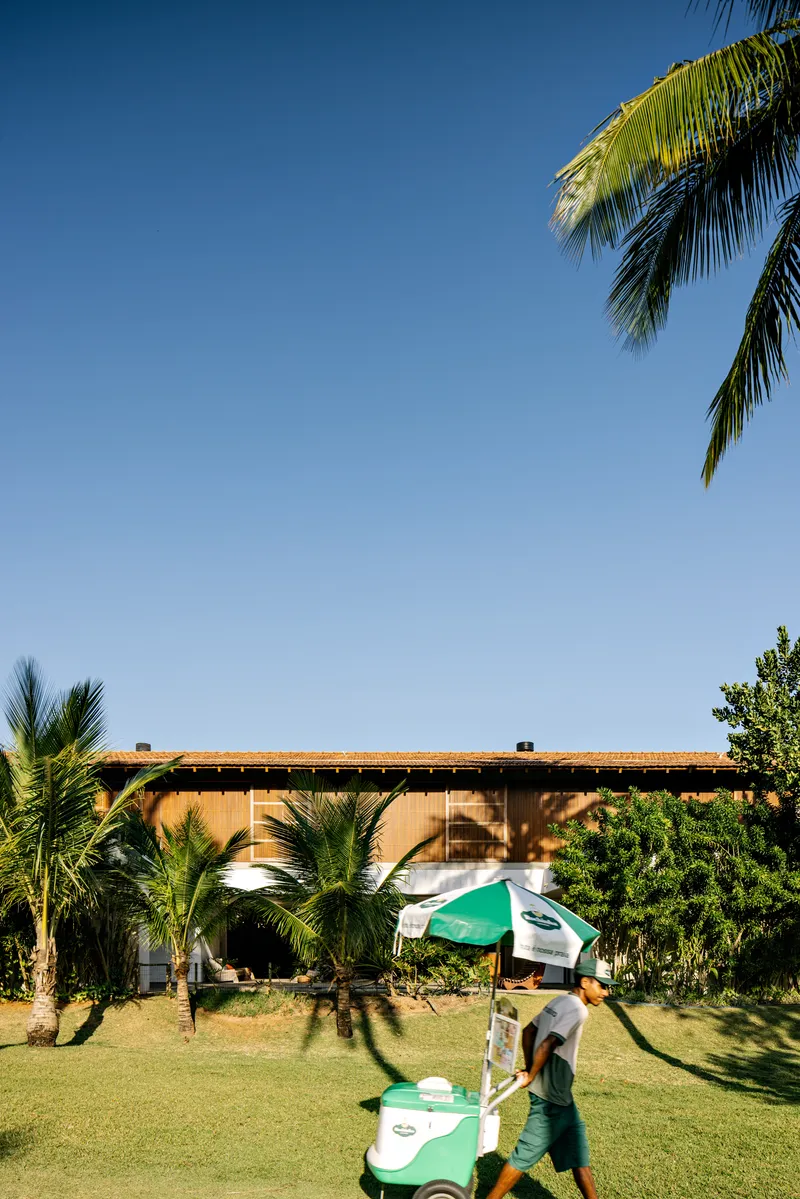
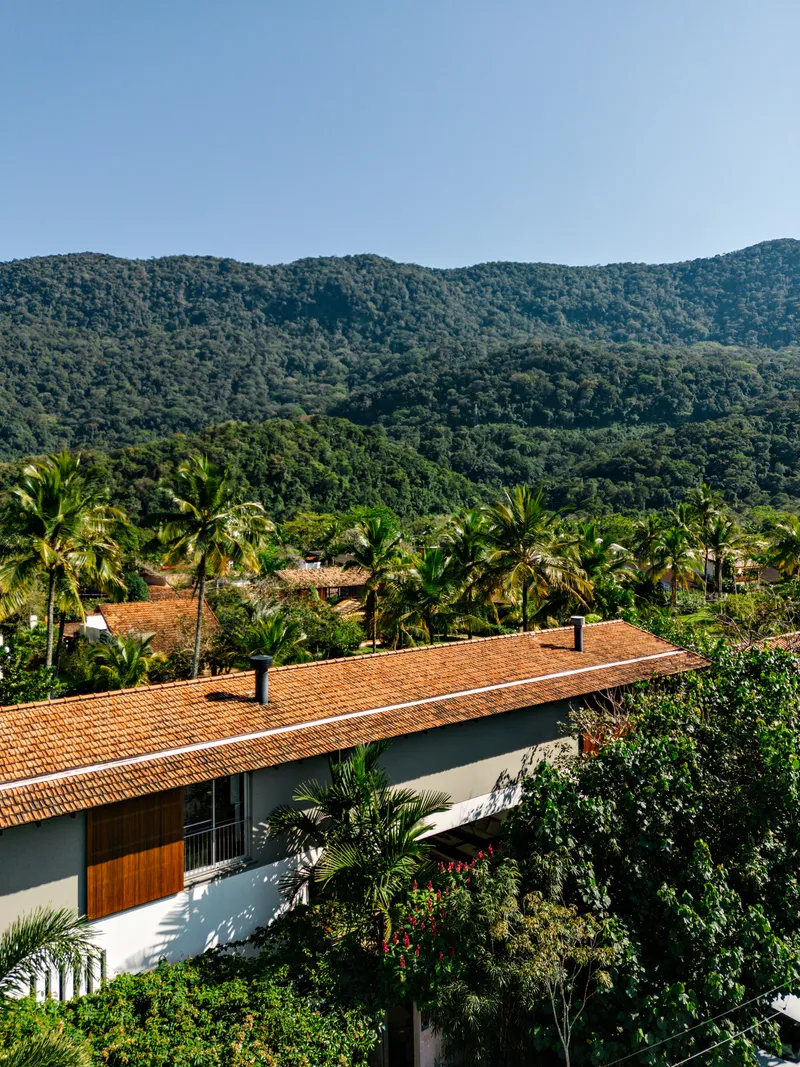
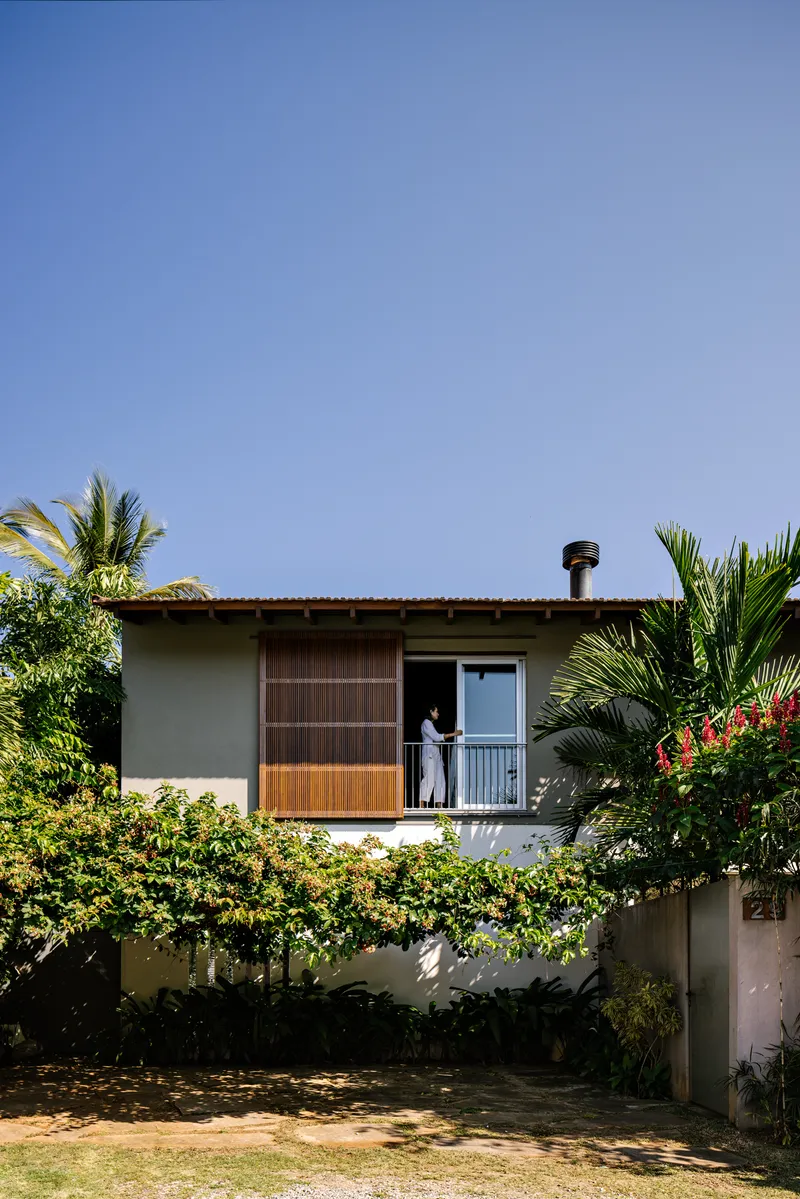
From the approach, the house reads as a long, low pavilion crowned by terracotta tiles and fringed by palms. Horizontal timber screening wraps the upper floor, its rhythm loose enough to let coastal breezes pass while diffusing direct light into the bedrooms behind. The choice of terracotta on the roof and warm timber on the facade grounds the building in a regional vernacular, yet the proportions are unmistakably modern: a shallow pitch, knife-edge eaves, and a cantilevered upper volume that hovers over the garden.
Against the backdrop of forested mountains, the house does not compete. It sits low, bracketed by existing trees that the design team evidently took pains to preserve. The tall vegetation is not just decorative; it is the primary privacy device, replacing walls and fences with a green buffer that shifts with the seasons.
The Pool as Organizing Element
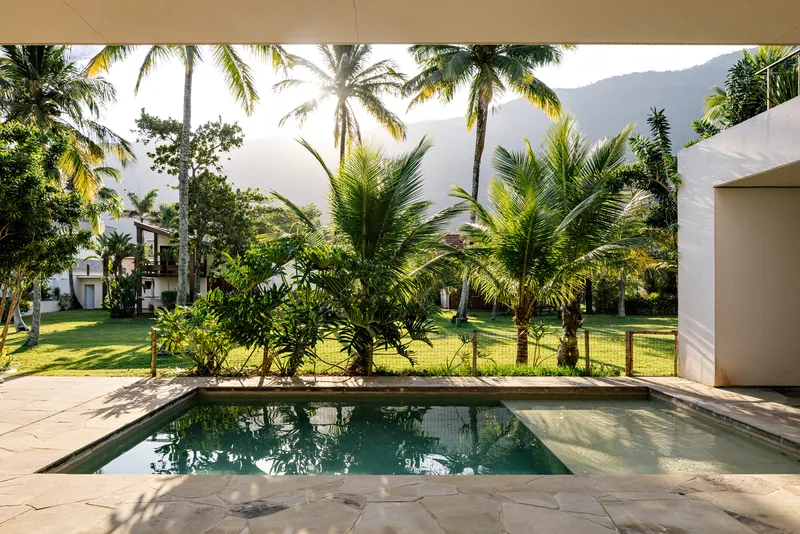
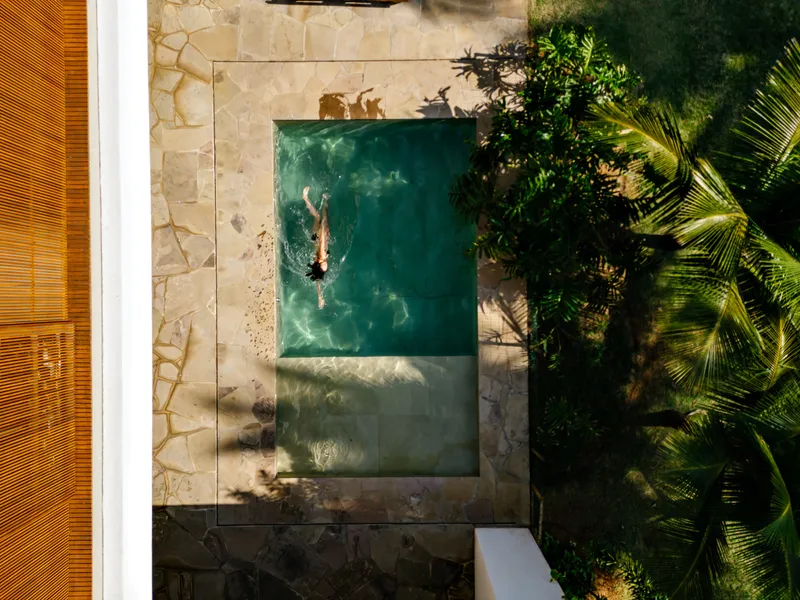
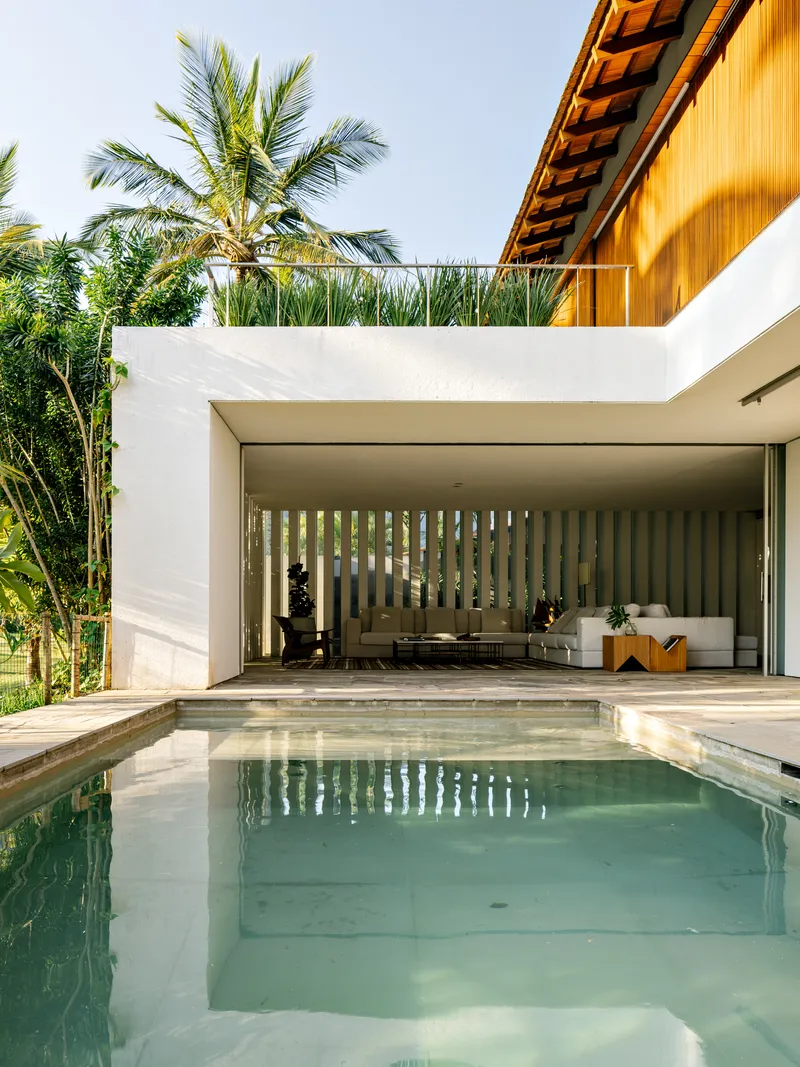
The rectangular swimming pool does more spatial work than most pools manage. Positioned at the center of the U, it anchors the ground-floor plan and draws the living spaces outward toward the light. Sandstone paving wraps around it, creating a continuous terrace that can serve a dozen people or feel intimate for two. The pool's east-west orientation catches afternoon sun, while the palm grove beyond screens it from direct views off the neighboring road.
From above, the geometry is clearest: pool, paving, and planted strips form a clean rectangle that contrasts with the organic scatter of palm trunks. The material transition from basalt indoors to sandstone outdoors is handled without ceremony, a subtle shift in texture that reinforces the sense of continuous ground plane.
Terraces and Thresholds
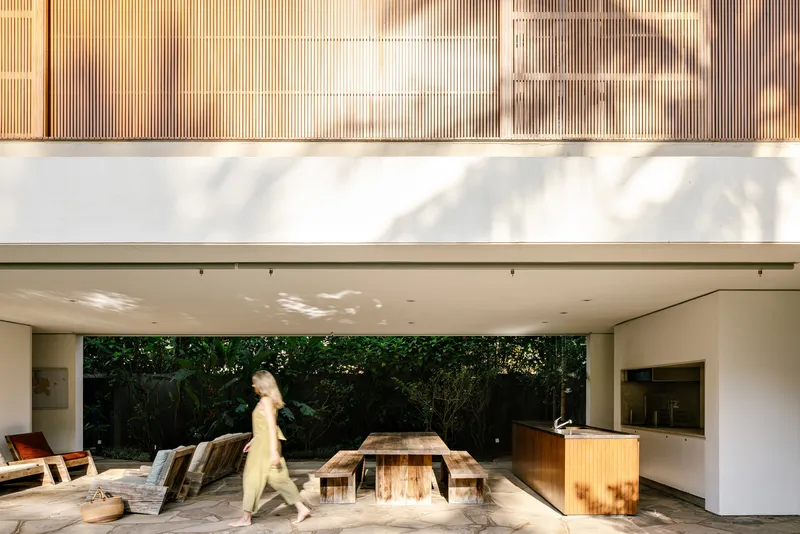
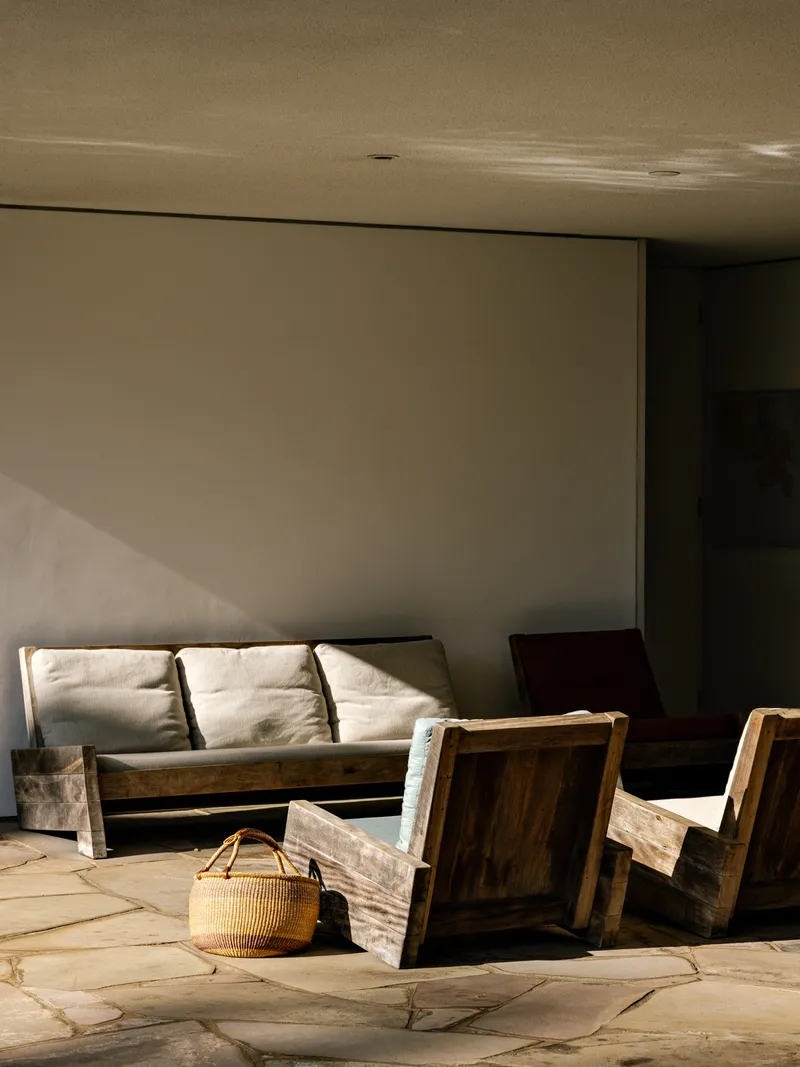
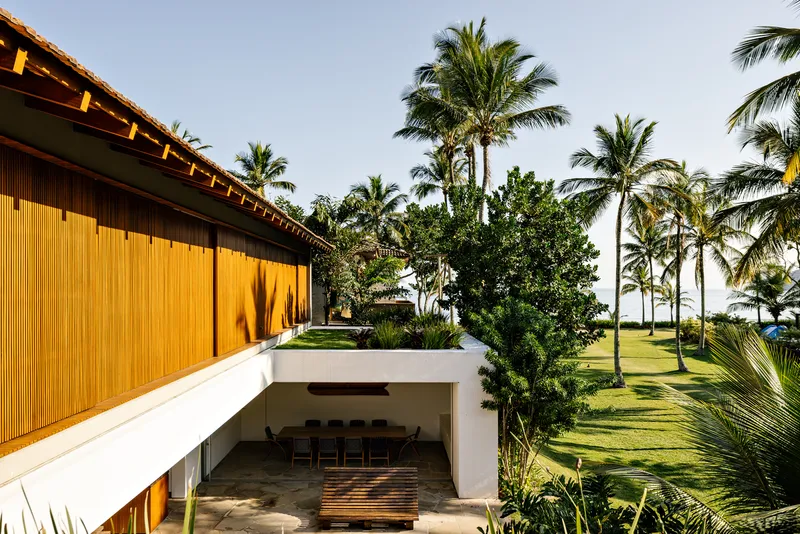
Gui Mattos treats the covered terrace not as a leftover zone but as the heart of the house. A long timber dining table sits beneath deep eaves, shaded by the upper volume that projects outward on slender supports. The effect is a room without walls: protected from rain, ventilated by cross-breezes, and visually continuous with the pool terrace. Reclaimed timber lounge chairs on irregular stone paving give an adjacent outdoor sitting area a more rugged, casual character.
Upstairs, the private terraces are a different proposition entirely. Enclosed by vertical timber cladding and planted shrubs, they offer glimpses of the garden below without exposing the bedrooms to the public path. The detail of the metal railing behind planted screens is smart: the greenery will thicken over time, turning the balconies into leafy alcoves.
Ground Floor: Integrated Living
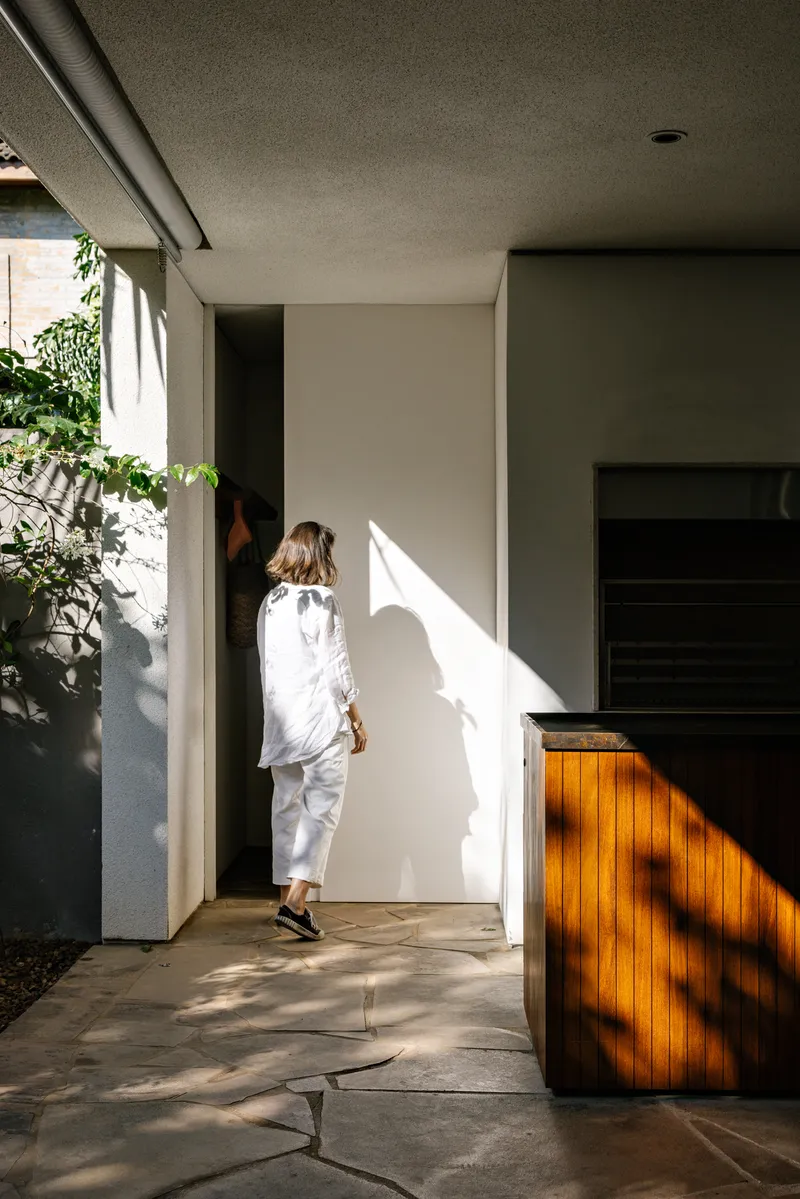
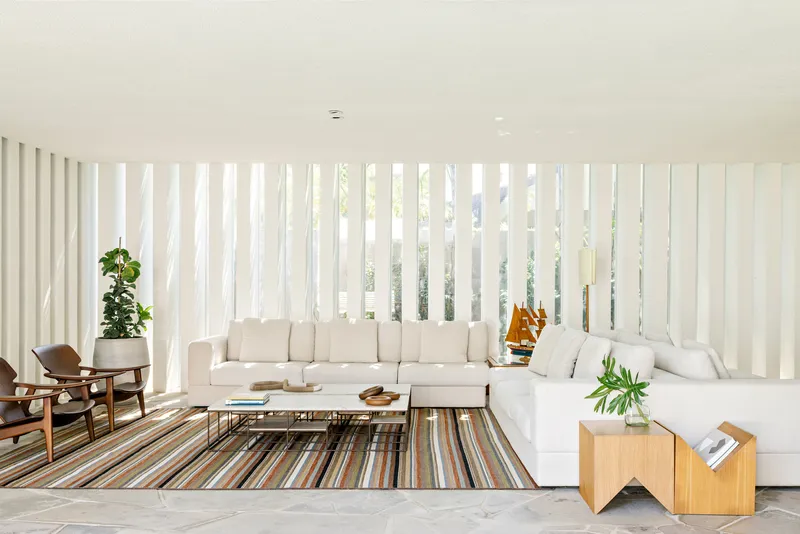
Step inside and the ground floor unfolds as a single flowing space. An entry corridor lined with timber-clad counters and a planted courtyard transitions into the main living area, where vertical white louvres filter eastern light onto grey marble flooring. The louvres are doing double duty: they control glare from the morning sun while creating a rhythmic shadow pattern that changes through the day. It is one of the project's most photogenic moments, but also one of its most functionally resolved.
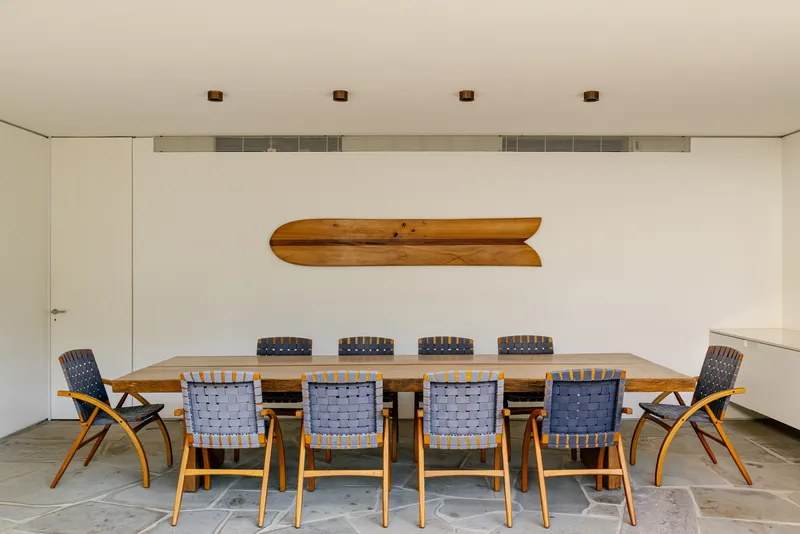
The dining zone carries a more curated feel, with woven chairs, a hefty timber table, and a wooden canoe mounted on the white wall, a nod to the coastal setting that lands just this side of decorative excess. Throughout the ground floor, the integration of spaces means that sightlines extend from kitchen to garden to pool, a triangulation that keeps the house feeling much larger than its 575 square meters.
Material Warmth Upstairs
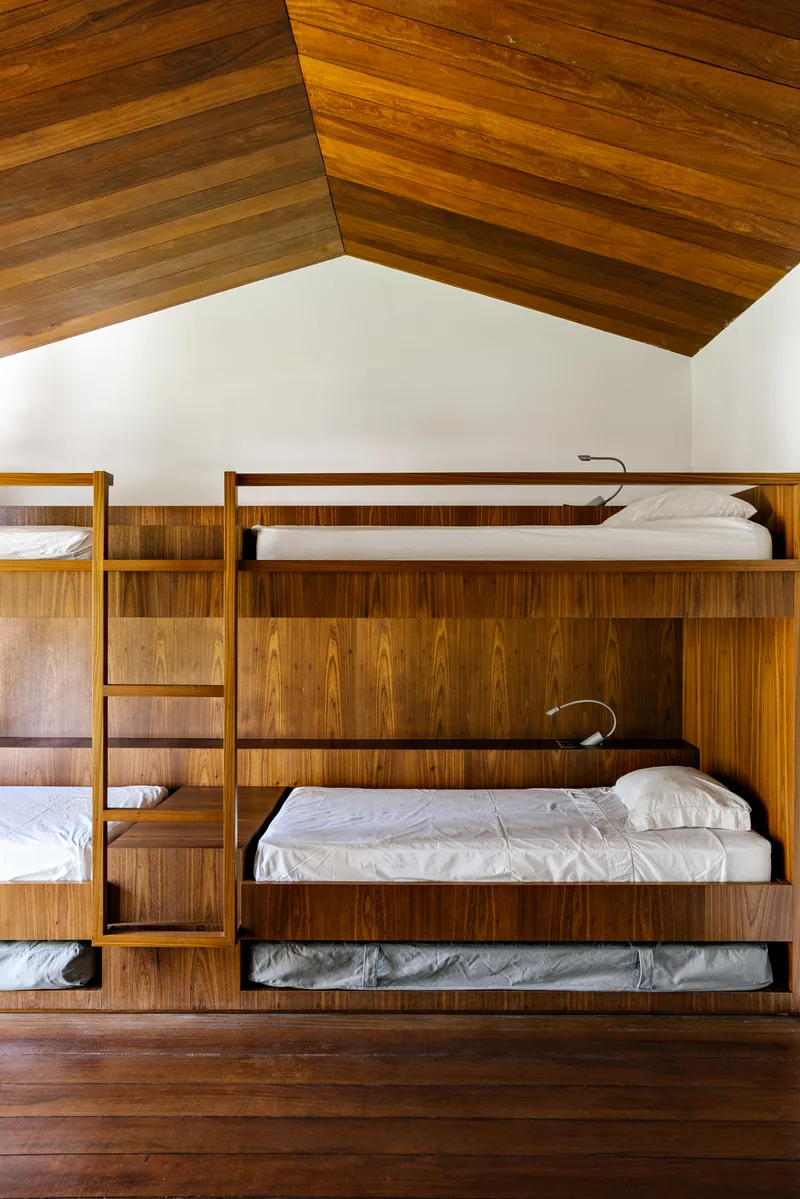
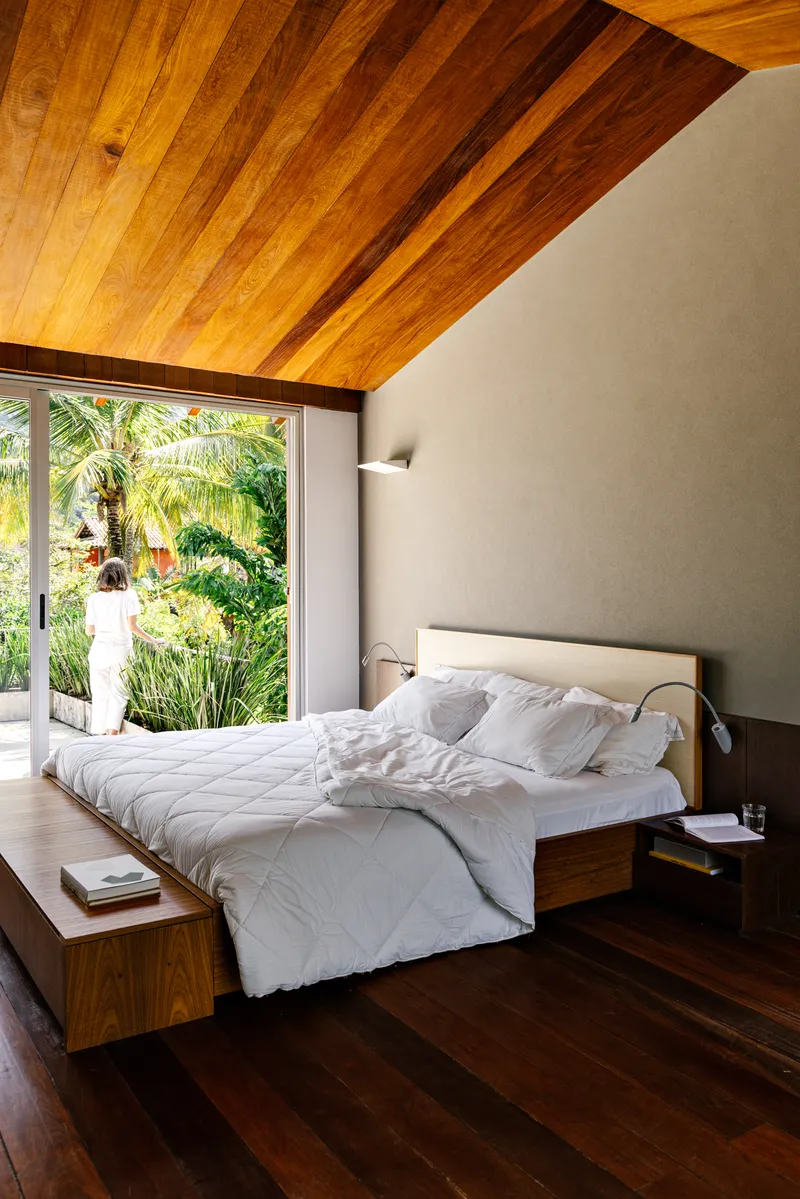
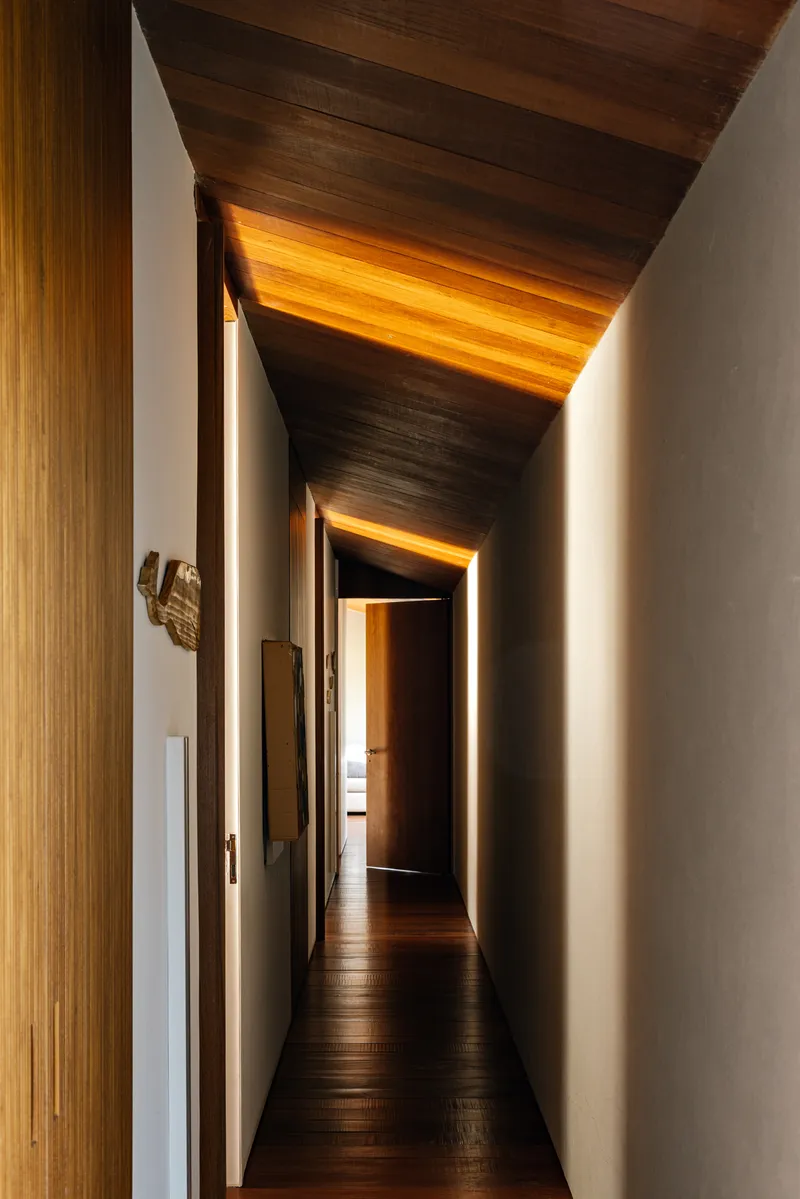
The upper floor is a world apart. Horizontal wood planking lines gabled ceilings, making bedrooms feel more like refined cabins than beach-house suites. Built-in timber bunk beds slot neatly under the sloped roof, maximizing headroom where it counts and tucking storage into the residual space. The detailing is careful: concealed lighting washes white walls at dusk, and folded timber ceiling planes in the corridor create a sense of compression before each bedroom opens up to its own garden view.
One bedroom opens through floor-to-ceiling glass directly into a garden planted with white-barked trees, collapsing the boundary between sleeping space and landscape. The choice to orient bedrooms northward, toward the timber-clad face, means they receive even, indirect light rather than the harsh glare off the sea.
Kitchens, Baths, and Details
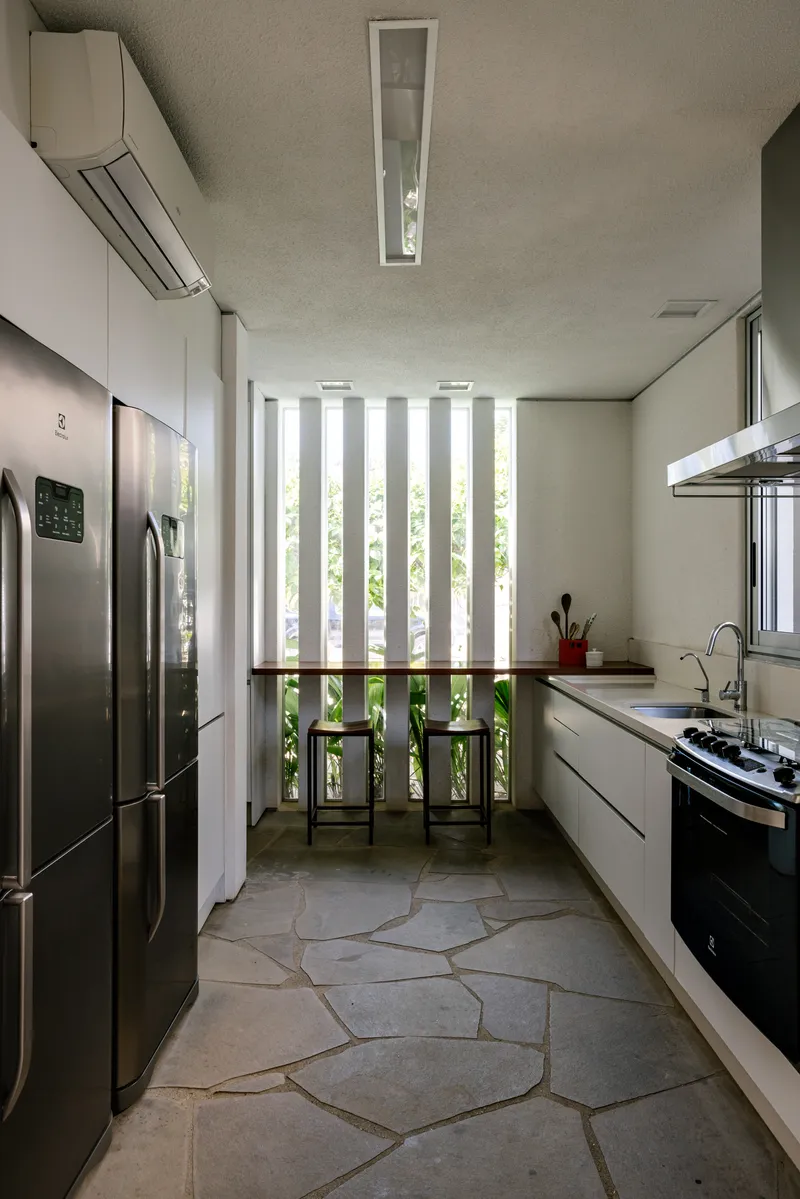
The galley kitchen is framed by a vertical slatted screen that filters garden views, keeping the work zone connected to the landscape without making it feel exposed. Irregular stone flooring grounds the space in a tactile, almost rustic register, while the white walls and clean shelving keep it functional.
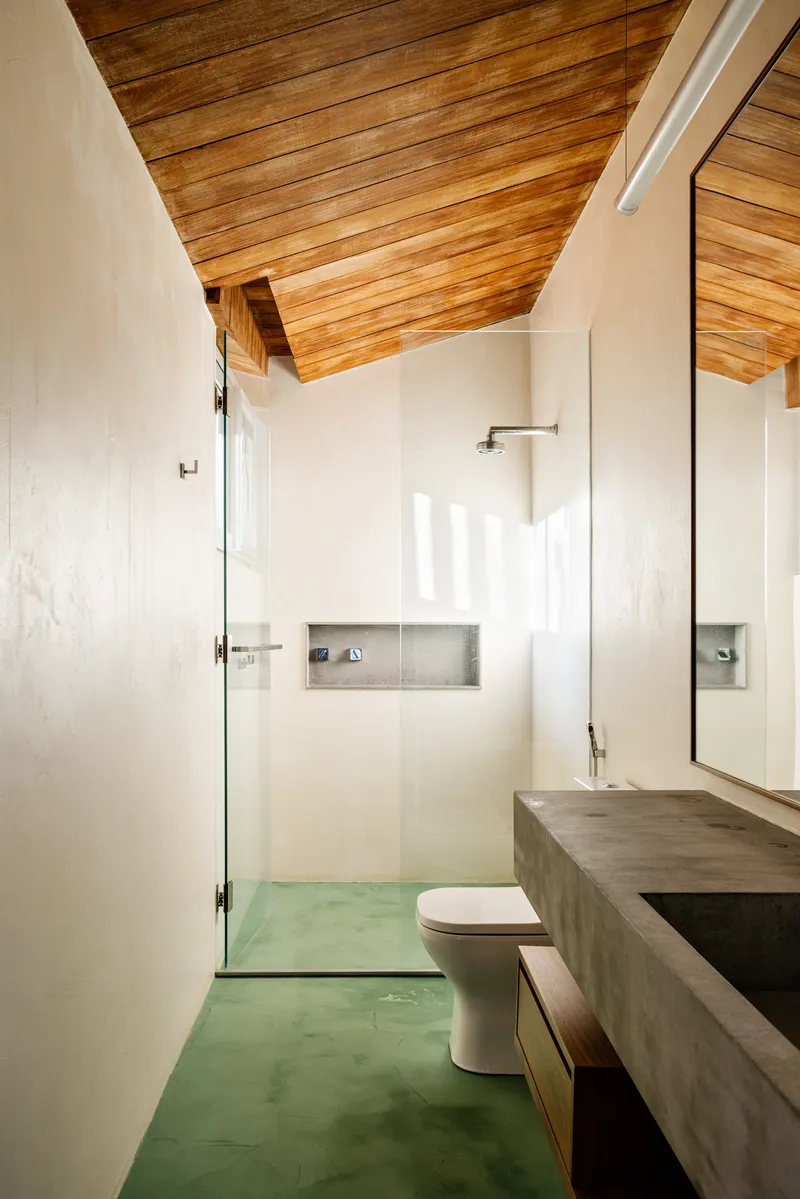
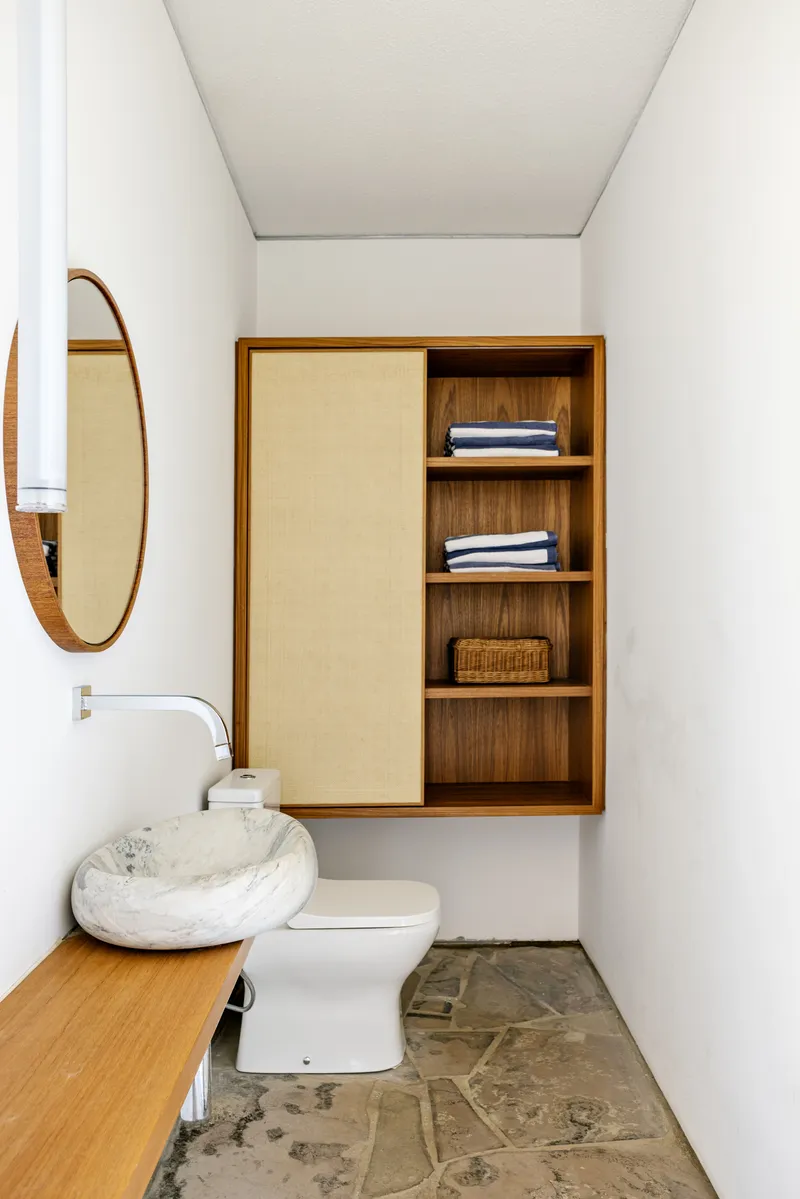
Bathrooms oscillate between two moods. One is lined in green polished concrete with an exposed timber ceiling and a recessed shower niche, a combination that feels tropical and unapologetic. Another takes a quieter approach: a wall-mounted timber cabinet, a stone vessel sink, and nothing else. In both cases, the material choices acknowledge that this is a house by the sea, where surfaces must tolerate humidity and sand without pretending they do not exist.
Living Room and Interior Light
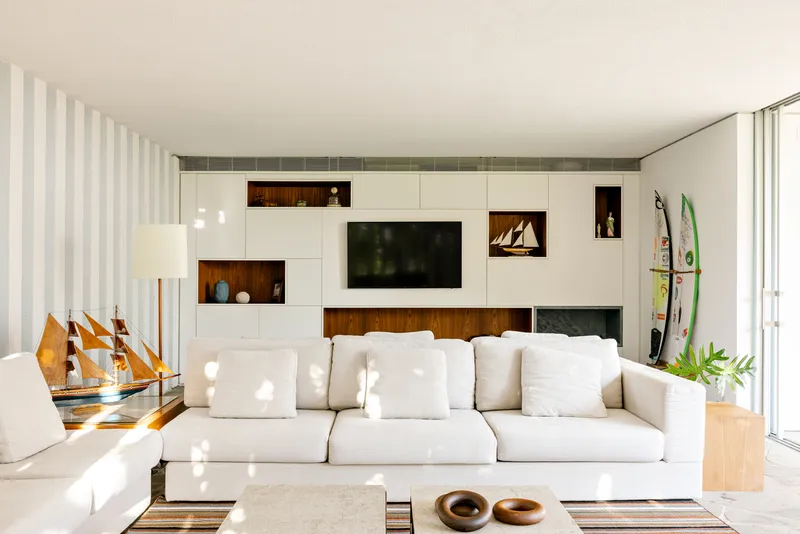
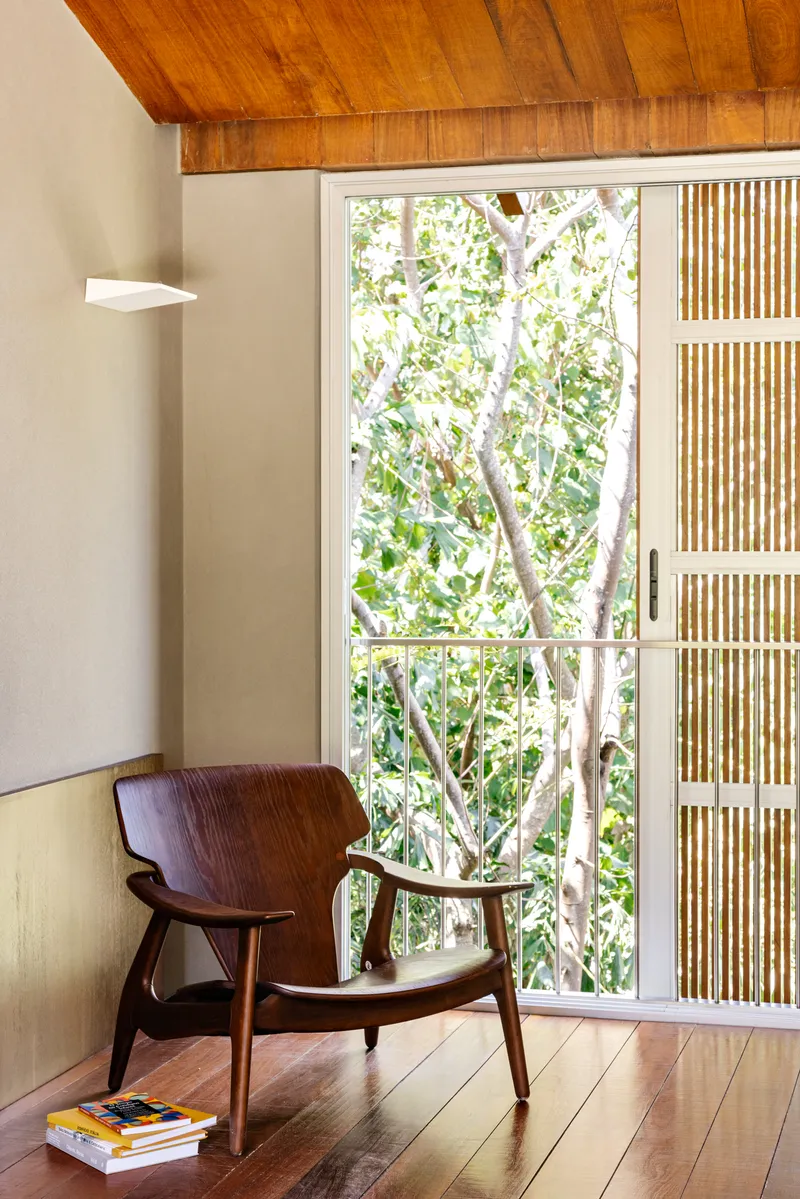
Diffused light is the real protagonist of the interior. Loopholes on the east and northwest faces bring soft illumination into the living room without direct solar gain, a strategy that keeps the house comfortable year-round without relying heavily on air conditioning. A white storage wall with timber insets and vertical sheer curtains softens the light further, giving the main living area an almost gallery-like calm that contrasts with the lush greenery pressing in from every opening.
The timber-panelled ceiling in the corner spaces and glazed doors opening to gardens with white-barked trees reinforce the idea of a house that is perpetually reaching outward. Even in its most enclosed moments, Guaecá House offers a view to something green.
Plans and Drawings
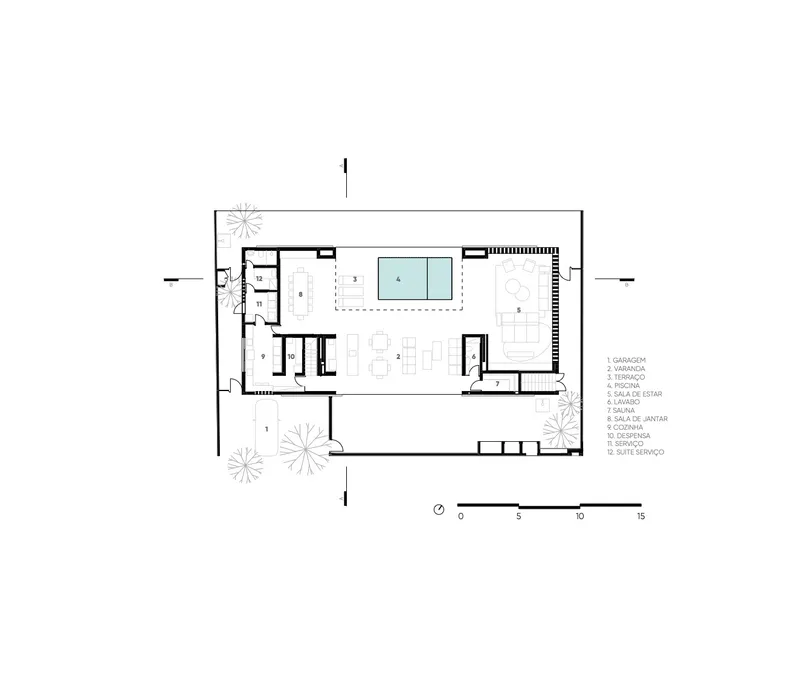
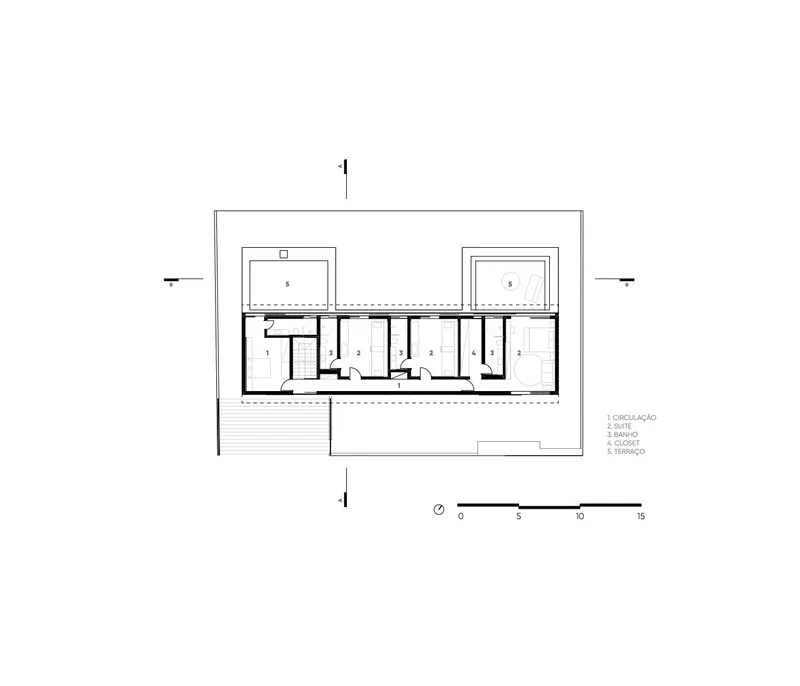
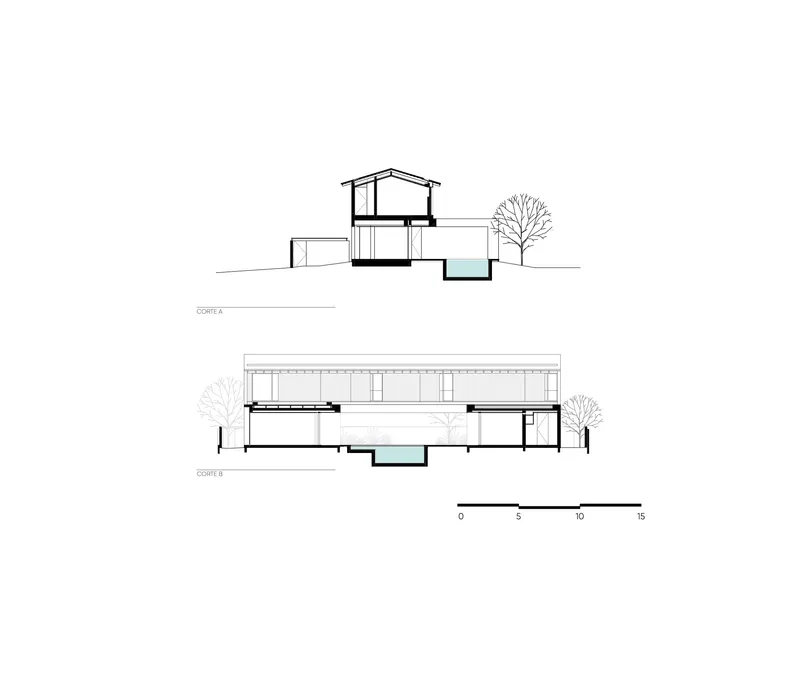
The ground-floor plan makes the U-shaped strategy legible: living spaces wrap around the central pool terrace, with the garden extending to the south and the access roads buffered to the north. The upper-floor plan reveals a more linear arrangement, with bedrooms strung along the northern bar and two courtyards flanking the central volume. The section drawings are particularly instructive, showing how the cantilevered upper floor creates the deep covered terrace below while the shallow pitched roof keeps the overall profile low against the mountain backdrop.
Why This Project Matters
Guaecá House is not trying to reinvent the Brazilian beach house. What it does, and does convincingly, is demonstrate that you can build a generous coastal home on a semi-public site without resorting to fortress walls or opaque compounds. The combination of vegetation, cantilevered volumes, and carefully oriented timber screens creates a layered privacy gradient that never feels defensive. It is a house that breathes, welcomes the landscape in, and still gives its inhabitants room to retreat.
The material choices carry the argument. Basalt, sandstone, timber, and textured white plaster are not revolutionary, but they are deployed with a consistency and tactile sensitivity that elevates the project above its peers. Gui Mattos and the design team understood that on the coast, materials must age gracefully, and that warmth is not just a visual quality but a performance criterion. The house will look better in ten years than it does today, and that is the most honest compliment you can pay an architect working in a climate that tests everything.
Guaecá House by Gui Mattos (lead architects: Riccardo Buso, André Delmanto, Tiago Mestre, Raquel Palmieri). Located in São Sebastião, Brazil. 575 m². Completed in 2018. Photography by Fran Parente.
About the Studio
Share Your Own Work on uni.xyz
If projects like this are the kind of work you want to make, uni.xyz is a place to publish your own, find collaborators, and enter design competitions.



Popular Articles
Popular articles from the community


The Musturak Paradise: Senior Living Architecture for a Connected Future in Temara, Morocco
The Musturak Paradise reimagines senior living architecture in Temara via private homes, social spaces, culture, community, and shared care.

Co-Life: Senior Housing Design That Reconnects Older Adults With the City
Co-Life reimagines senior housing design through healing gardens, shared streets, workshops, and a sustainable community across generations.

Co-life: Sustainable Architecture for Age-Friendly Community Living
Co-life reimagines sustainable architecture for seniors through courtyards, rammed earth, shared gardens, and spaces designed for belonging.

The Ocean Hive: Sustainable Architecture for a Self-Sufficient Civilization at Sea
The Ocean Hive imagines sustainable architecture at sea, where modular habitats, algae, wave power and ocean waste sustain a growing colony.


Similar Reads
You might also enjoy these articles

Bao Huynh Watercolor Atelier: A Serene Art Retreat in Hội An
Bao Huynh Watercolor Atelier in Hội An blends multifunctional art spaces, sustainable design, local materials, and family-friendly living in a serene environment.

Atelier Macri Concept Store Interior Design by CASE-REAL
Atelier Macri store features a "ko" counter, walnut wood details, cork displays, blending retail, gallery, and seamless customer experiences.

Manuel Vargas Izquierdo Stadium and High-Performance Sports Center: Architectural Excellence in Jalpa de Méndez
The Manuel Vargas Izquierdo Stadium blends sustainable design, inclusive sports facilities, and cultural-inspired architecture, revitalizing Jalpa de Méndez’s public spaces.

KAKR Buluh Awar Hall: Revitalizing Community and Ecology Through Bamboo Architecture
Community built bamboo hall revitalizes Buluh Awar village, empowering youth, restoring ecology, celebrating vernacular craftsmanship through sustainable architecture and culture.


Explore Residential Building Competitions
Discover active competitions in this discipline


Challenge to design mud housing for contemporary communities


Challenge to reimagine the Iron Throne


Photograph architecture without architects


Illustrate the lost glory of Angkor Wat - Render Challenge
Comments (0)
Please login or sign up to add comments
No comments yet. Be the first to comment!