
Habitable Form Makes a 2,888-Square-Foot Kiawah Island House That Lives Like a Porch
Raised into the live oaks on a South Carolina barrier island, Victory Bay House turns covered outdoor space into its primary architecture.

The most honest thing you can do on a barrier island is admit that the outdoors is the better room. Habitable Form's Victory Bay House, completed in 2022 on Kiawah Island, South Carolina, starts from that premise and refuses to let go. At 2,888 square feet the house is compact by coastal-resort standards, but its network of deep porches, covered walkways, and operable enclosures makes the livable area feel far larger. The whole structure tucks under a canopy of ancient live oaks between the Atlantic Ocean and the Kiawah River, sitting four feet above the required FEMA flood elevation because the firm chose to treat resilience not as a minimum threshold but as a design opportunity.
What makes the project genuinely interesting is the degree to which it collapses the distinction between porch and room. The plan is one room deep throughout, a low-country vernacular move that ensures every interior space touches daylight and breeze on two sides. For roughly a third of the year, folding glass walls open the house entirely, turning the whole building into a shaded, elevated platform in the trees. The program serves a retired couple whose adult children and grandchildren visit regularly, so the design separates a treetop suite from the main living areas, allowing that upper zone to drop to humidity-control mode when unoccupied. It is an all-electric, solar-ready house built with cast-in-place concrete columns and heavy timber porches joined by steel plate connections, materials chosen not for fashion but for the salt air and UV punishment that a barrier island delivers year-round.
Living in the Canopy
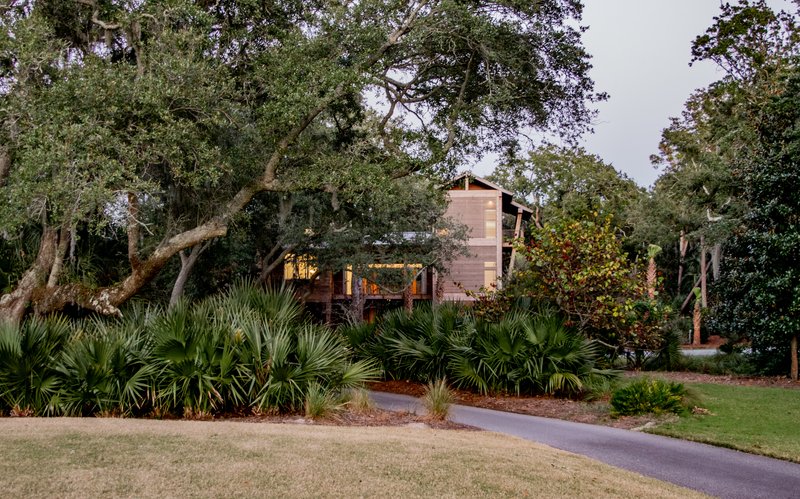
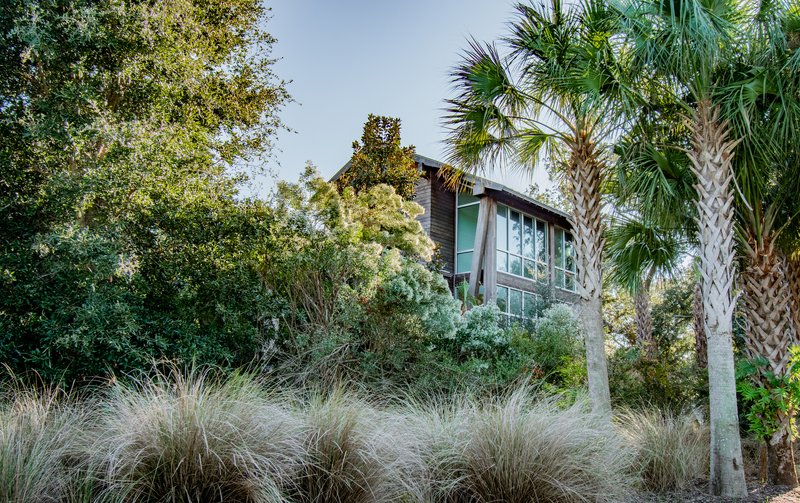
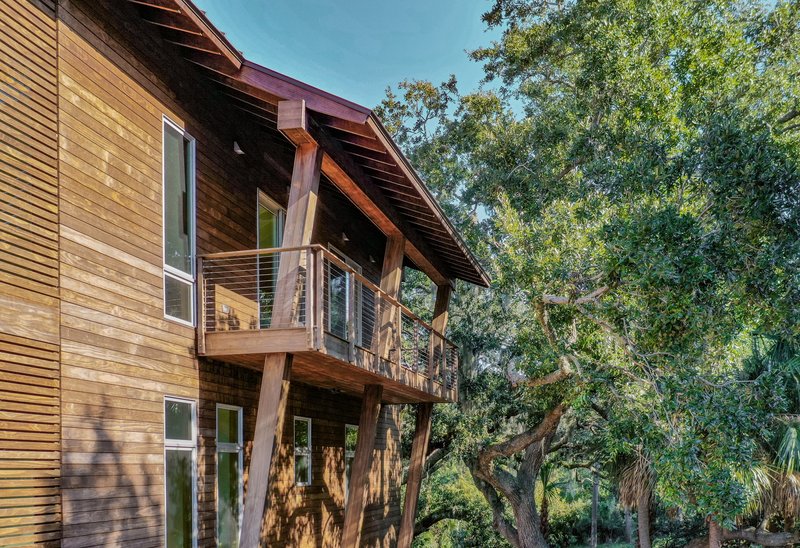
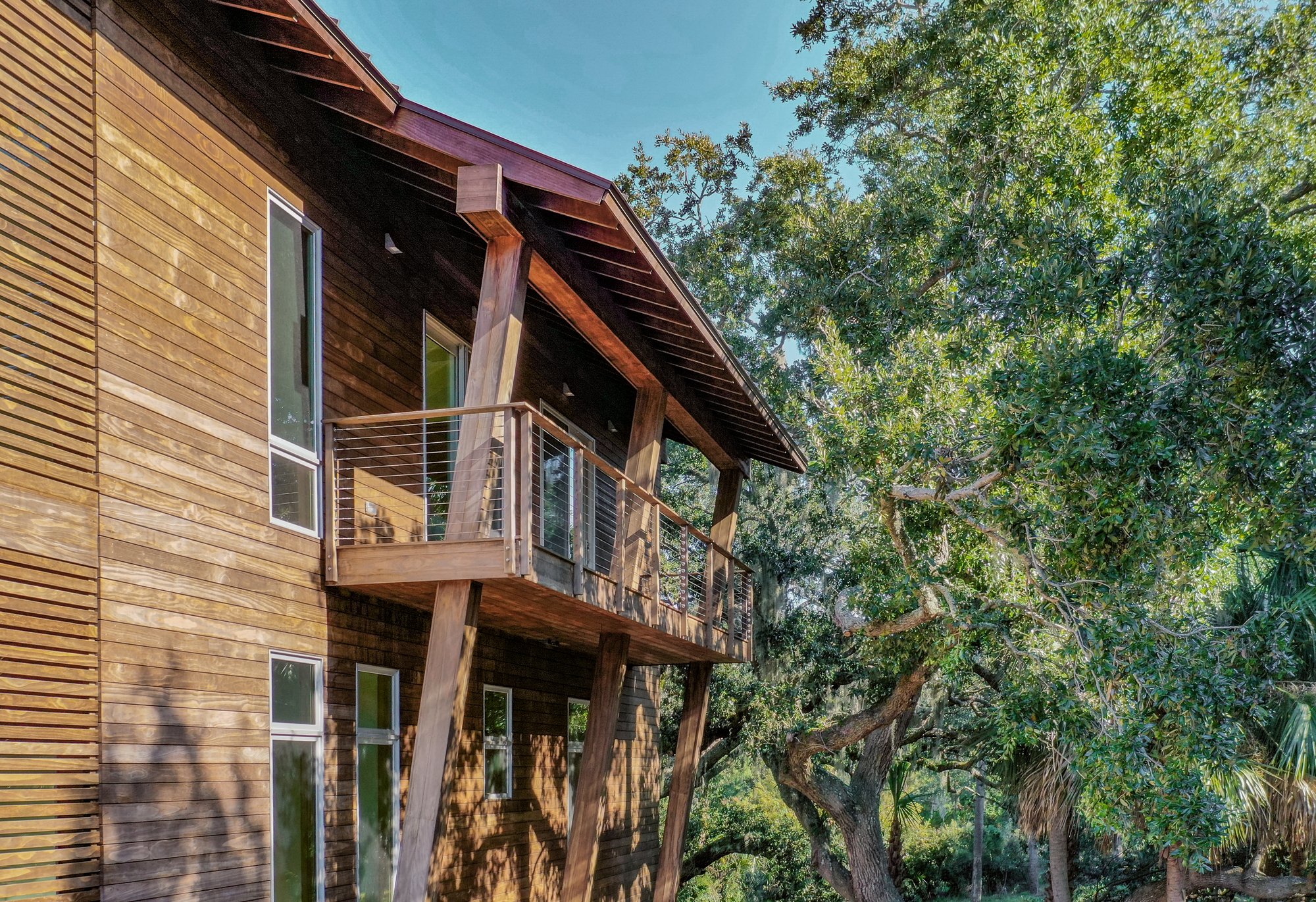
Kiawah's live oaks are the site's primary infrastructure. The house slips between them, its elevated timber volumes positioned to preserve root zones and existing dune vegetation. From the lawn the structure reads as a lantern in the branches, its horizontal cladding and deep eaves deferring to the sculptural mass of the trees rather than competing with them. The two-story facade barely clears the first heavy limbs, and the cantilevered balcony pushes into the canopy so that you are sitting inside the tree rather than looking at it.
Landscape architect Outdoor Spatial Design kept the ground plane loose, with palmetto and ornamental grasses rising on a natural slope toward the glazed upper volume. There is no heroic arrival sequence, no grand stair. You approach through vegetation, the house revealing itself in fragments filtered by leaves and fronds.
The Porch as Architecture
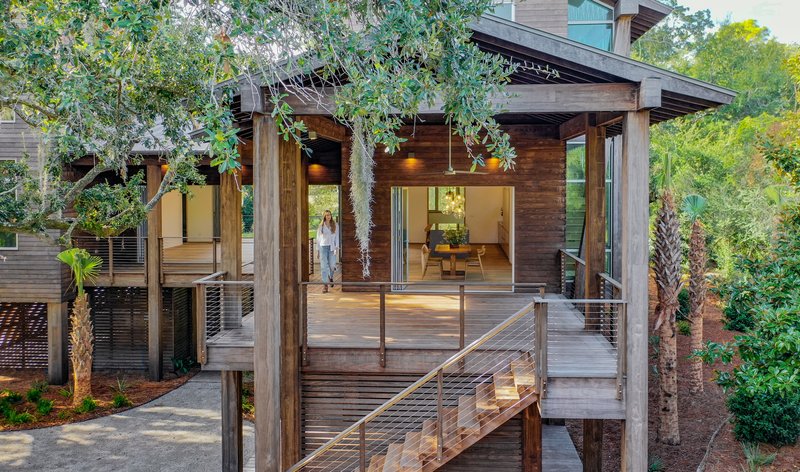
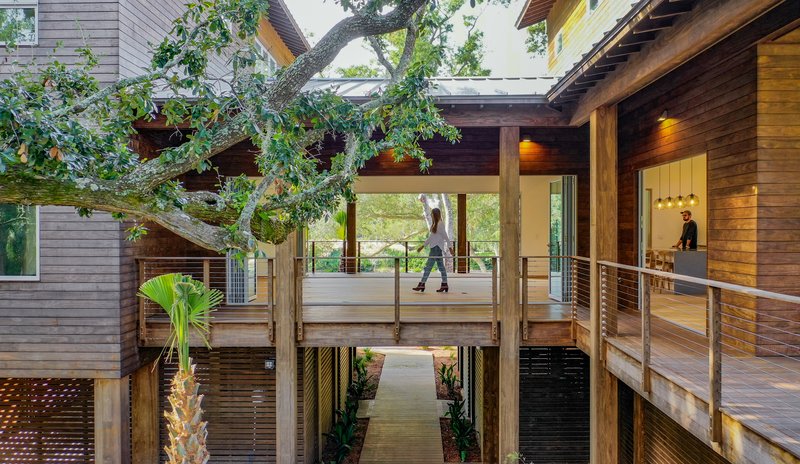
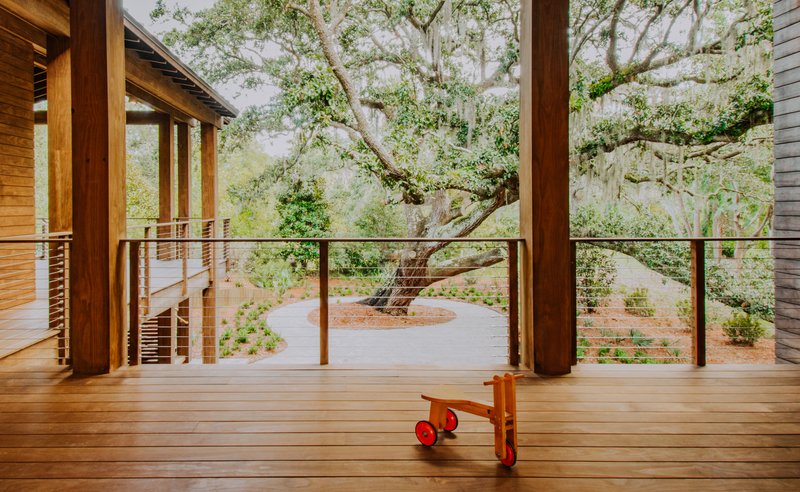
In most coastal houses the porch is an appendage, a deck bolted to the side of a conditioned box. Here it is the organizing principle. Heavy timber columns carry deep overhangs that shade the walkways connecting the house's separate volumes, and cable railings keep the edges transparent so that the tree canopy remains the visual boundary. The covered walkway between buildings, captured at dusk with a figure crossing the elevated deck, shows how circulation itself becomes a room: wide enough to linger, shaded enough to use at midday, open enough to catch the coastal breeze.
The cast-in-place concrete columns that lift the house above flood level also give the porch its structural logic. Rather than using CMU block, the firm opted for poured concrete to improve wind resistance, a decision that pays off aesthetically too: the columns are slender and precise, letting the heavy timber beams they support read as floating platforms rather than bunkers.
Screens, Thresholds, and Filtered Light
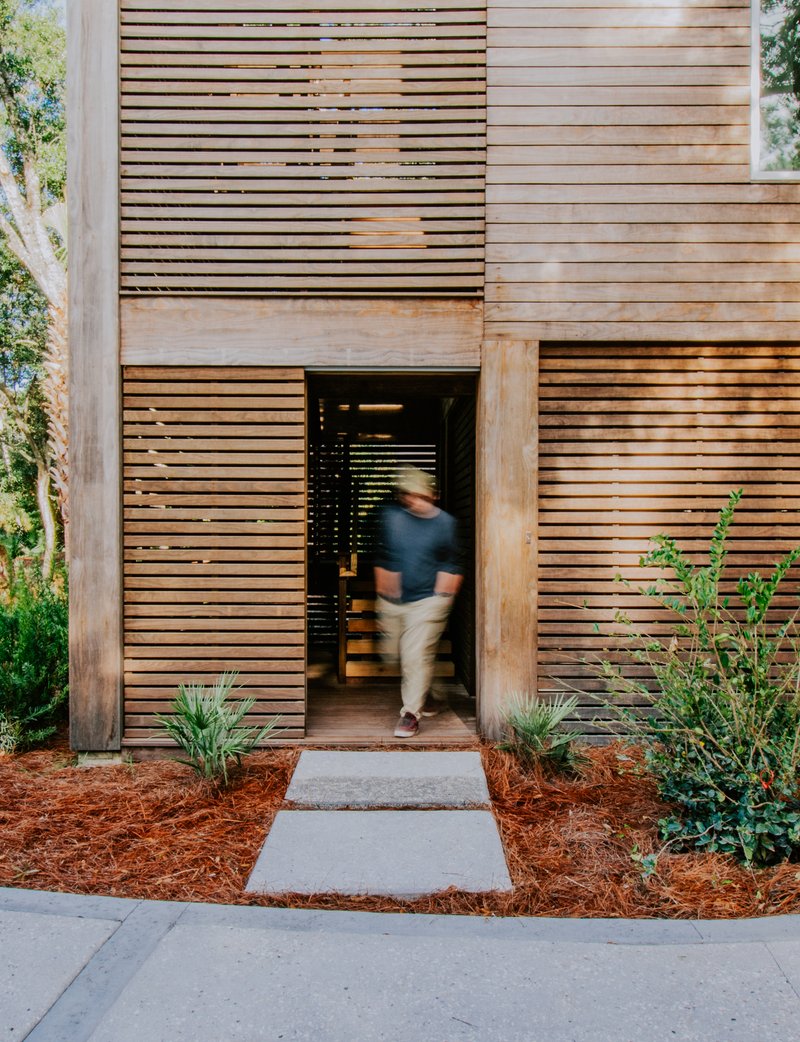
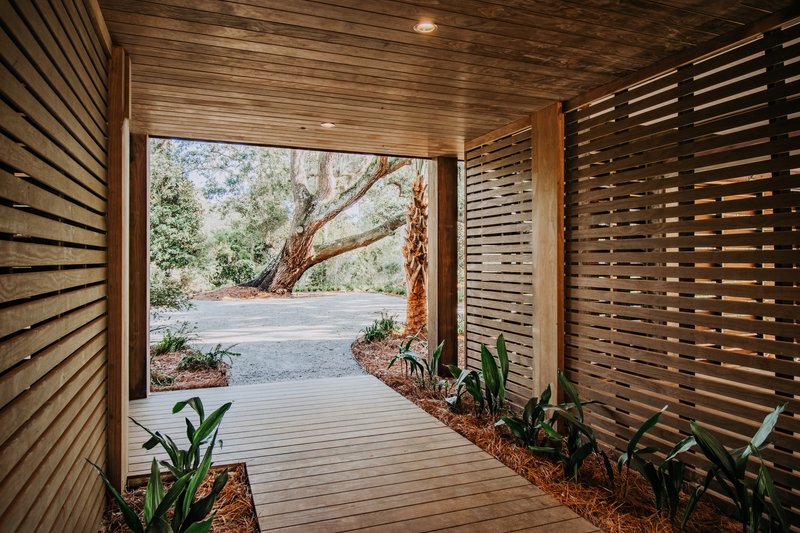
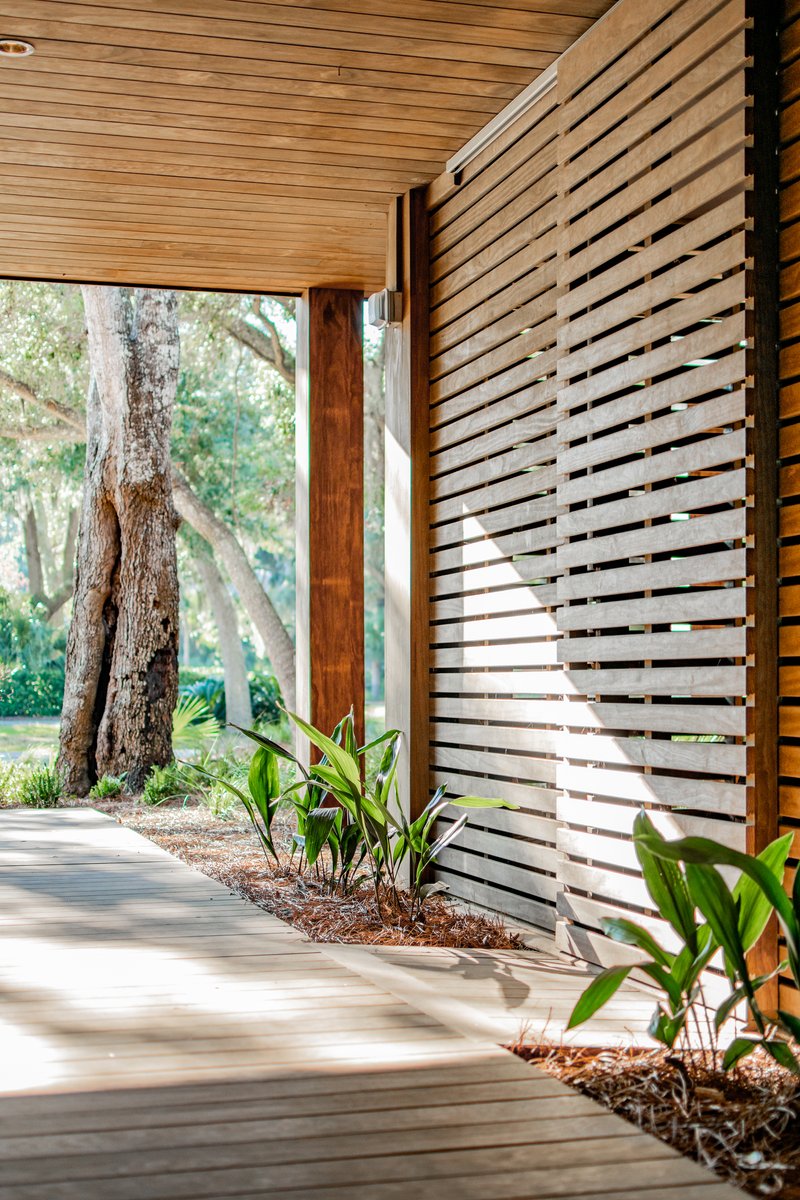
Between full enclosure and full exposure, the house deploys a layered system of horizontal and vertical timber screens. At the entry threshold, slatted panels filter sunlight into stripes across the planted beds, turning arrival into an event of light rather than of mass. The covered walkway uses the same slatted screen walls to frame a single oak tree in the distance, a telescopic view that makes you aware of exactly where you stand on the site.
These screens are not decorative. On a barrier island where UV exposure is relentless, they control solar gain on the west and south elevations while maintaining airflow. They also give the house visual depth: from outside, the layered planes of cladding, screen, and glass create a moiré effect that shifts as you move. The corner detail of the timber screen wall shows the precision of the joinery, each slat casting a shadow line that changes by the hour.
Opening the Interior
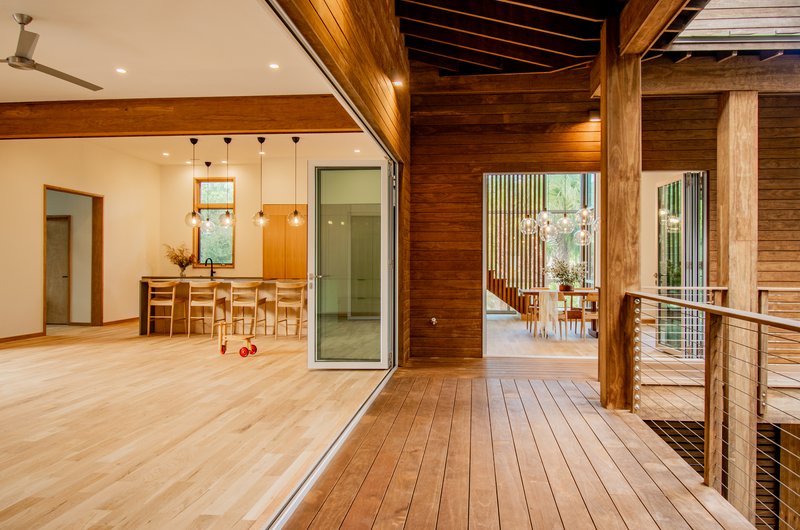
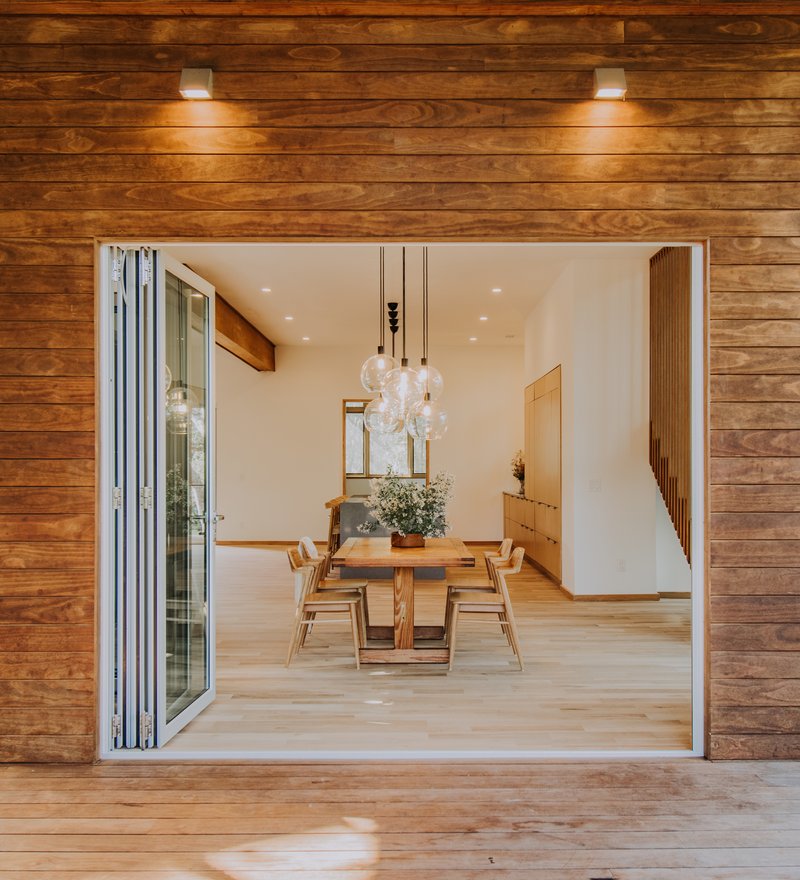
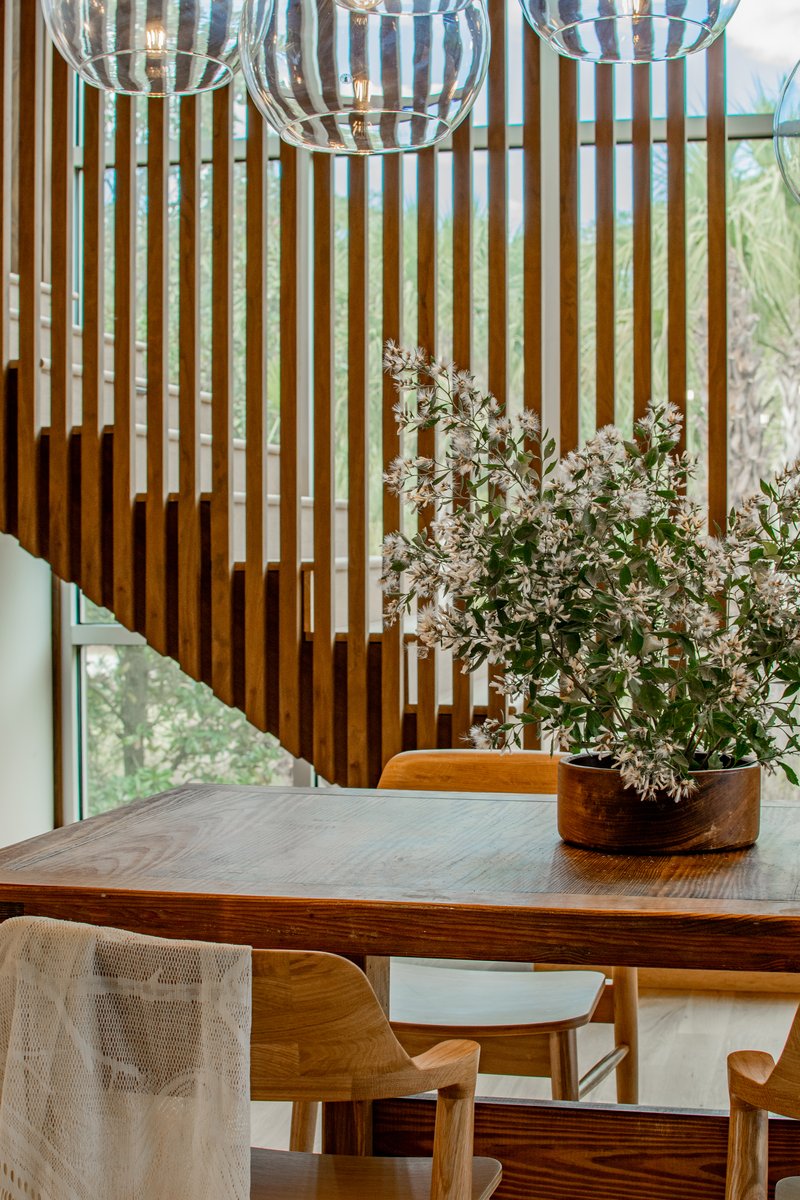
Inside, the one-room-deep plan reads as a continuous volume of timber. Exposed ceiling beams run uninterrupted from wall to wall, and the horizontal plank walls give every room a consistent grain that ties interior to exterior. The open-plan living space opens directly to the deck through folding glass doors, so the boundary between dining room and porch is literally a threshold you can erase.
The material palette is deliberately restrained: pale timber, white plaster, clear glass pendant lights. There is no accent wall, no contrasting stone countertop fighting for attention. The discipline lets the changing quality of light, filtered through oaks and screens, do the work of atmosphere. The dining room with its flowering branches and vertical timber batten wall is the best evidence of this strategy: a room that would be plain under flat fluorescent light but comes alive when animated by the dappled patterns the house invites in.
Stair as Light Well
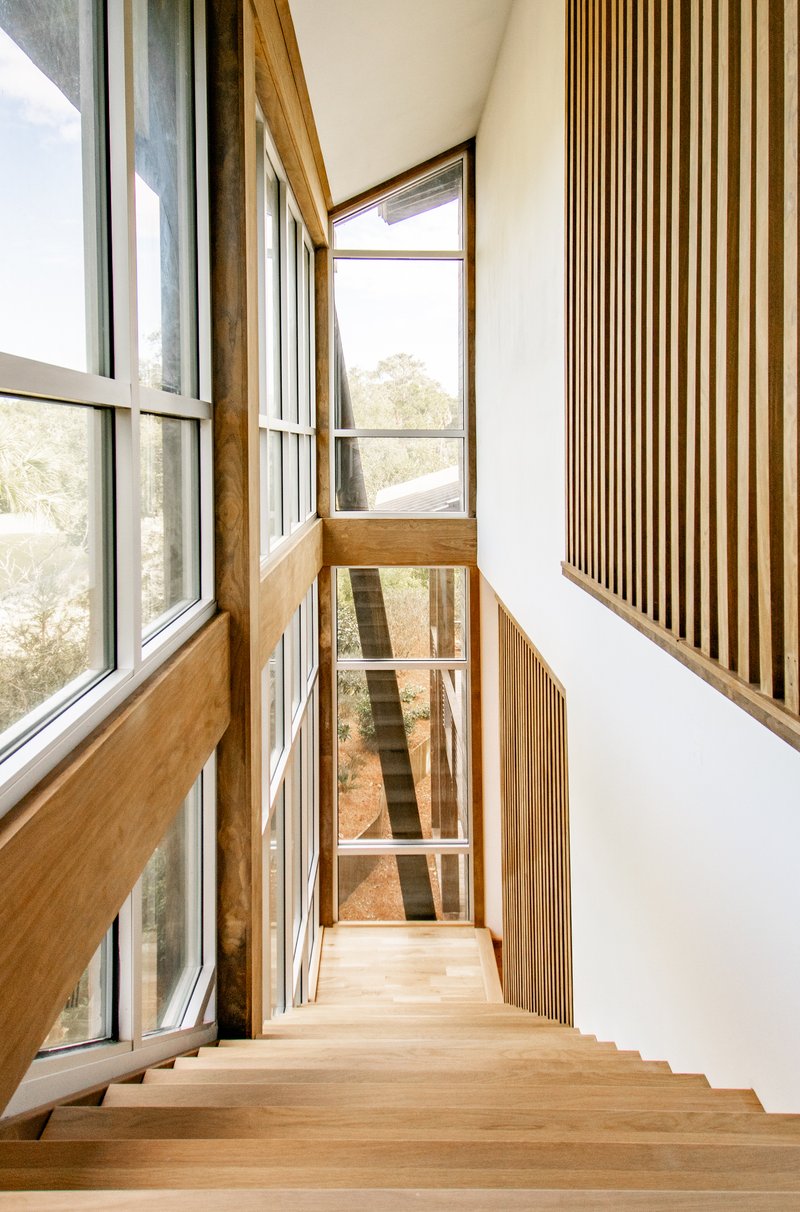
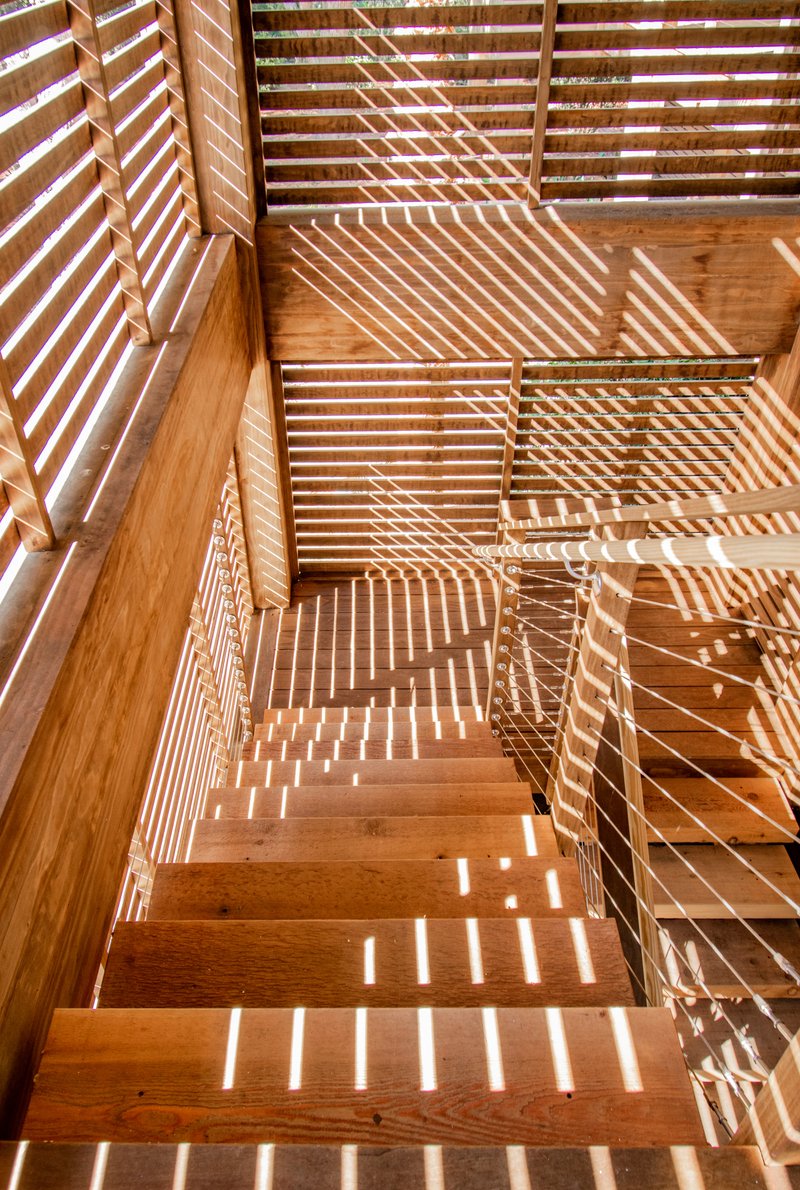
The staircase linking the main living level to the treetop suite doubles as the house's primary light well. Floor-to-ceiling windows line one side while vertical wood slat screens on the opposite wall modulate the view into layers of texture and shadow. Seen from above, the stair is a study in geometry: pale treads spiraling downward, dappled sunlight from horizontal louvers painting stripes across the landing.
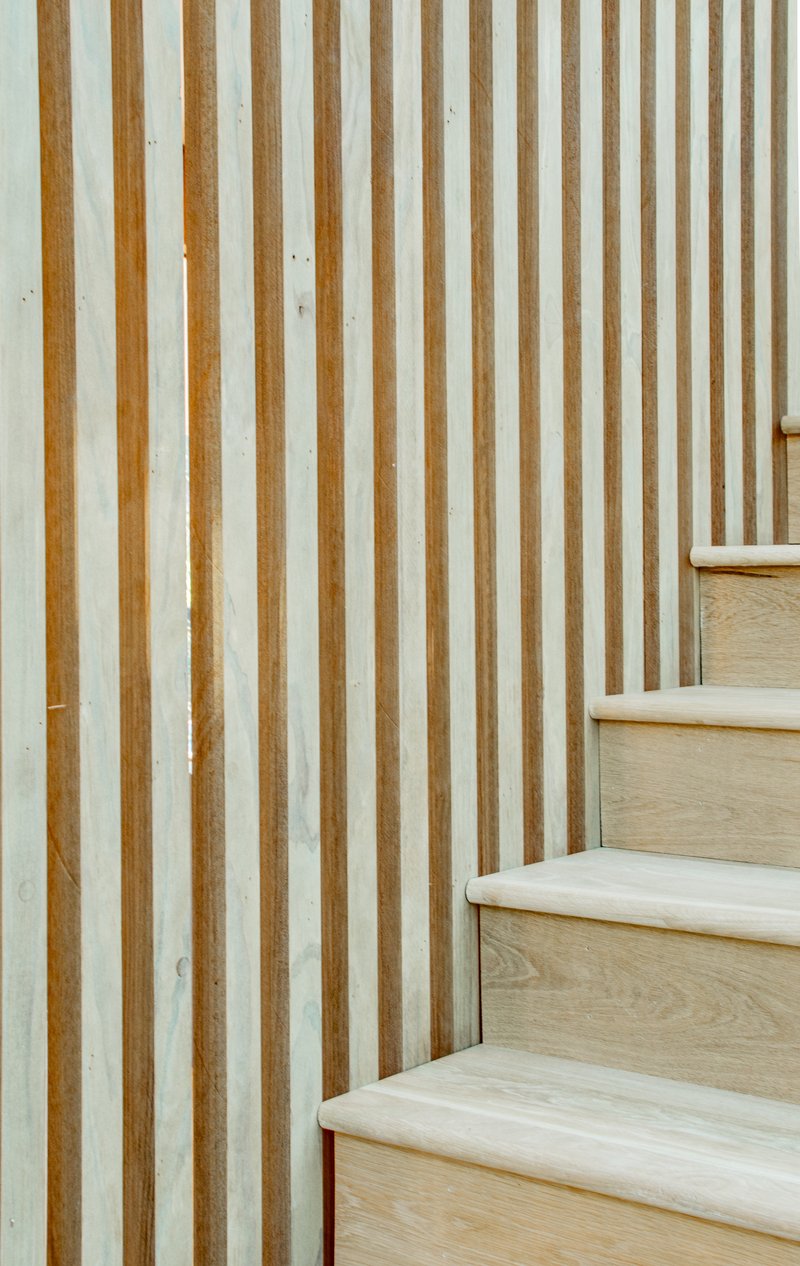
The detail where the stair treads meet the slatted timber and plaster wall reveals the care taken at transitions. There is no trim piece hiding a sloppy joint. Wood meets plaster in a clean reveal, the kind of restraint that only reads as simple because the builders got the tolerances right.
Structure and Detail
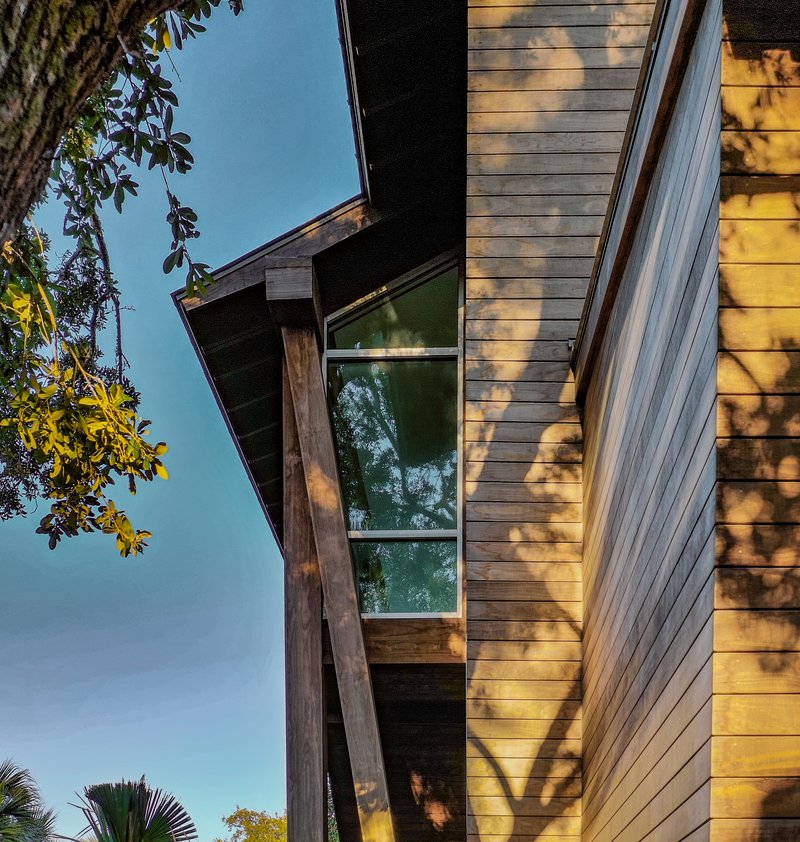
The angled timber column supporting the deep eave is the house's most legible structural gesture. Afternoon shadows rake across the horizontal siding, revealing the eave's true depth: generous enough to keep rain off the walls and sun off the glass for most of the day. Steel plate connections at the heavy timber joints are left exposed, honestly expressing the engineered moment where wood and metal meet. Structural engineer Tobias West deserves credit here. On a barrier island, connections are where buildings fail in storms, and making them visible is both a design move and an accountability move.
Plans and Drawings
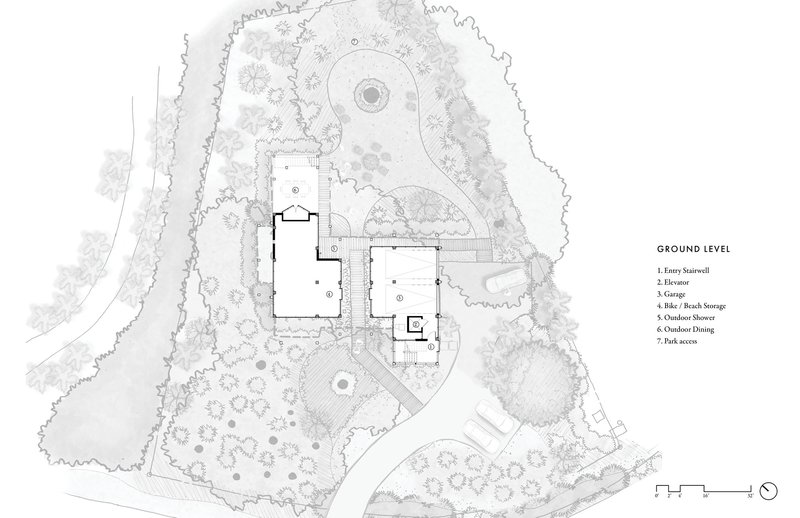
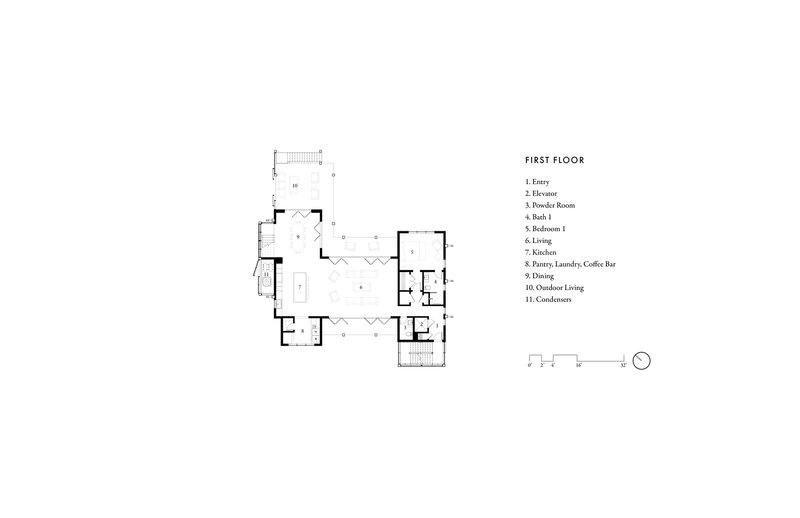
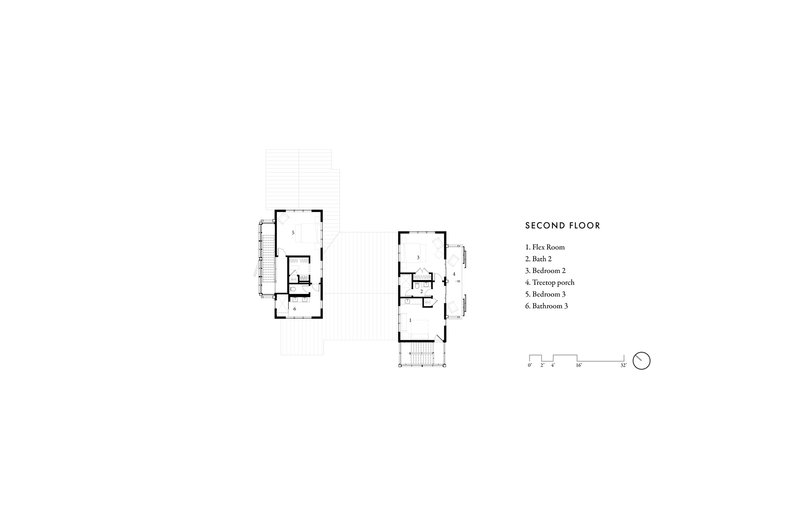
The site plan confirms just how carefully the footprint threads between existing tree canopies. The branching layout of the first floor plan, with its entry porches splaying toward different orientations, is the clearest diagram of the house's strategy: orient every room toward the coastal breeze while separating public and private zones. The second floor plan shows the treetop suite with its own porch, a self-contained apartment that can operate independently of the rest of the house.
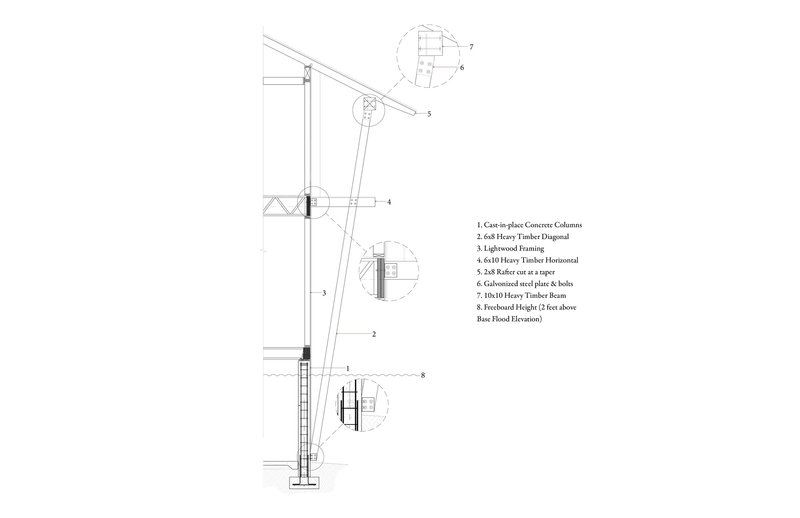
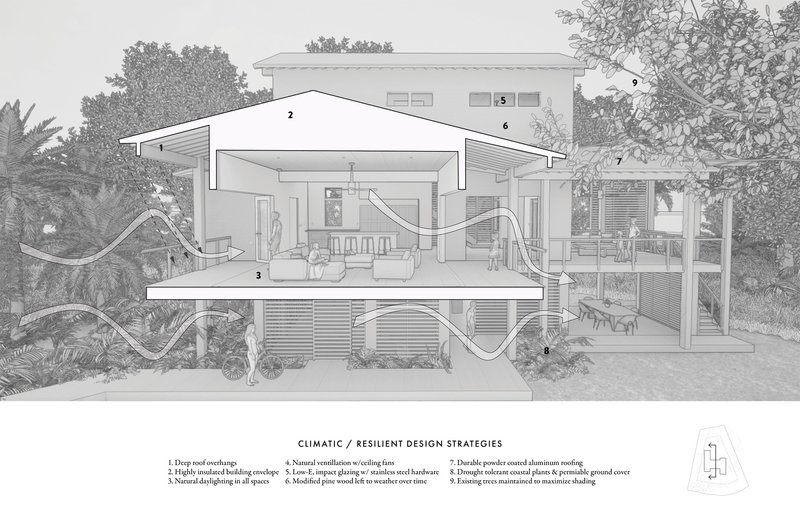
The detail section of the sloped roof connection reveals the hybrid structure: timber beams landing on cast-in-place concrete columns with a clean separation between warm wood and cool concrete. The ventilation section overlaid on a photograph is the most instructive drawing in the set. It traces airflow from the ground plane up through the two-story volume, demonstrating that the house's tall proportions and one-room depth are not aesthetic choices but thermodynamic ones. Warm air rises through the stairwell and exits at the ridge, pulling cooler air in through the lower openings. For roughly four months of the year, this passive stack effect replaces mechanical cooling entirely.
Why This Project Matters
Victory Bay House is a quiet argument against the coastal McMansion. Where most resort-island houses maximize conditioned square footage and treat the landscape as a view to be consumed through glass, Habitable Form treats the landscape as the primary living space and uses architecture to mediate the transaction: shade where you need it, breeze when you want it, shelter when the weather turns. The result is a house that uses less energy, occupies a smaller footprint, and offers more livable space than a conventional house twice its size.
The project also demonstrates that resilience and beauty are not competing agendas. Elevating four feet above FEMA requirements, using cast-in-place concrete columns for wind resistance, selecting materials for salt and UV durability: these are pragmatic engineering decisions that also produce the house's most compelling formal qualities, the slender stilts, the deep eaves, the layered screens. When the next hurricane comes, this house will be standing. In the meantime, it will be the best porch on the island.
Victory Bay House by Habitable Form in collaboration with Spivey Architects. Kiawah Island, South Carolina, United States. 2,888 square feet. Completed 2022. Structural engineer: Tobias West. Landscape architect: Outdoor Spatial Design. Photography by Emily Heezen.
About the Studio
Share Your Own Work on uni.xyz
If projects like this are the kind of work you want to make, uni.xyz is a place to publish your own, find collaborators, and enter design competitions.




Popular Articles
Popular articles from the community

The Faith: Modular Architecture for Play, Learning, and Hope in Kutupalong Refugee Camp
A modular playground architecture project in Bangladesh where play, learning, safety, and hope rebuild childhood inside a refugee camp anew.

Kaffeebühnen: Coffee Shop Architecture Designed as a Civic Stage Between Vienna’s City and Park
Kaffeebühnen turns coffee shop architecture into a civic stage, linking Vienna’s park edge, urban life, warm timber yards, and coffee craft.
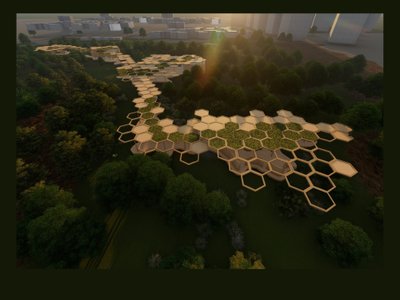
Eco Chapel: A Green Architecture Pavilion Designed in Symbiosis with the Forest
Eco Chapel uses green architecture to weave prayer, learning and reuse into a forest pavilion shaped by modular hexagonal canopies for life.
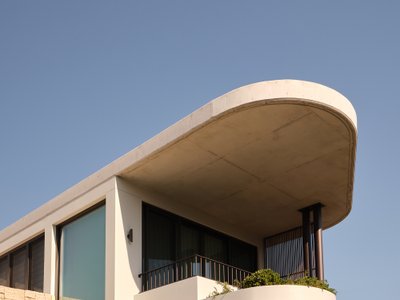
Stanton Architects Sculpts a Curving Family Home into Sydney's Inner West Fabric
Five Dock House uses cantilevers, curved concrete, and layered courtyards to carve out privacy on a tight suburban lot in Sydney.


Similar Reads
You might also enjoy these articles
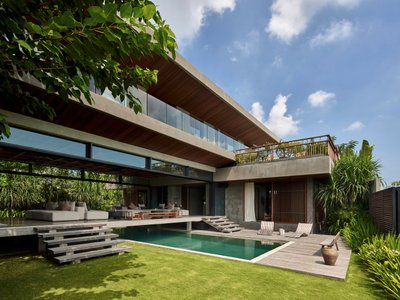
Freebird Residence by Alexis Dornier: A Tropical Modernist Sanctuary in Bali
Floating living pavilion above pool anchors H-shaped tropical villa, blending Japanese minimalism, sustainable strategies, lush landscape, and sculptural interiors.
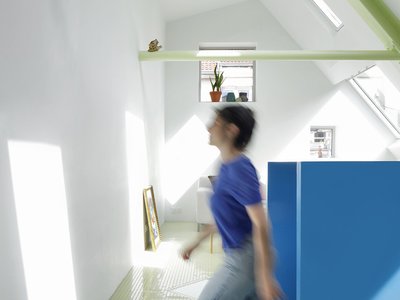
127af Flips a Tiny Bagnolet Rowhouse Upside Down with a Handcrafted Roof Extension
A 55-square-meter terraced house on the edge of Paris gains a luminous upper living floor through lightweight timber and steel.
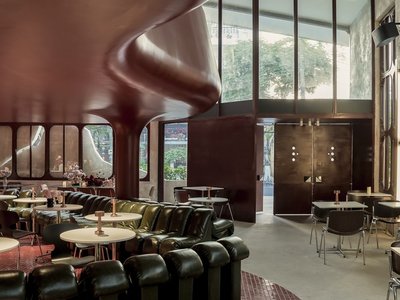
1.61 Design Workshop Wraps a 600-Square-Meter Café in Vietnam in Sculptural Burgundy Drama
Reden Café & Bistro pairs a helical staircase, mosaic floors, and deep red interiors to rethink Vietnamese hospitality space.

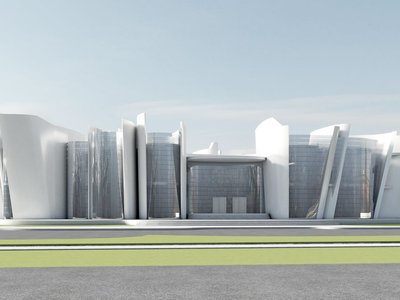
The Unbound Brain: A School Shaped by Cognitive Architecture
Cylindrical learning pods radiate like neurons from a central cortex, turning the floor plan into a spatial model of human thought.


Explore Installations Competitions
Discover active competitions in this discipline




The Global Benchmark for Architecture Dissertation Awards


Challenge to design a portable theatre


Challenge to design a portable music platform


Challenge to design an open learning module for the elderly
Comments (0)
Please login or sign up to add comments
No comments yet. Be the first to comment!