

Safdie Architects Scales Habitat '67 to 1,800 Units on China's Bohai Sea Coast
Habitat Qinhuangdao Phase II stacks and staggers 30-story towers across 40 acres of gardens, terraces, and skybridges in northern China.


Moshe Safdie has spent more than five decades trying to prove a single thesis: that high-density housing does not have to sacrifice daylight, private outdoor space, or a feeling of individuality. Habitat '67 in Montreal was the proof of concept, a 158-unit experiment in prefabricated concrete modules. Habitat Qinhuangdao Phase II, completed on the coast of the Bohai Sea roughly 200 miles east of Beijing, is the thesis at full scale. Designed by Safdie Architects for Kerry Properties, the second phase alone adds over 1,000 units and 244,000 square meters of built area, bringing the combined development to more than 1,800 residences spread across 40 acres of landscaped ground.
What makes the project genuinely interesting is not the volume but the method. Safdie's team treats each 30-story tower as two 15-story slab buildings stacked in offset tiers, connected by massive truss skybridges at the 18th and 33rd floors. The offset creates terraces at nearly every level and carves out what the firm calls "urban windows," large voids that frame sightlines between the city behind and the sea ahead. Every unit is guaranteed at least three hours of direct sunlight on the winter solstice, a local code requirement that the stepped massing turns from constraint into organizing principle. The result is a residential megastructure that reads less like a wall of apartments and more like a terraced hillside town.
Stepped Massing and the Bohai Sea Horizon
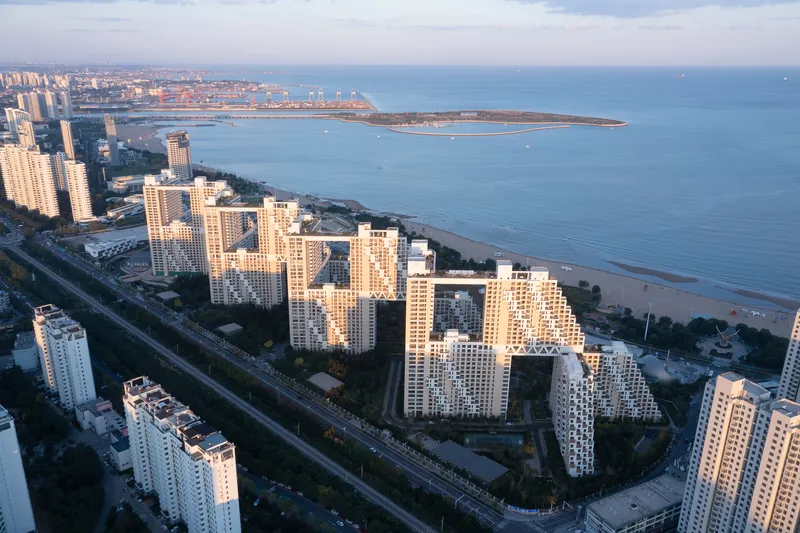
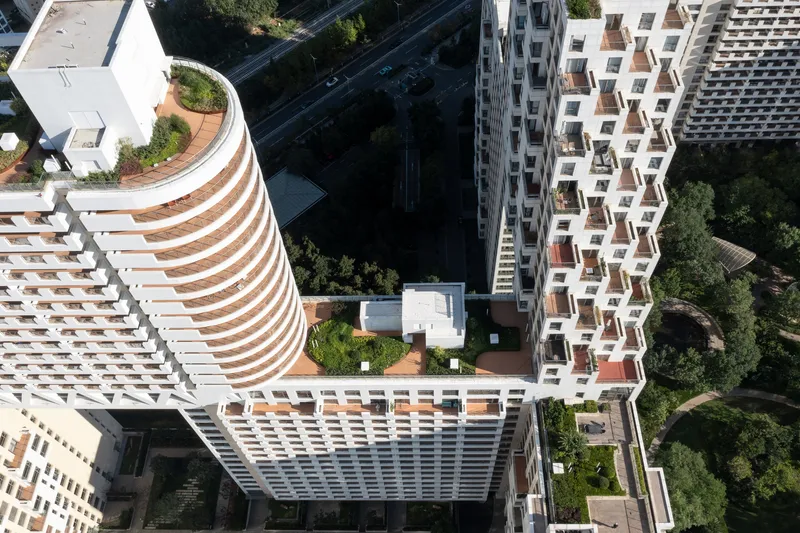
Seen from above at golden hour, the development's relationship to the coastline becomes legible. The towers are oriented with their long elevations facing east, west, and south to harvest sunlight, while the stepped profiles pull back from the waterfront, ensuring that upper units do not shadow the lower ones. The golden light catches each terrace edge distinctly, reinforcing the reading of the building as a stack of individual garden platforms rather than a monolithic slab.
The site plan is organized around two spines: a beachfront boardwalk running north-south and an east-west bazaar-like promenade that cuts through the ground plane. These two axes create a legible public realm at grade, anchored by a 5,500-square-meter art center with exhibition spaces, dining, and cafés. For a resort community, this kind of civic infrastructure is significant. It signals that the development aspires to be a neighborhood, not just a vacation compound.
Courtyards Held Between Towers
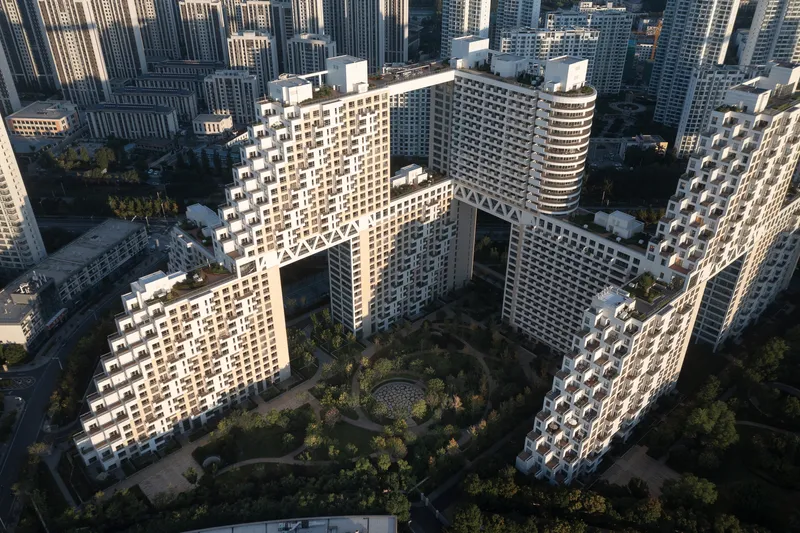
The aerial views reveal the project's most potent spatial move: four towers arranged to enclose a landscaped courtyard at ground level. The staggered balconies terrace inward, giving the courtyard proportions that shift as you look upward. At the base, the enclosure is generous; at the roofline, it opens to sky. The landscaping at grade, developed in collaboration with WAA+, Ager Group, and DQLand, interprets the natural environment of Qinhuangdao through varied topography, adventure playgrounds, planted promenades, ponds, fountains, and streams.
The courtyard typology solves a problem common to beachfront megadevelopments. Without it, towers this size tend to produce dead zones on their landward sides, windswept plazas with no programmatic reason to linger. By folding the towers around shared green space and activating the ground plane with 160,000 square meters of public landscape, Safdie's scheme gives residents a second orientation: not just toward the sea, but inward toward community.
Skybridges, Terraces, and the Penthouse Principle
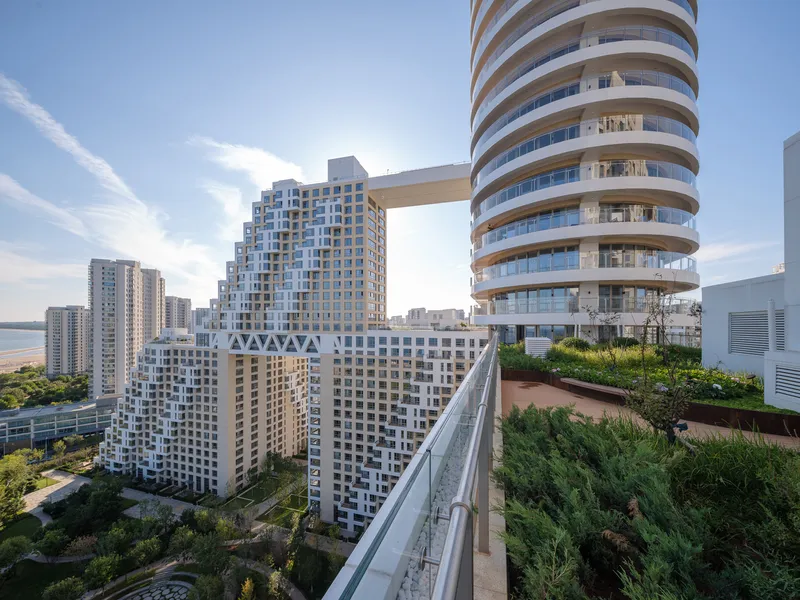
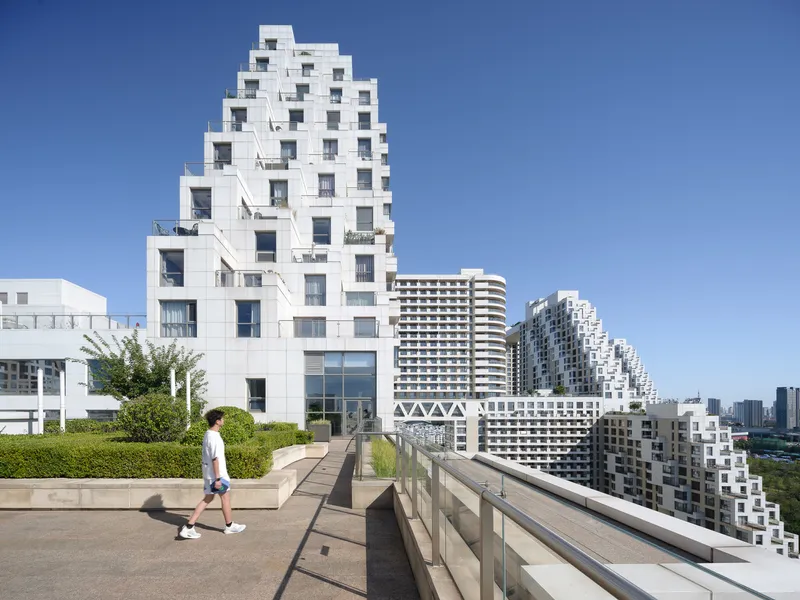
The structural skybridges at the 18th and 33rd floors are visible as exposed trusses that allow the upper residential blocks to straddle the lower ones. These are not decorative connections. They carry communal gardens and pool areas at the 15th and 30th levels, creating elevated parkland that would otherwise require standalone podium structures. The truss expression is honest and muscular, a refreshing contrast to the camouflaged engineering typical of luxury housing.
At the unit level, the stepped configuration delivers on Safdie's longstanding promise that every apartment should feel like a penthouse. Private terraces, balconies, and solariums are standard, not premium add-ons. The planted rooftop terraces visible in close-up views show grasses and shrubs with enough soil depth to support genuine garden conditions, not token planters. Looking across from one terrace to the neighboring tower, the scale of each offset becomes clear: these are real outdoor rooms, not narrow ledges.
Reinforced Concrete at Residential Scale
The buildings are constructed in reinforced concrete with a concrete-steel composite structural system, executed by China Railway Group Limited with facade consultation from AECOM and Zhejiang Zhongnan Construction Group. The material palette is deliberately restrained: white and light-toned concrete surfaces, clean horizontal banding at slab edges, and recessed glazing. The restraint is strategic. With this many terraces, balconies, and offsets generating visual complexity through geometry alone, a quiet material language prevents the facades from becoming chaotic.
The concrete also ages well in a marine environment when properly detailed, which matters for a development whose identity depends on crisp, legible terracing. Over time, the planted terraces will soften and green the facades, and the concrete will serve as a stable background. It is a long-term bet on simplicity that few developers would make without an architect willing to argue for it.
Why This Project Matters
Habitat Qinhuangdao Phase II is the largest built test of the thesis Safdie introduced 57 years ago in Montreal. At 1,800 units across two phases, it answers the scalability question definitively: the principles of individual outdoor space, daylight access, and visual connectivity do hold at megascale, provided the architect controls the massing logic and the developer commits to landscape as infrastructure, not amenity. The skybridges, courtyards, and planted terraces are not gestures. They are load-bearing elements of the social contract between density and livability.
The project also recalibrates expectations for resort housing in China. Rather than isolating towers on open lawns or hiding them behind gates, Safdie's scheme builds a legible public realm with cultural programming, varied landscapes, and pedestrian spines that connect beach to city. It treats the beachfront not as a scenic backdrop but as an orientation device that shapes every floor plate. For architects and planners working on high-density waterfront sites anywhere, Habitat Qinhuangdao is now the benchmark to argue with.
Habitat Qinhuangdao Phase II by Safdie Architects. Located in Qinhuangdao, Hebei Province, China, on the coast of the Bohai Sea. Phase II area: 244,000 square meters; total development: 40 acres (16 hectares). Developed by Kerry Properties. Photographs by SFAP.
About the Studio
Share Your Own Work on uni.xyz
If projects like this are the kind of work you want to make, uni.xyz is a place to publish your own, find collaborators, and enter design competitions.



Popular Articles
Popular articles from the community


Hill & Cross Opera: Sculptural Opera House Architecture Shaped by Tallinn’s Landscape and Identity
Hill & Cross Opera reimagines opera house architecture in Tallinn through its sculptural hill, civic plaza, glass wave and a luminous cross.

The Musturak Paradise: Senior Living Architecture for a Connected Future in Temara, Morocco
The Musturak Paradise reimagines senior living architecture in Temara via private homes, social spaces, culture, community, and shared care.

Conexión: Biophilic Design Reimagines High-Rise Living in Hong Kong
Conexión reimagines high-rise living in Hong Kong through biophilic design, green facades, shared spaces, daylight, water and nature within.

The Earth Pod: 3D Printed Homes for Resilient Refugee Communities
The Earth Pod reimagines refugee housing through 3D printed homes made from clay, combining resilience, self-sufficiency, and rapid shelter.

Similar Reads
You might also enjoy these articles


Hodi-Mandai Geram
Project Function: Preservation and revitalization of the Intangible heritage and socio-spatial identity of the Hodi by Housing, Cultural Memory Center, Sacred Grove, landscape, local tourism economy


Olio Towers: A Mid-Rise for Performers That Fuses Housing, Rehearsal, and Stage
Located blocks from Houston's Theater District, this modular tower stacks living units around a central performance atrium.

Oasis: Modular Green Housing Carved into Dhaka's Urban Fabric
A shortlisted Plugin Housing entry reclaims unauthorized settlements in Dhaka with stepped concrete volumes, green roofs, and ventilation-driven design.

Black Hole: A Floating Megastructure for the Post-Physical Era
Emiliano Mazzarotto envisions a spherical, self-scaling arena where e-sports, digital hotels, and holographic stadiums replace traditional public space.

Explore Housing Competitions
Discover active competitions in this discipline



Challenge to reimagine the Iron Throne


Photograph architecture without architects


Illustrate the lost glory of Angkor Wat - Render Challenge


Design challenge to reuse E-waste
Comments (0)
Please login or sign up to add comments
No comments yet. Be the first to comment!