
HAGISO Wraps a Family of Seven in a Curving Envelope on a Tight Maebashi Plot
A 103-square-meter house near Maebashi Station uses curved walls and a central courtyard to shelter five children and their parents from the region's dry w


How do you fit seven people into 103 square meters and still make a house feel generous? HAGISO, the Tokyo-based practice led by Mitsuyoshi Miyazaki, answers the question with Path Envelope in Maebashi, a residence whose curving stucco walls wrap around a central courtyard like cupped hands. The house sits in a dense residential neighborhood near Maebashi Station, hemmed in by neighboring rooftops on every side, yet it manages to carve out a surprising amount of sky, air, and communal ground for a couple and their five children.
What makes the project worth attention is its refusal to treat compactness as a constraint to be endured. Instead, Miyazaki leans into the curve, both literally and programmatically. The encircling wall is not decorative; it deflects the dry winter winds that sweep across the northern Kanto plain while funneling seasonal breezes and light into the courtyard. Inside, a gymnasium-like double-height volume the architects call the "Arena" gives the house a collective heart, a space where family life can be loud, physical, and uncontained, even when the footprint says otherwise.
A Curve Against the Wind
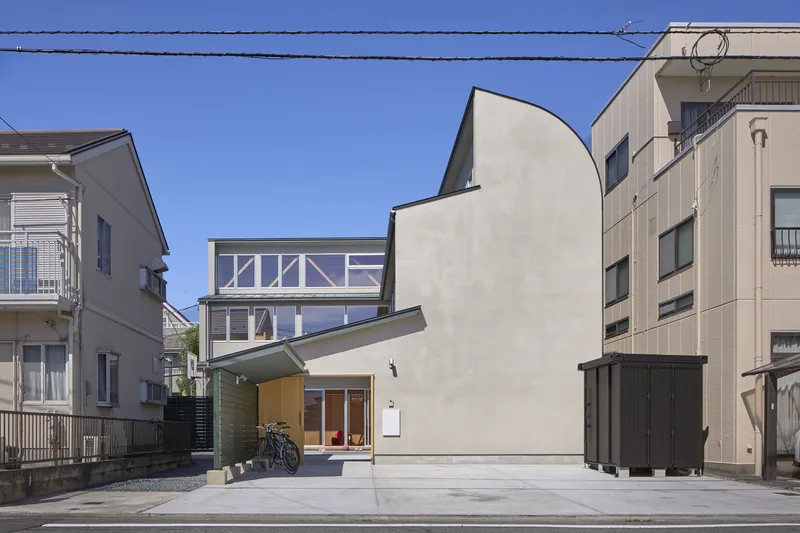
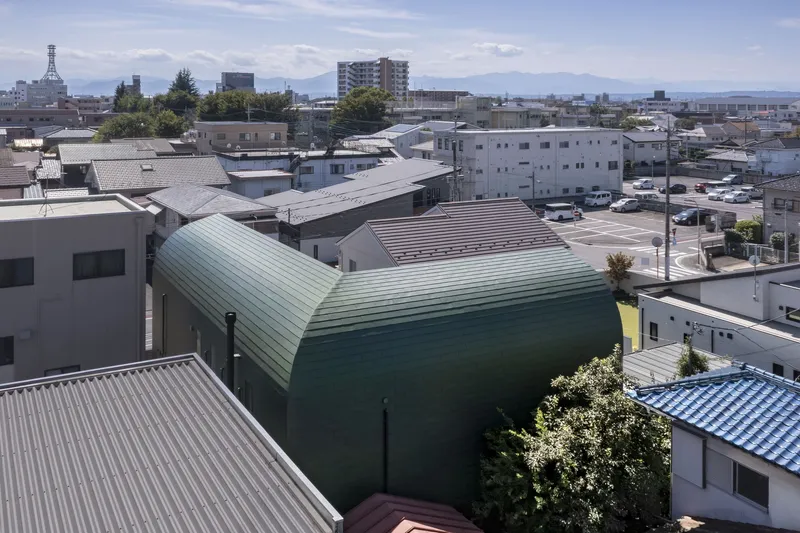
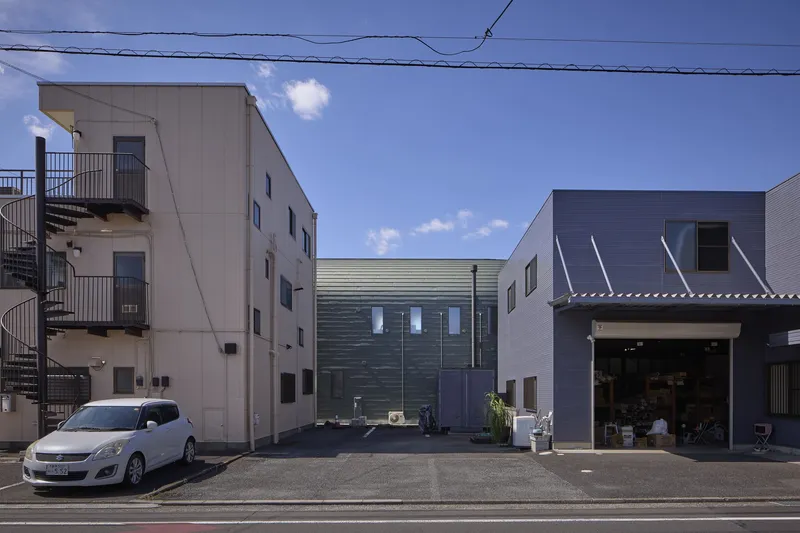
From the street, the house reads as a continuous white stucco wall that bends gently between its neighbors, offering no sharp corners and very few windows to the public side. The aerial view reveals the logic: a corrugated metal roof traces the same arc, rising above the surrounding pitched roofs like a smooth shell. On the opposite flank, dark timber cladding signals a different material register where the building meets a narrow side yard. The curve is not arbitrary. Northern Kanto is known for dry, persistent winds, and the encircling wall creates a lee on the courtyard side, making outdoor time viable across seasons.
The Courtyard as Common Ground
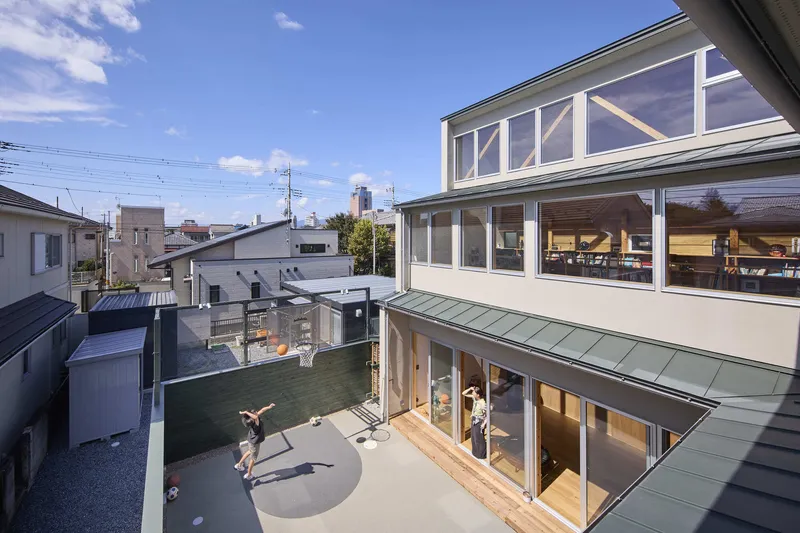
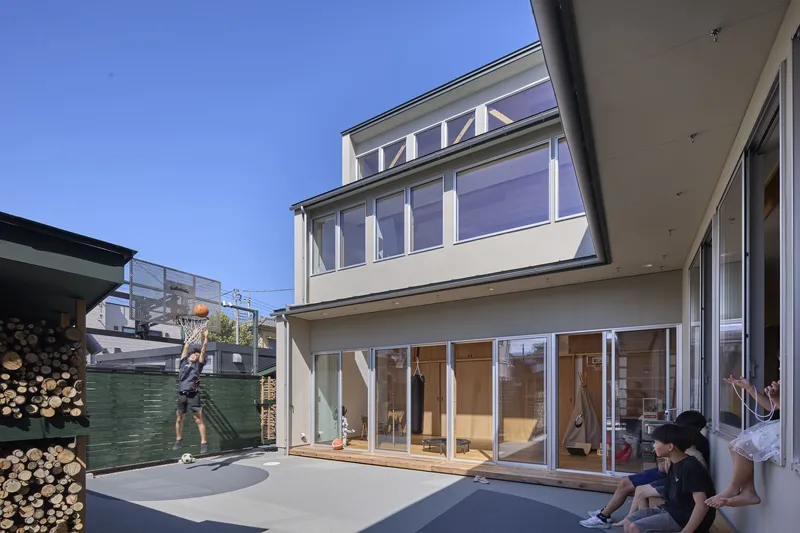
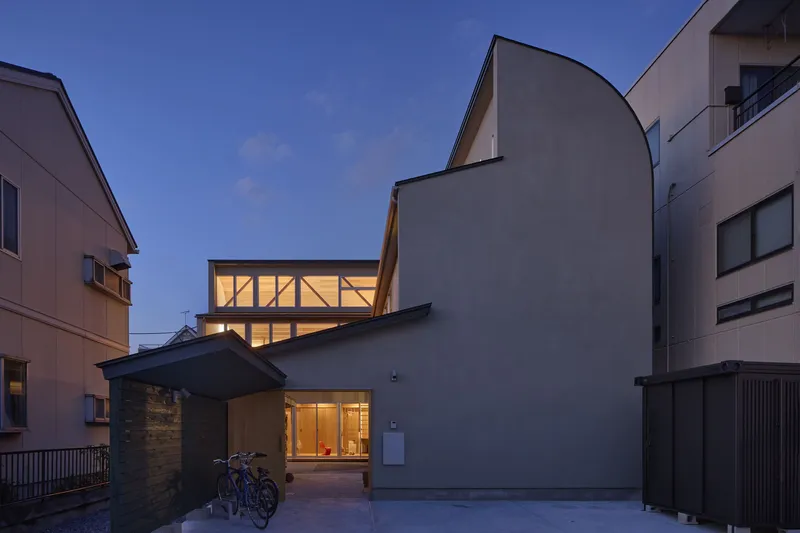
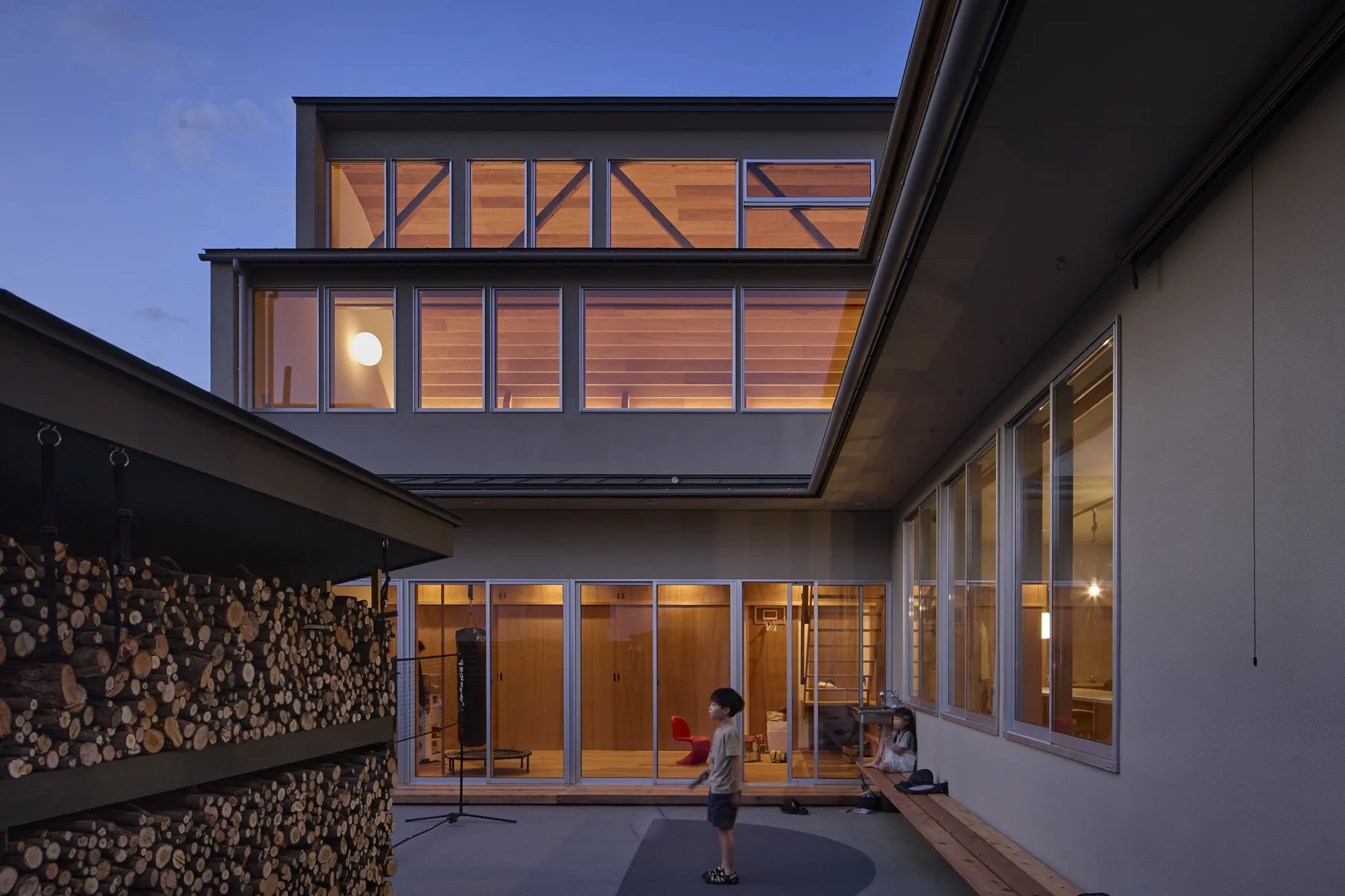
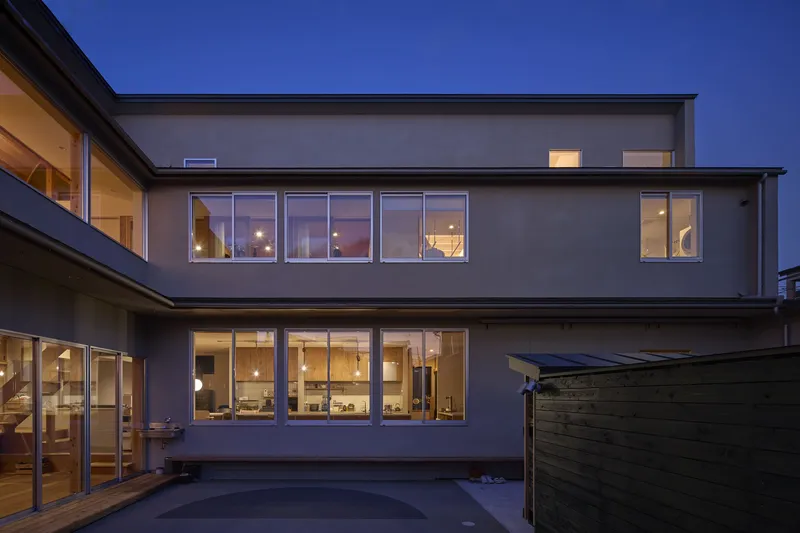
The courtyard is the social engine of the house. At dusk it comes alive: children run across the concrete terrace, the family gathers behind sliding glass doors, and the stacked glazed volumes glow from within like a lantern. The paved surface is deliberately simple, almost austere, so that the architecture frames the activity rather than competing with it. Sliding panels on the ground floor dissolve the boundary between inside and out, extending the kitchen and dining area into the open air when conditions allow.
By night, the courtyard becomes a kind of communal stage. The illuminated rear elevation, two stories of floor-to-ceiling glass, puts domestic life on gentle display to itself, reinforcing the sense that the house is oriented inward, toward its own shared center, rather than toward the street.
The Arena: A Gymnasium Inside a House
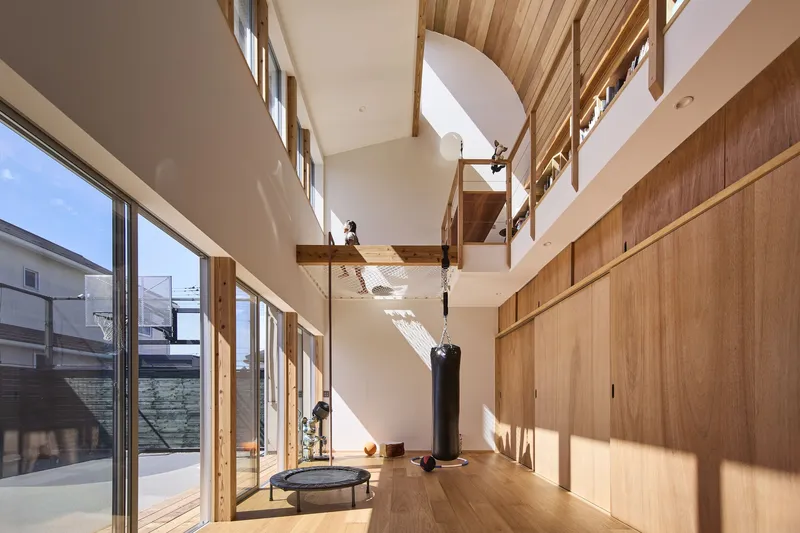
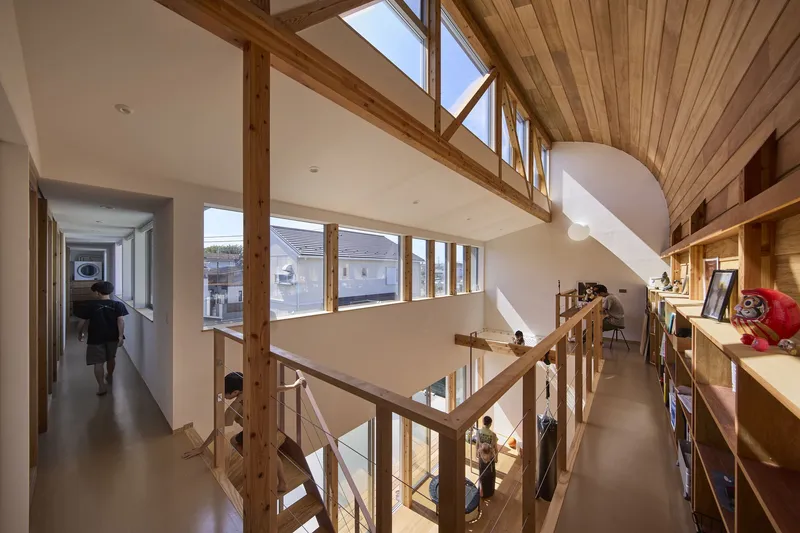
The double-height space HAGISO calls the Arena is the most striking interior move. Exposed timber framing lines the walls and supports a clerestory band that floods the room with raking sunlight. A wooden staircase threads through the volume, connecting split levels without ever closing off the vertical openness. The proportions recall a small gymnasium or a barn more than a living room, and that is the point: with five children in the house, the architecture needs to accommodate chaos, not just elegance.
Clerestory windows placed high on the curved wall pull light deep into the space without sacrificing privacy from neighbors. The timber structure is left exposed throughout, turning the frame into furniture, decoration, and spatial rhythm all at once. It is a strategy that keeps material costs down while giving the interior a warmth and legibility that drywall and paint could never match.
Color, Steel, and the Pink Staircase
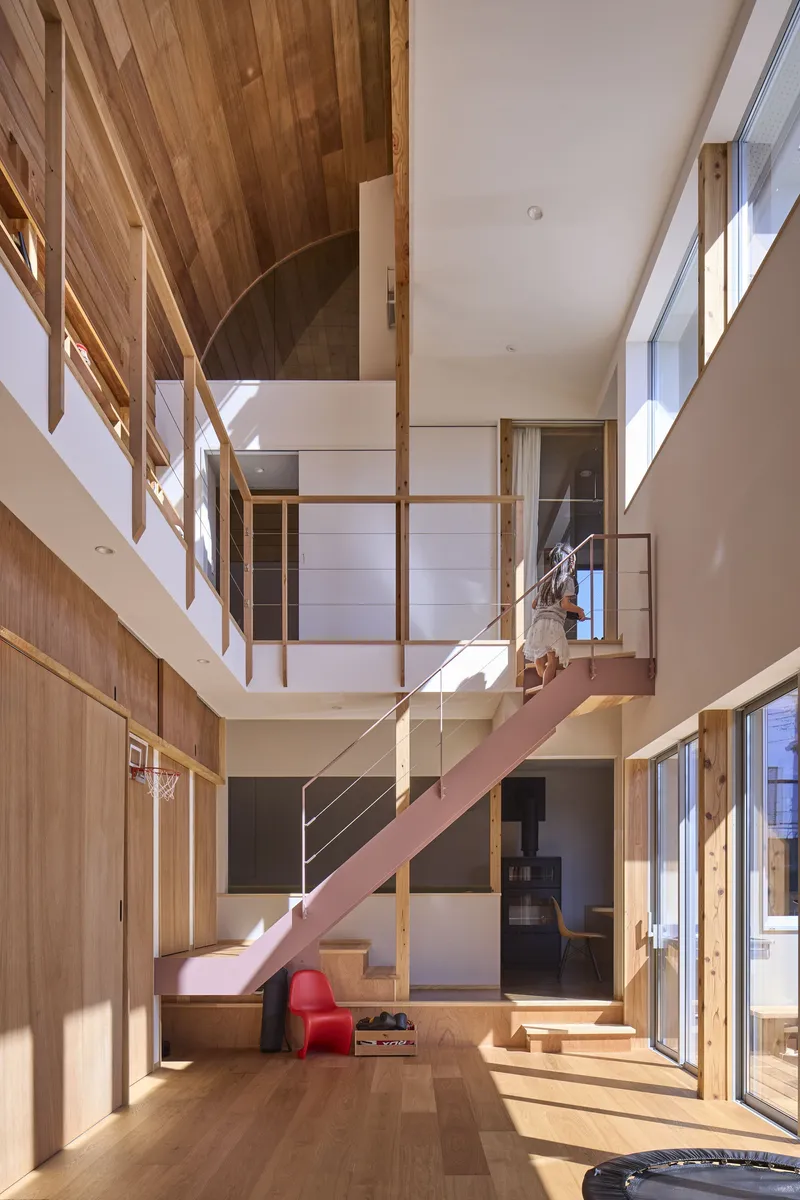
Amid all the pale timber and white stucco, a pink steel staircase cuts across the split levels with unapologetic cheerfulness. It connects the main living zone to the upper bedrooms and mezzanine, its powder-coated finish providing the single strongest color note in the entire house. The decision feels intentional rather than whimsical: in a house designed for children, one bold gesture of color signals that play and personality have a seat at the table.
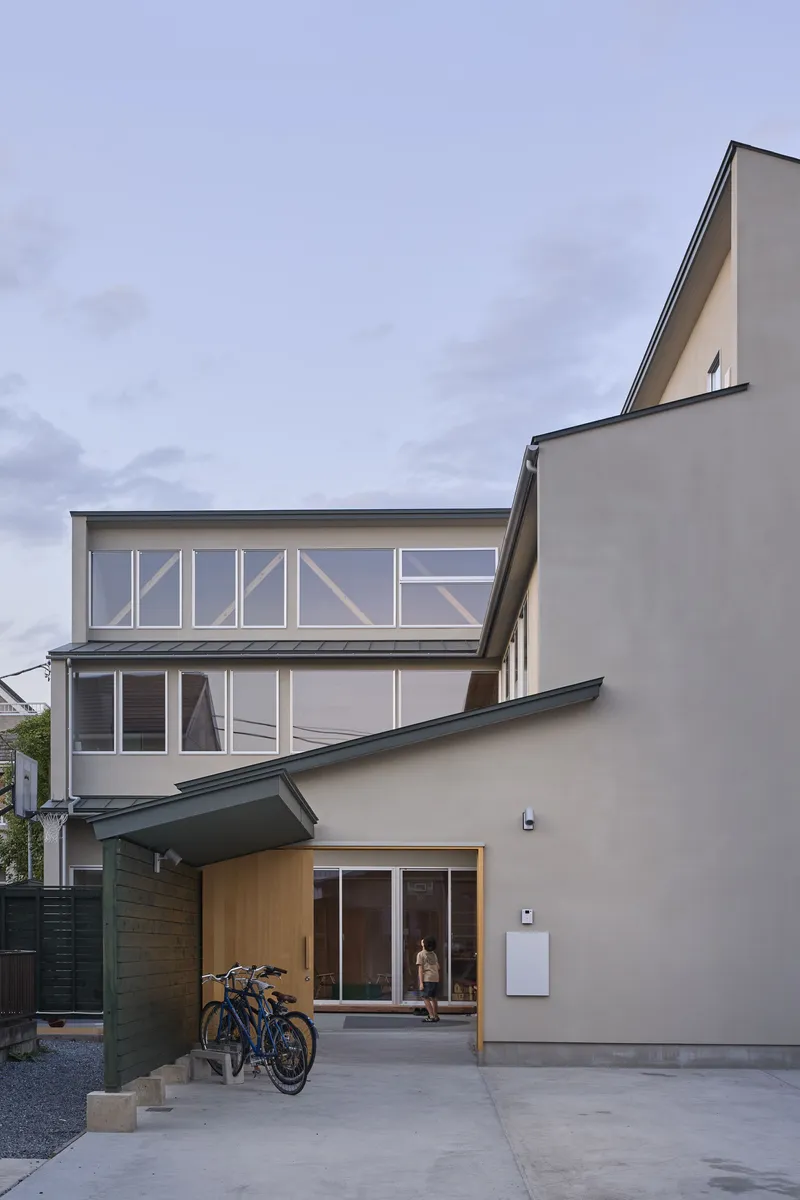
At the street entry, a rendered carport wall and a glazed upper volume form a restrained public face, bicycles parked casually underneath. The twilight view of the rear elevation, two stories of glass framed in thin mullions, completes the tonal range: from opaque curve to total transparency, the house shifts register depending on which face you are looking at.
Living, Cooking, Studying
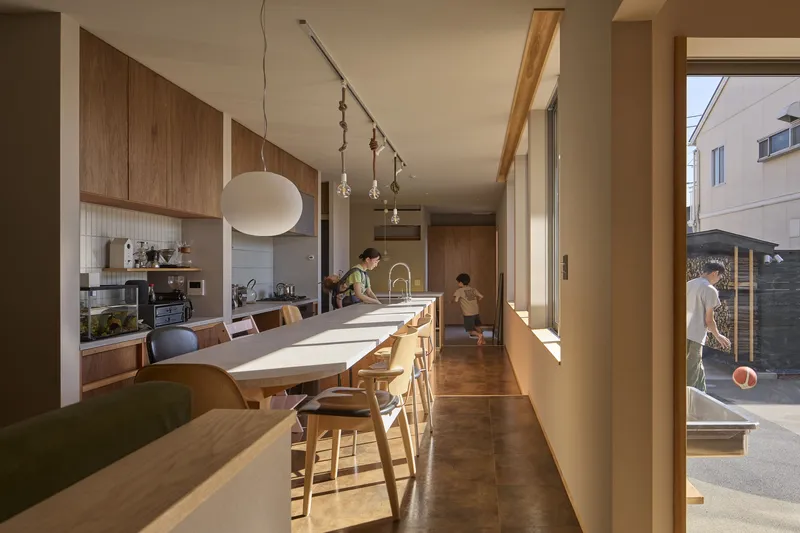
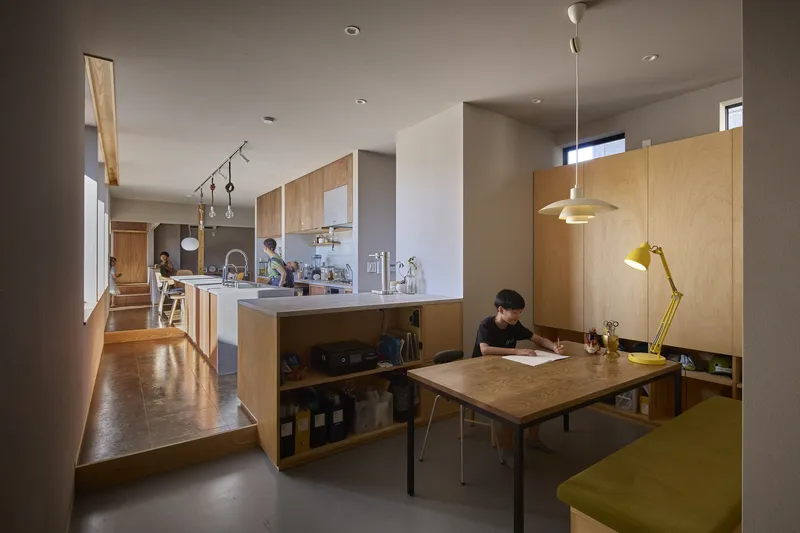
The kitchen and dining zone occupies a long, sunlit room with light wood cabinetry and a communal table that doubles as a homework station. One image shows a child studying at a desk integrated into the kitchen counter under pendant lighting, a small detail that reveals how carefully the plan accommodates the daily reality of a large family. There is no separate study, no formal dining room. Everything overlaps, and the architecture supports the overlap rather than resisting it.
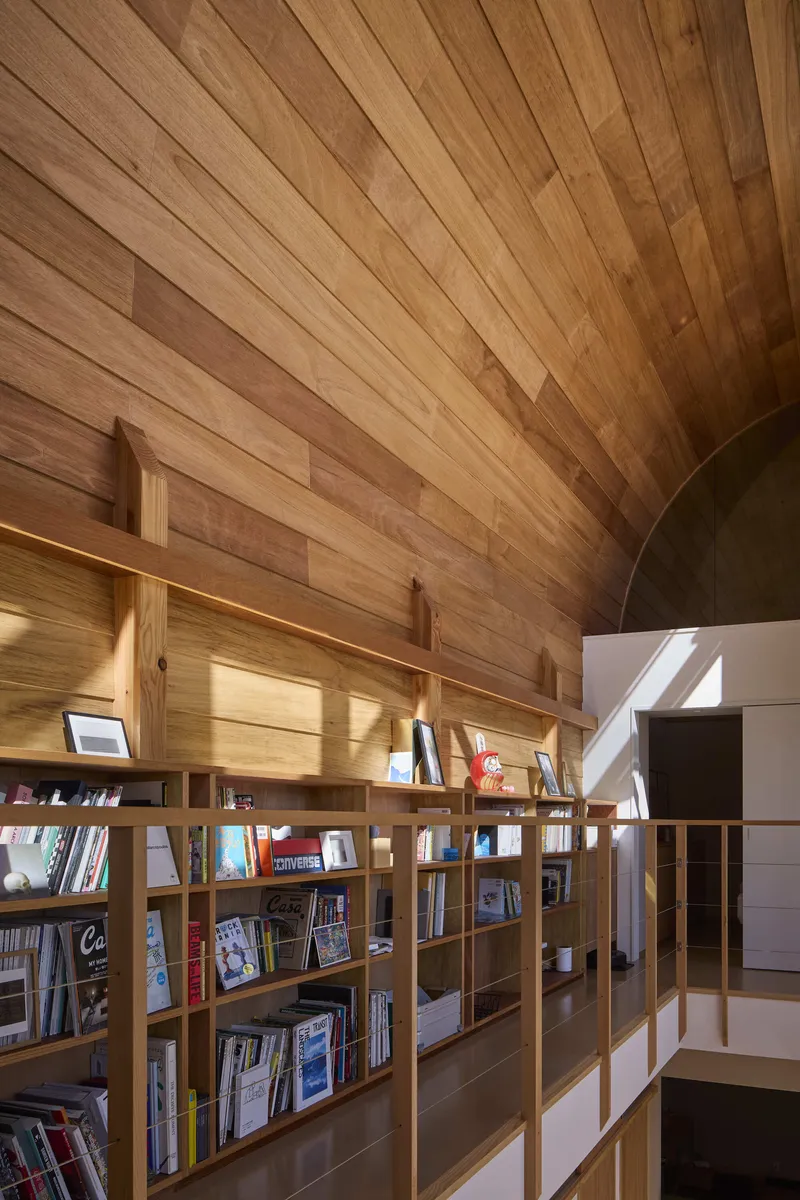
Above, a mezzanine lined with bookshelves curves under the timber-plank ceiling, its upper edge lit by indirect strip lighting. The space feels like a nest, compact and warm, elevated above the communal noise below. It is a retreat within the house that does not require a door, only a change in altitude.
Private Rooms Under the Vault
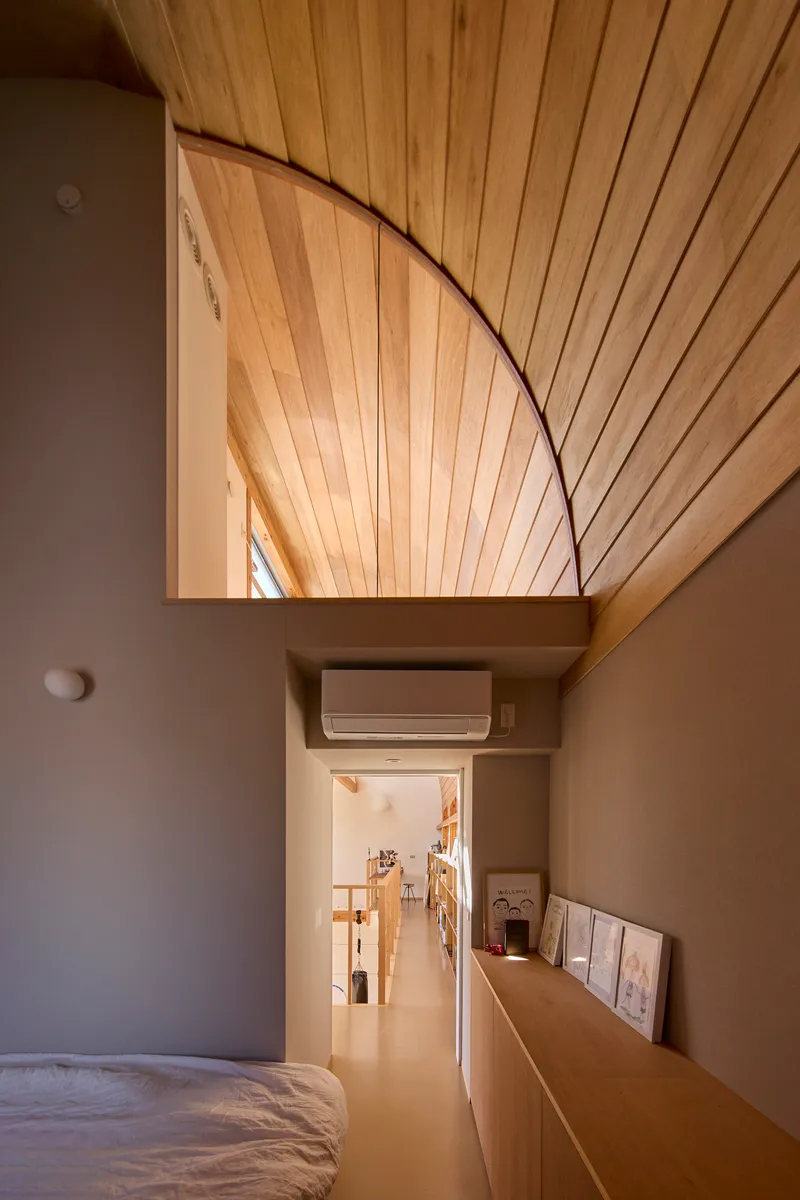
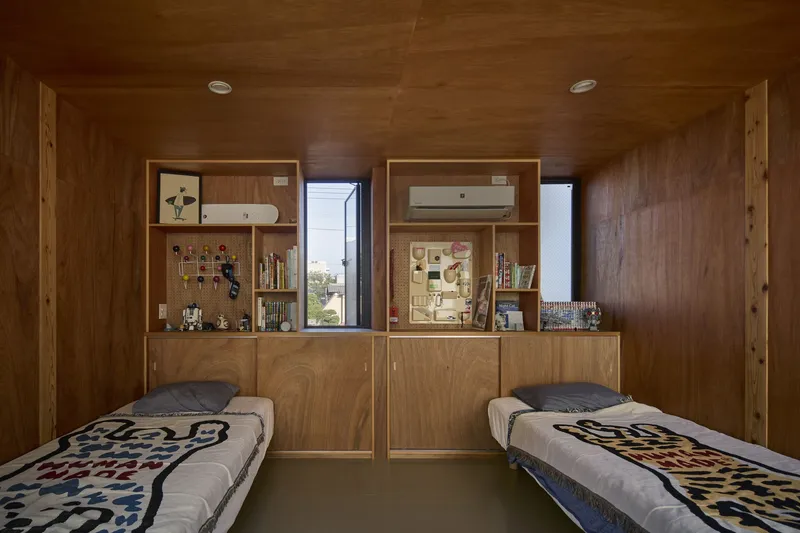
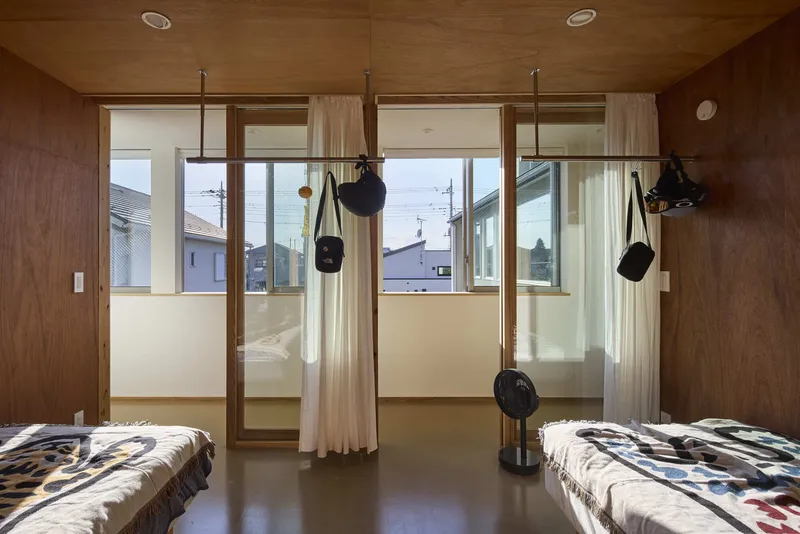
The bedrooms are compact, as they must be in a house this size, but Miyazaki treats each one as a framed view rather than a leftover volume. One room looks through a grey-framed opening to the curved timber ceiling vault of the corridor beyond, collapsing the boundary between private and shared space. Another pairs twin beds with built-in storage and narrow windows that frame rooftop views of the neighborhood. A third opens through sliding glass doors to a small balcony, with hanging storage bags suspended from ceiling rods to keep the floor clear.
Storage is handled with the same quiet precision. Walk-in closets with timber shelving, exposed beam ceilings, and even a central island unit squeeze maximum utility out of the curved plan geometry. These are not glamorous spaces, but they work hard, and in a house for seven, that matters more than anything else.
Side Yards and Thresholds
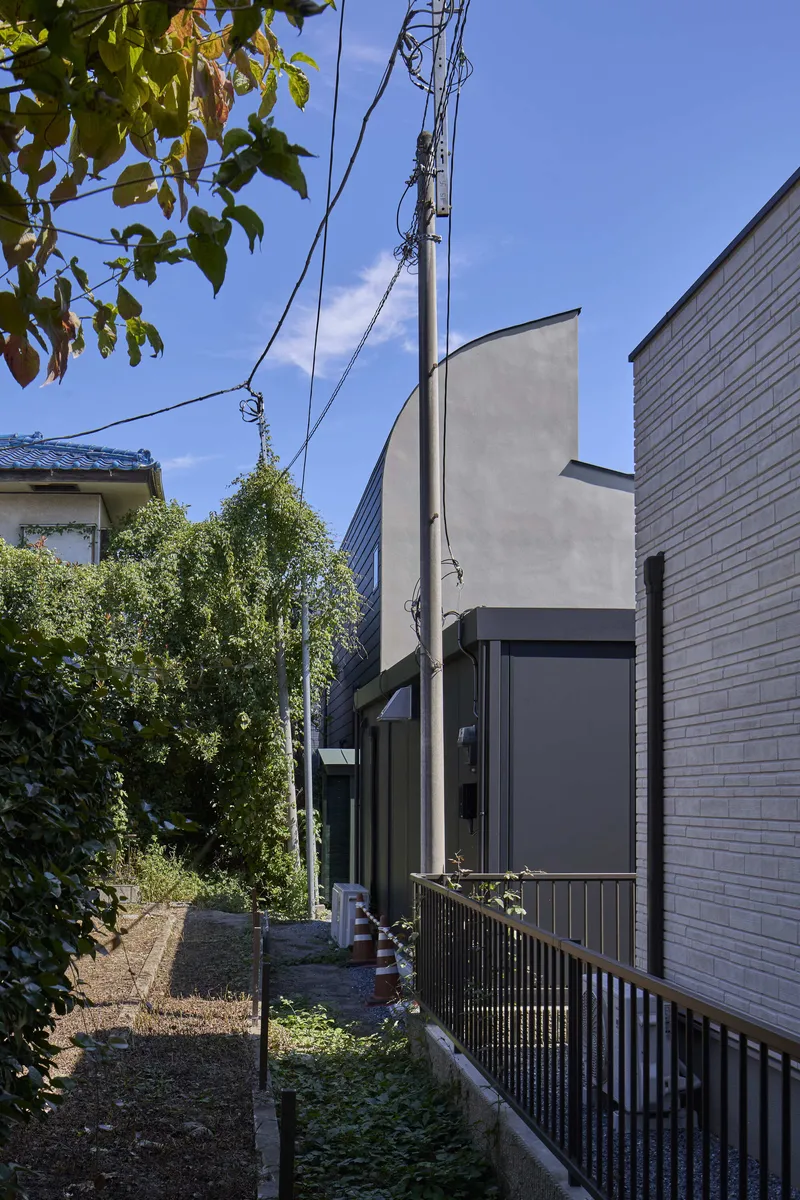
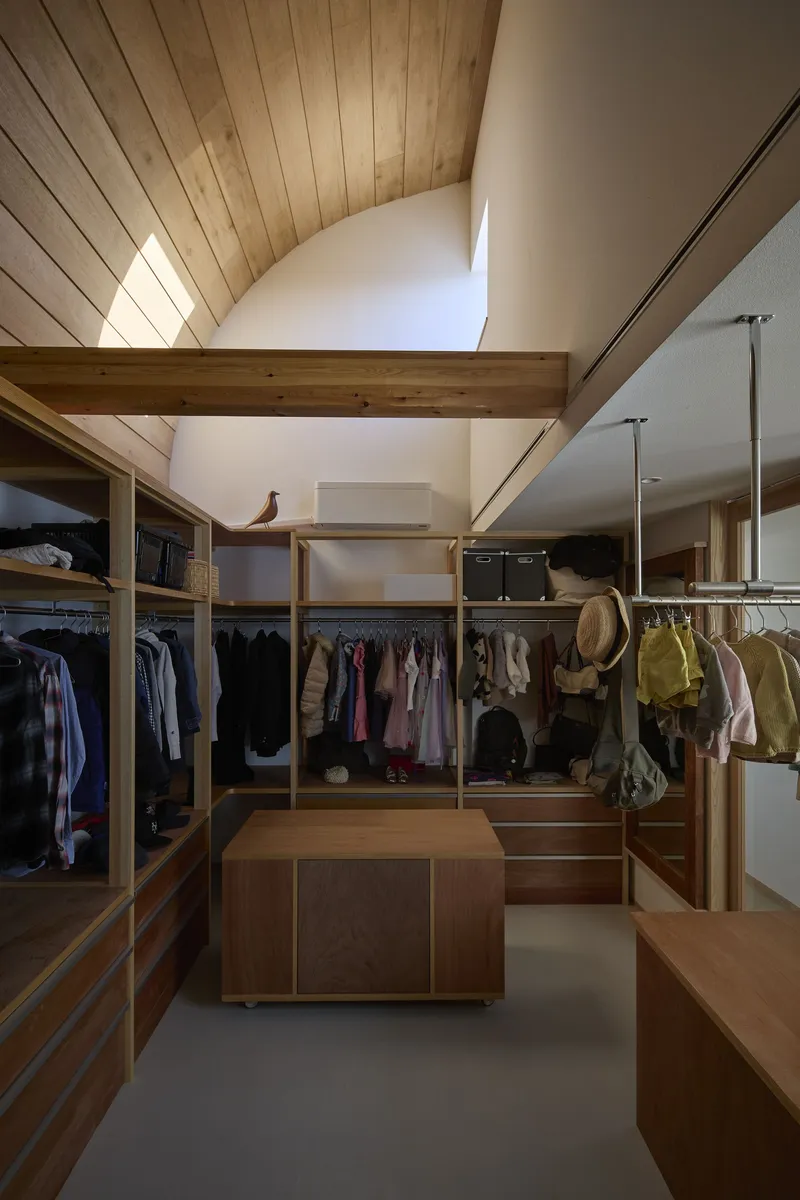
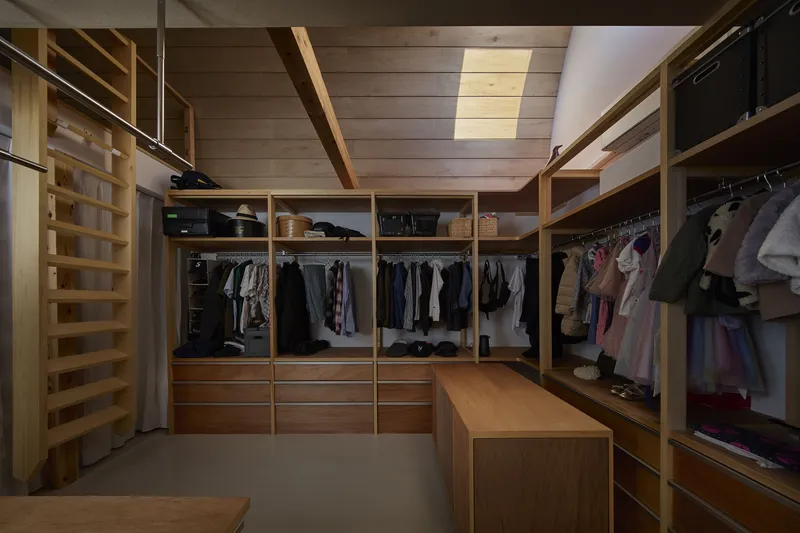
A narrow planted strip between the rendered wall and a neighboring timber-clad house hints at the density of the site. The gap is barely wide enough for a person to walk through, yet HAGISO has planted vegetation along its length, turning what could be dead space into a green seam. Inside, the closet and storage interiors continue the exposed timber language, with plank ceilings and beam structures visible overhead. The consistency is deliberate: every space in the house, no matter how utilitarian, shares the same material vocabulary.
Plans and Drawings
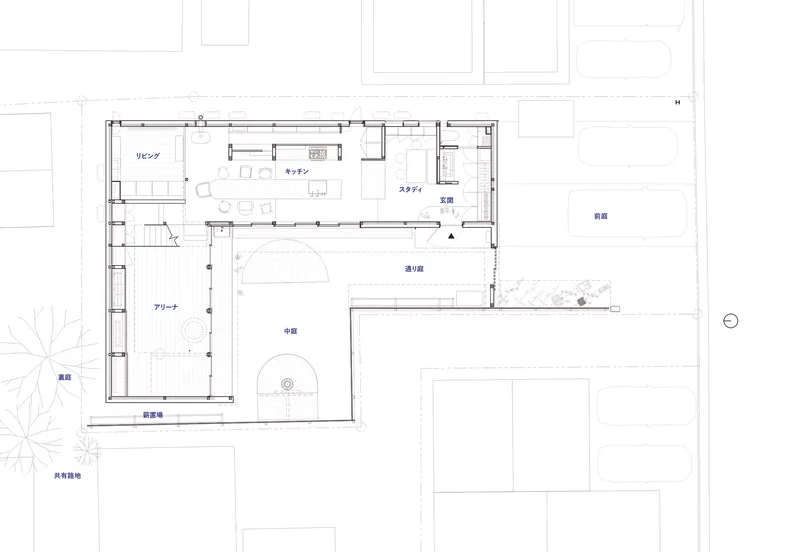
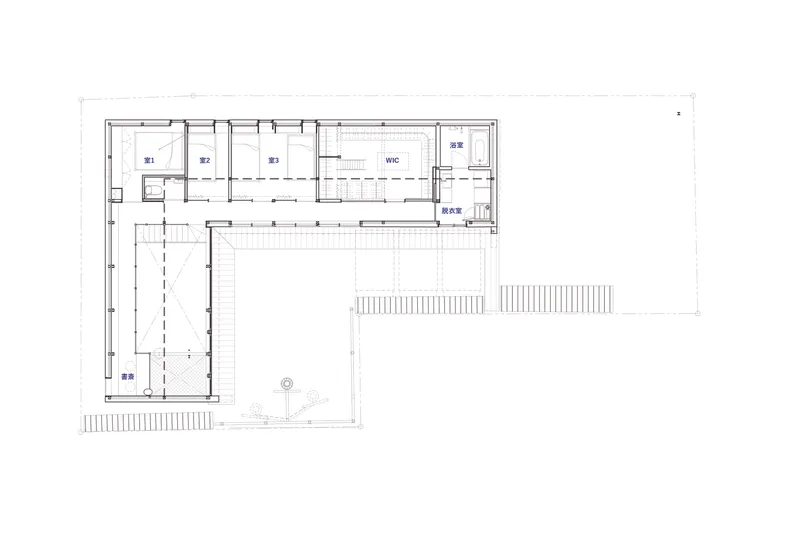
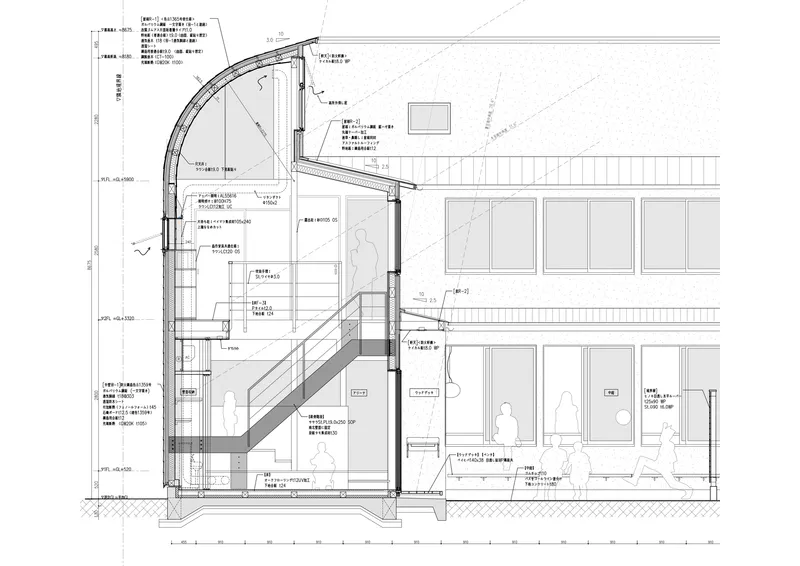
The ground floor plan confirms the courtyard-centric organization: kitchen, dining, and living areas wrap around the open-air void, with the curved exterior wall defining the outer boundary. The upper floor distributes three rooms and a terrace overlooking the courtyard below. The section drawing is the most revealing document. It shows the staircase threading through the split-level arrangement, the double-height Arena rising under the curved roof, and the way clerestory windows sit at the apex to pull light into the deepest parts of the plan. For 103 square meters, the spatial complexity is remarkable.
Why This Project Matters
Path Envelope in Maebashi is a reminder that small houses for large families do not have to feel like exercises in deprivation. Miyazaki and HAGISO have treated every square meter as an opportunity for spatial generosity, whether through the Arena's vertical openness, the courtyard's ability to extend the living area outdoors, or the mezzanine library's quiet elevation above the fray. The curved wall is not a formal indulgence; it solves a real climatic problem while giving the house an identity that distinguishes it from the orthogonal grid around it.
The architects describe the house as an envelope that cradles time spent by family and community, not a machine for living. That distinction plays out in the details: a kitchen counter that becomes a homework desk, a courtyard terrace that becomes a playground, closets that share the same timber warmth as the living room. When the program is this demanding and the footprint this tight, the quality of a house is measured not by what it looks like but by how well it absorbs the life inside it. Path Envelope absorbs a lot.
Path Envelope in Maebashi, designed by HAGISO (lead architect: Mitsuyoshi Miyazaki). Located in Maebashi, Japan. 103 m². Completed in 2025. Photography by Tomoyuki Kusunose.
About the Studio
Share Your Own Work on uni.xyz
If projects like this are the kind of work you want to make, uni.xyz is a place to publish your own, find collaborators, and enter design competitions.




Popular Articles
Popular articles from the community


Play: Fragments of Their World
Familiar architecture becomes modular playground design, creating safe spaces where displaced children can learn, connect, imagine and play.

The Earth Pod: 3D Printed Homes for Resilient Refugee Communities
The Earth Pod reimagines refugee housing through 3D printed homes made from clay, combining resilience, self-sufficiency, and rapid shelter.

Co-life: Sustainable Architecture for Age-Friendly Community Living
Co-life reimagines sustainable architecture for seniors through courtyards, rammed earth, shared gardens, and spaces designed for belonging.

The Musturak Paradise: Senior Living Architecture for a Connected Future in Temara, Morocco
The Musturak Paradise reimagines senior living architecture in Temara via private homes, social spaces, culture, community, and shared care.


Similar Reads
You might also enjoy these articles

Bao Huynh Watercolor Atelier: A Serene Art Retreat in Hội An
Bao Huynh Watercolor Atelier in Hội An blends multifunctional art spaces, sustainable design, local materials, and family-friendly living in a serene environment.

Atelier Macri Concept Store Interior Design by CASE-REAL
Atelier Macri store features a "ko" counter, walnut wood details, cork displays, blending retail, gallery, and seamless customer experiences.

Manuel Vargas Izquierdo Stadium and High-Performance Sports Center: Architectural Excellence in Jalpa de Méndez
The Manuel Vargas Izquierdo Stadium blends sustainable design, inclusive sports facilities, and cultural-inspired architecture, revitalizing Jalpa de Méndez’s public spaces.

KAKR Buluh Awar Hall: Revitalizing Community and Ecology Through Bamboo Architecture
Community built bamboo hall revitalizes Buluh Awar village, empowering youth, restoring ecology, celebrating vernacular craftsmanship through sustainable architecture and culture.


Explore Residential Building Competitions
Discover active competitions in this discipline



Challenge to design a barrier free sports center


Challenge to design an outdoor ice-rink and park


Challenge to design mud housing for contemporary communities
Comments (0)
Please login or sign up to add comments
No comments yet. Be the first to comment!