
1+1>2 Architects Weave a Village School into the Mountains of Northern Vietnam
Built with local stone and adobe by the community it serves, Hang Tau's school doubles as the social heart of a remote Mong village.


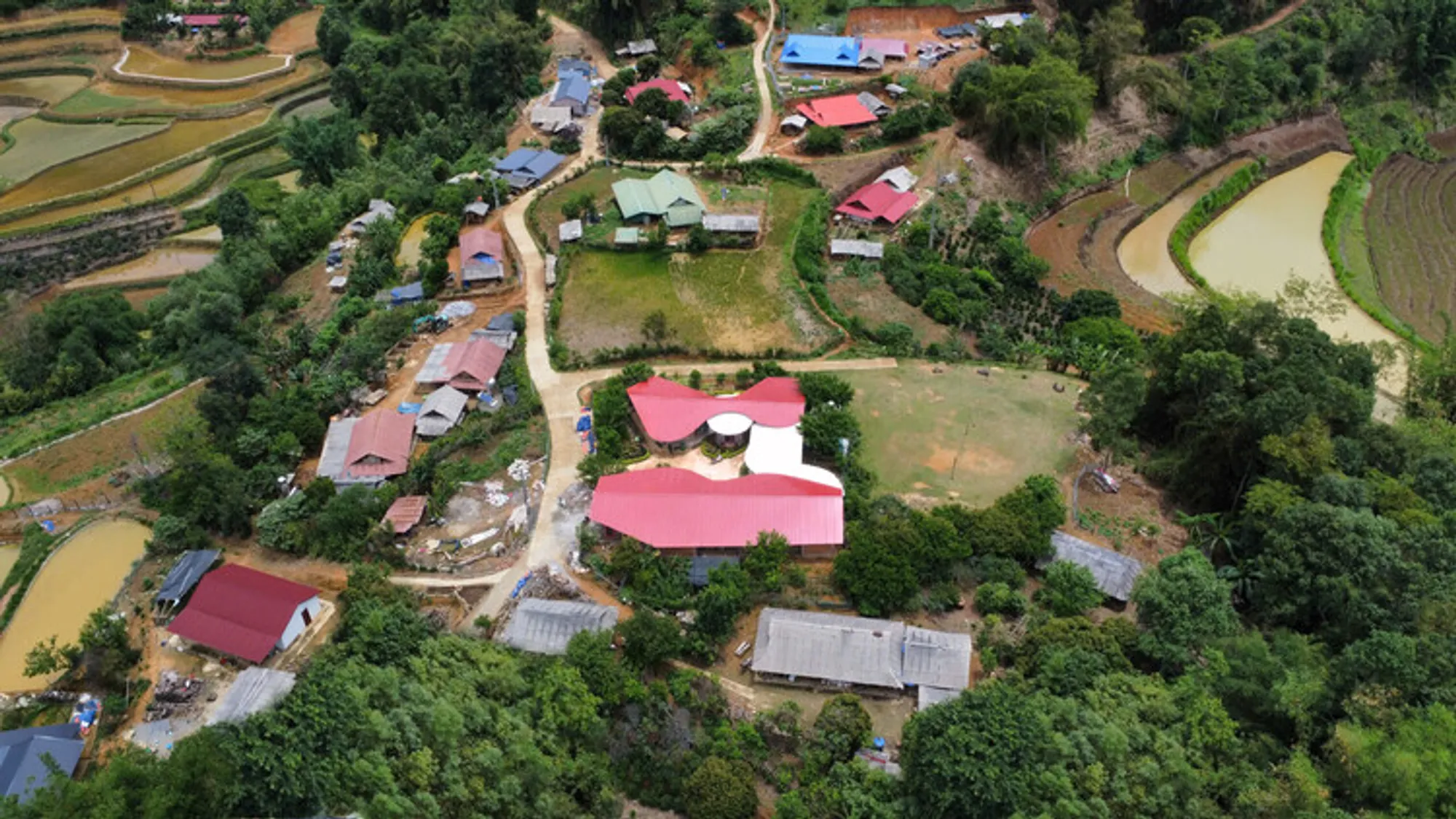
Twenty kilometers from the nearest town, perched midway along the Pha Din Pass in Dien Bien Province, a cluster of red roofs now punctuates the terraced hillside of Hang Tau village. Designed by Hanoi-based 1+1>2 Architects, the Hang Tau Kindergarten and Primary School is a 1,328 square meter campus serving over 100 children from the local Mong ethnic community. It contains four classrooms, two teacher housing units, and two shared kitchens, all organized into interlocking blocks that step down the mountain slope rather than flatten it. The architects refused to level the site, and that single decision set the terms for everything that followed.
What makes the project worth studying is not just its sensitivity to terrain or its use of local materials, though both are impressive. It is the way the school collapses the distinction between institutional building and communal infrastructure. In remote Vietnamese mountain communities, schools routinely become gathering spaces for adults after hours. 1+1>2 designed for that reality from the outset, creating covered courtyards, open-air bridges, and sheltered walkways that serve educational and social functions simultaneously. The building does not sit in the village; it belongs to it.
A Red Roofline That Reads as Landscape
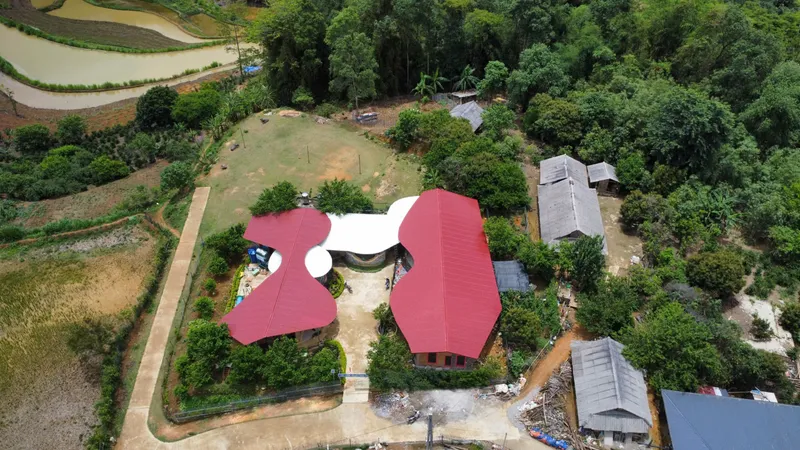
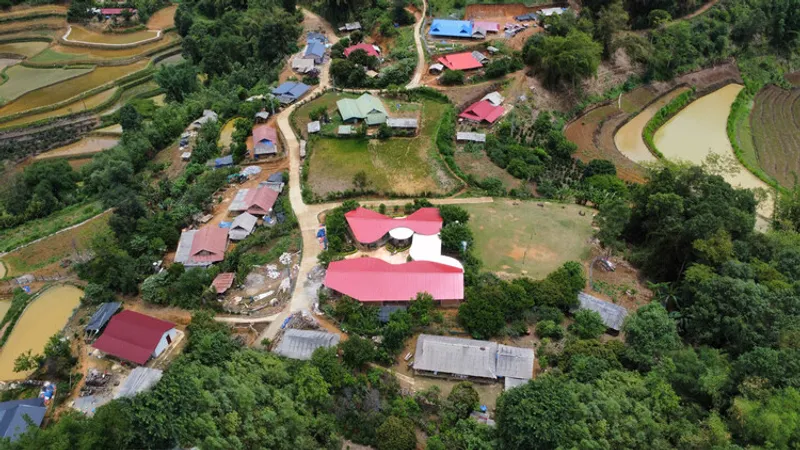
From the air, the school's defining gesture becomes legible: a sweeping, three-lobed corrugated metal roof whose curves mirror the surrounding peaks. The roofline unifies the kindergarten, library, courtyard, and primary school into a single composition while giving each functional block its own distinct volume. Red metal reads as warm and familiar against the green of terraced rice paddies rather than alien and industrial. The school sits among village homes and fields as though it grew alongside them, which is precisely the point.
The form also performs. The curved roof creates generous overhangs that shade the courtyard and playground below, while its pitch encourages natural ventilation by drawing warm air upward and out. In a climate with hot, humid summers and cold mountain winters, passive strategies like these are not aesthetic choices. They are survival strategies for a building that will likely never have mechanical cooling.
Stone, Adobe, and the Logic of Making Walls on Site
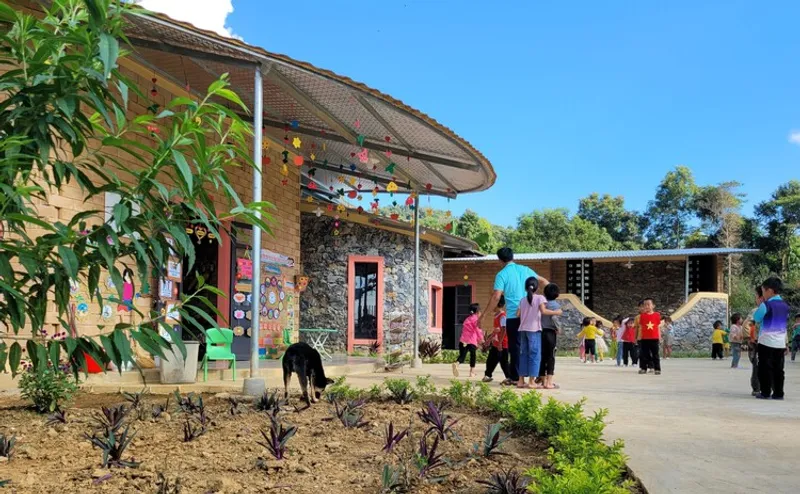
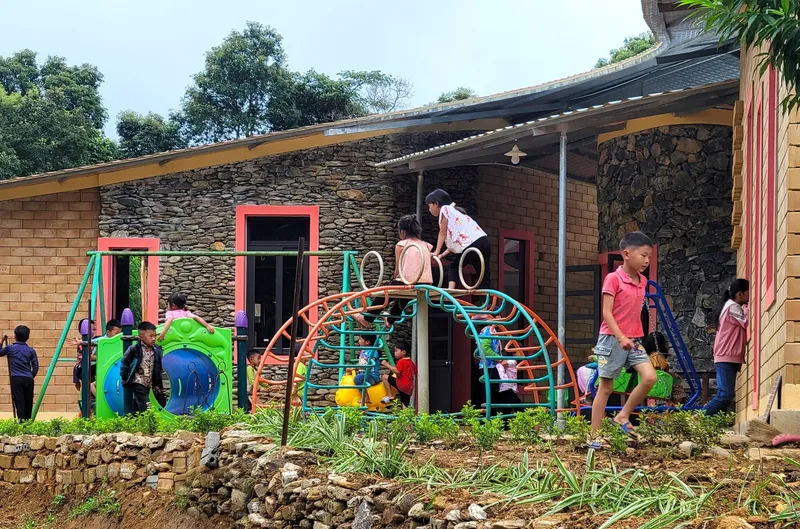
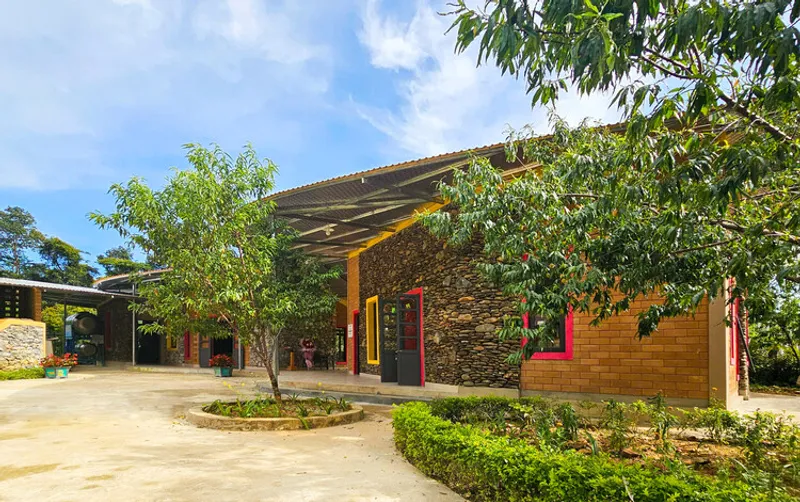
The walls of Hang Tau school are its most tactile achievement. Local mountain stone forms the foundations and lower courses, while adobe bricks, produced on site from excavated soil, make up the bulk of the wall mass. The interwoven patterns of stone and adobe are not decorative afterthoughts; they reference H'Mong stone-stacking techniques and traditional textile patterns. The result is a wall system that looks handmade because it is handmade, by the same villagers whose children now fill the classrooms.
There is a hard-nosed pragmatism underneath the craft. Sourcing and fabricating materials locally eliminated the cost and logistical burden of trucking construction supplies up a mountain pass. Villagers participated directly in the building process, which gave the community a stake in the finished school that no ribbon-cutting ceremony could replicate. The thermal mass of stone and adobe also keeps classrooms warm in winter and cool in summer, a passive performance benefit that aligns neatly with the zero-budget mechanical services reality of the site.
The Courtyard as Shared Ground
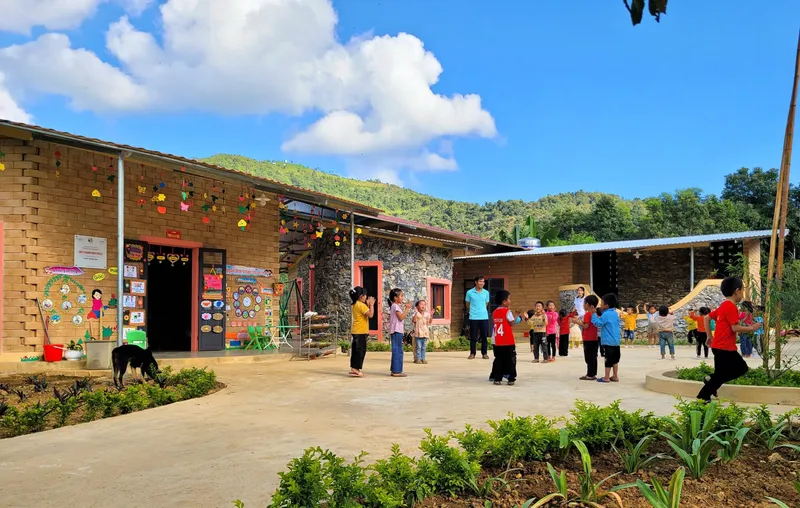
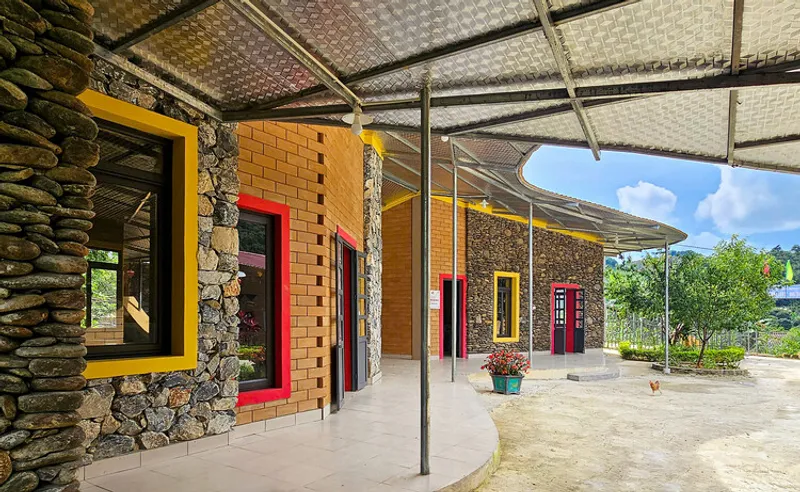
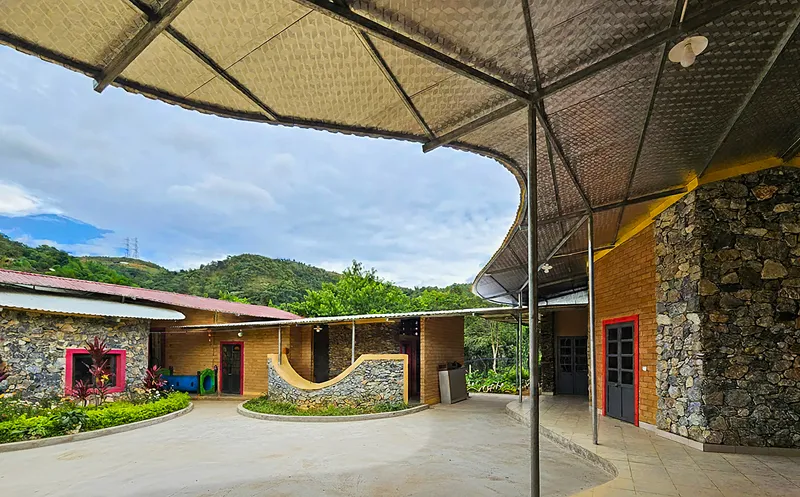
The campus is organized around a central courtyard that doubles as playground, gathering space, and circulation hub. Classroom wings face inward toward this shared ground, creating a sense of enclosure without confinement. Children spill out of classrooms directly into the courtyard, and the covered overhead canopy, a woven bamboo structure, filters light while providing rain and sun protection. The yellow and pink window frames scattered across the stone facades add bursts of color that feel joyful without being patronizing.
Looking at the courtyard from beneath the bamboo canopy, you notice how the architecture frames the landscape beyond. The hills are always visible through gaps between buildings and above low rooflines. The school does not wall children off from their environment; it positions them within it. The covered walkways and open-air bridges connecting the blocks reinforce the feeling of a small, interconnected village rather than a monolithic institution. For a community where the nearest town is a long journey away, that sense of familiarity matters enormously.
Interiors Built from What the Mountain Provides
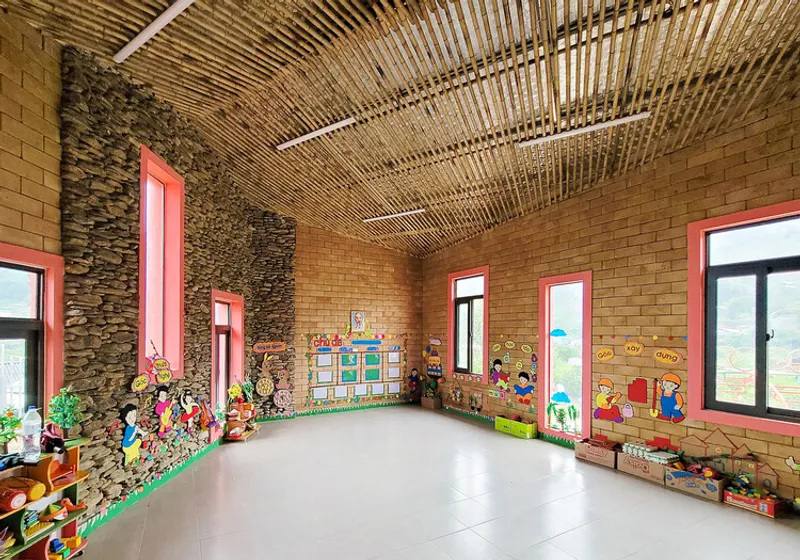
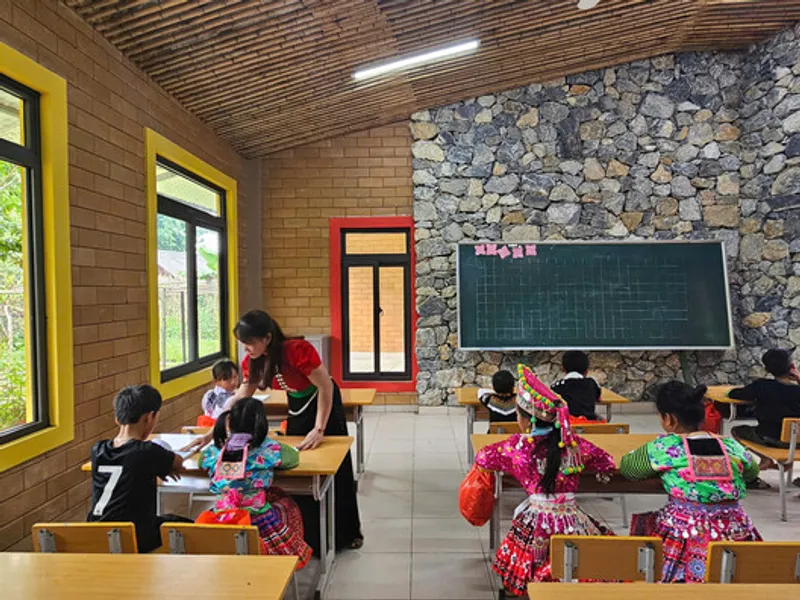
Inside the classrooms, bamboo slatted ceilings and timber slat treatments create warm, breathable overhead planes. Exposed stone feature walls anchor the rooms visually, while perforated brick sections allow cross-ventilation to flow through the space. The color palette is restrained: natural stone grays, earth-toned adobe, warm timber, and those recurring pink and red window frames that mark openings like punctuation in a long sentence. Nothing here is imported for effect. Every surface is a direct consequence of what was available and what was needed.
The high ceilings deserve specific mention. In a mountainous subtropical climate, ceiling height is a passive cooling tool. Warm air rises and exits through upper ventilation openings, pulling cooler air in at ground level. 1+1>2 sized the classrooms generously enough to make this effect meaningful, creating rooms that feel open and airy rather than cramped. For children accustomed to the expansiveness of mountain life, a low-ceilinged box would have been an insult. These rooms respect the scale of the world their students inhabit.
Covered Connections and Threshold Moments
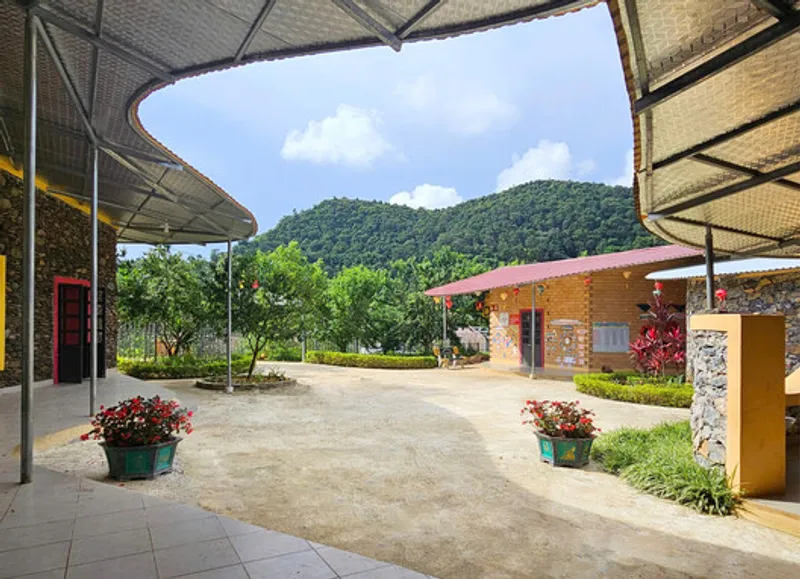
The covered walkways linking the school's blocks are more than circulation. They are threshold spaces where interior meets exterior, where the geometry of the curved roof meets the irregular slope of the hillside. Standing under the walkway, you look out toward adjacent pavilions and the mountain beyond, framed by the low sweep of corrugated metal overhead. These are the kinds of in-between spaces that children colonize instinctively: not quite inside, not quite outside, sheltered but free.
The playground equipment visible at the base of the stone and brick facade reinforces the school's dual role. During school hours, this is where children climb and run. After hours, it becomes an informal gathering point for the wider community. 1+1>2 designed these edges and transitions with enough generosity that the building can serve multiple populations and purposes without feeling strained.
Plans and Drawings
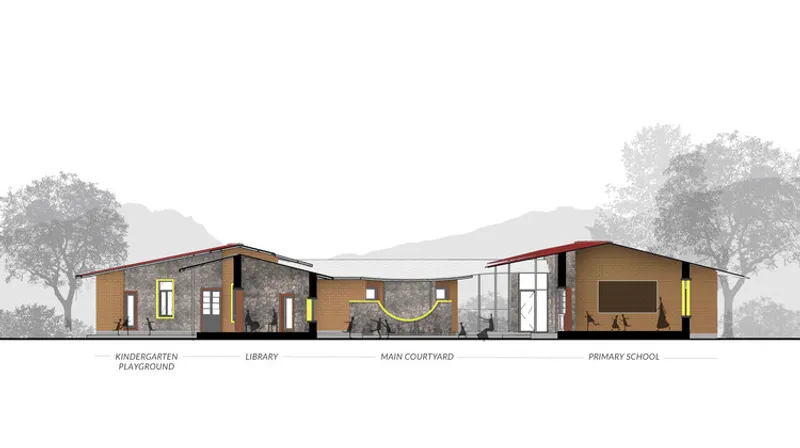
The elevation drawing makes the school's relationship to topography explicit. The kindergarten, library, courtyard, and primary school volumes are labeled across a continuous hillside section, revealing how each block steps down with the terrain. The roofline rises and dips in response to the mountain profile behind it, confirming that the aerial impression of landscape mimicry is an intentional design strategy rather than a happy accident. The drawing also shows how the stilted structure lifts the building above the slope, allowing the ground plane to remain largely undisturbed.
Why This Project Matters
Hang Tau Kindergarten and Primary School is a case study in what happens when architects treat constraints as design parameters rather than obstacles. Limited transportation access becomes a reason to manufacture materials on site. A steep slope becomes a spatial organizer. A community with limited construction budgets becomes a labor force with intimate knowledge of local building techniques. 1+1>2 did not parachute into Dien Bien Province with a predetermined form; they developed a building system from the ground up, literally, using excavated soil for adobe bricks and mountain stone for foundations.
The broader lesson here is about the role of the school building in communities that have very little other public infrastructure. In Hang Tau, the school is the communal center, the covered public space, the landmark that tells you where the village begins. 1+1>2 understood that responsibility and designed accordingly: not a minimal functional box, but a generous, materially rich campus that gives back dignity to a community that has long been underserved. The children of Hang Tau now learn inside walls that their parents helped build, under roofs that echo the mountains they call home. That is architecture earning its keep.
Hang Tau Kindergarten and Primary School by 1+1>2 Architects. Located in Hang Tau village, Quai To commune, Dien Bien Province, Vietnam. 1,328 square meters. Photographs by Nguyen Gia Phong and Son Vu.
About the Studio
Share Your Own Work on uni.xyz
If projects like this are the kind of work you want to make, uni.xyz is a place to publish your own, find collaborators, and enter design competitions.


Popular Articles
Popular articles from the community


EW PARK: Sustainable Architecture Reimagines the Future of Urban Parking
EW PARK reimagines city parking as a modular wooden tower combining automation, solar energy, electric mobility, and adaptable urban design.

Co-Life: Senior Housing Design That Reconnects Older Adults With the City
Co-Life reimagines senior housing design through healing gardens, shared streets, workshops, and a sustainable community across generations.

The Earth Pod: 3D Printed Homes for Resilient Refugee Communities
The Earth Pod reimagines refugee housing through 3D printed homes made from clay, combining resilience, self-sufficiency, and rapid shelter.

The Ocean Hive: Sustainable Architecture for a Self-Sufficient Civilization at Sea
The Ocean Hive imagines sustainable architecture at sea, where modular habitats, algae, wave power and ocean waste sustain a growing colony.

Similar Reads
You might also enjoy these articles


Hodi-Mandai Geram
Project Function: Preservation and revitalization of the Intangible heritage and socio-spatial identity of the Hodi by Housing, Cultural Memory Center, Sacred Grove, landscape, local tourism economy


Olio Towers: A Mid-Rise for Performers That Fuses Housing, Rehearsal, and Stage
Located blocks from Houston's Theater District, this modular tower stacks living units around a central performance atrium.

Oasis: Modular Green Housing Carved into Dhaka's Urban Fabric
A shortlisted Plugin Housing entry reclaims unauthorized settlements in Dhaka with stepped concrete volumes, green roofs, and ventilation-driven design.

Black Hole: A Floating Megastructure for the Post-Physical Era
Emiliano Mazzarotto envisions a spherical, self-scaling arena where e-sports, digital hotels, and holographic stadiums replace traditional public space.
Explore Educational Building Competitions
Discover active competitions in this discipline



Challenge to design public laboratory


Challenge to reimagine the Iron Throne


Photograph architecture without architects


Illustrate the lost glory of Angkor Wat - Render Challenge
Comments (0)
Please login or sign up to add comments
No comments yet. Be the first to comment!