

Hanging Spaces: Suspended Residential Pods Float Inside a Shared Vertical Volume
A modular housing prototype in Williamsburg, Brooklyn stacks organic dwelling units within a light-filled communal frame.


What if a building's most important space isn't inside the apartments, but between them? Hanging Spaces takes that question literally, suspending three residential pods within a single open volume so that the gaps, the staircases, the mezzanines, and the light wells become the architecture's real social infrastructure. The result is a compact housing prototype where interaction is not forced but designed to be negotiable: residents choose, moment by moment, whether to engage with others or retreat into an enclosed pod.
Designed by Isabella Nieling, the project received an Honorable Mention in the Nano Nest 2020 competition. Sited in Williamsburg, Brooklyn, one of New York's most land-scarce and expensive neighborhoods, the proposal responds to the realities of multi-family living on a narrow urban footprint. Rather than subdividing floor plates into conventional apartments, Nieling stacks self-contained dwelling units that appear to float within a shared vertical enclosure, replacing rigid functional zoning with a permeable, light-saturated communal structure.
A Street-Level Encounter with Suspended Living

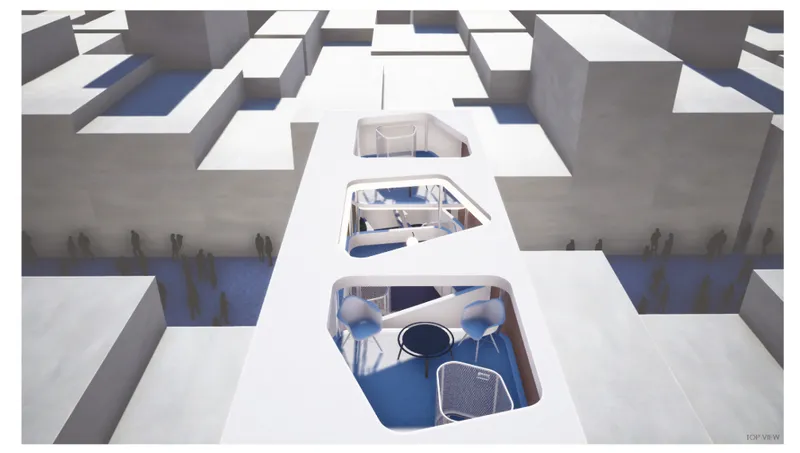
The physical model reveals how the building meets the sidewalk. A sectional cutaway exposes the stacked levels to passersby, while facing seating benches at the entrance extend the social realm outward to the public street. From above, three roof openings punch light down through the interior, making the building read as a series of voids rather than a solid mass. This porosity is deliberate: the generous facade cutouts and skylights drive daylight and natural ventilation deep into the building, ensuring that even the lowest unit benefits from direct sun.
The aerial view shows how Hanging Spaces sits within the dense Williamsburg block. Its open roof apertures distinguish it from neighboring buildings, signaling a fundamentally different relationship between interior volume and sky. The building's structure, a frame of prefabricated concrete elements and steel pipes, is expressed honestly; it reads as scaffolding for life rather than enclosure against it.
Curved Volumes Nested Floor by Floor
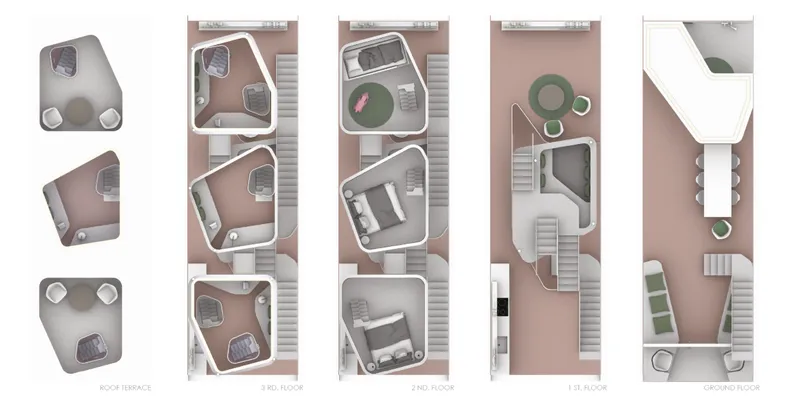
The plan sequence, running from roof terrace down to ground level, shows three organic white volumes positioned within the rectangular frame of each story. These curved dwelling pods define the private realm: bedrooms and enclosed living areas shaped by a soft, non-orthogonal geometry that contrasts with the building's rectilinear shell. The space left over between pod and perimeter wall becomes corridor, lounge, and mezzanine. It is this leftover space, not the pods themselves, that generates the project's communal life.
Each unit is equal in height but serves a different lifestyle need. Nieling designed the user profile around a mixed household: two parents with young children sharing the building with an early-retired couple who sublet part of a unit. The arrangement balances caregiving responsibilities and affordability in a city where childcare is both expensive and hard to find. Shared spaces like mezzanine platforms and terraces allow informal childminding and collective cooking, while the enclosed pods guarantee acoustic and visual privacy when needed.
Mesh, Concrete, and Three Modes of Inhabitation

The interior rendering captures the material quality of the in-between space: a concrete staircase rises behind a dining table, while a mesh screen wall filters light without blocking sightlines. These semi-transparent boundaries are central to Nieling's concept of negotiable interaction, one of three spatial modalities the project supports. Shared lounges and mezzanine sofa platforms allow residents to be "with each other." Enclosed bedroom pods offer full privacy. And open corridors, stairs, and mesh-screened zones create a middle ground where occupants can see and be seen without committing to conversation.
The rendering also demonstrates how open planning reflects modern work-life patterns. With fluid boundaries between domestic tasks, remote work, and leisure, the architecture avoids assigning fixed functions to any one zone. A dining table sits comfortably beside a staircase; a lounge overlooks a kitchen. The layout trusts residents to improvise their daily routines rather than prescribing them.
Section as Manifesto: Ladders, Platforms, and Occupied Voids

The longitudinal section is the project's most telling drawing. It reveals the full vertical stacking of multi-level dwelling units connected by ladders and platforms, with human figures cooking, lounging, climbing, and reading at various heights. The section makes visible what the plans only imply: that the void between pods is continuously inhabited. Mezzanine sofa platforms act as gathering points with views through the entire interior, while gaps between floors allow sound and light to travel vertically, knitting the building into a single social organism.
Structurally, the drawing confirms the modular strategy. Facade shells, stair elements, and platform supports are designed for prefabrication offsite, then assembled on the narrow lot to reduce construction time and cost. Nieling positions this approach as scalable: the same kit of parts could be adapted to similarly constrained urban sites in other dense cities. The section, then, is not just a record of one building; it is a template for replication.
Why This Project Matters
Hanging Spaces confronts a tension that most compact housing projects either ignore or resolve too neatly: the conflict between density and dignity. By suspending private pods inside a generous communal volume, Nieling refuses to treat small-footprint living as a problem of pure compression. Instead, the project argues that what makes a home livable at high density is not the size of the apartment but the quality and accessibility of shared space around it. The three-mode framework of togetherness, privacy, and negotiable interaction is a simple but powerful organizational principle that could inform housing design well beyond Brooklyn.
Equally significant is the project's insistence on economic realism. Prefabricated concrete elements and steel pipes are not exotic materials; they are the workhorse components of urban construction. By designing for offsite fabrication and onsite assembly, Nieling keeps the proposal grounded in buildability while still pushing the spatial ambition of what affordable multi-family housing can look like. In a real estate market that punishes experimentation, Hanging Spaces makes a persuasive case that modularity and architectural invention are not opposites but allies.
View the Full Project
About the Designers
Designer: Isabella Nieling
Enter a Design Competition on uni.xyz
uni.xyz runs architecture and design competitions year-round that reward proposals with spatial conviction and real site intelligence.
Project credits: Hanging Spaces by Isabella Nieling Nano Nest 2020 (uni.xyz).


Popular Articles
Popular articles from the community


Tsunami Convergenics: Turning Catastrophic Ocean Forces into Underwater Housing Infrastructure
A speculative underwater settlement off the coast of Onagawa, Japan, treats tsunamis and typhoons as energy sources rather than threats.

The Amber Palace Opera: A Geological Fiction Surfaces on Tallinn's Baltic Waterfront
Pierre Brillard reimagines a Baltic legend as a public landscape, opera house, and waterfront promenade rooted in Tallinn's coastal identity.
Opera by the Sea Estonia: Three Shells Dissolving Architecture into Tallinn's Coastline
A winning opera house proposal replaces monumental form with interconnected shells that blur the boundary between building, park and Baltic Sea.

Singing Woman: Contemporary Architecture Inspired by Estonia’s Voice and the Sea
Singing Woman turns Estonia’s song culture into flowing opera house architecture, blending public life, landscape, sea, and national memory.

Similar Reads
You might also enjoy these articles

Day and Night Park: A Time-Based Urban Newsstand in Beijing
A temporary urban newsstand in Beijing blending travel, light, and reading through poetic colors, compact form, and community-focused design.

Modernist Patio Renovation in El Masnou, Barcelona by Oliver Segura Arquitectura + Cebrià Arquitectura
Modernist patio renovation blending tradition and innovation with a movable pool, leveled floors, and Catalan materials in El Masnou.

Alto Residencial Coop: Cooperative Housing Development in Santiago de Compostela by Carbajo Barrios Arquitectos
A linear cooperative housing complex blending white volumes and perforated metal façades, enhancing community living, natural light, privacy, and urban integration.
Vil Genis School by BPA ARCHITECTURE – Massy, France
Vil Genis School in Massy, France, features sustainable design, south-facing classrooms, community integration, accessible spaces, and modern educational architecture.

Explore Vertical Space Competitions
Discover active competitions in this discipline

Challenge to design luxury tourism on rails

VR headsets Storefront design competition

Competition to design a workstation for architects

Designing a staircase for a client
Comments (0)
Please login or sign up to add comments
No comments yet. Be the first to comment!