

Harry Gugger Studio Folds a Concrete House into a Steep Wooded Hillside above Lake Zurich
In Thalwil, Switzerland, a polygonal bush-hammered concrete residence exploits building regulations and split levels to capture the slope.


Building on a steep, wooded lot in the Zurich lakeside municipality of Thalwil demands more than just good engineering. It demands a willingness to let the terrain and local regulations co-author the design. Harry Gugger Studio accepted those terms fully with Thalwil House, a 390 m² residence completed in 2021 whose polygonal footprint was literally drawn by the regulatory building line and the mandated forest setback. What could have been a constraint became the project's organizing logic, producing a faceted volume that reads differently from every angle and locks into the hillside like a geological formation.
The most interesting move here is the studio's tactical reading of Swiss bay window regulations. By folding projections outward along a recognizable bend line on the east and west facades, Gugger maximized usable floor area while each bay reads, per building law, as a simple facade fragment rather than an extension. The result is a house that squeezes every permissible square meter from a difficult lot without looking like it is trying. A bush-hammered concrete shell, split-level interiors, and a four-zone garden complete a project that is less about spectacle and more about calibrated intelligence.
A Concrete Shell Shaped by Regulation
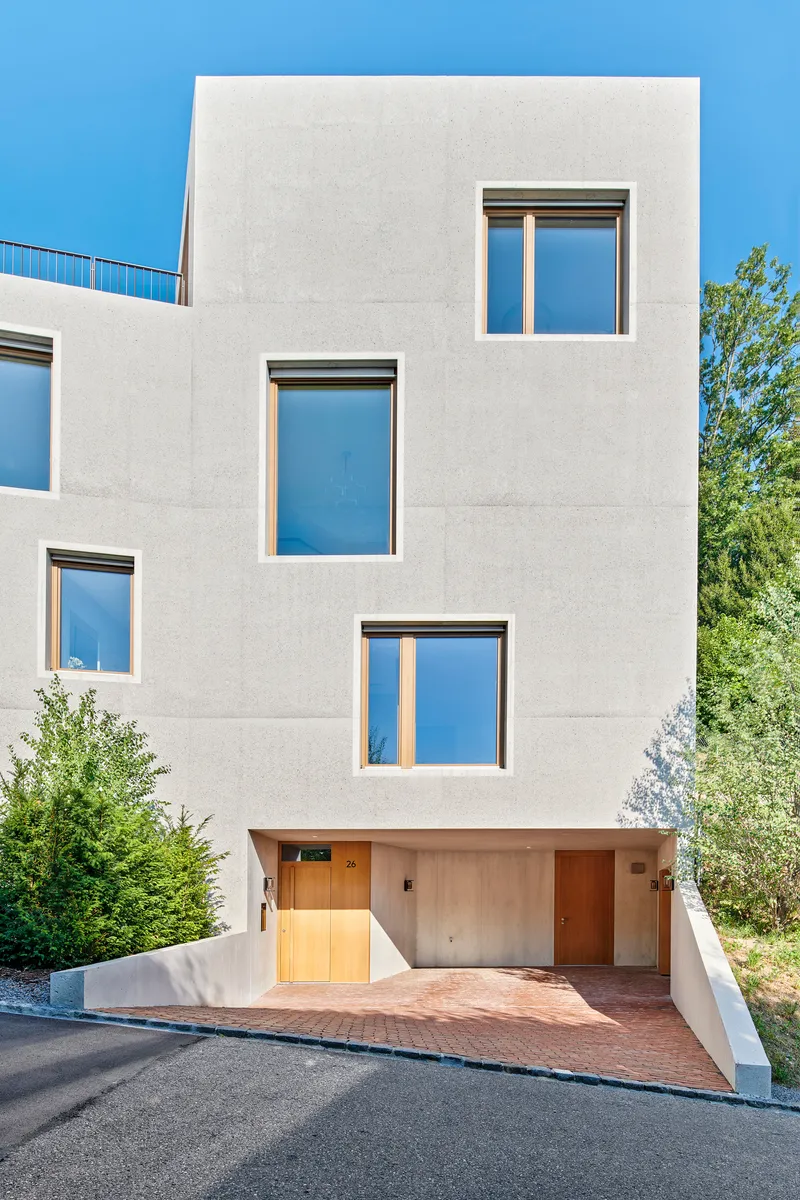
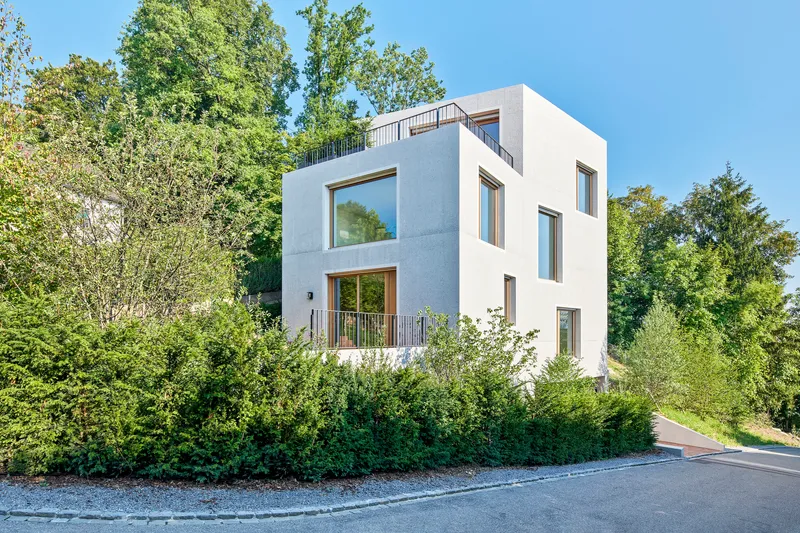

The house's pentagonal plan is not a formal whim. It traces the intersection of the maximum building line and the required distance from the adjacent forest. Harry Gugger Studio treated these legal boundaries as design drivers, producing an angular footprint that shifts in section as the terrain drops away. From the street, the recessed entry loggia and offset window openings give the facade a composed, almost civic quality. Walk downhill and the volume reveals itself as a stack of cantilevered terraces stepping into the slope.
The facade material does a lot of the work. An in-situ concrete envelope, bush-hammered to a mineral texture in a light warm beige-gray, wraps the building from below ground to roofline. Untreated off-form concrete cornices frame oak window openings, creating what looks like smooth stone surrounds but is in fact a single, continuous material system. Up close, the surface has a sculptural, almost lithic presence that roots the house visually in the rocky hillside it inhabits.
Reading the Terrain in Section


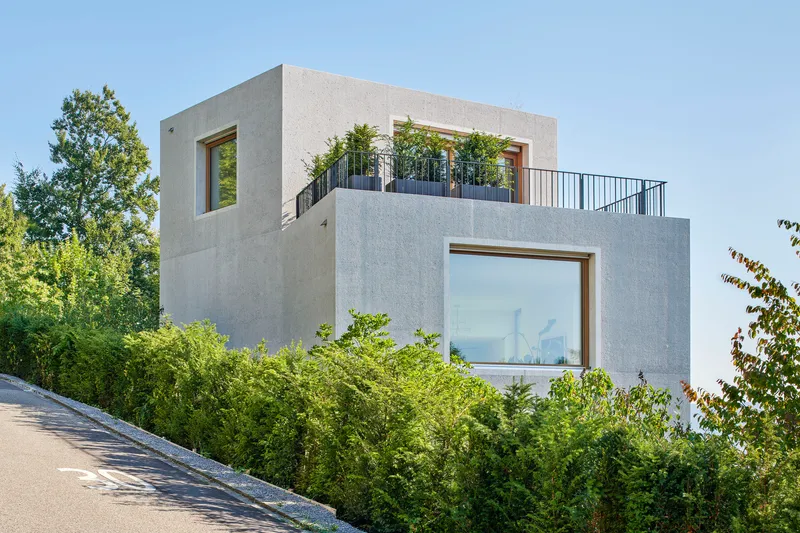
The section tells the real story. A basement houses services at the base of the slope, the first full level holds bedrooms, the second level common areas, and a partially set-back attic provides a studio. Split levels between these zones allow the house to follow the hillside's gradient rather than fight it, and every level opens onto a terraced outdoor space. The brick-paved terrace at the common level catches the full Lake Zurich panorama, while upper terraces with planted containers extend the garden vertically.
Embedding the lower floors into the hillside was not just a topographic response but a thermal one. The earth-contact walls reduce thermal loads, and the terracing ensures cross-ventilation at each level. Outdoor rooms at multiple altitudes mean the residents can follow sun and shade throughout the day without descending to the garden.
The Staircase as Spatial Engine
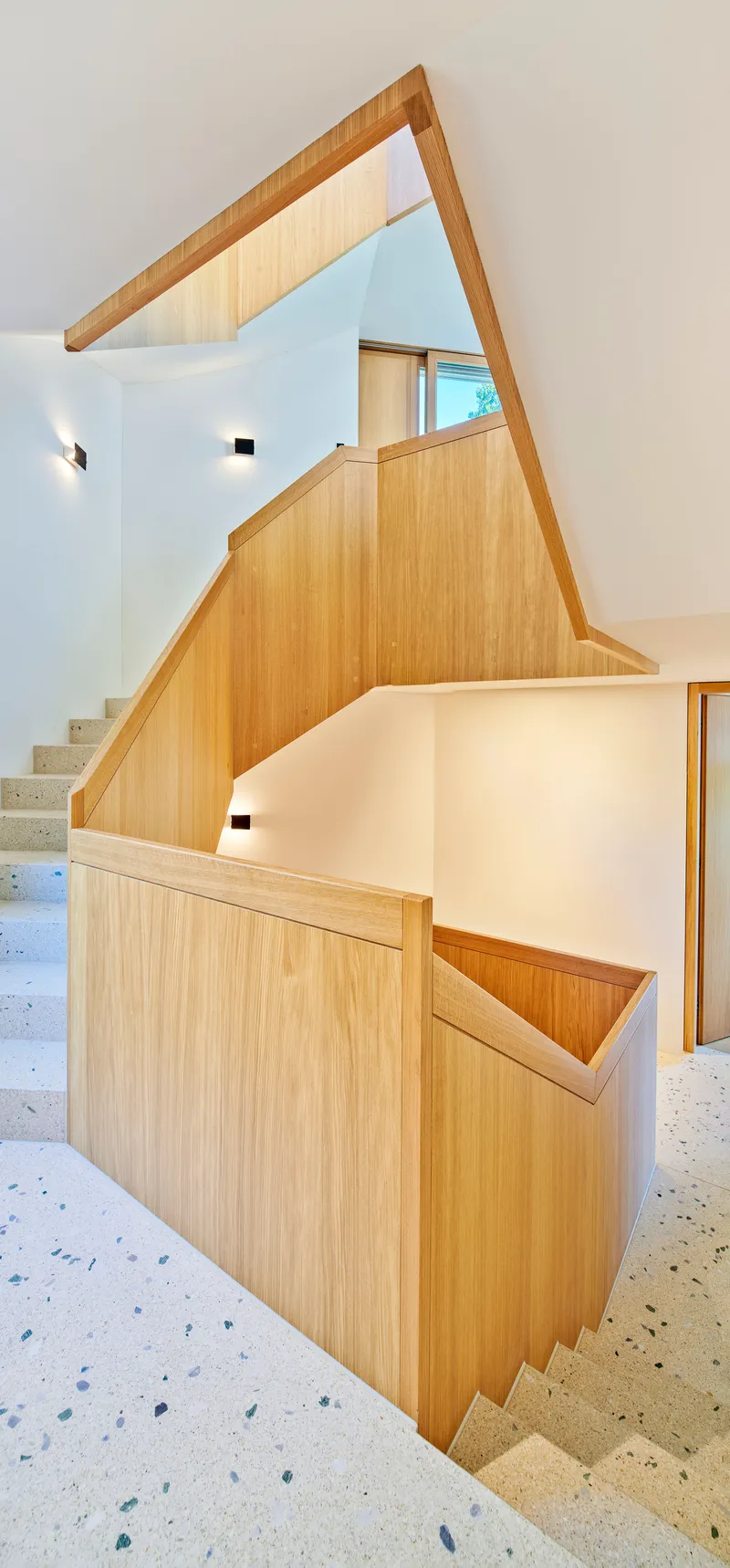


In a house organized around split levels, the staircase is not a corridor between floors. It is the spatial engine. Harry Gugger Studio gave it the treatment it deserves: a generous timber-clad volume with short flights that create natural pauses and sightlines at each half-level. A skylight floods the upper runs with daylight, and the angular timber cladding on walls and ceiling wraps the stair volume like a carved wooden core, contrasting deliberately with the terrazzo treads and the bush-hammered concrete outside.
Corner windows at the landings frame views of rooftops, treetops, and distant hills, turning the act of moving between floors into a sequence of composed vistas. The staircase connects without compressing. It is one of the most legible demonstrations of why split-level planning, when paired with a generous circulation element, can deliver spatial variety that a conventional two-story section simply cannot.
Living Spaces Oriented to the View


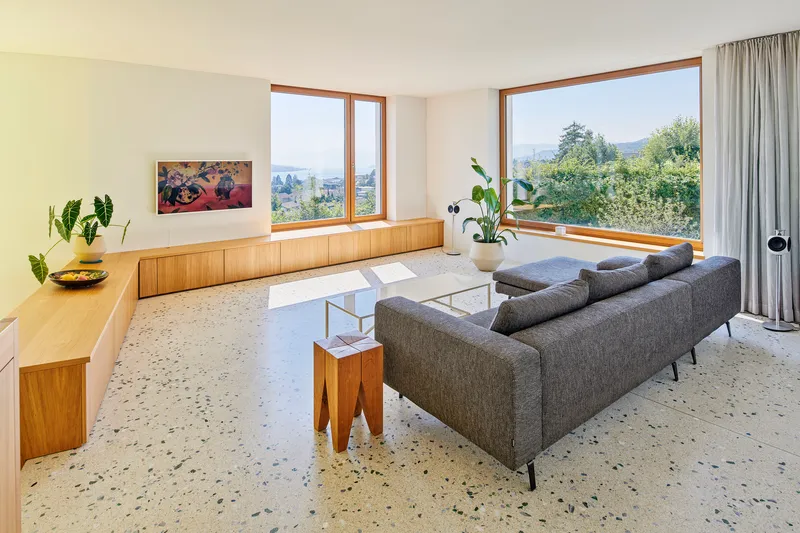
The common level occupies the second floor, placing kitchen, dining, and living areas at the altitude where the canopy thins and the lake view opens up. Terrazzo floors, pale timber cabinetry, and a chartreuse dining table give the interior a bright, Nordic calm that offsets the muscular concrete exterior. Floating pale green kitchen units and a marble backsplash introduce color without competing with the framed landscape outside.
Timber-framed windows are punched rather than continuous, controlling glare and privacy while directing attention toward specific views: the treetops to the south, the distant cityscape to the east. A built-in timber bench integrates into the staircase landing, creating a threshold between living and kitchen zones that is furniture, architecture, and circulation all at once.
Bedrooms and Private Quarters


The bedrooms sit one level below the common spaces, partially embedded into the slope and shielded by the garden. Each room opens onto its own terrace via sliding glass doors, with timber storage walls and pendant lights keeping the palette warm and restrained. The effect is cave-like in the best sense: sheltered, quiet, grounded.
A freestanding bathtub beneath a corner window is the project's most quietly luxurious gesture. Pale stone tiles line the walls, and the view slips out over distant hills. It is a space where the relationship between enclosure and exposure, the central theme of the entire house, is distilled to its simplest form.
Four Gardens on One Slope
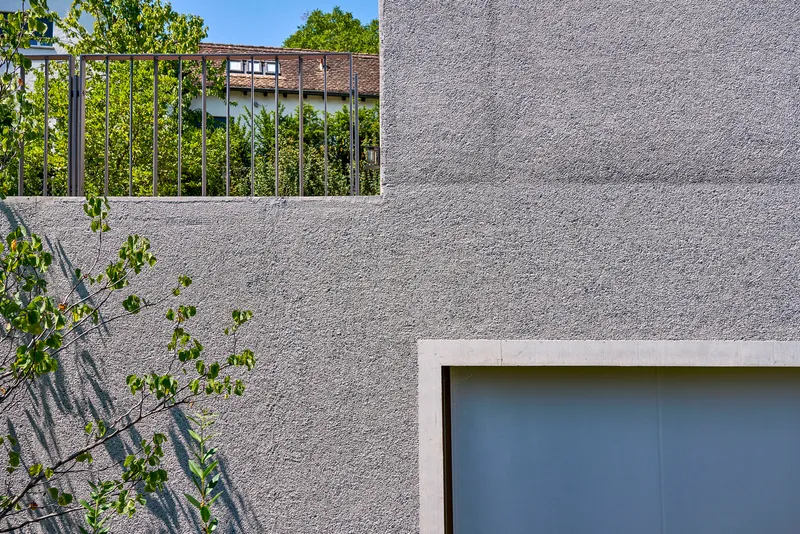


The landscape design divides the steep lot into four distinct zones: a forest garden, a garden grove, a perennial garden, and an herb garden. Each references the local ecology at a different scale, from the semi-wild upper slope to the cultivated terraces at the common level. Young trees cast sharp shadows on the bush-hammered concrete, a pairing that will only deepen as the plantings mature and begin to soften the angular facade.
The garden is not decorative backdrop. It mediates between the house and the surrounding woodland, easing the visual transition from architecture to forest. The terraced structure mirrors the split-level interior, so moving from inside to outside at any floor means stepping onto a garden zone calibrated to that altitude and orientation.
Plans and Drawings


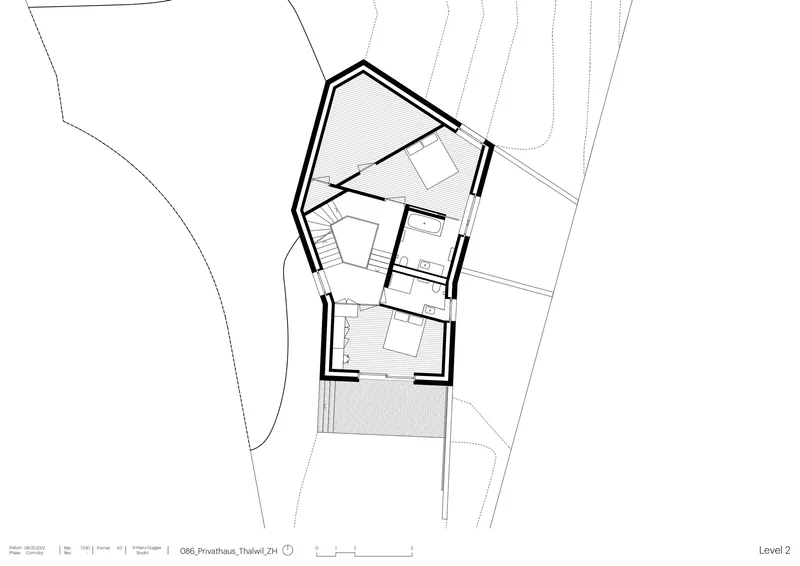

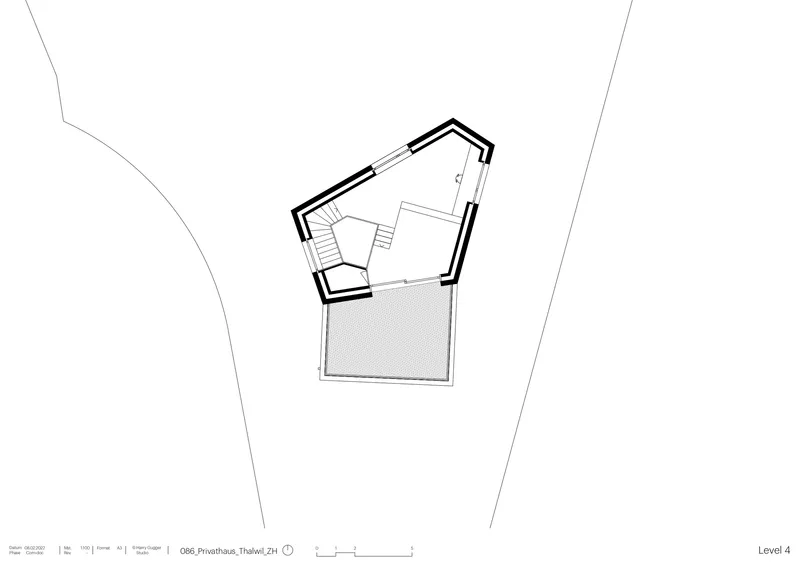


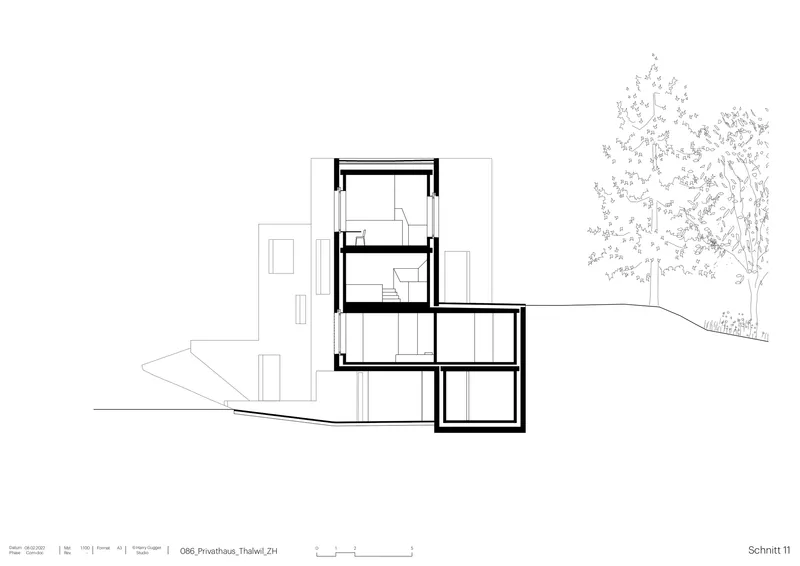
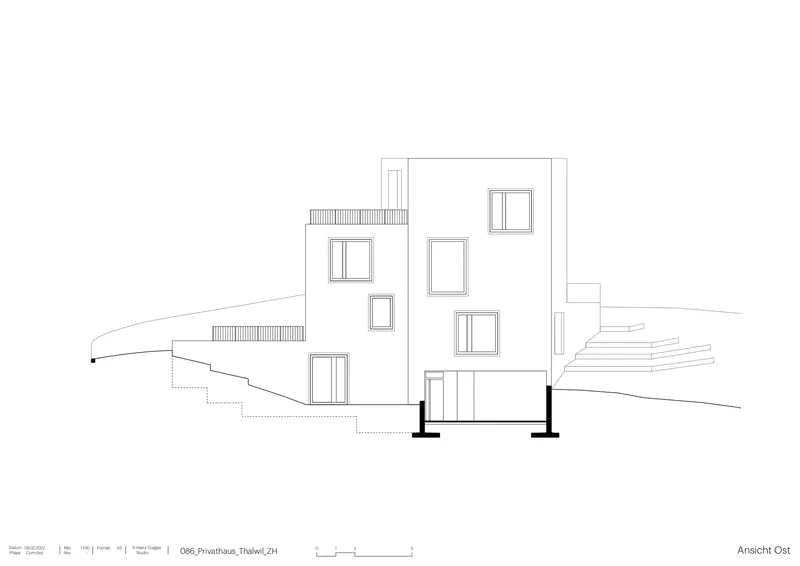
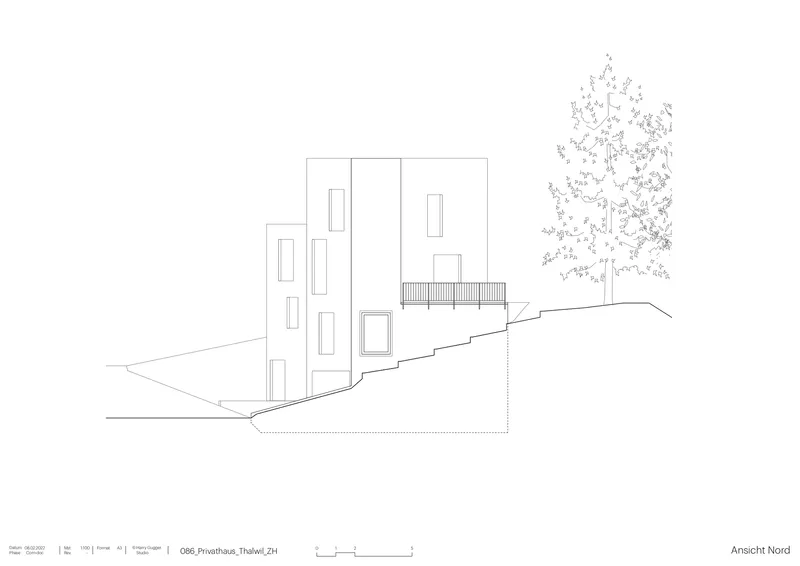
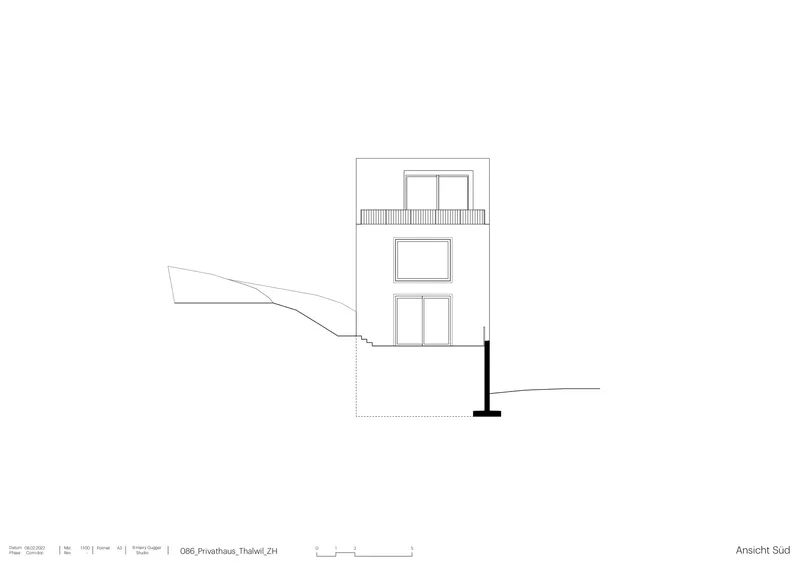

The drawings make the regulatory logic explicit. The site plan reveals the triangular lot pinched between contour lines and curved roads, with the pentagonal footprint occupying nearly the maximum permissible envelope. Floor plans show how the angled walls and bay window projections generate rooms that are neither orthogonal nor disorienting, just slightly rotated to capture specific views. Sections are the most revealing documents: three cuts through the building demonstrate how split levels cascade downhill, each floor offset by roughly half a story, and how the concrete shell transitions seamlessly from retaining wall to above-grade facade.
Elevations confirm the asymmetry. No two facades share a window pattern, because no two faces encounter the same condition of slope, exposure, neighbor, or forest edge. The scattered punched openings, which look almost random in the photographs, resolve in elevation as careful calibrations of view, privacy, and daylight.
Why This Project Matters
Thalwil House is a case study in productive constraint. The polygonal plan, the split-level section, even the bay window projections are all direct responses to site geometry and building code. Harry Gugger Studio did not fight the rules or retreat into a timid box. They read the regulatory framework as a design brief and extracted spatial generosity from it. That approach yields a house that feels inevitable on its site rather than imposed upon it.
The material strategy reinforces the lesson. A single concrete system, bush-hammered outside and cast smooth at the cornices, handles structure, envelope, and expression simultaneously. Oak frames and terrazzo floors warm the interior without introducing competing systems. The result is a house that is technically rigorous and sensorially rich, proof that on difficult terrain, the best architecture is often the one that listens hardest to what the site and its regulations are already saying.
Thalwil House by Harry Gugger Studio. Located in Thalwil, Switzerland. 390 m². Completed in 2021. Photography by Daniela Burkart.
About the Studio
Share Your Own Work on uni.xyz
If projects like this are the kind of work you want to make, uni.xyz is a place to publish your own, find collaborators, and enter design competitions.


Popular Articles
Popular articles from the community


longwave studio Reorganizes a 112 m² Tainan Apartment Around the Daily Routines of a Family and Two Cats
In Tainan, Taiwan, birch plywood, rust-red furniture and a freestanding plaster wall link arrival, storage, work and family life in one apartment.

U.GA Architects Wraps an Oval Rooftop Pool in Curved Board-Formed Concrete on Busan's Jeollidan-gil
In Busan's Jeonpo-dong, a 454 m² mixed-use block stacks a neighborhood facility, guest rooms and an oval rooftop pool inside spiraling concrete walls.

GROUP A Strips a 1969 Rotterdam Harbor Headquarters to Its Frame and Wraps It in Timber Louvers
In Rotterdam's M4H harbor district, Ferro Offices reuses a 1969 frame, adds one timber storey and reaches BREEAM-NL Outstanding.

David Macias Steps a Doorless Stone and Plaster House Down a Tropical Colombian Hillside
In the humid hills of Colombia, Threshold House replaces the front door with an open void and terraces its 850 m² down the slope instead of fighting it.

Similar Reads
You might also enjoy these articles


LAVA Architecten Gives Vocational Education a Sawtooth-Roofed Face on a Mechelen School Campus
In Mechelen, Belgium, a 2,053 m² STEM school on a 6×6 m grid turns workshops and classrooms into rooms that can be rearranged as teaching changes.

KEMA Studio Turns a Derelict Marvila Attic into a 60 m² Lighthouse Apartment Above Lisbon
In Lisbon's Marvila district, a rebuilt roof, four skylights and two plywood volumes turn an unlivable attic into a bright home facing the Tagus.

Pixel Gardens: One Repeated Module Stacked Into a Terraced Social Housing Tower for Famagusta
Salem Bader's shortlisted housing tower builds a vertical neighbourhood from one repeated module, offsetting units to carve terraces, light and air.

Bao Huynh Watercolor Atelier: A Serene Art Retreat in Hội An
Bao Huynh Watercolor Atelier in Hội An blends multifunctional art spaces, sustainable design, local materials, and family-friendly living in a serene environment.

Explore Residential Building Competitions
Discover active competitions in this discipline

Comments (0)
Please login or sign up to add comments
No comments yet. Be the first to comment!