
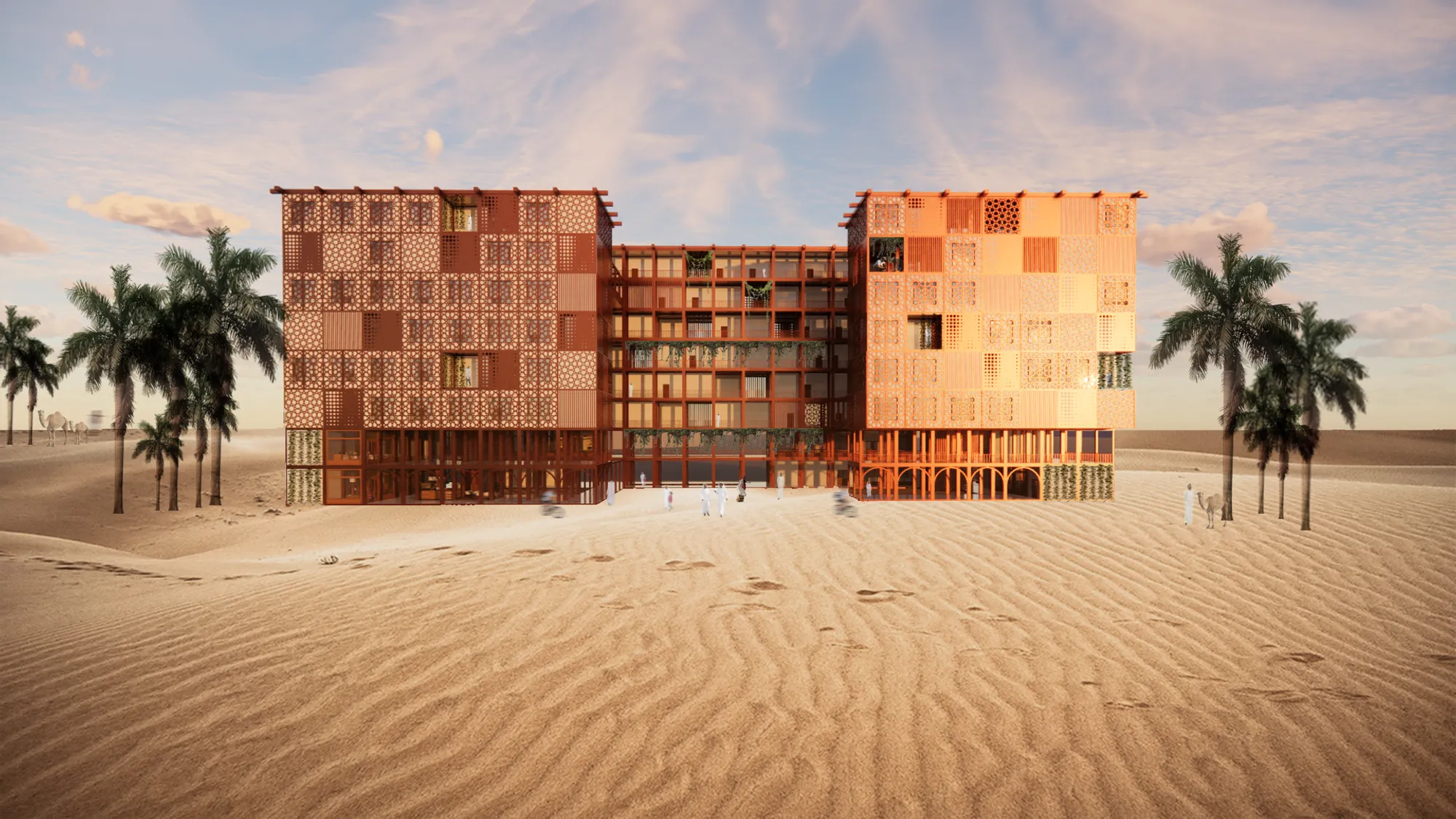
Harvest Box
Eco-living & farming
Due to the increasing human population resulting in an increase in agriculture to increase food production. However, it is an unsustainable agriculture that has a negative effect on the environment. So we have figured out how to make agriculture more efficient and sustainable, also has a minimal impact on nature, which can allow people to participate in agriculture.
So we came up with a project called Harvest Box, with the aim of being sustainable architecture. There will be the use of renewable resources. There is a community farm that can produce enough food for the residents and make the residents have a shared lifestyle by learning about agriculture, experienced by themself. The home units built using a modularity system that can be flexible with user and function. The design concept is Stack up & Void, lined up modules leaving a gap for air and light to pass through. Design tools are arch shapes, Islamic patterns, and colors of palm wood and copper.
As our project is located in Dubai, United Arab Emirates with hot weather, our farm needs to be indoors, We use a vertical aquaponics farm system, complete with air, light and water circulation systems. But it still requires manual labor to harvest and take care of the produce, to create interactions between people. And in addition, we also have composting from food waste within the project to be used in traditional farm systems and in individual home gardens. There is also a water recycling system in the residential zone. We use the advantage of sunlight in Dubai by installing solar panels to generate electricity for the building.
As for home units that are used as modular systems, we figured out how to be flexible, coming up with the idea that our units are fully customizable. They can be moved along the rails or can be combined with another room to make a larger room. And because our location is in the educational land area. Our main target group are students. which from the behavior of some groups of students may want to live together which our concept can answer this question. The remaining empty space will become a multi-purpose area. The residents can use this area to garden or do various activities freely according to the needs of the residents.



Popular Articles
Popular articles from the community


The Ocean Hive: Sustainable Architecture for a Self-Sufficient Civilization at Sea
The Ocean Hive imagines sustainable architecture at sea, where modular habitats, algae, wave power and ocean waste sustain a growing colony.

The Musturak Paradise: Senior Living Architecture for a Connected Future in Temara, Morocco
The Musturak Paradise reimagines senior living architecture in Temara via private homes, social spaces, culture, community, and shared care.

Lunar Spiral: Space Architecture Shaped by the Mathematics of the Universe
Lunar Spiral reimagines space architecture through Fibonacci geometry, lunar regolith, levitating habitats, and self-sustaining Moon living.

Hill & Cross Opera: Sculptural Opera House Architecture Shaped by Tallinn’s Landscape and Identity
Hill & Cross Opera reimagines opera house architecture in Tallinn through its sculptural hill, civic plaza, glass wave and a luminous cross.


Similar Reads
You might also enjoy these articles

Day and Night Park: A Time-Based Urban Newsstand in Beijing
A temporary urban newsstand in Beijing blending travel, light, and reading through poetic colors, compact form, and community-focused design.

Modernist Patio Renovation in El Masnou, Barcelona by Oliver Segura Arquitectura + Cebrià Arquitectura
Modernist patio renovation blending tradition and innovation with a movable pool, leveled floors, and Catalan materials in El Masnou.

Alto Residencial Coop: Cooperative Housing Development in Santiago de Compostela by Carbajo Barrios Arquitectos
A linear cooperative housing complex blending white volumes and perforated metal façades, enhancing community living, natural light, privacy, and urban integration.
Vil Genis School by BPA ARCHITECTURE – Massy, France
Vil Genis School in Massy, France, features sustainable design, south-facing classrooms, community integration, accessible spaces, and modern educational architecture.





Comments (0)
Please login or sign up to add comments
No comments yet. Be the first to comment!