

Akitephile Breaks a Vietnamese Family Home into Angular Volumes That Breathe Around Courtyards
Haushaus in Vietnam clusters gabled wings around open courts, weaving garden life into every room of a multigenerational home.


Most houses in dense Vietnamese neighborhoods fill their plots wall to wall, surrendering light and ventilation to maximize square footage. Akitephile's Haushaus takes the opposite approach: it fractures a single domestic program into a cluster of angular volumes, each one rotated slightly off axis so that courtyards, gardens, and reflecting pools slip between them. The result is a house that feels less like a building and more like a small compound, one where every room has an outdoor edge and every corridor opens onto sky.
What makes Haushaus genuinely interesting is its refusal to separate the architectural gesture from domestic pragmatism. The fragmented plan is not scenography. It solves real problems: cross ventilation through every wing, daylight deep into double-height interiors, privacy between generations sharing one roof, and a garden presence that collapses the boundary between inside and out. The pitched corrugated metal roofs read as a family of forms rather than a single monolith, letting the house sit among its neighbors without overwhelming them.
A Roofscape of Gables
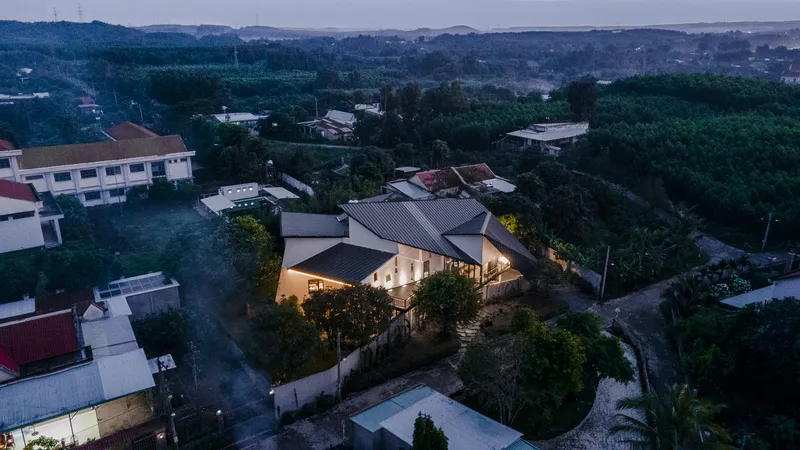

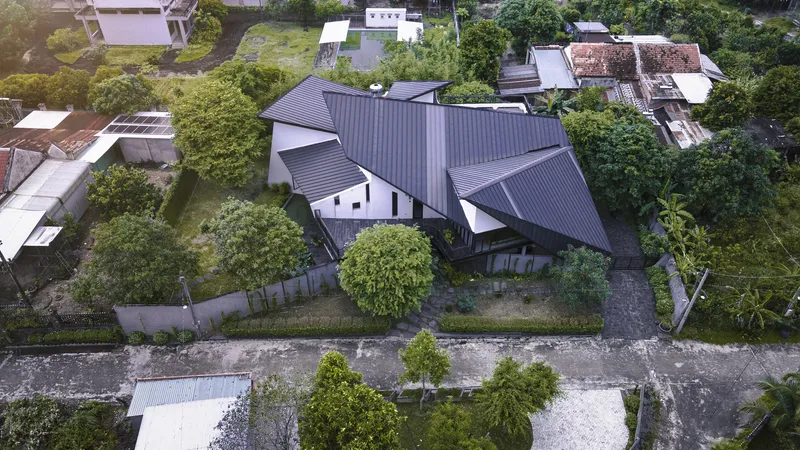
From above, Haushaus reads as a constellation of overlapping pitched roofs, each one clad in corrugated metal and angled to create ridgelines that catch light differently throughout the day. The multi-gabled silhouette is deliberate: rather than one dominant volume, the house presents several smaller ones, scaling the project down to its surroundings. Dense tree canopy and neighboring houses frame the composition, and the gaps between roof planes mark the courtyards below.
The choice of corrugated metal over tile or concrete is worth noting. It keeps the roof planes lightweight, allows for the sharp folds and overlaps that define the profile, and ages well in Vietnam's humid climate. The material also gives the house an industrial grain that contrasts with the softer plaster and stone surfaces at ground level, preventing the design from tipping into the precious.
Facade and Entry: Stone, Plaster, and Shadow
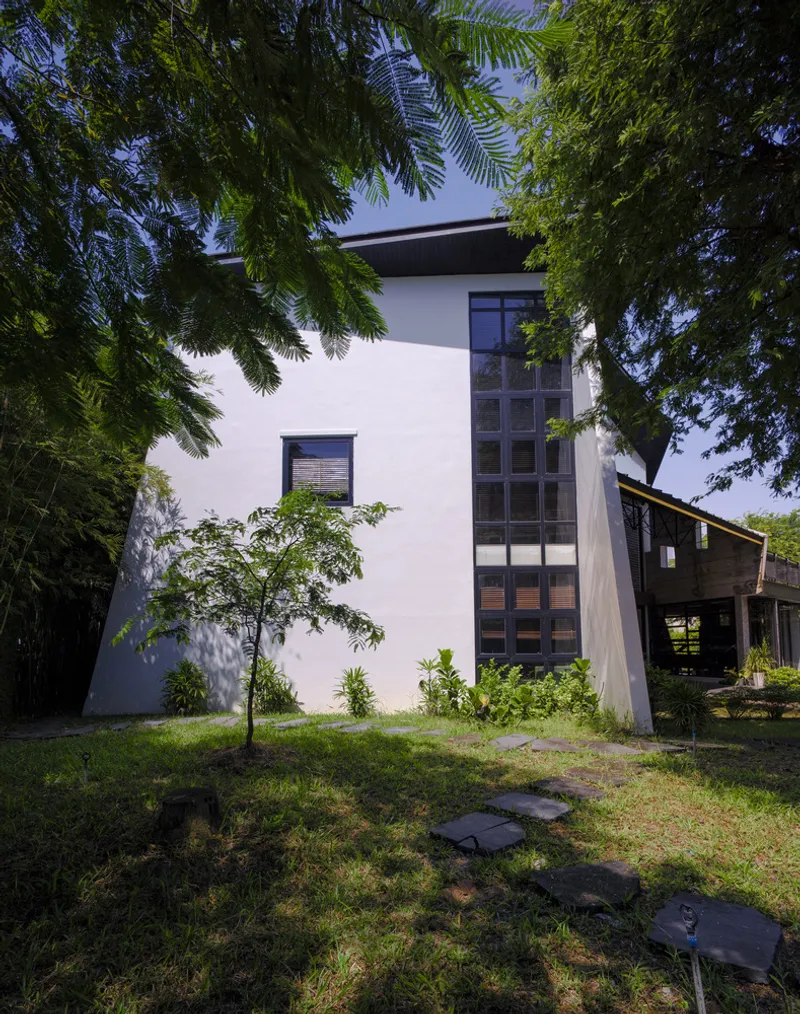
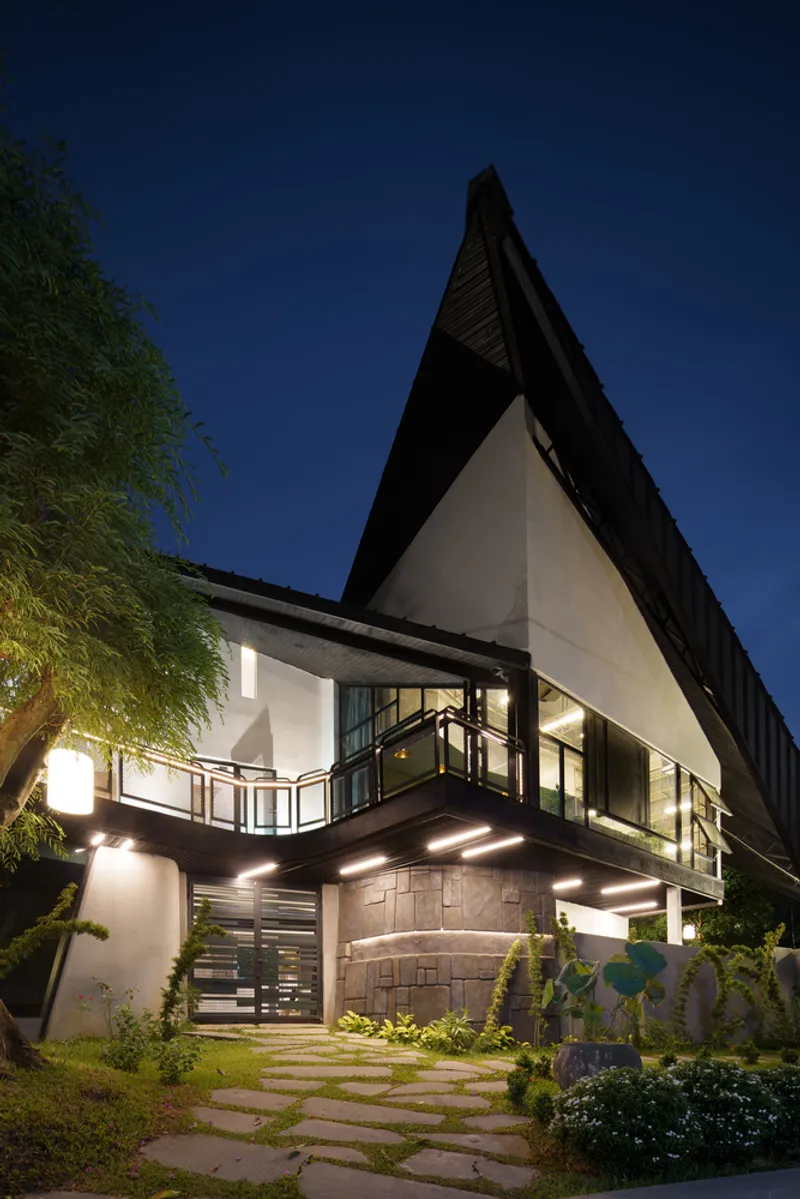
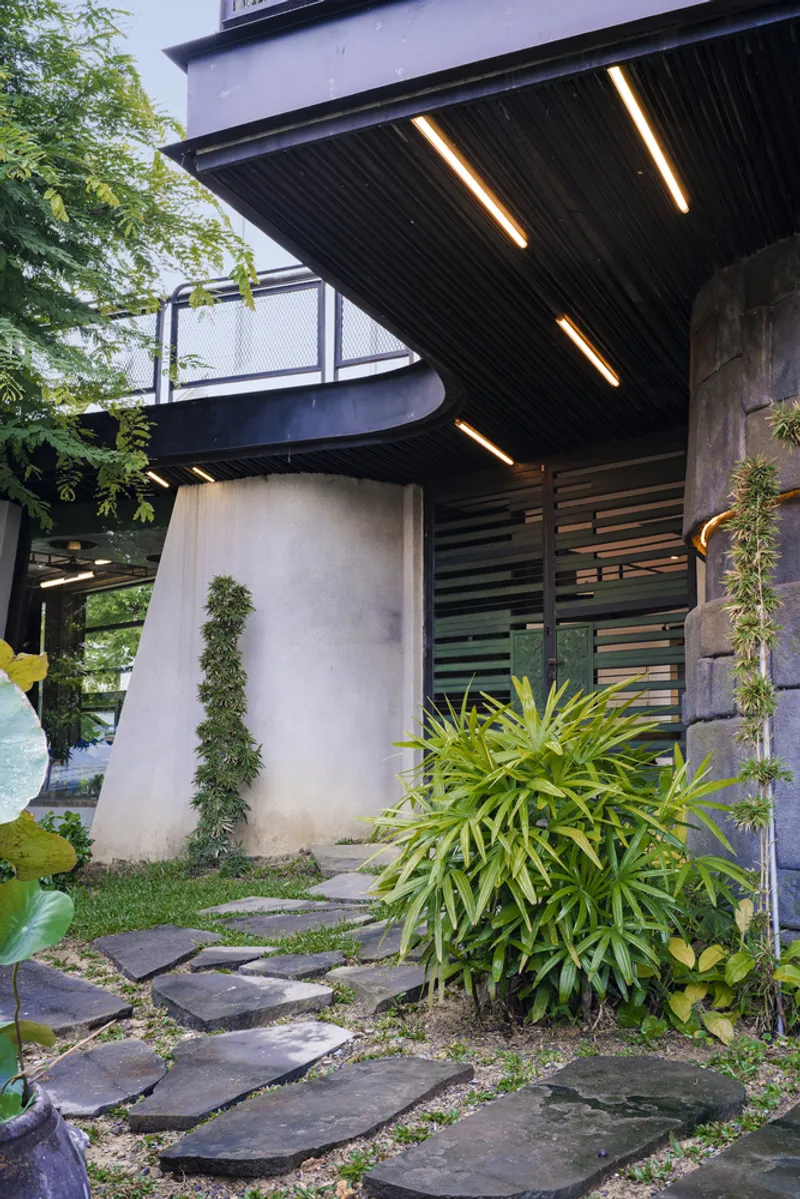
The street-facing facade reveals the house in layers. A rough stone base wall anchors the composition; above it, white rendered plaster surfaces and angular metal roof overhangs create deep shadow lines. The vertical ribbon window on the primary face is a restrained move, offering privacy while pulling a thin strip of daylight into the interior. At dusk the overhangs become graphic frames, their sharp geometry outlined against glowing interiors.
The entry sequence is choreographed rather than direct. Irregular stepping stones thread through planted beds beneath a covered walkway lined with linear ceiling lights and concrete columns. You arrive slowly, moving from the public realm into a garden threshold before reaching any enclosed room. It is a classic Southeast Asian technique, the verandah reinterpreted through a contemporary lens, and it works because the planted beds are generous enough to feel like landscape, not decoration.
Courtyards as Connective Tissue
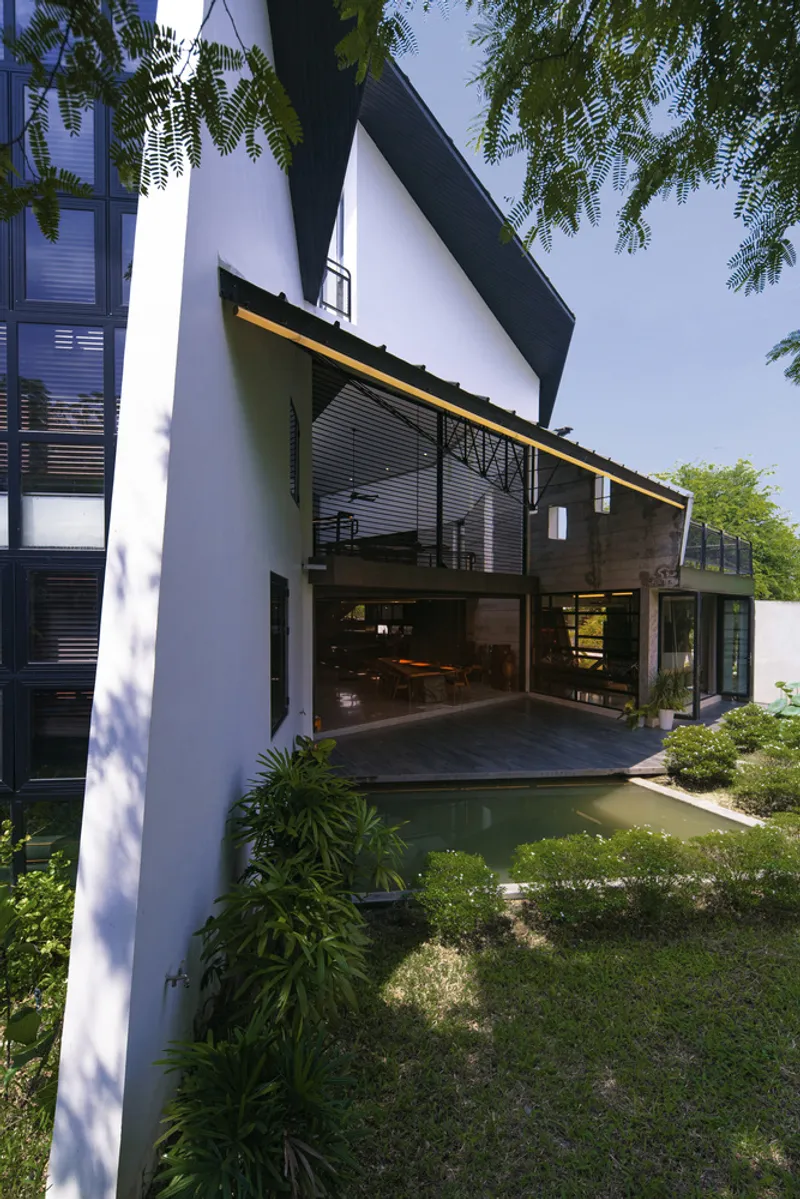
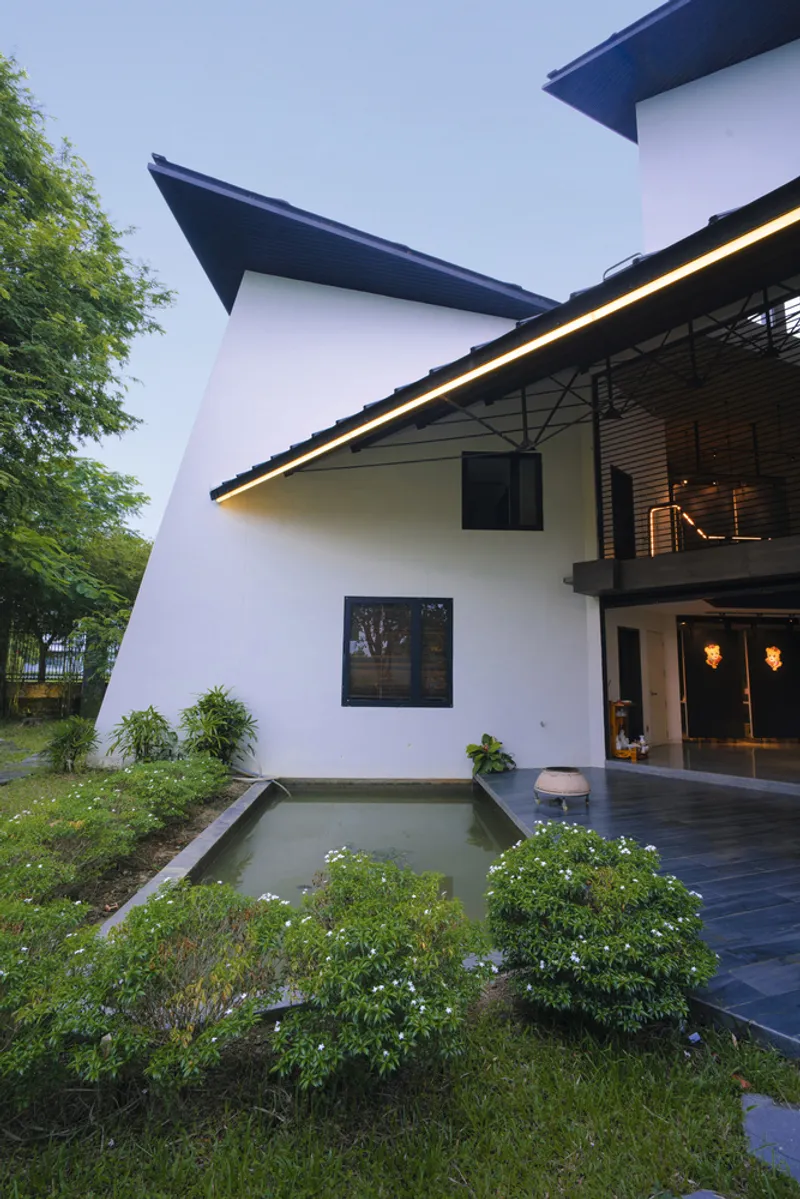
The central courtyard with its reflecting pool is the heart of Haushaus. It operates as a thermal regulator, a visual anchor, and a social space simultaneously. Open louvered facades face the pool, drawing cooled air into adjacent rooms while projecting shimmering reflections across ceilings. The cantilevered upper volume overhangs the garden, offering shade at midday and creating a sheltered outdoor room at ground level.
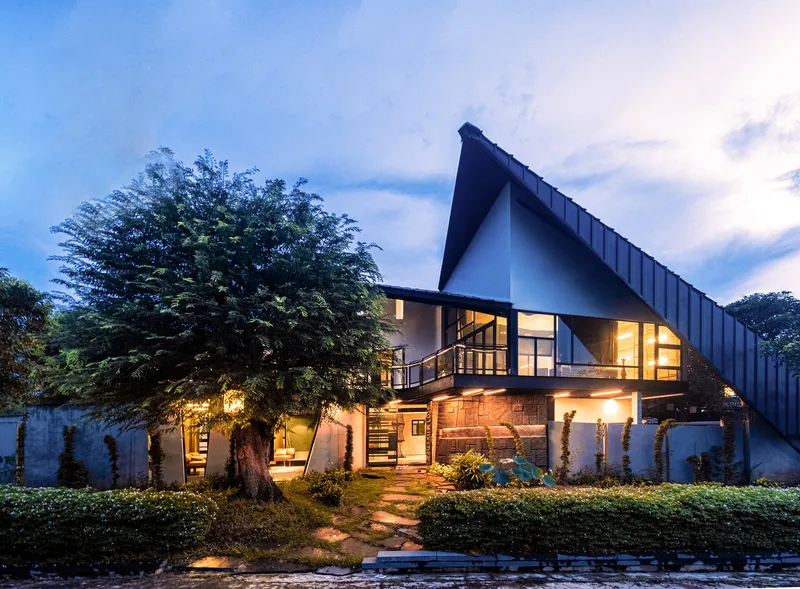
At twilight the courtyard transforms. Interior lighting turns the house into a lantern, and the garden elevation reads as a layered composition of illuminated rooms, planted terraces, and dark roof planes. A mature tree beside the stone base provides scale and softness, reminding you that the architecture is ultimately in service of the life growing around it.
Double Heights and the Interior Void
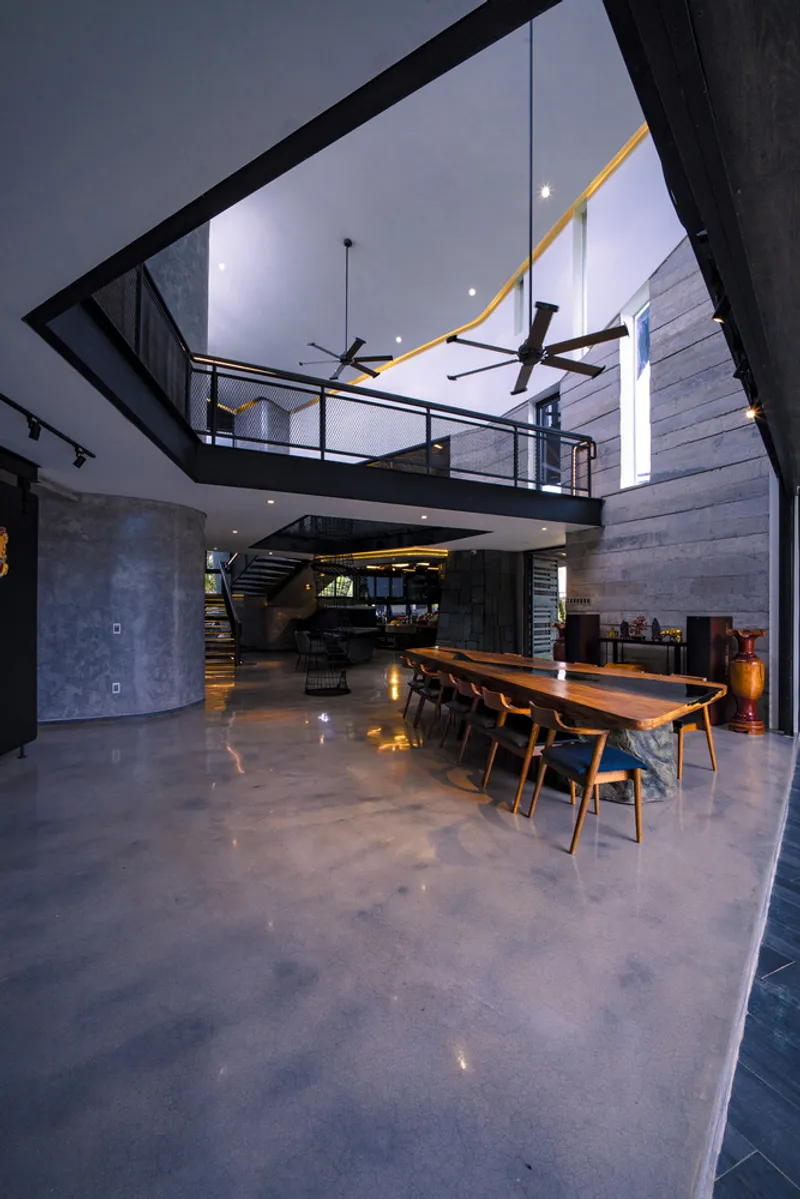
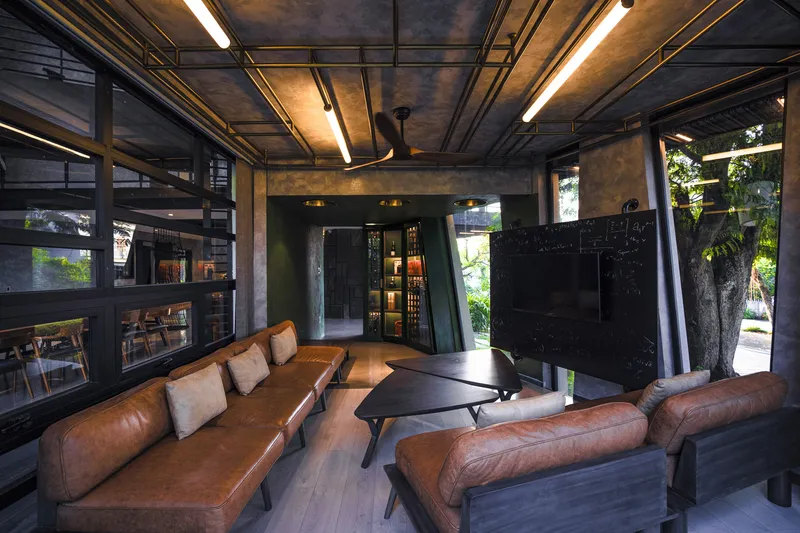

Inside, the fractured plan generates dramatic vertical spaces. The main living volume rises to a full double height, with boardformed concrete walls and a cantilevered steel walkway crossing overhead. A dining table sits beneath this volume, scaled down by the intimacy of the furniture against the soaring ceiling. The effect is cinematic without being theatrical: you feel the volume rather than gawk at it.
The interior courtyard at image ten is a quieter counterpoint. Here, a black mesh floor opens to the level below, and boardformed concrete walls rise to an overcast sky. It is a decompression chamber within the house, a space that exists primarily to let air and light circulate. The mesh floor reappears as a motif throughout the project, turning horizontal surfaces into filters rather than barriers.
Mezzanines and the Mesh Bridge
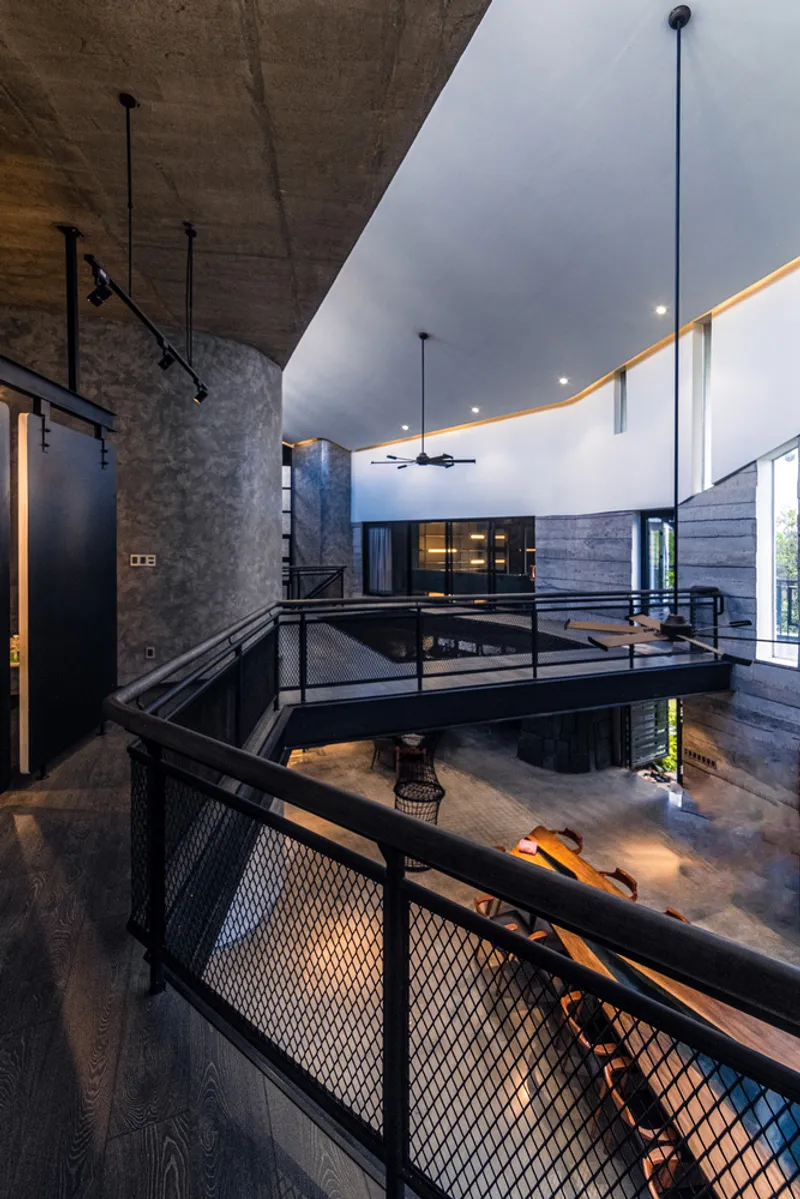
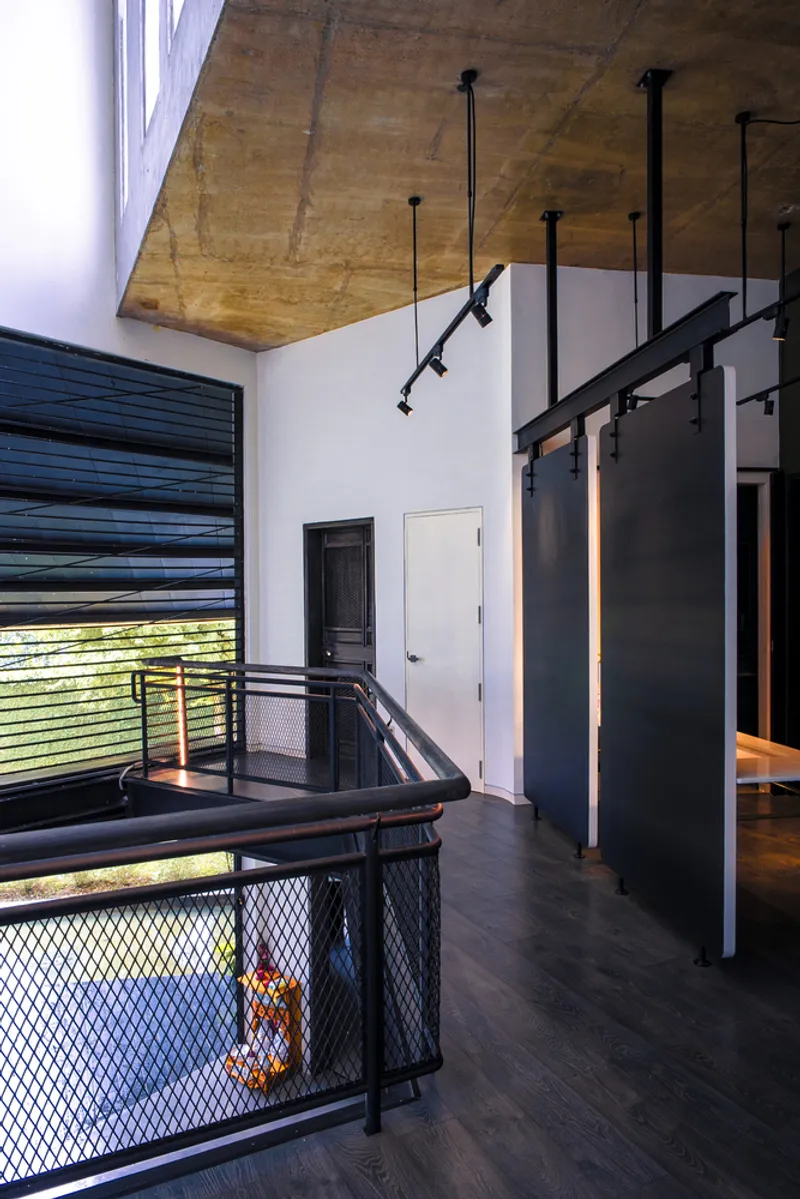
The mesh-floored mezzanine bridge is one of the more compelling details. Spanning the central void, it connects the wings at an upper level while maintaining visual porosity between floors. Light passes through, sound passes through, and you maintain a constant awareness of the house as a single volume rather than a stack of isolated rooms. The exposed concrete soffit above and white plaster walls alongside give the bridge a material clarity that keeps it from feeling accidental.
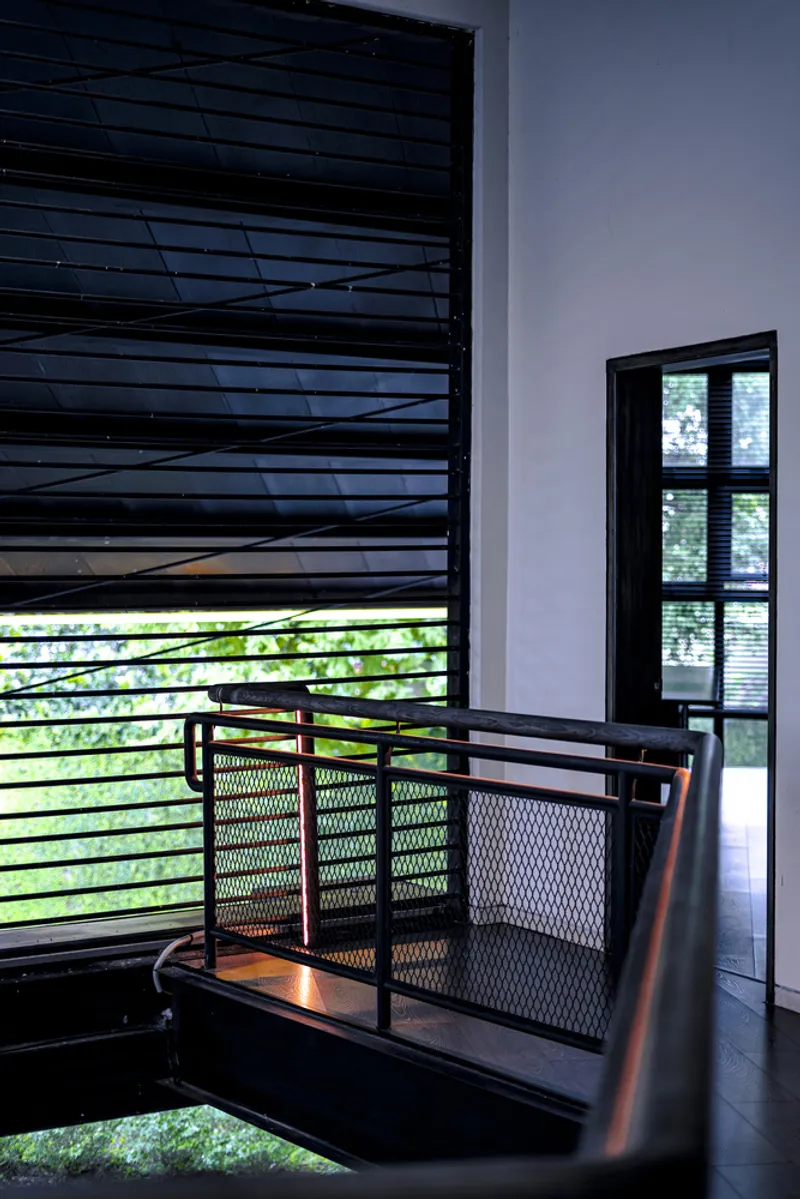
At the upper landing, an exposed plywood ceiling and black pendant track lights introduce warmer, more domestic materials. The balustrade of metal mesh continues, and horizontal louvered windows open directly to greenery. These upper spaces feel both protected and porous, a balance that requires careful section design to pull off.
Material Warmth: Kitchen and Living Rooms

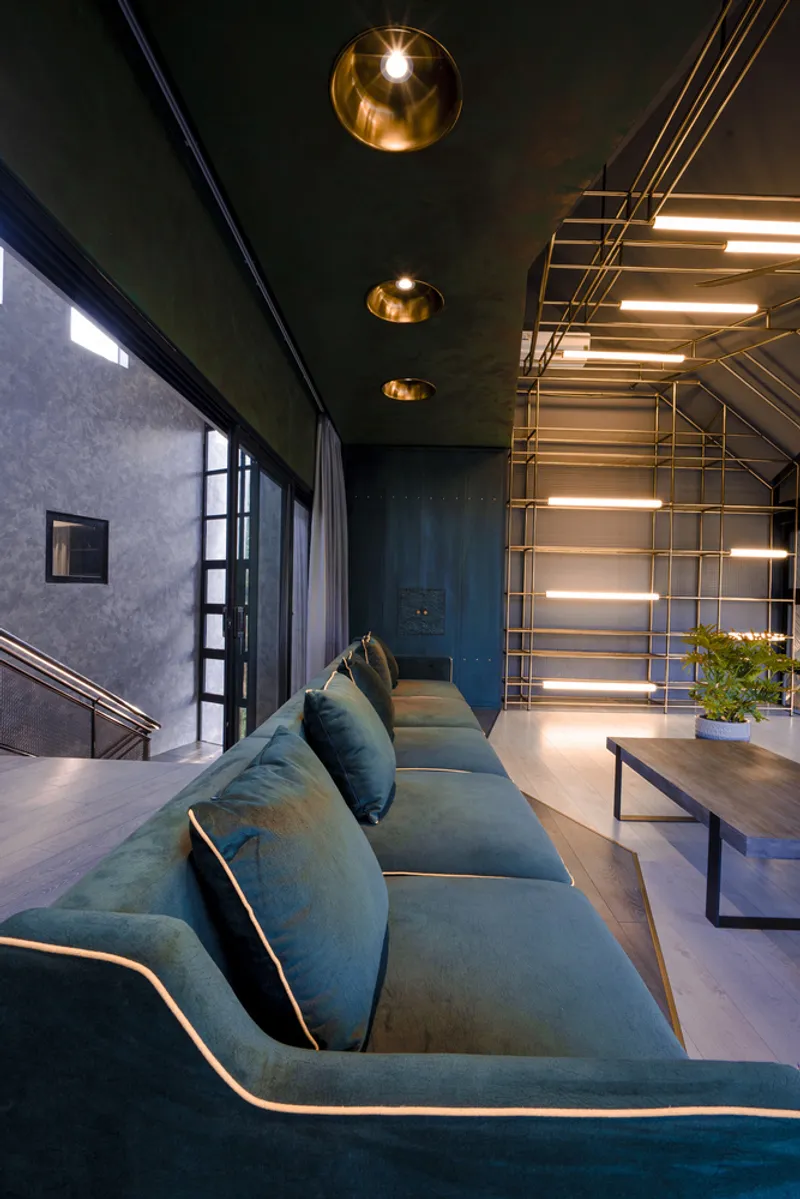

The kitchen island anchors one wing with a dark green base and polished concrete countertop beneath a curved plaster ceiling. Inset pendant lights follow the curve, and the effect is intimate and specific, a room designed for cooking rather than displaying. The living room nearby takes a different tonal register: teal upholstery, exposed brass tube lighting, and gold pendant fixtures create a palette that is rich without being heavy.
A suspended brass geometric light frame in the living zone is the closest the project comes to ornament, and it earns its place by structuring the visual field overhead. These material decisions, brass, teal, polished concrete, dark green, form a deliberate palette that holds together across rooms without insisting on uniformity. Each wing has its own atmosphere, and that diversity mirrors the multigenerational family the house was designed to hold.
Street Presence After Dark
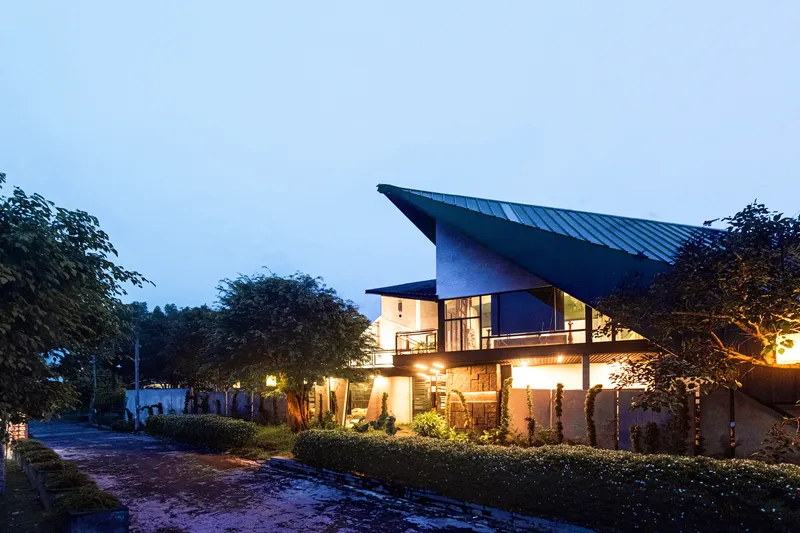
At street level after dark, the pitched metal roof and planted hedge along the property edge establish the house as a quiet neighbor. The roof profile is legible but not aggressive, and the hedge gives the house a soft perimeter that few contemporary projects bother to cultivate. Illuminated from within, the angular forms glow behind foliage, disclosing the inhabitation without exposing it. It is a generous relationship with the street: present but not exhibitionist.
Plans and Drawings
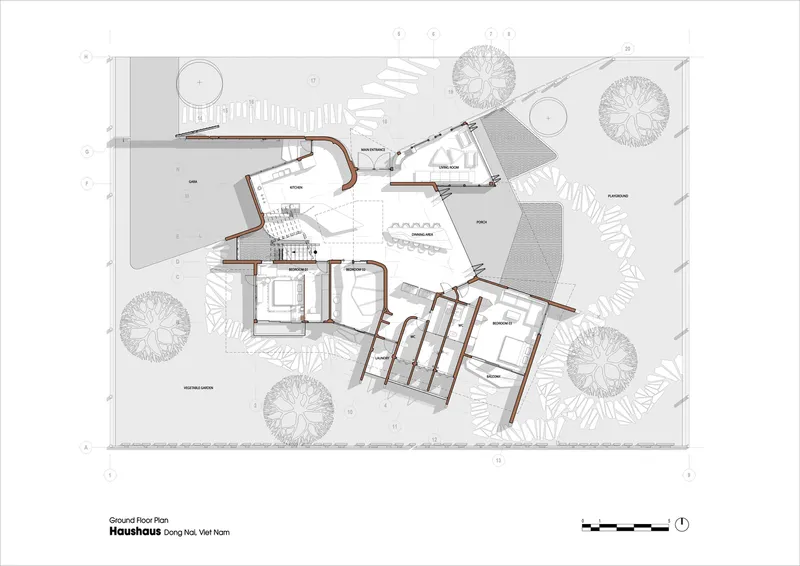
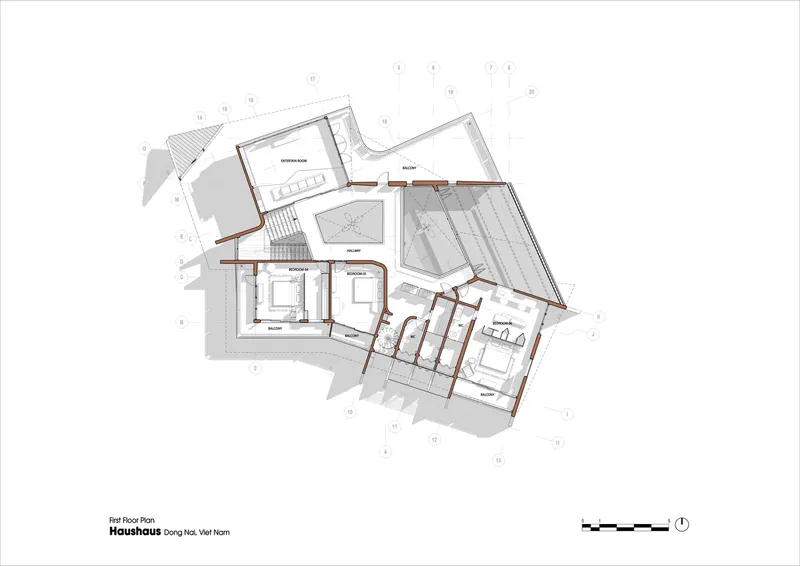
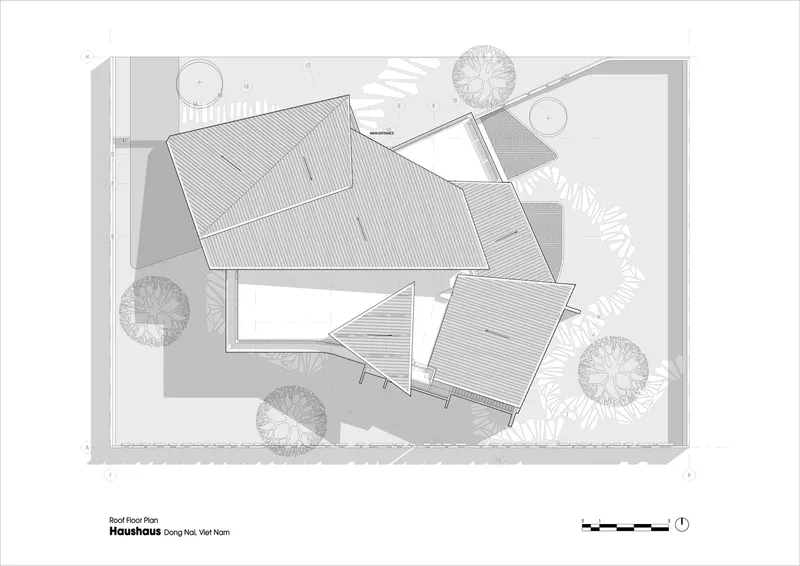
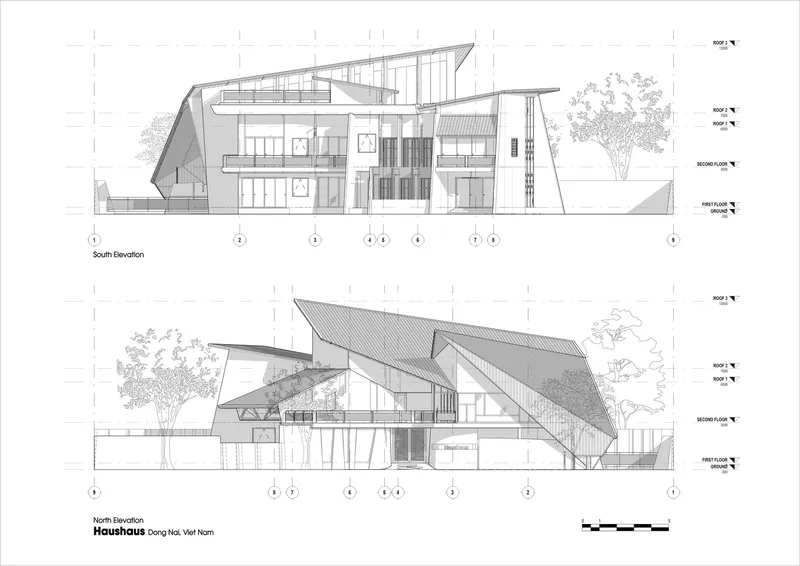
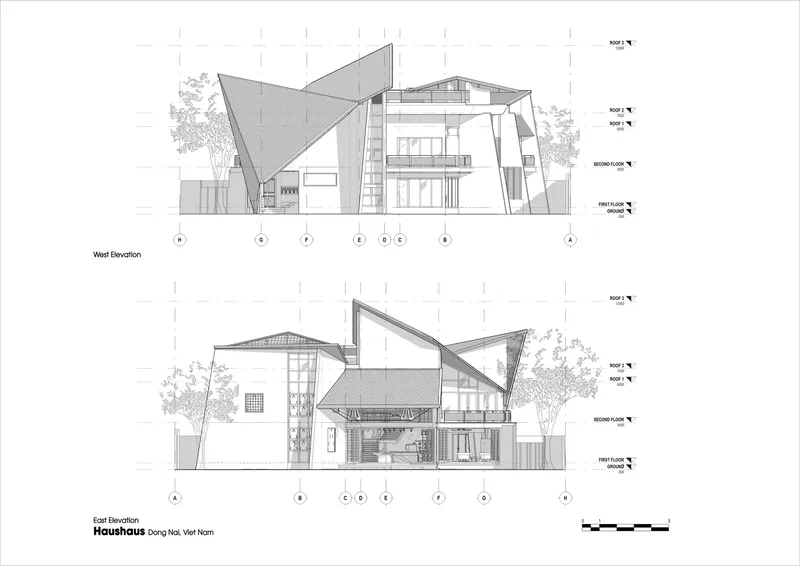
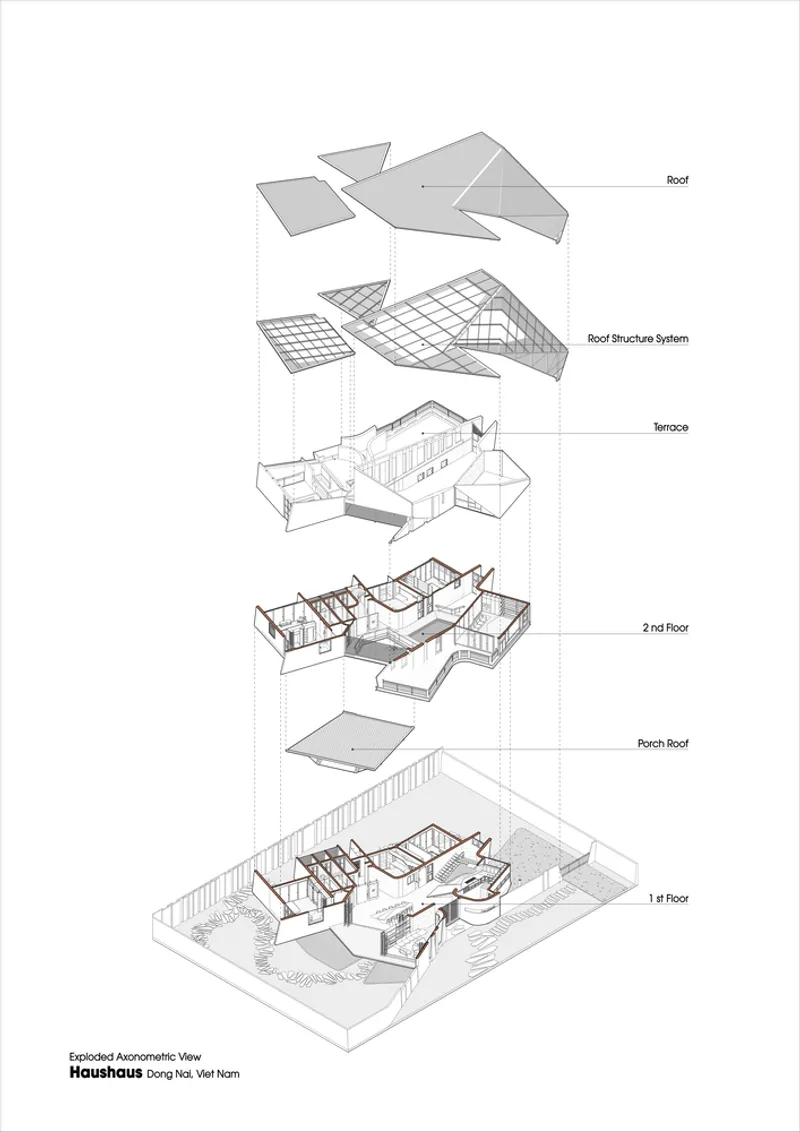
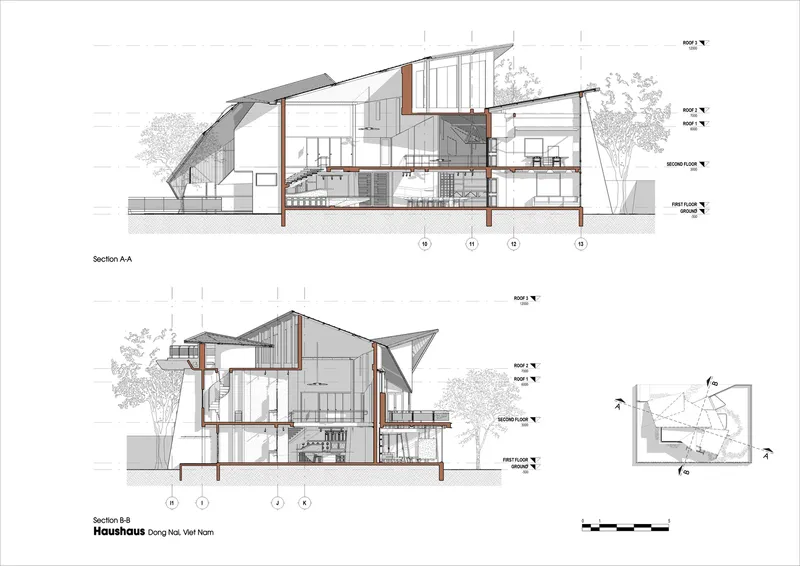
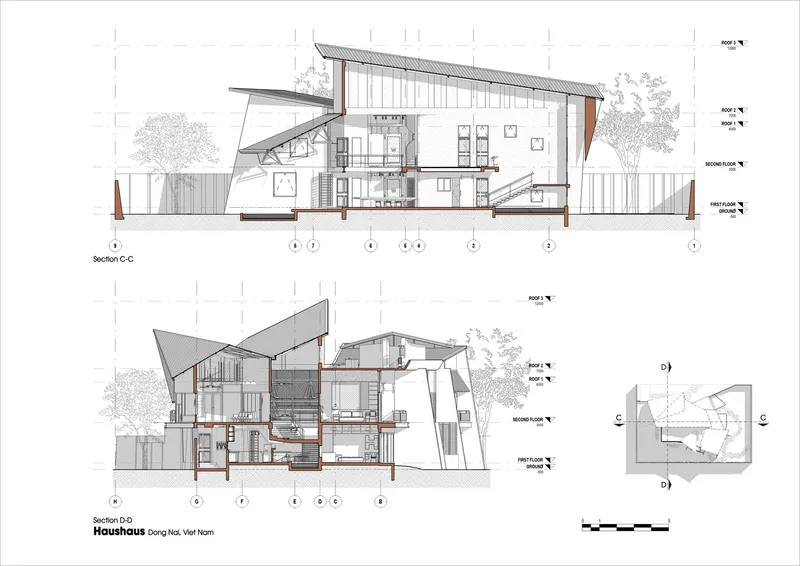
The ground floor plan confirms what the photographs suggest: the house is organized as a cluster of angular volumes rotated around courtyards, with landscape threading between them. The first floor distributes bedrooms and living spaces across the wings, ensuring each room has at least two exterior exposures. The roof plan reveals the logic of the overlapping corrugated metal planes, which are not merely formal but functional, channeling rainwater and defining the courtyards below.
The sections are where the real ambition of the project becomes clear. Multi-level interior spaces push up beneath angular rooflines supported by orange structural columns, and the relationship between the pitched ceilings and the mezzanine bridges creates a spatial richness that the plans alone do not communicate. The exploded axonometric drawing, which separates the assembly from roof planes down through floors to the site, is a useful pedagogical tool: it shows how the apparent complexity of the house resolves into a relatively straightforward layering of distinct systems.
Why This Project Matters
Haushaus matters because it treats fragmentation as a domestic strategy rather than an aesthetic preference. In a context where infill houses typically maximize enclosed area, Akitephile demonstrates that breaking the volume apart and allowing landscape to infiltrate produces better rooms, better air, and a richer spatial experience. The approach is replicable: the core ideas, courtyard ventilation, rotated axes, mesh floors as environmental filters, do not depend on an exceptional budget. They depend on a willingness to trade gross floor area for quality of life.
The project also shows how a strong material palette can unify a complex plan without flattening it. Each wing feels distinct in atmosphere, yet the recurring language of boardformed concrete, corrugated metal, plaster, and brass holds the whole composition together. For multigenerational families navigating the tension between togetherness and privacy, Haushaus proposes an architecture that accommodates both: connected by courtyards, separated by walls, and always open to the garden.
Haushaus by Akitephile, Vietnam. Photography by Dung Huynh.
About the Studio
Share Your Own Work on uni.xyz
If projects like this are the kind of work you want to make, uni.xyz is a place to publish your own, find collaborators, and enter design competitions.


Popular Articles
Popular articles from the community


Singing Woman: An Opera House That Performs Before the Curtain Rises
Ovidiu Cristian Pavel's conceptual opera house translates Estonia's choral identity into a sculpted waterfront landmark facing the Baltic Sea.

Aquadapt: An Underwater Habitat That Rewrites Its Rooms by the Hour
Curved modules ring the seabed while one shell shifts from breakfast room to cinema, farm and football pitch as residents' needs change.


FCC Arquitectura Expands a Portuguese Granite House with a Board-Marked Concrete Wing
In Portugal, JV House pairs a cleaned-up whitewashed and granite dwelling with a timber-shuttered concrete extension, courtyards and a garden pool.

Cube Design Draws an Ecological Corridor Between Two Shenzhen Hills with the Nankai Building
Beside Shenzhen's container docks, the Nankai Building pairs stacked balconies with a climbing green screen to connect two hillsides across its height.

Similar Reads
You might also enjoy these articles


Hodi-Mandai Geram
Project Function: Preservation and revitalization of the Intangible heritage and socio-spatial identity of the Hodi by Housing, Cultural Memory Center, Sacred Grove, landscape, local tourism economy


Olio Towers: A Mid-Rise for Performers That Fuses Housing, Rehearsal, and Stage
Located blocks from Houston's Theater District, this modular tower stacks living units around a central performance atrium.

Oasis: Modular Green Housing Carved into Dhaka's Urban Fabric
A shortlisted Plugin Housing entry reclaims unauthorized settlements in Dhaka with stepped concrete volumes, green roofs, and ventilation-driven design.

Black Hole: A Floating Megastructure for the Post-Physical Era
Emiliano Mazzarotto envisions a spherical, self-scaling arena where e-sports, digital hotels, and holographic stadiums replace traditional public space.

Explore Housing Competitions
Discover active competitions in this discipline

Challenge to reimagine the Iron Throne

Photograph architecture without architects

Illustrate the lost glory of Angkor Wat - Render Challenge

Design challenge to reuse E-waste
Comments (0)
Please login or sign up to add comments
No comments yet. Be the first to comment!