
Atelier PRO Architects Turns a Dated Office into a Greenhouse Gateway for Anthura in Bleiswijk
A plant breeder's outdated headquarters becomes a transparent, campus-like landmark in the Dutch horticultural glass belt.


Greenhouse districts are odd places. They are neither urban nor agricultural, packed with enormous glass structures that sprawl without the guidance of conventional building regulations. In Bleiswijk, south of The Hague, Atelier PRO Architects confronted exactly this condition when Anthura, one of the world's largest anthurium and orchid breeders, asked the firm to overhaul a severely outdated office building sitting at the edge of a 450,000 square meter greenhouse complex. The brief was deceptively simple: make the headquarters tell the company's story.
What makes the project worth studying is the restraint with which it was executed. Rather than demolish and rebuild, Atelier PRO stripped the existing metal structure and floors back to their skeleton, then wrapped them in a new identity. The resulting 2,000 square meter office is less a standalone building than a threshold between the public world and Anthura's technical inner world of climate-controlled breeding halls. Vertical facade elements, a raised plinth, a fully glazed display greenhouse wall, and a tropical courtyard garden all work in concert to bridge a dramatic scale gap and reframe how a horticultural company presents itself to the outside.
A Facade That Borrows Its Logic from the Greenhouse
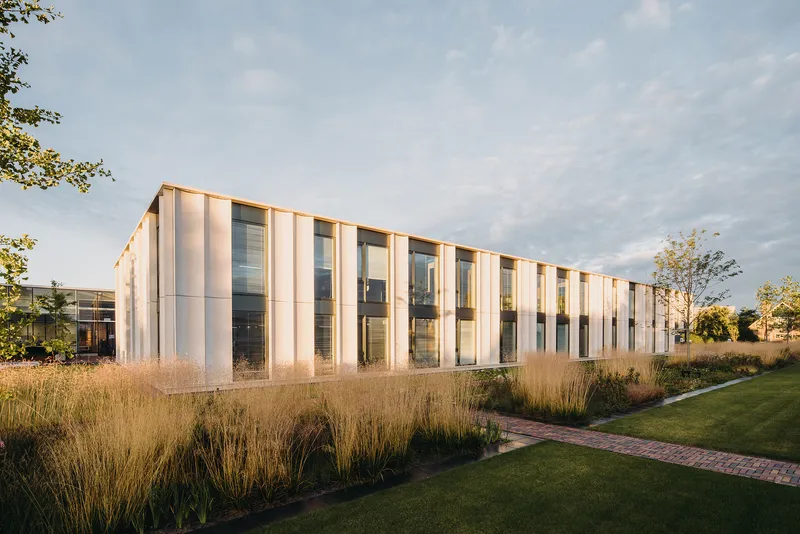
The most conspicuous move is the vertical paneling that runs the full height of the facade. These slender white elements blur the distinction between individual floors, optically stretching the building upward to hold its own against the continuous greenhouse glass behind it. The language is deliberate: vertical mullions are the signature rhythm of Dutch greenhouse construction, and Atelier PRO simply translates that vernacular into an architectural register. Viewed at dusk, the facade glows behind beds of ornamental grasses, reading less like a corporate headquarters and more like a luminous extension of the growing facilities.
Lifting the office onto a slight pedestal was a smart compositional decision. Without it, the building would merge visually with the relentless horizontal band of greenhouse glazing. The platform gives the headquarters just enough visual separation to assert a civic presence in a landscape where designed architecture is the exception, not the rule.
The Canteen as Social Core
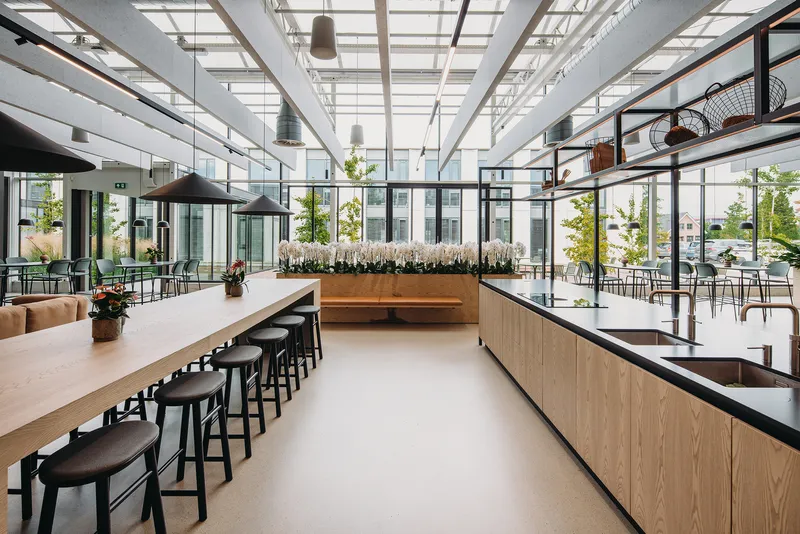
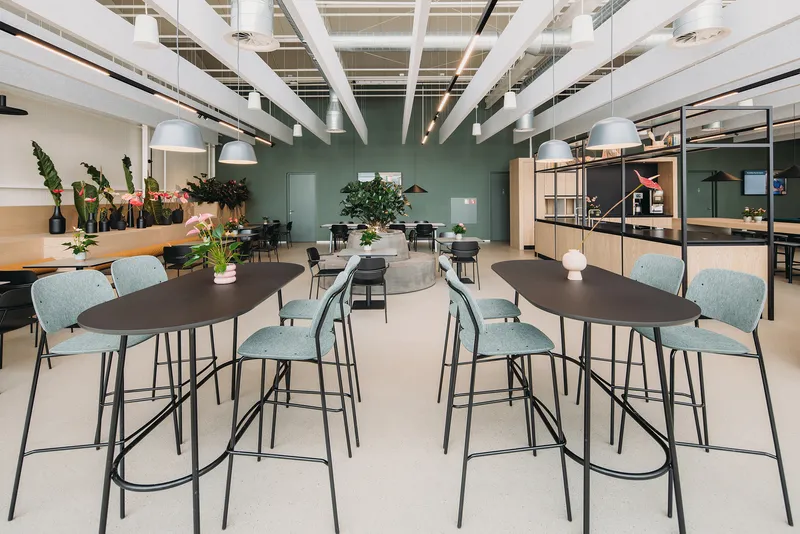
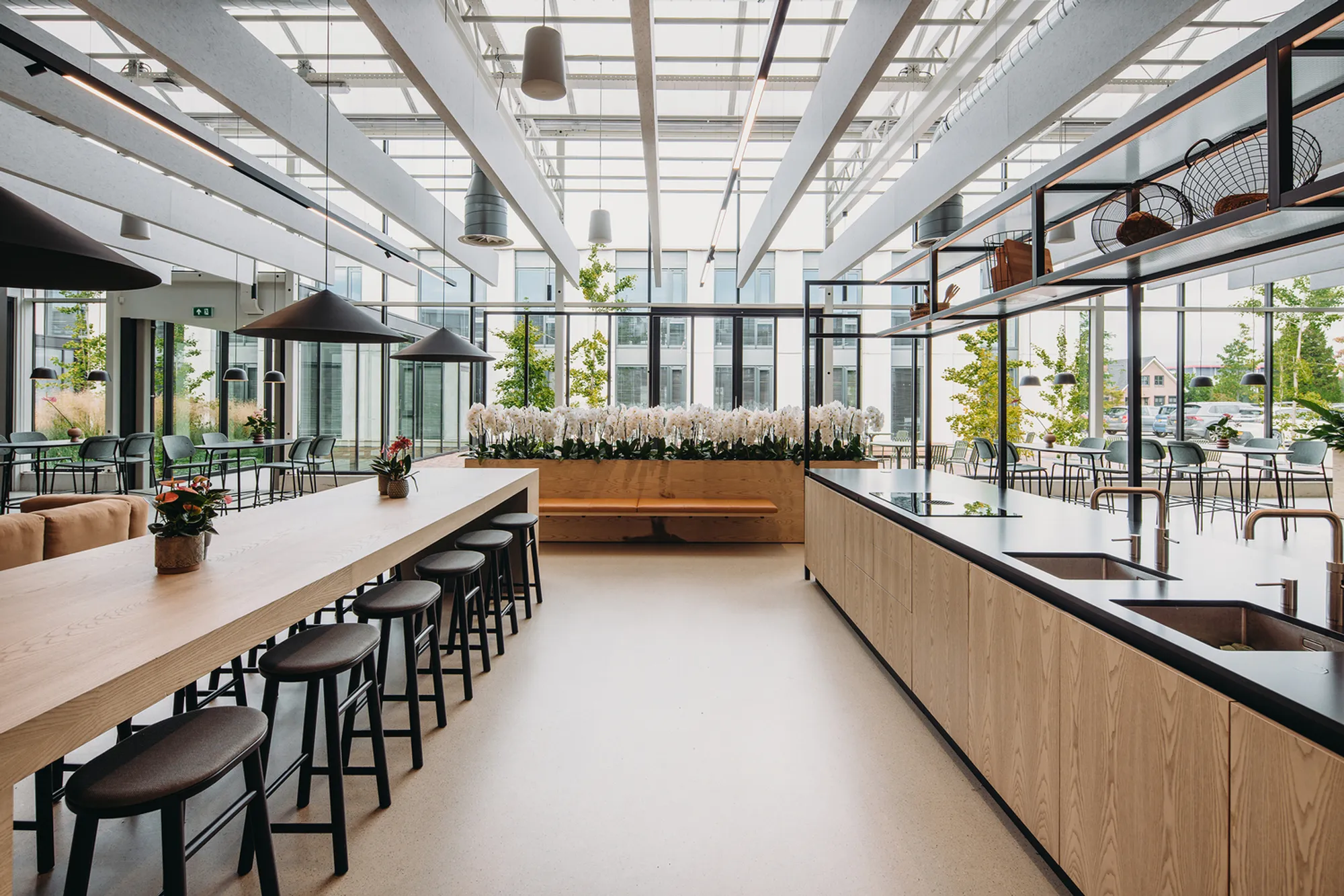
Placing the staff canteen at the literal center of the building is one of those deceptively simple organizational choices that shapes daily life. The dining hall sits beneath a timber skylight grid that floods the room with daylight, lined with long counters and greenery that echo the botanical world outside. It functions as a crossroads: every route through the building passes near or through it, so chance encounters are built into the plan rather than left to hope.
Adjacent to the canteen, a more informal cafe zone with upholstered bar stools and dark oval tables provides an alternative register for quick meetings or solo work. The exposed white structural grid overhead is the original metal construction, left visible as both an economic and aesthetic decision. Retaining these bones kept embodied carbon low and gave the interior a loft-like openness that a new build would have achieved only at greater cost.
Transparency as Brand Strategy
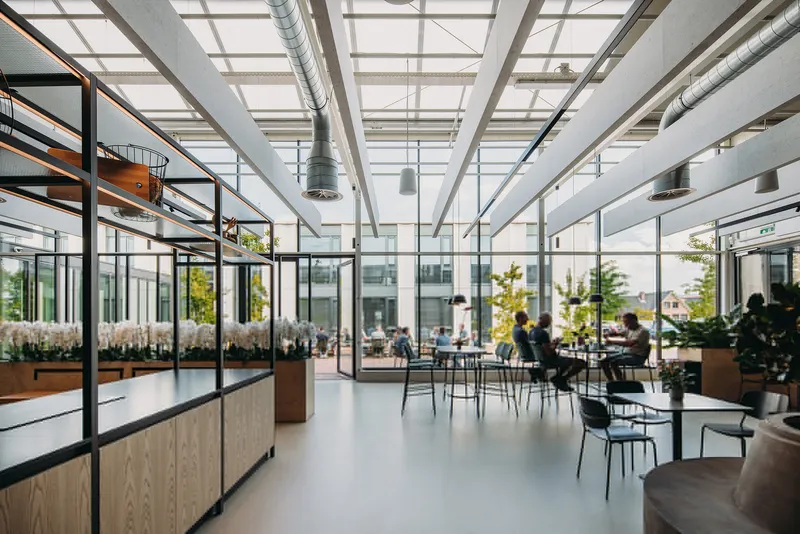
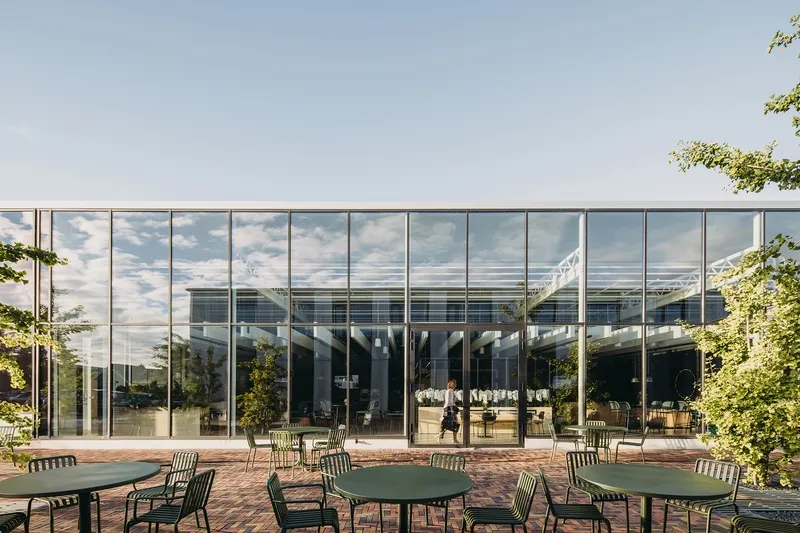
Before the renovation, the display greenhouse facade was completely closed. Atelier PRO replaced it with a floor-to-ceiling glass wall, converting what was once a back-of-house barrier into the building's most theatrical moment. Visitors following the designed 'customer journey' move from reception spaces through exhibition areas and eventually arrive at this transparent threshold, where the full scale of Anthura's breeding operation comes into view. The architectural sequence doubles as a narrative device: the company's story unfolds spatially rather than through signage alone.
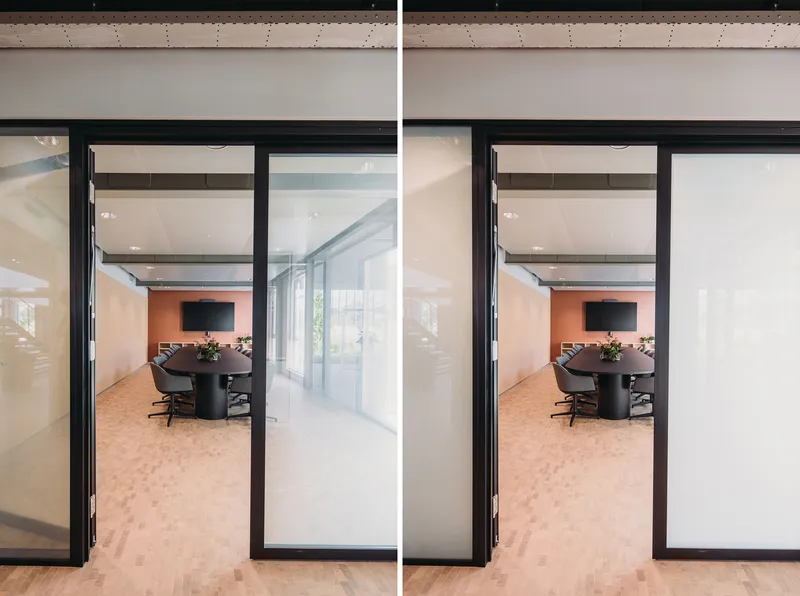
Black-framed glass partitions and doors carry this transparency into the office interior, allowing conference rooms and collaboration zones to remain visually connected to the open plan. Exposed concrete ceiling beams and white roof trusses are left unclad, reinforcing the honest, industrial character that Atelier PRO carried over from the existing structure. The result is a workspace that feels generous without being oversized.
A Tropical Garden in a Dutch Courtyard
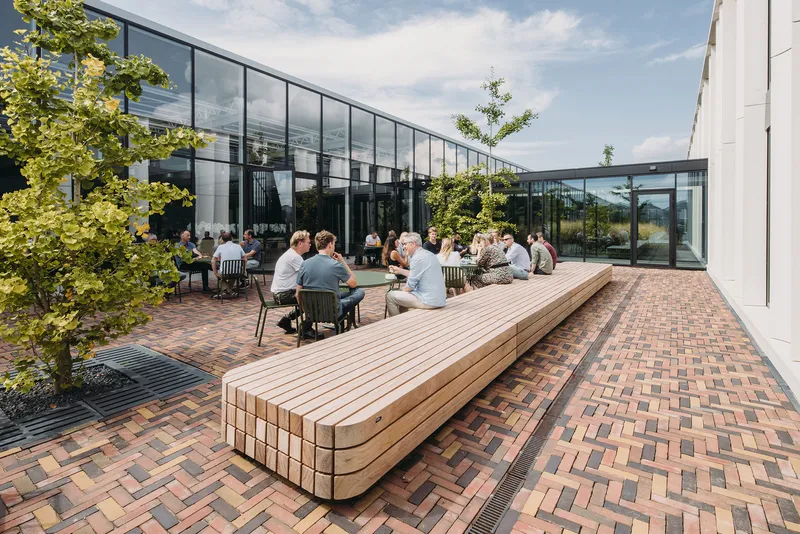
Between the office and the greenhouse sits an enclosed courtyard garden designed by Oase Landscape and Urban Planning. With herringbone brick paving, timber benches, and planted trees, it reads as a compressed version of the tropical environments that Anthura cultivates at industrial scale. The landscape architect's brief was to translate the atmosphere of indoor tropical plants into a viable Dutch outdoor setting, and the result is a sheltered microclimate that staff and visitors actually use, not just admire through glass.
Green metal furniture on the adjacent brick terrace reinforces the botanical palette without being literal. It is a subtle choice: the color connects to the surrounding plant world but avoids the cliché of recreating a garden center aesthetic. These outdoor zones extend the building's usable area during warmer months and give employees direct access to fresh air and daylight, a pragmatic counterpoint to the carefully controlled climate inside the greenhouses.
Interior Materials: Warm Tones and Living Plants
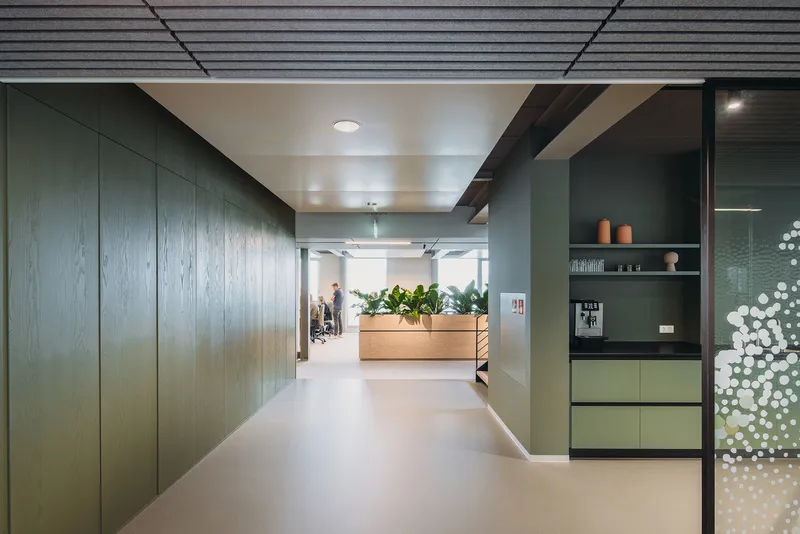
Inside, warm wood-clad wall panels and open shelving set against green surfaces create a domestic scale within the larger open plan. The material palette leans on natural finishes and Durastone seamless resilient flooring, applied without joints to keep surfaces clean and continuous. It is a practical choice for a workplace where plants are constantly being rotated through the interior as part of a living display strategy: perennial greenery is supplemented by seasonal and changing specimens that keep the space looking different from month to month.
The graphic layer, developed in collaboration with a graphic designer and exhibition designer, runs throughout the building and extends to outdoor signage. Rather than treating wayfinding as an afterthought, Atelier PRO integrated it into the architectural experience from the outset. The effect is a coherent identity system that ties together reception, exhibition, workspace, and landscape into a single legible whole.
Why This Project Matters
Greenhouse districts have long been designed by engineering logic alone. Buildings grow, merge, and mutate without architects, and the result is a landscape of pragmatic efficiency that offers nothing to the people who work in it or visit it. Atelier PRO's intervention at Anthura proves that even a modest renovation in one of these zones can shift the register entirely. By retaining the existing structure, opening up closed facades, and inserting a coherent spatial sequence, the firm turned an anonymous office into a building that communicates something specific about its occupant and its context.
The broader lesson is about adaptive reuse as identity work. Anthura did not need a signature tower or a sculptural pavilion. It needed architecture that could mediate between the vast, climate-controlled world of its greenhouses and the human-scaled rituals of collaboration, hospitality, and daily work. The fact that this was achieved by keeping the bones of a building most firms would have demolished makes the project all the more relevant at a moment when the profession is reckoning with the carbon cost of starting from scratch.
Head Office Anthura, designed by Atelier PRO Architects. Bleiswijk, the Netherlands. Approximately 2,000 m². Completed 2022. Photography by Eva Bloem.
About the Studio
Share Your Own Work on uni.xyz
If projects like this are the kind of work you want to make, uni.xyz is a place to publish your own, find collaborators, and enter design competitions.



Popular Articles
Popular articles from the community


Play: Fragments of Their World
Familiar architecture becomes modular playground design, creating safe spaces where displaced children can learn, connect, imagine and play.

Lunar Spiral: Space Architecture Shaped by the Mathematics of the Universe
Lunar Spiral reimagines space architecture through Fibonacci geometry, lunar regolith, levitating habitats, and self-sustaining Moon living.

The Earth Pod: 3D Printed Homes for Resilient Refugee Communities
The Earth Pod reimagines refugee housing through 3D printed homes made from clay, combining resilience, self-sufficiency, and rapid shelter.

Riyadh For All: Intergenerational Urban Design for Active Aging in Rabat
Riyadh For All reimagines urban design in Rabat with intergenerational co-living, adaptive courtyards, and Moroccan cultural exchange today.


Similar Reads
You might also enjoy these articles


Hodi-Mandai Geram
Project Function: Preservation and revitalization of the Intangible heritage and socio-spatial identity of the Hodi by Housing, Cultural Memory Center, Sacred Grove, landscape, local tourism economy


Olio Towers: A Mid-Rise for Performers That Fuses Housing, Rehearsal, and Stage
Located blocks from Houston's Theater District, this modular tower stacks living units around a central performance atrium.

Oasis: Modular Green Housing Carved into Dhaka's Urban Fabric
A shortlisted Plugin Housing entry reclaims unauthorized settlements in Dhaka with stepped concrete volumes, green roofs, and ventilation-driven design.

Black Hole: A Floating Megastructure for the Post-Physical Era
Emiliano Mazzarotto envisions a spherical, self-scaling arena where e-sports, digital hotels, and holographic stadiums replace traditional public space.


Explore Office Building Competitions
Discover active competitions in this discipline



Challenge to reimagine the Iron Throne


Photograph architecture without architects


Illustrate the lost glory of Angkor Wat - Render Challenge


Design challenge to reuse E-waste
Comments (0)
Please login or sign up to add comments
No comments yet. Be the first to comment!