
CUDO Fuses a Florist and a Café into One Adaptable Interior in Wrocław's Borek District
Helen Café layers pre-war brick references and post-war white modernism into a 126-square-meter space that shifts from brunch spot to workshop venue.


Combining a florist with a café is a proposition that could easily collapse into visual chaos: too many textures, too many agendas, too little discipline. CUDO sidesteps that trap at Helen Café in Wrocław by treating the hybrid program not as a novelty but as a design constraint worth taking seriously. The 126-square-meter space on Januszowicka Street in the Borek district operates as both Rośliny, a plant shop, and Helen Café, a coffee and events venue, and it does so without partitioning the two. Instead, a single material language and a deliberately mutable floor plan allow the room to toggle between identities throughout the day.
What makes the project genuinely interesting is how it reads the neighborhood and feeds that reading back into the palette. Borek is a residential quarter where German pre-war brick construction sits shoulder to shoulder with Polish post-war modernist housing blocks from the 1950s. CUDO distills that duality into two dominant material moves: dark grey brick tiles that recall the older fabric, and expanses of white that reference the social modernism that followed. The result is a compact interior that feels historically rooted without resorting to pastiche.
Street Presence and the Green Threshold
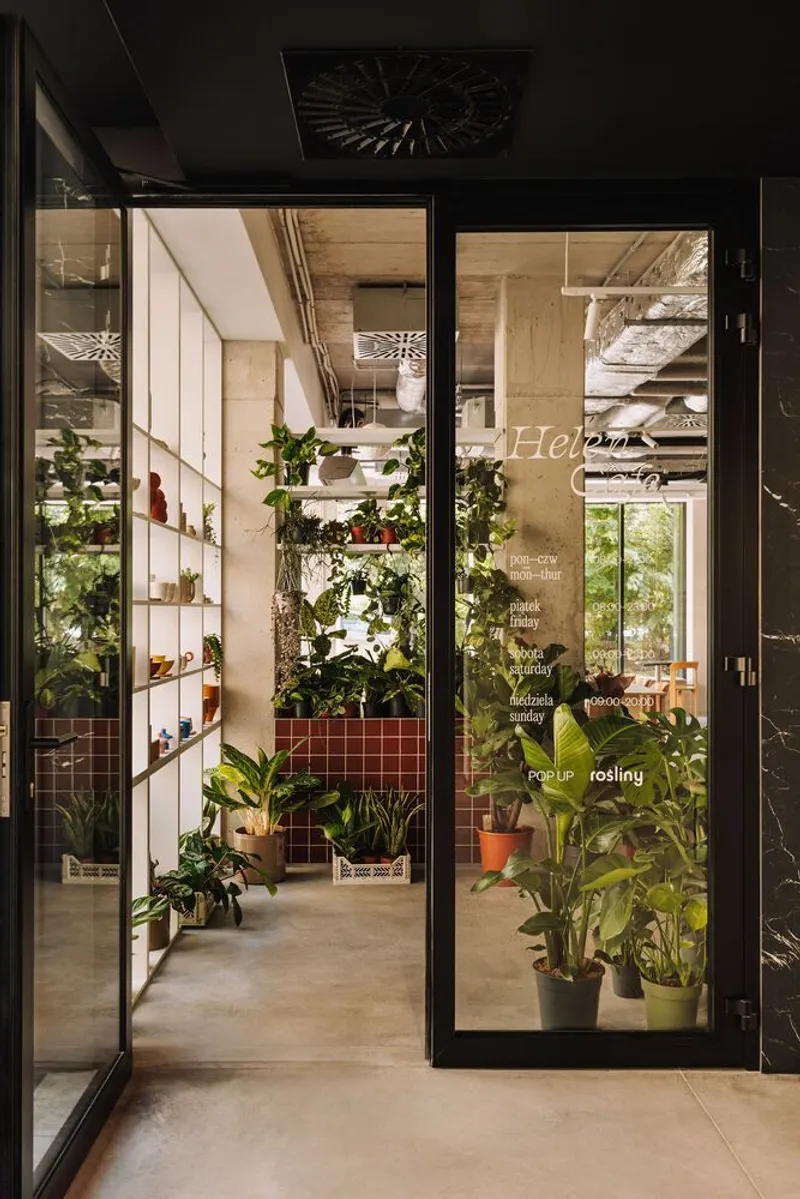
The full-height glazing along the street front does more than let light in. It stages the interior greenery as a public gesture, blurring the line between courtyard planting and indoor display. Black steel frames give the shopfront a graphic crispness that contrasts with the organic mass of potted plants behind the glass. From the sidewalk, you read the space as half greenhouse, half bar, which is precisely the ambiguity the program demands.
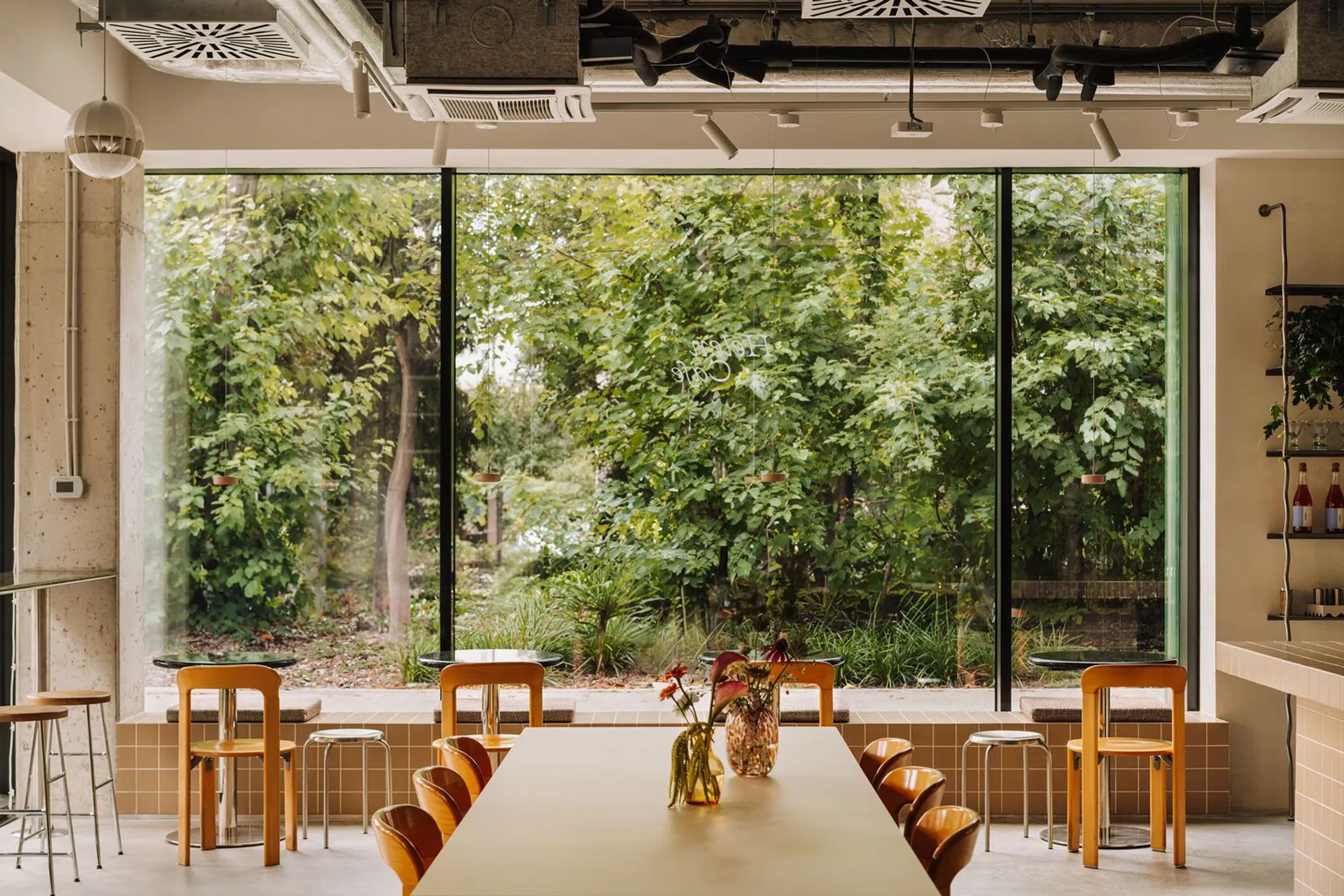
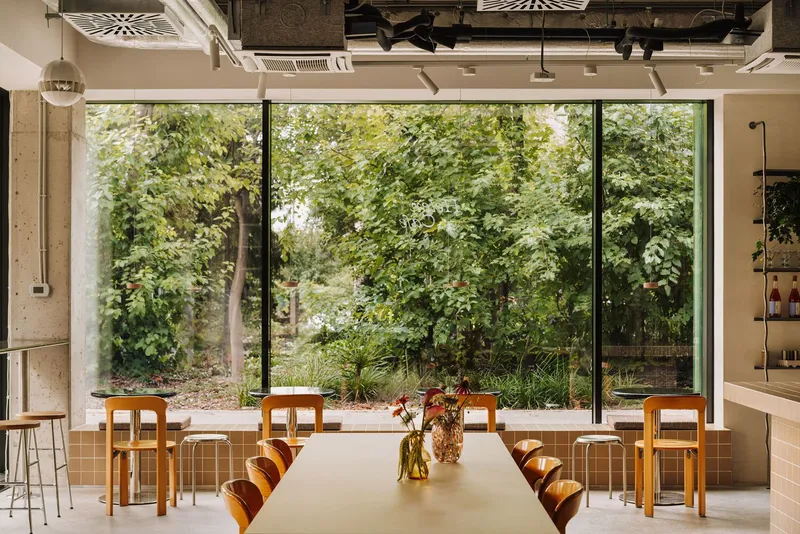
Inside, the polished concrete floor and the planted courtyard beyond the rear glazing extend the biophilic logic in both directions. Timber tables and chairs sit on a surface that feels continuous with the exterior ground plane. The intention is clear: nature is not decoration here but infrastructure, defining zones, softening acoustics, and giving the florist half of the business a reason to exist within the café rather than alongside it.
The Central Bar as Organizing Spine
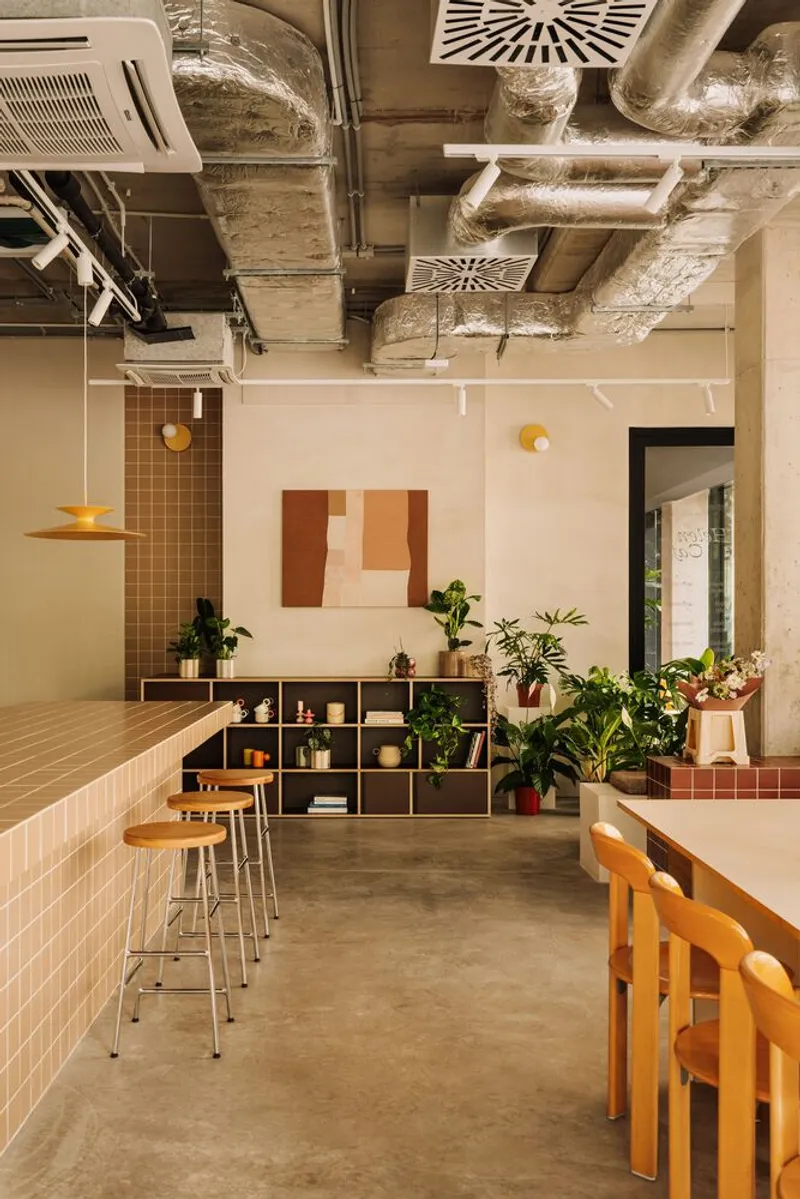
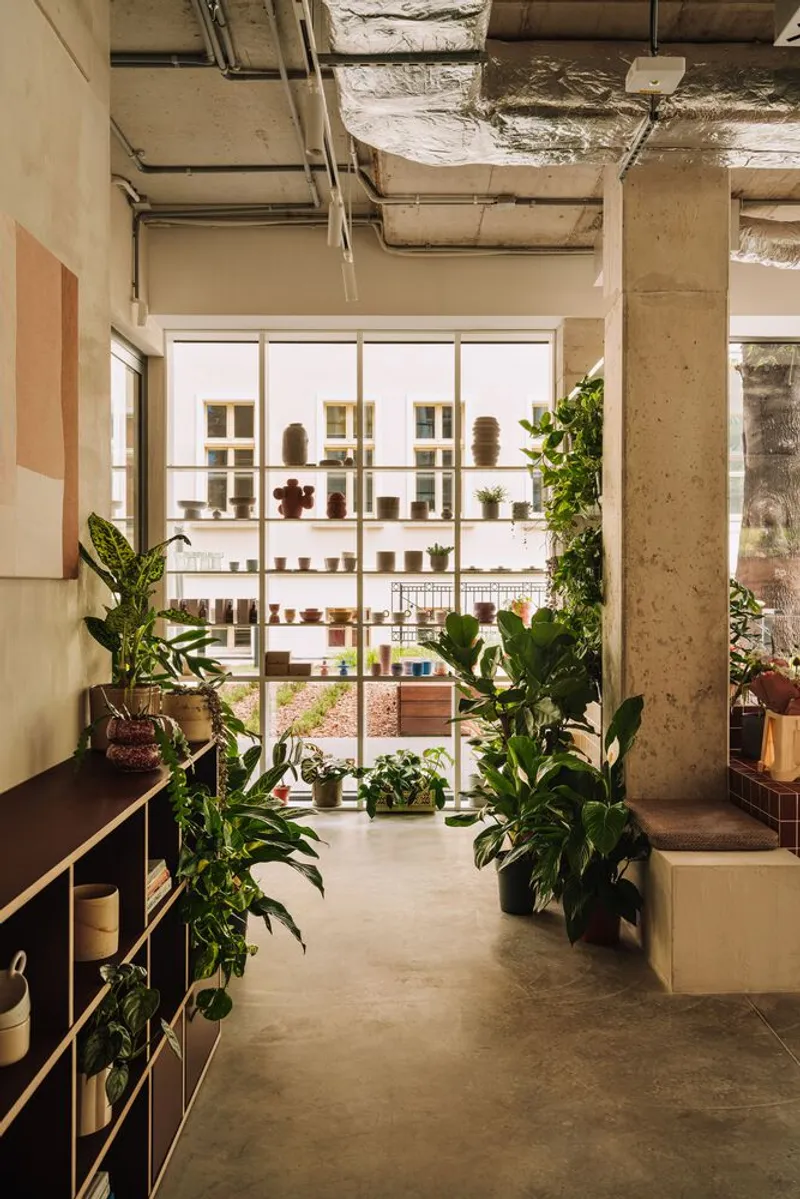
A long bar runs through the space, serving as the primary organizational device. On one side it handles coffee preparation and display; on the other, it opens to a workshop zone backed by the kitchen's shared wall. Technological equipment is concentrated along this common partition, functioning as a 'backbar' that operates independently depending on whether the room is in café mode, workshop mode, or event mode. The arrangement is pragmatic and legible: guests always know where the service core is, regardless of how the rest of the furniture has been rearranged.
The tiled counter, paired with bar stools beneath the exposed concrete ceiling and its visible ductwork, gives the bar a workbench quality. Nothing is hidden. Ventilation runs, structural beams, and lighting tracks are all left readable, reinforcing the impression that this is a space designed to be used hard and reconfigured often.
Plant Platforms and Seating That Doubles
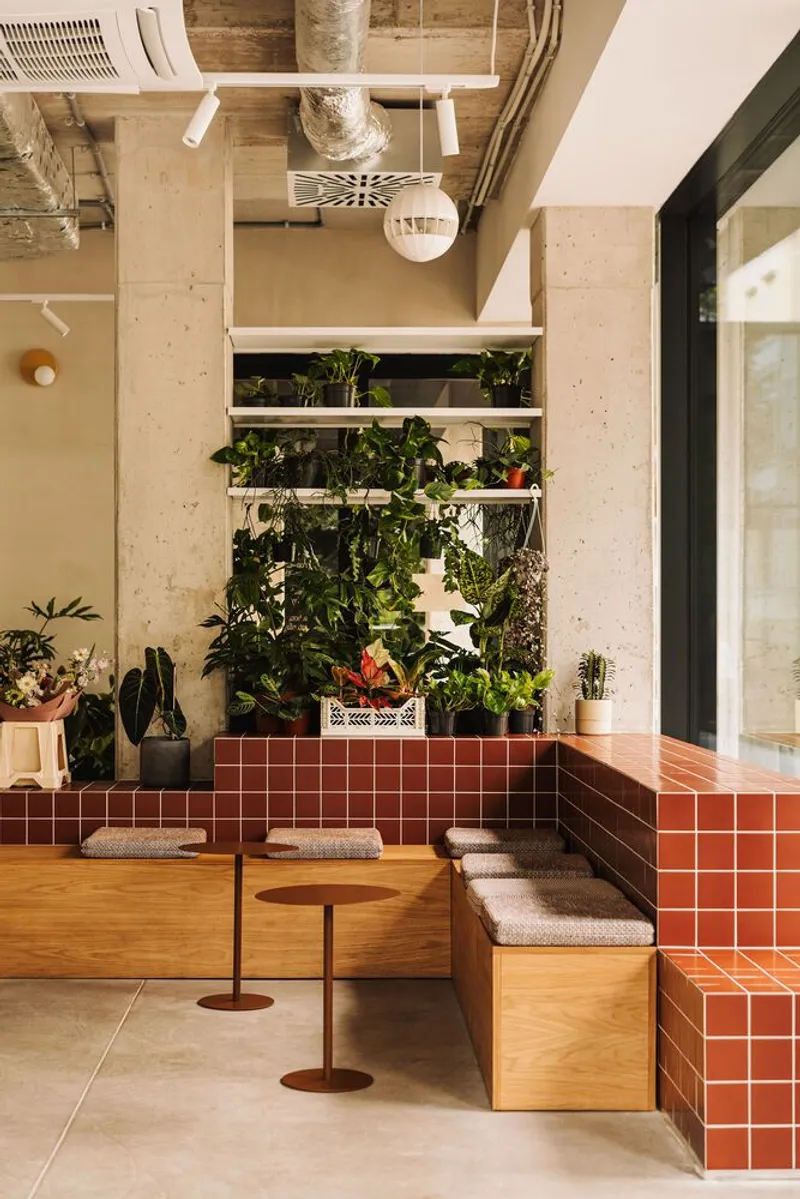
Raised pedestals throughout the room perform a quiet double duty. Clad in terracotta tile, they serve as bases for vertical planted walls and as bench seating in the same gesture. The timber bench shown against the living wall is a good example: it reads as lounge furniture until you notice the plants growing directly above and beside it, turning a seat into a display shelf for the florist operation. The platforms give the room a layered topography that makes 126 square meters feel substantially larger.
Concrete columns punctuate the plan and frame views through the greenery toward the white metal display shelving at the rear. These framed vistas are deliberate. They reward movement through the space and prevent the interior from reading as a single flat room.
Serpentine Shelving and Material Warmth
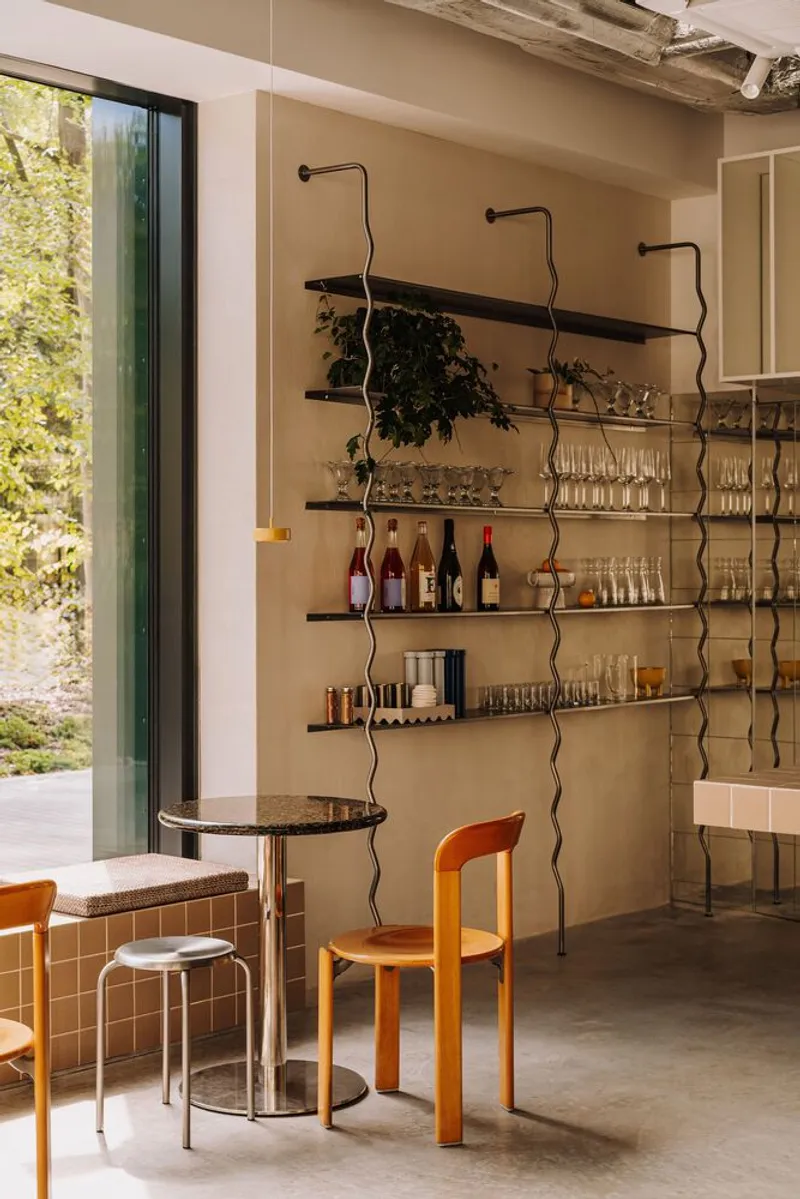
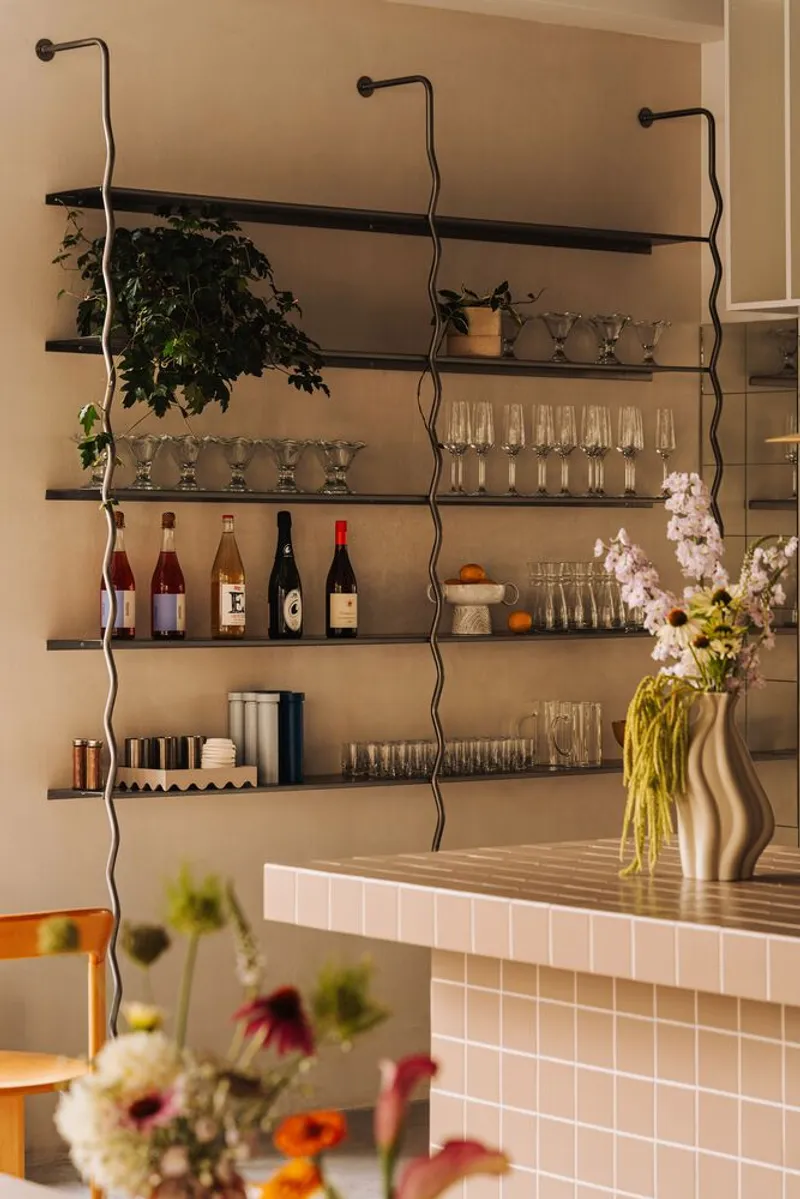
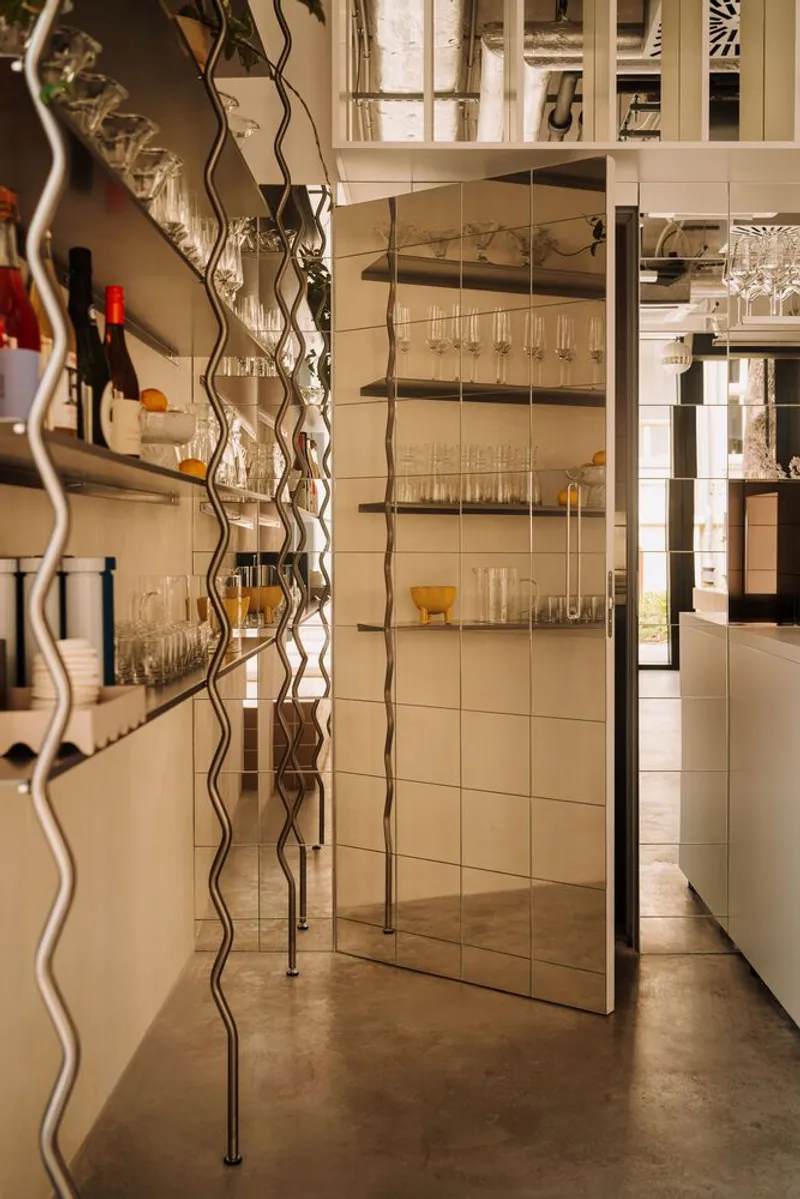
The wavy metal shelving units are among the most distinctive elements. Their serpentine profiles introduce a soft, almost playful geometry into an otherwise rectilinear envelope. Stocked with wine bottles, glassware, and the occasional potted plant, they perform as both storage and visual texture. The warm-toned metal catches the interior lighting and creates pockets of intimacy, particularly near the small round table with its orange chair, where the scale shifts from communal to personal.
Mirrors placed behind and beside the shelving amplify the greenery and the warm light, making the walls feel porous rather than solid. The mirrored glass doors visible in one corner extend the effect, reflecting the serpentine shelves into an implied depth that visually doubles the room. It is a familiar trick, but executed with enough restraint that it enhances rather than overwhelms.
Reading the Neighborhood in the Palette
The material strategy is worth unpacking because it is more than just 'earthy tones.' CUDO explicitly ties the dark grey brick tiles to Borek's pre-war German construction, a period that gave the district its dense residential grain. The white surfaces, meanwhile, reference the post-war modernist buildings that introduced new social programs, schools, community halls, into the neighborhood during the 1950s. By holding these two references in a single room, the café becomes a compressed timeline of its street.
Concrete bridges the two registers. It is neither warm nor cool, neither pre-war nor post-war, and its exposure on the ceiling keeps the space honest about its own era. The green facade of the building itself feeds into the interior through the large windows, making the exterior planting a third material layer that unifies the historical references with the living, organic character of the florist program.
Why This Project Matters
Hybrid commercial programs are everywhere now, but most treat the combination as a branding exercise rather than a spatial one. Helen Café stands out because CUDO designed the flexibility into the architecture itself: the bar's dual orientation, the pedestals that are simultaneously planting beds and furniture, the mobile elements that allow a full room transformation between morning service and an evening workshop or DJ set. The adaptability is structural, not cosmetic.
More importantly, the project demonstrates that a small interior fit-out can engage with urban history without becoming a museum. The material palette is specific to Borek's layered identity, and that specificity gives the space an authenticity that no amount of generic 'industrial chic' could replicate. For a 126-square-meter café in a residential neighborhood, that is a significant achievement, and a model worth studying for anyone designing small-scale commercial interiors in historically complex contexts.
Helen Café by CUDO, Januszowicka Street, Borek district, Wrocław, Poland. 126 m². Completed 2023. Photography by Migdał Studio.
About the Studio
Share Your Own Work on uni.xyz
If projects like this are the kind of work you want to make, uni.xyz is a place to publish your own, find collaborators, and enter design competitions.




Popular Articles
Popular articles from the community


Lunar Spiral: Space Architecture Shaped by the Mathematics of the Universe
Lunar Spiral reimagines space architecture through Fibonacci geometry, lunar regolith, levitating habitats, and self-sustaining Moon living.

Co-Life: Senior Housing Design That Reconnects Older Adults With the City
Co-Life reimagines senior housing design through healing gardens, shared streets, workshops, and a sustainable community across generations.

Co-life: Sustainable Architecture for Age-Friendly Community Living
Co-life reimagines sustainable architecture for seniors through courtyards, rammed earth, shared gardens, and spaces designed for belonging.

The Earth Pod: 3D Printed Homes for Resilient Refugee Communities
The Earth Pod reimagines refugee housing through 3D printed homes made from clay, combining resilience, self-sufficiency, and rapid shelter.

Similar Reads
You might also enjoy these articles


Hodi-Mandai Geram
Project Function: Preservation and revitalization of the Intangible heritage and socio-spatial identity of the Hodi by Housing, Cultural Memory Center, Sacred Grove, landscape, local tourism economy


Olio Towers: A Mid-Rise for Performers That Fuses Housing, Rehearsal, and Stage
Located blocks from Houston's Theater District, this modular tower stacks living units around a central performance atrium.

Oasis: Modular Green Housing Carved into Dhaka's Urban Fabric
A shortlisted Plugin Housing entry reclaims unauthorized settlements in Dhaka with stepped concrete volumes, green roofs, and ventilation-driven design.

Black Hole: A Floating Megastructure for the Post-Physical Era
Emiliano Mazzarotto envisions a spherical, self-scaling arena where e-sports, digital hotels, and holographic stadiums replace traditional public space.


Explore Interior Design Competitions
Discover active competitions in this discipline


Challenge to design luxury tourism on rails


Challenge to reimagine the Iron Throne


Photograph architecture without architects


VR headsets Storefront design competition
Comments (0)
Please login or sign up to add comments
No comments yet. Be the first to comment!