
HelgessonGonzaga Raises a Tar-Coated Weekend Pavilion Above the Rocks of a Swedish Nature Reserve
House Tjurpannan sits on granite bedrock at the edge of the open sea in Grebbestad, channeling boathouse traditions into 90 square meters of shelter.


There is a particular kind of building that earns its presence on a site not by dominating the landscape but by learning from it. House Tjurpannan, designed by HelgessonGonzaga Arkitekter and completed in 2022 on Sweden's west coast, belongs to that lineage. Perched on concrete pillar footings above exposed granite bedrock at the edge of the Tjurpannan Nature Reserve, the 90 square meter weekend retreat draws its material logic directly from the jetties and boathouses that dot the coastline around Grebbestad. Its blackened timber skin, coated in tar, is not a stylistic gesture but a vernacular necessity: in a place shaped by relentless wind and open sea, you either protect your wood or you lose it.
What makes the project genuinely interesting is the tension between its rugged, almost primitive exterior and the transparent, light-filled life it frames inside. The house is conceived less as a building and more as a platform: a raised base from which a family launches into the landscape for hiking, swimming, and foraging, then returns for shelter that feels closer to luxurious camping than conventional domesticity. A wooden grid of glulam posts, spaced at regular intervals and built from standard lumber lengths sourced at a local hardware store, simultaneously defines the structure, the room divisions, and the aesthetic. Nothing is hidden. The pragmatism is the architecture.
Grounded by Bedrock, Lifted by Stilts


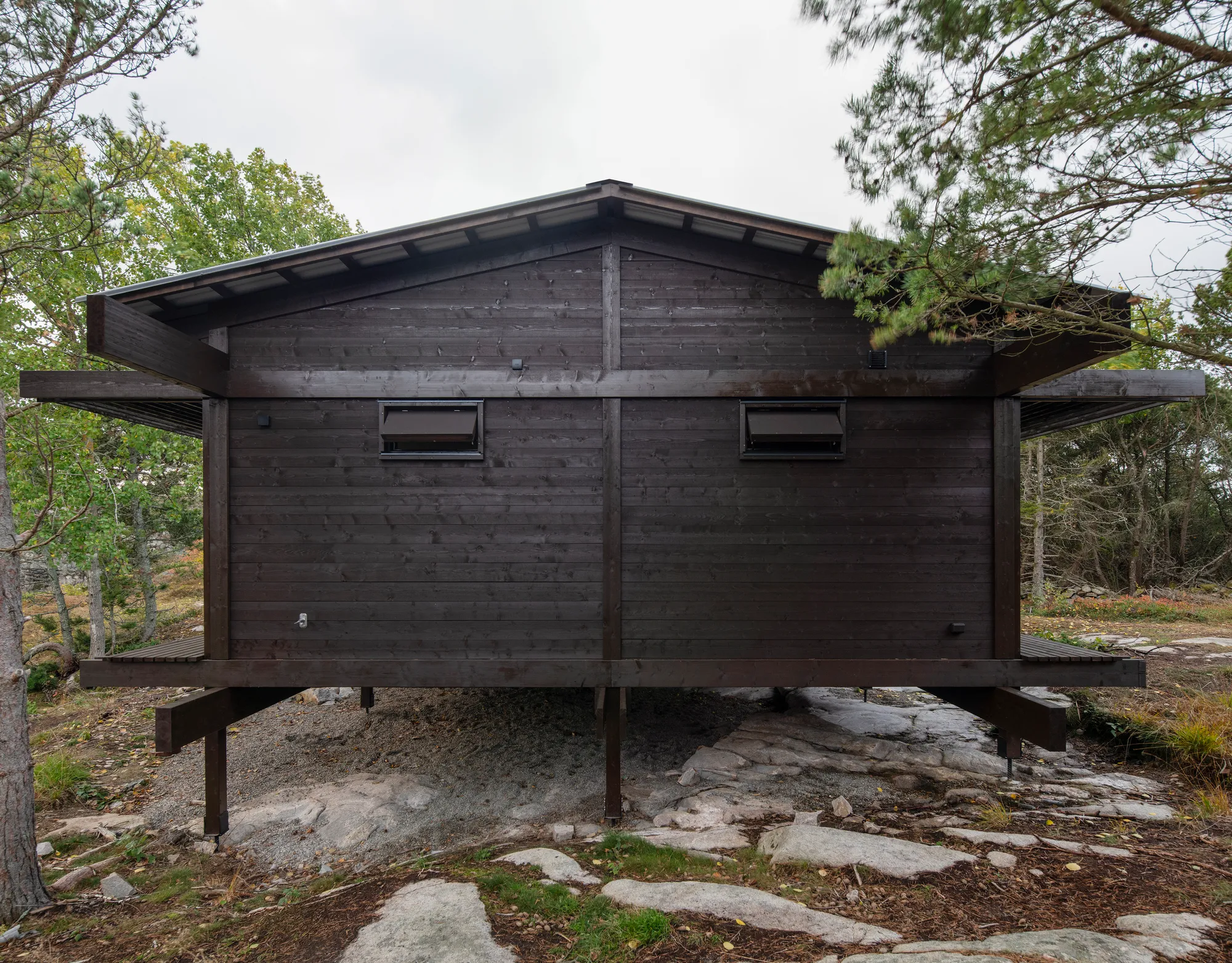
The house arrives where the terrain begins to flatten out, becoming a portal toward the reserve and the open water beyond. Its low profile is deliberate: dark natural colors and a corrugated metal roof keep the silhouette recessive against the pines and bare birches. By raising the structure on plinths, HelgessonGonzaga avoids disturbing the rock surface and echoes the way local boathouses are elevated to mitigate flooding from storm surges. You approach through a path that threads an old stone wall in the cultural landscape, and the building announces itself gradually, more like something that has always been here than something that was placed.
The distant view through autumn grasses and driftwood reinforces how the cabin's dark mass recedes into the landscape. It reads as a piece of infrastructure, a dock or a shed, rather than a house. That reading is earned, not accidental.
The Tar Skin and Its Local Logic
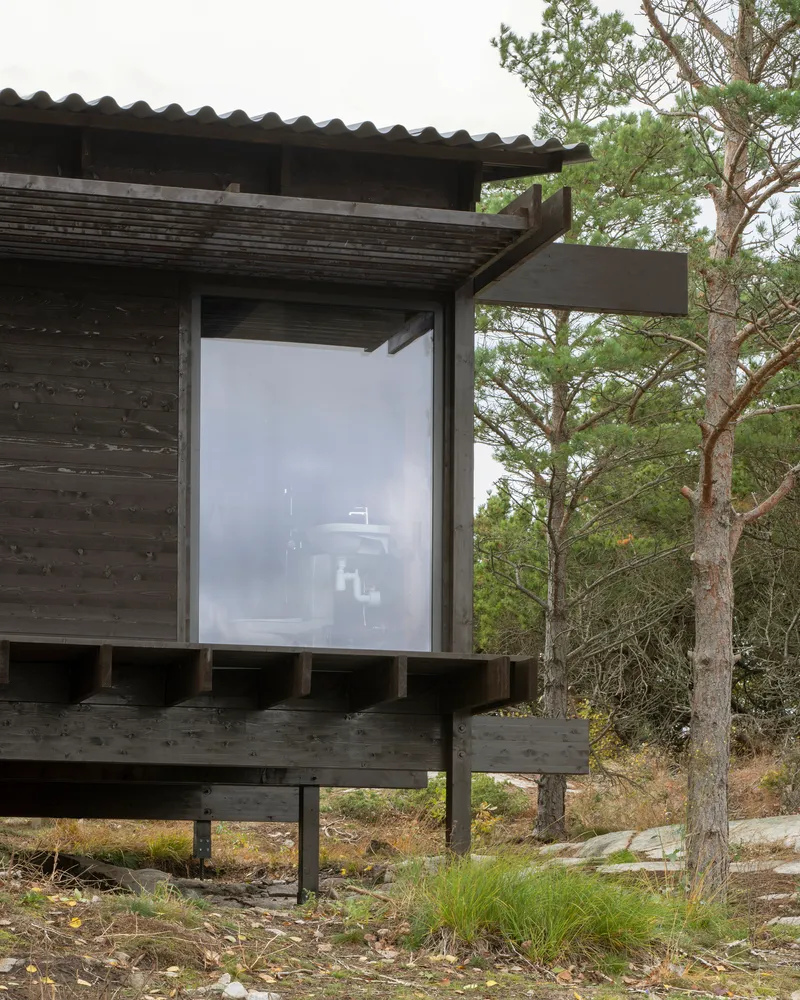
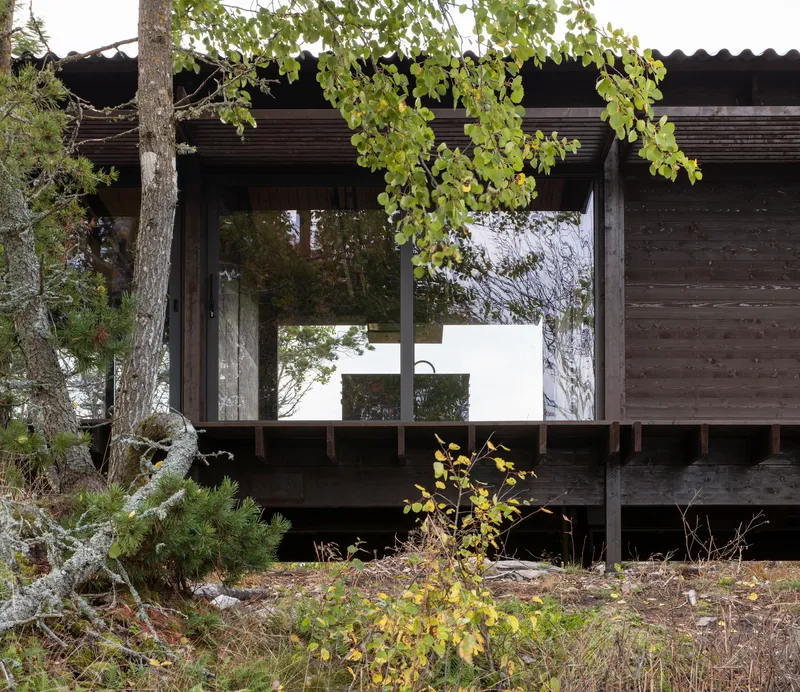
Up close, the blackened timber cladding reveals a texture that is rough and slightly uneven, absorbing light rather than reflecting it. Tar coating is one of the oldest preservation techniques on the Scandinavian coast, applied to boathouses and jetties for centuries. Here it serves double duty: protecting the wood from salt spray and constant wind exposure while anchoring the building visually in its immediate context. The deep overhangs, supported by exposed timber posts, protect the narrow decks and glass doors from driving rain. These covered terraces function as transitional zones, outdoor rooms where weather is experienced at a comfortable remove.
The corner detail at the junction of cladding, overhang, and post reveals the care taken in proportioning these elements. Nothing is oversized or heroic. The columns are slender, the overhang is generous but not theatrical, and the corrugated metal roof has the utilitarian directness of a fishing shed. The architecture refuses to aestheticize the harsh conditions and instead absorbs them into its material vocabulary.
Transparent Living Between Trees and Sea
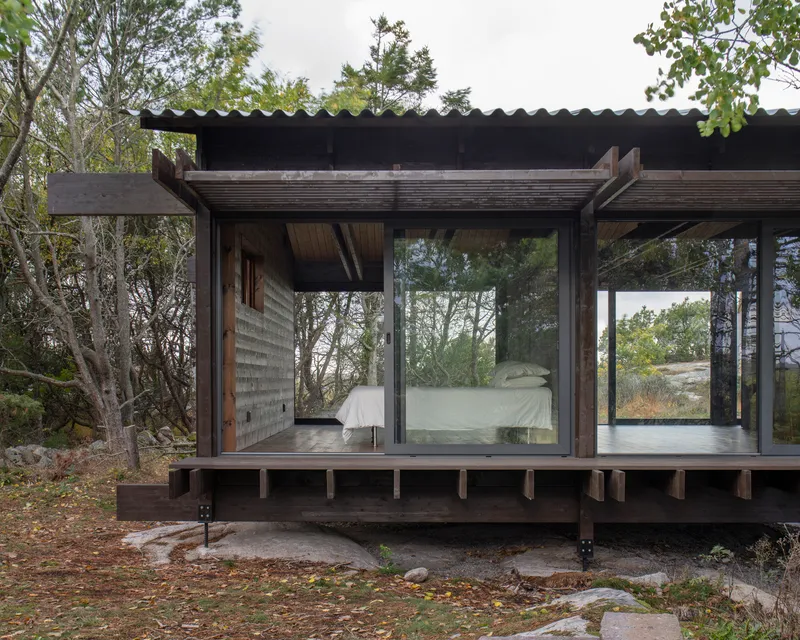

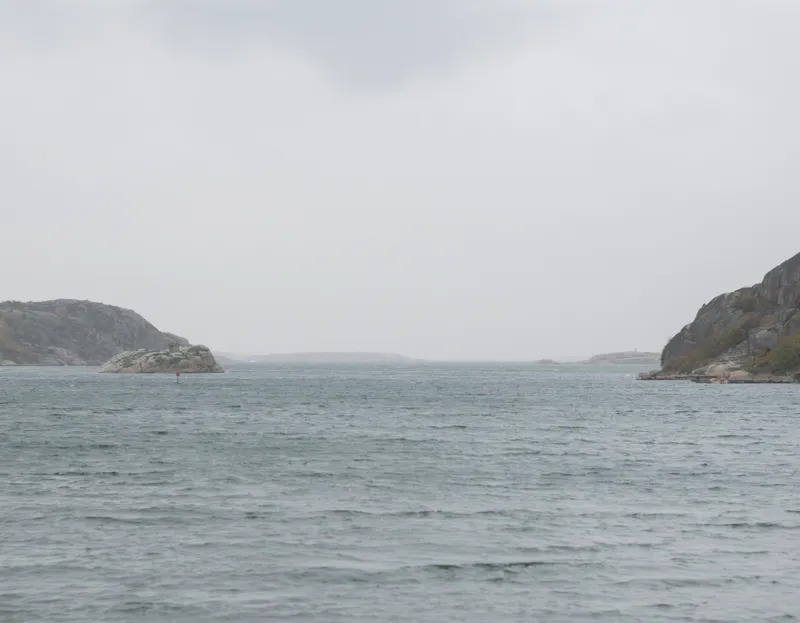
If the exterior is opaque and protective, the interior is its opposite. Full-height glazing wraps the lakeside elevation, dissolving the boundary between the raised timber deck and the landscape beyond. The bedroom module, enclosed in glass on three sides, places you among the pine canopy. On an overcast day, the grey sky and water merge into a single field visible through the transparent walls, and the house becomes less a shelter than a frame. This is the core idea: the building exists to organize your relationship with what lies outside it.
The view across grey water toward rocky islands captures the exposure that defines the site. The house does not turn its back on the harshness. It opens itself to it, protected only by glass and overhang, trusting its tar and timber shell to handle the rest.
Structure as Interior

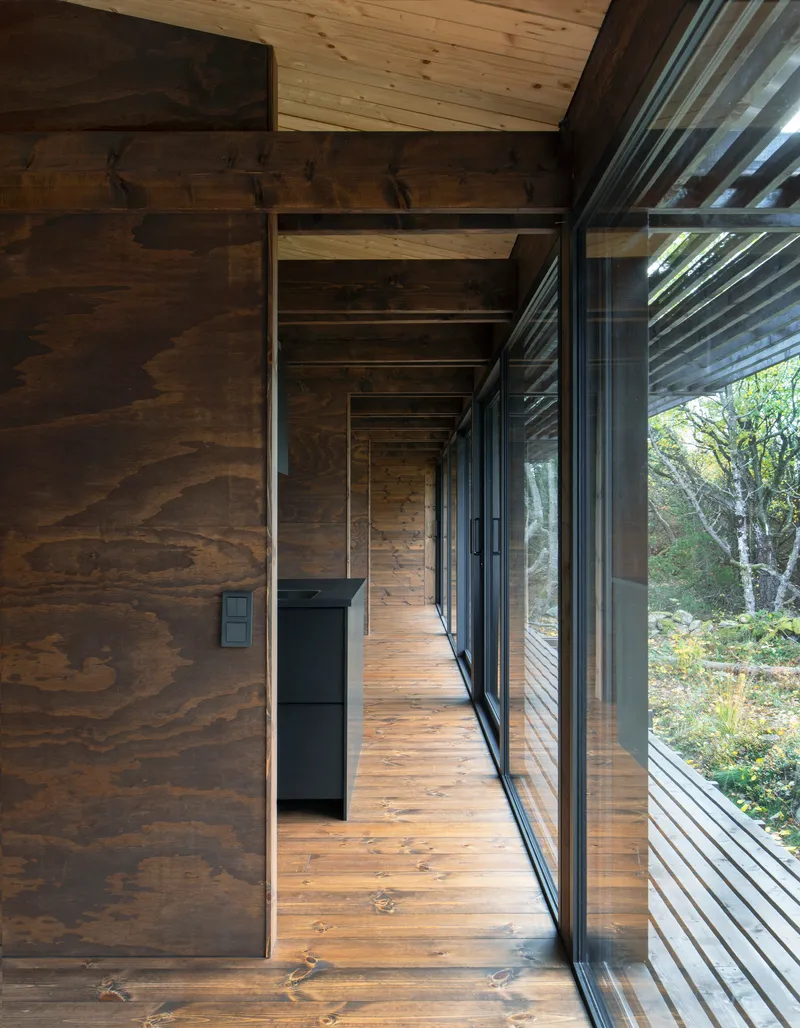

Inside, the structural grid of glulam posts is left entirely exposed, and the pale timber plank ceiling runs continuously between them, creating a rhythm that defines circulation and room boundaries without solid walls. The corridor along the glazed side is a good example: wood slat ceiling and continuous windows produce a sequence that feels more like a covered walkway than a hallway. Simple partition walls at the center allow rooms to flow into one another, with only the bathroom fully enclosed. The kitchen, with its concrete cabinet walls beneath the wood ceiling, introduces a cooler material counterpoint that sharpens the warmth of the timber.
The dark-stained plywood panels that line certain interior walls create a tonal bridge between the tarred exterior and the lighter ceiling. An acoustic guitar leaning against one of these panels captures the domestic register the house operates at: informal, unhurried, sized for weekends rather than permanent occupation. The interiors do not try to impress. They try to recede, letting the landscape do the work through the glass.
A Pragmatic Material Palette
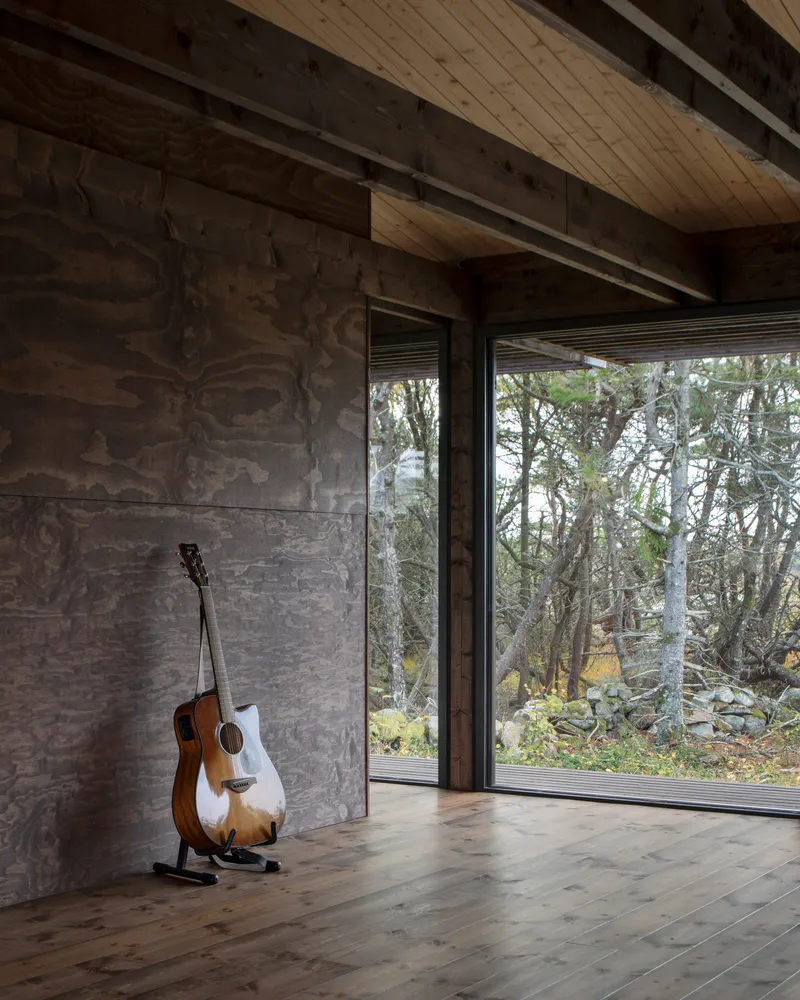
HelgessonGonzaga describes the construction approach as pragmatic, and the material evidence supports this. The structural grid is largely defined by standard wooden elements available from a local hardware store, which means the dimensions of the house are shaped by what is readily available rather than by custom fabrication. This constraint gives the project an honesty that more expensively detailed weekend houses often lack. The corrugated metal roof, the off-the-shelf lumber, the tar coating: every surface speaks of a building that could be maintained, repaired, and even partially rebuilt using the same supply chain that produced it.
The rustic quality is not a style applied after the fact. It emerges from the construction logic itself, from choosing standard lengths and leaving joints visible. In a moment when Scandinavian architecture is often associated with refined minimalism, House Tjurpannan offers a different proposition: that austerity and resourcefulness can be more compelling than polish.
Plans and Drawings

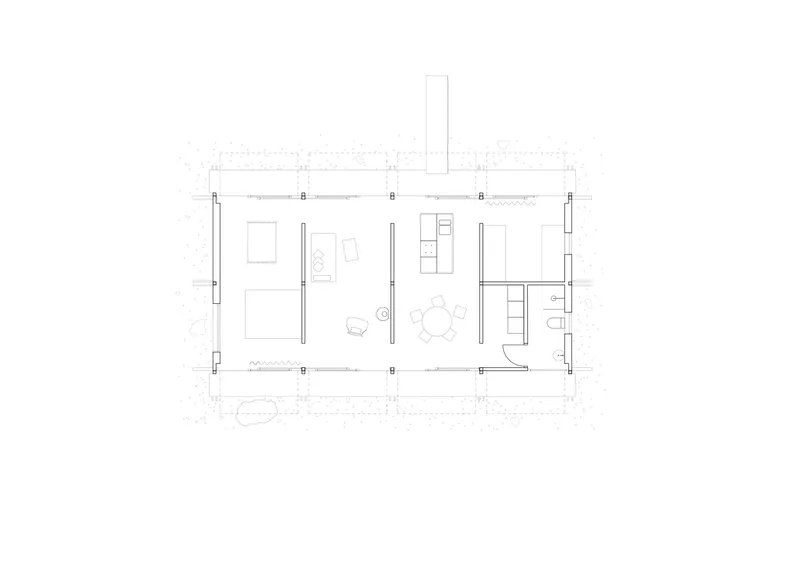

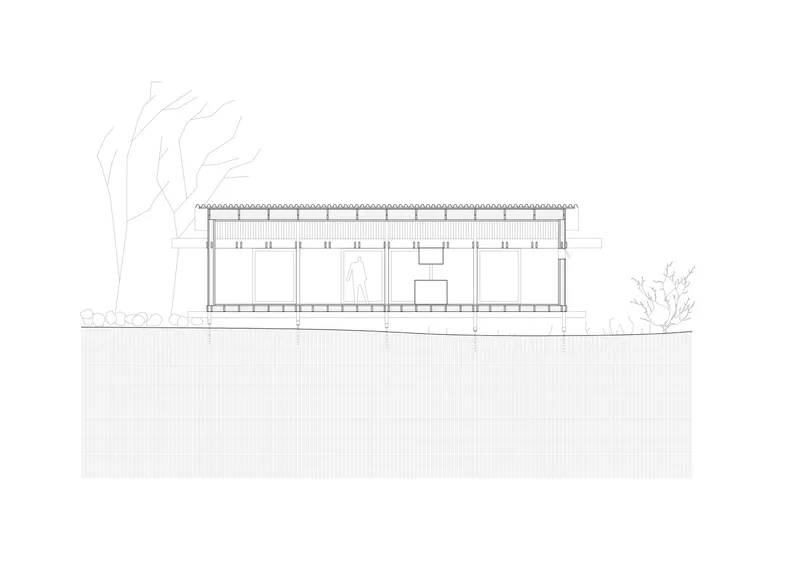


The site plan confirms what the photographs suggest: the rectangular volume is set precisely where the contoured hillside begins to level off, positioned among scattered tree clusters rather than in a clearing. The floor plan reveals the open layout with a central living area and a compact bathroom core, all organized within the regular structural grid. Elevation and section drawings make the gabled profile legible, showing how the pavilion sits above the undulating terrain on its pilotis, the corrugated roof extending into generous overhangs.
The two physical models are worth noting. Built with dried grasses and bare branches, they test the building's relationship to its landscape at a scale where proportions can be felt rather than calculated. The low horizontal model and the steeper gabled version suggest the architects explored more than one roofline before settling on the final pitch, a process visible in the models' different profiles. These are working tools, not presentation pieces, and they reinforce the project's ethos of directness.
Why This Project Matters
House Tjurpannan matters because it demonstrates that building in a sensitive natural context does not require either invisibility or spectacle. The house is present, unapologetically a building, but it earns its place by drawing on the material traditions and construction logic of its coast. The tar, the stilts, the overhangs: these are not references applied for cultural credibility but responses to the same conditions that produced the boathouses they echo. In 90 square meters, the project delivers a complete argument about what a weekend house can be when it refuses to pretend it is something else.
For architects working on retreat typologies in exposed landscapes, this project offers a useful lesson in restraint. The decision to use standard lumber from a local supplier rather than custom-engineered components is not a budget compromise but a design stance. It ties the building to its region economically as well as aesthetically, and it makes eventual repair and adaptation straightforward. In a climate of increasingly elaborate weekend houses, House Tjurpannan's insistence on being a well-built platform for outdoor life, nothing more and nothing less, is quietly radical.
House Tjurpannan by HelgessonGonzaga Arkitekter, Grebbestad, Sweden. 90 m², completed 2022. Photography by Mikael Olsson.
About the Studio
Share Your Own Work on uni.xyz
If projects like this are the kind of work you want to make, uni.xyz is a place to publish your own, find collaborators, and enter design competitions.



Popular Articles
Popular articles from the community


The Ocean Hive: Sustainable Architecture for a Self-Sufficient Civilization at Sea
The Ocean Hive imagines sustainable architecture at sea, where modular habitats, algae, wave power and ocean waste sustain a growing colony.

The Musturak Paradise: Senior Living Architecture for a Connected Future in Temara, Morocco
The Musturak Paradise reimagines senior living architecture in Temara via private homes, social spaces, culture, community, and shared care.

Co-life: Sustainable Architecture for Age-Friendly Community Living
Co-life reimagines sustainable architecture for seniors through courtyards, rammed earth, shared gardens, and spaces designed for belonging.

AL-JANNAH: Sustainable Architecture and Permaculture for Afghan Widows
AL-JANNAH uses sustainable architecture and permaculture to create resilient oasis of housing, learning, work and renewal for Afghan widows.

Similar Reads
You might also enjoy these articles

Bao Huynh Watercolor Atelier: A Serene Art Retreat in Hội An
Bao Huynh Watercolor Atelier in Hội An blends multifunctional art spaces, sustainable design, local materials, and family-friendly living in a serene environment.

Atelier Macri Concept Store Interior Design by CASE-REAL
Atelier Macri store features a "ko" counter, walnut wood details, cork displays, blending retail, gallery, and seamless customer experiences.

Manuel Vargas Izquierdo Stadium and High-Performance Sports Center: Architectural Excellence in Jalpa de Méndez
The Manuel Vargas Izquierdo Stadium blends sustainable design, inclusive sports facilities, and cultural-inspired architecture, revitalizing Jalpa de Méndez’s public spaces.

KAKR Buluh Awar Hall: Revitalizing Community and Ecology Through Bamboo Architecture
Community built bamboo hall revitalizes Buluh Awar village, empowering youth, restoring ecology, celebrating vernacular craftsmanship through sustainable architecture and culture.


Explore Residential Building Competitions
Discover active competitions in this discipline



Challenge to design a portable theatre


Challenge to design a portable music platform


Challenge to design an open learning module for the elderly


Challenge to design mud housing for contemporary communities
Comments (0)
Please login or sign up to add comments
No comments yet. Be the first to comment!