

Helicom Habitat: Hexagonal Pods That Learn from Penguins and Ice Floes
Robert Czajka's modular Arctic settlement uses biomimetic geometry, passive solar strategies, and hydroponic systems to sustain life at the poles.


Penguins survive Antarctic winters by huddling: rotating positions, sharing body heat, minimizing exposed surface area. It is a deceptively simple strategy, and it turns out to be a viable blueprint for architecture. Helicom Habitat takes this biomimetic logic and translates it into a hexagonal modular settlement designed for the extreme conditions of polar regions, where low-angle sunlight, snowstorms, and months of darkness make conventional building typologies irrelevant. Each unit locks into a larger cluster the way ice floes aggregate on open water, creating shared thermal mass and a collective urban form that grows organically across the tundra.
Designed by Robert Czajka and published on uni.xyz, the project responds to the accelerating geopolitical and scientific interest in polar habitation. As climate change reshapes the Arctic, Helicom proposes a self-sufficient settlement that produces its own energy, grows its own food, treats its own waste, and still manages to feel like a place worth living in. The design evolves through clearly defined phases: from raw ice floe geometry, to hexagonal enclosure, to insulated pod, and finally to a fully integrated habitable unit capable of aggregation into diverse community configurations.
A Snowfield of Clustered Domes
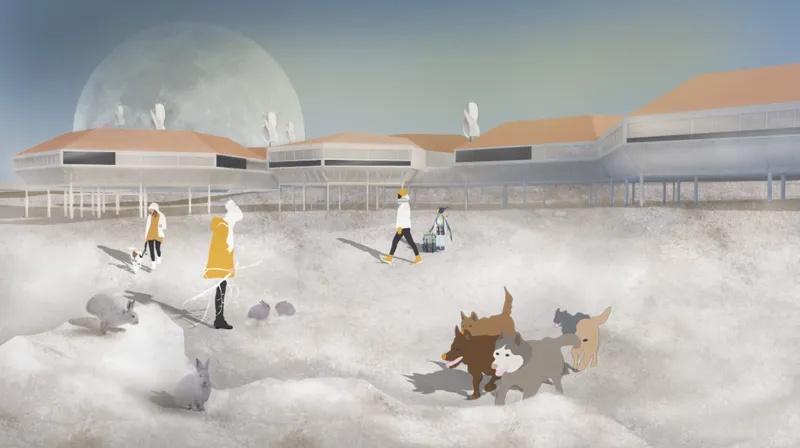
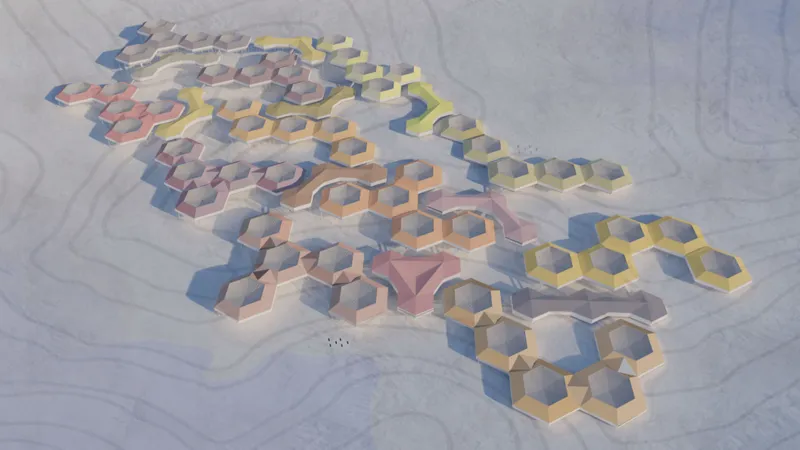
From the ground, Helicom reads as a series of domed and undulating roof forms rising from the snowpack, their curves suggesting geological formations more than architectural objects. Figures and dogs cross a snowy plaza between the structures, giving scale to a settlement that feels both intimate and resilient. From above, the hexagonal modules reveal their organizational logic: clustered organically across the landscape, following contour lines rather than imposing a grid. The plan echoes the floe-field metaphor that drives the entire project, with each unit oriented to maximize solar capture on its reflective elevated faces while minimizing wind exposure.
The modules are elevated on piers, a critical strategy for polar construction that prevents heat transfer from melting the permafrost beneath. Angled roofs and slotted skylights redirect low-angle sunlight deep into interior spaces, while wind turbines and solar panels mounted on the elevated surfaces generate renewable energy year-round. The hexagonal geometry is not merely aesthetic; it is the most spatially efficient form for maximizing shared wall area between adjacent units, reducing the total surface exposed to subzero temperatures.
Timber, Warmth, and Social Life Under Beams
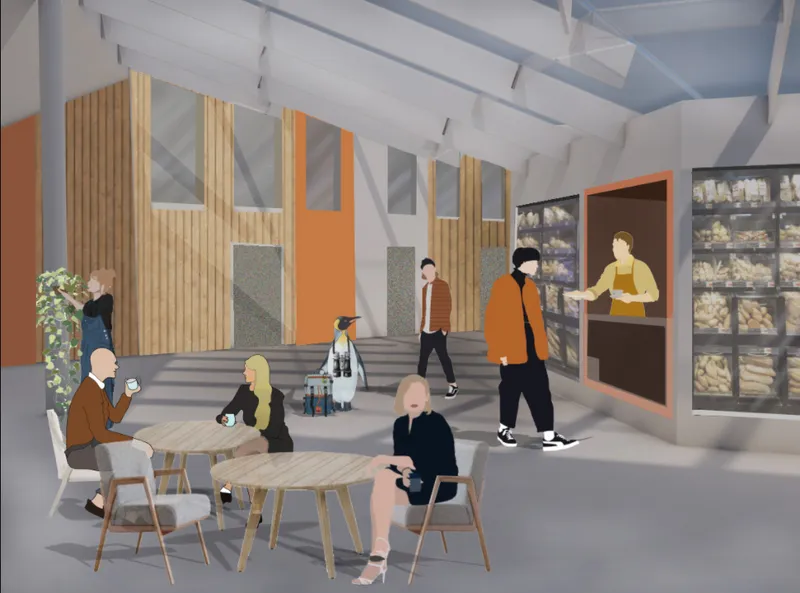
The interior rendering dispels any notion that Arctic architecture must be cold or austere. People gather at round tables beneath exposed timber beams, separated by vertical wood slat partitions that modulate space without sealing it off. These communal zones, which include a bakery and café, are designed specifically to counter the psychological toll of polar isolation by fostering social interaction and daily routine. The material palette of warm timber and the soft spatial division create an atmosphere closer to a Nordic village hall than a research outpost.
The warmth in these spaces is not incidental. Passive heating systems use thermal discharge from servers located beneath the floor, channeling waste heat upward through convection to warm communal areas. It is a neat piece of systems thinking: computation generates heat as a byproduct, and in a climate where heat is the most precious commodity, that byproduct becomes the primary service. Hydroponic farming systems embedded within the modules supply food, while melted snow is recycled for water, closing the resource loop.
Infrastructure Embedded in Form
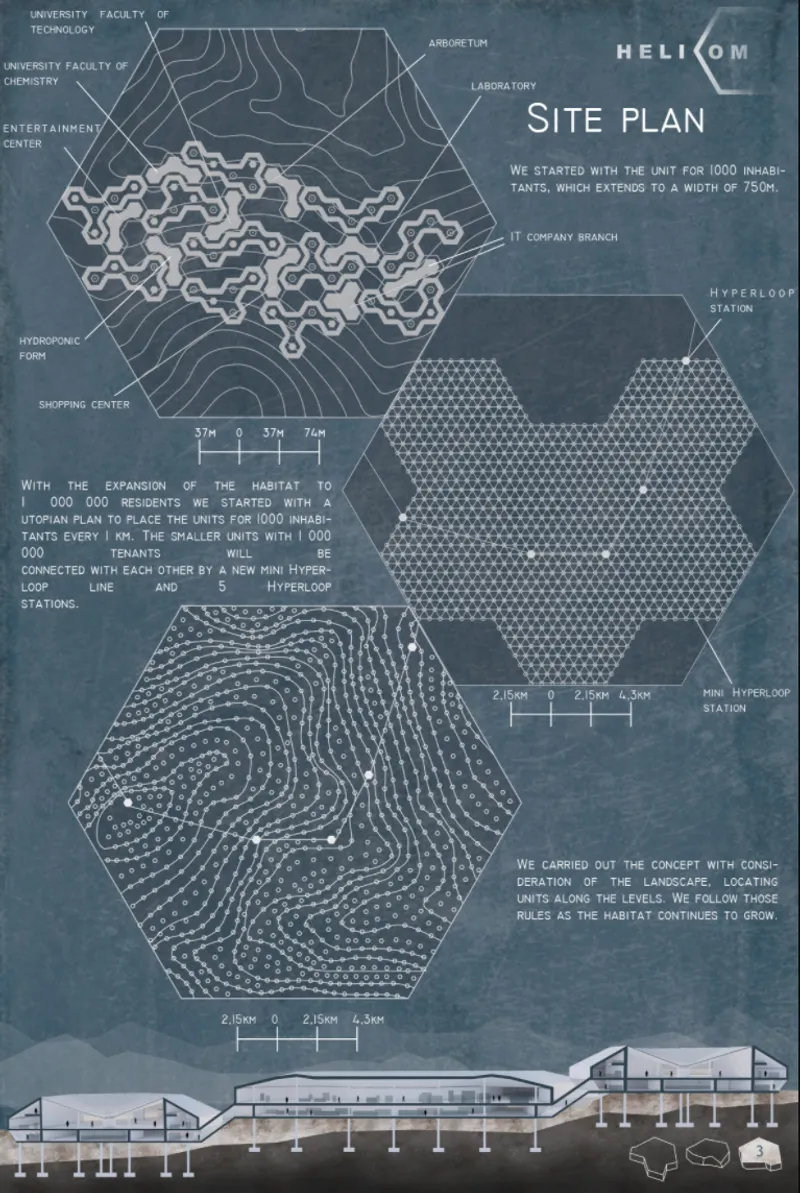
The site plan drawing reveals the full scope of Czajka's proposal. Hexagonal unit clusters are mapped against topography, with sections and programmatic labels indicating how water, air, and transit infrastructure are carried through a centralized corridor system. A hyperloop transit line threads through the settlement, connecting distant clusters without exposing inhabitants to the elements. Waste is treated through localized composting and returned safely to the environment, a detail that signals the project's commitment to closed-loop sustainability rather than extraction.
The drawing also makes clear how the modular system scales. Individual units can function autonomously for small research teams, while larger aggregations support genuine community life with shared amenities, food production, and energy networks. The design is replicable by definition: each hexagon follows the same structural logic, meaning settlements can expand incrementally as populations or research demands grow.
Glowing Beneath the Aurora
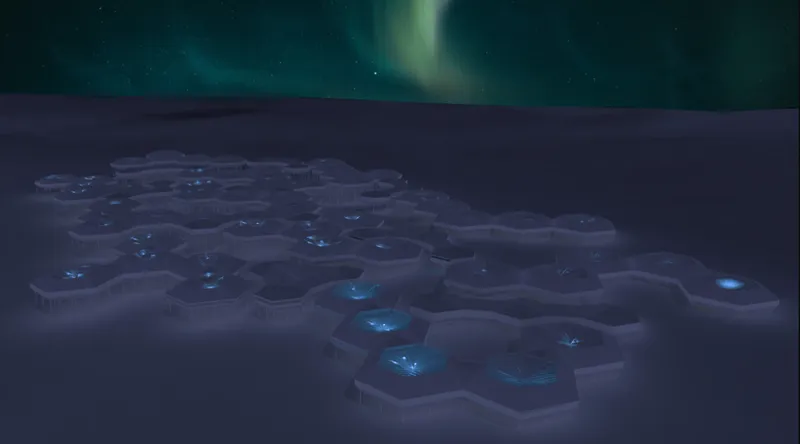
The night rendering is the most evocative image in the series. Clustered hexagonal volumes glow with blue skylight beneath the northern lights, the settlement reading as a bioluminescent organism on the snow. Powered entirely by its self-sufficient energy systems, the scene demonstrates that sustainable Arctic architecture does not have to be grim or survivalist. There is poetry in these glowing modules, a quiet assertion that human settlement in extreme environments can be both pragmatic and beautiful.
Why This Project Matters
Helicom Habitat succeeds because it treats the Arctic not as a hostile frontier to be conquered but as an ecosystem to be learned from. The biomimetic logic is rigorous: penguin huddle behavior informs cluster geometry, ice floe patterns drive modular aggregation, and passive solar strategies respond to the specific angles and durations of polar light. Every system, from hydroponic food production to server waste-heat recovery, is tuned to the reality of a place where nothing can be wasted and every calorie of energy counts.
What elevates the project beyond technical competence is its insistence on social life. The bakery, the café, the warm timber interiors: these are not afterthoughts but core components of a settlement designed for human beings, not just human survival. As polar regions become increasingly relevant to science, geopolitics, and climate migration, Robert Czajka's work offers a credible and humane model for how we might actually live at the edges of the habitable world.
View the Full Project
About the Designers
Designer: Robert Czajka
Enter a Design Competition on uni.xyz
uni.xyz runs architecture and design competitions year-round that reward proposals with spatial conviction and real site intelligence.
Project credits: Helicom by Robert Czajka.


Popular Articles
Popular articles from the community


Juan García Correa, John González and Claudia Rueda Sink a Circular Amphitheater into a Manizales Engineering Building
On the La Nubia campus in Manizales, Colombia, the S1 Building folds labs and offices into a hillside of ramped lawns that double as a campus route.

LT2A and OPEN Architectes Thread a Brick and Glass High School Through a Wooded Belgian Campus
In Braine-l'Alleud, a 3,000 m² wing for Collège Cardinal Mercier pairs pale brick with a glazed colonnade, deferring to a small chapel and a dense wood.

Architekt Andreas Gruber Scatters 23 Dark Timber Chalets Across a South Tyrolean Forest Edge
In Molini di Tures, Amonti Chalets breaks a resort into a hamlet of gabled timber houses, with parking, storage and services pushed into the slope.

Jaramillo Van Sluys Arquitectura and Urbanismo Turn a Demolished Registry Lot in Quito into an Orchard Plaza
In Quito's Centro Histórico, a 2,800 m² plaza exposes the San Agustín convent wall and redraws its lost Augustinian orchard in volcanic stone.

Similar Reads
You might also enjoy these articles


Vereda Arquitetos Renovates a 40-Square-Meter Apartment Inside Niemeyer's Copan Building
A compact unit in São Paulo's most iconic residential tower gets a material overhaul that pairs exposed concrete with bold blue Formica.

Shakur's House: Exposed Brick as an Interior Organiser in a 168 m² Mashhad Residence
Brick moves indoors in this Mashhad residence, where masonry walls, glass partitions and teal planes sequence a compact home without closing it off.

Day and Night Park: A Time-Based Urban Newsstand in Beijing
A temporary urban newsstand in Beijing blending travel, light, and reading through poetic colors, compact form, and community-focused design.

Modernist Patio Renovation in El Masnou, Barcelona by Oliver Segura Arquitectura + Cebrià Arquitectura
Modernist patio renovation blending tradition and innovation with a movable pool, leveled floors, and Catalan materials in El Masnou.


Comments (0)
Please login or sign up to add comments
No comments yet. Be the first to comment!