

Helios
A Path to Protected Freedom

Concept
Humans have continuously made enormous leaps of progress in the evolutionary process by coming up with imaginative responses to their environments.
The pivotal role that the creative fields play in our lives can be highlighted best by how our detached living during the pandemic and lockdowns would have been unbearable without access to the visual, literary and performing arts, amongst others.
However, in the current times, our stagnant and sedentary lifestyles are not conducive to cultivate our creativity - instead, causing a wide range of mental health issues. Be it for the reasons of a break from our work, or exposing ourselves to different people with varying cultures, or simply the exploration of new regions, traveling works wonders for our mental health. This affinity for moving about can be traced back to our roots of rootless existence. What if we decided to learn from our innate human instincts?
Most people would envision themselves seated in the pristine arms of nature when they think of rejuvenation. Immersing oneself in nature's expansive exhibits of beauty invigorates our creative spark, igniting our imagination to invent, innovate and go beyond the boundaries of what we know to be possible.
HELIOS enables the occupants to step out of our bubble of existence, explore new landscapes and cultures without stepping outside the safety of their homes. Be it over land, water, or ice - being a hovercraft floating on a cushion of air - HELIOS allows the family of four to travel where their heart takes them, giving them access to unexplored regions as though a cheat code in reality itself.
Form Development
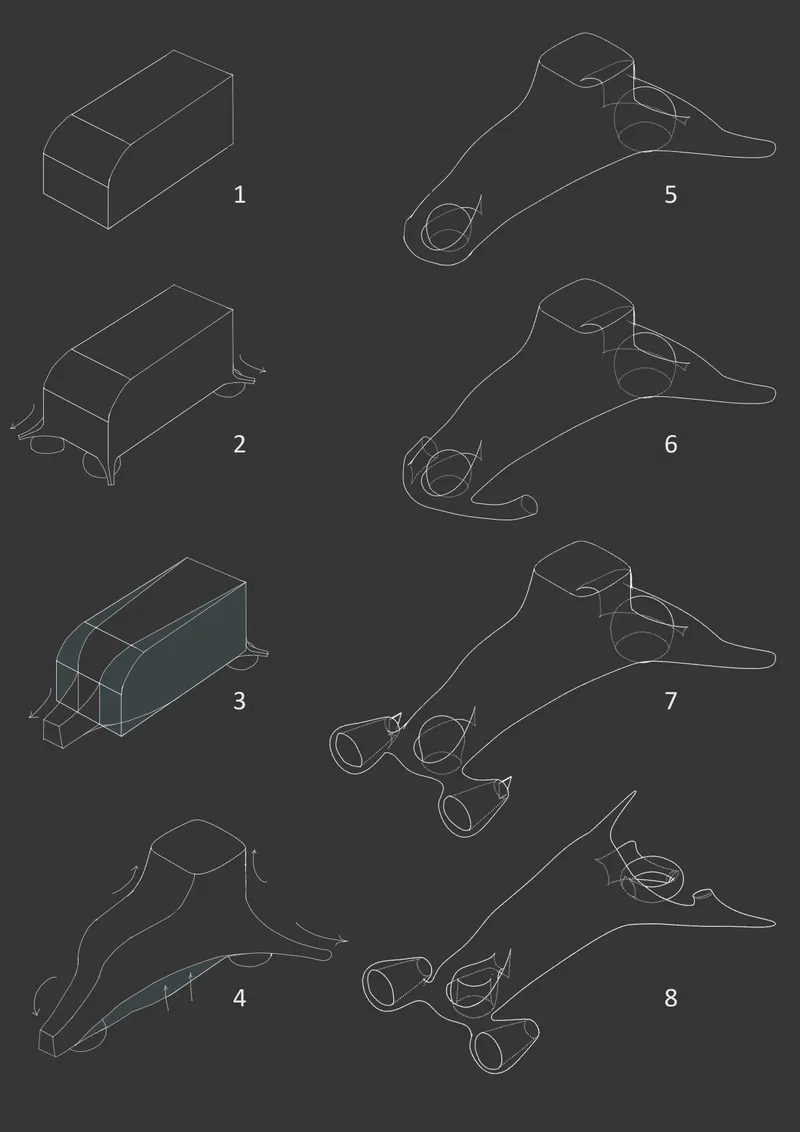
1. Cuboid of size 6.2 m x 2.4 m (extra 2 m x 2.4 m space for front services like dashboard)
2. Pulled the bottom vertices to make legs with thrusters below each leg.
3. Chopped the cuboid’s mass to get a streamlined body, hence merged the front legs
4. Raised the module’s floor by increasing the size of the legs so as to have enough clearance from the outer terrain. Provision for extra 5m2 provided above the module.
5. Increased the size of thrusters and decreased its quantity to 2. The thrusters are held in place by rings.
6. Propellers are introduced on both sides of the front ring which will also acts as the front legs.
7. Discarded the idea of 5m2 extension on the top and introduced 2.5 m2 extensions on both sides of the module so as to have a proportionate and balanced structure. Optimised the size of rear end’s ring and legs.
Project Description
Helios, a God from Greek mythology, is seen as both a personification of the Sun and the fundamental creative power behind it and as a result is often worshiped as a god of life and creation.
HELIOS, as a module, serves a similar purpose - being responsible for creating a protected environment for its residents, so that their creativity and freedom knows no bounds.
The module specifications are as follows:
Mobile State:
Area: 9.8 m2
(4.2 m x 2.3 m)
Static State:
Area: 14.8 m2
[9.8 m2 + (2.5 m2) x 2]
Multipurpose Spaces
The Heart of the module is the multipurpose space which can be used as Dining, Living or Bedroom or more than one of the above at the same time.
In the static state, the 2.5 m2 platform can be extended from both sides of the module to get 5m2 extra space for dining/bedroom area. This will be controlled from the main dashboard. PTFE fabric is used as connector between the walls of the extension and the main body of the module which will be folded in mobile state.
Foldable bunk beds. Can be folded to increase floor area for other purposes.
Foldable center table. Can be folded and put in the floor when not required.
The ladder will be used to access upper parts of the module like storage, bunk bed and seating space.
Material
The walls of the module are proposed to be made of aluminium, with fibreglass insulation sandwiched between them owing to the light-weight and durable nature of the metal.
PTFE fabric is used as connector between the walls of the extension and the main body of the module which will be folded in mobile state.


Popular Articles
Popular articles from the community

Temporary Home for Dogs: A Reversed Zoo Rethinks Animal Shelter Architecture
In Bucharest, a sinuous corridor and freed landscape flip the logic of containment, designing a shelter that works to make itself unnecessary.

Manzana Morphosis: Stretching Barcelona's Grid into a Living Landscape for 2050
A radical reworking of the Eixample manzana turns density into a tool for generous public space, vertical ecology, and environmental performance.

Opera by the Sea Estonia: Three Shells Dissolving Architecture into Tallinn's Coastline
A winning opera house proposal replaces monumental form with interconnected shells that blur the boundary between building, park and Baltic Sea.

The Amber Palace Opera: A Geological Fiction Surfaces on Tallinn's Baltic Waterfront
Pierre Brillard reimagines a Baltic legend as a public landscape, opera house, and waterfront promenade rooted in Tallinn's coastal identity.

Similar Reads
You might also enjoy these articles
The Rhythm of Seasons
A Farmers' Market Connecting Nature and the City

More Than a Building-Designing a Living System
More Than a Building-Designing a Living System
Base Beyond
DESERT COMPOUND ARID: TOURISM OF ABSENCE AND ABUNDANCE


Comments (0)
Please login or sign up to add comments
No comments yet. Be the first to comment!