

Hermès Workshops by Lina Ghotmeh Architecture: A Living Tribute to Craftsmanship and Sustainability in Normandy
Sustainable brick workshop by Lina Ghotmeh for Hermès, blending craft, local materials, and bioclimatic design in Normandy, France.


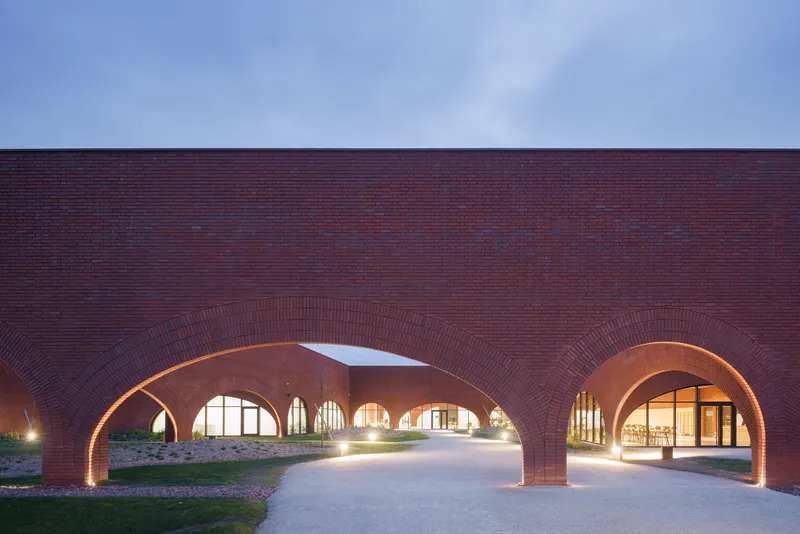
In the picturesque town of Louviers, France, a remarkable architectural statement has taken root—the Hermès Workshops, designed by the visionary Lina Ghotmeh Architecture. Completed in 2023, this 6,200-square-meter facility is more than a production space; it is a poetic exploration of craftsmanship, sustainability, and local heritage. Commissioned by the iconic French luxury brand Hermès, the project merges traditional artisanal practices with contemporary environmental responsibility, creating a model for ecological industrial architecture in the 21st century.
Rooted in History: Architecture as Archaeology
The concept behind the Hermès Workshops emerged through what Lina Ghotmeh describes as architectural “excavations.” Before a single line was drawn, her studio conducted in-depth research into the local terrain, historical context, and regional materials. The site, rich with Normandy’s clayey earth, sits on remnants of a Magdalenian hearth—evoking a deep, ancestral relationship between humans and their tools. This deep dive into place-based history inspired a design process that treats architecture as a form of archaeology of the future, drawing from the past to shape a forward-looking structure.
Materiality and the Power of the Hand
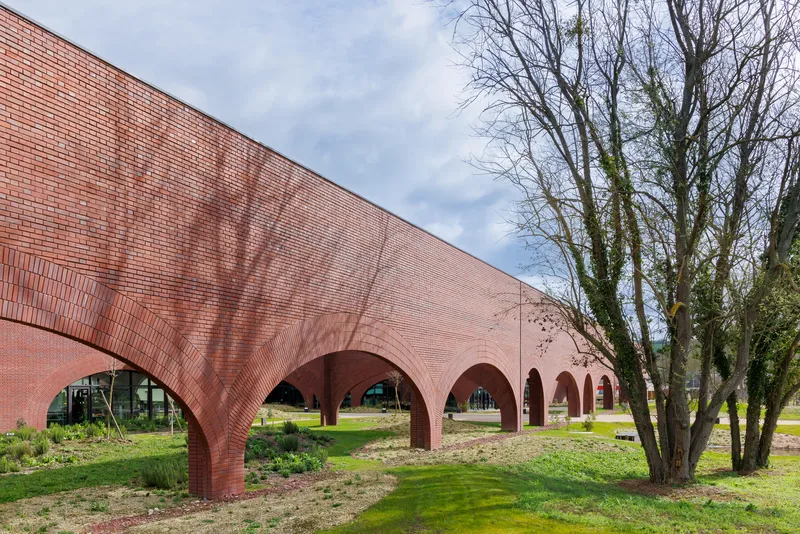
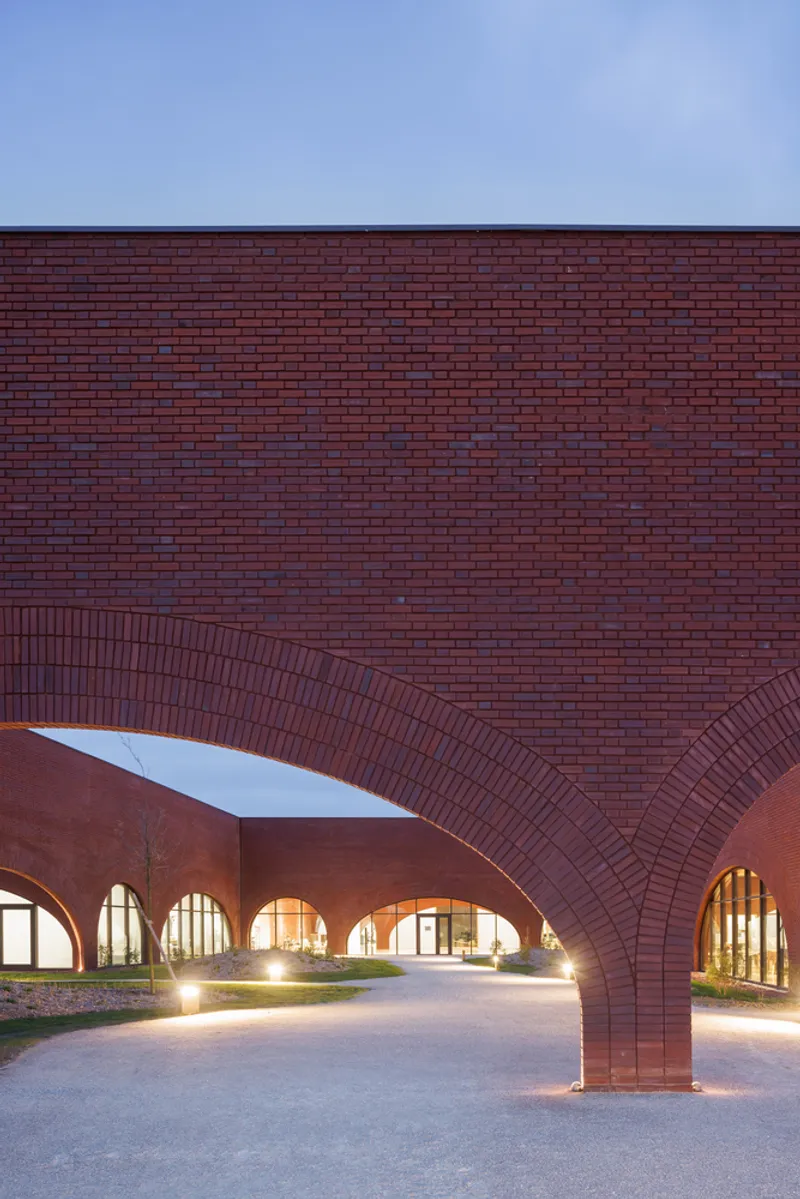
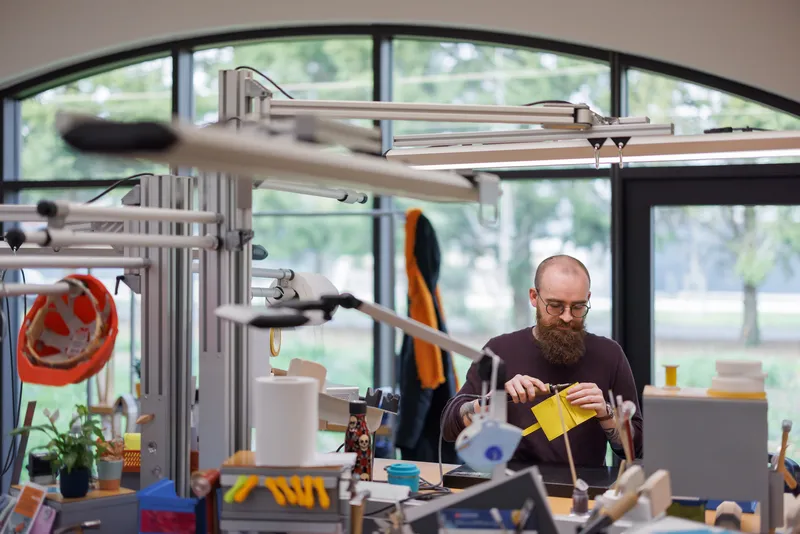
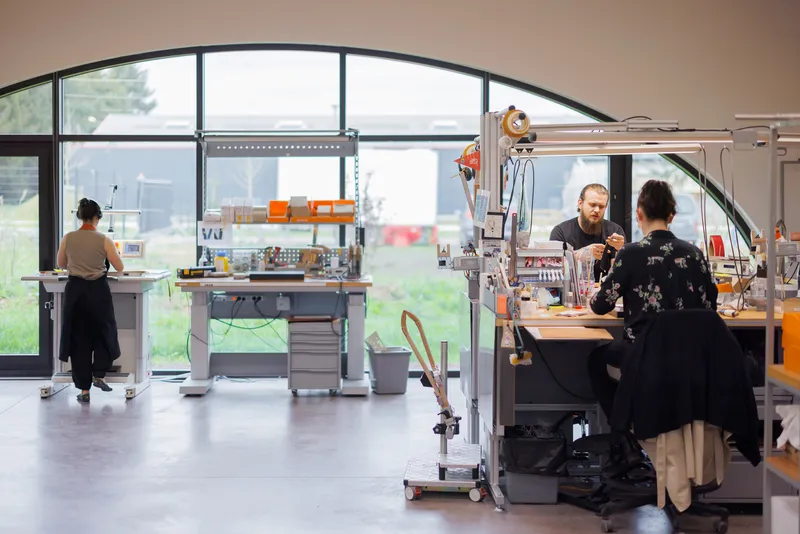
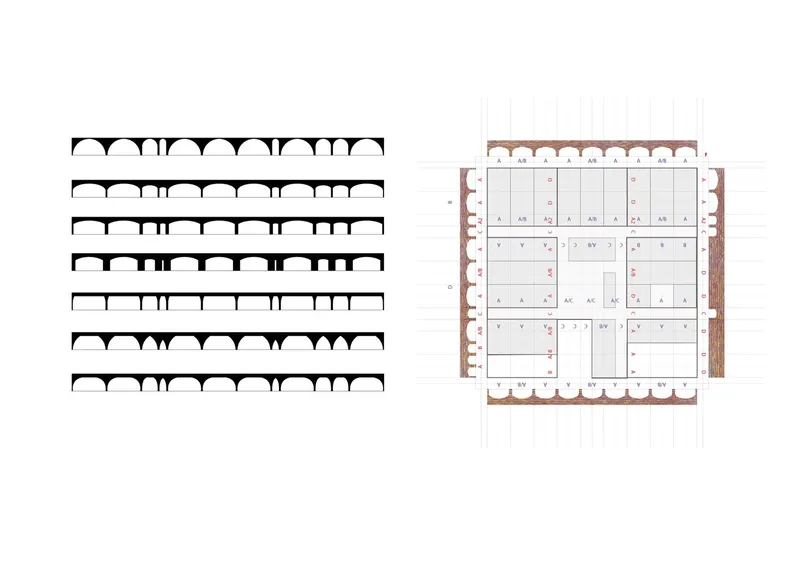
At the heart of the project lies a celebration of material integrity and craftsmanship. The building is constructed from over 500,000 hand-laid bricks, made just a few kilometers from the site using locally sourced earth. These artisanal bricks form the expressive facade and structure of the workshop, narrating a tactile story of human labor and artistry. Their rhythmic arrangement—carefully executed by master masons and companions—reflects a precise choreography of form, emphasizing both strength and elegance.
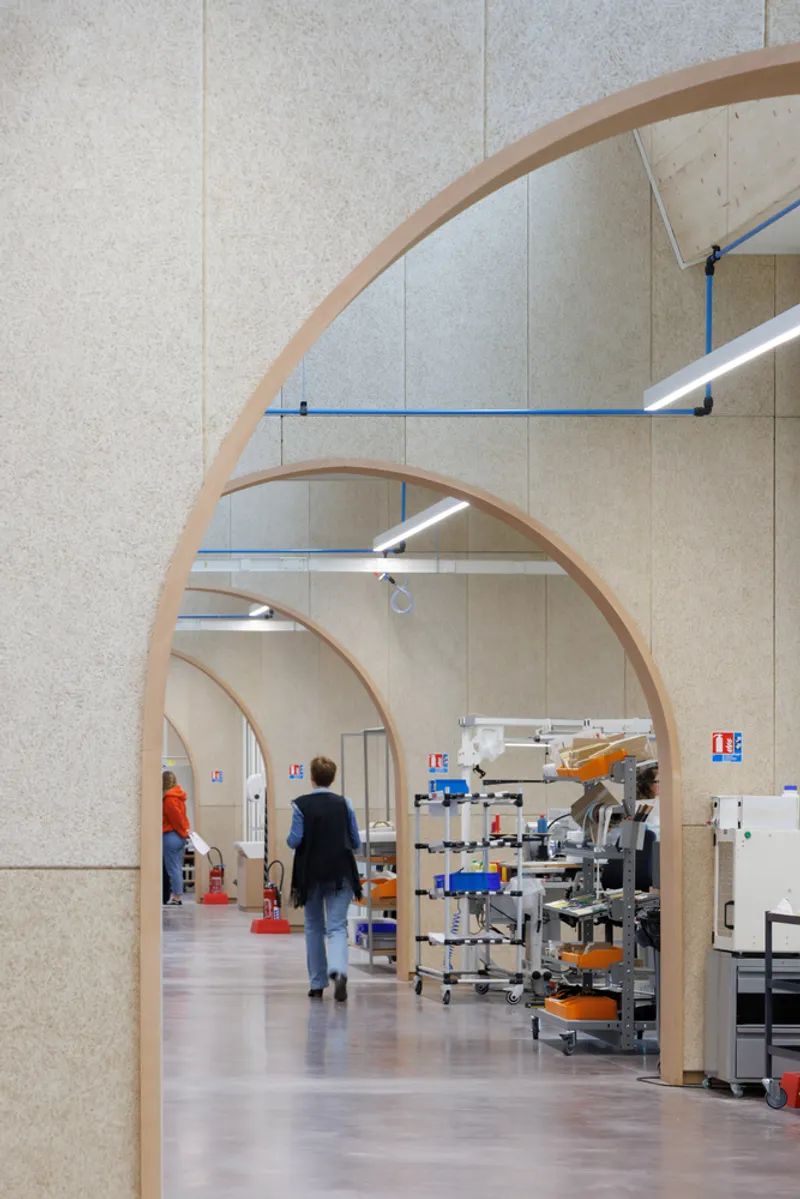
The building’s envelope, composed of structural brickwork, is defined by a sequence of 9-meter spans forming a perfect square—echoing the precision and balance found in both Hermès design principles and traditional construction techniques. The repetition and order in these structural intervals mirror the movement of hands in craft, reinforcing the intimate relationship between form and function.
A Courtyard for Collaboration and Dialogue
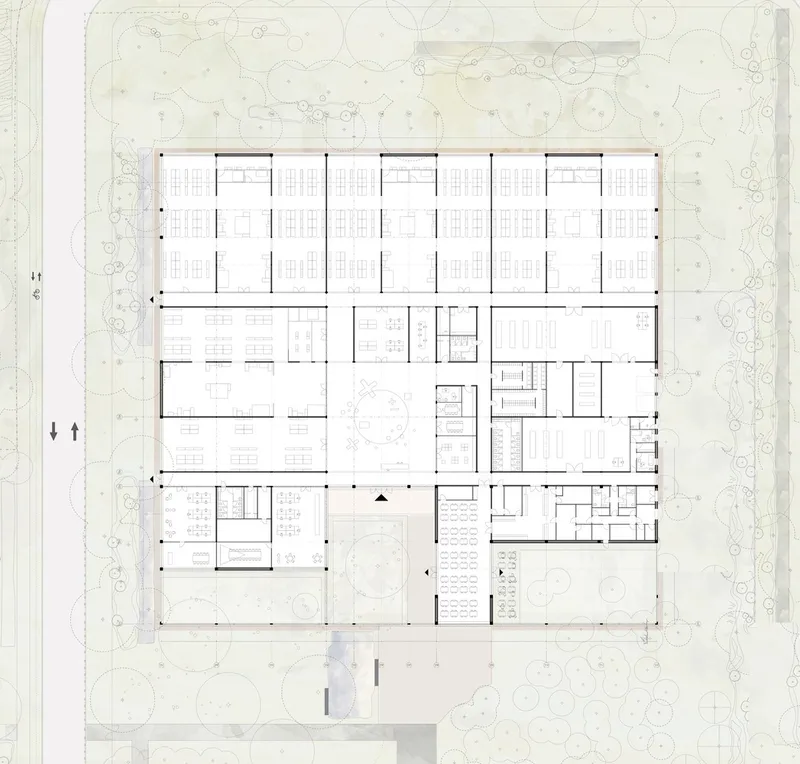
At the heart of the Hermès Workshops is an open courtyard, anchored by a mature oak tree—a symbol of longevity and rootedness. This tranquil space acts as a communal gathering point, a central plaza fostering interaction between artisans. Overhead, wooden beams stretch across the square, highlighting the natural palette that defines the entire structure: wood, earth, brick, and leather.
Suspended within this central courtyard is a site-specific installation by artist Emmanuel Saulnier. His dynamic composition of large, needle-like forms evokes the gallop of horses—one of Hermès’ iconic symbols—and mirrors the sweeping arches of the building itself. This sculptural gesture not only pays tribute to equestrian elegance but also to the rhythm and movement of skilled hands at work within the surrounding workshops.
Bioclimatic and Low-Carbon Design
Beyond aesthetics and symbolism, the Hermès Workshops exemplify environmentally conscious architecture. The building is certified E4C2, a designation that confirms its status as a positive energy, low-carbon facility. Embracing bioclimatic principles, the design optimizes natural ventilation, lighting, and thermal performance, drawing from the site’s resources without overexploitation.
Renewable energy systems are integrated throughout, and the excavated earth from the construction site was reused, reshaping the surrounding landscape in harmony with the structure. This approach highlights the studio’s commitment to circular construction methods, where every intervention respects the existing ecology.
A Living Manifesto of Hermès’ Values
The Hermès Workshops in Louviers is more than a building—it’s a living manifesto of Hermès’ enduring values: excellence in craftsmanship, respect for nature, and innovation grounded in tradition. Lina Ghotmeh’s sensitive and deeply contextual design embodies these ideals through its material honesty, environmental performance, and human-centered spatial organization.
This project sets a benchmark for the future of sustainable industrial architecture, proving that beauty, ethics, and performance can coexist within the same walls. It is a space where craft, culture, and climate intersect—inviting not only the hands of artisans but also the eyes of future architects to imagine a better, more grounded way to build.
All Photographs are works of Iwan Baan and Takuji Shimmura.


Popular Articles
Popular articles from the community


GROUP A Strips a 1969 Rotterdam Harbor Headquarters to Its Frame and Wraps It in Timber Louvers
In Rotterdam's M4H harbor district, Ferro Offices reuses a 1969 frame, adds one timber storey and reaches BREEAM-NL Outstanding.

Juan García Correa, John González and Claudia Rueda Sink a Circular Amphitheater into a Manizales Engineering Building
On the La Nubia campus in Manizales, Colombia, the S1 Building folds labs and offices into a hillside of ramped lawns that double as a campus route.

David Ortega Stacks a Two-Story Mexico City Penthouse Around a Steel Stair and a Pergola-Shaded Roof Terrace
In Colonia Roma, a 300 m² penthouse uses oak joinery, a planted steel stair and a slatted roof pergola to make a new-build apartment feel like a house.

David Macias Steps a Doorless Stone and Plaster House Down a Tropical Colombian Hillside
In the humid hills of Colombia, Threshold House replaces the front door with an open void and terraces its 850 m² down the slope instead of fighting it.

Similar Reads
You might also enjoy these articles


Hodi-Mandai Geram
Project Function: Preservation and revitalization of the Intangible heritage and socio-spatial identity of the Hodi by Housing, Cultural Memory Center, Sacred Grove, landscape, local tourism economy


Olio Towers: A Mid-Rise for Performers That Fuses Housing, Rehearsal, and Stage
Located blocks from Houston's Theater District, this modular tower stacks living units around a central performance atrium.

Oasis: Modular Green Housing Carved into Dhaka's Urban Fabric
A shortlisted Plugin Housing entry reclaims unauthorized settlements in Dhaka with stepped concrete volumes, green roofs, and ventilation-driven design.

Black Hole: A Floating Megastructure for the Post-Physical Era
Emiliano Mazzarotto envisions a spherical, self-scaling arena where e-sports, digital hotels, and holographic stadiums replace traditional public space.

Explore Architecture Competitions
Discover active competitions in this discipline

Challenge to design public laboratory

Challenge to reimagine the Iron Throne

Photograph architecture without architects

Illustrate the lost glory of Angkor Wat - Render Challenge
Comments (0)
Please login or sign up to add comments
No comments yet. Be the first to comment!