
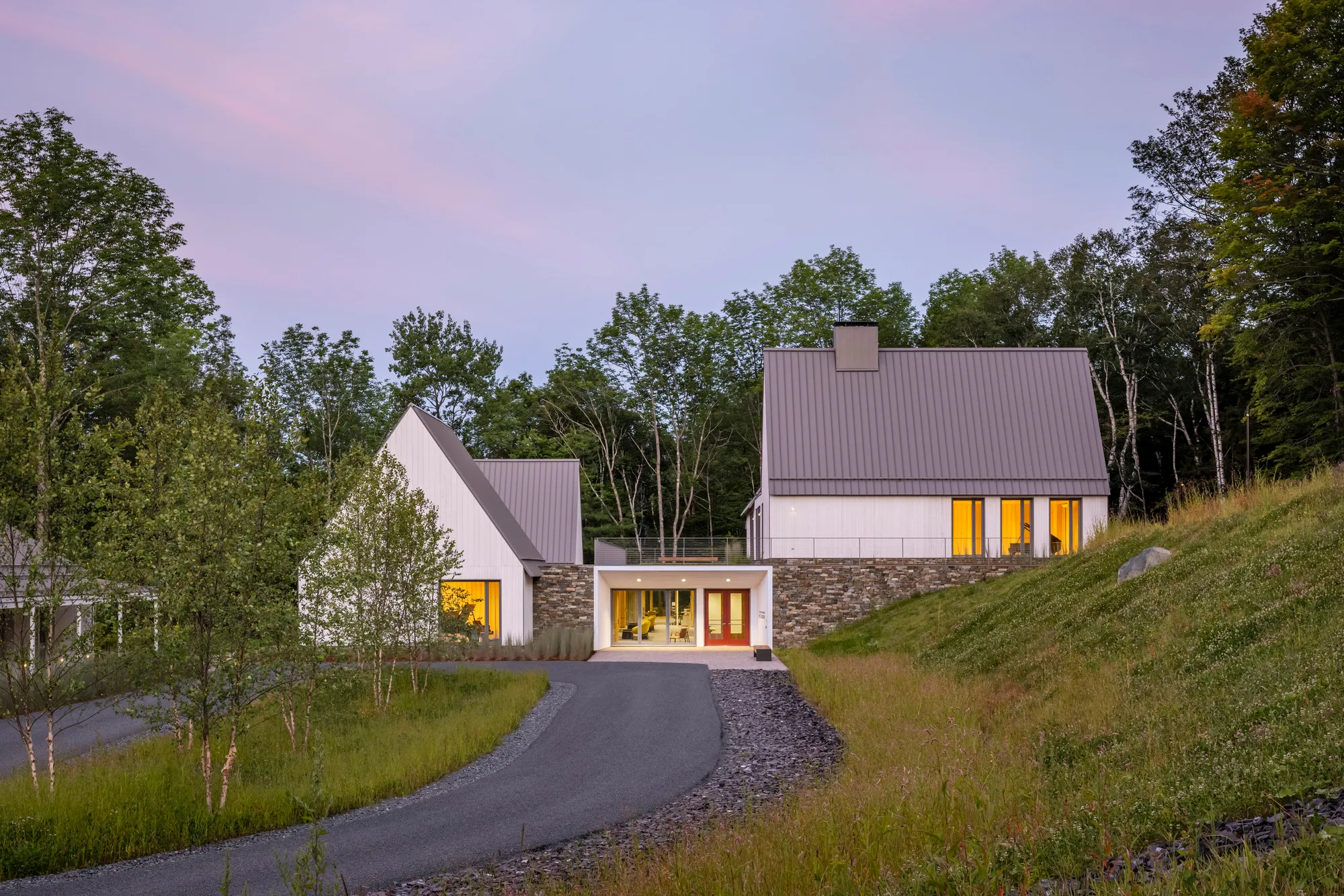
HGA Nestles a Cedar-Clad Music Building into the Vermont Hills at Marlboro
A cluster of gabled volumes channels New England's agrarian vernacular to house rehearsal rooms and a 10,000-score archive on a forested campus.


For seventy years, the musicians who arrived each summer at Marlboro Music's Potash Hill campus rehearsed inside retrofitted farm buildings that were charming but acoustically compromised. The new Reich Rehearsal Building and Music Library, completed in 2021 by HGA under the leadership of Joan Soranno and John Cook, replaces that patchwork with purpose-built rehearsal rooms, an archive library holding more than 10,000 scores, administrative offices, and flexible common spaces. The trick was to do all of this without breaking the spell of the place.
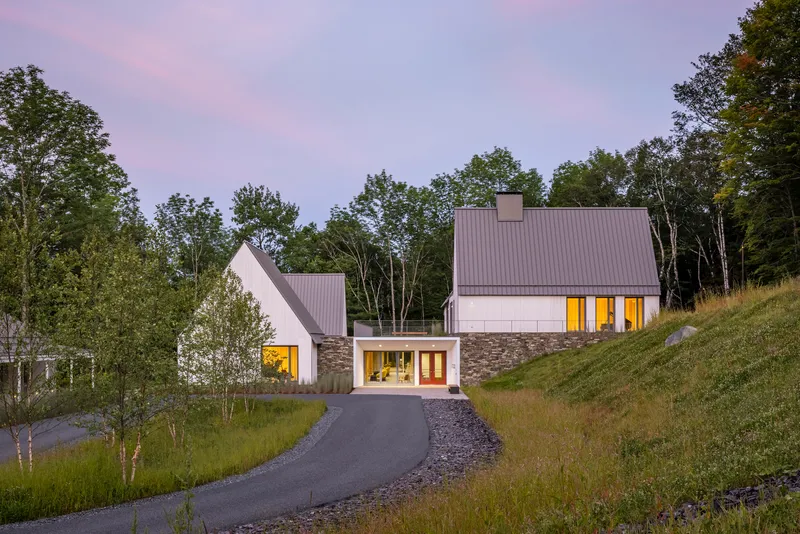
What makes the project genuinely interesting is its refusal to announce itself. The building reads as a small village of pitched-roof forms stepping down the hillside, each volume scaled and clad to sit among the existing 19th-century structures rather than outshine them. HGA drew on the Cape Cod cottage typology, a 400-year-old lineage rooted in 17th-century English settler dwellings, and translated it into a contemporary wood-and-stone envelope that holds geothermal heating, green roofs, and carefully tuned acoustics. The result is architecture that defers to landscape and program in equal measure.
A Village of Gables on a Sloping Site
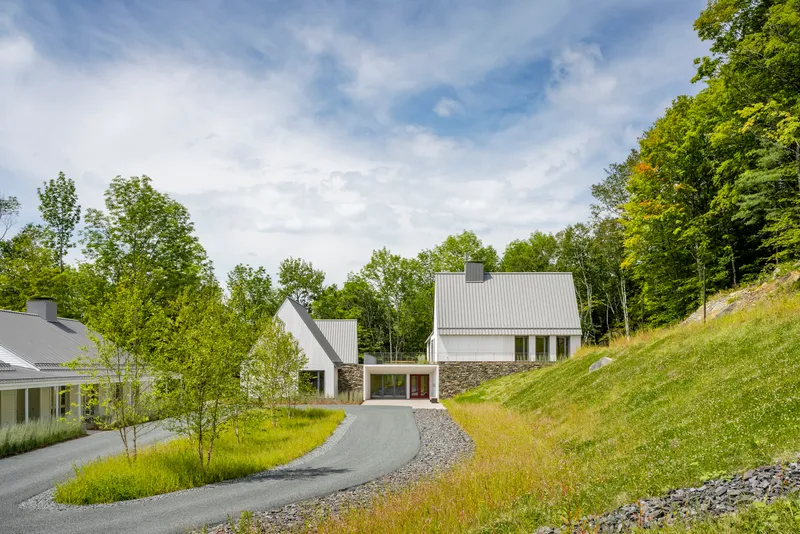
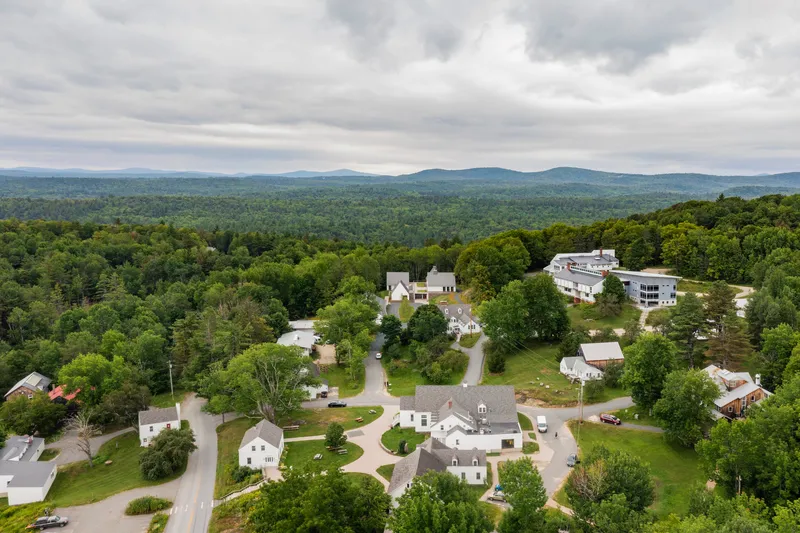
Seen from the air, the building reads not as a single mass but as a cluster of four pitched-roof volumes that step down in plan along the natural grade of the hill. The strategy is both pragmatic and rhetorical. By splitting the program into discrete forms connected by lower linking elements, HGA keeps each volume at a domestic scale consistent with the campus's agrarian character. Fully accessible entrances appear on both levels: the upper floor connects to the campus road above, and the lower floor meets the landscape below.
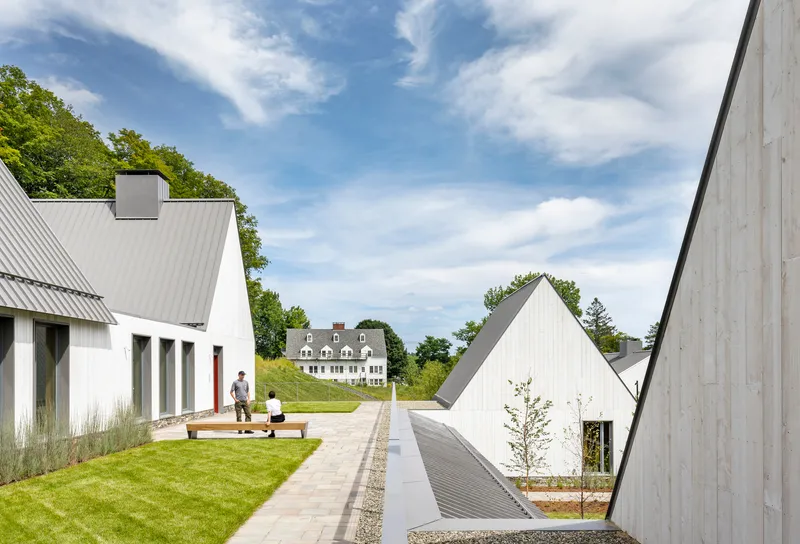
A central paved pathway passes between the gabled forms, creating south-facing outdoor rooms where musicians can gather between sessions. These interstitial spaces are as deliberate as the interiors. The curved gravel drive, the planted grasses, and the stone base walls all reinforce the reading of the building as something that has accumulated over time, not dropped in at once.
White Board and Stone: An Envelope That Belongs
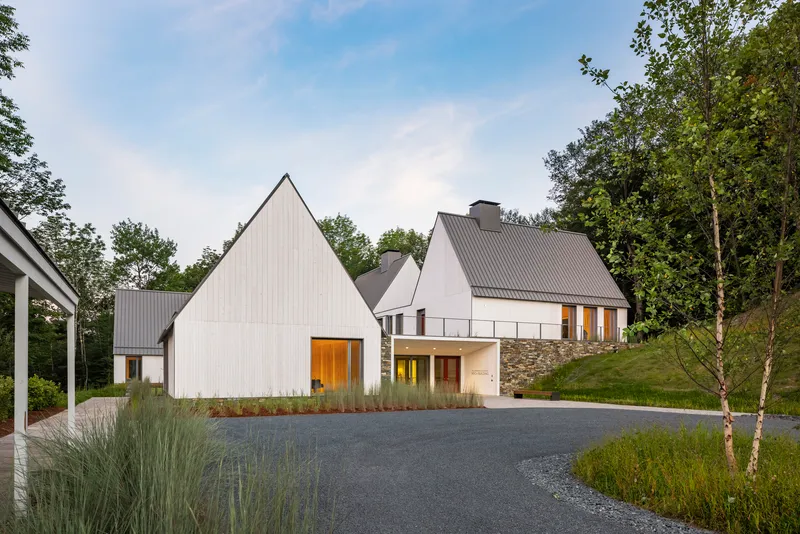
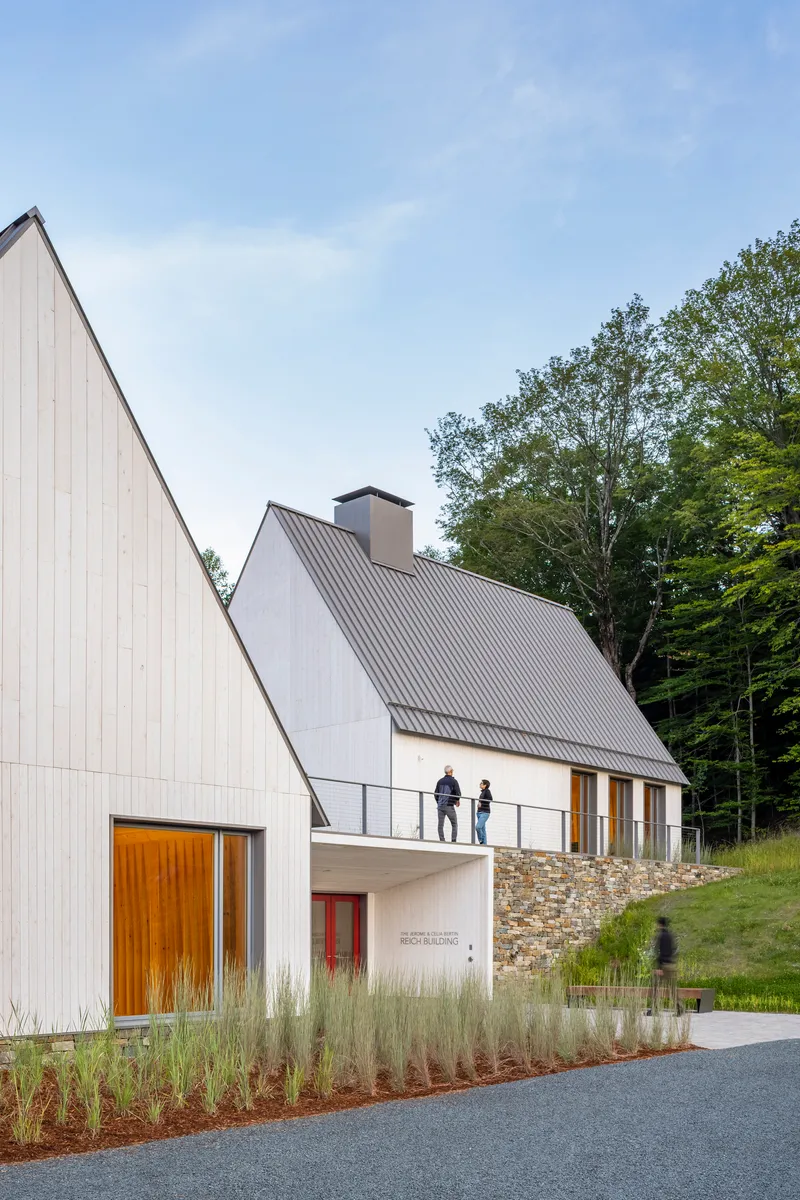
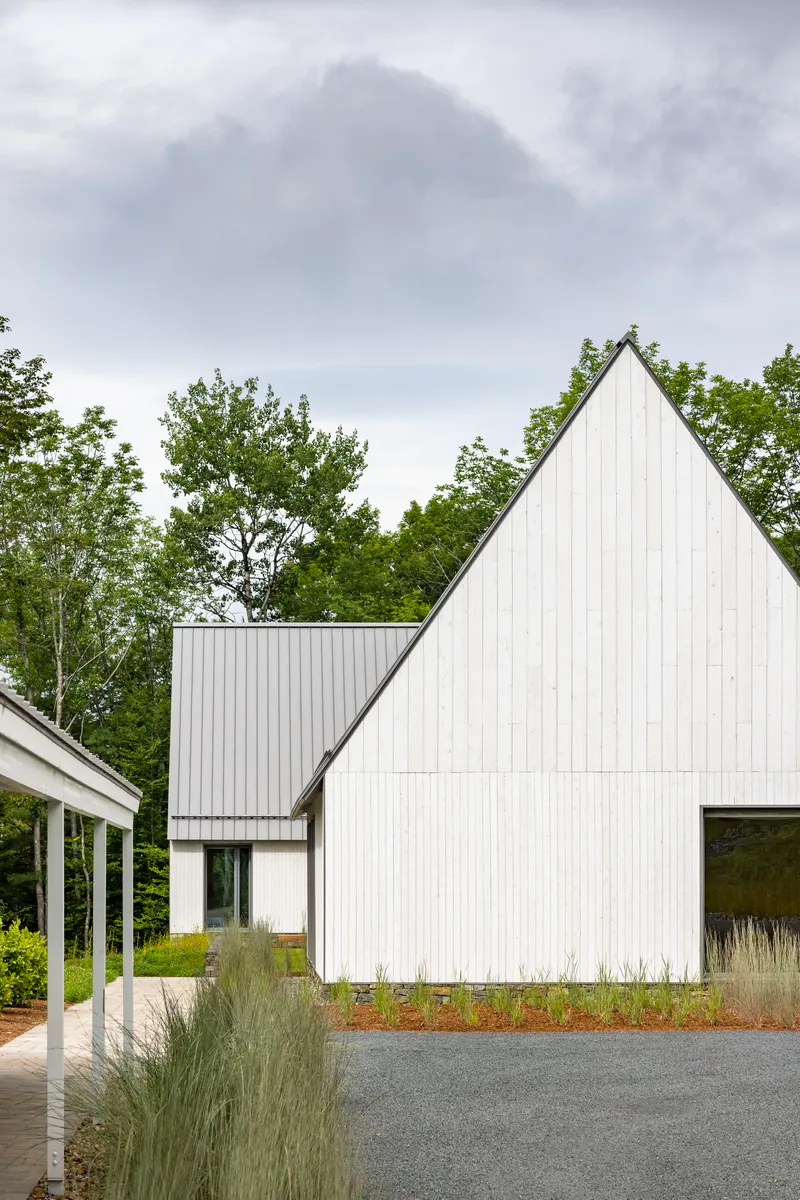
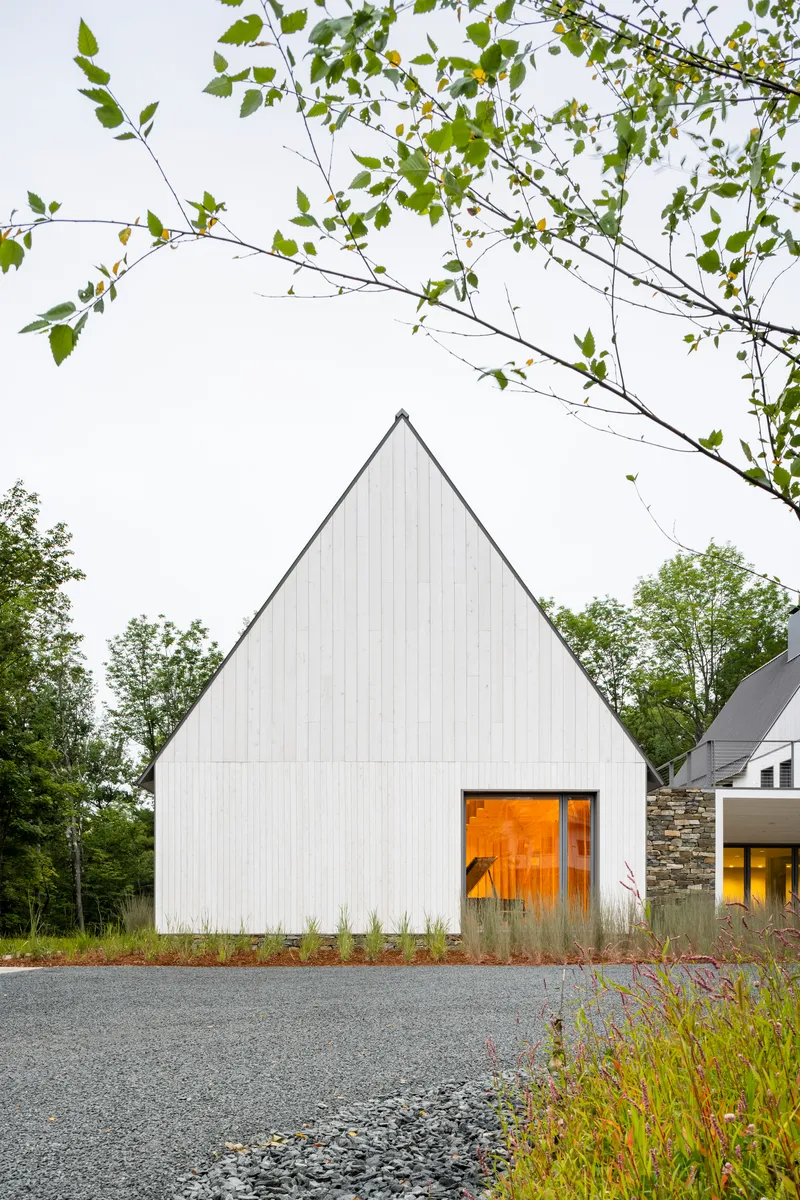
The exterior combines white vertical cedar siding with standing seam metal roofs and local stone bases. It is a material palette that could have been sourced from any number of New England barns within a few miles of the site, and that is precisely the point. Rather than mimicking the old farm buildings, HGA abstracts their proportions, textures, and color relationships. The stone walls ground the structure to the earth while the white cedar lifts the gable forms skyward.
Heavy-duty snow guards line the roofs, a nod to Vermont's extreme winters. Minimal site lighting preserves the dark-sky character of this rural setting. Even the plantings follow a restrained logic: 40 percent of the total site area and 71 percent of the planting beds are sown with pollinator-supportive native species, requiring no fertilizer or pesticides.
Timber Interiors Tuned for Listening
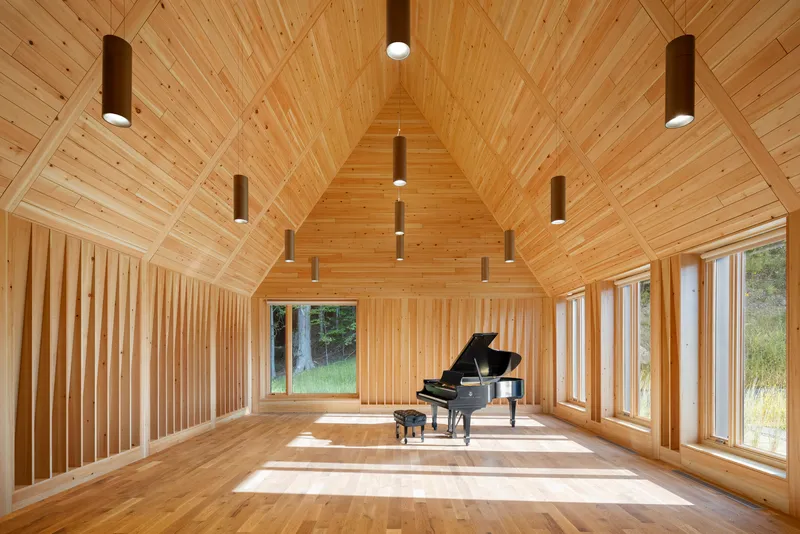
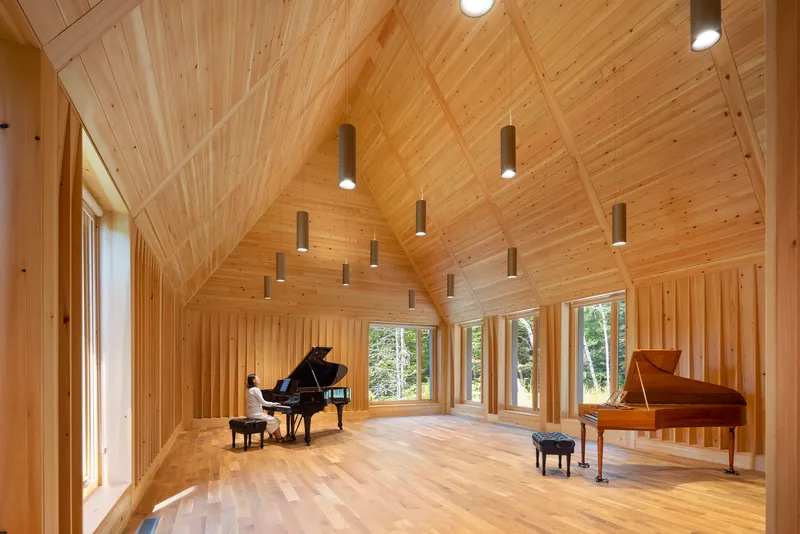
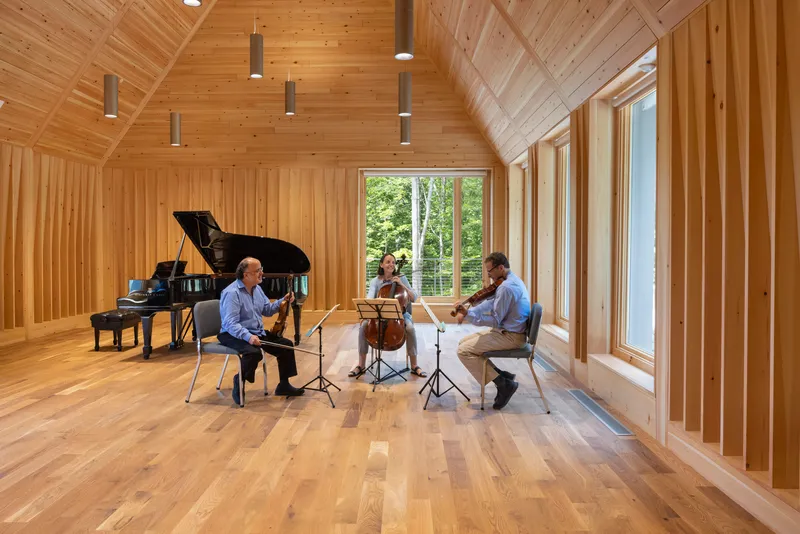
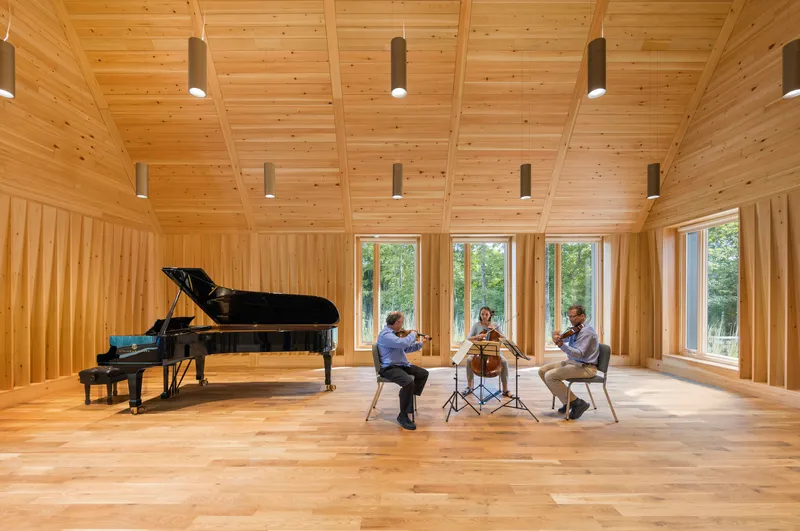
Step inside one of the three rehearsal studios and the shift is immediate. Locally sourced white pine slats line the walls and vaulted ceilings, producing a warm, uniform surface that HGA explicitly intended to evoke the wood of the instruments themselves. High ceilings give increased volume for the blending of instruments, while the drier acoustic character, compared to a concert hall, provides the clarity essential for intensive study and preparation. Cylindrical pendant lights hang at mid-height, keeping the upper volume free and luminous.
Tall windows on the gable ends and sidewalls bring daylight deep into the rooms and frame views of the surrounding forest. These windows are operable, allowing natural ventilation during the summer sessions. The effect is a rehearsal space that breathes with the landscape: birdsong drifts in, light shifts across the pine surfaces, and the boundary between inside and outside softens. During the academic year, these same rooms convert to classrooms, a straightforward programmatic efficiency that justifies the investment in acoustic and spatial quality.
A Quiet Room for 10,000 Scores
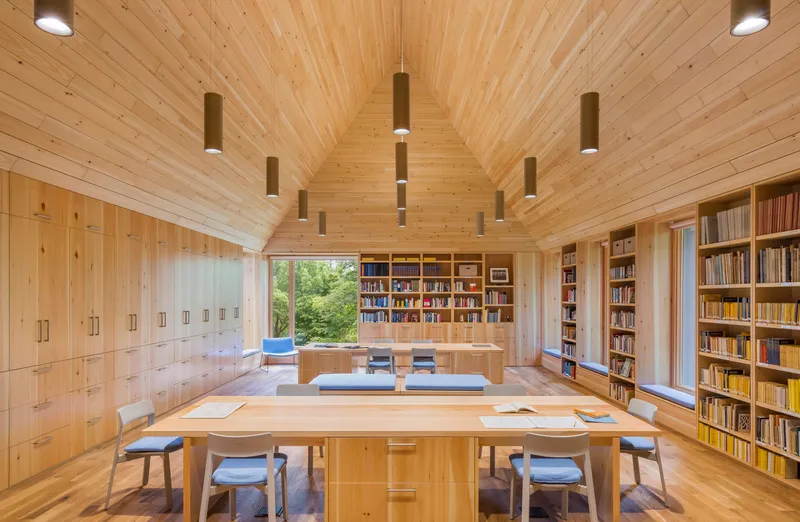
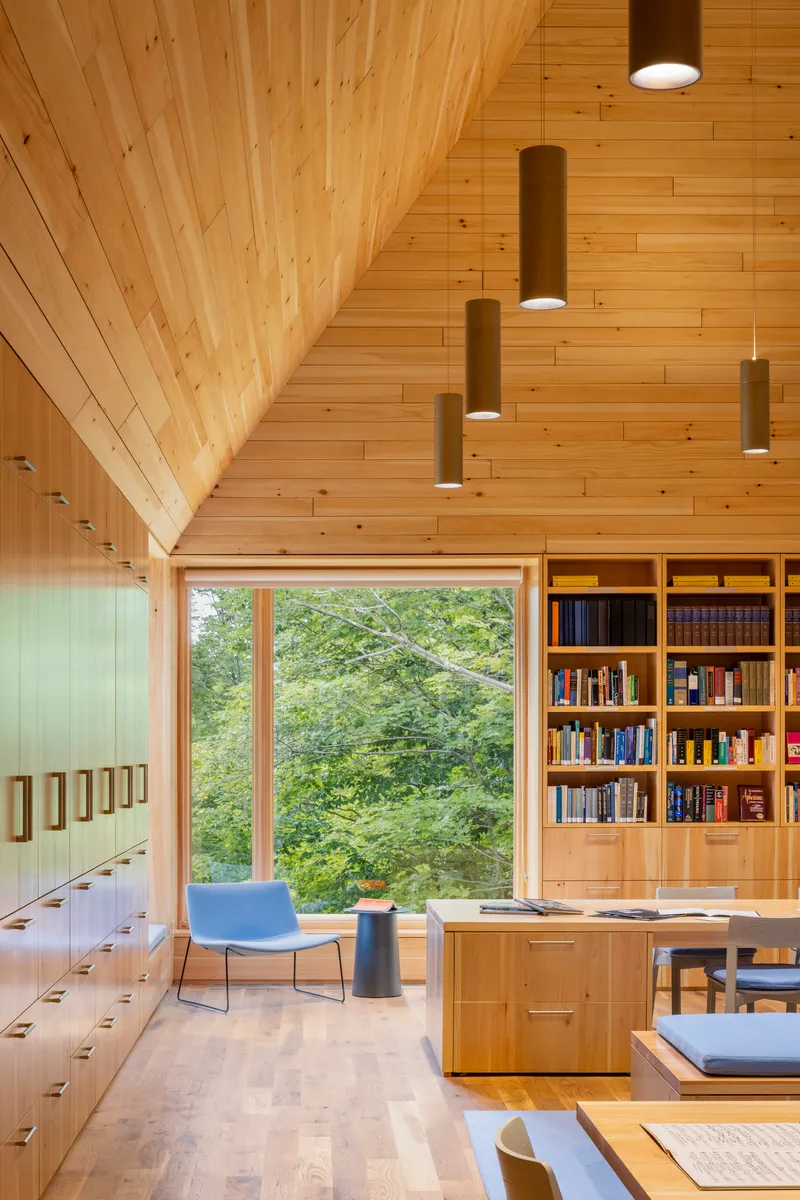
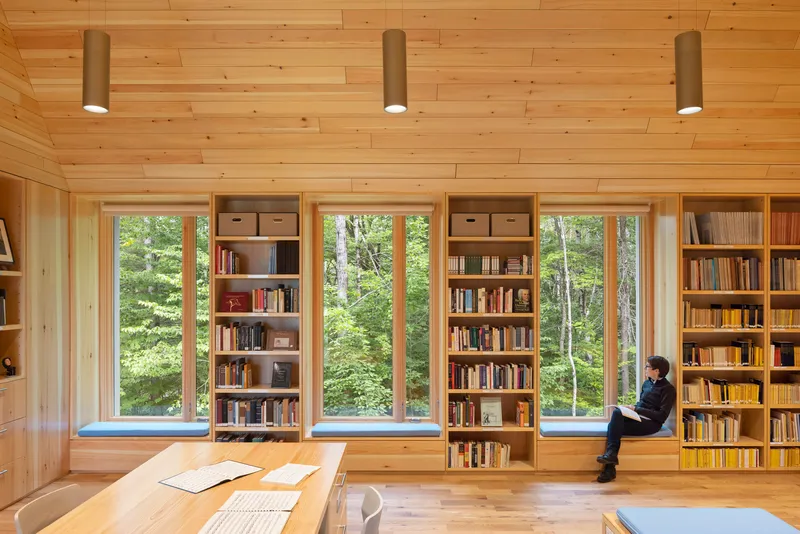
The music library occupies one of the linked volumes, its vaulted timber ceiling and built-in shelving creating a space that feels more like a scholar's private study than an institutional archive. More than 10,000 scores are housed here, alongside seminar seating for researchers and flexible work areas for two librarians. Climate control, fire protection, and security are calibrated to archival standards, though you wouldn't know it from the atmosphere: the room is warm, quiet, and flooded with light from windows overlooking the forested hillside.
A reader sits in a deep window sill. Built-in shelving wraps the perimeter without crowding the central reading tables. The palette of light timber and white walls continues the rehearsal rooms' language, binding the library to the rest of the building. It is a space designed for the slow, focused work of studying a score, and it rewards that concentration with generous views of the Green Mountains.
Campus Fabric and Forest Canopy
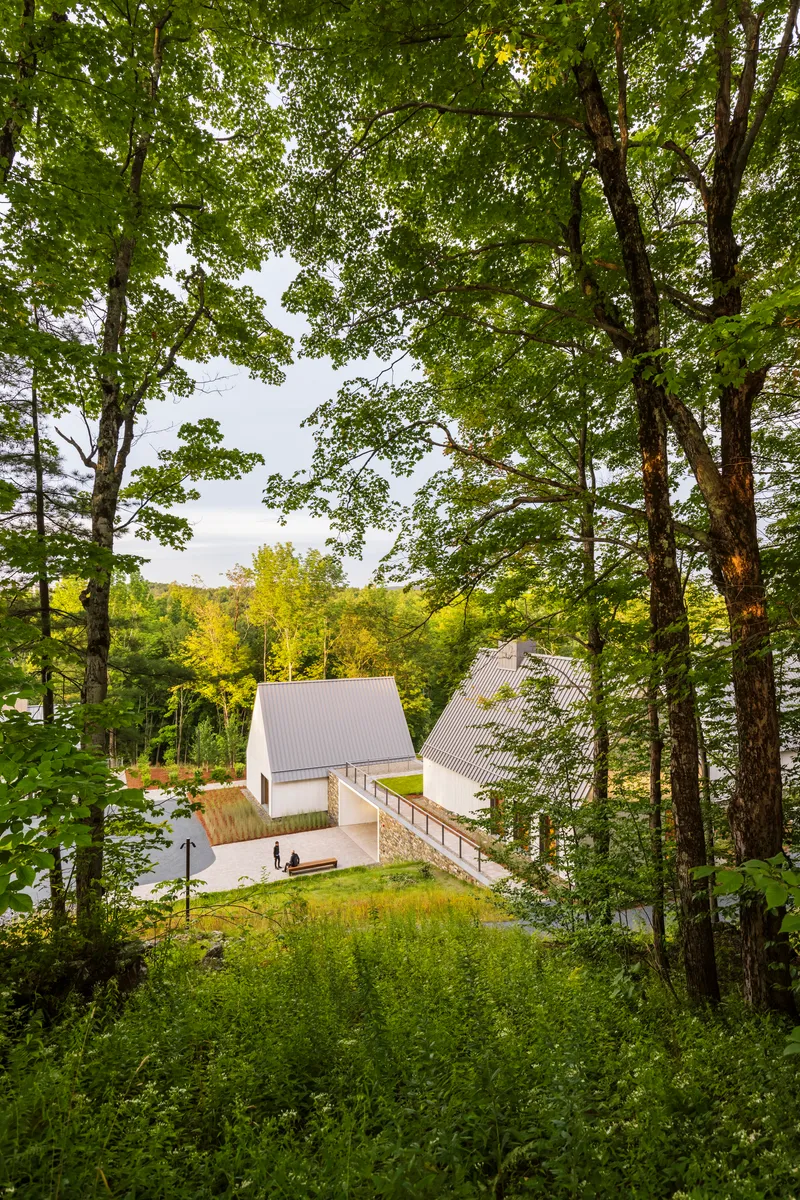
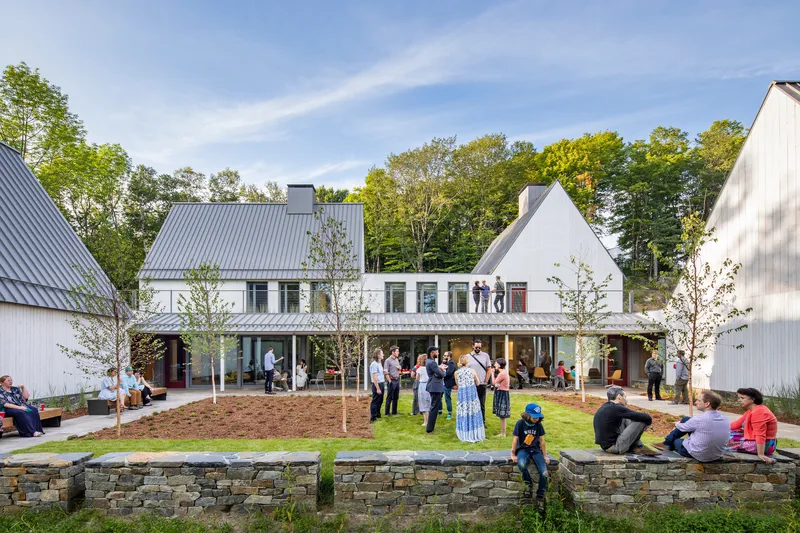
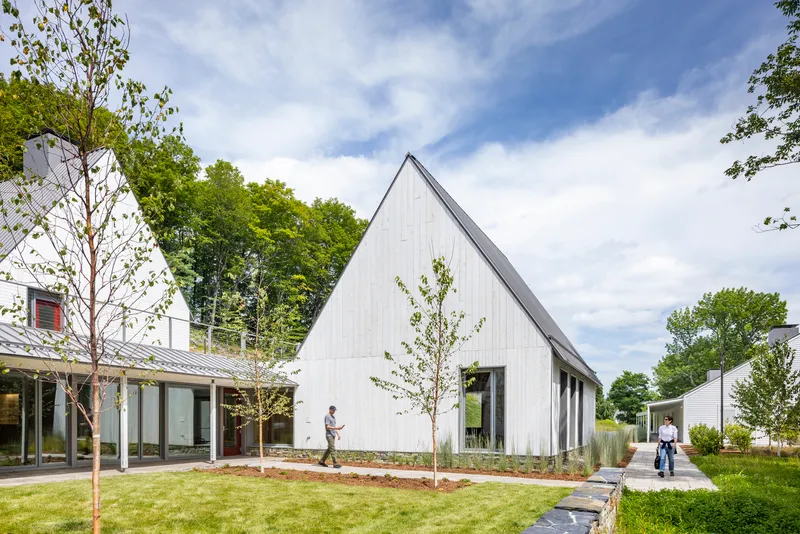
Viewed through the surrounding tree canopy, the new building nearly disappears. Timber walkways link the gabled volumes to the existing campus, maintaining the informal pedestrian circulation that has defined Potash Hill for decades. The building had to satisfy Vermont's ACT 250 criteria, legislation enacted in 1970 to protect the state's fragile environment, and HGA responded by minimizing site disturbance, maintaining the natural boundaries of surrounding forests, and allowing the green roof to serve double duty as an outdoor terrace for events.
On a summer afternoon, visitors gather on the lawn between the white gabled structures. The scene could be a village green. That legibility, the sense that this is a community of buildings rather than a single institution, is what lets the project succeed at a scale that far exceeds its footprint.
The Poetics of an Empty Room
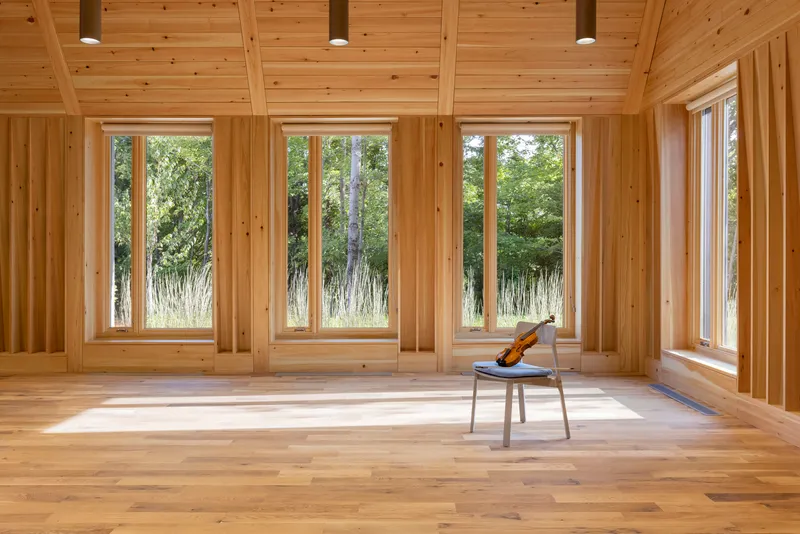
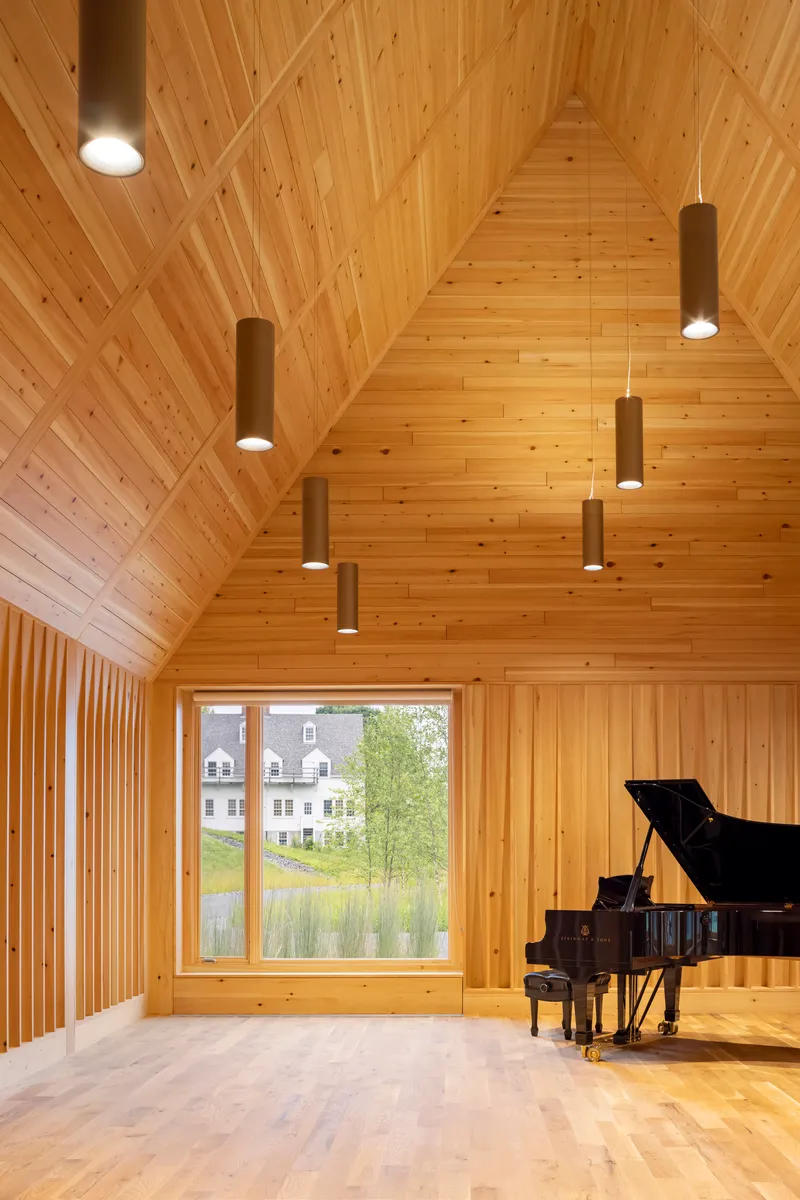
One image captures the building's ambition in miniature: an empty room, four tall windows, a single chair with a violin, and afternoon sunlight striping the floor. No audience, no stage, no spectacle. Just a musician and a room built to listen. The picture window in an adjacent rehearsal hall frames the neighboring gabled volumes and the grass between them, collapsing the distinction between performance and landscape.
At dusk, warm timber glows through the entry as birch branches overhang the gable end. The building is most itself in these liminal moments: lit from within, quiet outside, the stone base holding steady against the slope. It is architecture that knows when to step back.
Geothermal Loops and Passive Strategies
The sustainability strategy works on multiple fronts without ever dominating the design. A geothermal well field provides both chilled and hot water through radiant floor and fan coil systems. Passive solar gains are managed through careful calibration of glass area, tree canopy, and orientation. LED lighting, low-VOC materials, wood wall structure to reduce embodied carbon, and products carrying Environmental Product Declarations all contribute to a performance that exceeded AIA 2030 standards. The green roof manages stormwater while offering a usable terrace; the operable windows reduce mechanical cooling loads during summer months.
What sets this approach apart is its integration. None of these systems are visible or legible as green features. They simply make the building work better in its climate, which is exactly how sustainability should operate in a setting this sensitive.
Plans and Drawings
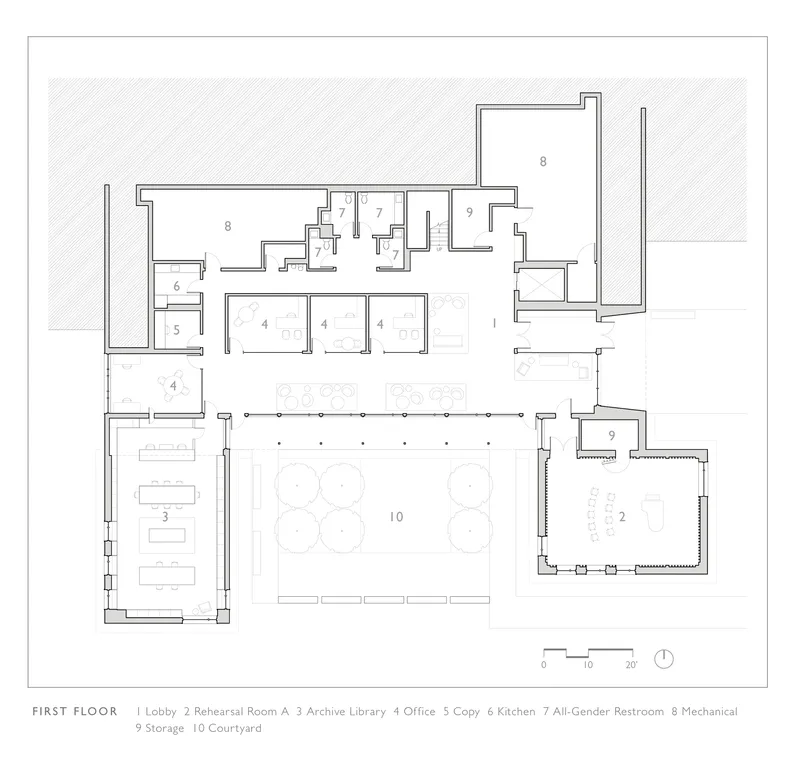
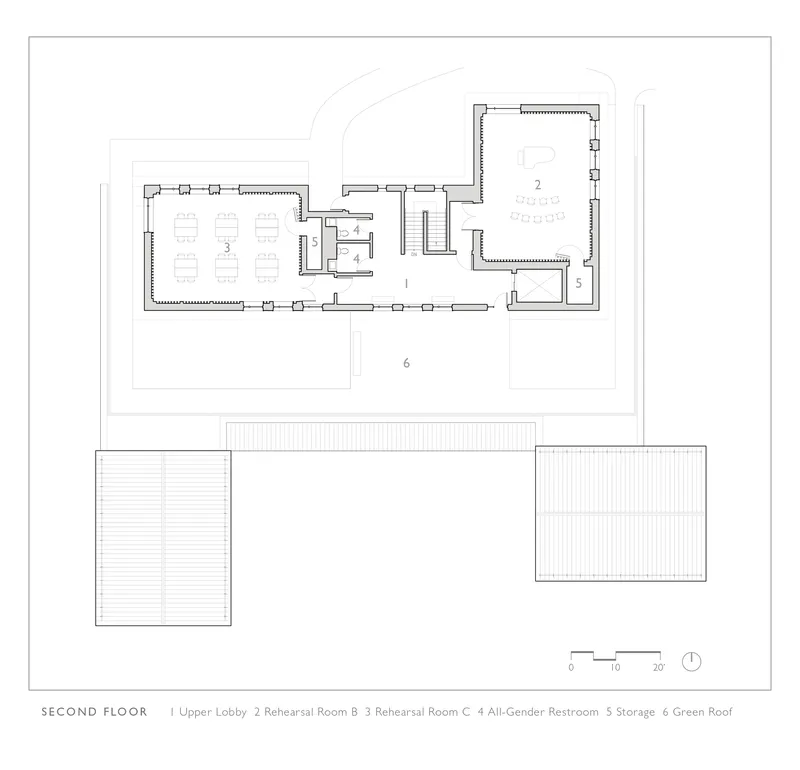
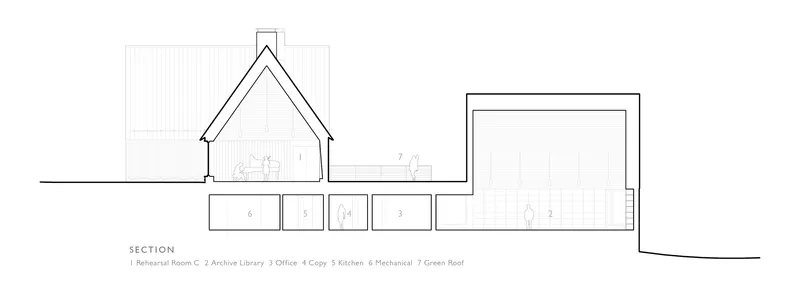
The floor plans reveal the organizational logic behind the apparent informality. The first floor groups the lobby, offices, archive library, and one rehearsal room around a central courtyard. The second floor adds two more rehearsal rooms and a green roof terrace that bridges between the upper campus and the main volumes. The section drawing shows how the pitched-roof forms step with the terrain, each volume rising to its full interior height while the linking flat-roof wing stays low, creating the compression and release sequence that gives the lobby its spatial charge.
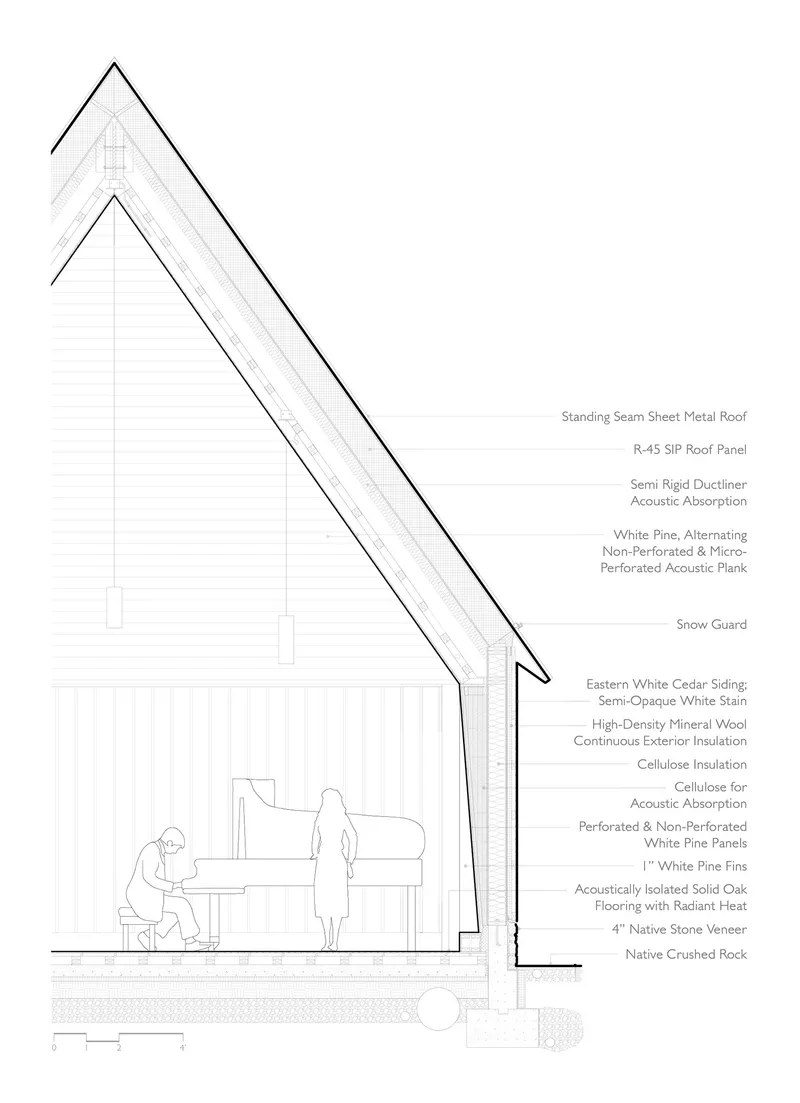
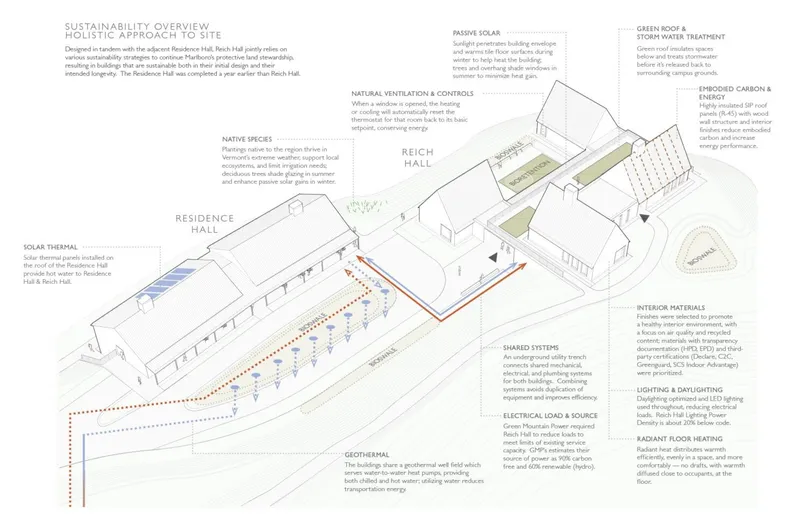
The detailed wall section documents the care embedded in every assembly: roof membrane, insulation layers, cedar cladding, and flooring build-ups are annotated with precision. The axonometric site drawing maps the full range of sustainability systems, from solar thermal panels and geothermal loops beneath the ground to natural ventilation pathways through the building. These drawings are the project's quiet proof that vernacular form and advanced environmental performance are not competing ambitions.
Why This Project Matters
The Marlboro Music Reich Rehearsal Building succeeds because it treats context not as a constraint but as a design generator. Too many institutional projects on sensitive sites oscillate between timid replication and aggressive contrast. HGA found a third path: abstracting the proportions, materials, and siting strategies of New England's agrarian building tradition into a thoroughly contemporary plan that holds geothermal systems, archival-grade climate control, and acoustically tuned rehearsal rooms. The building looks inevitable, which is the hardest thing for new architecture to achieve.
At a moment when music institutions around the world are investing in flashy concert halls, Marlboro's decision to build for rehearsal rather than performance is itself a statement. The architecture follows suit. It prioritizes the intimate, concentrated act of making music over the spectacle of presenting it. The result is one of the most quietly accomplished cultural buildings completed in the United States in recent years, a project whose restraint is its radicalism.
Marlboro Music Reich Rehearsal Building & Music Library by HGA, led by Joan Soranno, FAIA, and John Cook, FAIA. Marlboro, Vermont, United States. Completed 2021. Photography by Albert Vecerka / Esto.
About the Studio
Share Your Own Work on uni.xyz
If projects like this are the kind of work you want to make, uni.xyz is a place to publish your own, find collaborators, and enter design competitions.




Popular Articles
Popular articles from the community


Co-Life: Senior Housing Design That Reconnects Older Adults With the City
Co-Life reimagines senior housing design through healing gardens, shared streets, workshops, and a sustainable community across generations.

Hill & Cross Opera: Sculptural Opera House Architecture Shaped by Tallinn’s Landscape and Identity
Hill & Cross Opera reimagines opera house architecture in Tallinn through its sculptural hill, civic plaza, glass wave and a luminous cross.

The Musturak Paradise: Senior Living Architecture for a Connected Future in Temara, Morocco
The Musturak Paradise reimagines senior living architecture in Temara via private homes, social spaces, culture, community, and shared care.

Play: Fragments of Their World
Familiar architecture becomes modular playground design, creating safe spaces where displaced children can learn, connect, imagine and play.


Similar Reads
You might also enjoy these articles

Bao Huynh Watercolor Atelier: A Serene Art Retreat in Hội An
Bao Huynh Watercolor Atelier in Hội An blends multifunctional art spaces, sustainable design, local materials, and family-friendly living in a serene environment.

Atelier Macri Concept Store Interior Design by CASE-REAL
Atelier Macri store features a "ko" counter, walnut wood details, cork displays, blending retail, gallery, and seamless customer experiences.

Manuel Vargas Izquierdo Stadium and High-Performance Sports Center: Architectural Excellence in Jalpa de Méndez
The Manuel Vargas Izquierdo Stadium blends sustainable design, inclusive sports facilities, and cultural-inspired architecture, revitalizing Jalpa de Méndez’s public spaces.

KAKR Buluh Awar Hall: Revitalizing Community and Ecology Through Bamboo Architecture
Community built bamboo hall revitalizes Buluh Awar village, empowering youth, restoring ecology, celebrating vernacular craftsmanship through sustainable architecture and culture.





Comments (0)
Please login or sign up to add comments
No comments yet. Be the first to comment!