
Hide-and-Seek
Journal of design

For water management, step wells are a very great design. People enter the step wells to find water, which is an experience of exploring the unknown. We approach the reservoir step by step, and when we are about to approach, we will find water. traces - moss, water stains. It's like a childhood game we used to play - do Mickey, we are always guessing where "he" is when doing Mickey? Explore step by step until you find his trace, or will you guess if you have found it? We always look for it with hope, along the traces of "his".
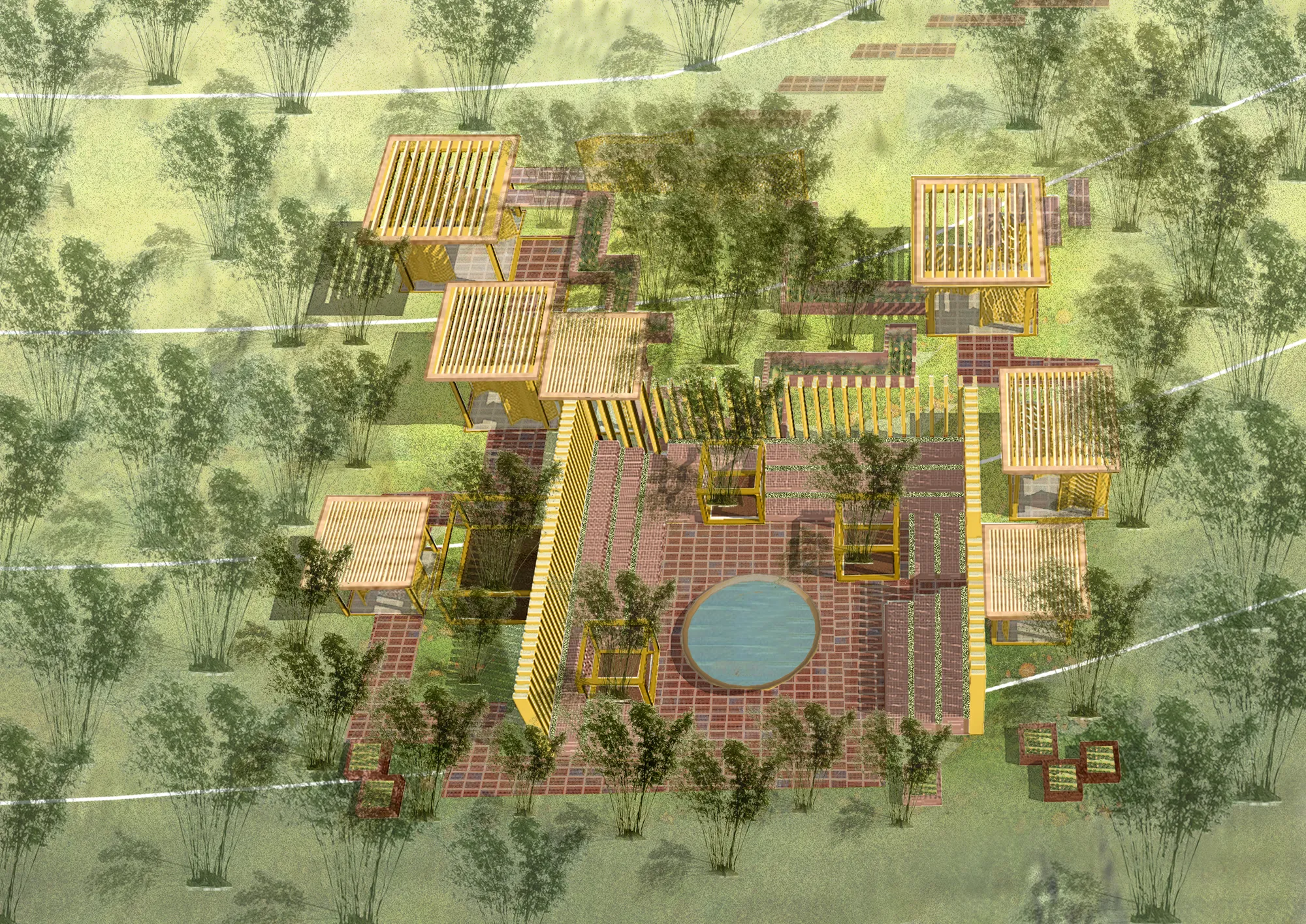
My design concept revolves around doing mystery. Rain has various forms, it exists in many places, it appears in front of us during the rainy season, we feel it and appreciate it, but it comes and goes without a trace, it has been hiding quickly, so we can't find it . In the dry season we started to look for him, following the traces it left, looking down step by step. Difficulties in the search process remind people of the importance of water resources. The appearance of water makes people happy, and the hiding of water makes people distressed. We might as well start a game with water. Let the joy not expire.
In Bangalore, the rainy season only occurs for three months, and in the short three-month rainy season, people are enjoying themselves in the rain, people are enjoying being hit by the rain, enjoying everything that the rain brings, and they are listening to the rain here. , collecting rain, painting with rain, diving into puddles, and happily enjoying this rainy season. Rainwater flows to different places in the carnival, infiltrating through five different infiltration paths and then purifying. The two ways of purification are plant root purification and soil conservation. In this rainy season, the rain is hiding. Although people are revelling with the rain, they do not know where it is hiding. The strong dynamic sense of the rain makes it a thing that comes and goes without a trace. Then we have to continue to enjoy the joy, to enjoy the joy of finding water, which always appears to us in another form during the dry season. It is providing resources for our life in another form. It nourishes the soil, irrigates the plants, and recharges the groundwater. From the rainy season to the dry season, watching the water appearing on the surface gradually decrease, watching the water resource reserves decrease, we should meditate - water is not inexhaustible, and in the process of exploration can also realize the source of water Not easy. So water management is a very important issue.
In the rainy season, the management of rainwater mainly focuses on water collection and water purification. Water is mainly collected in five forms in the design:
1. Infiltration pavement: The road pavement is composed of porous permeable bricks, including flower ponds and benches, which are composed of porous permeable bricks, allowing more rainwater to penetrate into the reservoir, and more plants in the gaps while water infiltrates. growing in.
2. Grass-planting ditch: There is surface runoff formed by excess rainwater under the grass, which flows into the reservoir.
3. Flower Pond: Plant the wet plants that absorb pollutants as flower pond plants, and adjust and improve the water quality while storing water.
4. Percolation tank: The pool at the end of the site is an open water area while collecting water.
5. Infiltration ditch: Use voids such as pebbles and gravel in the underground layer to provide storage space for rainwater.
way to purify water
1. Plant root purification: Plant roots filter pollutants out of the water, and plants add oxygen and organic matter to the soil.
2. Soil conservation: Soil conservation of water source is due to the storage, retention and operation of water energy in soil pores.
Water management during the rainy season is mainly about water storage and water utilization
How to store water:
1. Grass quilt water storage: Because more water is stored, the grass quilt is more prosperous in the dry season.
2. Bamboo water storage: Bamboo has a developed root system, and water stays in the gaps.
3. Soil water storage: a. Water adhering to the membrane is adsorbed by molecules to the surface of soil particles. b. Water forms a thicker film occupying less space known as capillary pore water.
Water use:
1. Irrigation: Irrigation pipes are installed in the reservoir, which can irrigate the surrounding bamboo forests.
2. Replenishing the soil layer water: the water filtered downwards replenishes the soil layer.
People will be connected by water here, gather because of water, and talk about the traces of water they have found. In this elastic space, people will hold various activities to pray for the arrival of more water. In this process, people are more aware of the importance of water, and water resources are hard-won.



Popular Articles
Popular articles from the community


Co-life: Sustainable Architecture for Age-Friendly Community Living
Co-life reimagines sustainable architecture for seniors through courtyards, rammed earth, shared gardens, and spaces designed for belonging.

Lunar Spiral: Space Architecture Shaped by the Mathematics of the Universe
Lunar Spiral reimagines space architecture through Fibonacci geometry, lunar regolith, levitating habitats, and self-sustaining Moon living.

The Ocean Hive: Sustainable Architecture for a Self-Sufficient Civilization at Sea
The Ocean Hive imagines sustainable architecture at sea, where modular habitats, algae, wave power and ocean waste sustain a growing colony.

The Earth Pod: 3D Printed Homes for Resilient Refugee Communities
The Earth Pod reimagines refugee housing through 3D printed homes made from clay, combining resilience, self-sufficiency, and rapid shelter.


Similar Reads
You might also enjoy these articles

Day and Night Park: A Time-Based Urban Newsstand in Beijing
A temporary urban newsstand in Beijing blending travel, light, and reading through poetic colors, compact form, and community-focused design.

Modernist Patio Renovation in El Masnou, Barcelona by Oliver Segura Arquitectura + Cebrià Arquitectura
Modernist patio renovation blending tradition and innovation with a movable pool, leveled floors, and Catalan materials in El Masnou.

Alto Residencial Coop: Cooperative Housing Development in Santiago de Compostela by Carbajo Barrios Arquitectos
A linear cooperative housing complex blending white volumes and perforated metal façades, enhancing community living, natural light, privacy, and urban integration.

Vil Genis School by BPA ARCHITECTURE – Massy, France
Vil Genis School in Massy, France, features sustainable design, south-facing classrooms, community integration, accessible spaces, and modern educational architecture.


Comments (0)
Please login or sign up to add comments
No comments yet. Be the first to comment!