
Hilâl: Where Water Becomes the Architecture
A runner-up entry in the Ripple competition reimagines waterfront infrastructure as a living classroom for ecological filtration and oyster habitat.


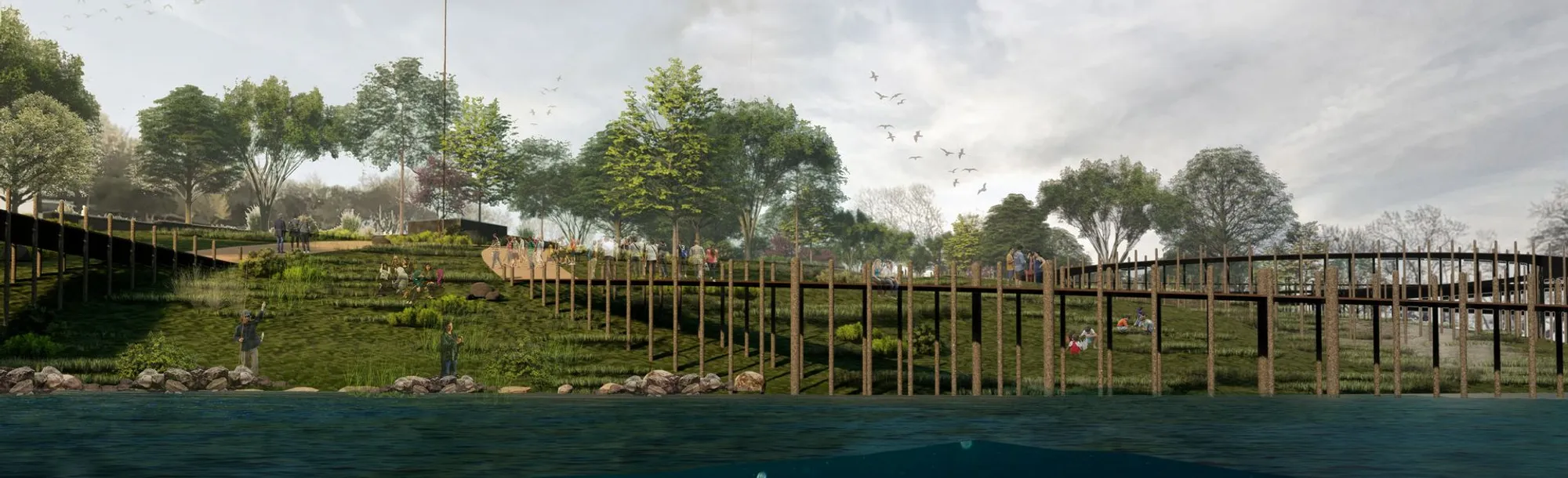
Most waterfront projects treat the edge between land and water as a line to be hardened. Hilâl treats it as a gradient to be inhabited. The project unfolds as a sequence of ecosystems: rain gardens, wetlands, terraced slopes embedded with timber pilings, and ECO concrete columns engineered to foster oyster habitats below the waterline. Every surface, every slope, every material choice serves a dual purpose: public space and water filtration infrastructure, woven so tightly together that visitors cannot experience one without understanding the other.
Designed by Laura Dieguez and Thuy Tran, Hilâl was recognized as a Runner-Up in the Ripple competition. The name itself, meaning "crescent" in Arabic, hints at the curving, cyclical nature of water as it moves through the site. The designers conceived the project as an outdoor educational experience, where the landscape and circulation are planned to integrate water as a guiding element, pulling visitors through distinct zones of ecological engagement.
A Monument Plaza That Anchors the Public Edge
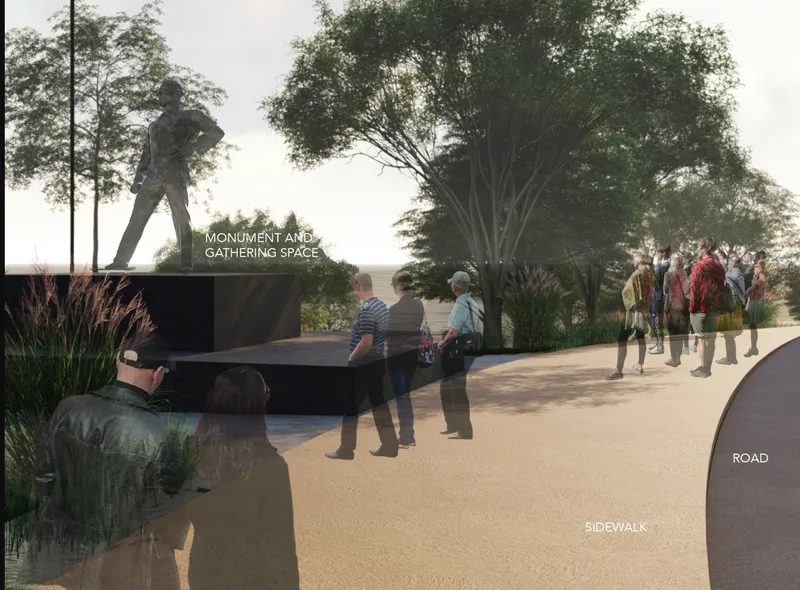
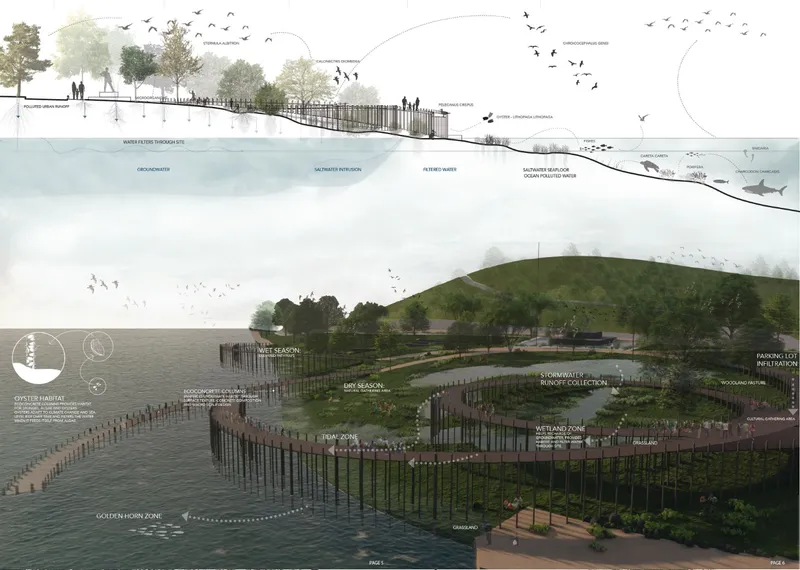
The arrival sequence begins at a monument plaza shaded by mature canopy trees, where visitors gather along a paved sidewalk before descending toward the water. The plaza works as a civic threshold, marking the transition from urban ground to ecological infrastructure. Beneath this composed public surface, the section and axonometric drawings reveal the true complexity of the project: layered waterfront landscape zones extend from upland rain gardens through wetland corridors down to submerged oyster habitat supported by ECO concrete columns. The section makes visible what the surface experience only implies, that every step toward the water passes through another stage of natural filtration.
Dusk Along the Garden Zones
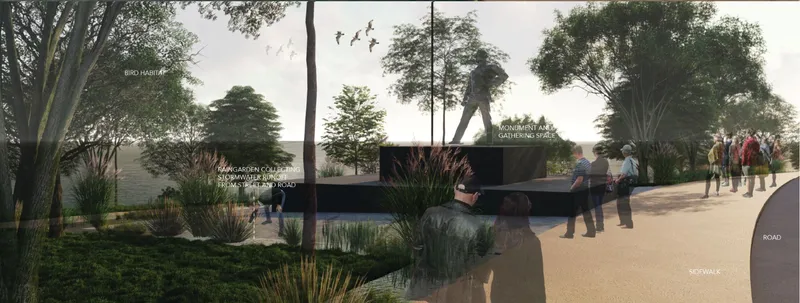
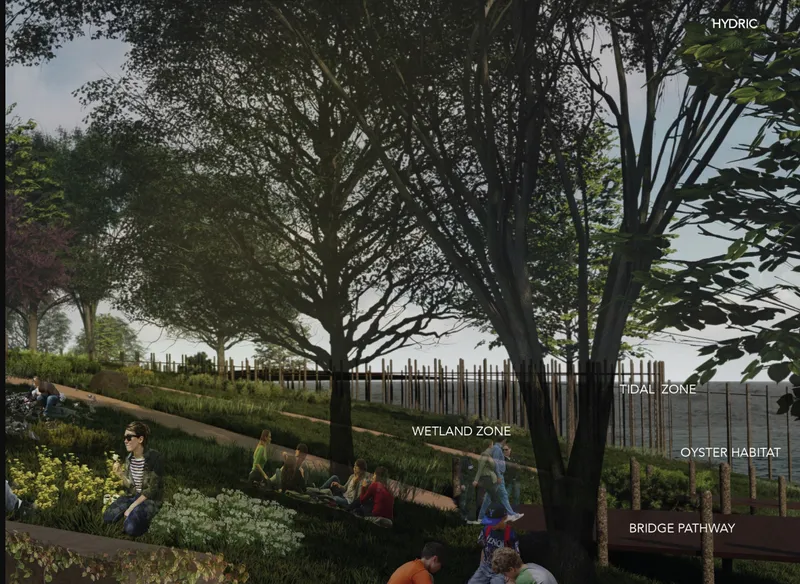
At dusk, the planted garden zones flanking the monument take on a quieter register. Visitors move along the sidewalk past dense native plantings, the low light emphasizing the textural variety of grasses and groundcover that do the invisible work of stormwater absorption. Further into the site, the sloped wetland zone becomes the most spatially active landscape: timber pilings punctuate terraced ground where people walk among planted shelves that step down toward the waterline. The pilings are not decorative; they stabilize the slope while creating micro-habitats in the saturated soil between them.
Terraced Ground as Social and Ecological Infrastructure
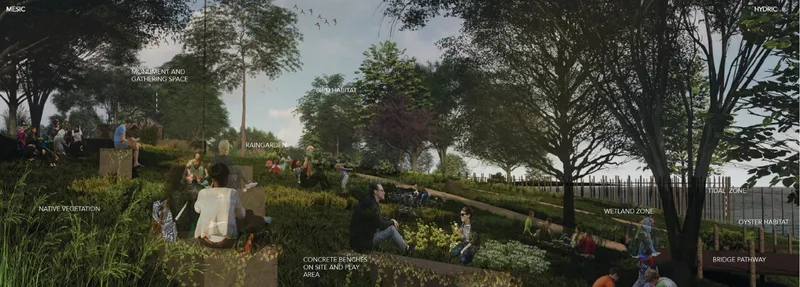
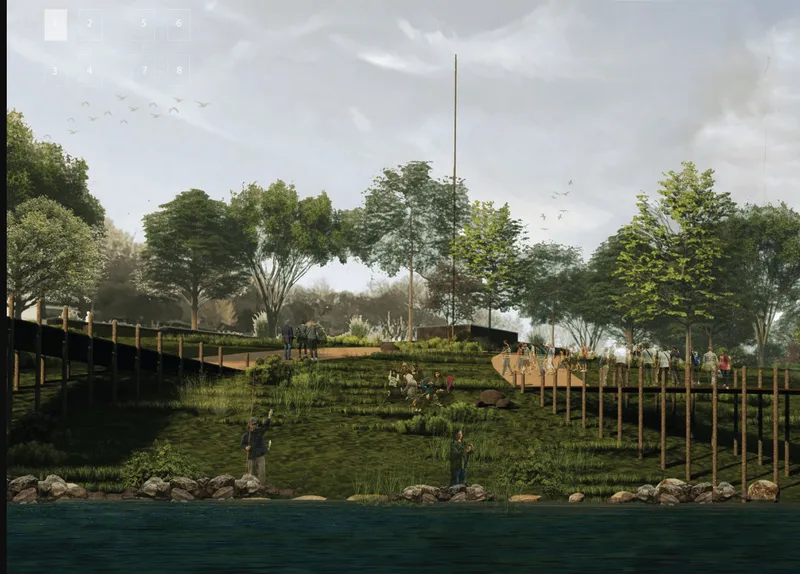
The panoramic view from the upper terrace shows visitors seated on grass under scattered canopy trees, a scene that reads as a simple park until you register the engineered slope below them. From the water, the view reverses: the terraced shoreline reveals itself as a constructed ecology, timber pilings holding planted slopes in place while visitors occupy the edges between dry ground and wet habitat. The dual reading of these terraces is the project's strongest move. The same landform that invites someone to sit and watch the water is simultaneously filtering runoff, slowing erosion, and providing substrate for aquatic life.
The Quiet Edges: Fencing, Rain Gardens, and Pedestrian Paths
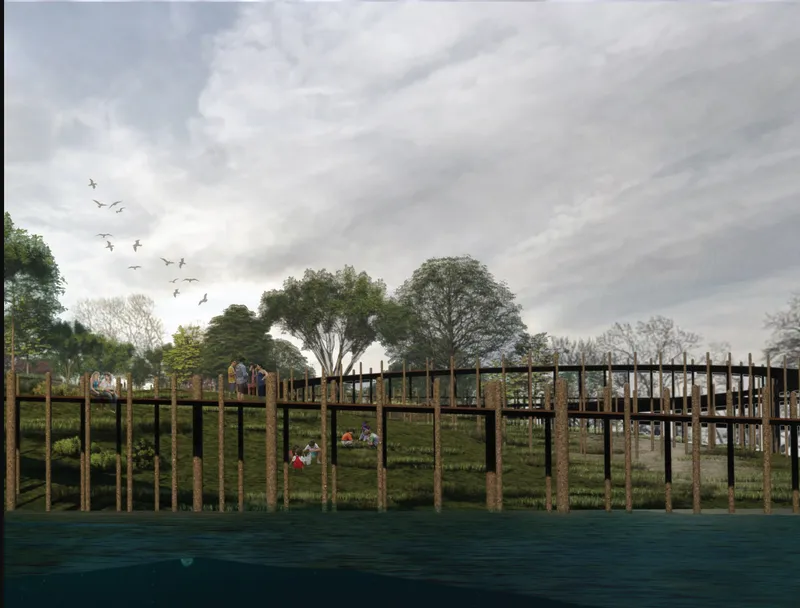
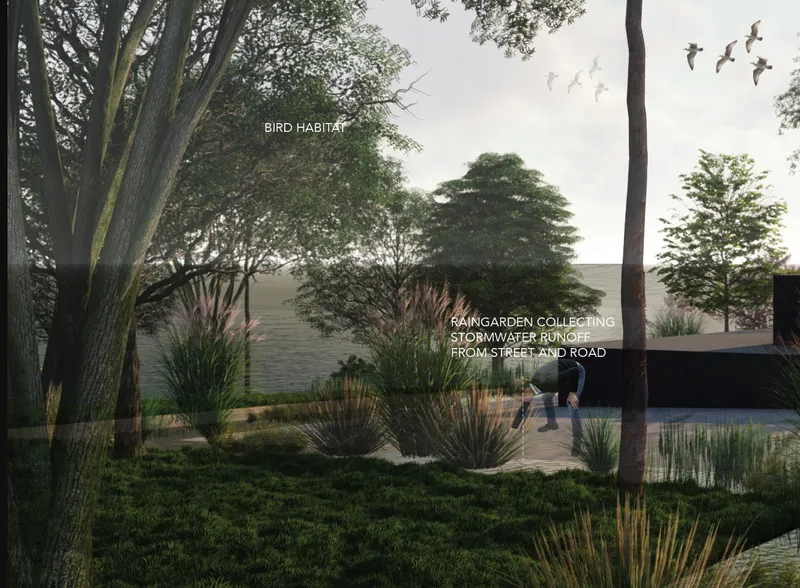
At the site's periphery, a timber post fence borders a lawn area where the landscape transitions from active ecological zones back to familiar parkland. The fence marks a boundary without creating a wall, allowing visual continuity while signaling a shift in ground condition. Nearby, a rain garden thick with native plantings sits alongside a pedestrian pathway and existing trees. The gravel infiltration parking lot, though less photogenic, completes the hydrological cycle by capturing runoff at the point of arrival. Every zone in Hilâl, from the parking surface to the oyster columns below the waterline, participates in a continuous filtration sequence.
Why This Project Matters
Hilâl demonstrates that water infrastructure does not need to be hidden below grade or segregated behind fences. By making filtration systems into public landscapes, Dieguez and Tran propose that ecological literacy is a spatial experience, not a signboard. Visitors learn about water conservation by walking through it, sitting on it, and watching it work at the shoreline.
The project's strength lies in its refusal to separate performance from experience. Rain gardens are also gathering spaces. Timber pilings are both structural and ecological. The terraced slopes are park, classroom, and filtration system at once. For a competition focused on the ripple effects of water, Hilâl responds with a design where every intervention sends its own ripple outward, from surface to substrate, from visitor to habitat.
View the Full Project
About the Designers
Designers: Laura Dieguez, Thuy Tran
Enter a Design Competition on uni.xyz
uni.xyz runs architecture and design competitions year-round that reward proposals with spatial conviction and real site intelligence.
Project credits: Hilâl by Laura Dieguez, Thuy Tran Ripple (uni.xyz).



Popular Articles
Popular articles from the community


Conexión: Biophilic Design Reimagines High-Rise Living in Hong Kong
Conexión reimagines high-rise living in Hong Kong through biophilic design, green facades, shared spaces, daylight, water and nature within.

Riyadh For All: Intergenerational Urban Design for Active Aging in Rabat
Riyadh For All reimagines urban design in Rabat with intergenerational co-living, adaptive courtyards, and Moroccan cultural exchange today.

Co-Life: Senior Housing Design That Reconnects Older Adults With the City
Co-Life reimagines senior housing design through healing gardens, shared streets, workshops, and a sustainable community across generations.

Lunar Spiral: Space Architecture Shaped by the Mathematics of the Universe
Lunar Spiral reimagines space architecture through Fibonacci geometry, lunar regolith, levitating habitats, and self-sustaining Moon living.


Similar Reads
You might also enjoy these articles

Day and Night Park: A Time-Based Urban Newsstand in Beijing
A temporary urban newsstand in Beijing blending travel, light, and reading through poetic colors, compact form, and community-focused design.

Modernist Patio Renovation in El Masnou, Barcelona by Oliver Segura Arquitectura + Cebrià Arquitectura
Modernist patio renovation blending tradition and innovation with a movable pool, leveled floors, and Catalan materials in El Masnou.

Alto Residencial Coop: Cooperative Housing Development in Santiago de Compostela by Carbajo Barrios Arquitectos
A linear cooperative housing complex blending white volumes and perforated metal façades, enhancing community living, natural light, privacy, and urban integration.
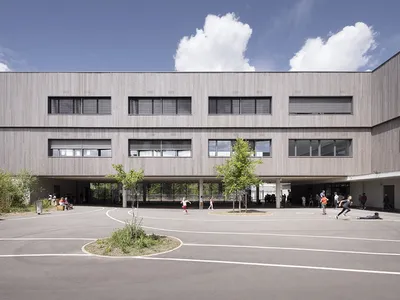
Vil Genis School by BPA ARCHITECTURE – Massy, France
Vil Genis School in Massy, France, features sustainable design, south-facing classrooms, community integration, accessible spaces, and modern educational architecture.


Comments (0)
Please login or sign up to add comments
No comments yet. Be the first to comment!