

Hive Center: A White Gallery in Beijing's 798
Penda China stripped 3,300 square meters of factory space in Beijing's 798 Art District and replaced it with a white, skylit contemporary art gallery.


Beijing's 798 Art District is a grid of former military electronics factories from the 1950s, converted into galleries, studios, and cafes starting in the early 2000s. Most conversions kept the original red brick and concrete barrel vaults as an aesthetic feature. Hive Center for Contemporary Art, renovated by Penda China (led by Sun Dayong), does the opposite. It strips the industrial character from 3,300 square meters of factory space and replaces it with a white, skylit interior that treats the building as a purpose-built gallery rather than a converted warehouse.
The result is the largest single gallery in 798, and one of the most resolved contemporary art spaces in Beijing. The renovation touches everything: facade, lobby, exhibition halls, circulation, offices, and storage. The palette is white plaster, grey polished concrete floor, steel skylight structure, and glass. The strategy is to remove visual noise and let the art and the light do the work.
The Facade: A White Volume in a Brick Street
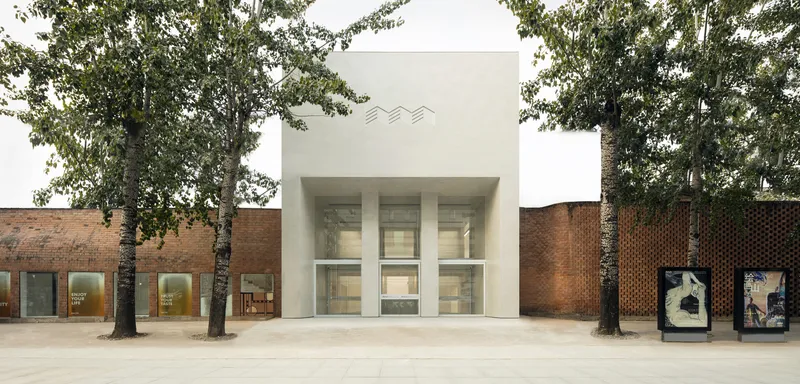
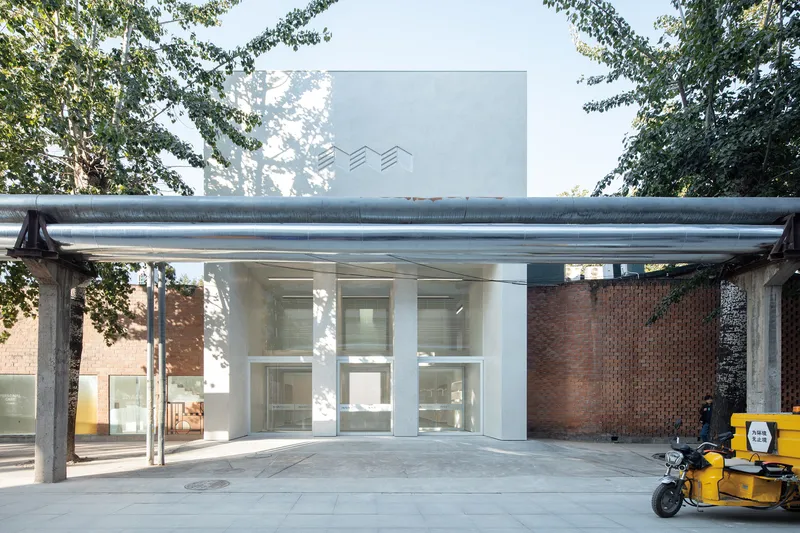
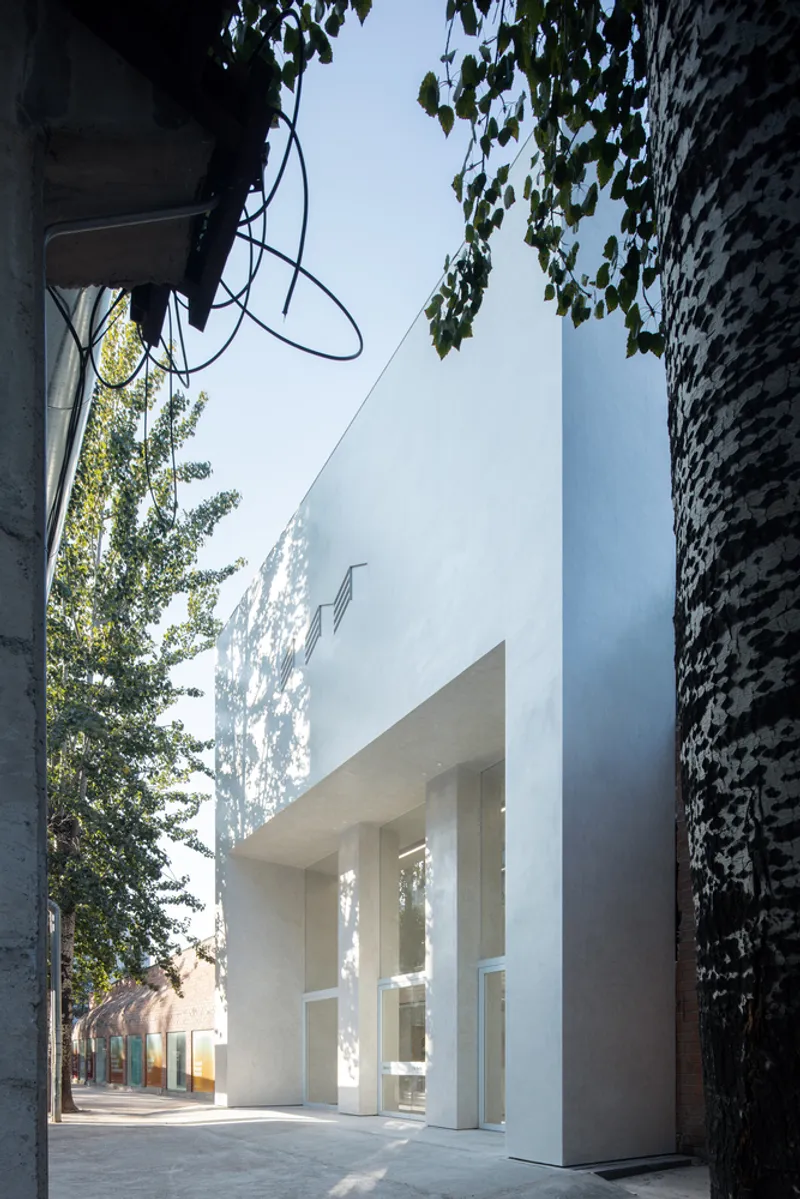
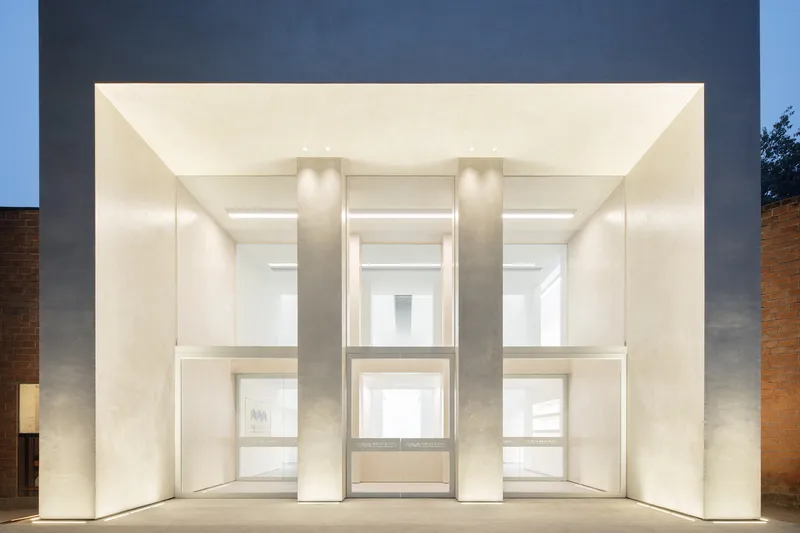
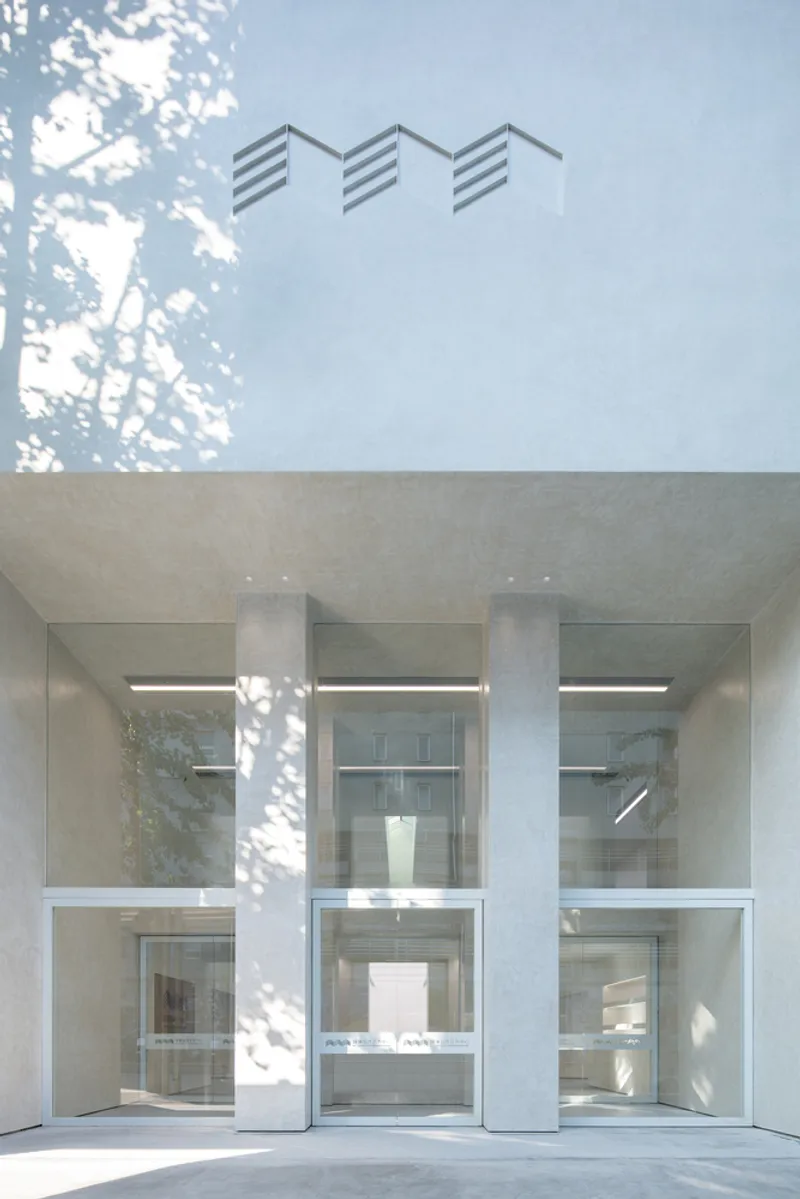
The street facade is the most visible change. A tall white cubic volume replaces the original entrance, rising above the single-storey brick wings on either side. Three full-height glass openings reveal the lobby behind the facade. The wavy Hive logo sits high on the white surface. Plane trees frame the approach. The building announces itself as something different from the red brick galleries around it: white, precise, and unapologetic about being new.
At night, warm light floods through the three glass openings and the white concrete glows against the dark street. The columns cast long shadows. The building becomes a lantern.
The Lobby and Colonnade
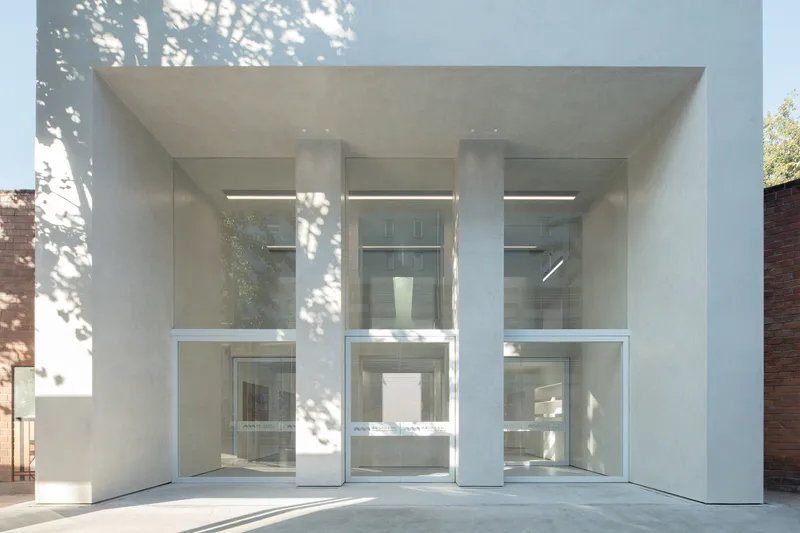
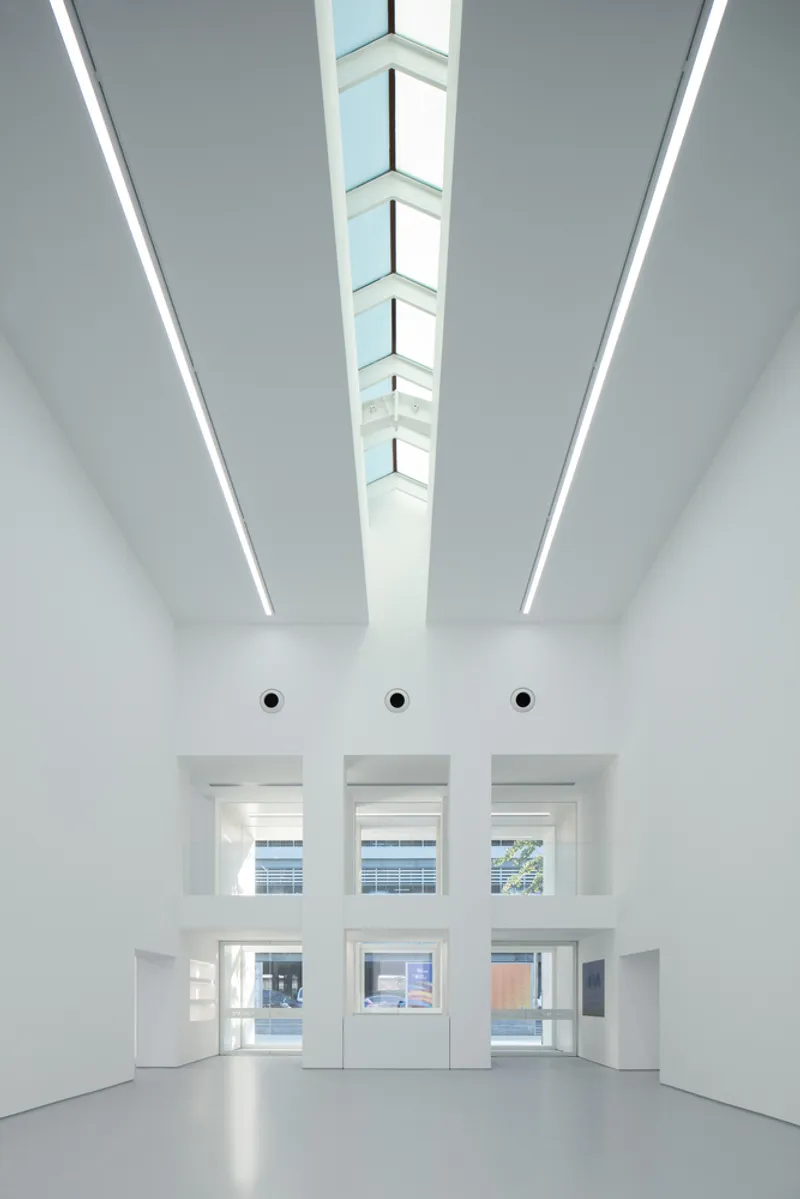
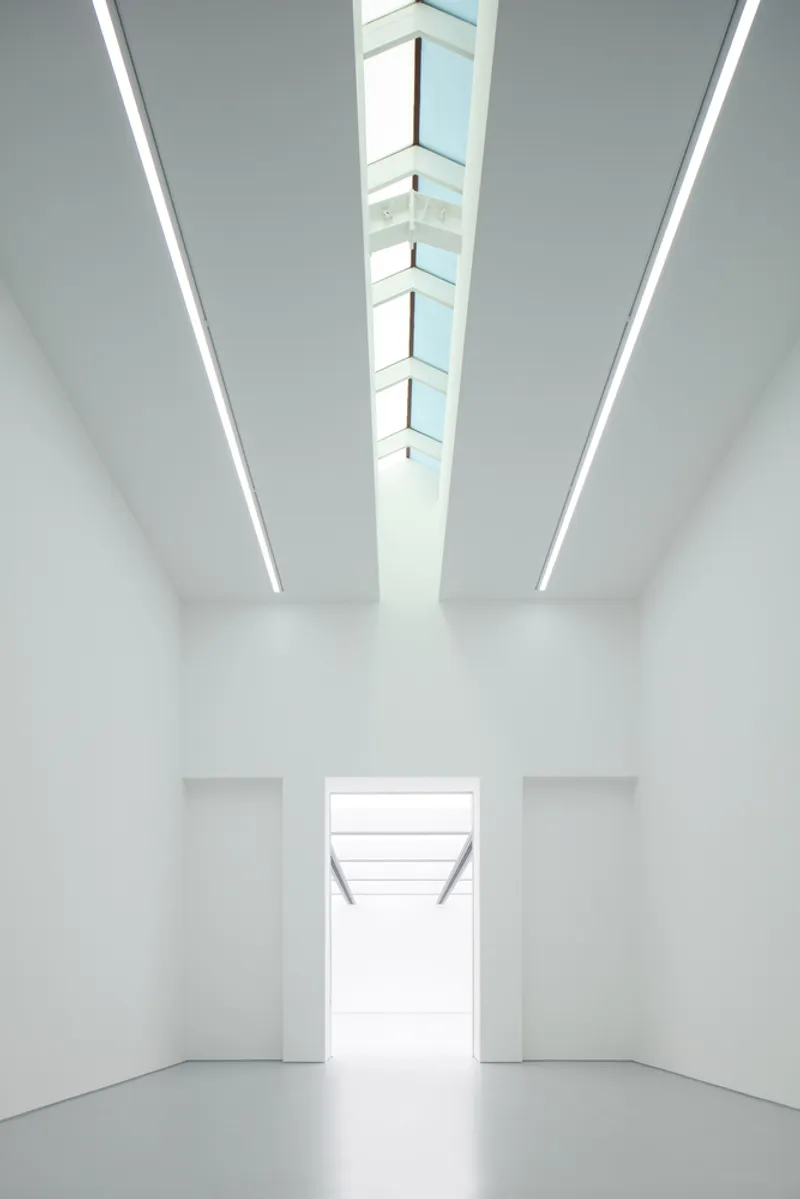
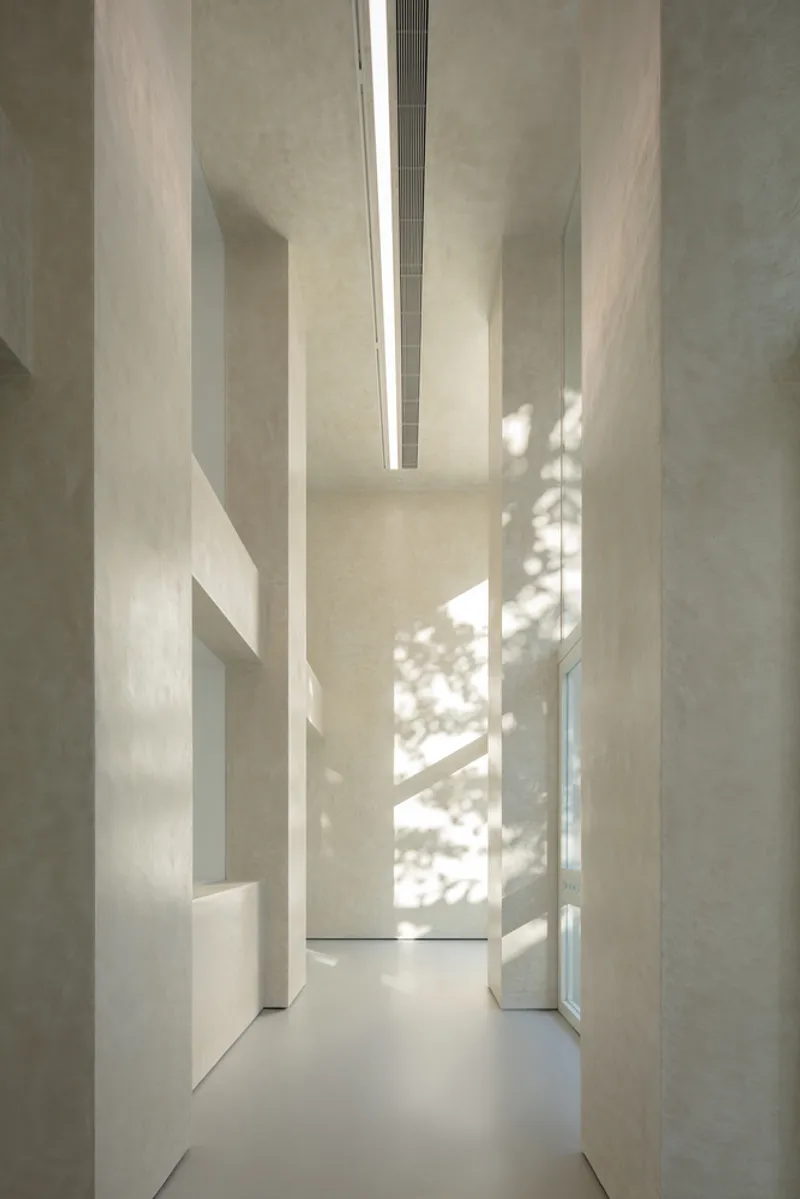
Inside, the lobby is a double-height white volume with a colonnade of rectangular concrete columns. The reference is deliberate: Sun Dayong cites the Karnak Temple as an influence. The columns create rhythm and scale without decoration. A linear skylight runs the length of the ceiling. The floor is grey polished concrete. The proportions are generous. The entry sequence moves from the bright street through the glass, past the columns, and into the galleries beyond.
The Main Exhibition Hall
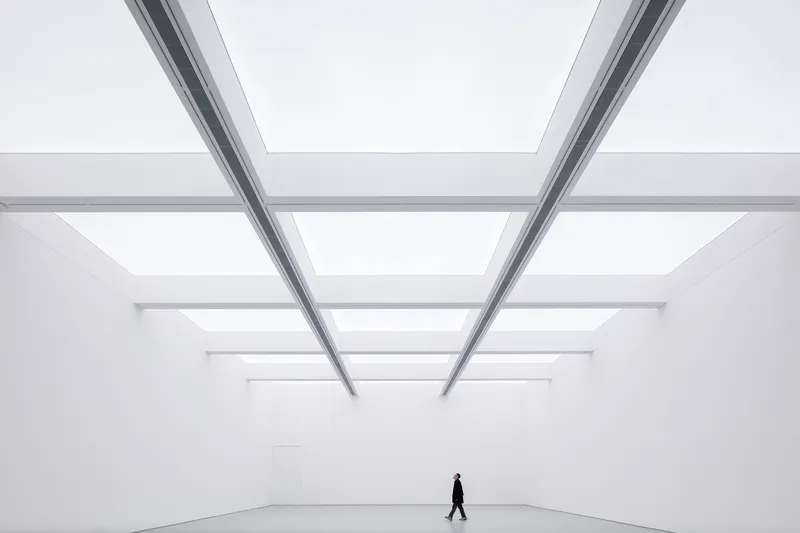
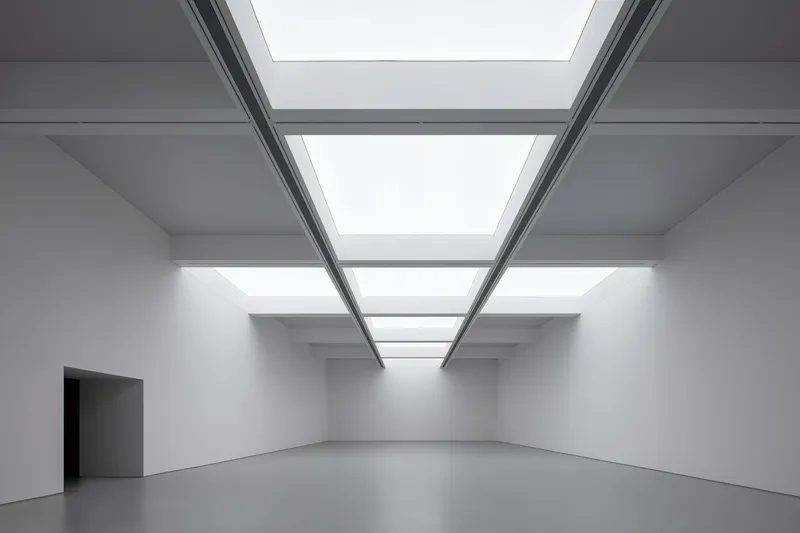
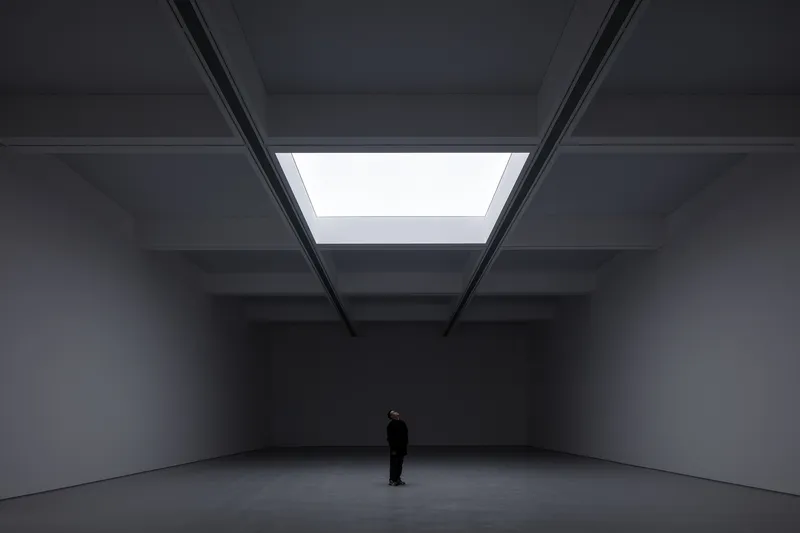
The main hall is the heart of the building: a vast, open room under a pitched roof with a full skylight grid. Steel beams converge at the ridge. The ceiling is divided into panels that simulate even, diffused natural light. The effect is consistent illumination across the entire room, with no hot spots and no shadows, the ideal condition for viewing art. A figure walking across this room gives the scale: the ceiling is high, the walls are distant, the space is generous enough to hold large-scale installations.
A second configuration darkens the room entirely, with only a central skylight panel left open. This creates a dramatic, compressed atmosphere for exhibitions that need controlled light or a more intimate mood.
Gallery Rooms and Circulation
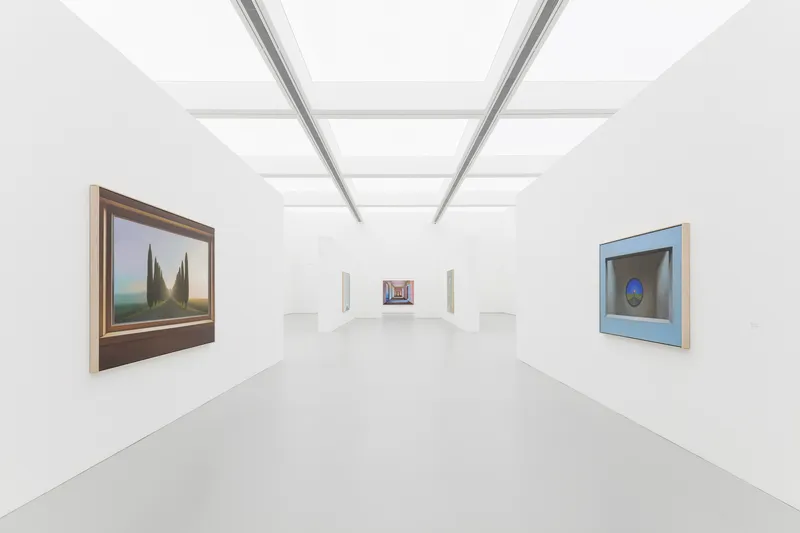
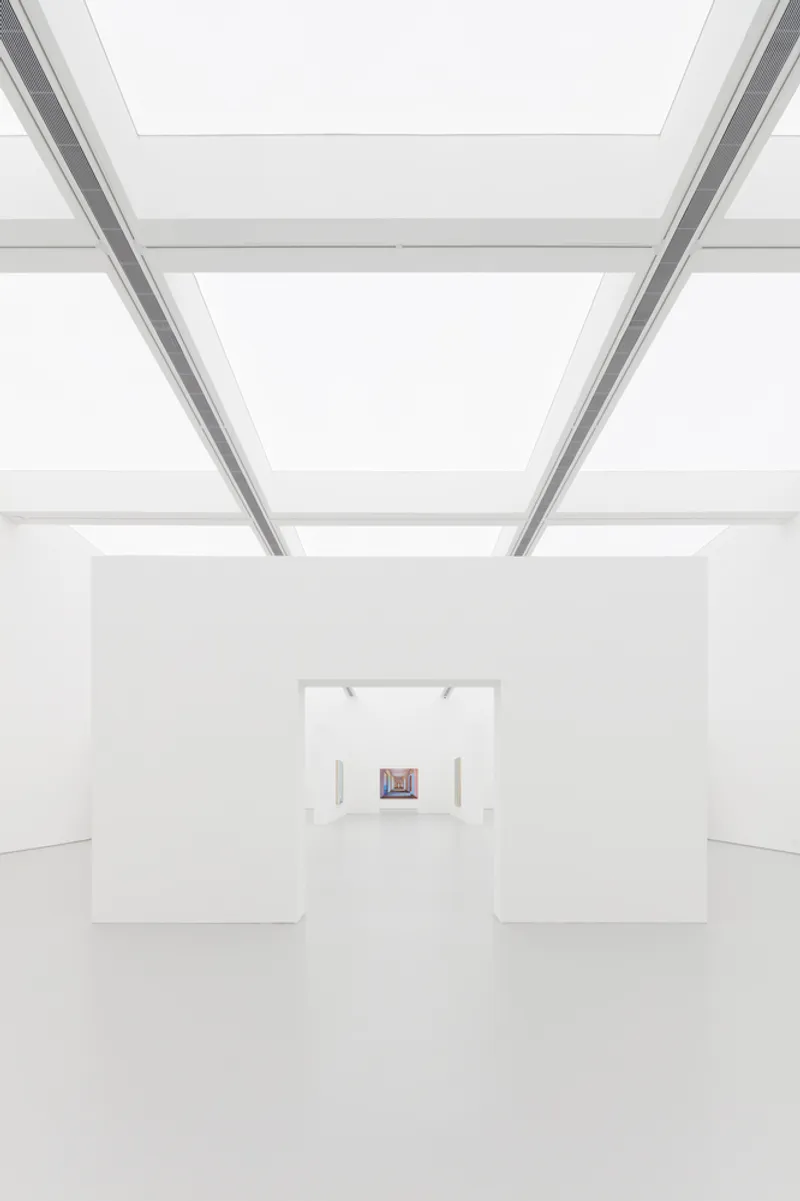
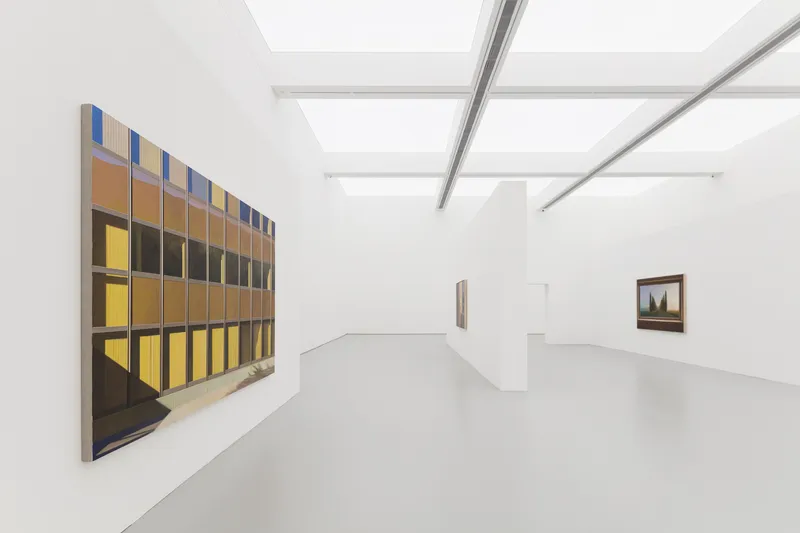
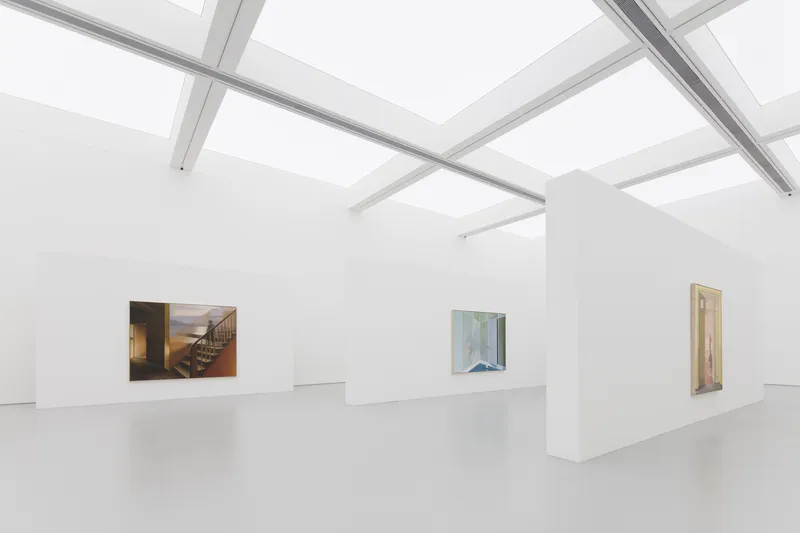
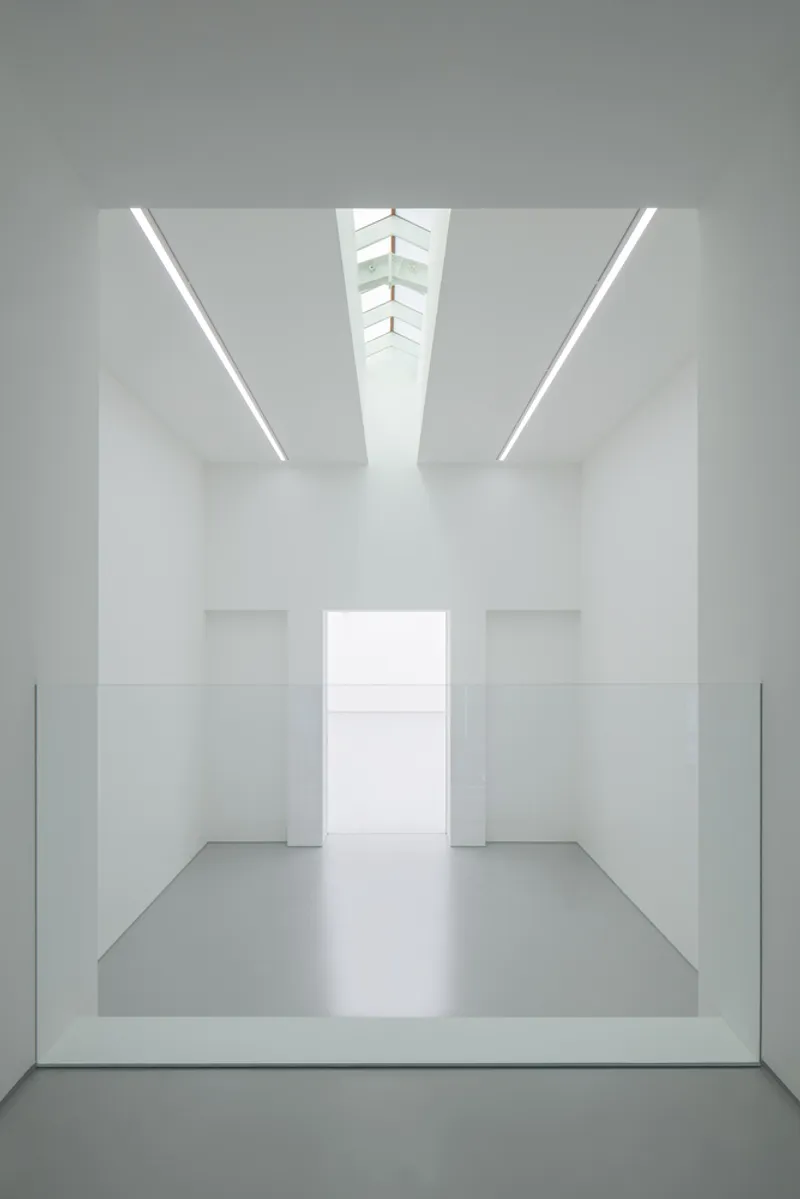
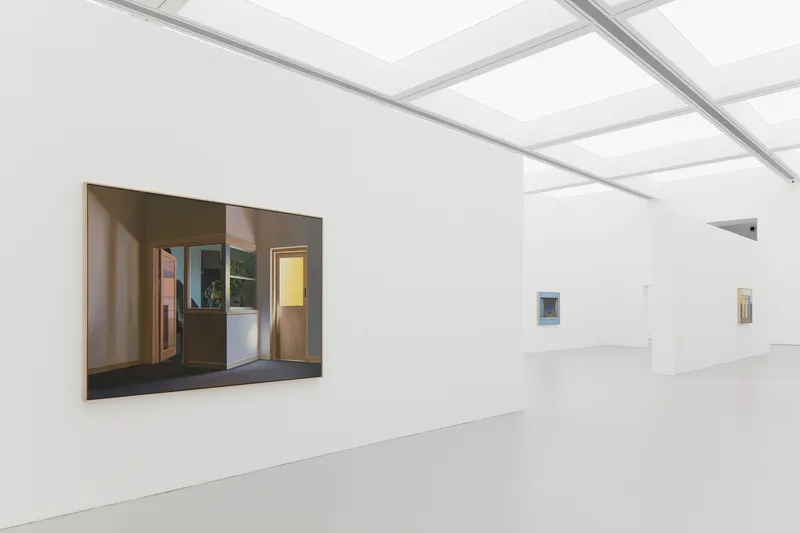
The first-floor galleries are a sequence of white rooms with freestanding partition walls. Each room has its own linear skylight. The enfilade view through aligned openings creates a deep perspective that draws visitors forward. Paintings are hung on the partitions rather than the perimeter walls, which allows curators to reconfigure the layout for each exhibition.
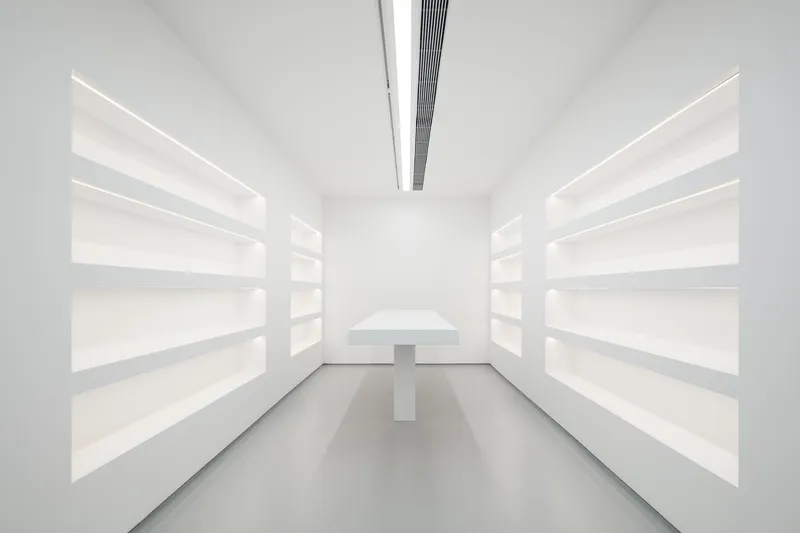
A smaller room with white shelving on both walls serves as an archive, reading room, or shop. The display table at the centre and the linear ceiling light above it create a focused, quiet space.
The Stair, Bridge, and Upper Level
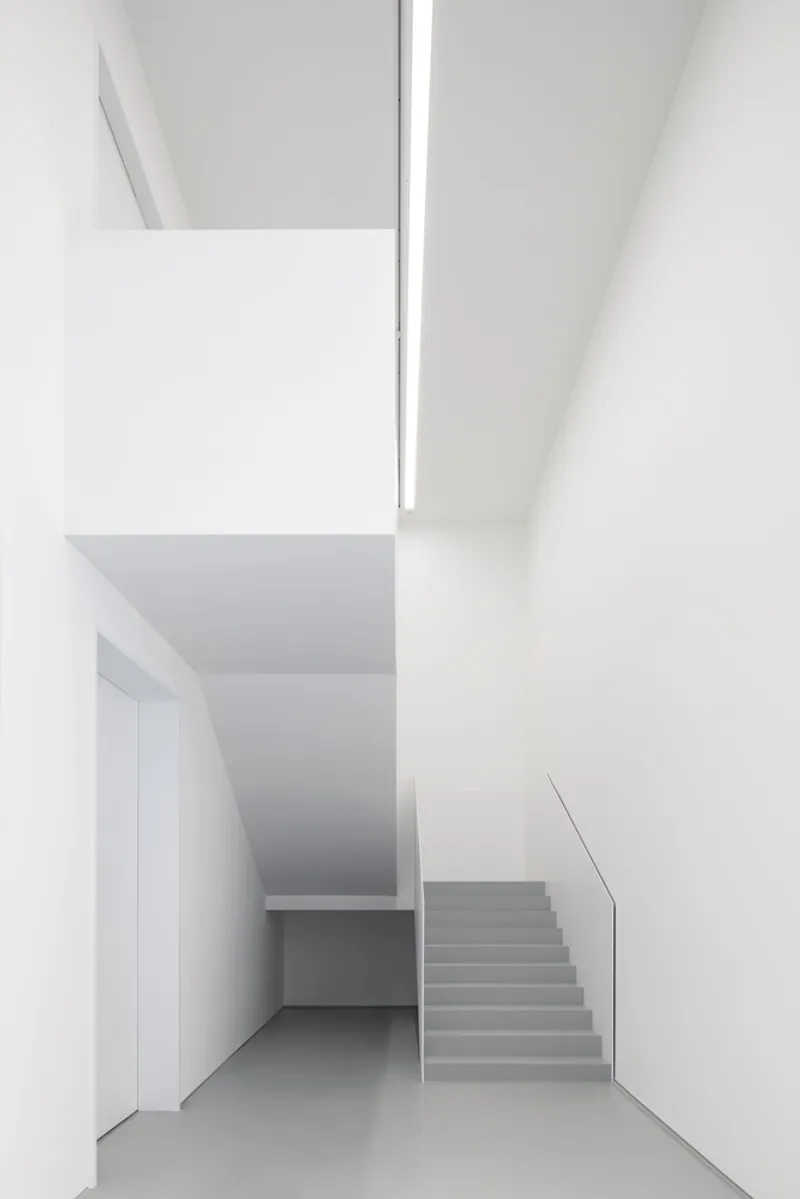
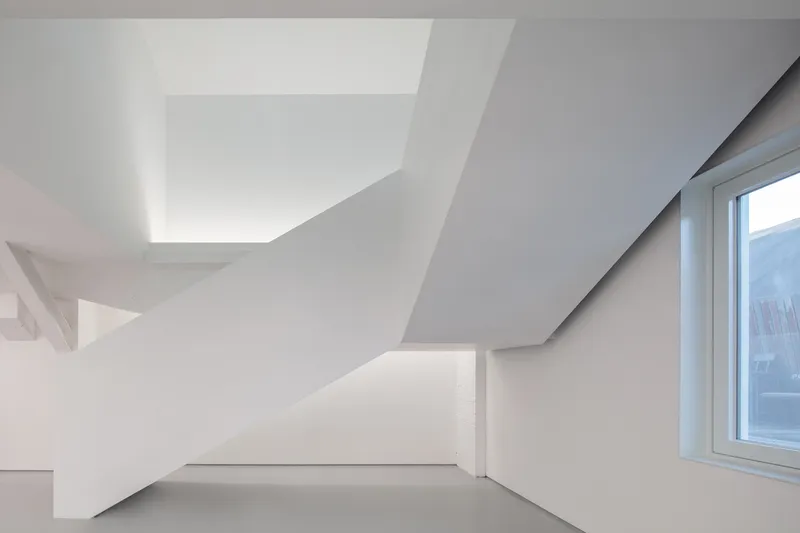
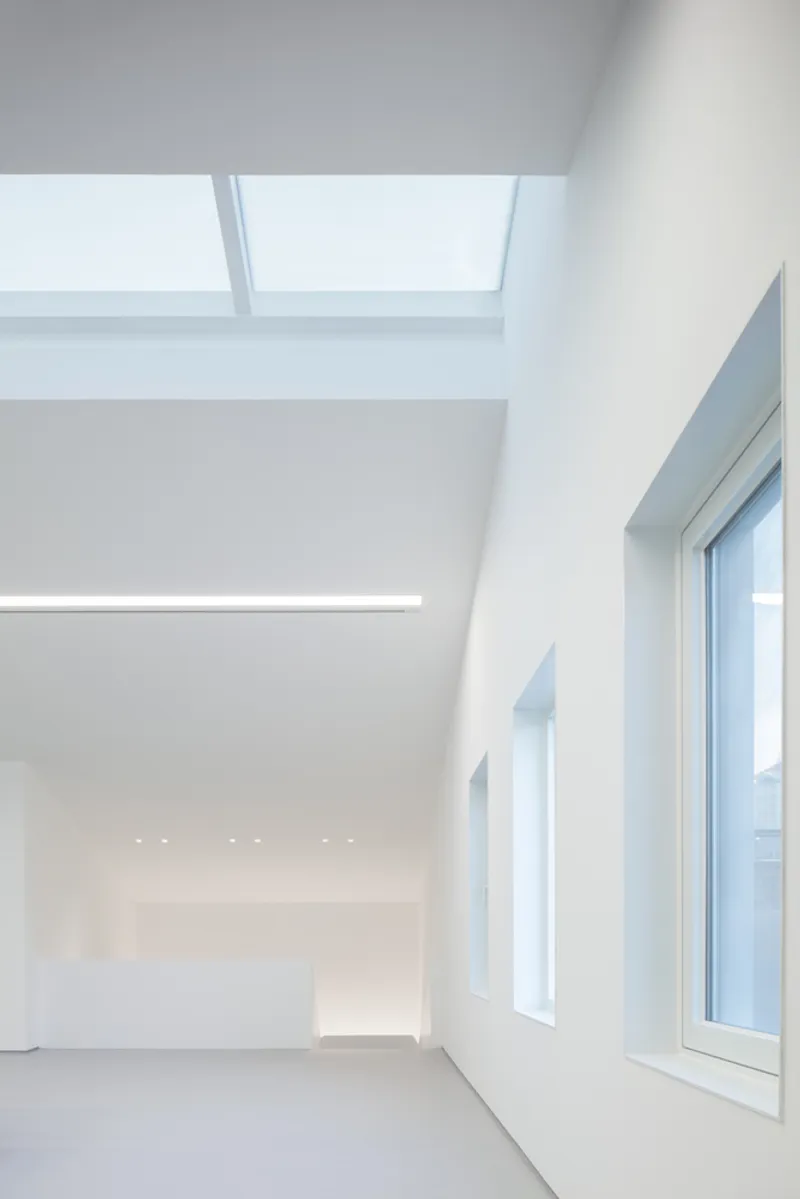
The stair is a simple concrete run with a glass balustrade, set in a double-height void with a skylight above. The angular white planes of the stair underside create sharp geometric shadows. The second floor opens onto a bridge corridor that overlooks the ground-floor gallery below and looks out through tall windows to the plane trees outside.
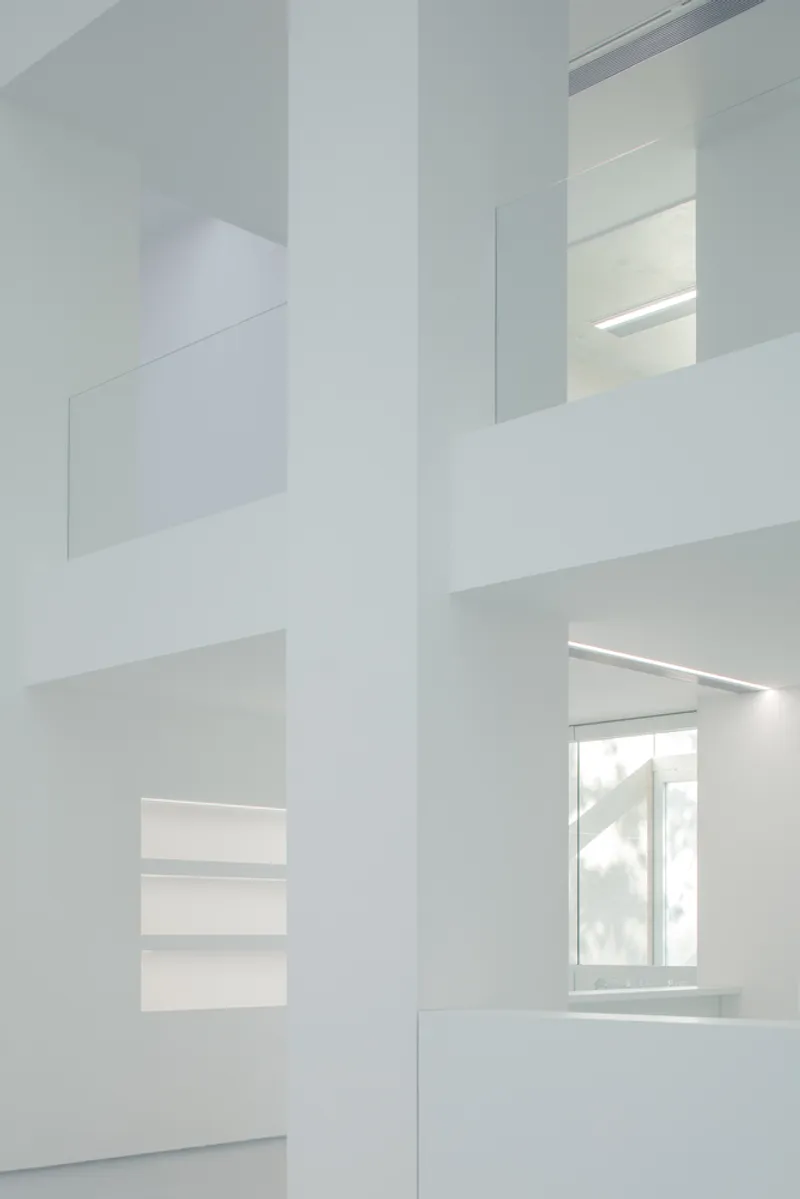
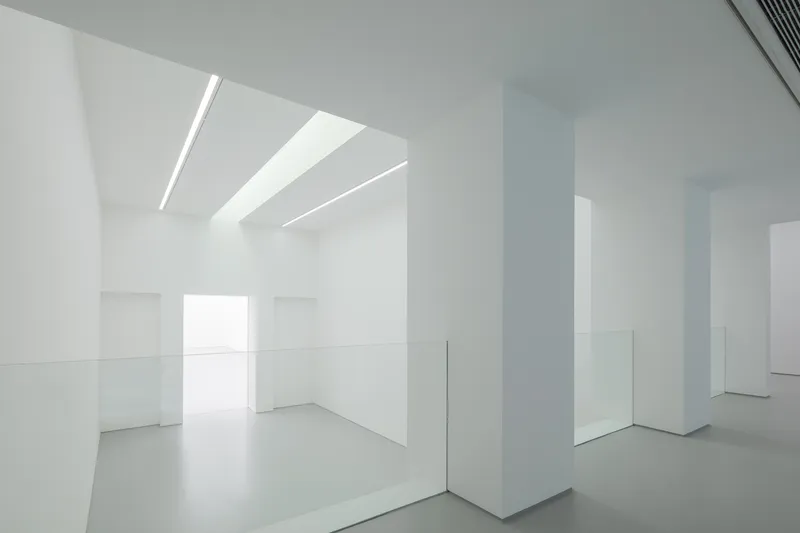
The upper level contains the reading area, VIP rooms, and offices. The void at the centre allows visual connection between floors. Glass balustrades preserve the sense of openness. The atmosphere remains consistently white and lit from above.
The Brick Threshold
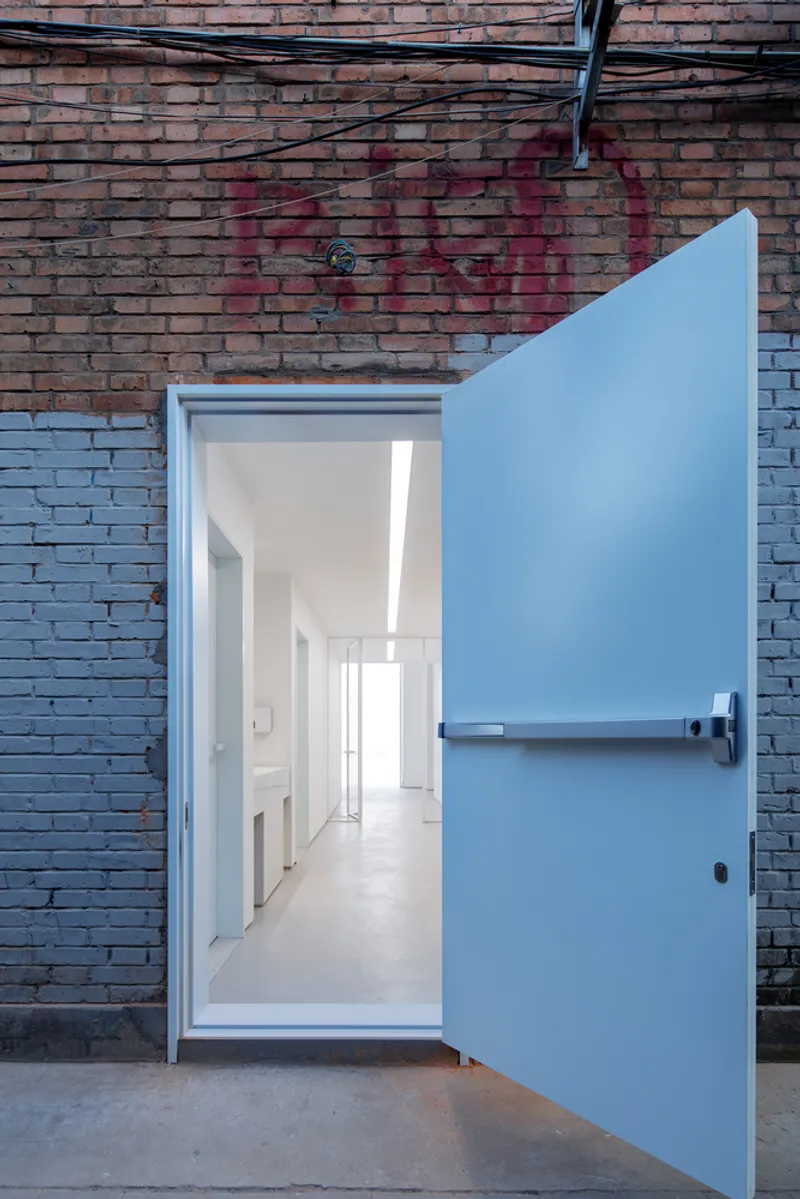
Two images reveal the boundary between the old and the new. A blue steel door in the original brick wall opens onto a white corridor: the transition is immediate and total. From a side alley, the white volume appears between existing buildings, a clean insertion into the industrial fabric. These moments are the clearest expression of the renovation strategy: the old structure remains on the outside, but the interior has been entirely replaced.
White as a Design Strategy
Sun Dayong frames the white palette through Kenya Hara's philosophy of "emptiness." White is not a colour but an absence of visual information, a condition that makes the art visible. The gallery is not competing with the work it houses. The only visual events are the skylights, the columns, and the proportions of the rooms. This restraint requires precision: every joint, every surface, every light fixture must be exact, because there is nothing to hide behind.
Light is the second material. The skylight grid in the main hall, the linear strips in the smaller rooms, and the tall windows in the lobby all work together to produce an interior that changes subtly through the day without ever losing its even, diffused quality.
Drawings
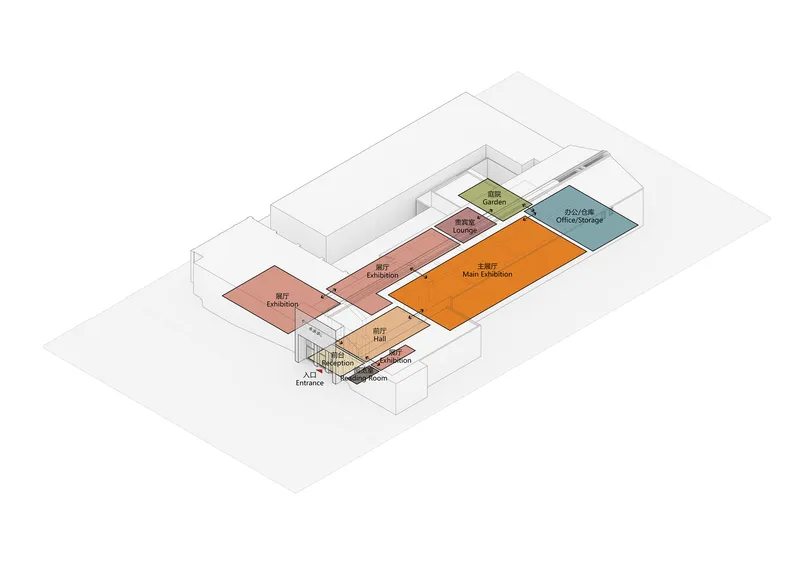
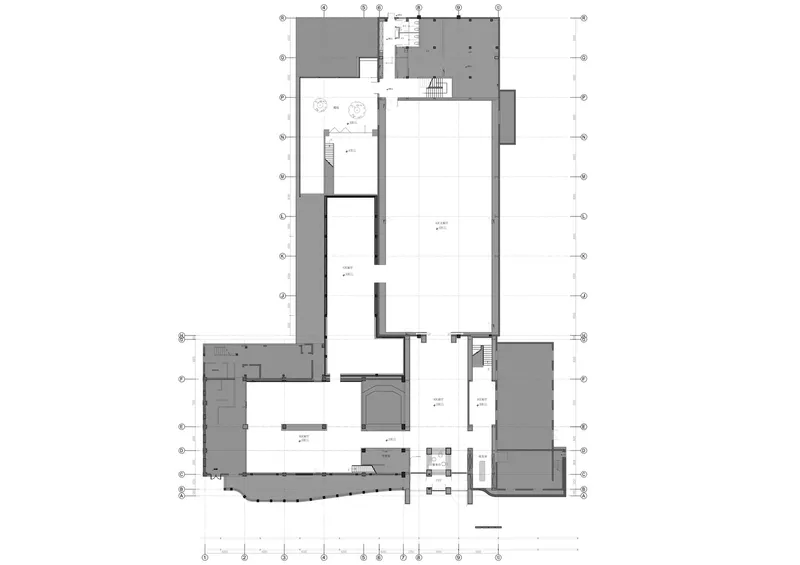
The axonometric programme diagram shows the colour-coded zones: entrance and reception at the front, exhibition halls flanking the centre, the main exhibition space at the rear, lounge and garden in the north wing, offices and storage at the far end. The floor plan confirms the L-shaped layout and the sequence from entry to galleries to services.
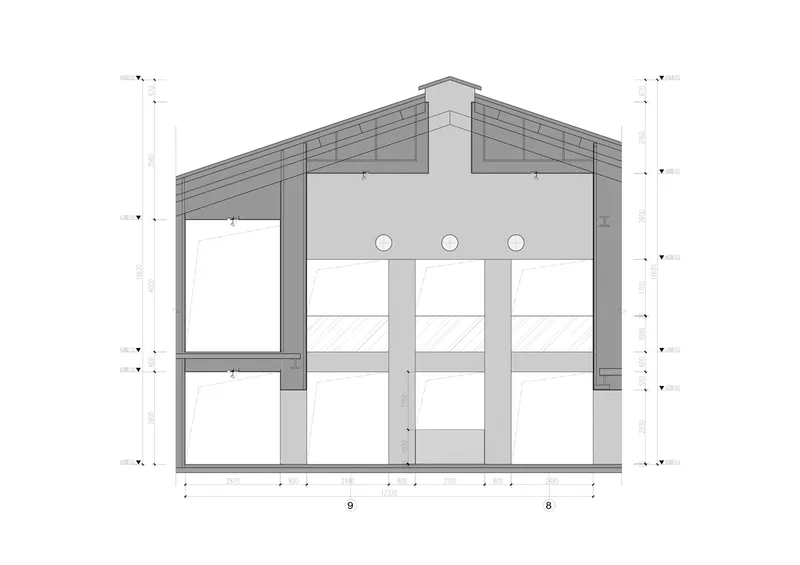
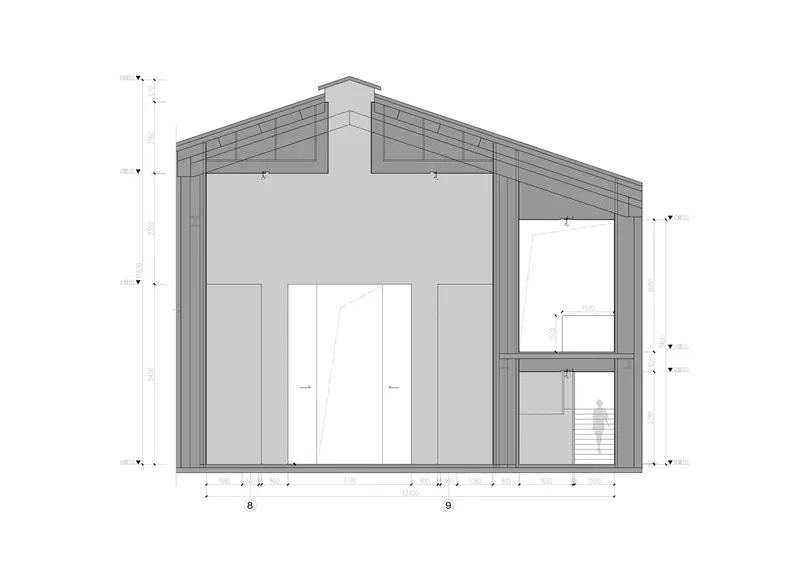
The two sections cut through the pitched roof, showing the skylight monitors at the ridge, the double-height column grid in the main hall, and the stair wing with the upper gallery. The dimensional annotations show the generous ceiling heights.
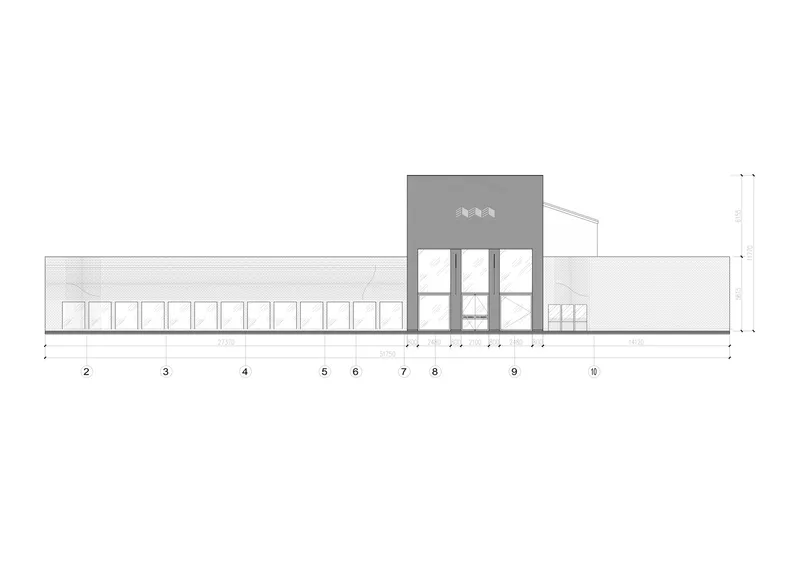
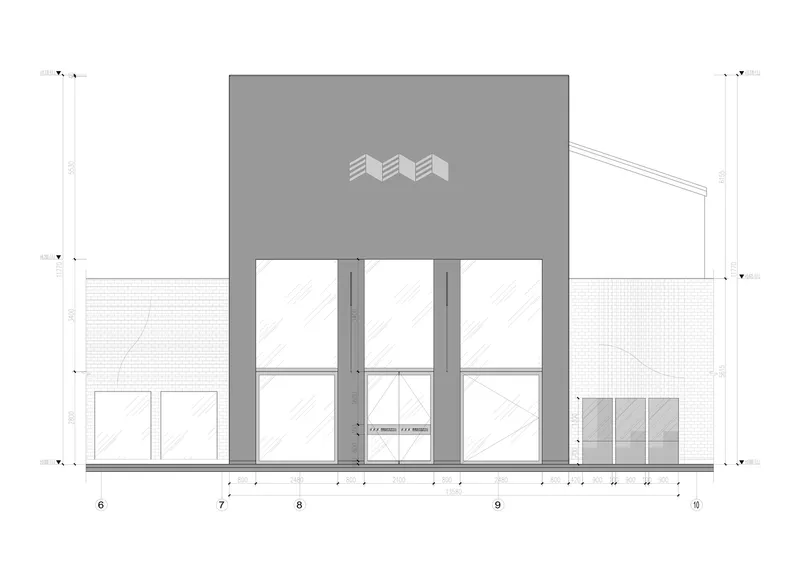
The elevations show the white entry volume rising above the long, low brick wings. The front elevation reads as a simple, powerful composition: three openings, white surface, wavy logo.
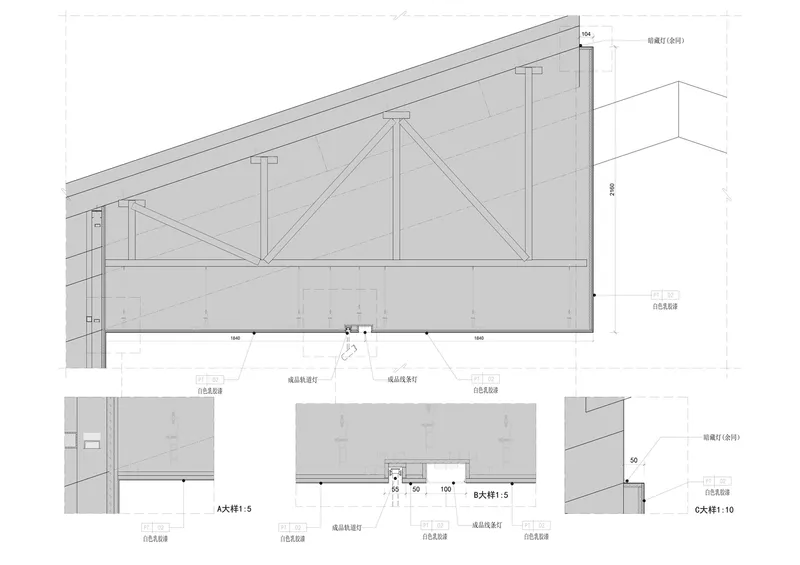
The skylight detail drawing shows the steel trusses, linear light fixtures, and ceiling panel connections that produce the even illumination throughout the galleries.
Why This Project Matters
Most 798 conversions celebrate the industrial shell. Hive Center erases it. That is a deliberate and defensible choice for a gallery of this scale: at 3,300 square meters, the building needs to compete with purpose-built institutions in Berlin, London, and New York, not with converted lofts in the same district. The white box, done well, remains the most effective format for displaying contemporary art. Penda China has done it well.
If you are designing a contemporary art gallery, a museum renovation, or any large-scale white-box exhibition space, this project is worth studying for how the skylight grid, the colonnade, and the clean circulation produce a space that is both monumental and neutral.
About the Studio
Share Your Own Work on uni.xyz
If you are working on gallery design, museum renovation, or exhibition architecture, uni.xyz is a place to publish your work and connect with a global design community.
Project credits: Hive Center for Contemporary Art by Penda China (Sun Dayong). Beijing, China. Photographs: Lin Dong, Xia Zhi.


Popular Articles
Popular articles from the community


LT2A and OPEN Architectes Thread a Brick and Glass High School Through a Wooded Belgian Campus
In Braine-l'Alleud, a 3,000 m² wing for Collège Cardinal Mercier pairs pale brick with a glazed colonnade, deferring to a small chapel and a dense wood.

Architekt Andreas Gruber Scatters 23 Dark Timber Chalets Across a South Tyrolean Forest Edge
In Molini di Tures, Amonti Chalets breaks a resort into a hamlet of gabled timber houses, with parking, storage and services pushed into the slope.

David Macias Steps a Doorless Stone and Plaster House Down a Tropical Colombian Hillside
In the humid hills of Colombia, Threshold House replaces the front door with an open void and terraces its 850 m² down the slope instead of fighting it.

U.GA Architects Wraps an Oval Rooftop Pool in Curved Board-Formed Concrete on Busan's Jeollidan-gil
In Busan's Jeonpo-dong, a 454 m² mixed-use block stacks a neighborhood facility, guest rooms and an oval rooftop pool inside spiraling concrete walls.

Similar Reads
You might also enjoy these articles


Hodi-Mandai Geram
Project Function: Preservation and revitalization of the Intangible heritage and socio-spatial identity of the Hodi by Housing, Cultural Memory Center, Sacred Grove, landscape, local tourism economy


Olio Towers: A Mid-Rise for Performers That Fuses Housing, Rehearsal, and Stage
Located blocks from Houston's Theater District, this modular tower stacks living units around a central performance atrium.

Oasis: Modular Green Housing Carved into Dhaka's Urban Fabric
A shortlisted Plugin Housing entry reclaims unauthorized settlements in Dhaka with stepped concrete volumes, green roofs, and ventilation-driven design.

Black Hole: A Floating Megastructure for the Post-Physical Era
Emiliano Mazzarotto envisions a spherical, self-scaling arena where e-sports, digital hotels, and holographic stadiums replace traditional public space.

Explore Architecture Competitions
Discover active competitions in this discipline

Challenge to reimagine the Iron Throne

Photograph architecture without architects

Illustrate the lost glory of Angkor Wat - Render Challenge

Design challenge to reuse E-waste
Comments (0)
Please login or sign up to add comments
No comments yet. Be the first to comment!