
Home-spice
A temporary home, it is in truth a home.

The design brief calls for a hospice architecture in California, which goes beyond function totouch the psychological well-being of terminally ill children. For most children patients and their families, the decision to go to hospice is significant as they let go of hospital physical treatments to live in a place that forges the children’s last experiences of life on earth. For this reason, we are emotionally moved by the topic, at the same time, comprehend the huge challenge and responsibility of the design.
At initial design brainstorming, we give ourselves the task of soul searching what constitutes ‘beauty’ in life. To us, beauty in life is experience that touches the heart. We crystallise this ‘beauty’ into two main areas that we strive to embed in our design: experience of companionship and experience of nature. These two experiences, contain psychological therapeutic qualities that can alleviate pain, create calmness and joy, which we see mostneeded for our children patients.
Inspiration and intent
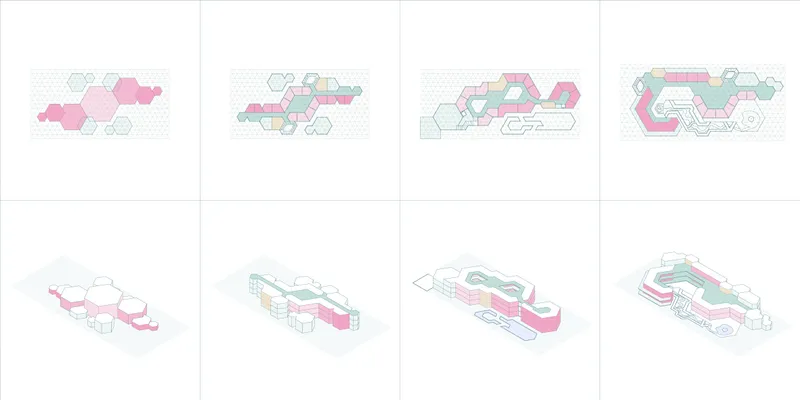
Nature is inspiring. This time, we are illuminated by bee honeycomb: the repeating and connecting hexagon shape, the void and the filled space, more importantly the sense of community relation in this mini-structure. We take this form inspiration and begin to test how it can be applied on a human-scale. Starting with superimposing a 2.5m triangle grid, we commence the development of our architectural design with hexagon in plan. The form iterated in parts and as a whole parallelly: through enlarging and shrinking, deforming and stretching, and joining and detaching of multiple hexagons, giving the optimal aesthetic, space and circulation in union with function.
Our final design develops along multiple strategies, firstly to enhance encounter and exchange in form of spacious communal areas while providing needed solitude. Secondly there is to be a spatial and functional link between these communal areas and children patients wards. Last but not least, we are to encapsulate landscape into architecture, and create an overlap between interior and exterior. All these should at the same time meet the functional needs of a hospice.
The design
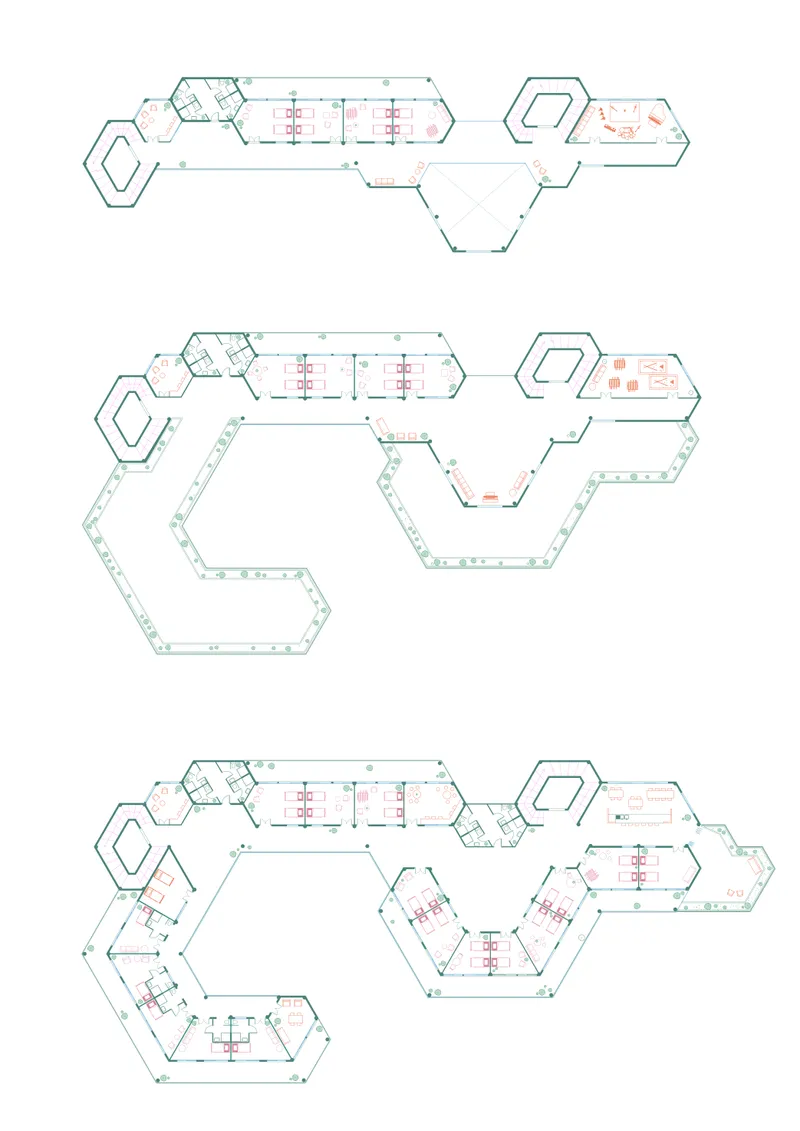
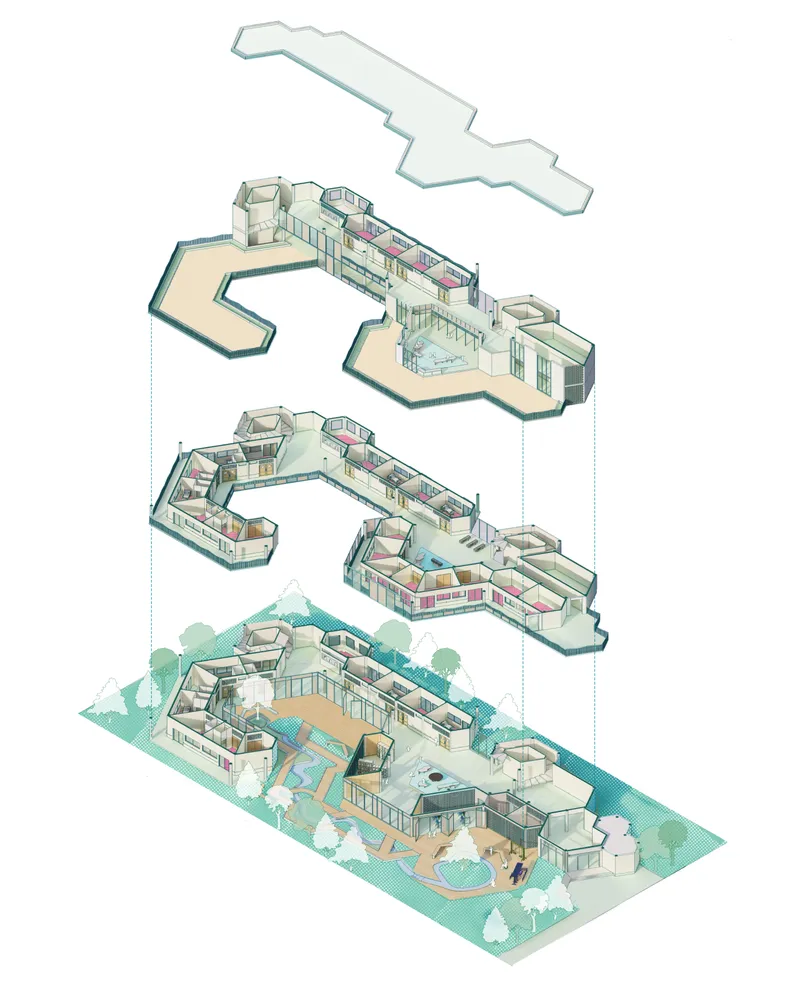
The wards are organised into three zones, separated yet linked together by a corridor and communal area that runs-along from street-facing entrance to far end. Each ward is provided with sheltered balcony, with view that opens to nature. Children patients are assigned to respective zones according to their health condition.
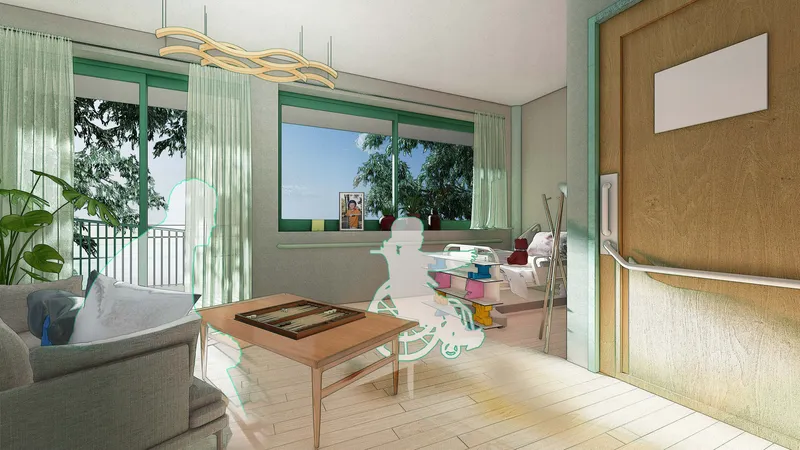
Zone 1 and 2 are shared wards to foster patient companionship for less critical children. Zone 3 is individual wards for most critical children patients, where most generous space is offered for constant stay of their family to share last moments with their child comfortably. The placement of Zone 3 in relation to the whole promises the most tranquil and quiet setting, being at the far end. The zoning strategy is coherent across four floors. Each floor is to have nurse and medical stations, distributed between zones that offers needed and immediate medical care. Dining areas, workshop spaces and consulting rooms are organised across four floors. All programs are arranged to have exposure to nature and natural lighting. Lift shafts and staircases are set in place in accordance to efficiency of accessibility with the overall plan circulation.
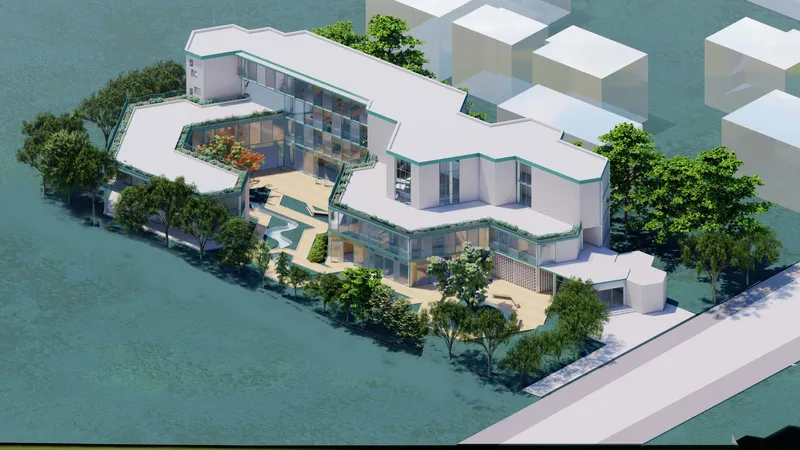
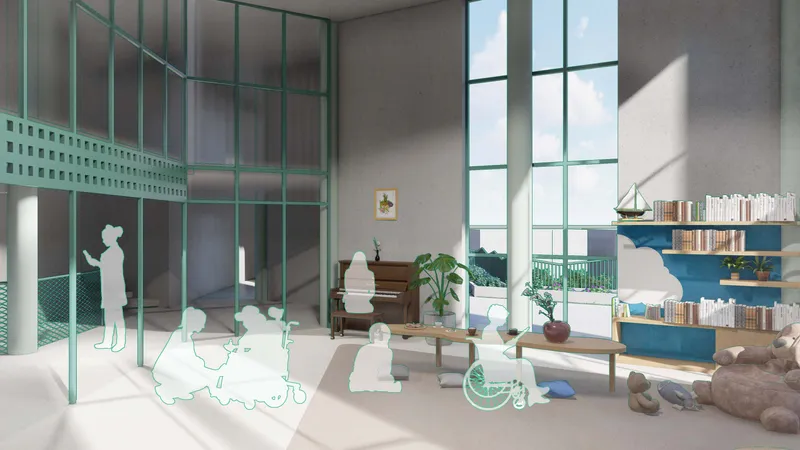
As a whole, the architecture ascends to the north. The varying heights give lightness to the form externally. Internally, ceiling height variation offers spatial and visual diversity. A two-storey atrium is provided in the third floor that overlooks a rooftop garden. The disposition of and relationship between the parts of the architecture is designed to maximise visual interaction among children patients and visitors engaging in activities happening all around.
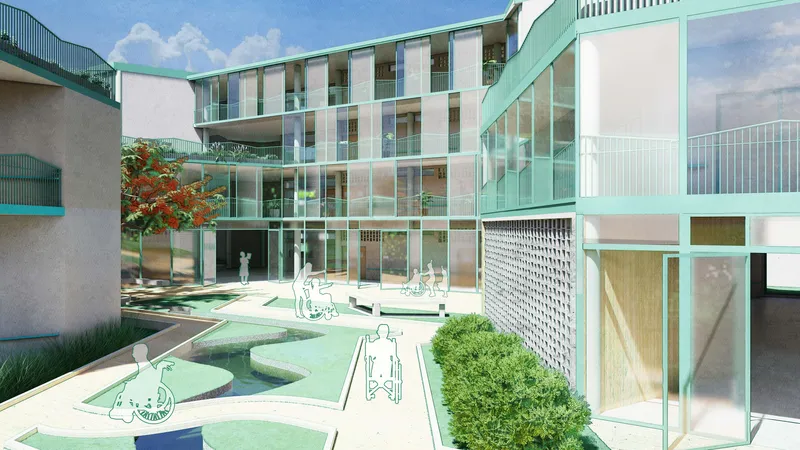
Nature-children interaction is our key intent, and our design is consistent to reflect such emphasis. In addtion to ward balconies, at ground level, the three ward zones interlock and wrap around to form a courtyard garden. The garden then flows physically to extend towards a larger landscape design where we incorporate a crucial nature element: water. Multiple openings to the entire big nature setting is created along the elongated corridor and communal area. Two spacious rooftop gardens are provided on the third floor, and one on the second floor in a more intimate scale.
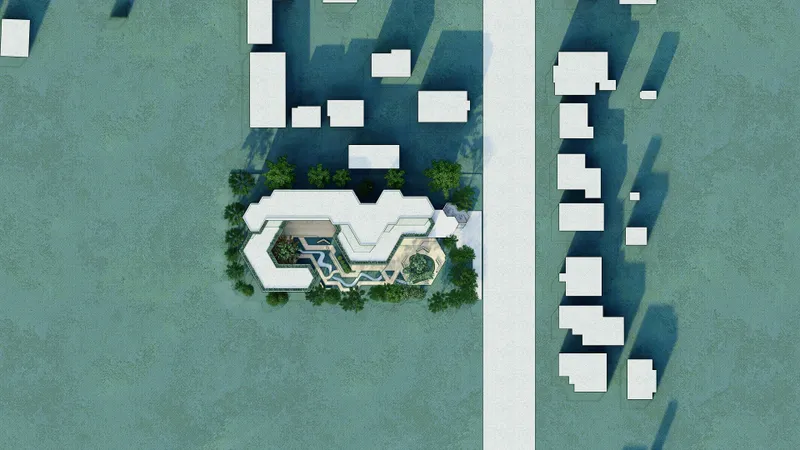
We design the relation between the hospice and the broader community outside with care. The site given to design is with a domestic ambience, surrounded by local houses and a public school nearby. The ground floor entrance to the hospice is set perpendicular to the public pedestrian and car road. It is setback and lined up with trees at both sides to form a soft boundary to the public and a warm guide to enter. We want to create children patients a place that they would conjure up associations with their own homes, at the same time a building that will coexist in harmony with the neighbourhood. We extracted architectural features from houses of the neighbourhood and broader California, hence the brick walls and gardens are translated to fit into the hospice. Moreover, soothing concrete design with a combination of wood floors and tiling, is to resonate the pleasant neighbourhood.
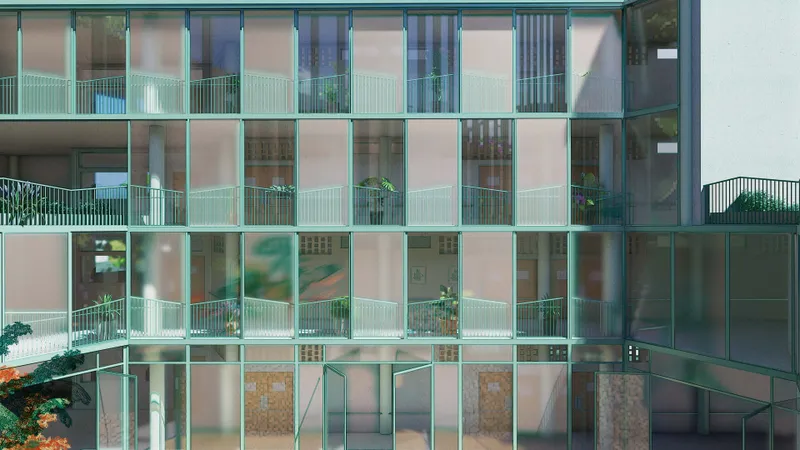
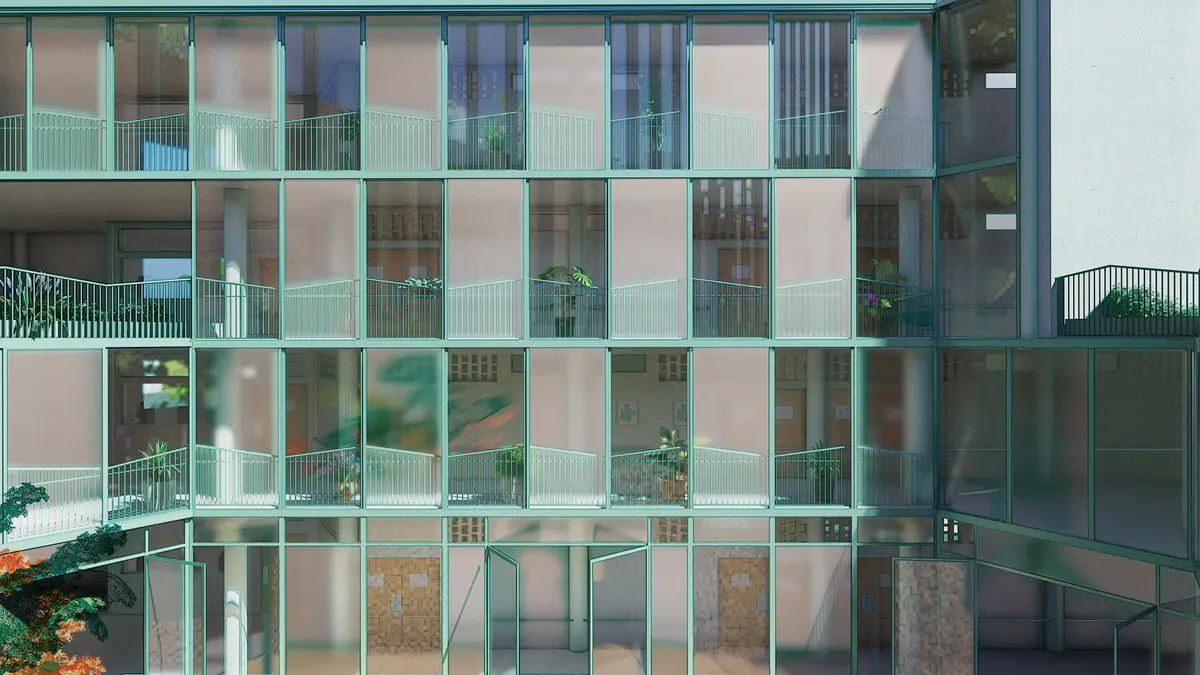
Façade-mounted sliding panels of matt glass help to shield rain and provide shade from direct sunlight. Easy to move, the panels are in constant use, open and close, by children patients, visitors and staffs, giving the buildings an ever-changing exterior appearance. We understand the importance of colour psychology, especially for children. Hence, the façade framing and column structures are of refreshing and soothing pastel green. Furthermore, the colour of seasonal change, from the summer chanting flowers to the yellow autumn leaves and more, are designed to be reflected upon the panel glass. The building façade is thus a painting canvas displaying the passage of time in nature. In our hospice design we try to create a temporary home, it is in truth a home, that one is able to find company from both man and nature. While our design focus is on children patients, we earnestly believe this companionship can be felt by visiting families as well. Our design is a place of final goodbye for the families, and of final destination for children patients. Even though the ending is inevitable and not a desire, one still can also embrace the beauty of life, and to be at every peace and comfort, with our hospice design.


Popular Articles
Popular articles from the community

Faces of the Soviet Avant-Garde: Turning Moscow's Street Names into an Open-Air Museum
A network of sculptural installations across a Moscow residential district transforms forgotten architect names into spatial encounters with cultural memor

The Amber Palace Opera: A Geological Fiction Surfaces on Tallinn's Baltic Waterfront
Pierre Brillard reimagines a Baltic legend as a public landscape, opera house, and waterfront promenade rooted in Tallinn's coastal identity.

Manzana Morphosis: Stretching Barcelona's Grid into a Living Landscape for 2050
A radical reworking of the Eixample manzana turns density into a tool for generous public space, vertical ecology, and environmental performance.
Temporary Home for Dogs: A Reversed Zoo Rethinks Animal Shelter Architecture
In Bucharest, a sinuous corridor and freed landscape flip the logic of containment, designing a shelter that works to make itself unnecessary.

Similar Reads
You might also enjoy these articles

The Rhythm of Seasons
A Farmers' Market Connecting Nature and the City


More Than a Building-Designing a Living System
More Than a Building-Designing a Living System
Base Beyond
DESERT COMPOUND ARID: TOURISM OF ABSENCE AND ABUNDANCE

Comments (0)
Please login or sign up to add comments
No comments yet. Be the first to comment!