
HOOD
YOUNG VOLUNTEERS COMMUNITY

Main concept
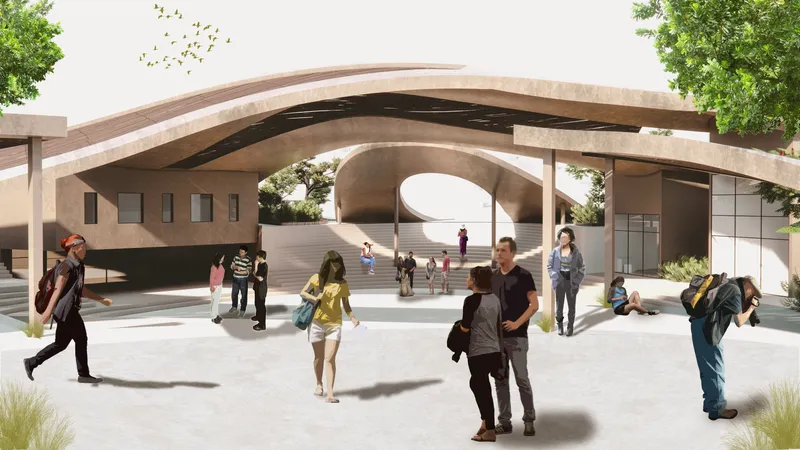
According to the surveys conducted on the project site, it has been determined that there are visual and cultural differences among the neighboring communities. The site's location is such that it can effectively bridge this gap, diminish the differences, and promote greater interaction among the residents. Therefore, we have endeavored to design a center that, by finding suitable solutions, eliminates cultural boundaries and differences, provides voluntary services, and creates conditions for community gatherings in order to enhance the quality of life for the neighborhood residents
How does the design blur the physical and cultural boundaries between the two neighborhoods?
To achieve this, two main axes have been considered for the project, which play an effective role in inviting residents from the opposite sides of the site. At the intersection of these two axes, a social center has been designed where people can hold their cultural events and celebrations. It's as if these two axes accompany the residents, guide them into the project, and ultimately connect them at the central point despite all their differences.


What functions have been considered in the project?
In the project, enclosed and semi-open classrooms have been designed for holding various courses, counseling rooms, halls and temporary accommodation rooms for foreign volunteers and local residents, product stalls for neighborhood residents, and a social center for hosting various events and celebrations. However, it should be noted that the spaces have been designed flexibly and have the potential to change their use based on existing needs.

How does the design respond to the existing topography?
In this project, we tried to design the Hood Center inspired by the topography in a way that it sits well within the heart of the site. To achieve this, we considered the southern masses almost level with the street, designed the social center at the lowest point of the topography, planned the northwest entrance axis on the topography, and also connected the northern shells to street level.

Consideration of the site's climate in the design process
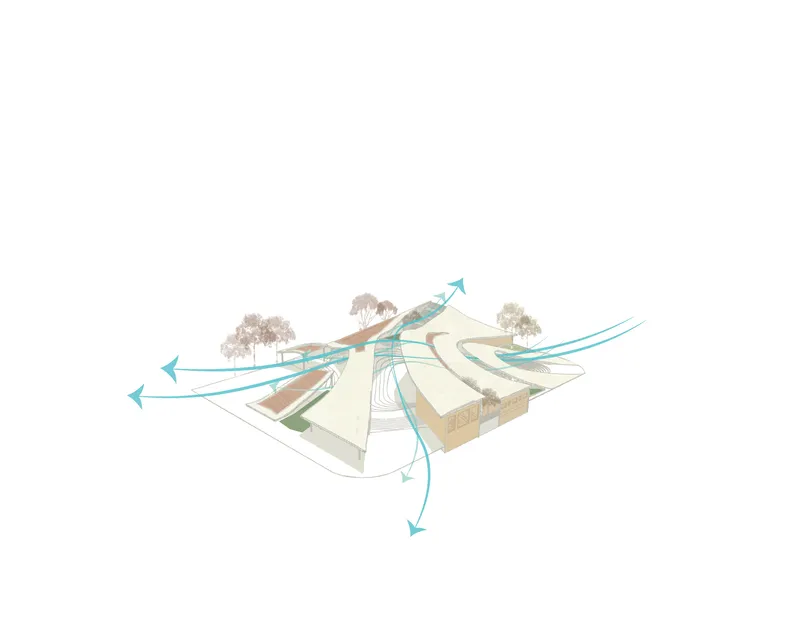
Given that the city is located on the coast and experiences high humidity, the ribbon-like form of the shells, along with the gaps and openings between them, effectively directs airflow into the center and allows for natural ventilation.
Additionally, we made an effort to select the most suitable materials considering the climate. Therefore, we used concrete for the shells and masses, which has good resistance to moisture, and for the shading elements, we utilized wooden reeds as they are readily available in this area.

Popular Articles
Popular articles from the community


David Macias Steps a Doorless Stone and Plaster House Down a Tropical Colombian Hillside
In the humid hills of Colombia, Threshold House replaces the front door with an open void and terraces its 850 m² down the slope instead of fighting it.

Juan García Correa, John González and Claudia Rueda Sink a Circular Amphitheater into a Manizales Engineering Building
On the La Nubia campus in Manizales, Colombia, the S1 Building folds labs and offices into a hillside of ramped lawns that double as a campus route.

U.GA Architects Wraps an Oval Rooftop Pool in Curved Board-Formed Concrete on Busan's Jeollidan-gil
In Busan's Jeonpo-dong, a 454 m² mixed-use block stacks a neighborhood facility, guest rooms and an oval rooftop pool inside spiraling concrete walls.

Architekt Andreas Gruber Scatters 23 Dark Timber Chalets Across a South Tyrolean Forest Edge
In Molini di Tures, Amonti Chalets breaks a resort into a hamlet of gabled timber houses, with parking, storage and services pushed into the slope.

Similar Reads
You might also enjoy these articles


Vereda Arquitetos Renovates a 40-Square-Meter Apartment Inside Niemeyer's Copan Building
A compact unit in São Paulo's most iconic residential tower gets a material overhaul that pairs exposed concrete with bold blue Formica.

Shakur's House: Exposed Brick as an Interior Organiser in a 168 m² Mashhad Residence
Brick moves indoors in this Mashhad residence, where masonry walls, glass partitions and teal planes sequence a compact home without closing it off.

Day and Night Park: A Time-Based Urban Newsstand in Beijing
A temporary urban newsstand in Beijing blending travel, light, and reading through poetic colors, compact form, and community-focused design.

Modernist Patio Renovation in El Masnou, Barcelona by Oliver Segura Arquitectura + Cebrià Arquitectura
Modernist patio renovation blending tradition and innovation with a movable pool, leveled floors, and Catalan materials in El Masnou.

Explore Community Architecture Competitions
Discover active competitions in this discipline


Challenge to reimagine the Iron Throne

Photograph architecture without architects

Illustrate the lost glory of Angkor Wat - Render Challenge

Design challenge to reuse E-waste
Comments (0)
Please login or sign up to add comments
No comments yet. Be the first to comment!