
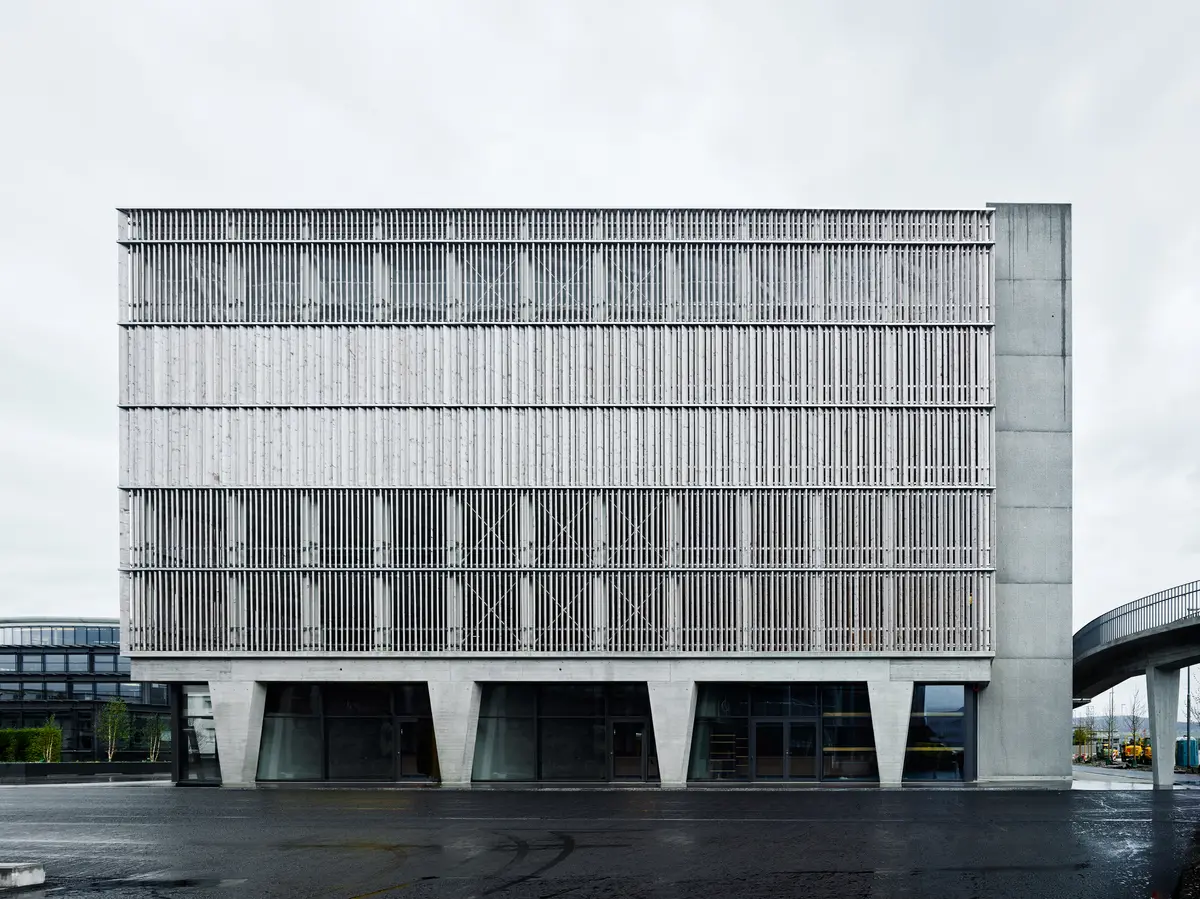
Hosoya Schaefer Architects Build a Timber-Clad Mobility Hub as Zug's Gateway to a Smart City District
A parking structure, retail hub, and pedestrian bridge in Zug, Switzerland, designed to evolve alongside autonomous vehicle technology.


The parking garage is perhaps the hardest building type to elevate. It is infrastructure by definition, a box for cars, a necessary piece of civic plumbing that cities tolerate rather than celebrate. Hosoya Schaefer Architects understood this when they took on the Mobility Hub Zug Nord, and their response is neither denial nor disguise. The 17,000 square meter structure sits at the threshold of TechCluster Zug, a former V-Zug factory site being remade into an urban innovation district. It had to be a parking structure, yes, but it also had to be the front door to a new neighborhood, a transfer point between motorway, bus, bike, and eventually autonomous shuttles, and a piece of public life in its own right.
What makes this project genuinely interesting is the way it anticipates its own obsolescence. Hosoya Schaefer, who have overseen the broader masterplan since 2013, designed the hub to accommodate a future in which privately driven cars give way to autonomously parking vehicles. The column-free parking floors, the spiraling ramps, the V-shaped steel supports: all of it is conceived as a framework that can be repurposed. The building is not pretending to be timeless. It is designed to be useful now and adaptable later, which may be a more honest kind of permanence.
A Lamella Facade That Breathes and Shifts
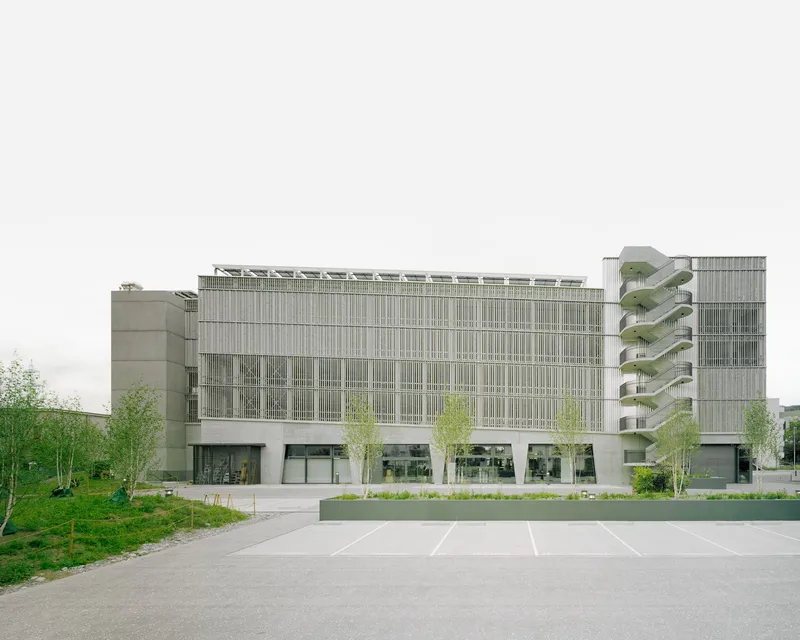
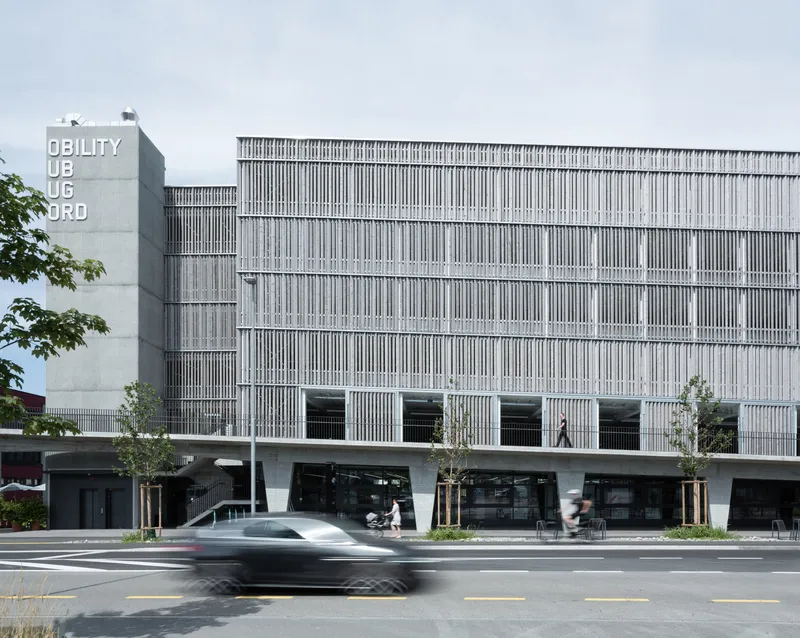
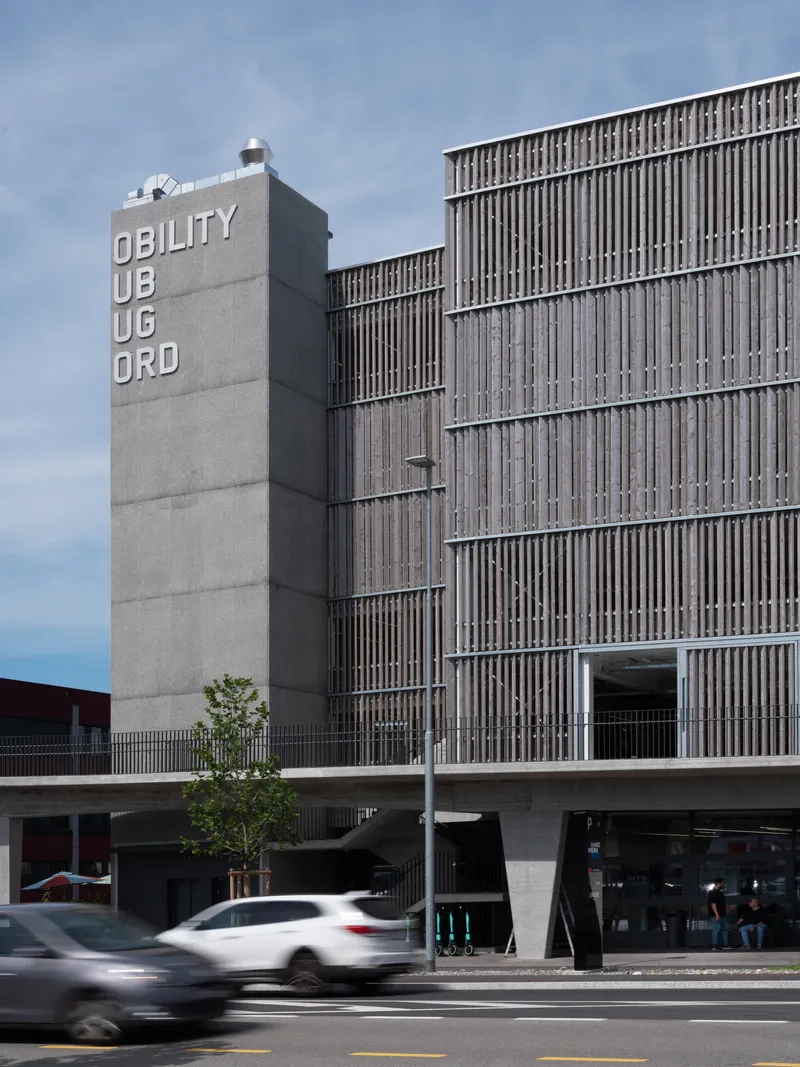
The building's most immediately striking element is its wooden lamella cladding, which wraps the upper levels in a screen that shifts between opaque and transparent depending on the angle of view. The lamellas are assembled from alternating narrow and wide slats, divided per floor and oriented differently at each level. Walk past the building and it seems to inhale and exhale, revealing the cars behind it in one moment and closing into a warm, rhythmic surface the next. It is glare protection, privacy screen, and architectural identity all at once.
At the ground floor, canted concrete columns replace the timber screen, giving the base a muscular openness that distinguishes public and commercial space from the parking levels above. The contrast is deliberate: the concrete reads as civic and grounded, while the timber is lighter, almost textile. It is a straightforward hierarchy, but it works because it is consistent.
The Pedestrian Bridge as Urban Connector

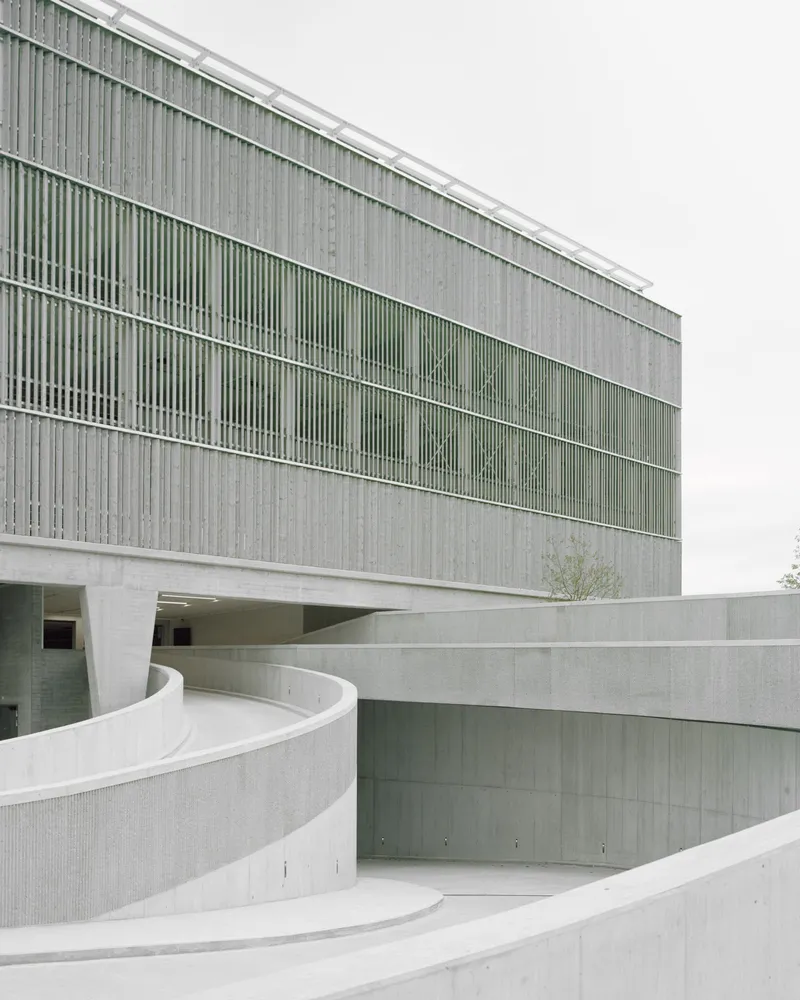
A curved pedestrian bridge arcs across the roadway, linking the mobility hub directly to the TechCluster district beyond. This is a critical gesture. Without it, the building would be a parking garage next to a highway bypass. With it, the hub becomes an actual threshold, channeling pedestrians from one district into another without requiring them to navigate traffic. The bridge's swing is echoed in the interior ramps, creating a continuous spatial language that ties infrastructure to architecture.
The canopy beneath the bridge extends over a landscaped bed of grasses and birch trees, softening what could have been a bleak transitional zone. It is a small move, but it signals that the ground plane has been thought through as carefully as the structure above it.
Structure as Performance
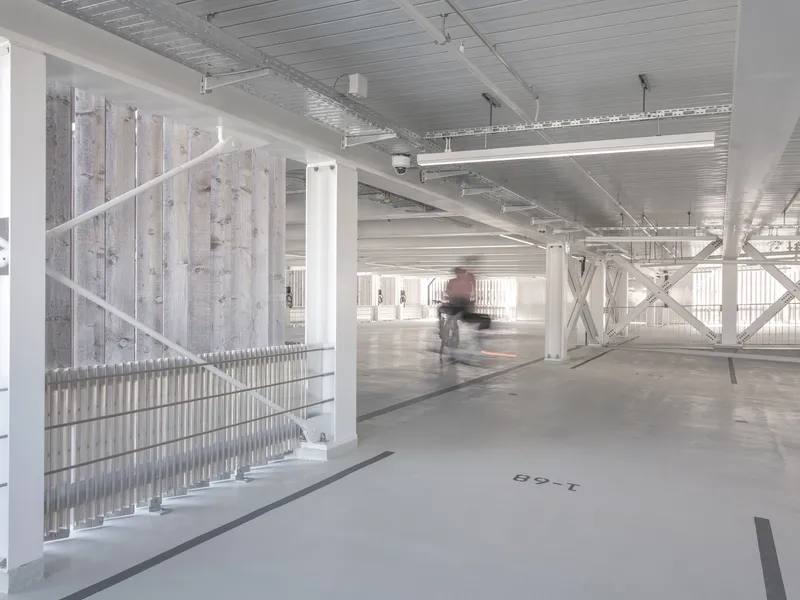
Inside, the parking levels reveal their structural logic without fuss. V-shaped supports carry loads to a surrounding beam, eliminating interior columns and giving each floor a remarkably open feel for a garage. White steel bracing and an exposed metal ceiling keep the palette industrial and legible. A cyclist passes through in a blur, which is exactly the point: this is not just for cars. Bikes, scooters, and pedestrians share the space as a matter of design philosophy, not afterthought.
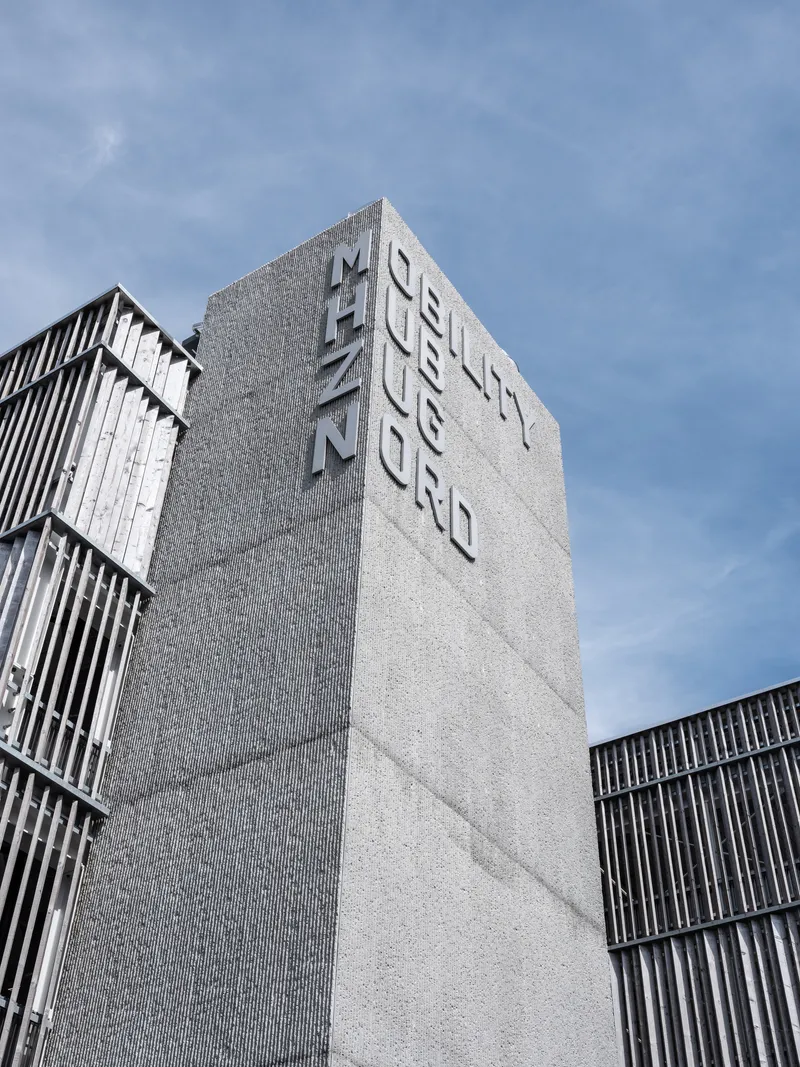
The concrete signage tower, with its raised letterforms cast directly into the textured surface, is a quiet detail worth noting. Typography and pictograms are applied to vertical and horizontal surfaces throughout the building, eliminating the need for applied signage panels. The information is literally built into the architecture. It is a small decision that reinforces the building's commitment to durability over decoration.
Landscape and Ground Plane
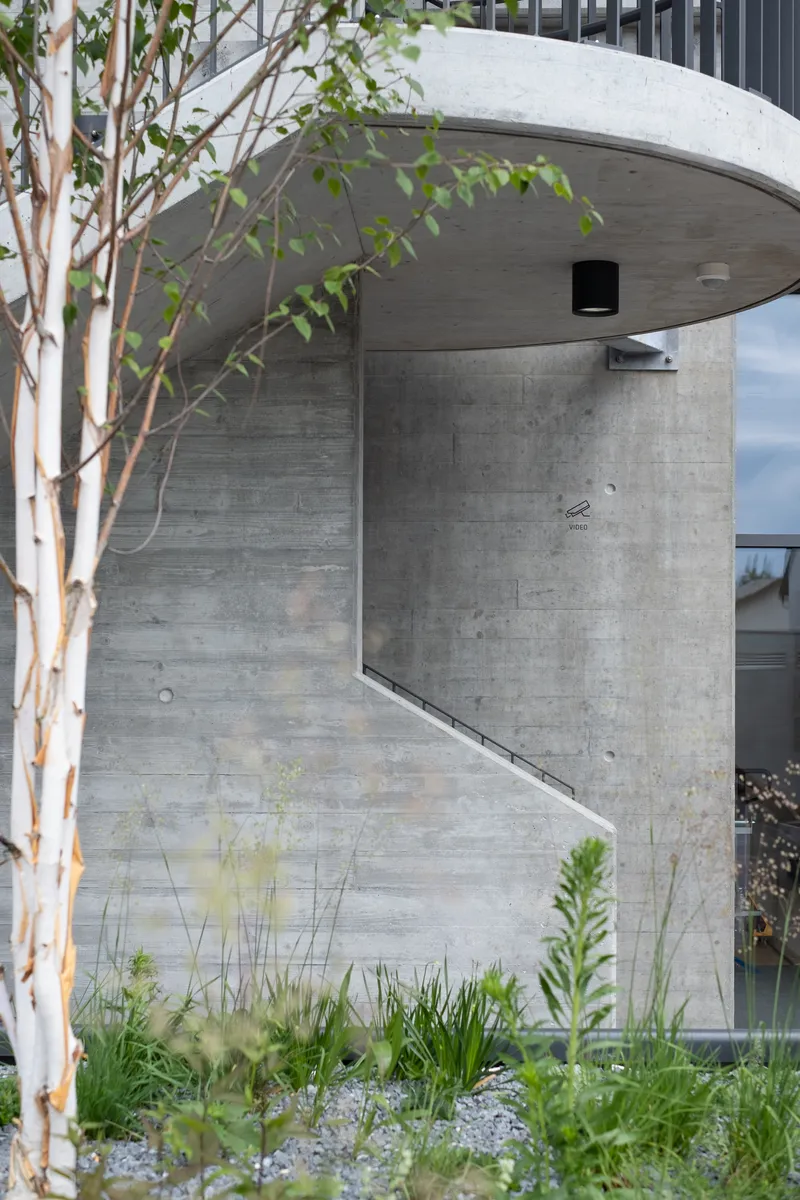
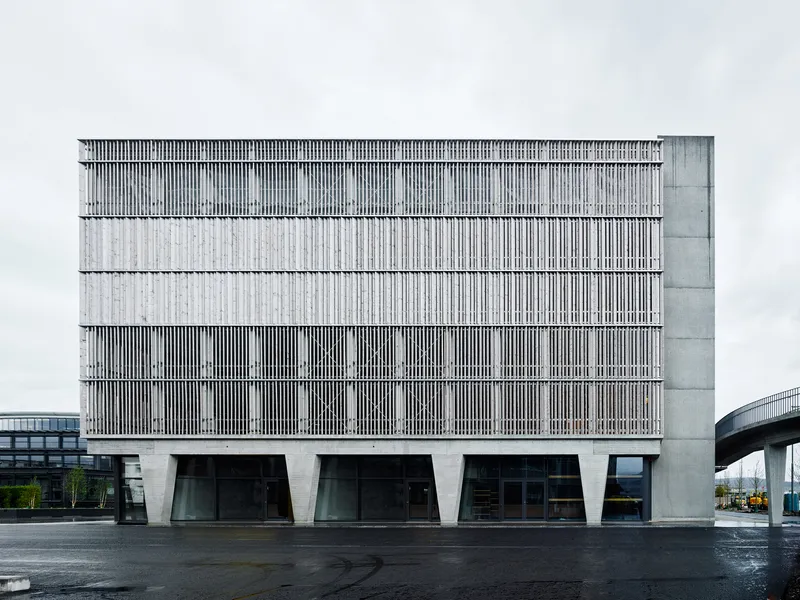
The site strategy wraps the building in a young birch grove and planted beds that will mature over time, gradually integrating the structure into a greener streetscape. The curved concrete canopy at ground level shelters the planting while framing the approach to the building. After rainfall, the concrete takes on a deeper tone that plays well against the pale timber above. It is not a landscape-forward project, but the planting is purposeful and positioned to mediate between the scale of the building and the pedestrian experience at its base.
Energy and Future-Proofing
A photovoltaic pergola crowns the structure, and the building connects to the area's district energy network. These are not headline-grabbing sustainability gestures, but they are the right ones for a building whose primary function is to store cars. The real sustainability argument, though, is spatial: the column-free floors and spiraling ramps are designed so that future autonomous vehicles can park more efficiently, increasing capacity without increasing the building's footprint. If those vehicles arrive, the hub adapts. If they don't, the floors remain flexible enough for other uses.
Hosoya Schaefer are essentially making a bet that infrastructure can be designed with enough generosity to survive technological shifts. It is a bet that more architects should be willing to make.
Plans and Drawings
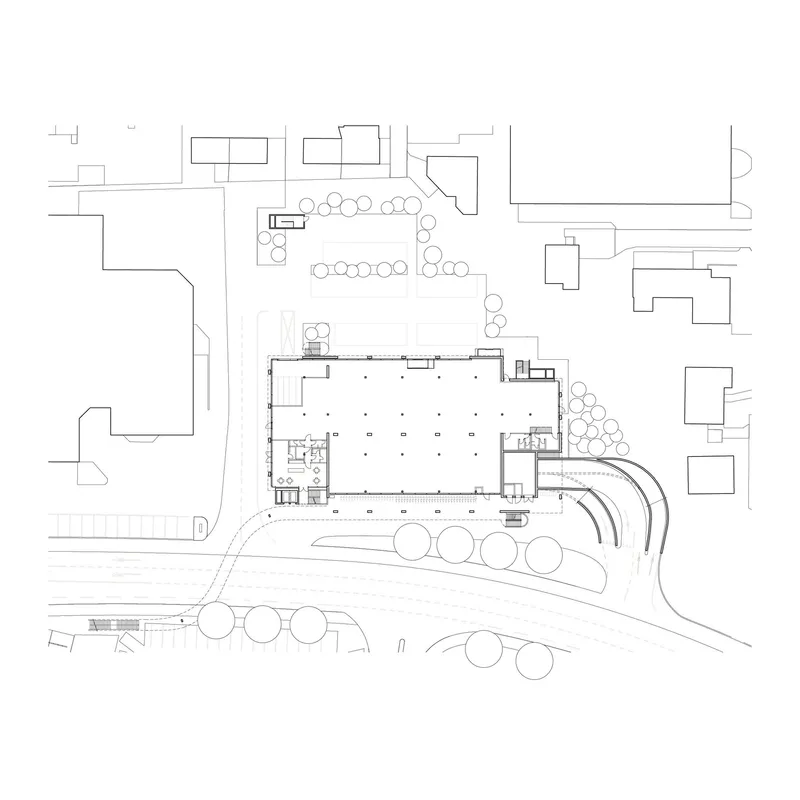
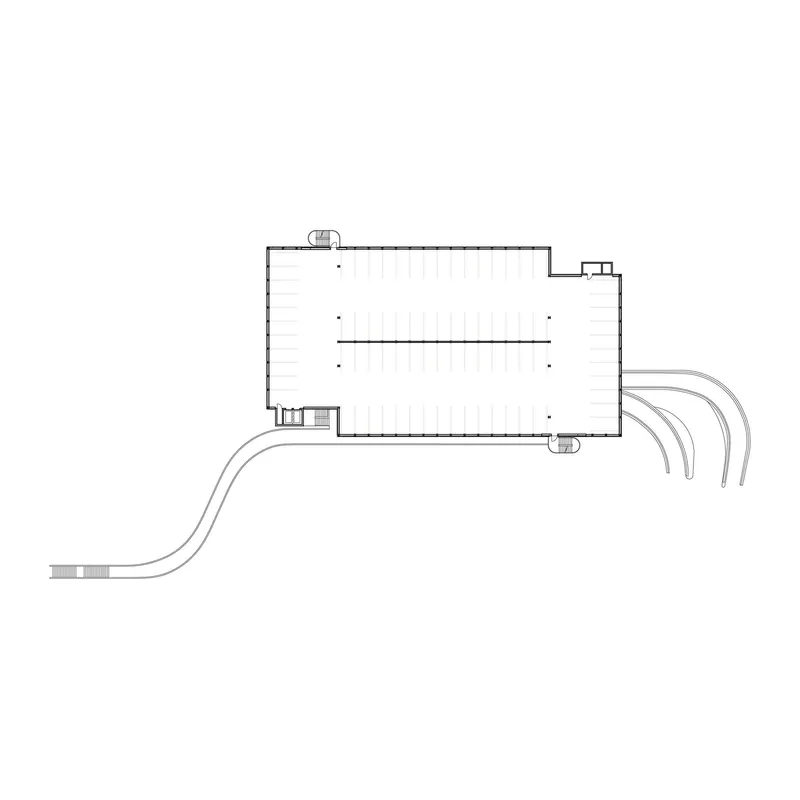
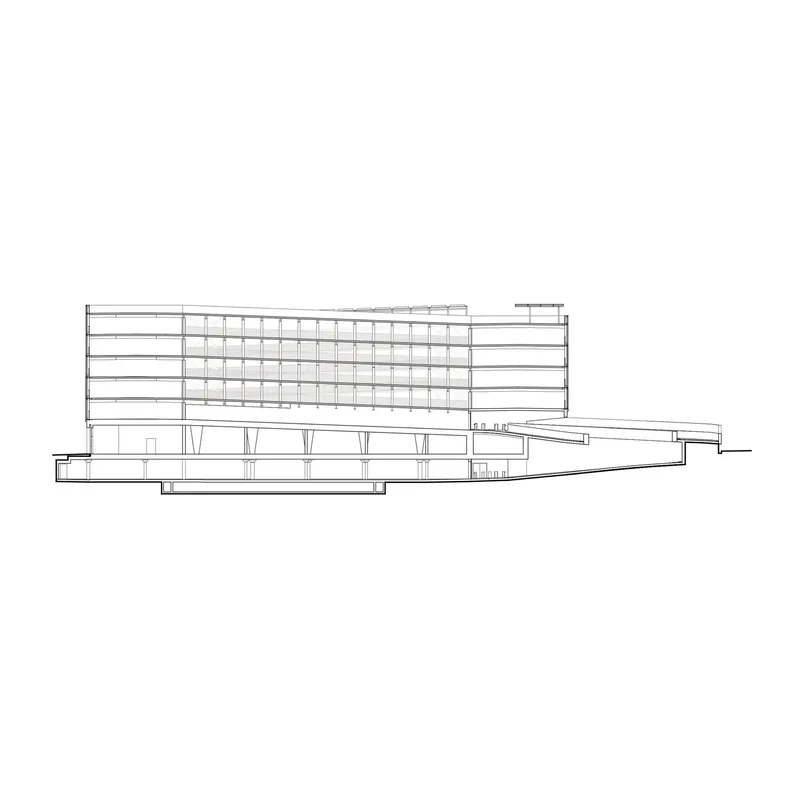
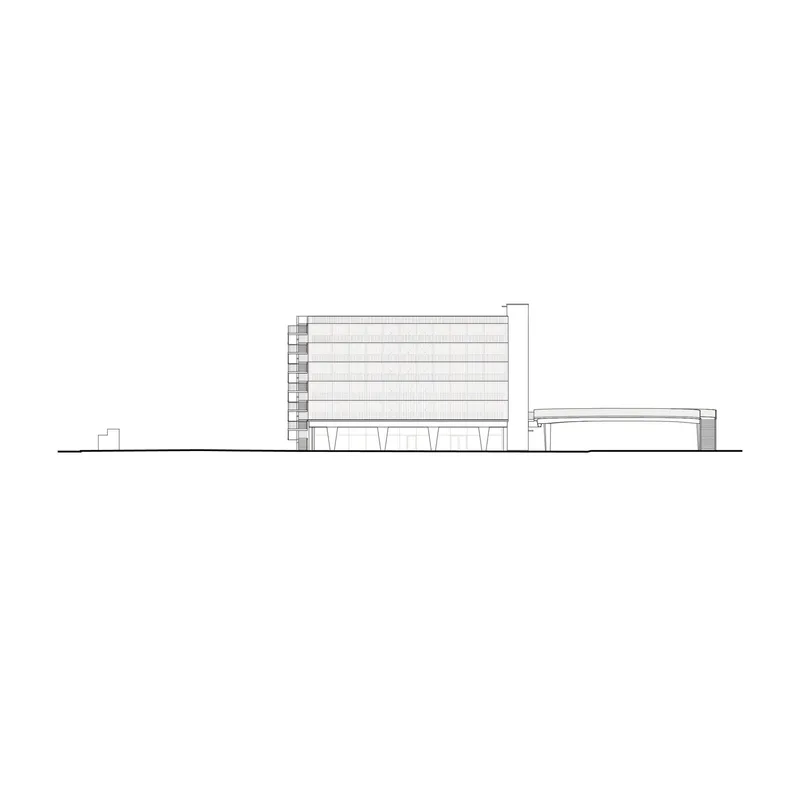
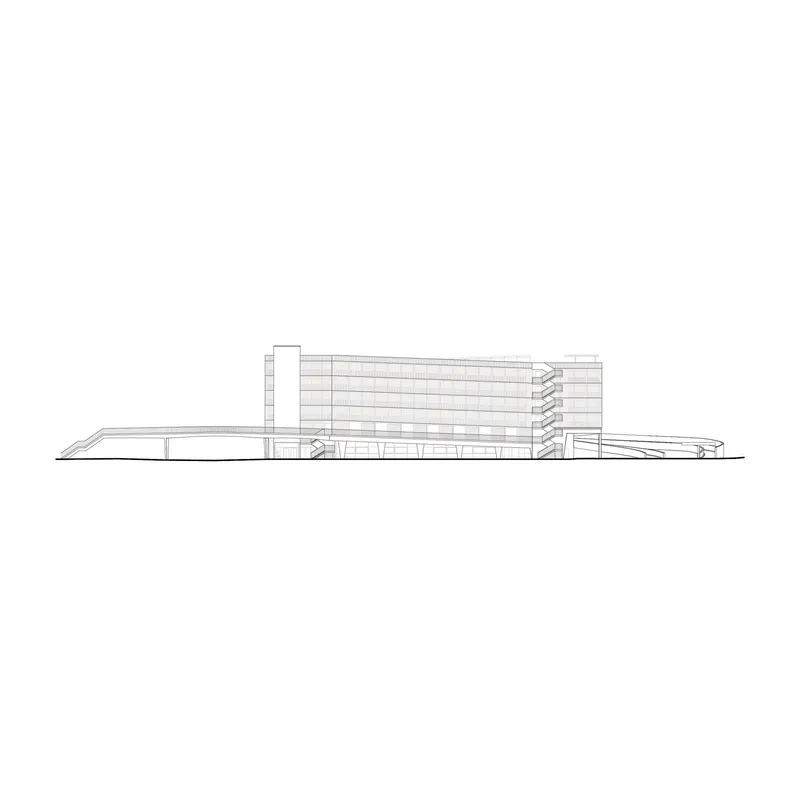
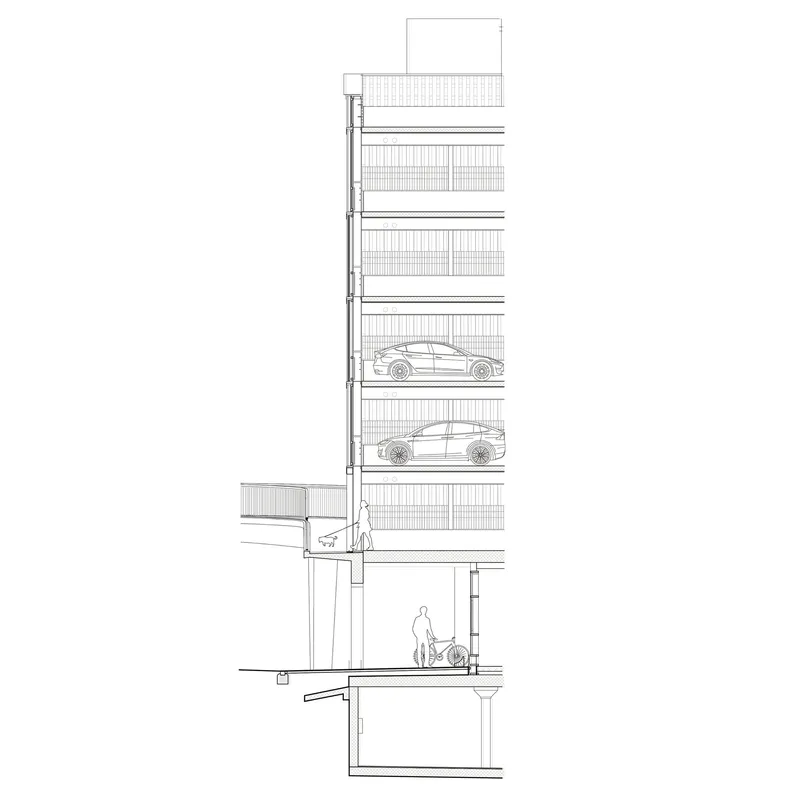
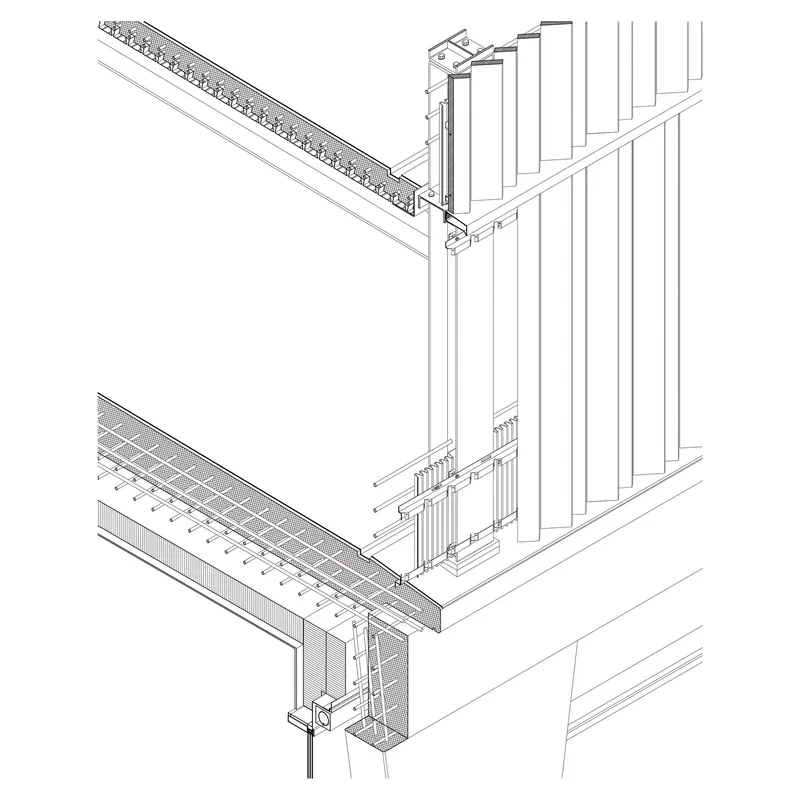
The site plan reveals how the building sits at the intersection of motorway access and the pedestrian approach to TechCluster Zug, framed by street trees and adjacent structures. Floor plans show the curving ramps tucked into a corner of the rectangular volume, keeping the parking floors unobstructed. Sections cut through the full height of the building and expose the relationship between the parking levels, the angled supports, and the ground floor commercial spaces. The elevation drawings make the layered horizontality of the facade legible, with cantilevered floor plates and the low-slung adjacent pavilion reading as distinct but related elements. An axonometric detail of the structural corner assembly confirms the care taken at the joint between steel beam and column, a moment where engineering discipline becomes architectural expression.
Why This Project Matters
Mobility Hub Zug Nord matters because it refuses the false modesty that usually accompanies parking structures. Hosoya Schaefer did not hide the program behind a pretty skin; they integrated it into a larger urban strategy that treats the car park as a legitimate civic building. The result is a structure that contributes to the streetscape, serves multiple modes of transport, and connects two parts of the city that would otherwise be separated by traffic.
More importantly, it is a building that takes the near future seriously without succumbing to techno-utopianism. The flexibility built into its floors, the multimodal transfer options, the energy infrastructure: all of these acknowledge that the way we move through cities is changing, and that the buildings we build for mobility today need to survive those changes. In a discipline often torn between permanence and spectacle, this project offers something rarer: intelligent contingency.
Mobility Hub Zug Nord by Hosoya Schaefer Architects (lead architects Markus Schaefer and Hiromi Hosoya), Zug, Switzerland. 17,000 m², completed 2022. Photography by Rasmus Norlander and Valentine Jeck.
About the Studio
Share Your Own Work on uni.xyz
If projects like this are the kind of work you want to make, uni.xyz is a place to publish your own, find collaborators, and enter design competitions.


Popular Articles
Popular articles from the community

Temporary Home for Dogs: A Reversed Zoo Rethinks Animal Shelter Architecture
In Bucharest, a sinuous corridor and freed landscape flip the logic of containment, designing a shelter that works to make itself unnecessary.
Faces of the Soviet Avant-Garde: Turning Moscow's Street Names into an Open-Air Museum
A network of sculptural installations across a Moscow residential district transforms forgotten architect names into spatial encounters with cultural memor

Tsunami Convergenics: Turning Catastrophic Ocean Forces into Underwater Housing Infrastructure
A speculative underwater settlement off the coast of Onagawa, Japan, treats tsunamis and typhoons as energy sources rather than threats.

Extended Shell: Retrofitting Kolkata's Balconies as Living Urban Thresholds
A modular retrofit system recovers the social and environmental intelligence of Kolkata's historic verandas for contemporary Park Street residents.

Similar Reads
You might also enjoy these articles

Pixel Gardens: One Repeated Module Stacked Into a Terraced Social Housing Tower for Famagusta
Salem Bader's shortlisted housing tower builds a vertical neighbourhood from one repeated module, offsetting units to carve terraces, light and air.

Bao Huynh Watercolor Atelier: A Serene Art Retreat in Hội An
Bao Huynh Watercolor Atelier in Hội An blends multifunctional art spaces, sustainable design, local materials, and family-friendly living in a serene environment.

Atelier Macri Concept Store Interior Design by CASE-REAL
Atelier Macri store features a "ko" counter, walnut wood details, cork displays, blending retail, gallery, and seamless customer experiences.

Manuel Vargas Izquierdo Stadium and High-Performance Sports Center: Architectural Excellence in Jalpa de Méndez
The Manuel Vargas Izquierdo Stadium blends sustainable design, inclusive sports facilities, and cultural-inspired architecture, revitalizing Jalpa de Méndez’s public spaces.

Comments (0)
Please login or sign up to add comments
No comments yet. Be the first to comment!