

House 258 by Cornetta Arquitetura: A Dialogue Between Forest, Valley, and Light
House 258 by Cornetta Arquitetura harmonizes concrete and wood on a sloped site, blending forest serenity with panoramic valley views.


Context and Concept
Nestled in the lush landscapes of São Roque, Brazil, House 258 by Cornetta Arquitetura embodies a thoughtful response to topography and nature. Designed by Pedro Cornetta, the residence occupies a steeply sloped lot, where the architectural gesture arises from a principle of sensitive integration with the site. Instead of dominating the terrain, the project adapts to it — preserving the existing grove and allowing the house to merge seamlessly with its surroundings.
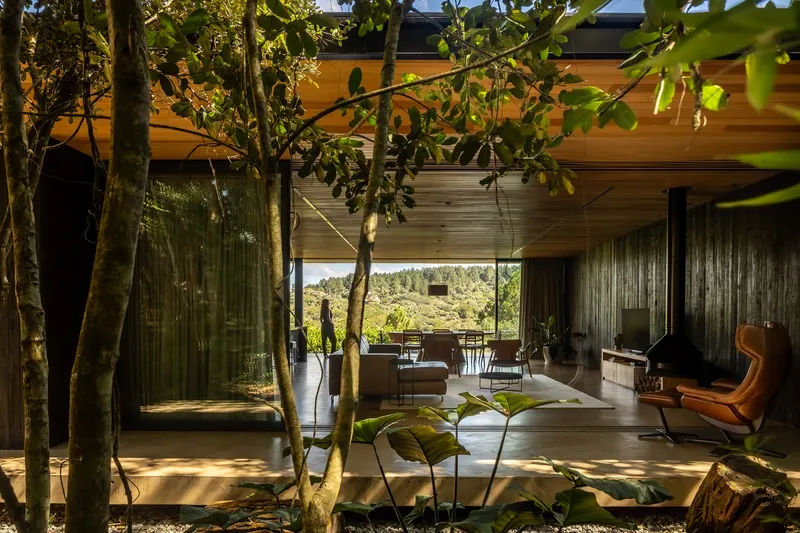
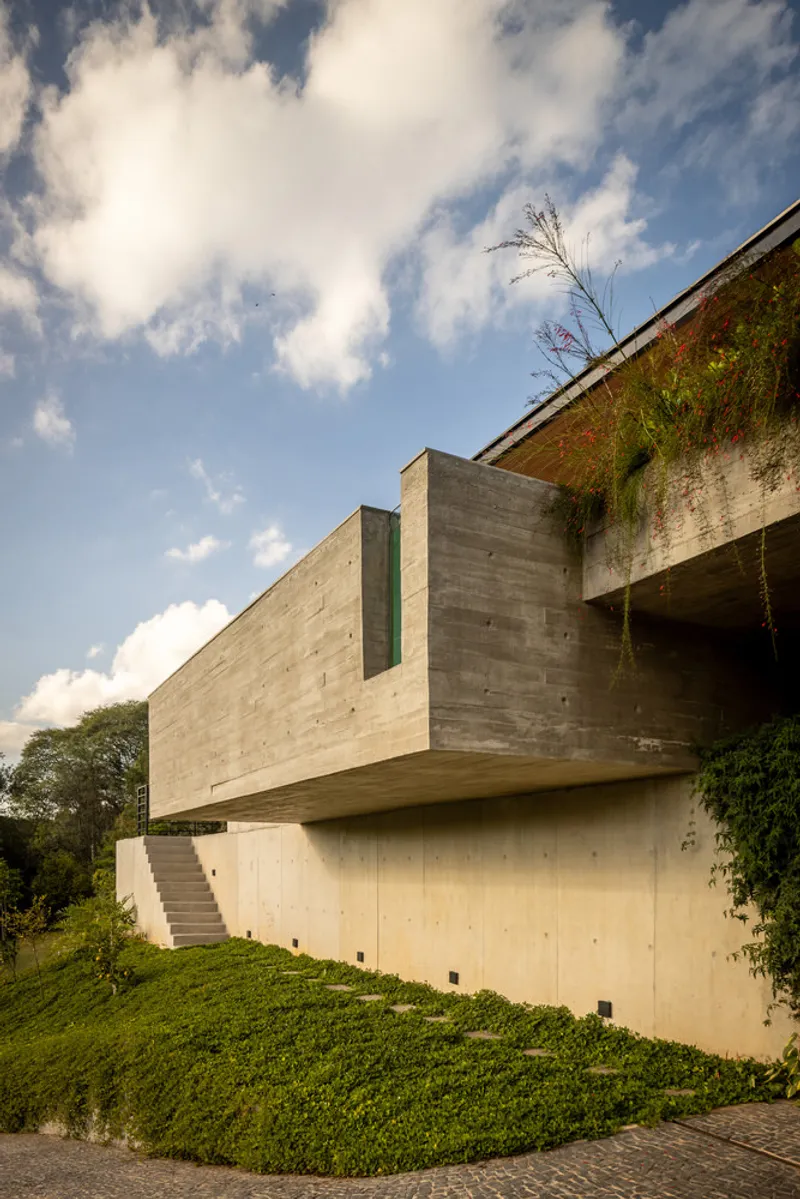
The architectural language of House 258 establishes a dialogue between opposites: light and shadow, forest and valley, weight and lightness. From one perspective, the house opens toward the sunset and vast valley views, its facade glowing with the warm tones of concrete at dusk. From another, it quietly dissolves into the shaded calm of the forest, where filtered sunlight softly illuminates the wooden interior spaces.

Materiality and Structure
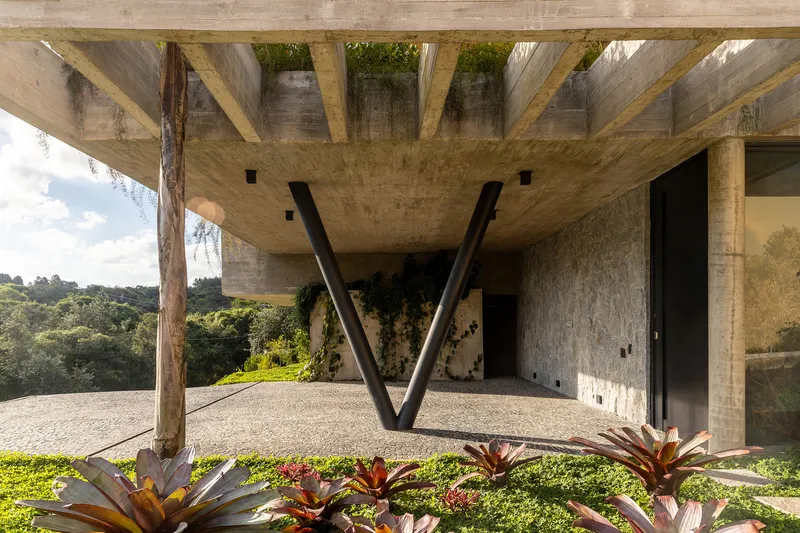
The 515 m² residence is structured in two distinct layers that reflect both function and material contrast. The lower level, visible only from the front elevation, anchors the house with a foundation of exposed concrete and split stone. This solid base accommodates the garage and service areas while functioning as a retaining wall that stabilizes the steep terrain.
Above, the upper pavilion rests lightly upon this base, crafted from metal and wood — a deliberate contrast to the heaviness below. This structural duality embodies the project’s conceptual balance: the grounding permanence of stone and concrete meets the ethereal openness of timber and glass.
Spatial Organization
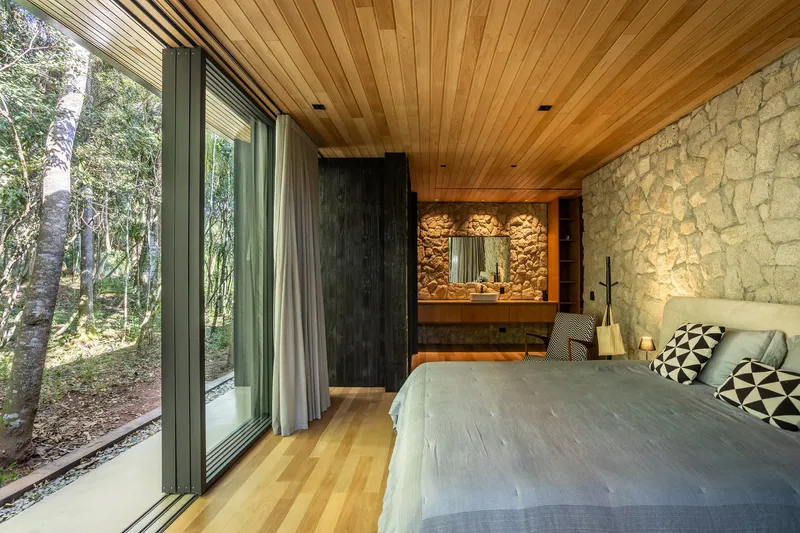
Access to the house is choreographed through a staircase of concrete and glass, leading from the terrain up to the main level. The plan is organized within a rectangular volume, divided by charred pine panels that create a tactile and visual partition between public and private zones.

On one side lies the private wing, composed of three suites and an office. Here, the interiors open toward the dense, shaded forest, offering a sense of intimacy, retreat, and quiet reflection. The choice of natural materials — wood, glass, and blackened pine — enhances the atmosphere of warmth and privacy.
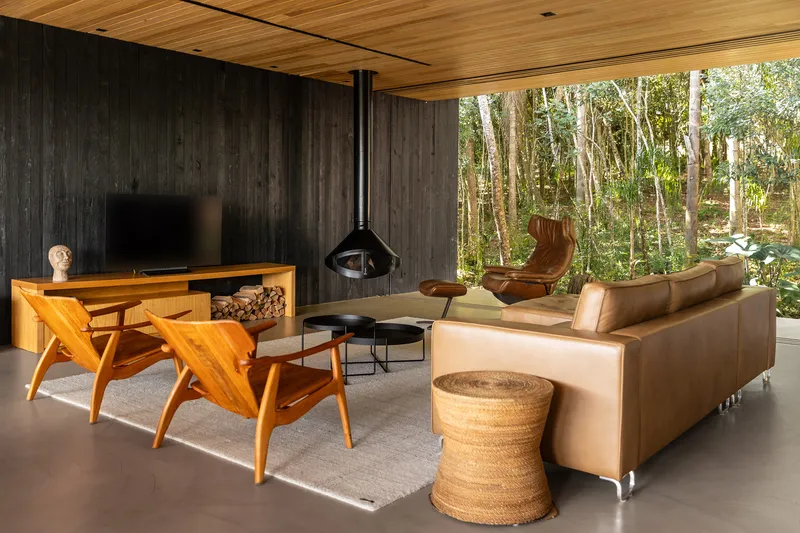
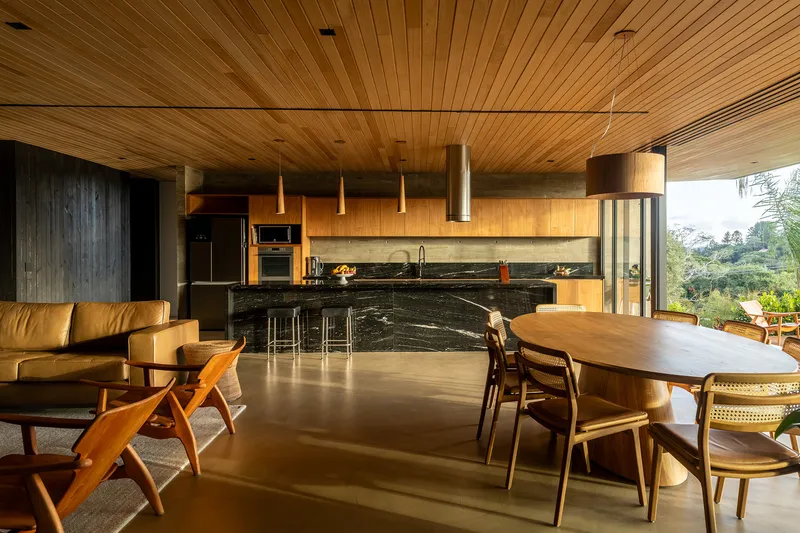
On the opposite side, the social spaces — including the living room, dining area, and integrated kitchen — open fully toward the valley and sunset. Large floor-to-ceiling openings invite light deep into the interior, dissolving the boundaries between inside and outside. The panoramic views transform throughout the day, bathing the house in the shifting hues of natural light.
Light, Atmosphere, and Landscape Integration
More than a residence, House 258 is an architectural meditation on light and landscape. The project captures the duality of Brazilian nature — lush, humid, and full of contrasts — through its careful orchestration of material texture and illumination. The concrete base absorbs heat and shadow, while the wooden pavilion above glows with the soft amber of evening sun.
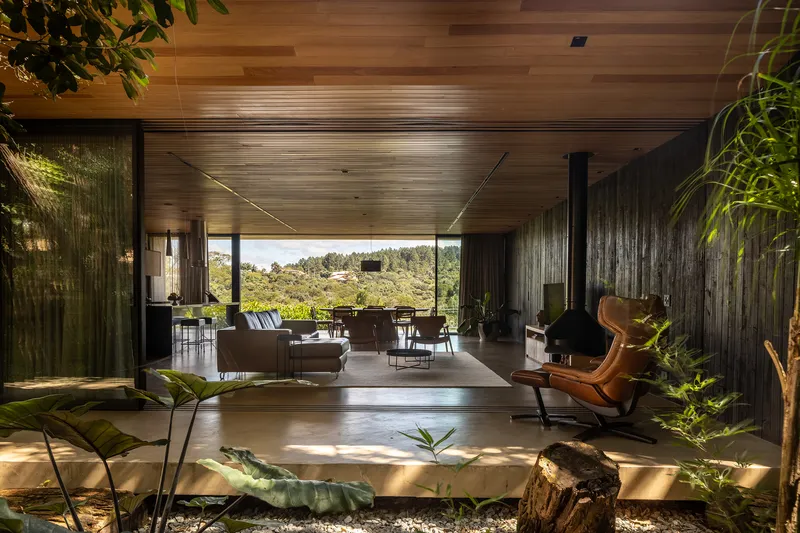
Cornetta Arquitetura’s design achieves a rare equilibrium: technical precision fused with poetic sensitivity. The architecture does not merely frame the landscape; it participates in it — revealing the coexistence of permanence and ephemerality, silence and brilliance, enclosure and openness.

With House 258, Cornetta Arquitetura demonstrates a profound respect for place and an elegant mastery of architectural storytelling. The project’s interplay of structure, material, and light transforms a complex site into a timeless dwelling that celebrates both human inhabitation and the natural world.
All photographs are works of João Paulo Soares


Popular Articles
Popular articles from the community


David Macias Steps a Doorless Stone and Plaster House Down a Tropical Colombian Hillside
In the humid hills of Colombia, Threshold House replaces the front door with an open void and terraces its 850 m² down the slope instead of fighting it.

Architekt Andreas Gruber Scatters 23 Dark Timber Chalets Across a South Tyrolean Forest Edge
In Molini di Tures, Amonti Chalets breaks a resort into a hamlet of gabled timber houses, with parking, storage and services pushed into the slope.

GROUP A Strips a 1969 Rotterdam Harbor Headquarters to Its Frame and Wraps It in Timber Louvers
In Rotterdam's M4H harbor district, Ferro Offices reuses a 1969 frame, adds one timber storey and reaches BREEAM-NL Outstanding.

Jaramillo Van Sluys Arquitectura and Urbanismo Turn a Demolished Registry Lot in Quito into an Orchard Plaza
In Quito's Centro Histórico, a 2,800 m² plaza exposes the San Agustín convent wall and redraws its lost Augustinian orchard in volcanic stone.

Similar Reads
You might also enjoy these articles


Hodi-Mandai Geram
Project Function: Preservation and revitalization of the Intangible heritage and socio-spatial identity of the Hodi by Housing, Cultural Memory Center, Sacred Grove, landscape, local tourism economy


Olio Towers: A Mid-Rise for Performers That Fuses Housing, Rehearsal, and Stage
Located blocks from Houston's Theater District, this modular tower stacks living units around a central performance atrium.

Oasis: Modular Green Housing Carved into Dhaka's Urban Fabric
A shortlisted Plugin Housing entry reclaims unauthorized settlements in Dhaka with stepped concrete volumes, green roofs, and ventilation-driven design.

Black Hole: A Floating Megastructure for the Post-Physical Era
Emiliano Mazzarotto envisions a spherical, self-scaling arena where e-sports, digital hotels, and holographic stadiums replace traditional public space.

Explore Architecture Competitions
Discover active competitions in this discipline

Challenge to reimagine the Iron Throne

Photograph architecture without architects

Illustrate the lost glory of Angkor Wat - Render Challenge

Design challenge to reuse E-waste
Comments (0)
Please login or sign up to add comments
No comments yet. Be the first to comment!