

Neo Architects Fragments a Coastal Home into the Fynbos Landscape of South Africa
House Azure scatters its pavilions across a steep Romansbaai hillside, letting indigenous vegetation weave through a 326 m² retreat.


Most coastal houses treat the ocean as a backdrop, something to frame and admire from behind a wall of glass. House Azure, designed by Neo Architects in the Romansbaai estate on South Africa's coast, does something more interesting: it treats the indigenous Fynbos landscape as an equal protagonist. The 326 square metre residence is broken into a series of semi-detached pavilions that step down a steep hillside, allowing the native Protea Fynbos vegetation to infiltrate the gaps between rooms. The result is a home that feels less like a single object placed on a site and more like a collection of spaces negotiating a truce with the terrain.
What makes the project worth studying is the specificity of its references. Neo Architects cite the fragmented morphology of the Protea Fynbos itself as a design driver, translating the scattered, irregular patterns of the local flora into a built logic of interconnected volumes and voids. That could easily read as post-rationalization, but the terraced massing, the way vegetation pushes into the building's perimeter, and the careful calibration of views suggest the idea was structural, not decorative. The Scandinavian minimalism that underpins the interiors keeps things from tipping into naturalistic pastiche.
The Oculus as Anchor

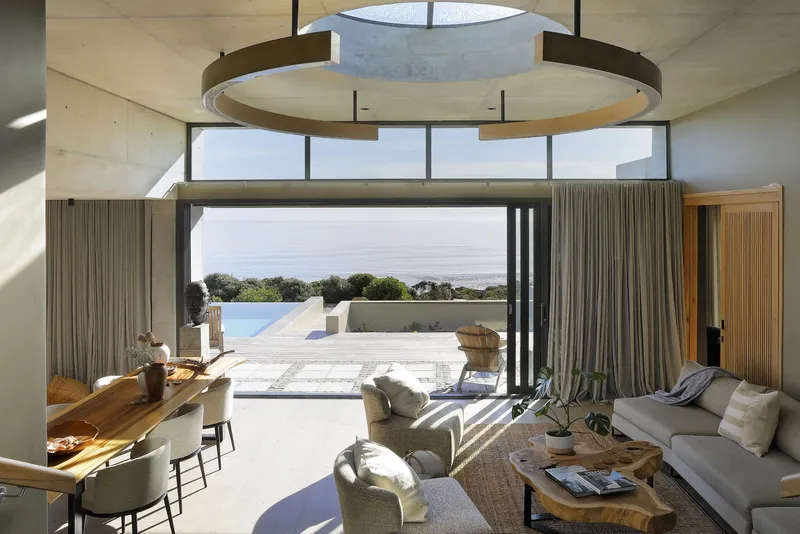
The double-height living space is the gravitational center of the house, and its organizing element is a large circular skylight that punches through the ceiling like a built oculus. It does more than admit light. It gives the open-plan layout, which could easily feel sprawling, a fixed point of reference. The dining area sits directly beneath it, bathed in a cone of daylight that shifts throughout the day. Floor-to-ceiling glazing on the seaward wall pulls the horizon into the room, but the skylight counterbalances that horizontal pull with a vertical one, keeping your eye moving.
The effect is theatrical without being theatrical for its own sake. In a home built around passive strategies, the oculus also performs: it draws warm air upward and brings diffuse light deep into the plan, reducing reliance on artificial fixtures during daylight hours. Form and performance are genuinely aligned here.
Material Palette: Concrete, Cameroon Timber, and Local Stone


The kitchen island tells you most of what you need to know about the material strategy. A raw concrete base supports a timber countertop, and above it, three black woven pendant lights hover like sculptural punctuation. The combination of locally sourced stone, durable hardwoods imported from Cameroon, and exposed concrete recurs throughout the house, creating a material language that is warm but restrained. Vertical timber cladding wraps exterior surfaces, adding grain and texture while weathering gracefully in the coastal climate.
The live-edge timber dining table in the open-plan area is the one moment where the material palette tips toward the expressive, and it works precisely because everything around it is disciplined. Matte black steel elements and recessed lighting keep the architectural envelope tight, letting individual pieces of furniture and craft carry the warmth.
Dissolving the Edge: Indoor-Outdoor Thresholds


The folding glass walls between dining room and terrace are not a novel move, but Neo Architects deploy them with precision. When fully retracted, the dining space and the infinity pool deck read as a single continuous surface, with the timber decking running to the edge of the hillside. The pool itself acts as a liquid datum line against the distant ocean, collapsing the depth between foreground and horizon. A hanging chair at the deck's edge reinforces the sense of suspension over the landscape.
The strategic window placement extends beyond the public rooms. Every space in the house, including the bathrooms, maintains a visual connection to either the ocean or the fynbos vegetation. Double-glazed units balance the expansive openings with thermal performance, a necessity in a climate where coastal winds and sun exposure can make all-glass facades a liability rather than a luxury.
Private Rooms: Rafters, Light, and Restraint
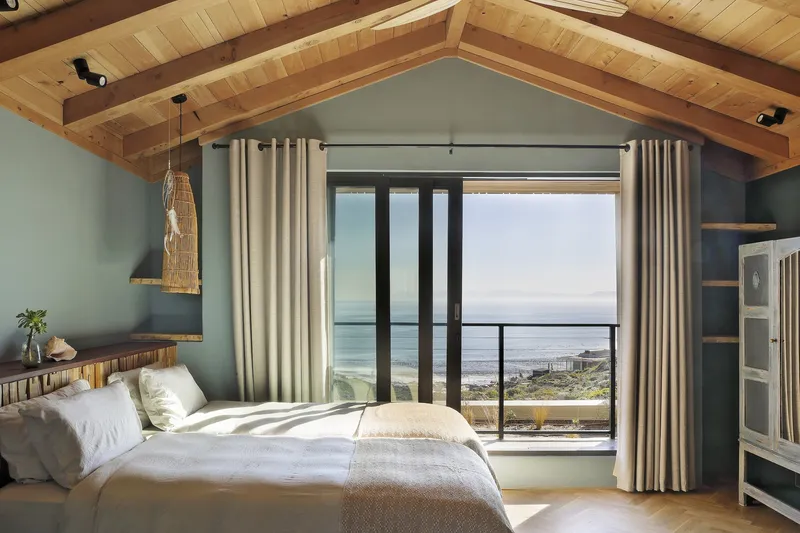


The bedrooms demonstrate that the open-rafter ceiling strategy is not just a stylistic choice but a spatial one. Exposed timber rafters in the bedroom suites pitch upward, drawing the eye and making modestly scaled rooms feel generous. Sliding glass doors open directly to ocean views, turning each bedroom into its own pavilion with a private relationship to the landscape. The separation between guest suite and main bedrooms follows from the fragmented site plan, giving each sleeping space acoustic and visual privacy without corridors or buffer rooms.
The bathroom detailing is notably considered. A narrow vertical window beneath the timber ceiling beams introduces a sliver of natural light into the shower enclosure, paired with patterned floor tiles that bring a moment of graphic density into an otherwise minimal palette. It is a small gesture, but it signals a design team attentive to every room, not just the ones that photograph well from the exterior.
Rooftop and Landscape: Working the Slope
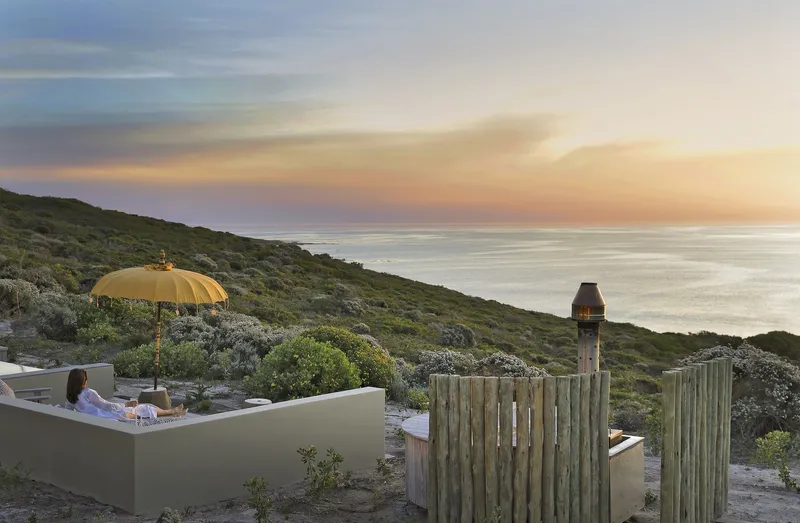

The rooftop terrace, shielded by a timber windscreen fence and anchored by a yellow umbrella that reads almost as a piece of land art against the muted coastal tones, reveals the terracing strategy from above. The house steps down the hillside in discrete platforms, each level slightly offset from the one above. This is not decorative topography. The terracing was a direct response to the steep site and the imperative to preserve the existing fynbos ground cover. Rather than cut and fill to create a single building pad, Neo Architects let the contours dictate the section.
At dusk, the infinity pool and timber deck glow against the dark vegetation, and the fragmented volumes of the house settle into the hillside like geological formations. The native flora reaching up to the exterior walls is not landscaping; it is the original condition that the architecture was designed to preserve. The project's environmental credibility lies not in any single green technology but in this fundamental site decision: build around the landscape rather than on top of it.
Why This Project Matters
House Azure demonstrates that fragmentation can be a genuine design strategy, not just a formal exercise. By breaking the program into semi-detached pavilions and letting the site's topography and vegetation set the rules, Neo Architects produced a home that is legible as contemporary architecture without asserting dominance over its setting. The Scandinavian minimalism provides discipline, but the project's intelligence comes from its reading of the South African coastal landscape and the specific patterns of Protea Fynbos ecology.
In a market saturated with glass-box coastal villas that treat nature as scenery, this house treats it as structure. The terracing, the material sourcing, the passive cooling, and the deliberate porosity of the plan all point toward an architecture that is comfortable being incomplete, letting the landscape do the rest. That is a harder trick than it looks, and Neo Architects pull it off with conviction.
House Azure by Neo Architects, Romansbaai, South Africa. 326 m². Photography by Perfect Hideaways.
About the Studio
Share Your Own Work on uni.xyz
If projects like this are the kind of work you want to make, uni.xyz is a place to publish your own, find collaborators, and enter design competitions.



Popular Articles
Popular articles from the community


Co-Life: Senior Housing Design That Reconnects Older Adults With the City
Co-Life reimagines senior housing design through healing gardens, shared streets, workshops, and a sustainable community across generations.
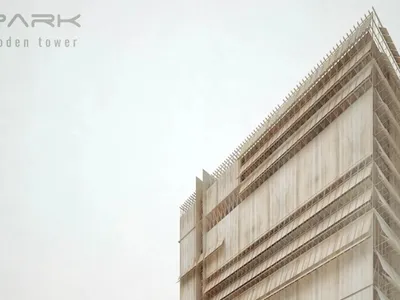
EW PARK: Sustainable Architecture Reimagines the Future of Urban Parking
EW PARK reimagines city parking as a modular wooden tower combining automation, solar energy, electric mobility, and adaptable urban design.

The Musturak Paradise: Senior Living Architecture for a Connected Future in Temara, Morocco
The Musturak Paradise reimagines senior living architecture in Temara via private homes, social spaces, culture, community, and shared care.

Hill & Cross Opera: Sculptural Opera House Architecture Shaped by Tallinn’s Landscape and Identity
Hill & Cross Opera reimagines opera house architecture in Tallinn through its sculptural hill, civic plaza, glass wave and a luminous cross.


Similar Reads
You might also enjoy these articles


Hodi-Mandai Geram
Project Function: Preservation and revitalization of the Intangible heritage and socio-spatial identity of the Hodi by Housing, Cultural Memory Center, Sacred Grove, landscape, local tourism economy


Olio Towers: A Mid-Rise for Performers That Fuses Housing, Rehearsal, and Stage
Located blocks from Houston's Theater District, this modular tower stacks living units around a central performance atrium.

Oasis: Modular Green Housing Carved into Dhaka's Urban Fabric
A shortlisted Plugin Housing entry reclaims unauthorized settlements in Dhaka with stepped concrete volumes, green roofs, and ventilation-driven design.

Black Hole: A Floating Megastructure for the Post-Physical Era
Emiliano Mazzarotto envisions a spherical, self-scaling arena where e-sports, digital hotels, and holographic stadiums replace traditional public space.


Explore Architecture Competitions
Discover active competitions in this discipline



Challenge to reimagine the Iron Throne


Photograph architecture without architects


Illustrate the lost glory of Angkor Wat - Render Challenge


Design challenge to reuse E-waste
Comments (0)
Please login or sign up to add comments
No comments yet. Be the first to comment!