

House Between Two Rivers by Taller 3000: A Masterpiece of Off-Grid Mountain House Architecture in Valle de Bravo
An off-grid mountain home in Valle de Bravo by Taller 3000, blending sustainable architecture with topography and brutalist materiality.


In the heart of Valle de Bravo, Mexico, nestled between two forest-lined rivers, Taller 3000 has crafted a stunning example of off-grid mountain house architecture. The House Between Two Rivers is more than a residence—it is a deliberate response to topography, climate, and the desire for self-sufficiency, seamlessly merging contemporary spatial language with raw materiality.


A Descent into Nature
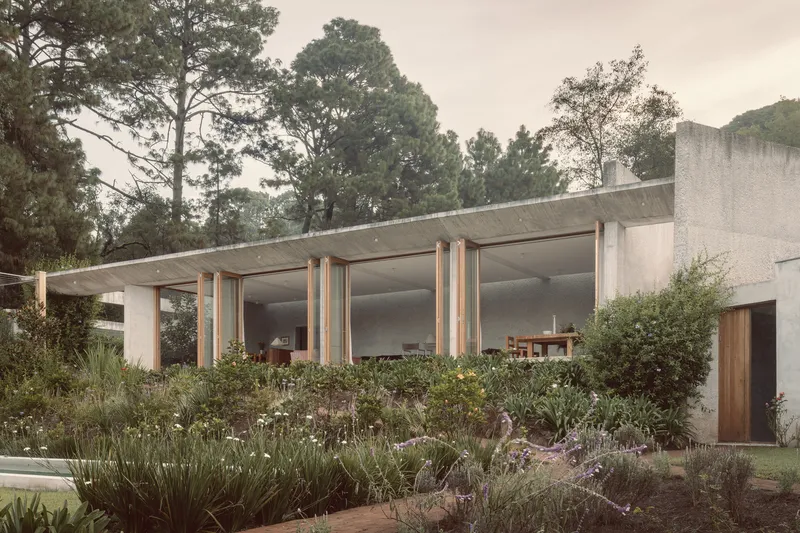
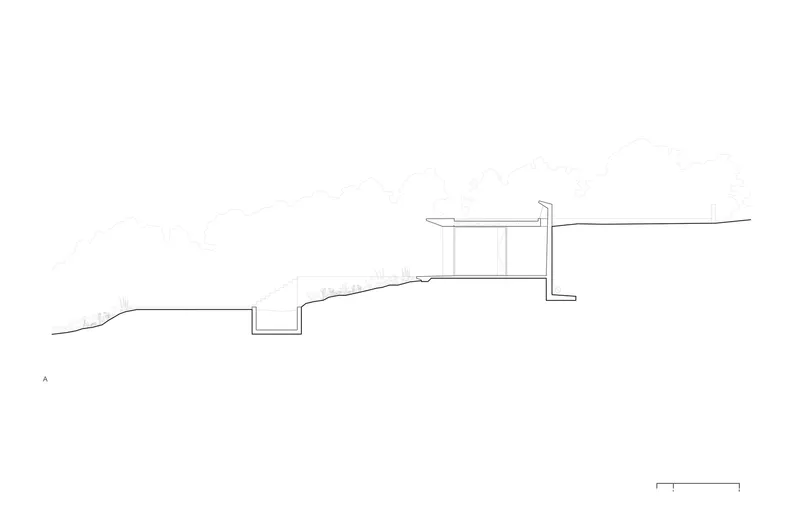
Approaching the house from above, the site reveals itself gradually, following the natural contours of a ridge framed by two rivers. The architects, led by Sebastián Mancera, embraced the steep terrain by embedding the house into the slope. Three exposed concrete walls anchor the home: the first welcomes visitors, while the others conceal functional areas—living and sleeping quarters—allowing the architecture to whisper rather than shout.


Program Divided by Purpose and Topography
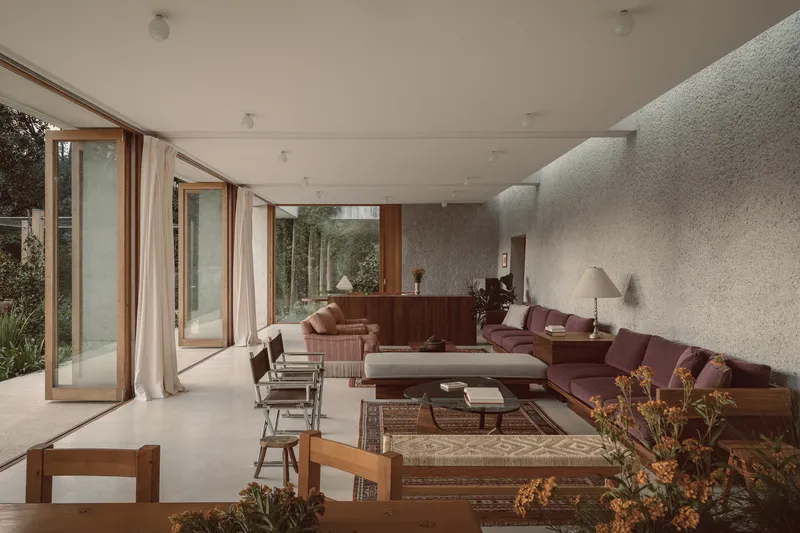
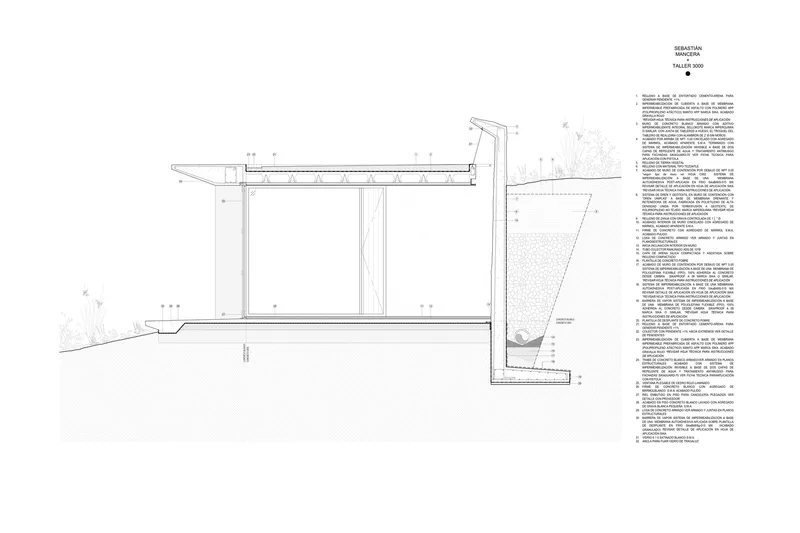
The program is split across two long volumes. The first bar houses the living area, kitchen, and social zones. Positioned perpendicular to the ridge, it opens westward with bi-folding doors crafted from Spanish cedar, framing forest views and letting in mountain light. During the day, the boundaries between inside and out dissolve entirely. The adjacent pool lies hidden lower on the slope, shielded by native shrubbery. A deliberate move underground conceals the kitchen, making the everyday feel both protected and secret.


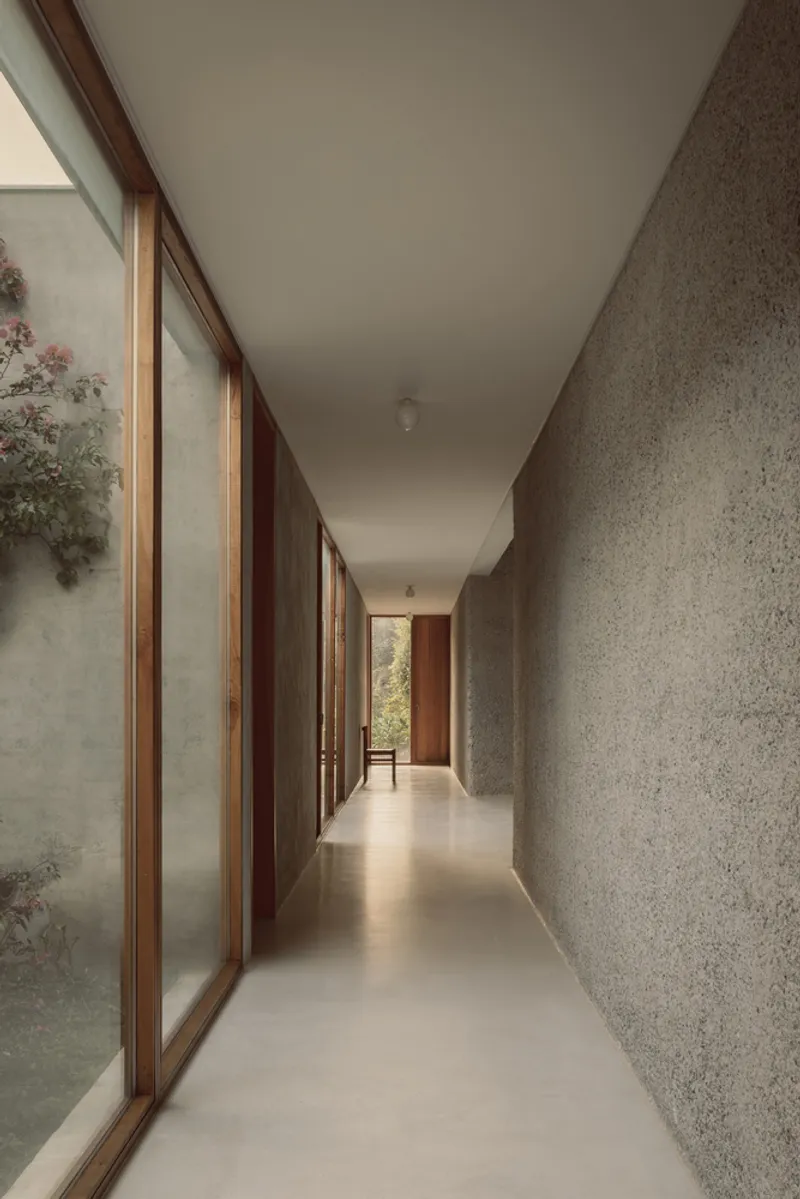
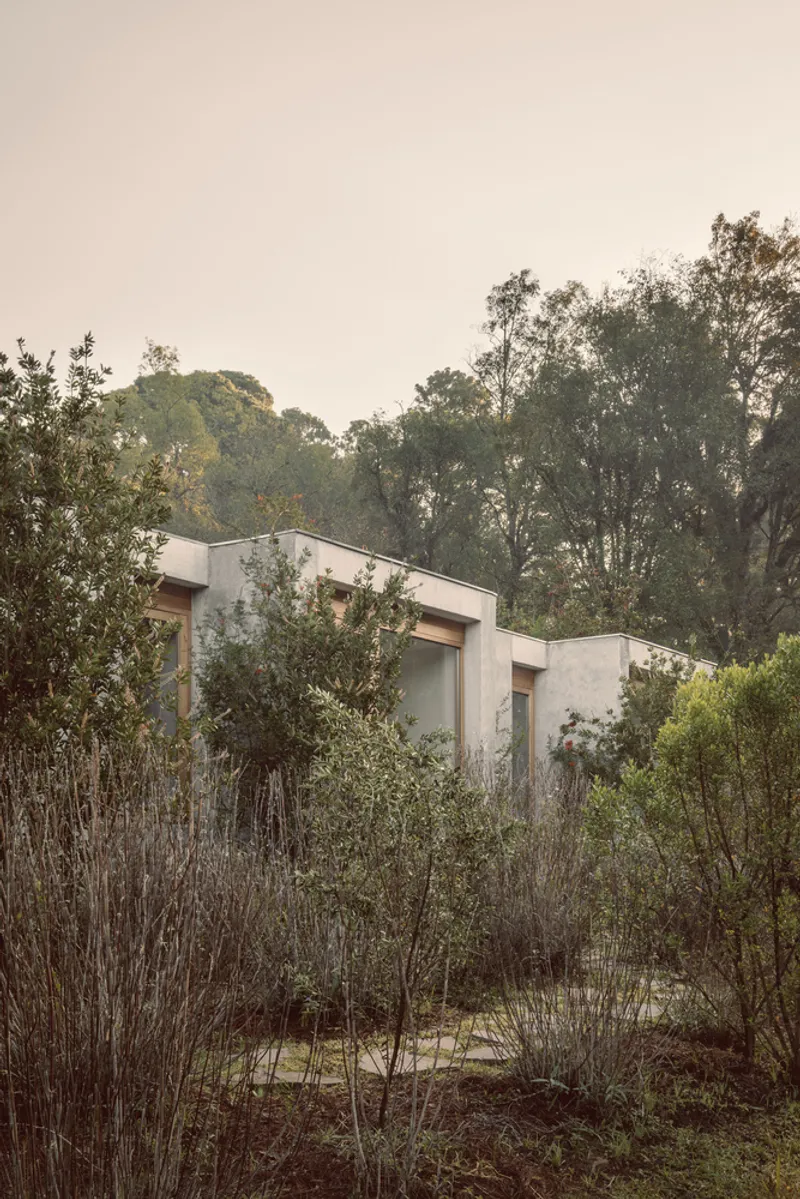
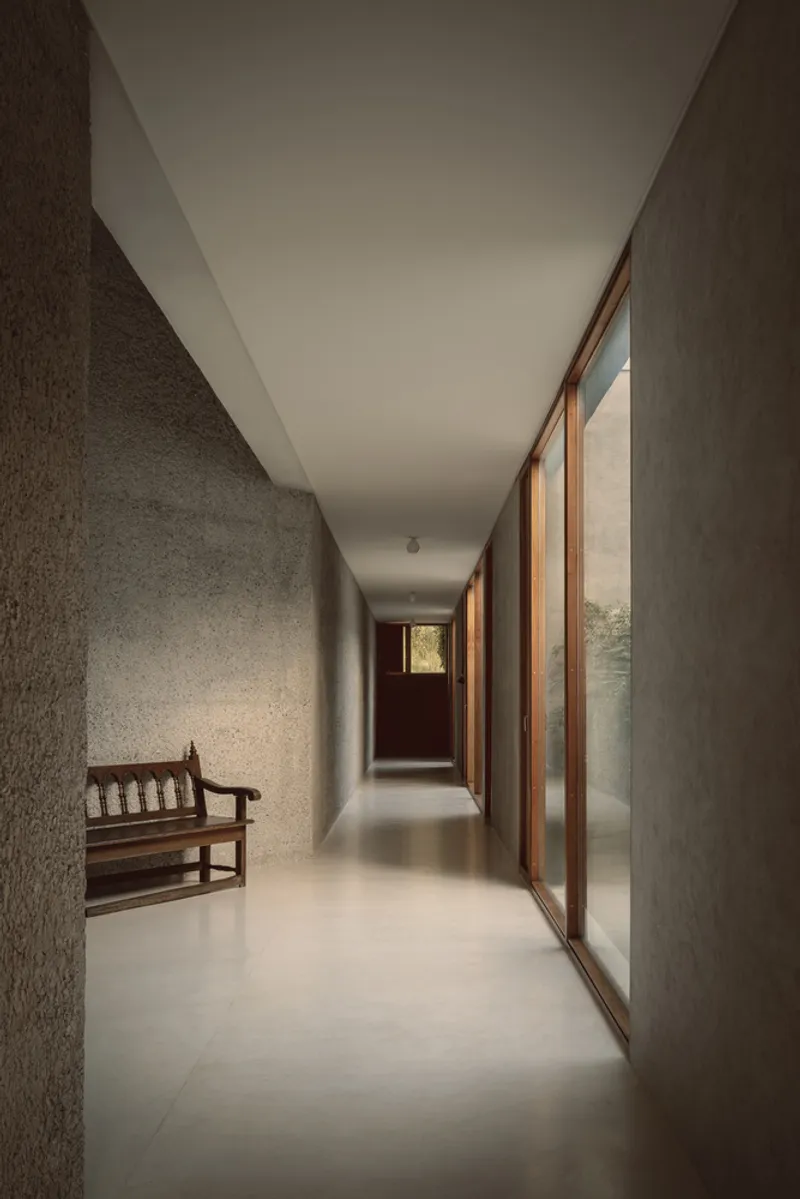
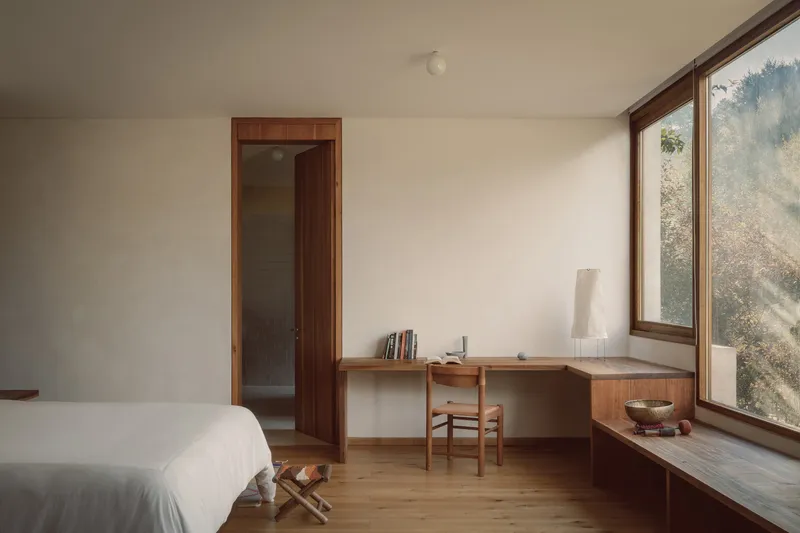
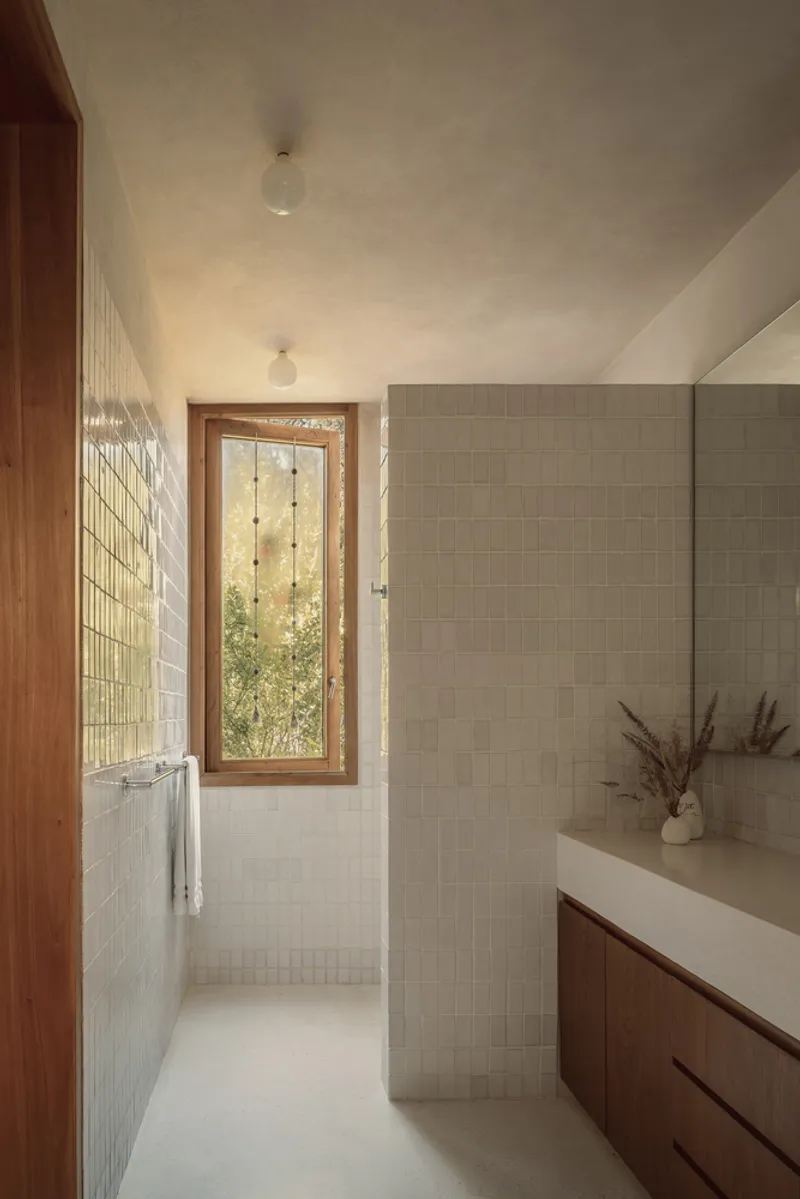
Further down the slope—two meters below the main bar—the second volume contains bedrooms. These rooms face south and are separated from the terrain by a narrow corridor illuminated by garden courtyards. Open-air terrariums bring filtered light and ventilation into the interiors, while cinderblock walls clad in thin concrete renders respond to the region's humid climate, allowing natural weathering to express the building’s material truth.

Circulation through Geometry
Movement between the two volumes is choreographed through a striking vertical circulation core: a knuckle of trapezoidal stairs. This unusual geometry mediates levels and accentuates the contrast between the openness of the upper bar and the intimate, cave-like nature of the lower sleeping quarters. This interplay of spatial compression and expansion becomes central to the architectural experience.


Brutalist Aesthetic, Environmental Logic
The use of hammered concrete throughout the house reinforces a brutalist aesthetic while serving practical needs. The thick retaining walls act as thermal masses, absorbing daytime heat and slowly releasing it during the cooler mountain nights. This passive thermal strategy eliminates the need for artificial heating. Moreover, the home is entirely off-grid, powered by solar panels and batteries, and receives fresh water from a nearby spring. These sustainable measures are embedded seamlessly into the design, never compromising the architectural clarity.



A House Rooted in Landscape
Taller 3000’s House Between Two Rivers embodies a deeply rooted architectural philosophy: build with the land, not against it. The design doesn’t dominate its setting—it collaborates with it. By cutting into the ridge, hiding elements underground, and embracing natural materials, the house becomes an extension of the forest itself.


This project is a powerful case study in off-grid mountain house architecture, illustrating how sustainability, minimalism, and sculptural form can coexist harmoniously. It stands as both a retreat and a testament to a thoughtful, context-driven design process that redefines what it means to dwell in nature.


All Photographs are works of César Béjar


Popular Articles
Popular articles from the community


graciastudio Turns a Viewless Tijuana Lot Inward Around a Courtyard of Concrete, Timber and Trees
In Tijuana, Jorge Gracia's GA2 House stacks a timber-clad private floor over exposed concrete and replaces a missing view with a planted interior patio.

David Ortega Stacks a Two-Story Mexico City Penthouse Around a Steel Stair and a Pergola-Shaded Roof Terrace
In Colonia Roma, a 300 m² penthouse uses oak joinery, a planted steel stair and a slatted roof pergola to make a new-build apartment feel like a house.

FCC Arquitectura Expands a Portuguese Granite House with a Board-Marked Concrete Wing
In Portugal, JV House pairs a cleaned-up whitewashed and granite dwelling with a timber-shuttered concrete extension, courtyards and a garden pool.


The Amber Palace Opera: A Geological Fiction Surfaces on Tallinn's Baltic Waterfront
Pierre Brillard reimagines a Baltic legend as a public landscape, opera house, and waterfront promenade rooted in Tallinn's coastal identity.

Similar Reads
You might also enjoy these articles

Cube Design Draws an Ecological Corridor Between Two Shenzhen Hills with the Nankai Building
Beside Shenzhen's container docks, the Nankai Building pairs stacked balconies with a climbing green screen to connect two hillsides across its height.

Praksis A and Studio Sted Bend a Red Timber Cabin Across the Granite of Norway's Southern Coast
On the southern Norwegian coast, a 105 m² cabin follows the rock on slender posts, pairing red cladding outside with pine, brick and plywood within.
David Ortega Stacks a Two-Story Mexico City Penthouse Around a Steel Stair and a Pergola-Shaded Roof Terrace
In Colonia Roma, a 300 m² penthouse uses oak joinery, a planted steel stair and a slatted roof pergola to make a new-build apartment feel like a house.

PARALELA and LB2 Thread a Public Walkway Through the Base of a Las Condes Residential Tower
In Las Condes, Santiago, the Hamlet Building gives its fenceless ground floor to a 70-metre wooded passage linking two streets and the metro.

Explore Architecture Competitions
Discover active competitions in this discipline

Challenge to reimagine the Iron Throne

Photograph architecture without architects

Illustrate the lost glory of Angkor Wat - Render Challenge

Design challenge to reuse E-waste
Comments (0)
Please login or sign up to add comments
No comments yet. Be the first to comment!