
KamakuraStudio Builds Its Own Home as a Neighborhood Living Room in Chiba
HOUSE F merges residence, office, and community hub within a timber tower threaded with greenery and shared purpose in suburban Japan.


In a suburban Chiba neighborhood where three quarters of the residents arrived within the last ten years, KamakuraStudio decided to stake its own claim not just as a practice but as a neighbor. HOUSE F is the firm's combined residence and office, completed in 2022, and it operates on a premise that sounds simple but is architecturally demanding: that a single building can be private enough for family life, productive enough for a working studio, and porous enough to function as a genuine community anchor. The result is a vertically organized timber structure whose ground floor doubles as a casual gathering space where locals share coffee, swap books, and watch films projected onto a wall.
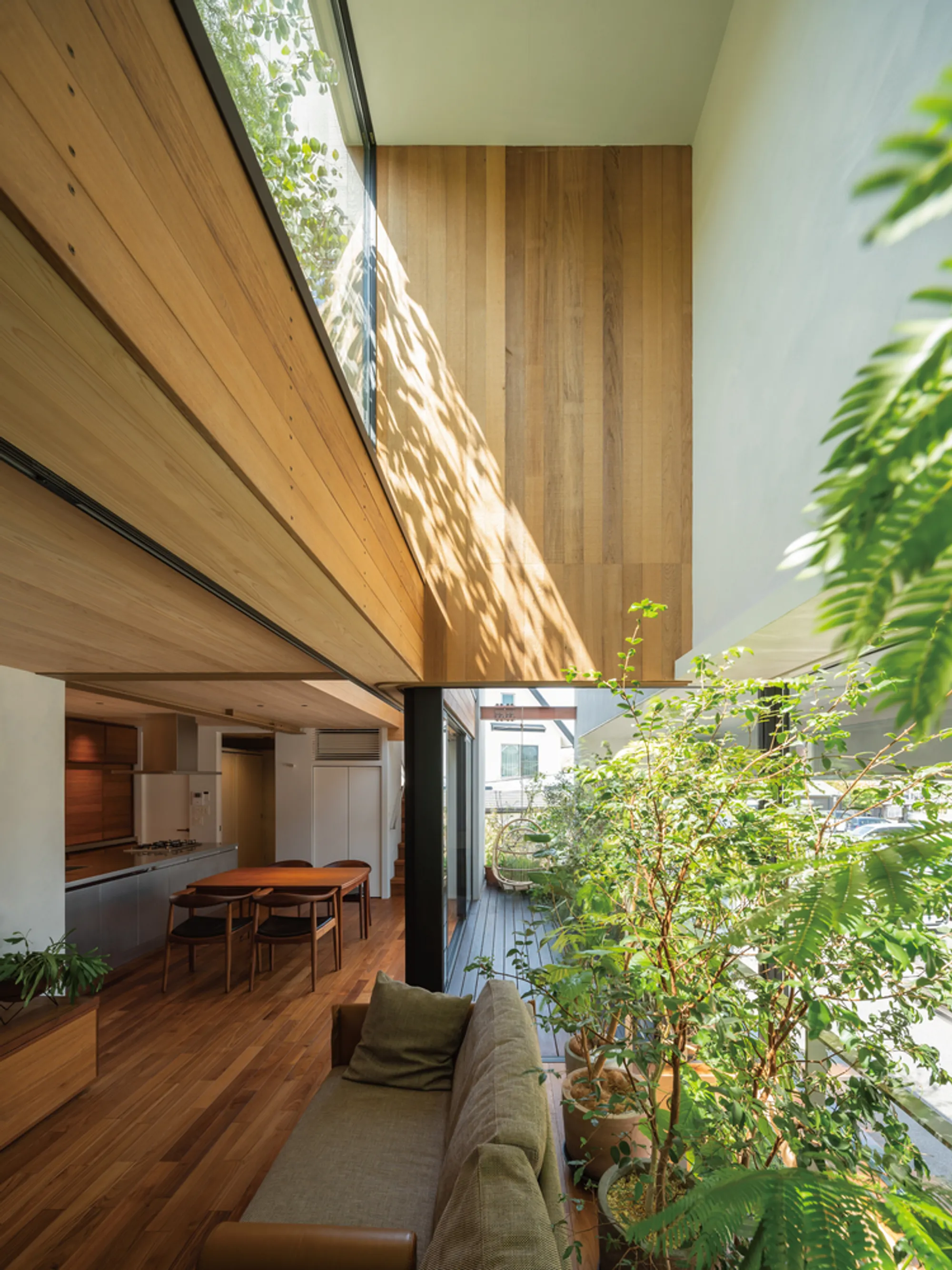
What makes HOUSE F genuinely interesting is not its altruism but its mechanics. The building solves a hard problem: how to graduate from public to private along a vertical axis without resorting to locked doors or blank walls. A central diagonal void, oriented south, pulls daylight and warm air from a wood stove on the first floor up through all three levels, terminating in a children's study space at the top. That void also hosts a cascade of plants, many propagated from cuttings exchanged among neighbors, turning the section into a living, breathing diagram of the architect's thesis that sustainable community starts with the small, daily act of paying attention to where you live.
A Street Presence That Shifts and Steps

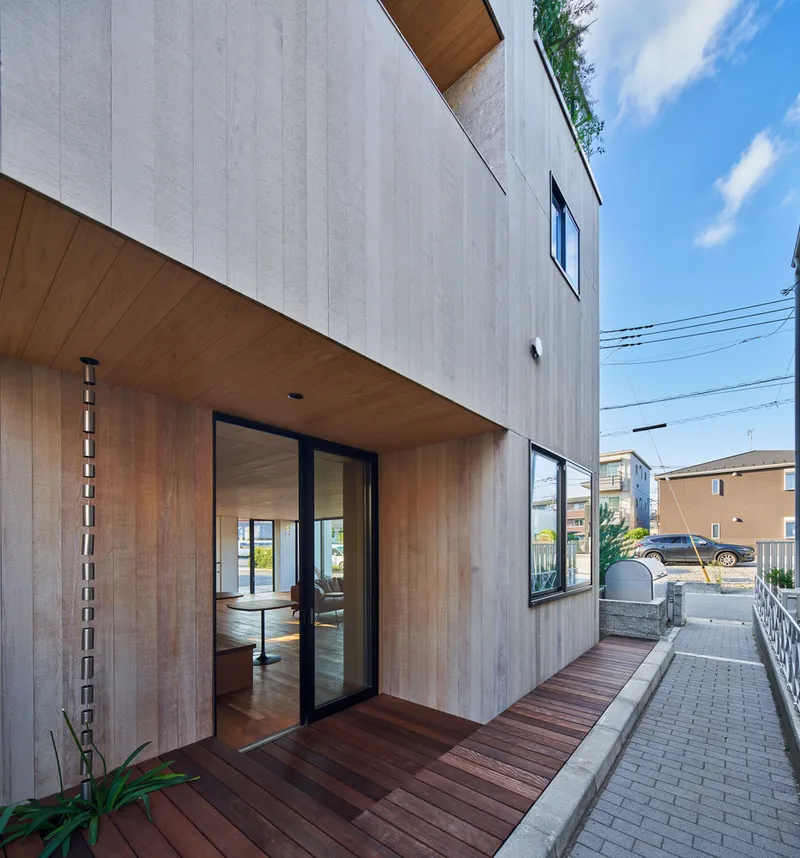
From the north-facing road, HOUSE F reads as a stack of pale timber volumes that step back as they rise, opening rooftop terraces to the sky and exposing pockets of greenery at each setback. The retreat from the street is deliberate: it grants privacy to the upper residential floors while making the ground level feel approachable, almost storefront-like. The west facade, by contrast, changes character depending on the time of day and the angle of approach, with cantilevered volumes casting shifting shadows over the timber cladding.
At ground level, a timber entry deck extends outward beneath the cantilever of the upper volume, sliding glass doors standing open as a permanent invitation. The canopy overhead is generous enough to shelter a few people from rain, blurring the threshold between sidewalk and interior. It is a small gesture that does a lot of social work, signaling that the boundary here is negotiable.
The Vertical Void as Engine

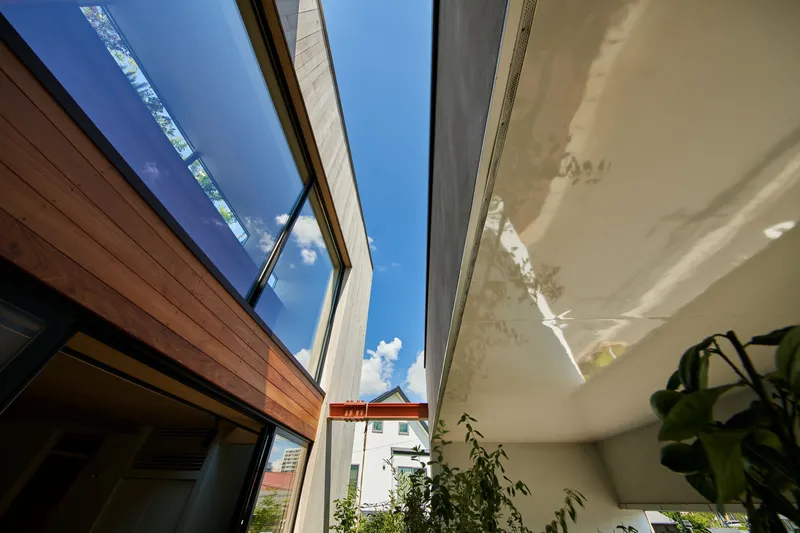
The most consequential move in the section is the south-facing diagonal void that connects all three floors. It operates simultaneously as a light well, a chimney for the wood stove's warmth, and a visual link that lets inhabitants on every level sense one another's presence. Angled timber ceilings amplify the effect, bouncing light deeper into the plan and lending the double-height living space a quality of dappled illumination that recalls standing beneath a forest canopy.
A narrow skylight between the two main volumes punctuates the top of the section, pulling a sliver of open sky into the core of the building. The reflective surfaces of the timber cladding brighten what could otherwise be a dim slot, turning a structural gap into a generous light source. It is a reminder that passive strategies work best when they are embedded in the architecture's primary geometry rather than bolted on as afterthoughts.
Living and Cooking at the Canopy Line
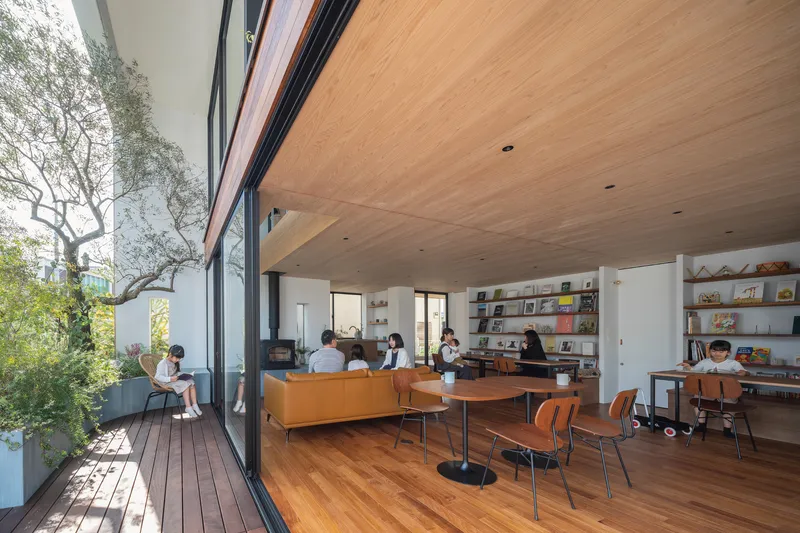
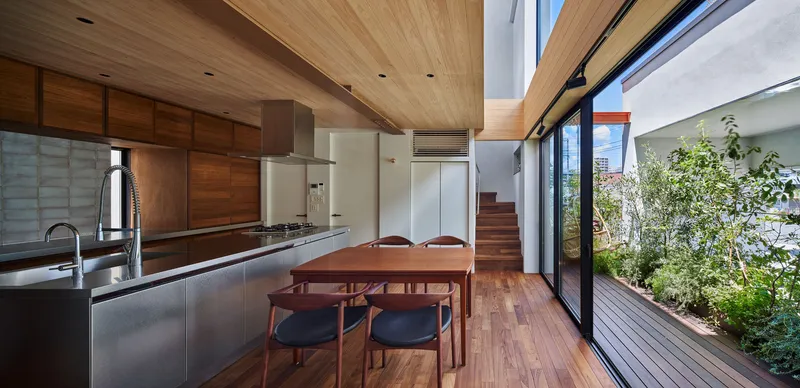

The second floor is given over to an open-plan living, dining, and kitchen arrangement that extends onto a timber balcony planted with edible species. The kitchen anchors the plan with a stainless steel island and timber cabinetry, oriented so the cook faces a planted courtyard through full-height glazing. It is a domestic space designed around the act of feeding people, scaled generously enough that the line between family dinner and neighborhood potluck can dissolve without friction.
Mature tree branches frame the deck and press against the edges of the living area, creating a condition where you are neither fully indoors nor outdoors. The timber ceiling overhead maintains a consistent material language from interior to exterior, refusing to mark a hard boundary. Floor-to-ceiling glass slides away entirely, so the deck becomes an extension of the kitchen counter on warm evenings.
Plants as Social Infrastructure

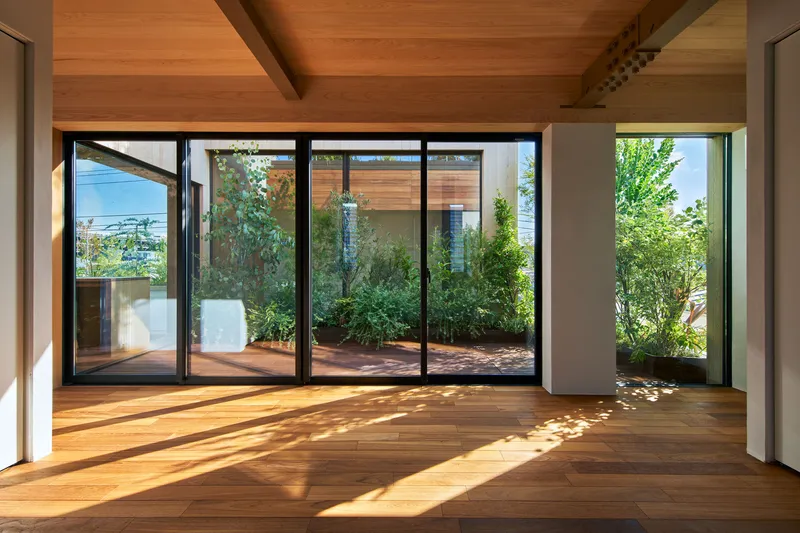
Potted plants fill nearly every circulation space, from the timber-floored hallway to the herringbone-paved threshold at the sliding glass doors. These are not decorative accessories. Many are propagated from cuttings shared among neighbors, a grassroots plant-swapping culture that the architect has elevated into an architectural strategy. The diagonal openings in the facade accommodate these plants, and their growth over time transforms the building's appearance, making the elevation a living record of community exchange.
The effect inside is biophilic in the truest sense: not a curated interior garden but a slightly unruly accumulation of species that reflects actual social relationships. When a neighbor contributes a cutting that thrives on the third-floor terrace, the building gains a new layer of meaning that no architect could have drawn in advance. It is a convincing argument that sustainability at the neighborhood scale depends less on technology than on cultivating habits of care.
Threshold and Transition
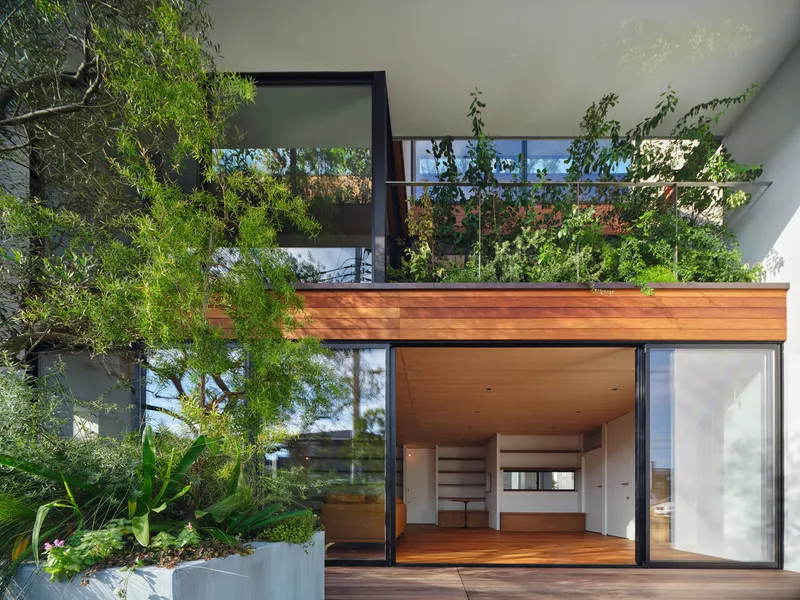
HOUSE F is full of in-between conditions. The timber-decked terrace on the upper level sits beneath a tree canopy with sliding glass doors that can close it off or open it completely to the interior. The entry deck below operates similarly, mediating between the street and the first-floor office. In both cases the architecture does not rely on walls to define public versus private; it uses floor level, material continuity, and the presence or absence of a roof to signal gradations of access.
These thresholds are where the building's social ambition becomes spatial reality. A neighbor who steps onto the entry deck is already half inside. A family member who sits on the upper terrace is still half outside. The building trusts its occupants to navigate these overlaps intuitively, and the evidence from the workshops, film screenings, and pop-up cafés hosted since 2022 suggests that trust is well placed.
Why This Project Matters
HOUSE F belongs to a lineage of architect-built homes that double as manifestos, but it distinguishes itself by centering community participation rather than formal experimentation. KamakuraStudio's wager is that a building can resist the twin pressures of suburban isolation and demographic decline not through grand infrastructure but through incremental, daily acts of sharing: a cup of coffee, a plant cutting, a film projected on a white wall. The architecture supports that wager with a section that graduates intelligently from open to intimate, and a material palette of timber and glass that ages gracefully alongside the relationships it shelters.
The broader lesson is one of agency. In a neighborhood where most residents are newcomers, the architect chose to make the ground floor of their own home available to strangers, trusting that architecture could catalyze belonging. Other communities have already begun asking how to replicate the model. That interest confirms something architects sometimes forget: the most powerful thing a building can do is lower the threshold for human connection, literally and figuratively.
HOUSE F by KamakuraStudio, Chiba, Japan. Completed 2022. Photography by Koji Fujii (Torel), Shinkenchiku-sha, and KeisukeFukui (KamakuraStudio).
About the Studio
Share Your Own Work on uni.xyz
If projects like this are the kind of work you want to make, uni.xyz is a place to publish your own, find collaborators, and enter design competitions.




Popular Articles
Popular articles from the community


The Musturak Paradise: Senior Living Architecture for a Connected Future in Temara, Morocco
The Musturak Paradise reimagines senior living architecture in Temara via private homes, social spaces, culture, community, and shared care.

Conexión: Biophilic Design Reimagines High-Rise Living in Hong Kong
Conexión reimagines high-rise living in Hong Kong through biophilic design, green facades, shared spaces, daylight, water and nature within.

The Earth Pod: 3D Printed Homes for Resilient Refugee Communities
The Earth Pod reimagines refugee housing through 3D printed homes made from clay, combining resilience, self-sufficiency, and rapid shelter.

Hill & Cross Opera: Sculptural Opera House Architecture Shaped by Tallinn’s Landscape and Identity
Hill & Cross Opera reimagines opera house architecture in Tallinn through its sculptural hill, civic plaza, glass wave and a luminous cross.

Similar Reads
You might also enjoy these articles


Hodi-Mandai Geram
Project Function: Preservation and revitalization of the Intangible heritage and socio-spatial identity of the Hodi by Housing, Cultural Memory Center, Sacred Grove, landscape, local tourism economy


Olio Towers: A Mid-Rise for Performers That Fuses Housing, Rehearsal, and Stage
Located blocks from Houston's Theater District, this modular tower stacks living units around a central performance atrium.

Oasis: Modular Green Housing Carved into Dhaka's Urban Fabric
A shortlisted Plugin Housing entry reclaims unauthorized settlements in Dhaka with stepped concrete volumes, green roofs, and ventilation-driven design.

Black Hole: A Floating Megastructure for the Post-Physical Era
Emiliano Mazzarotto envisions a spherical, self-scaling arena where e-sports, digital hotels, and holographic stadiums replace traditional public space.


Explore Open Building Competitions
Discover active competitions in this discipline



Challenge to reimagine the Iron Throne


Photograph architecture without architects


Illustrate the lost glory of Angkor Wat - Render Challenge


Design challenge to reuse E-waste
Comments (0)
Please login or sign up to add comments
No comments yet. Be the first to comment!