
João Caetano Arquitetura Wraps a Pink House Around a Sloped Caxias Plot
In Oeiras, Portugal, a 370-square-meter residence turns its back on the street and opens inward to gardens and a northern pool terrace.


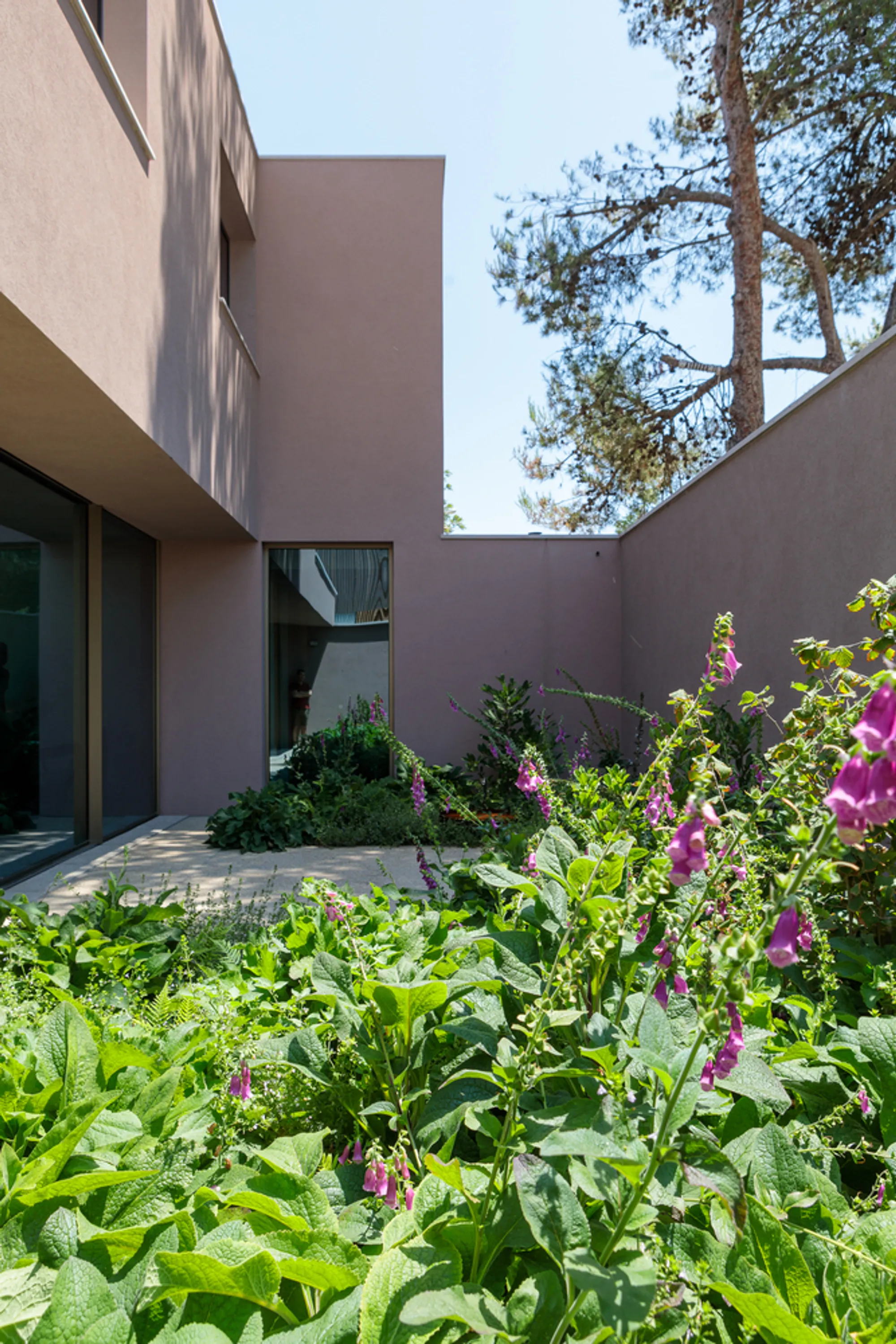
Most suburban houses treat the street as their audience. House in Caxias, designed by João Caetano Arquitetura on a difficult, sloping plot in Oeiras, Portugal, does the opposite. The residence faces inward, extending pink-rendered walls past its own volume to screen living spaces from neighbors and traffic alike. What the street receives is a near-mute facade; what the occupants receive is an immersive sequence of courtyards, mature trees, and a swimming pool terrace that runs the full width of the basement plinth.
The project, completed in 2023 after a seven-year design and construction process begun in 2016, had to satisfy a masterplan governing maximum built area, storey count, and offset distances. The plot compounded things with its irregular geometry, steep grade, and an orientation that placed the best views and largest garden area to the north, the worst direction for solar gain in southern Portugal. João Caetano's response was to split the program across three levels, pivot bedrooms south for light, and thread vegetation through every gap, so that the house will only grow more private with time.
The Courtyard as Core
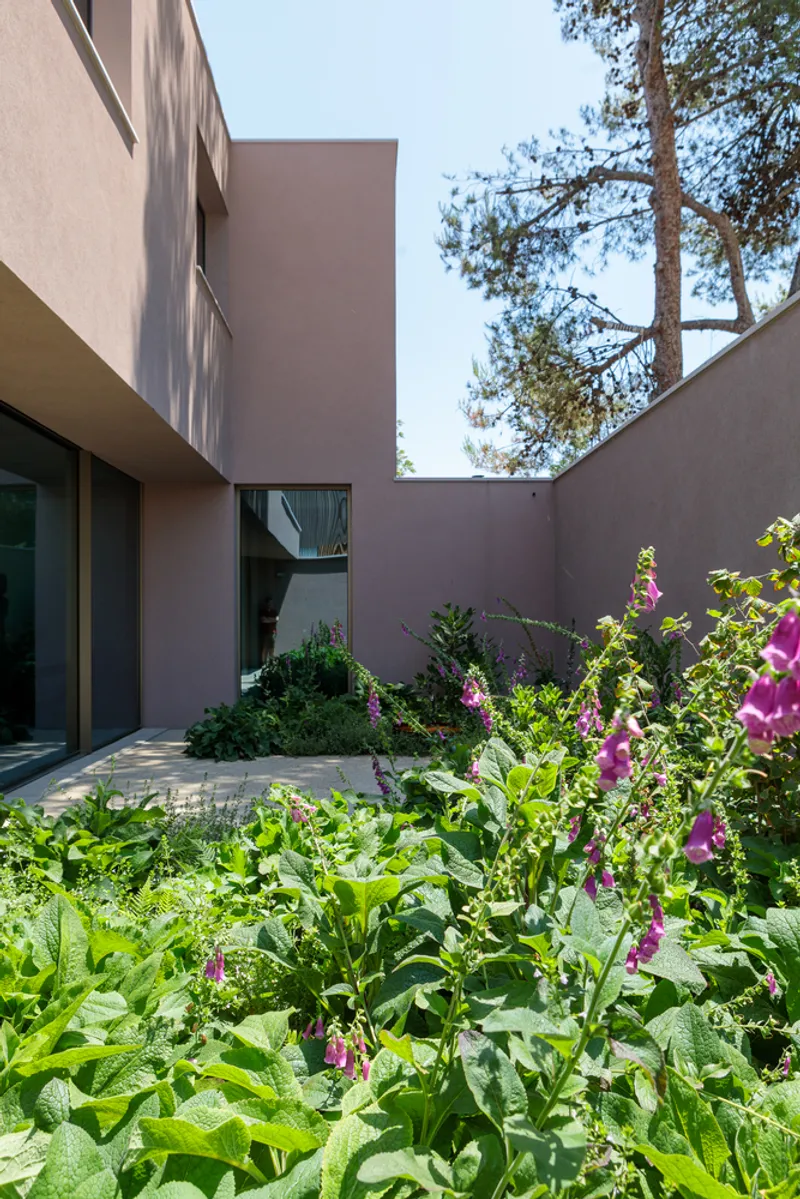
The south-facing enclosed patio is the emotional center of the ground floor. Wrapped in that distinctive pink render, it hosts exuberant planting: purple blooms, textured groundcover, and climbers that will eventually soften every vertical surface. An existing mature pine tree near the road anchors the composition, its canopy rising above the walls and lending the courtyard an almost arboretum quality. The landscape design, by Baldios Arquitectos Paisagistas, treats vegetation and construction as alternating registers, each calibrating the other.
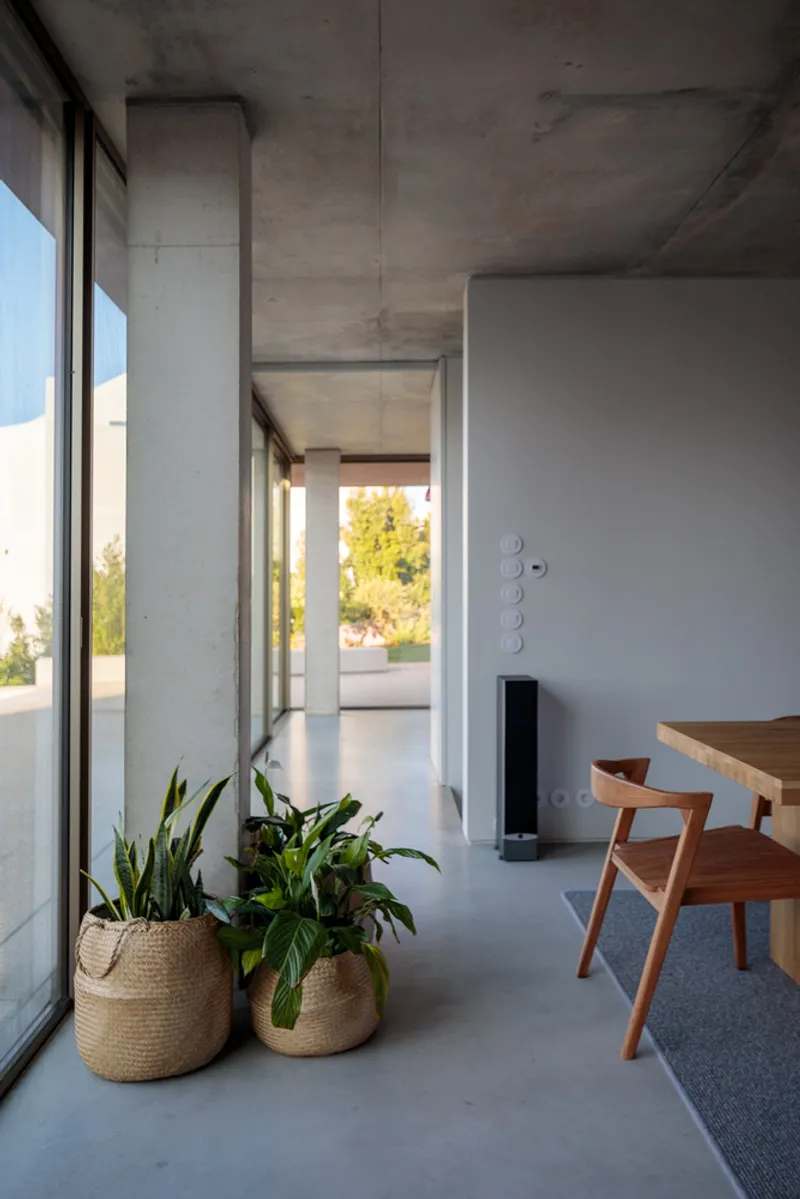
From the inside, full-height glazing dissolves the boundary. A raw concrete column and ceiling slab frame the view without decorating it, letting the color and movement of the garden carry the moment. There is a deliberate severity to the interior palette, concrete, white plaster, pale timber, that makes the courtyard read as the room's primary ornament.
Privacy Calibrated at the Bedroom Scale
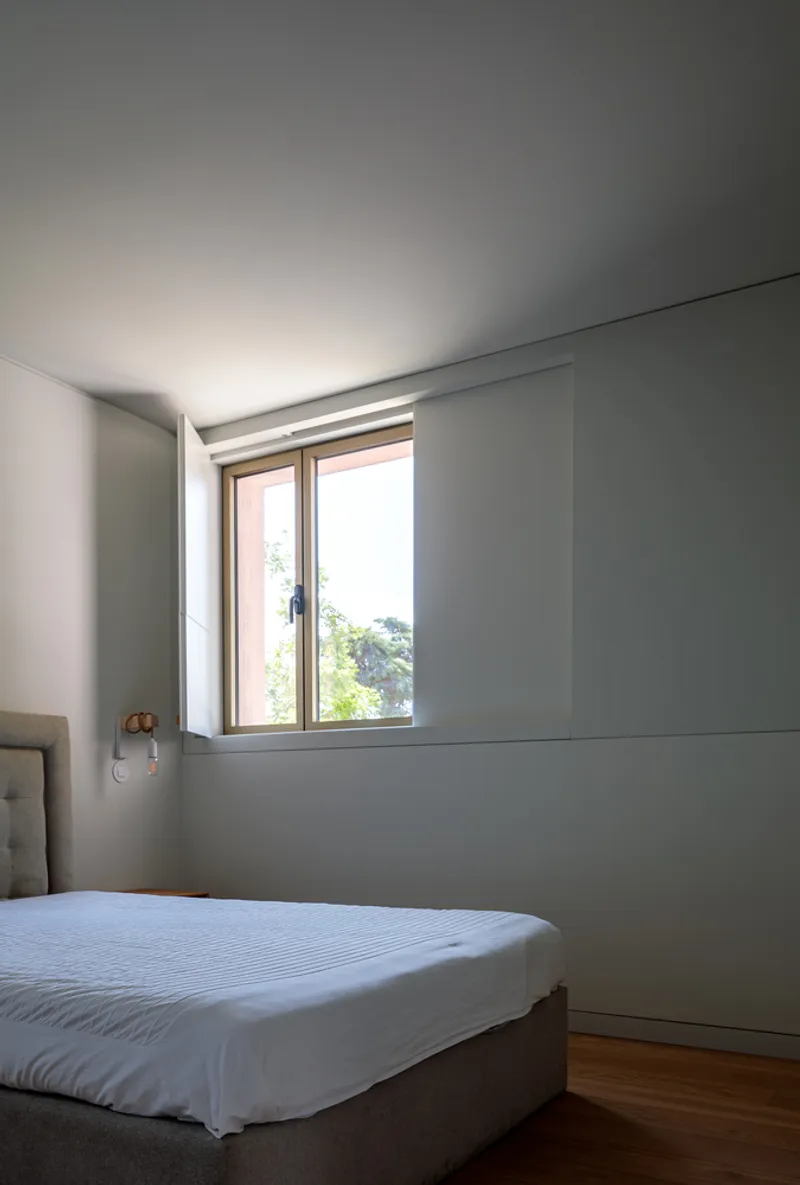
Upstairs, the first floor houses the private quarters, all oriented south to maximize solar exposure. The detail that sets these bedrooms apart is the window strategy: sills are deliberately raised, and deep timber reveals frame each opening like a viewfinder. Foliage presses close, and the pine canopy sits just beyond arm's reach, but the elevated sill line means a person lying in bed sees treetops and sky rather than the neighboring lot. Solid shutters add a second layer of control, letting occupants modulate daylight and seclusion simultaneously.
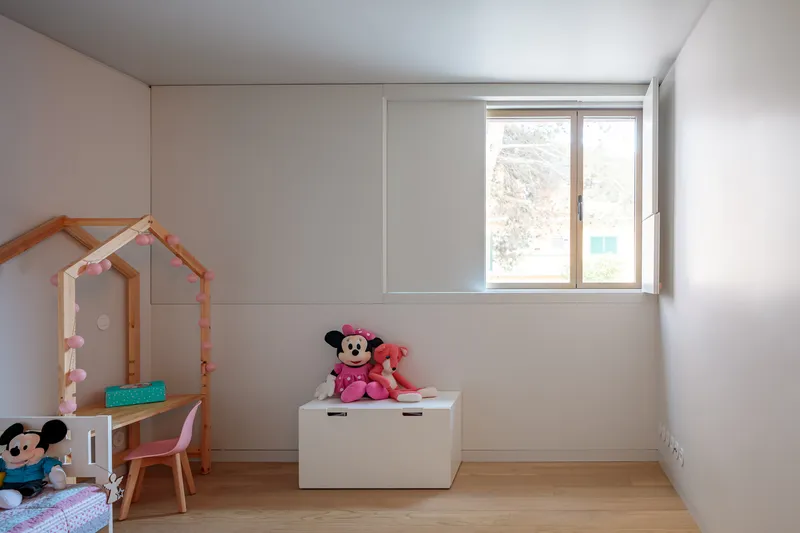
A children's bedroom repeats the logic in a lighter key: built-in white storage keeps the room minimal, pale oak flooring warms the space, and a single punched window frames bare winter branches with the same care that the master bedroom gives to summer greenery. These are rooms designed around restraint, where the view is edited rather than panoramic.
Circulation as Atmosphere
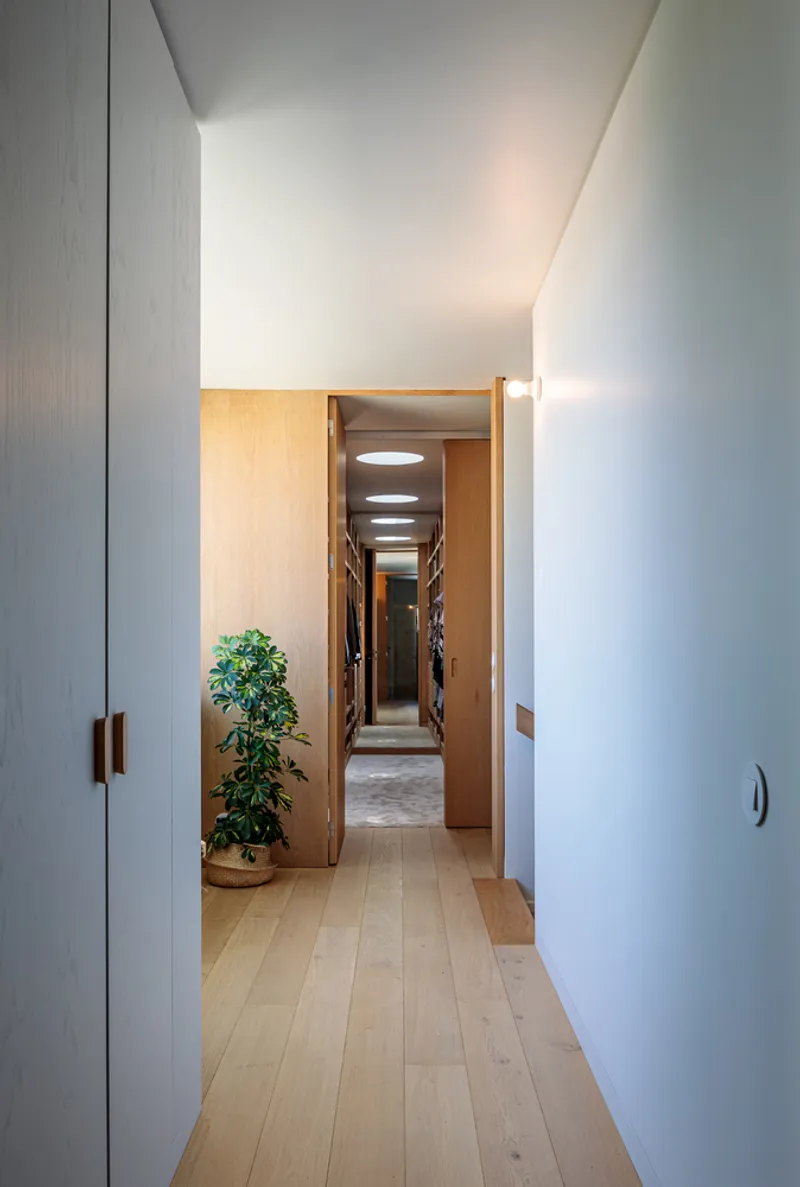
The corridor linking bedrooms is stripped to essentials: light timber flooring, white walls, and a luminous passage that pulls you forward. Nothing hangs on the walls. Nothing competes. It is a decompression chamber between the exuberance of the courtyard below and the seclusion of the sleeping quarters at either end.
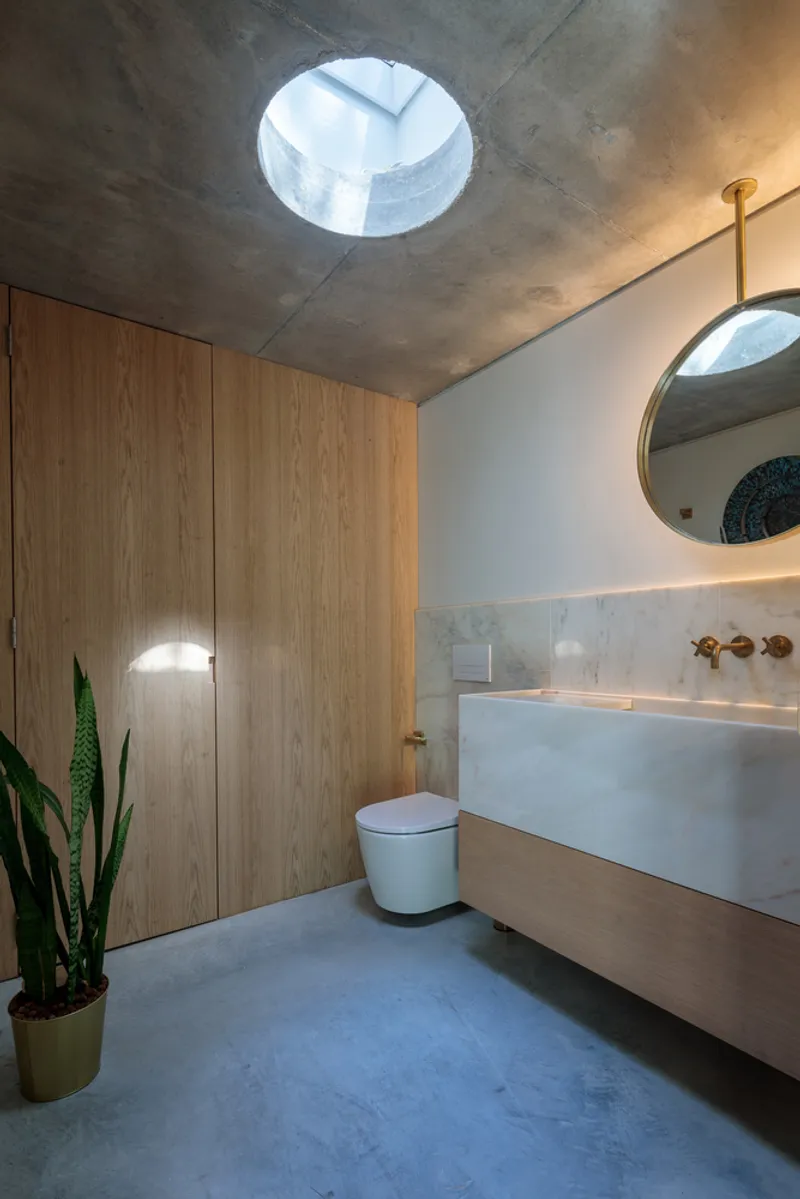
A bathroom tucked beneath a circular skylight reveals how precisely the architects controlled natural light on the upper level. The oculus drops a column of daylight onto a timber vanity and concrete ceiling, turning a utilitarian room into something almost devotional. It is a small move, but it summarizes the house's wider thesis: every opening is an argument about what you should see and how much light is enough.
Plans and Drawings
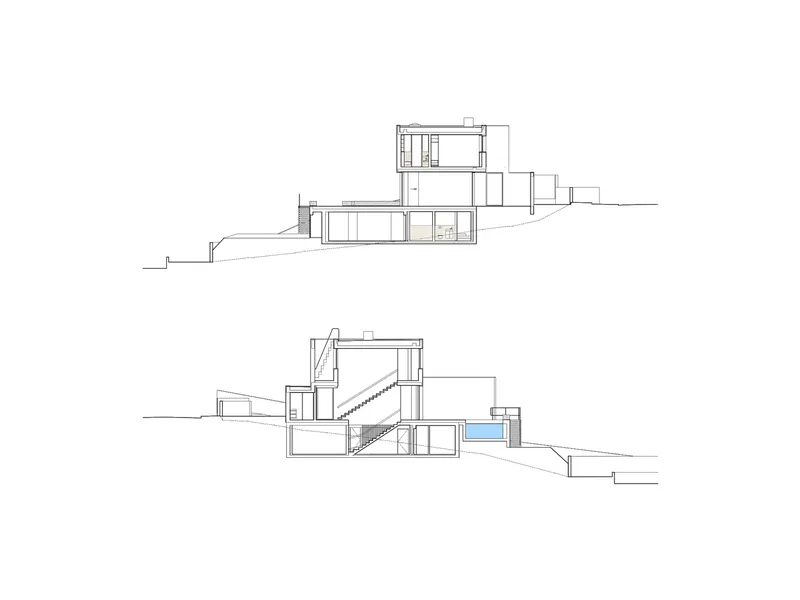
The section drawings reveal the full extent of the slope strategy. The basement plinth absorbs the grade change, embedding the garage, storage, and plant rooms into the hillside while projecting the swimming pool terrace outward at the north end. The ground floor sits atop this plinth, its living spaces opening in two directions: north toward the pool and views, south toward the courtyard. The first floor then steps back, pulling away from the pine canopy and giving the bedrooms their own horizon. Reading the section left to right, you see the house as a staircase of outdoor rooms, each at a different altitude and serving a different degree of exposure.
Why This Project Matters
House in Caxias is a quiet rebuke to the glass-box suburb. Instead of maximizing transparency, João Caetano Arquitetura maximizes selectivity: closed to the street, open to the courtyard, half-open to the pool terrace, filtered to the bedrooms. Every threshold is tuned to a specific degree of privacy and a specific quality of light. The pink render, bold as it is, functions less as a style choice and more as a signal: this is a wall you are not invited past. Behind it, landscape and architecture negotiate on equal terms.
The project also demonstrates that tight masterplan parameters, far from being obstacles, can sharpen an architect's thinking. The constraints of maximum area, storey limits, and offset distances forced a compact, three-level section that actually improves the way the house meets its sloped site. It is the kind of residential work that gains value over years, as the planting matures, the canopy thickens, and the house disappears a little further into the garden it was designed to cultivate.
House in Caxias by João Caetano Arquitetura. Oeiras, Portugal. 370 m². 2016–2023. Photography by Nuno Almendra.
About the Studio
Share Your Own Work on uni.xyz
If projects like this are the kind of work you want to make, uni.xyz is a place to publish your own, find collaborators, and enter design competitions.




Popular Articles
Popular articles from the community


Play: Fragments of Their World
Familiar architecture becomes modular playground design, creating safe spaces where displaced children can learn, connect, imagine and play.

The Musturak Paradise: Senior Living Architecture for a Connected Future in Temara, Morocco
The Musturak Paradise reimagines senior living architecture in Temara via private homes, social spaces, culture, community, and shared care.

Riyadh For All: Intergenerational Urban Design for Active Aging in Rabat
Riyadh For All reimagines urban design in Rabat with intergenerational co-living, adaptive courtyards, and Moroccan cultural exchange today.

Co-Life: Senior Housing Design That Reconnects Older Adults With the City
Co-Life reimagines senior housing design through healing gardens, shared streets, workshops, and a sustainable community across generations.


Similar Reads
You might also enjoy these articles


Hodi-Mandai Geram
Project Function: Preservation and revitalization of the Intangible heritage and socio-spatial identity of the Hodi by Housing, Cultural Memory Center, Sacred Grove, landscape, local tourism economy


Olio Towers: A Mid-Rise for Performers That Fuses Housing, Rehearsal, and Stage
Located blocks from Houston's Theater District, this modular tower stacks living units around a central performance atrium.

Oasis: Modular Green Housing Carved into Dhaka's Urban Fabric
A shortlisted Plugin Housing entry reclaims unauthorized settlements in Dhaka with stepped concrete volumes, green roofs, and ventilation-driven design.

Black Hole: A Floating Megastructure for the Post-Physical Era
Emiliano Mazzarotto envisions a spherical, self-scaling arena where e-sports, digital hotels, and holographic stadiums replace traditional public space.


Explore Architecture Competitions
Discover active competitions in this discipline



Challenge to reimagine the Iron Throne


Photograph architecture without architects


Illustrate the lost glory of Angkor Wat - Render Challenge


Design challenge to reuse E-waste
Comments (0)
Please login or sign up to add comments
No comments yet. Be the first to comment!