
Estúdio Artigas Converts a São Paulo Garage into a Light-Filled Urban House That Breathes
In São Paulo, a 180 m² residence replaces walls and barriers with wood, polycarbonate, and planted corridors that blur inside and out.


The pandemic forced a global rethinking of the house as refuge, but few projects commit to that rethinking as materially and spatially as the House of the Alley (Casa da Travessa) in São Paulo. Designed by Estúdio Artigas under the leadership of Marco Artigas with collaborator João Rodrigues de Lucca, this 180 m² residence grew out of a direct response to isolation: if a house must contain daily life, it should also breathe, adapt, and maintain an honest relationship with the ground beneath it. The result is an intervention that inserts new wood-framed volumes into an existing urban lot, converting a former garage into a planted corridor and pushing bedrooms onto the roof of an old laundry room.
What makes the project genuinely interesting is not the pandemic backstory but the structural logic. Wood is not decorative here. It is the primary structural and partitioning system, defining new openings that are sealed with translucent double polycarbonate rather than glass. The effect is diffuse, generous illumination without the hard glare of full transparency, and a house that reads as a series of layered thresholds rather than a collection of rooms. Every surface, from perforated metal mezzanine floors to garapeira wood decking, is selected to allow air and light to pass through, making cross-ventilation a spatial experience rather than a mechanical afterthought.
The Planted Corridor: Garage Turned Garden
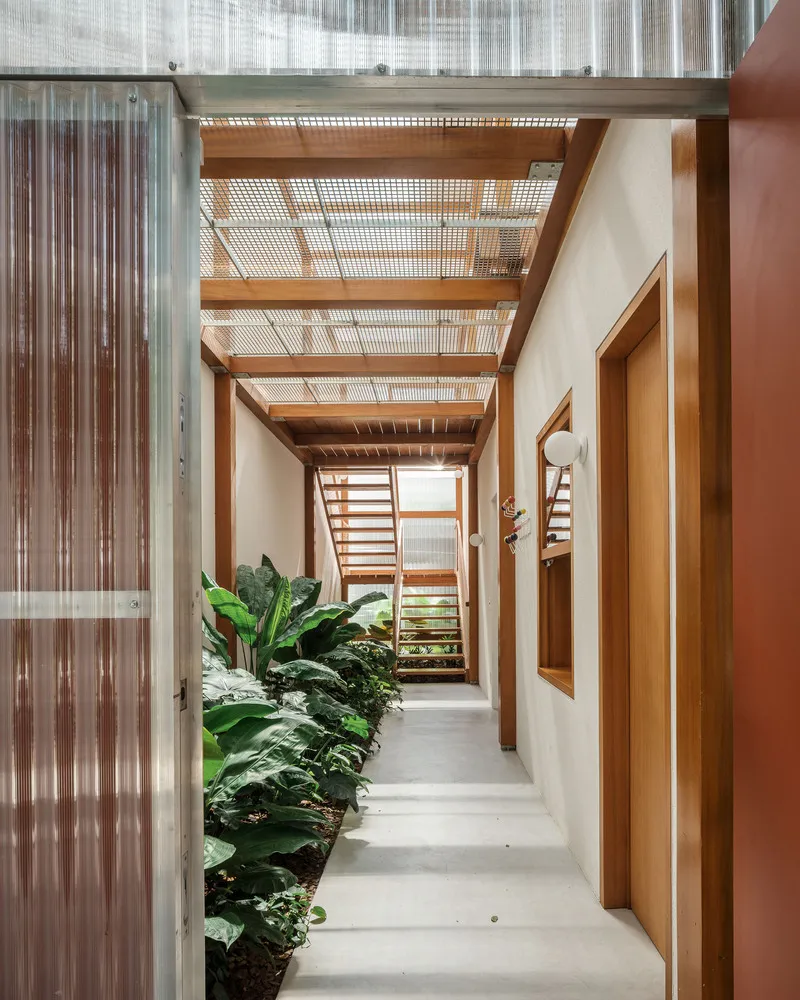
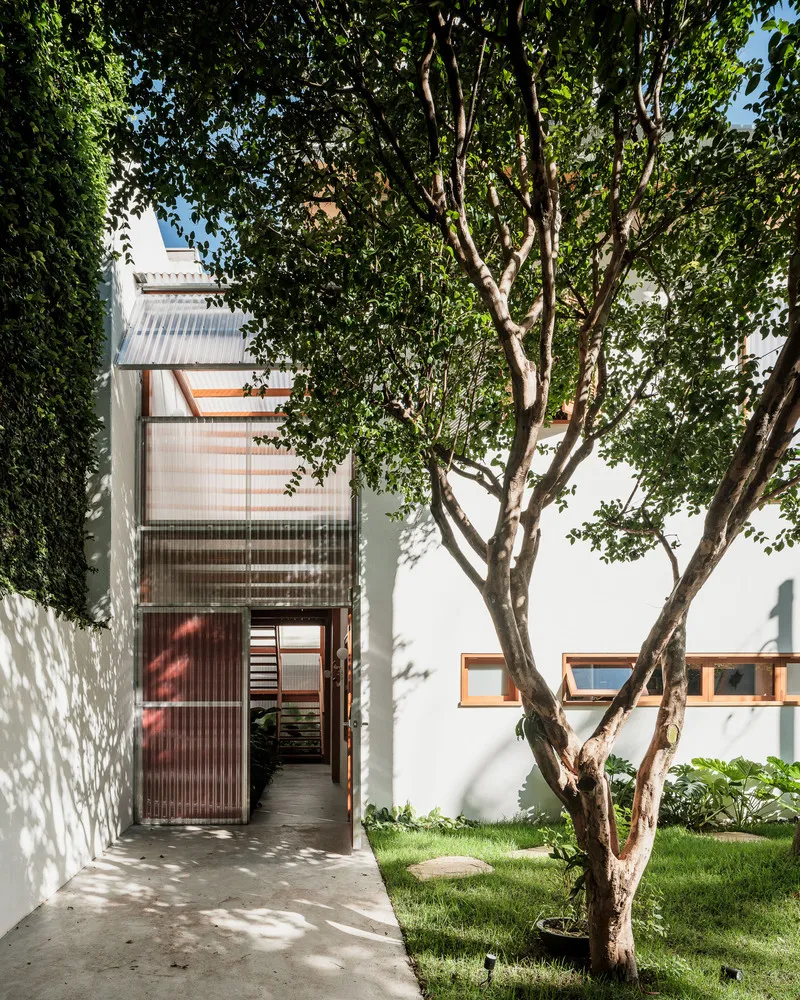
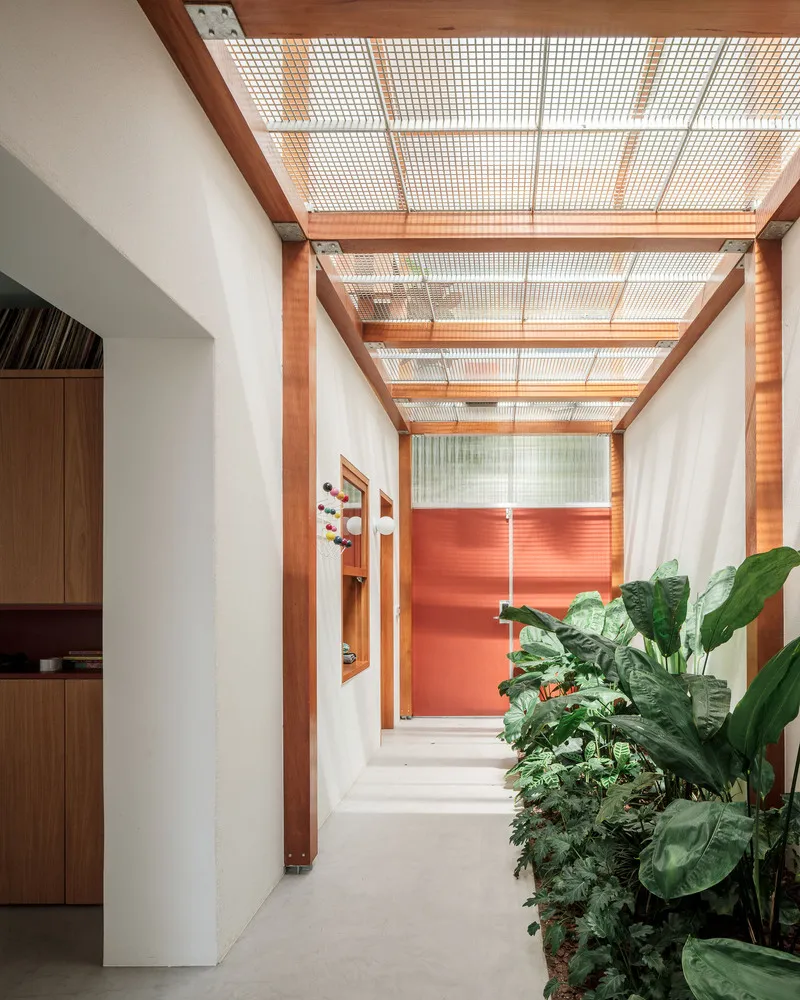
The most dramatic move is also the most visible from the street. The former garage has been gutted and reconceived as a planted entry corridor, flanked by beds of diverse species and roofed with translucent corrugated polycarbonate on a timber pergola frame. The corrugated canopy catches dappled shadows from a mature tree overhead, filtering São Paulo's intense sunlight into something gentler. Corrugated metal lines one wall while concrete remains polished underfoot, producing a material register that is industrial without being cold.
This corridor is more than circulation. It is the house's lungs. Air moves through the planting beds and up through the open staircase beyond, while the translucent roof creates a condition somewhere between indoors and outdoors. The decision to treat the ground plane as garden rather than parking is a small act of urban defiance: the house faces the alley not with a garage door but with foliage.
Vertical Connections: The Open Staircase
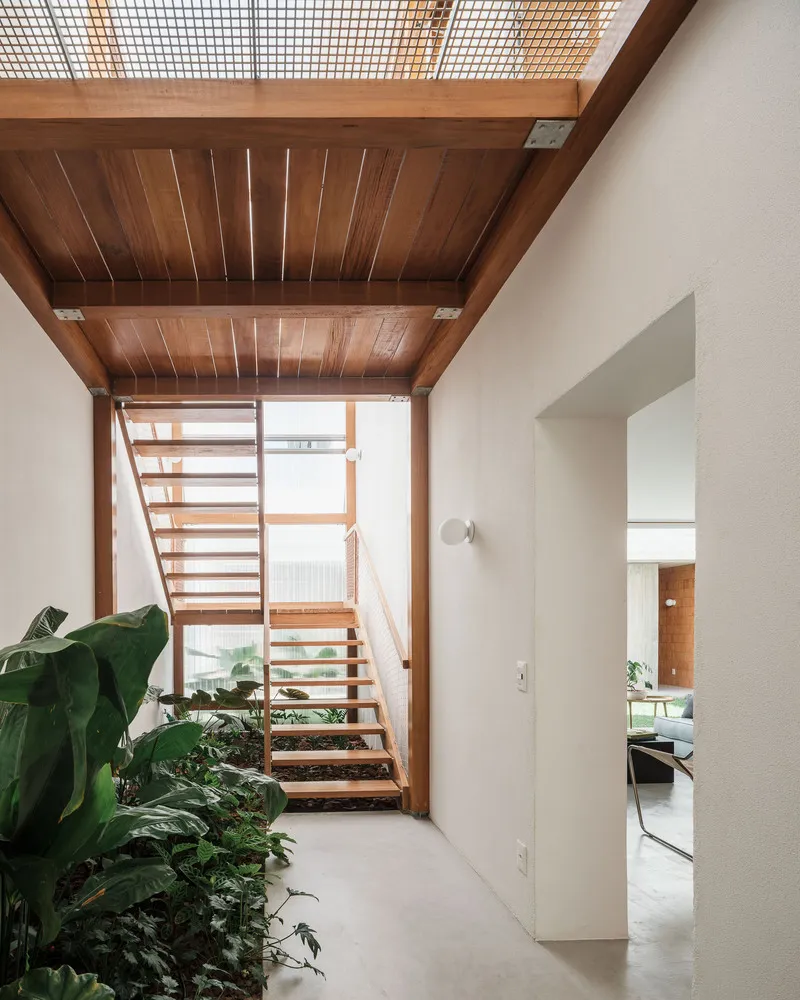
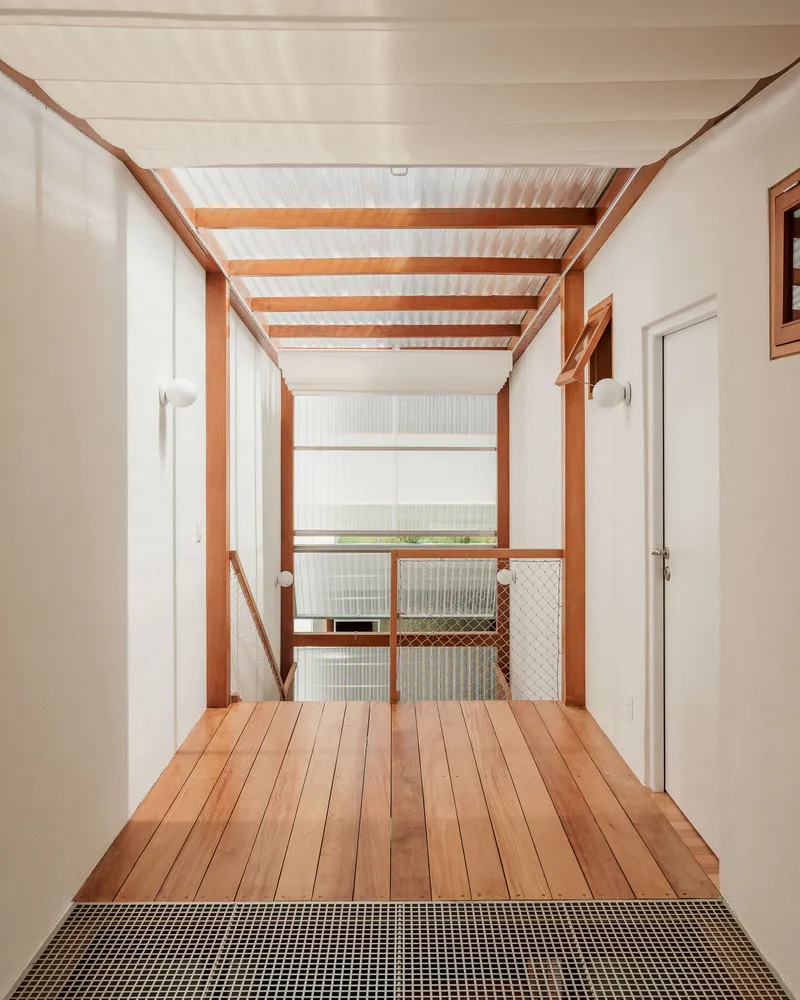
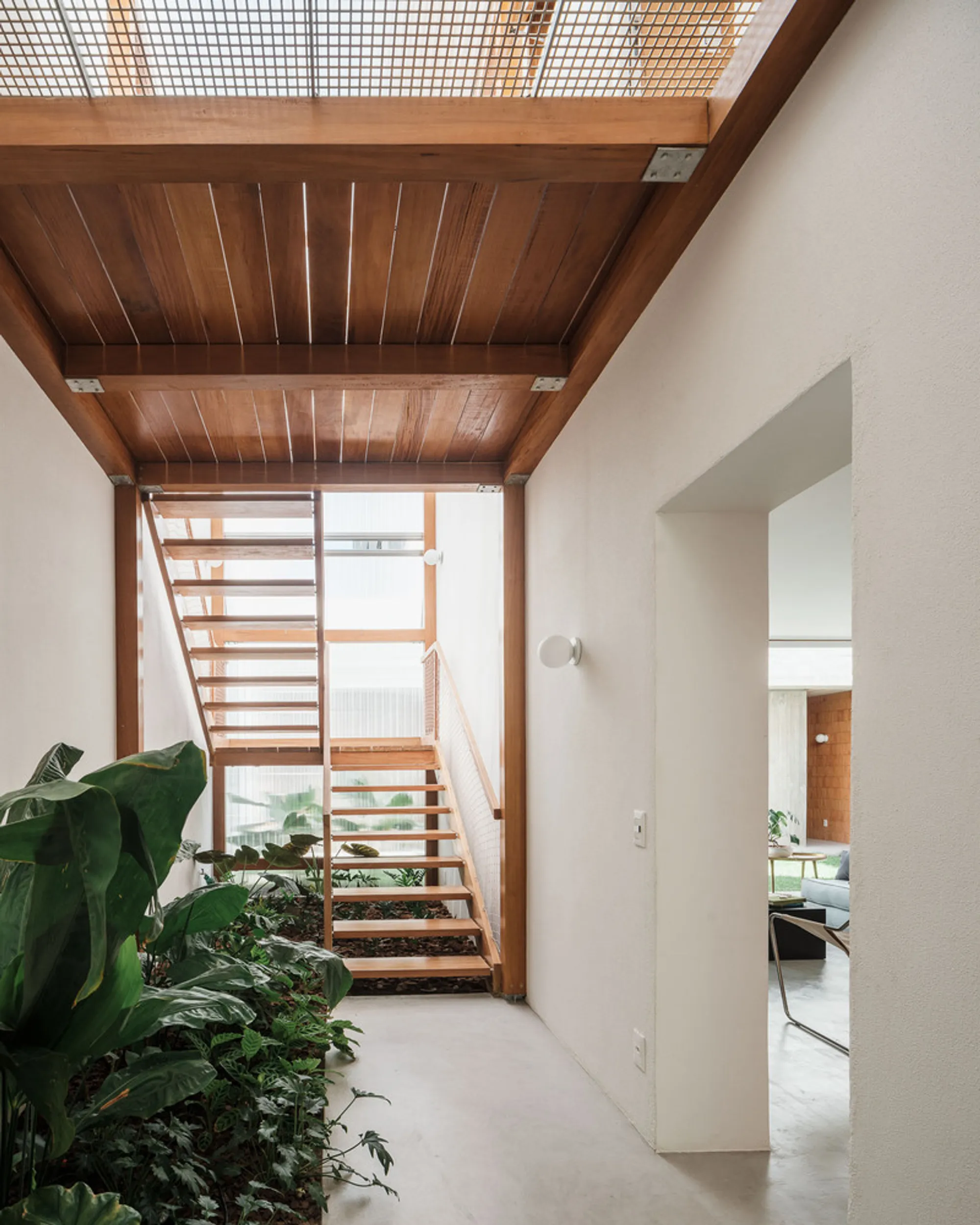
At the heart of the house, a timber staircase rises through a double-height volume lined with exposed beams and white-walled planting beds below. The staircase itself is open, its treads and structure legible, and it terminates at an upper hallway where timber flooring meets a wire mesh balustrade. That mesh is critical: it allows sight lines down to the planted corridor and entry below, maintaining the visual continuity that gives the house its sense of scale.
The intermediate landing, composed of garapeira wood planks and perforated metal sheet, is a clever piece of environmental engineering disguised as architecture. The perforations allow warm air to rise naturally while cooler air enters from the planted ground level. Standing on the mezzanine, you can see the front door, the garden, and the sky through polycarbonate panels simultaneously. It collapses the house into a single connected volume without sacrificing the privacy of the bedroom wing above.
Living Spaces: Wood as Framework and Finish
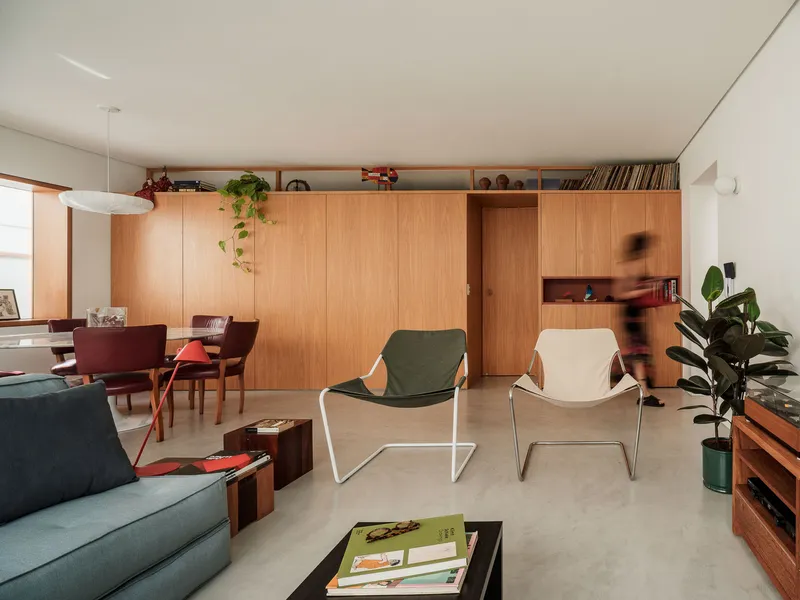
The living room anchors the social floor with floor-to-ceiling oak cabinetry that functions simultaneously as storage, display, and spatial divider. The woodwork here is precise and warm, a deliberate contrast to the raw concrete and corrugated metal elsewhere. Through the timber-framed pergola, a red tile wall and planted courtyard are visible in bright daylight, reinforcing the principle that every interior moment in this house has a corresponding exterior view.
There is a disciplined restraint in how the architects use wood. It appears as structure (beams, frames), as finish (flooring, cabinetry), and as spatial marker (the pergola rhythm), but it never becomes wallpaper. Each application is structurally justified. The central wood frame in the bedroom wing, for instance, supports bathrooms and wardrobes while defining the boundary between private and service zones. Nothing is merely ornamental.
Intimate Rooms: Concrete, Timber, and Daylight
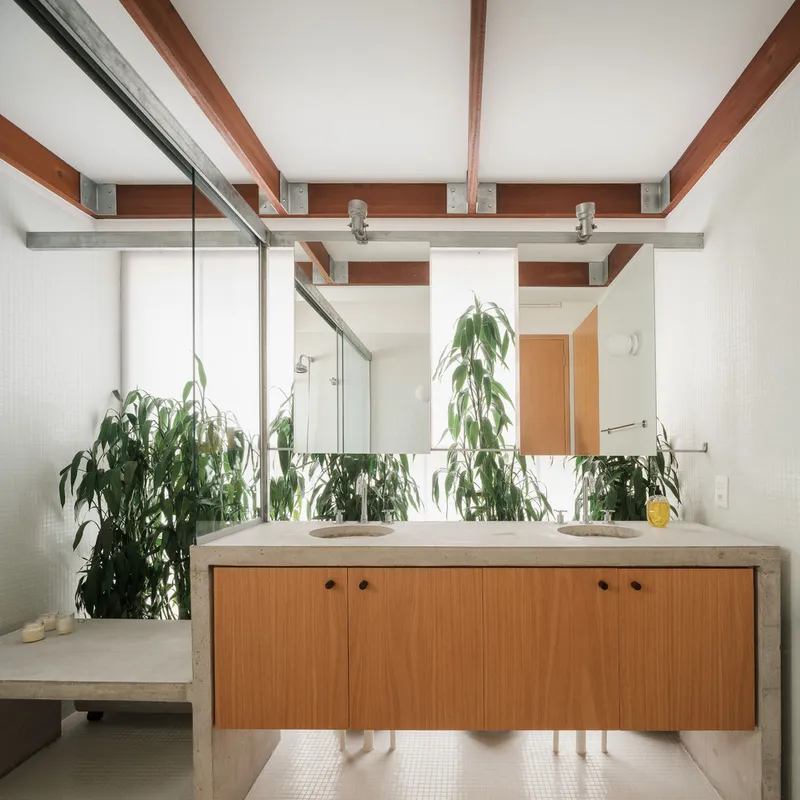
The master bathroom occupies the roof of the old laundry room, a strategic expansion that gains square meters without touching the lot's footprint. Timber cabinetry meets poured concrete surrounds, and exposed beams overhead give the ceiling a rhythm that makes a small room feel generous. Potted plants reflect in the mirror, a detail that connects even this most private space back to the planted logic of the rest of the house.
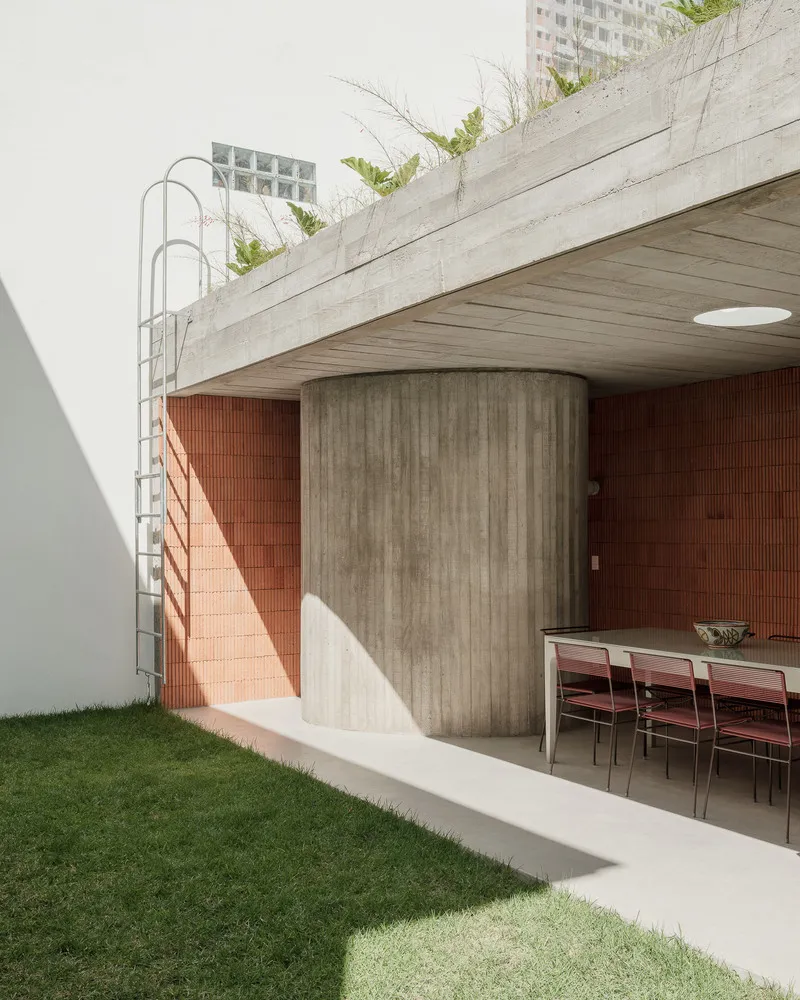
On the terrace side, a cylindrical concrete column and board-formed soffit frame a view of red brick and a metal ladder leading to the roof garden above. The board-formed concrete is left honest, showing the grain of its formwork. A green roof overhead contributes thermal mass and scenic value for the bedrooms. These are unglamorous, functional details, but they accumulate into a coherent environmental strategy: every surface either admits light, channels air, or retains heat.
The Open Annex: Cooking Under the Sky
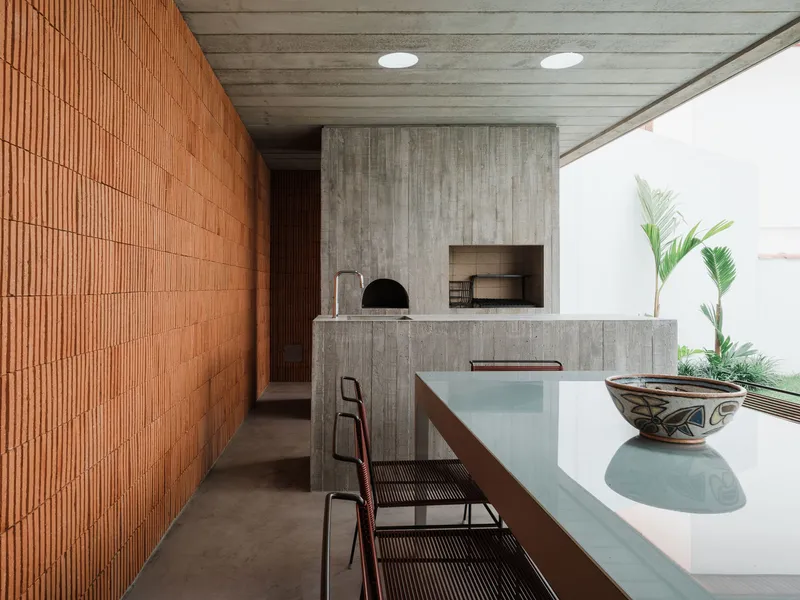
At the rear of the lot, a fully open annex extends the grassy garden with a covered outdoor kitchen. The program is familiar in Brazilian domestic architecture, but the execution is sharp: a board-formed concrete island, a pizza oven set against red tile, and a concrete plank ceiling that reads as heavy but is perforated enough to feel permeable. Exposed masonry and reinforced concrete ensure the annex can handle weather without enclosure.
The annex represents the most extroverted version of the house's core idea. If the planted corridor is semi-outdoor and the bedrooms are fully interior, this kitchen is architecture with almost no walls. It is a social space that belongs as much to the garden as to the house, and it completes a gradient from closed to open that runs through the entire section of the project.
Why This Project Matters
The House of the Alley matters because it treats environmental performance and spatial generosity as the same problem. Too many residential projects in dense urban contexts default to either hermetic enclosure or token greenery. Estúdio Artigas instead builds a house where the structural system (wood), the cladding system (polycarbonate), and the landscape strategy (planted corridors, green roof) all serve the same goal: making interior space feel continuous with the air, light, and vegetation outside. The perforated metal floors, the translucent roofing, the wire mesh balustrades are all pieces of a single ventilation and daylighting diagram, not isolated gestures.
Beyond its technical intelligence, the project offers an urban argument worth paying attention to. By converting a garage into a garden entrance, the house literally turns its face from car storage to planting. It refuses the walled compound model common in São Paulo and proposes, however modestly, a house that engages the alley. At 180 square meters, it proves that a relatively compact footprint can feel expansive when every threshold is designed to reveal what lies beyond it. For a post-pandemic house, that openness is not just aesthetic preference. It is a position on how to live.
House of the Alley (Casa da Travessa) by Estúdio Artigas, São Paulo, Brazil. 180 m², 2024. Lead architect: Marco Artigas. Collaborator: João Rodrigues de Lucca. Landscape design: Rose Sano.
About the Studio
Share Your Own Work on uni.xyz
If projects like this are the kind of work you want to make, uni.xyz is a place to publish your own, find collaborators, and enter design competitions.




Popular Articles
Popular articles from the community


Co-Life: Senior Housing Design That Reconnects Older Adults With the City
Co-Life reimagines senior housing design through healing gardens, shared streets, workshops, and a sustainable community across generations.

Riyadh For All: Intergenerational Urban Design for Active Aging in Rabat
Riyadh For All reimagines urban design in Rabat with intergenerational co-living, adaptive courtyards, and Moroccan cultural exchange today.

The Earth Pod: 3D Printed Homes for Resilient Refugee Communities
The Earth Pod reimagines refugee housing through 3D printed homes made from clay, combining resilience, self-sufficiency, and rapid shelter.

Hill & Cross Opera: Sculptural Opera House Architecture Shaped by Tallinn’s Landscape and Identity
Hill & Cross Opera reimagines opera house architecture in Tallinn through its sculptural hill, civic plaza, glass wave and a luminous cross.


Similar Reads
You might also enjoy these articles


Hodi-Mandai Geram
Project Function: Preservation and revitalization of the Intangible heritage and socio-spatial identity of the Hodi by Housing, Cultural Memory Center, Sacred Grove, landscape, local tourism economy


Olio Towers: A Mid-Rise for Performers That Fuses Housing, Rehearsal, and Stage
Located blocks from Houston's Theater District, this modular tower stacks living units around a central performance atrium.

Oasis: Modular Green Housing Carved into Dhaka's Urban Fabric
A shortlisted Plugin Housing entry reclaims unauthorized settlements in Dhaka with stepped concrete volumes, green roofs, and ventilation-driven design.

Black Hole: A Floating Megastructure for the Post-Physical Era
Emiliano Mazzarotto envisions a spherical, self-scaling arena where e-sports, digital hotels, and holographic stadiums replace traditional public space.
Explore Architecture Competitions
Discover active competitions in this discipline



Challenge to reimagine the Iron Throne


Photograph architecture without architects


Illustrate the lost glory of Angkor Wat - Render Challenge


Design challenge to reuse E-waste
Comments (0)
Please login or sign up to add comments
No comments yet. Be the first to comment!