

House of the Brick Veil: Passive Design for Six People on a Narrow Urban Lot
An undulating perforated brick facade and split-level section turn a tight infill site into a cross-ventilated home for three generations.


Stack six half-levels inside a narrow infill lot, wrap the street face in perforated brick, and carve a courtyard down the center. What you get is not a compromise between density and comfort but a genuine argument that the two can reinforce each other. The House of the Brick Veil is a residential project that treats every constraint of its site, a tight interior lot facing a busy pedestrian street in a tropical climate, as a design driver rather than a limitation.
Designed by Hazal Turgutlu and published on uni.xyz, the project houses an extended family of six: two architects, their three children, and a grandmother. The brief demanded dedicated work-from-home and client-meeting spaces, play zones for the kids, accessible greenery for the grandmother, and enough privacy that three generations could share a single structure without friction. Turgutlu's answer is a house that breathes, literally and programmatically, through a split-section strategy, a permeable facade, and a central courtyard that functions as the building's lung.
An Undulating Brick Screen That Filters Light, Air, and Gaze
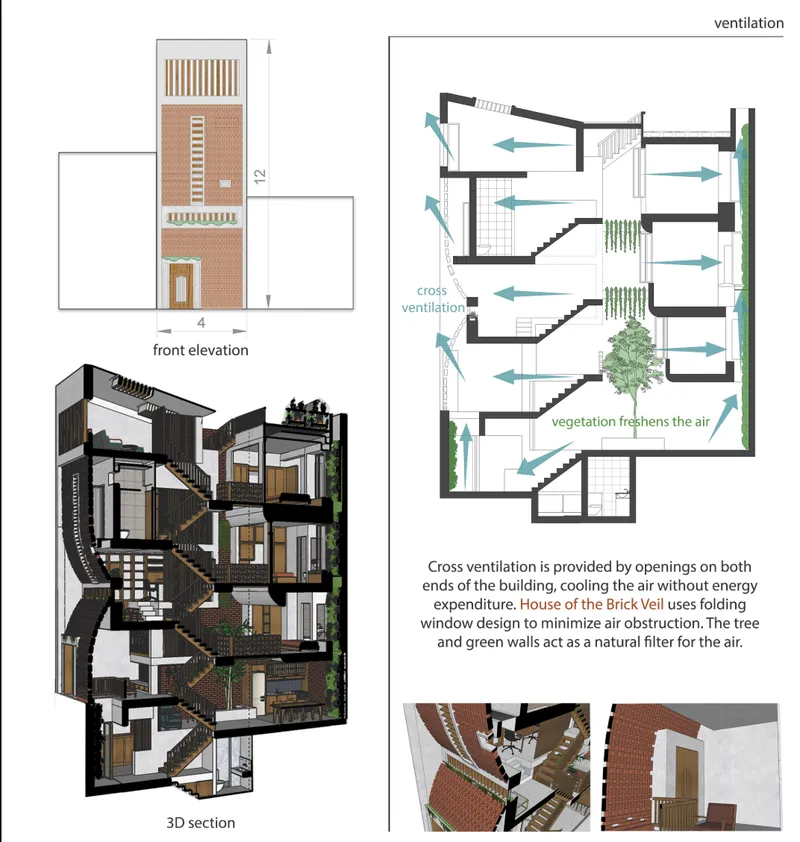
The front elevation, three-dimensional section cutaway, and ventilation diagrams shown here reveal how the undulating brick facade operates as more than ornament. Annotated airflow arrows trace cross ventilation paths from the perforated street-side screen through the interior and out the rear openings. The brick pattern is calibrated to admit filtered daylight while minimizing direct visual exposure from the pedestrian street, a passive climatic filter that simultaneously solves privacy. Behind the veil, folding windows at multiple levels let occupants fine-tune openness depending on weather and time of day.
Three locally sourced materials define the palette: brick, exposed concrete, and teak wood. The warmth of teak counters the rawness of the structural concrete, while the brick facade ties the house to its urban context. Together, they create a material language that feels both modern and grounded, avoiding the imported-finish aesthetic that often plagues tropical residential projects chasing sustainability credentials.
Daily Life Across Half-Levels: Shared Spaces Without Conflict

These hand-illustrated perspectives bring the house to life by populating its rooms with colorful furniture and actual use scenarios. You can see the brick walls carrying through to the interior, creating continuity between the protective exterior and the domestic spaces within. The drawings capture something that plans alone cannot: the quality of light filtering through the perforated facade, the presence of indoor greenery along walls and beside stairways, and the way half-level shifts create visual connections between floors without collapsing them into a single open volume.
The programme reflects a careful reading of who lives here and how. The grandmother's room sits on the second floor alongside a multipurpose space, positioned to give her proximity to the central courtyard greenery she loves without demanding she climb to the upper levels. The children's bedrooms occupy the third floor, buffered from the parents' private suite on the fourth. A mezzanine-level home office provides the architect couple with a dedicated workspace for client meetings, separated from the ground-floor lounge and kitchen where social life happens. Every half-level shift negotiates a different boundary between shared and private territory.
Six Levels on a Tight Footprint: The Section as Strategy
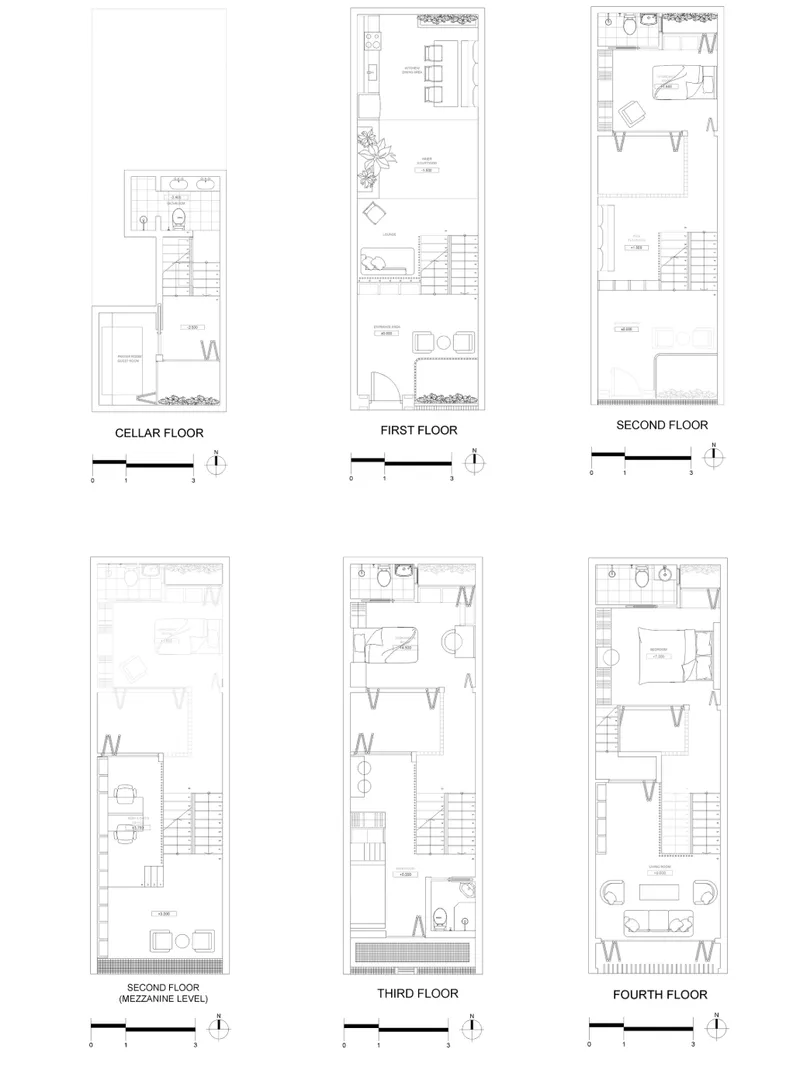
The floor plans, spanning cellar through fourth floor, show how Turgutlu extracts maximum programme from minimal ground coverage. A basement multipurpose guest room and bathroom sit below grade. The first floor holds the entry mudroom, lounge, kitchen and dining area, and the critical inner courtyard that splits the plan vertically. From here, stairways and bridges knit the levels together, ensuring natural light and airflow reach every corner. The courtyard is not leftover space; it is the organizational spine of the entire section, generating the exposed surfaces that make passive cooling viable in a humid tropical climate.
Green walls, a central tree within the courtyard, and strategic planting act as air filters and cooling agents, reducing the heat load that would otherwise demand mechanical intervention. The result is a compact house that handles humidity through architecture rather than equipment: perforated brick, indoor vegetation, operable windows, and a section designed to stack warm air upward and draw fresh air in from below.
Why This Project Matters
Passive house design is often presented through the lens of detached suburban homes with generous sites and hefty insulation packages. The House of the Brick Veil reframes that conversation for the conditions where it matters most: dense, tropical, space-constrained neighborhoods where mechanical cooling is an energy burden and privacy is constantly under pressure. By treating the facade as a climatic device, the section as a ventilation strategy, and the courtyard as a shared ecological core, Turgutlu demonstrates that passive principles scale down without losing potency.
What makes the project especially convincing is its refusal to separate performance from domesticity. The split-level arrangement is not just an airflow diagram; it is a social diagram, giving a grandmother, three children, and two working parents room to coexist with dignity. The brick veil is not just a shading device; it is the face the family presents to a busy street, porous enough to stay connected to urban life but opaque enough to protect the intimacy inside. That dual reading, technical and human, is what elevates this from a capable student exercise into a genuine proposition for urban housing.
View the Full Project
About the Designers
Designer: Hazal Turgutlu
Enter a Design Competition on uni.xyz
uni.xyz runs architecture and design competitions year-round that reward proposals with spatial conviction and real site intelligence.
Project credits: House of the Brick Veil by Hazal Turgutlu.




Popular Articles
Popular articles from the community


The Ocean Hive: Sustainable Architecture for a Self-Sufficient Civilization at Sea
The Ocean Hive imagines sustainable architecture at sea, where modular habitats, algae, wave power and ocean waste sustain a growing colony.

The Musturak Paradise: Senior Living Architecture for a Connected Future in Temara, Morocco
The Musturak Paradise reimagines senior living architecture in Temara via private homes, social spaces, culture, community, and shared care.
EW PARK: Sustainable Architecture Reimagines the Future of Urban Parking
EW PARK reimagines city parking as a modular wooden tower combining automation, solar energy, electric mobility, and adaptable urban design.

Co-life: Sustainable Architecture for Age-Friendly Community Living
Co-life reimagines sustainable architecture for seniors through courtyards, rammed earth, shared gardens, and spaces designed for belonging.


Similar Reads
You might also enjoy these articles

Day and Night Park: A Time-Based Urban Newsstand in Beijing
A temporary urban newsstand in Beijing blending travel, light, and reading through poetic colors, compact form, and community-focused design.

Modernist Patio Renovation in El Masnou, Barcelona by Oliver Segura Arquitectura + Cebrià Arquitectura
Modernist patio renovation blending tradition and innovation with a movable pool, leveled floors, and Catalan materials in El Masnou.

Alto Residencial Coop: Cooperative Housing Development in Santiago de Compostela by Carbajo Barrios Arquitectos
A linear cooperative housing complex blending white volumes and perforated metal façades, enhancing community living, natural light, privacy, and urban integration.

Vil Genis School by BPA ARCHITECTURE – Massy, France
Vil Genis School in Massy, France, features sustainable design, south-facing classrooms, community integration, accessible spaces, and modern educational architecture.


Explore Passive Architecture Competitions
Discover active competitions in this discipline


Challenge to design luxury tourism on rails


Challenge to reimagine the Iron Throne


Photograph architecture without architects


VR headsets Storefront design competition
Comments (0)
Please login or sign up to add comments
No comments yet. Be the first to comment!