
House of the Pink Spot by Frankie Pappas International
House of the Pink Spot transforms a dangerous GBV hotspot into a vibrant community pavilion, promoting safety, dialogue, equality, and empowerment.

Reclaiming Space, Safety, and Rights in Orange Farm
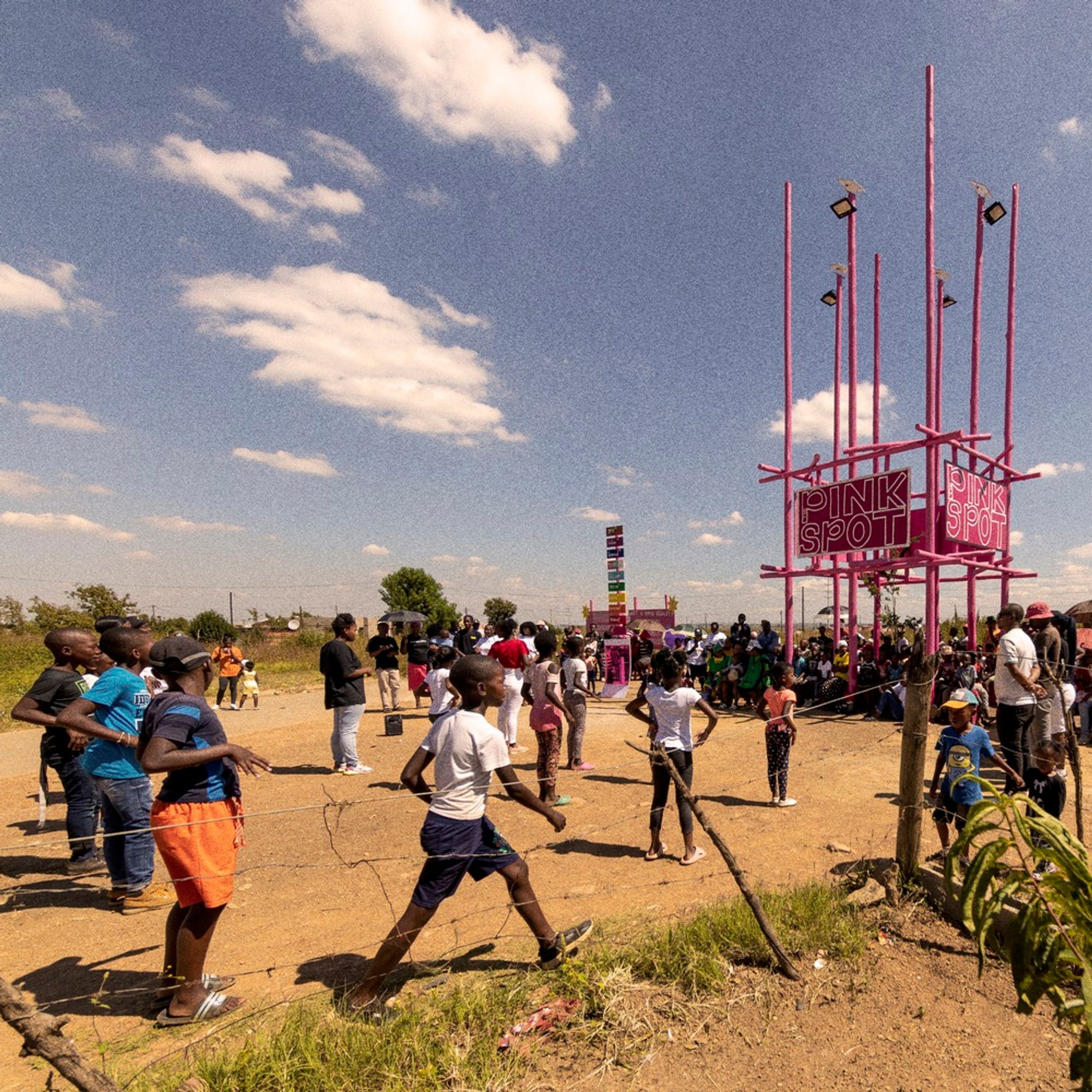
In the heart of Drieziek, Orange Farm, South Africa, House of the Pink Spot by Frankie Pappas International stands as a powerful example of how architecture can catalyze social change. Completed in 2023, this modest 9-square-meter public pavilion is far more than a structure—it is a symbol of resistance, community empowerment, and hope.

A Site Marked by Violence
The chosen site was once recognized as a gender-based violence (GBV) hotspot, an abandoned corner of land that had devolved into a garbage dump. With no working streetlights and little human activity at night, the space became a dangerous zone, amplifying risks of crime and violence. Transforming such a site into a beacon of safety was both urgent and symbolic.
The Vision: A Safe and Visible Landmark
Commissioned through Amnesty International South Africa’s Digital Disruptors Project, the brief was clear—reclaim the space for the community. The pavilion had to serve multiple purposes:
- A shaded seating and meeting point
- A place for dialogue, theatre, and storytelling
- A safe play space for children and a resting spot for elders
- A hub of information on human rights, gender equality, and GBV resources
Through simple yet strategic interventions, the pavilion disrupts a cycle of violence by offering visibility, light, and community presence.

Materiality: Local, Affordable, and Symbolic
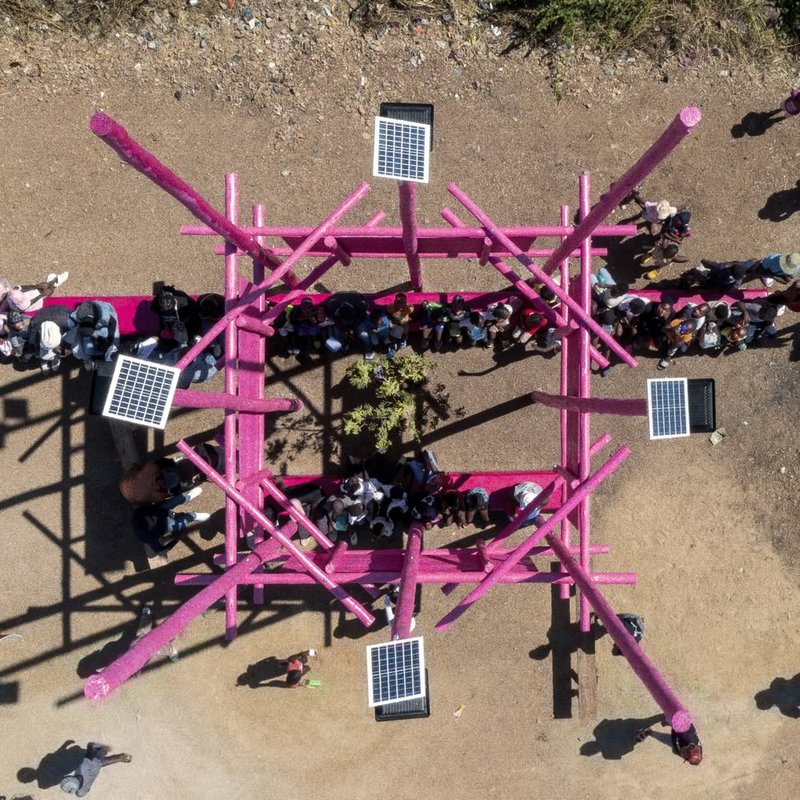
The material palette was deliberately kept local and accessible. All components were sourced from Orange Farm hardware stores:
- Bagged brick seating for durability
- Repurposed telephone poles as structural elements
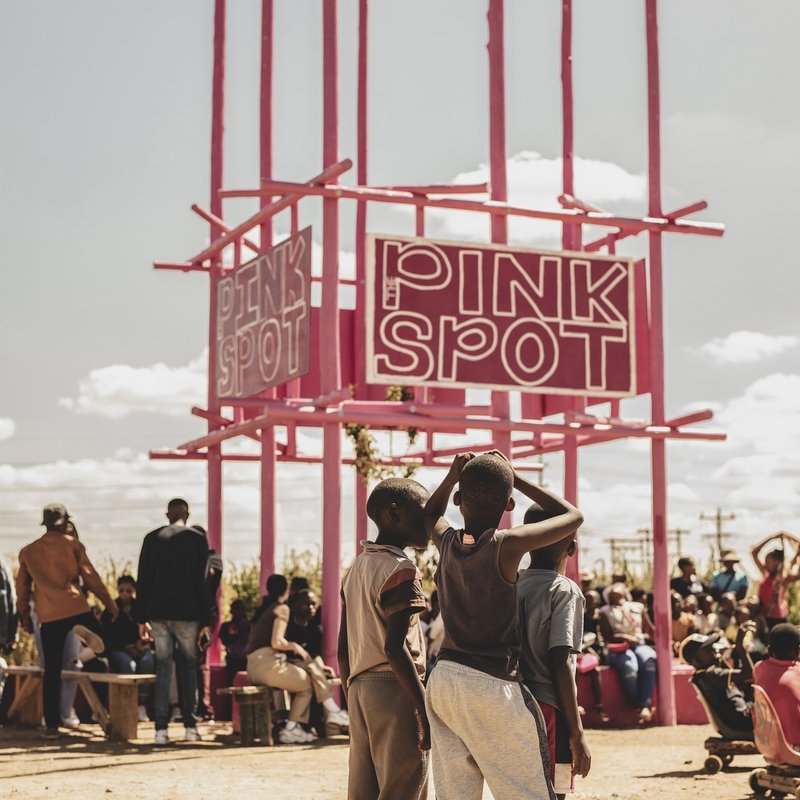
- Shutter ply signage boards carrying human rights education messages
- Buckets of bright pink paint, transforming the space into a visible landmark of resistance
Community members themselves hand-painted the signage, embedding collective ownership into the design.
The Pink Spot: Program and Social Purpose
Despite its small footprint, the House of the Pink Spot functions as:
- A community landmark visible from afar
- A public meeting spot for conversation and learning
- A study space and informal theatre
- A playground and dance hall where creativity and joy can thrive
The design emphasizes that architecture is not only structural but human—a catalyst for community gathering, resilience, and empowerment.
Built by the Community, For the Community
Young activists from Orange Farm, many of whom had directly experienced the effects of GBV, were central to the project. Through community consultations, residents ensured the pavilion reflected collective needs. Volunteers participated in construction, making the project community-led from inception to completion.
Remarkably, the entire installation was built in just two weeks—a testament to what unity, urgency, and shared vision can achieve.

Architectural Solutions Beyond Form
The design uses height, color, light, Wi-Fi access, seating, and shade to encourage safe occupation of the space. Yet, as Frankie Pappas and Amnesty International stress, the true solution lies not in architectural form alone but in community activation. The Pink Spot thrives because people inhabit, protect, and claim it.

A Symbol of Sustainability and Equality
The pavilion is not just about physical sustainability but social sustainability. It reinforces the idea that no sustainable future can exist without women’s safety, equality, and empowerment.
As Amnesty International reminds us:
“Each time a woman stands up for herself, without knowing it possibly, without claiming it, she stands up for all women.”
Architecture as Activism
The House of the Pink Spot exemplifies how architecture can reclaim unsafe public space and transform it into a site of healing and resistance. With its bold pink presence, it stands as a landmark of solidarity in Orange Farm—a reminder that design, when driven by community, can shift narratives and create safer futures.
All photographs are works of Tshepiso Seleke




Popular Articles
Popular articles from the community

Rojkind Arquitectos and Think Parametric Build a Glueless Pavilion from 67 Interlocking Panels
A serpentine fiber-cement installation in Chapultepec Park celebrates a decade of architectural media in Mexico City.
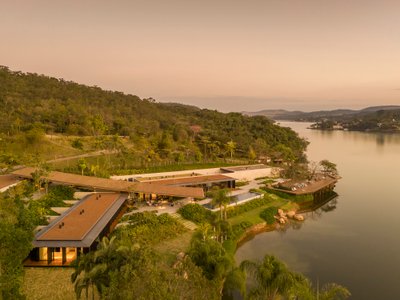
Bernardes Arquitetura Stretches a Timber Roof Along a Reservoir's Edge in Minas Gerais
Dam House in Itaúna lets a sweeping wooden canopy dissolve the boundary between hillside terrain and open water.
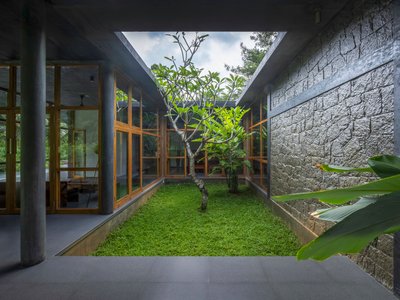
3dor Concepts Wraps a Kerala Home in Mirrored Concrete Arcs Around a Courtyard Tree
In the Western Ghats foothills of Thamarassery, a 270 m² single-story house uses two curved volumes to frame nature as its center.
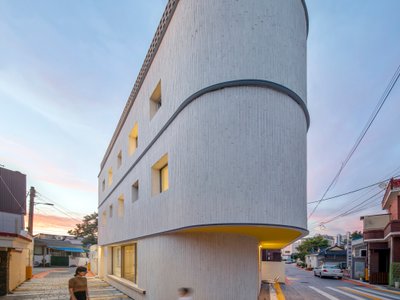
YOAP Architects Round a Corner in Yeongcheon with a Cylindrical Community Hub
A 197-square-meter brick and ribbed-clad tower turns a forgotten alley corner in South Korea into a public garden with a low threshold.


Similar Reads
You might also enjoy these articles

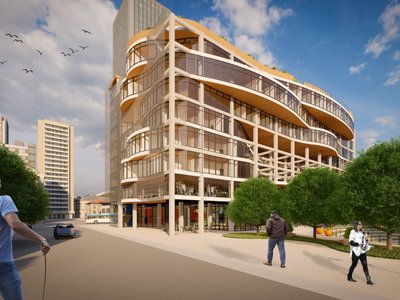
Olio Towers: A Mid-Rise for Performers That Fuses Housing, Rehearsal, and Stage
Located blocks from Houston's Theater District, this modular tower stacks living units around a central performance atrium.

Oasis: Modular Green Housing Carved into Dhaka's Urban Fabric
A shortlisted Plugin Housing entry reclaims unauthorized settlements in Dhaka with stepped concrete volumes, green roofs, and ventilation-driven design.

Black Hole: A Floating Megastructure for the Post-Physical Era
Emiliano Mazzarotto envisions a spherical, self-scaling arena where e-sports, digital hotels, and holographic stadiums replace traditional public space.
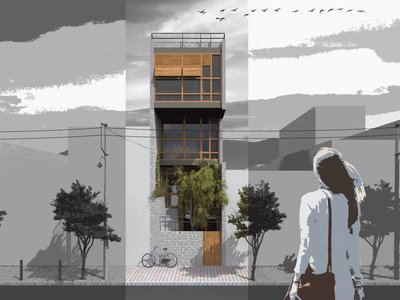
Compact & Sustainable Living in Piraeus: A Four-Level Family Home Built Around Light and Air
A narrow townhouse in one of Greece's densest port cities uses a central atrium and passive strategies to house three generations under one roof.

Explore Architecture Competitions
Discover active competitions in this discipline




The International Standard for Design Portfolios


The Global Benchmark for Architecture Dissertation Awards


The Global Benchmark for Graduation Excellence


Challenge to reimagine the Iron Throne
Comments (0)
Please login or sign up to add comments
No comments yet. Be the first to comment!