
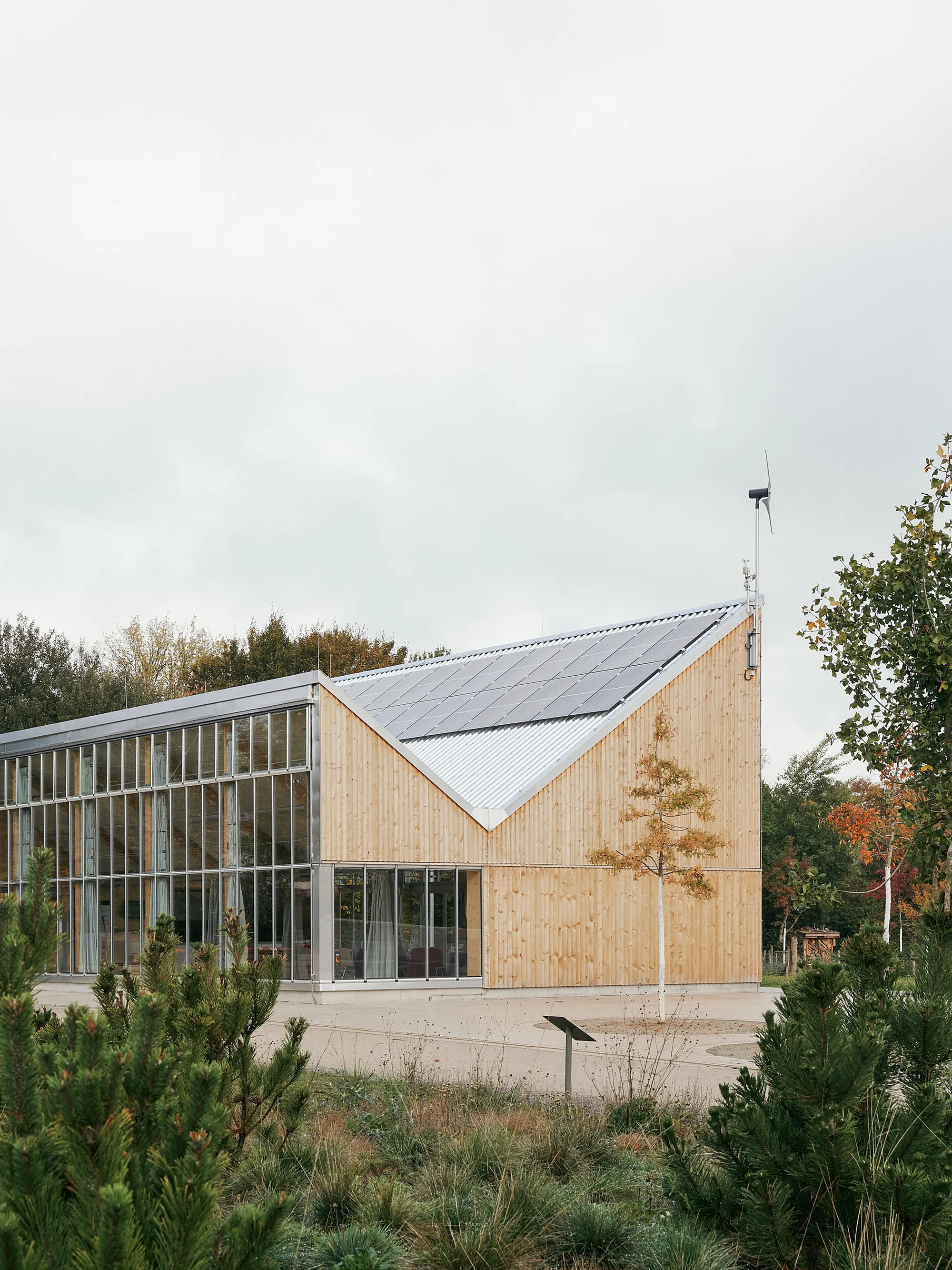
House of the Seasons: A German Climate Pavilion
New Architekten and Jutta Albus Architektur built a 235 m² climate pavilion in Schwerte, Germany that pairs a greenhouse with a timber hall.


Schwerte is a small town in Germany's Ruhr region, the kind of place that does not often appear in international architecture media. The House of the Seasons, a 235 square metre climate pavilion completed in 2025 by New Architekten and Jutta Albus Architektur, is the kind of small public project that should change that. It is one of the more interesting tests yet of an idea that German architecture has been arguing about for the last few years.
That idea is the Building Type E initiative, which roughly translates as simple building. The argument behind it is that German construction has become so over-engineered, so insulated against every possible climatic condition, that buildings are now more expensive, more carbon-intensive, and less pleasant to inhabit than they need to be. Building Type E proposes the opposite: structures that respond to climate instead of resisting it.
A Pavilion as an Experiment
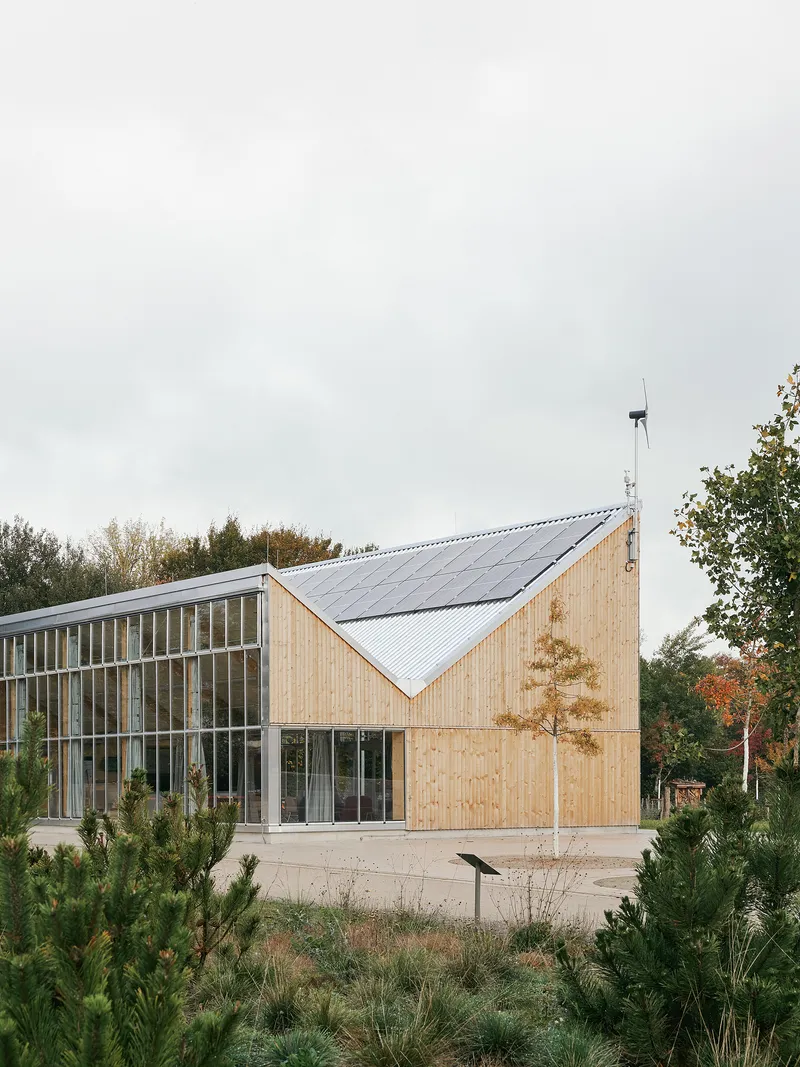
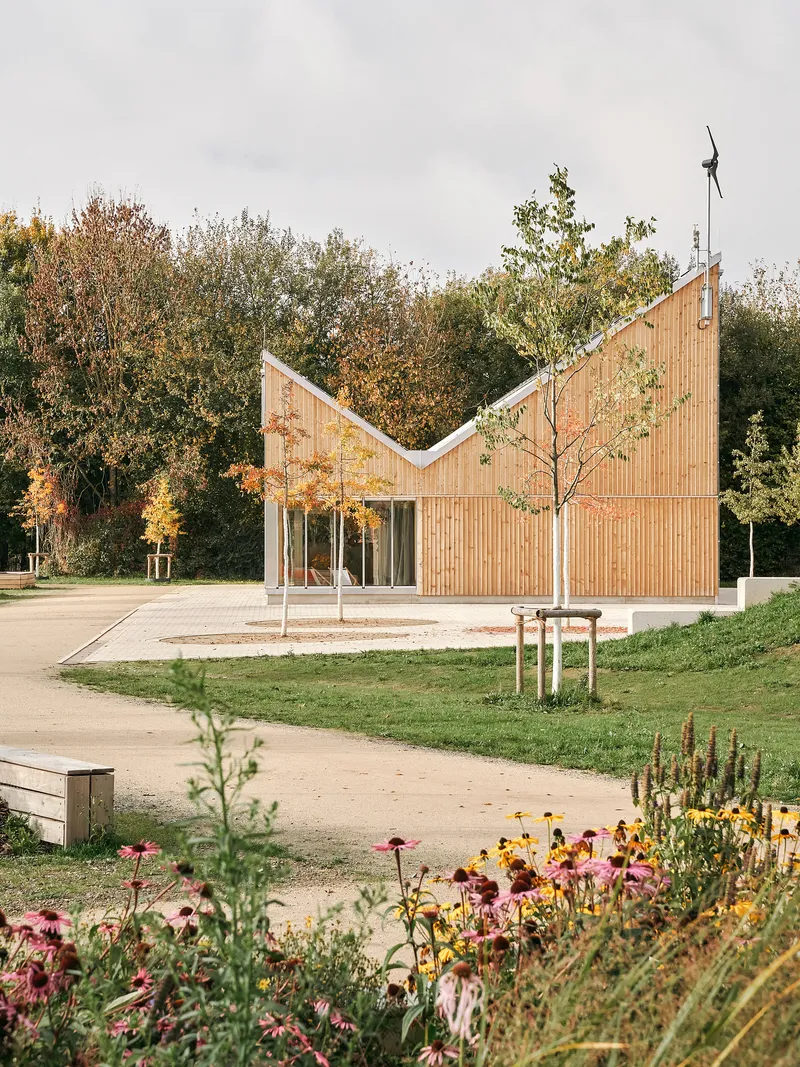
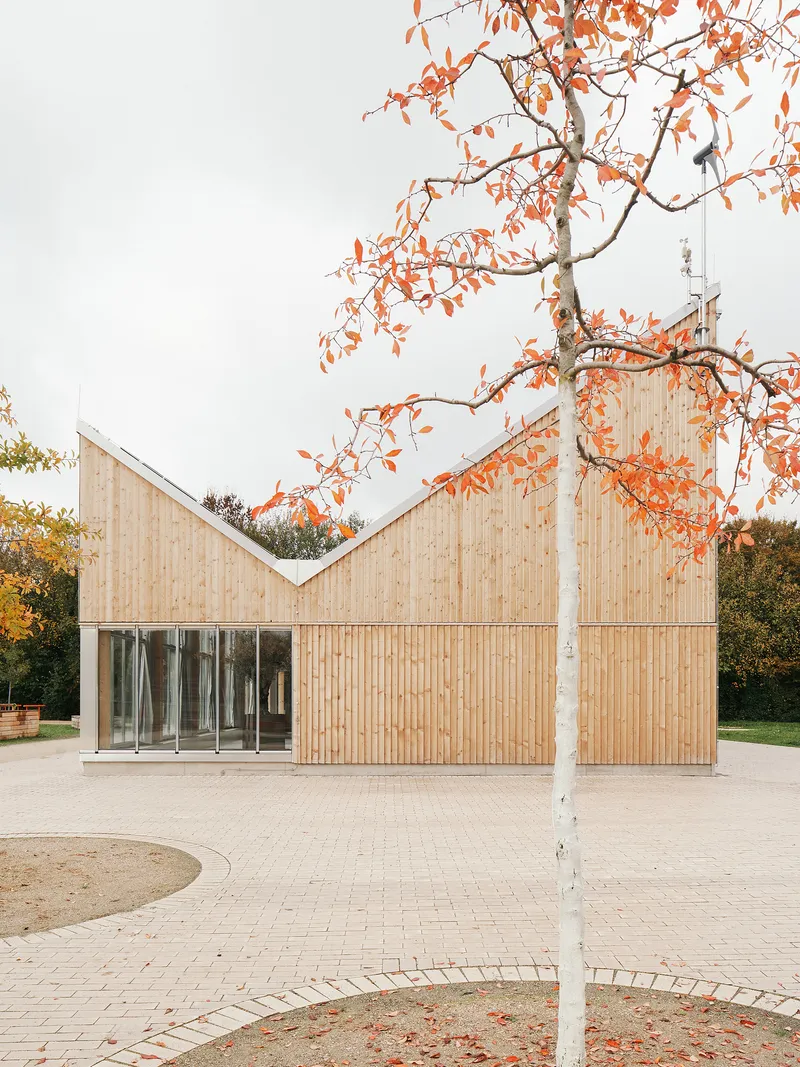
The House of the Seasons is what the architects call an applied architectural experiment. It sits in a public garden, called the Climate Garden, and the building's job is to demonstrate, in the most legible way possible, what happens when you stop trying to seal a building off from the weather.
The brief was difficult and the result is unusually direct. The interior is not climate-controlled in the conventional sense. It is conditioned by passive strategies: orientation, thermal mass, daylight, natural ventilation, and a long greenhouse facade that warms the interior in winter and shades it in summer. The pavilion changes through the year, the way buildings did before mechanical systems took over.
The Greenhouse and the Timber Hall
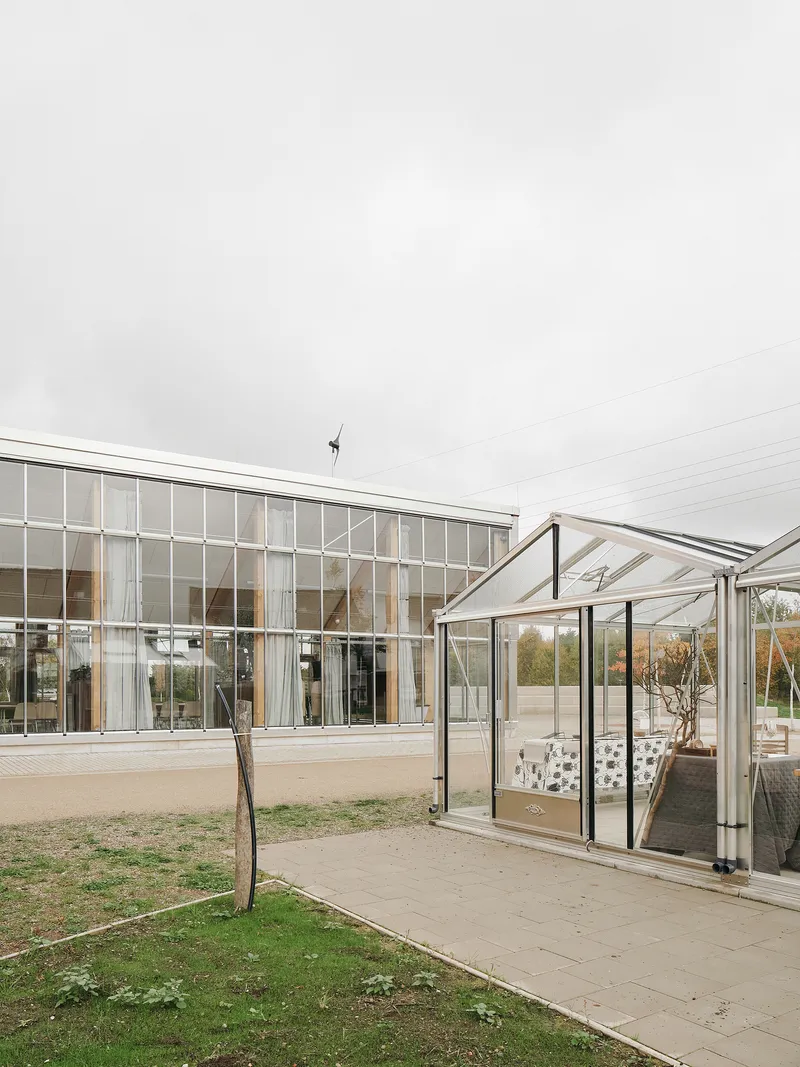
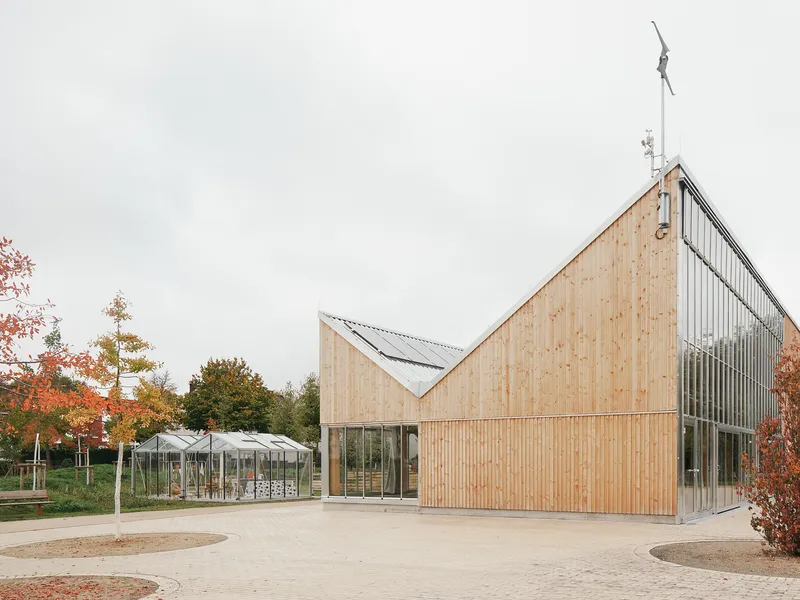
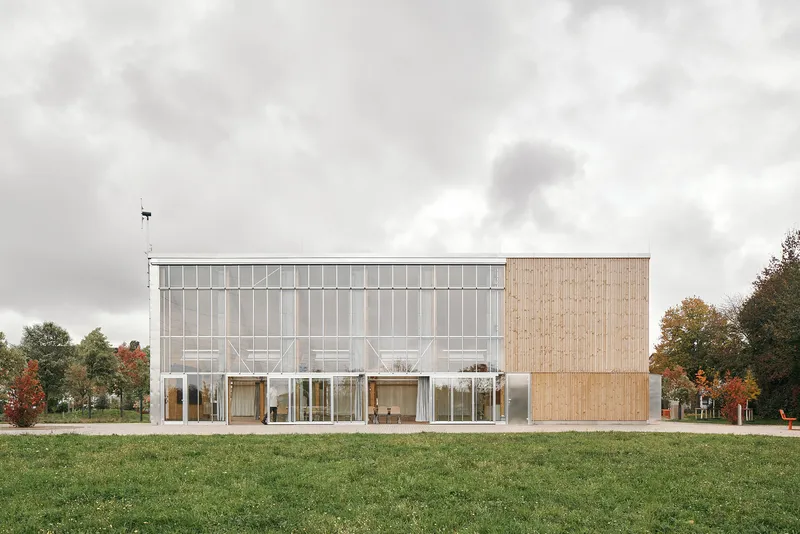
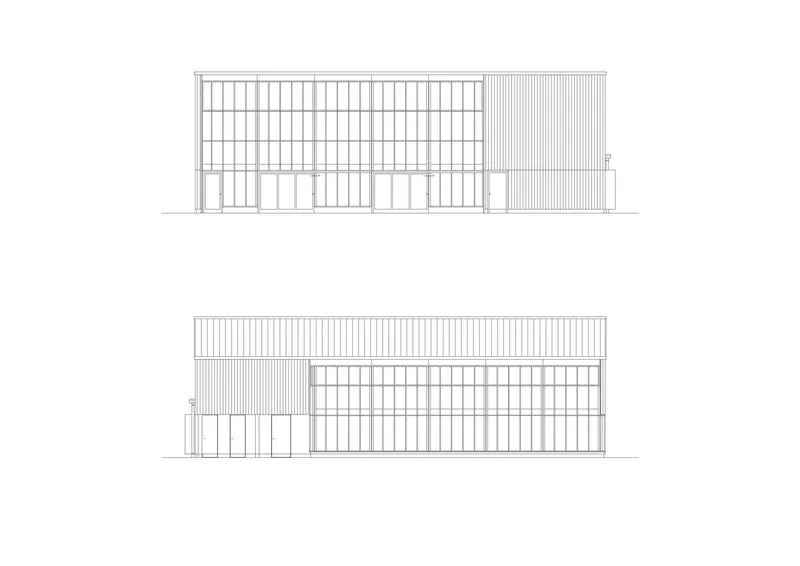
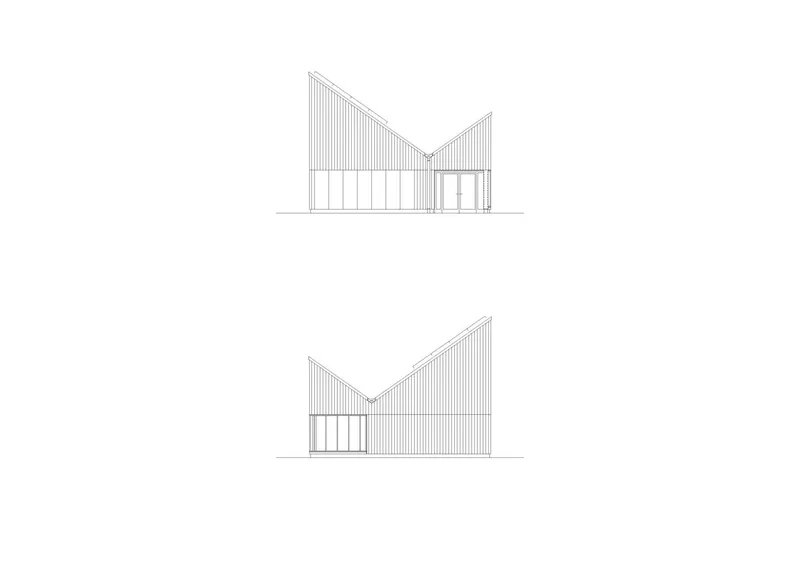
The plan pairs two volumes. On one side, a tall greenhouse hall built from a steel-and-glass curtain wall that looks deliberately agricultural. On the other, a timber-clad volume with a folded asymmetric pitched roof. The two halves share a structure of exposed glulam columns and beams, so the building reads as a single object even though the two climates inside it are very different.
This pairing is the core idea. The greenhouse acts as a thermal buffer. In cold months it traps the sun's heat and pushes it into the timber hall. In warm months it ventilates and shades. The cost of mechanical heating and cooling drops to almost zero. The architecture does the work.
The Roof, the Sun, and the Wind
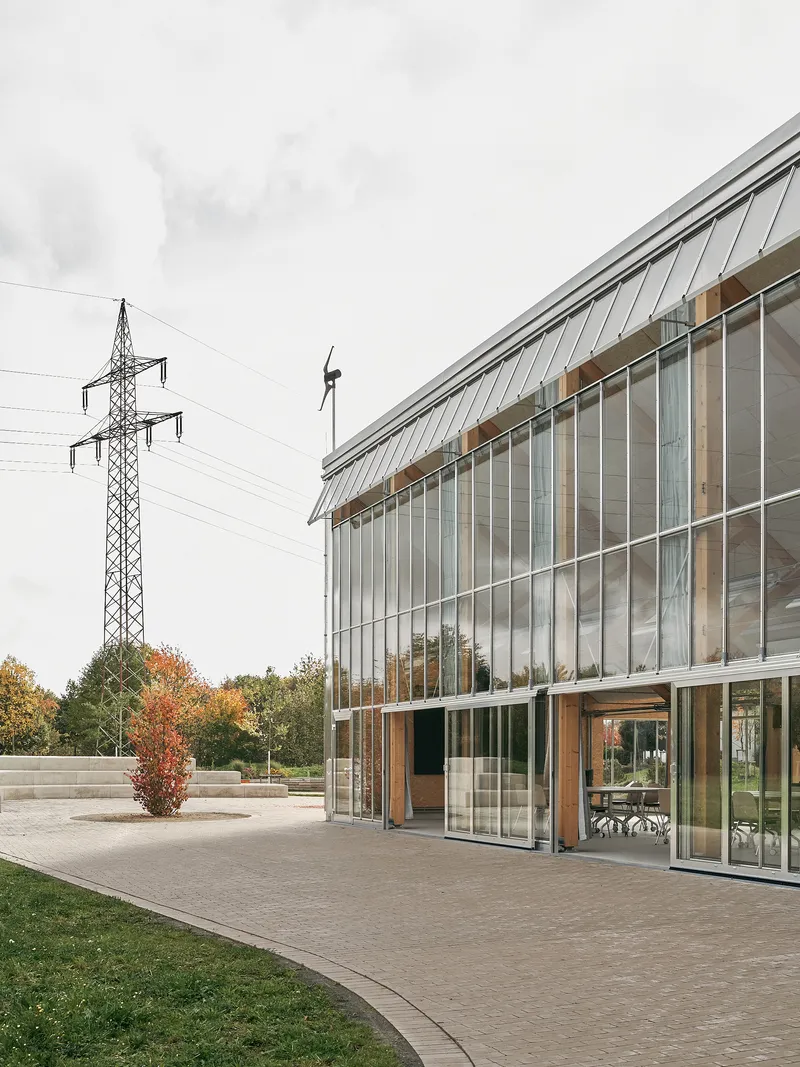
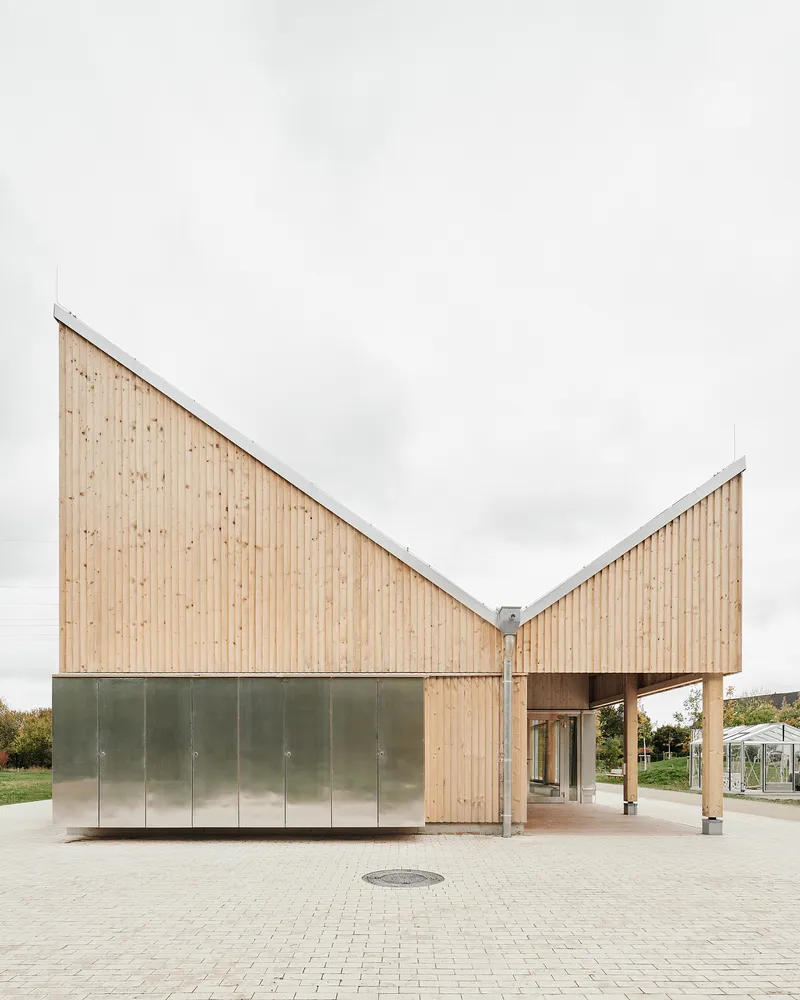
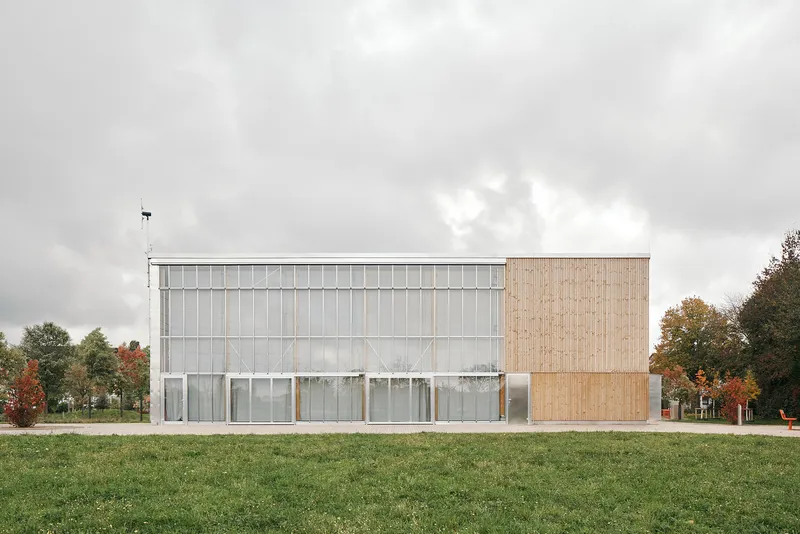
The roof is doing two jobs at once. The pitched south-facing slope carries solar panels. A small wind turbine sits at the ridge. Both are integrated into the architecture rather than bolted on as afterthoughts, which matters because most photovoltaic installations on public buildings still look like accessories. Here they look like part of the original idea.
The asymmetric profile of the roof, with its sharp folds and zinc flashing, gives the building its silhouette. From a distance it reads as a barn that has been pulled apart and put back together along different lines. That description is not quite right, but it is close enough to suggest where the form comes from: a regional vernacular reworked for a contemporary purpose.
Material Choice as Carbon Strategy
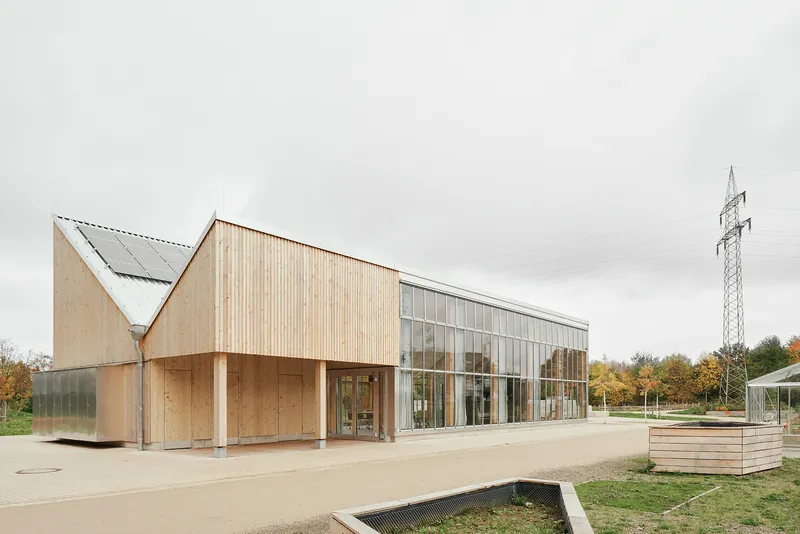
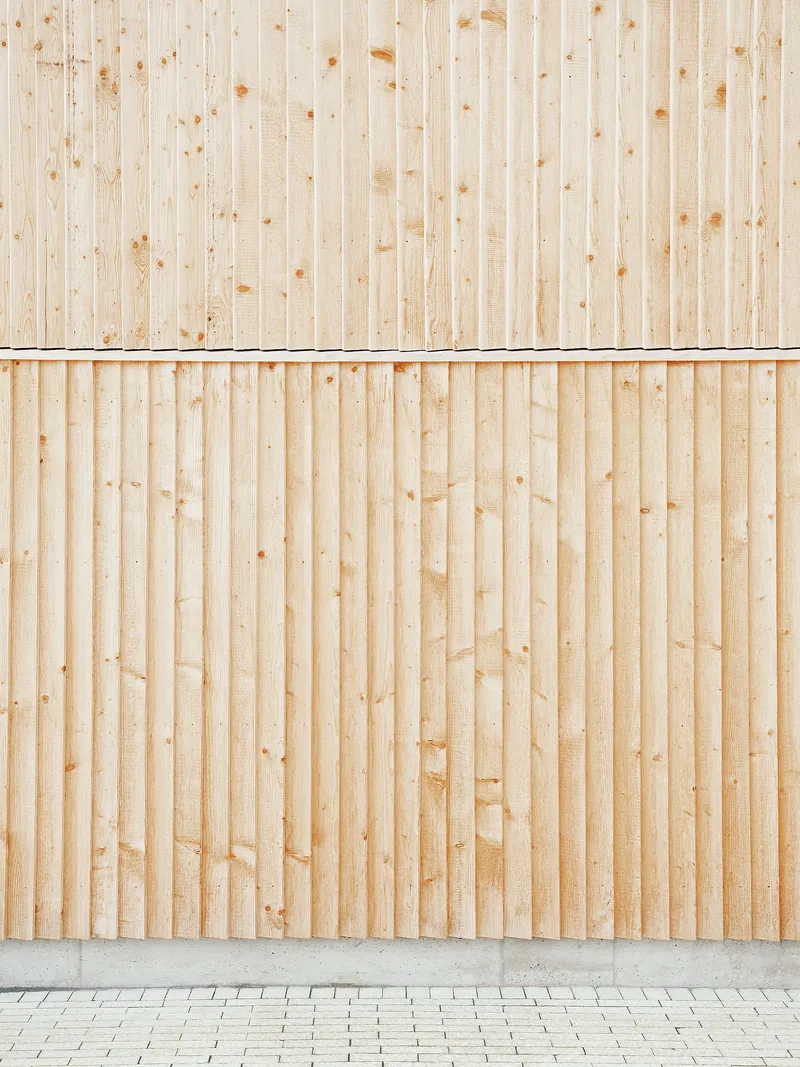
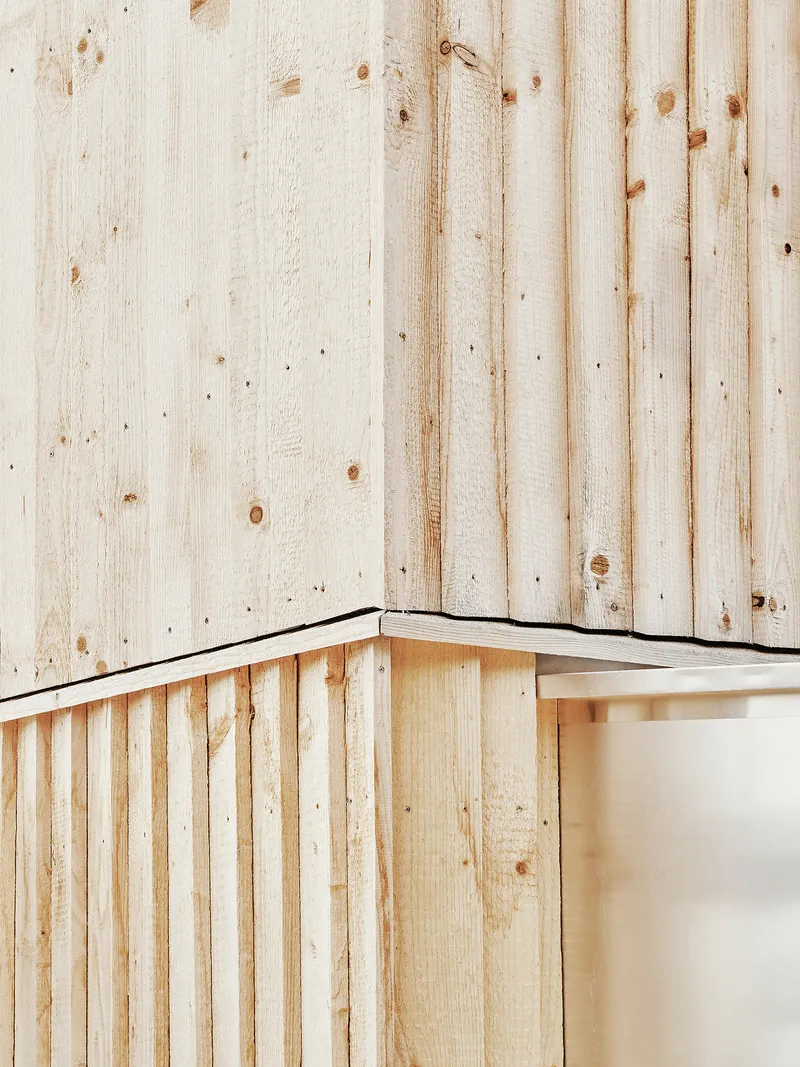
The building is constructed almost entirely from natural materials. The structure is glulam timber. The cladding is vertical larch boarding. The interior ceiling and acoustic panels appear to be hempcrete or wood-fibre composite. The base is wrapped in folded zinc, which is the only non-renewable layer and which functions as the building's wet-zone protection.
This is what a low-carbon public building actually looks like in 2025. It does not depend on imported materials or experimental composites. It uses what local mills can supply and what local carpenters know how to build. The architecture absorbs the constraints of the supply chain rather than fighting them.
Inside the Greenhouse Hall
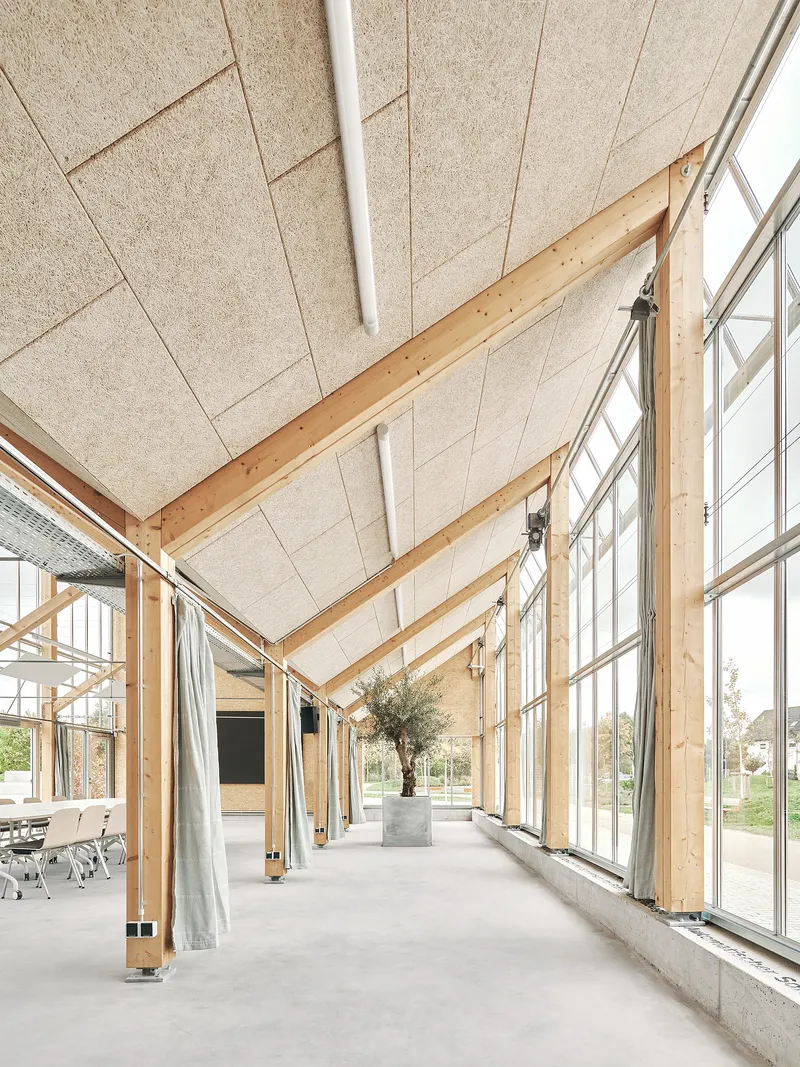
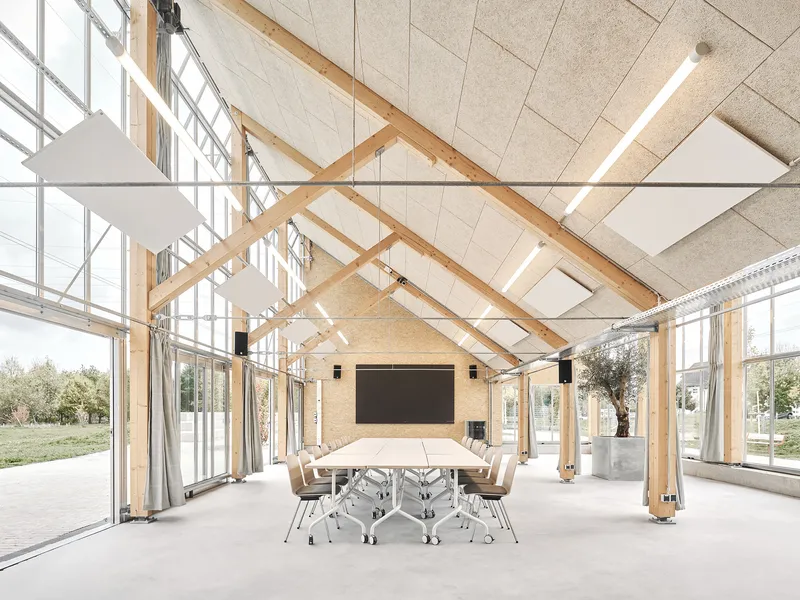
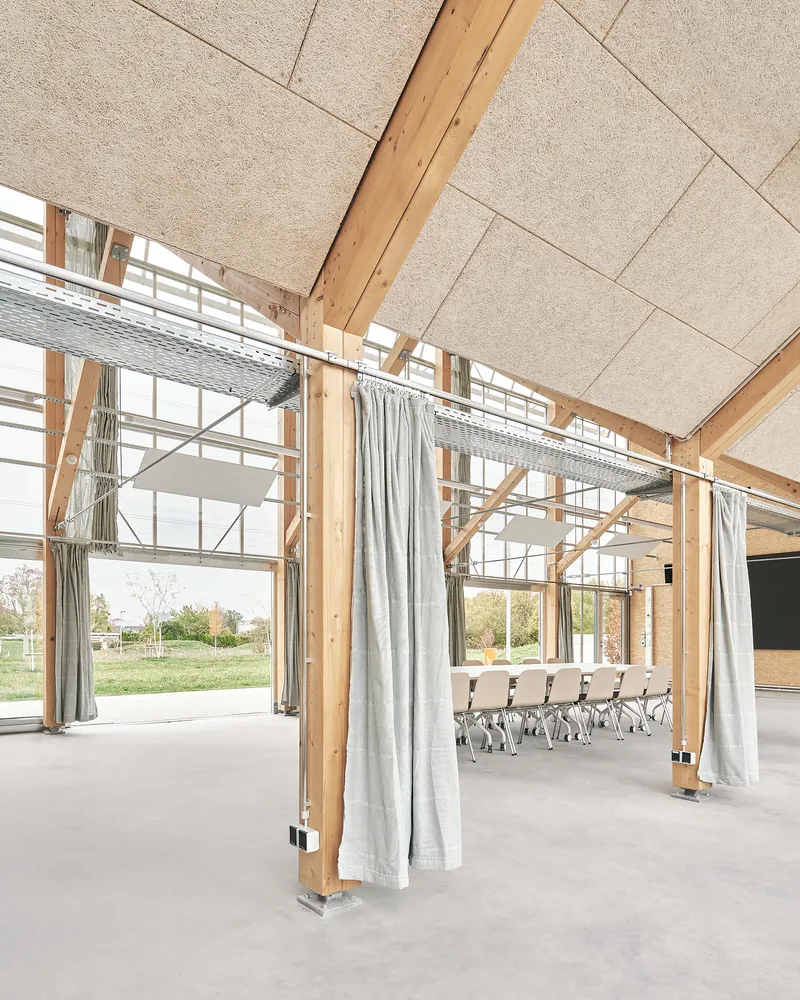
The interior of the greenhouse hall is one of the building's strongest moments. Long fabric curtains hang between the glulam columns, providing shade and acoustic softening when needed and disappearing when not. The ceiling exposes the timber portal frames so the structure becomes the most visible decoration.
The space is designed to host workshops, lectures, public events, and quiet visits to the surrounding garden. It is generous without being grand. A large central table with a screen and the timber rafters above turns it into a working room rather than a showpiece. People are clearly meant to use it, not just photograph it.
The Covered Porch and the Edges
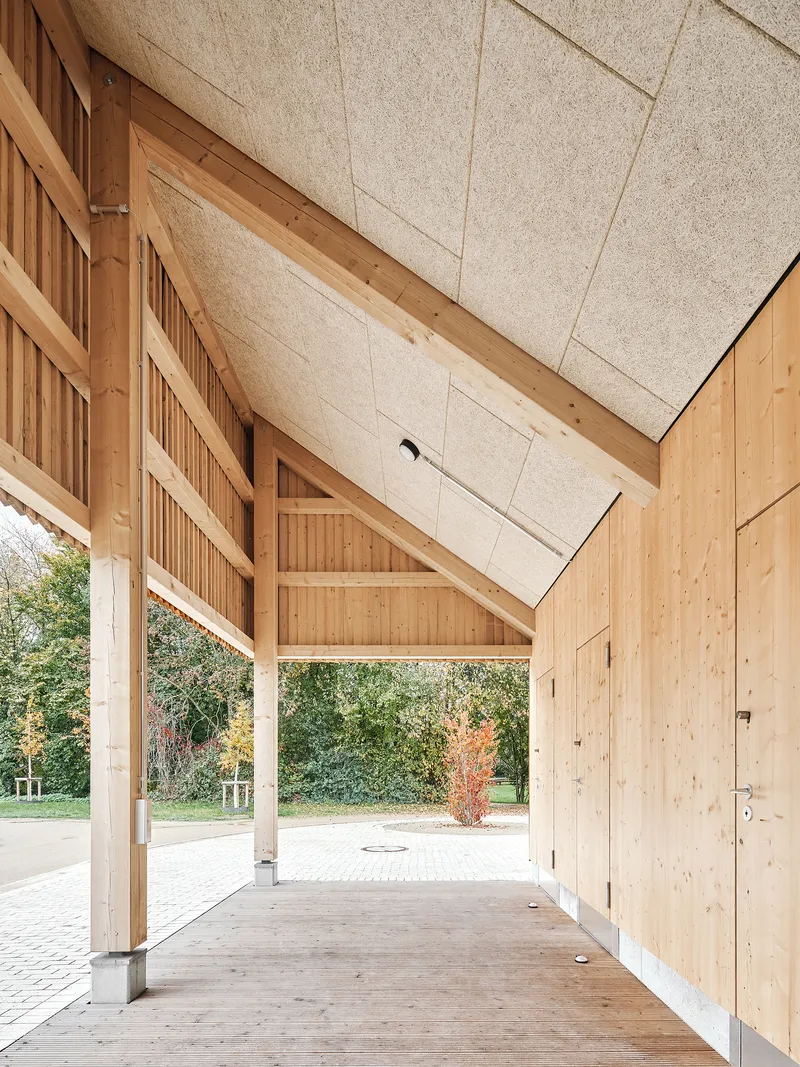
The covered porch is the threshold between the climate of the garden outside and the conditioned interior. Timber columns, exposed rafters, and hempcrete ceiling panels mark the edge clearly. This kind of in-between space is essential in any building that takes climate seriously, because it gives the user time to acclimatise rather than slamming them between two environments.
Drawings
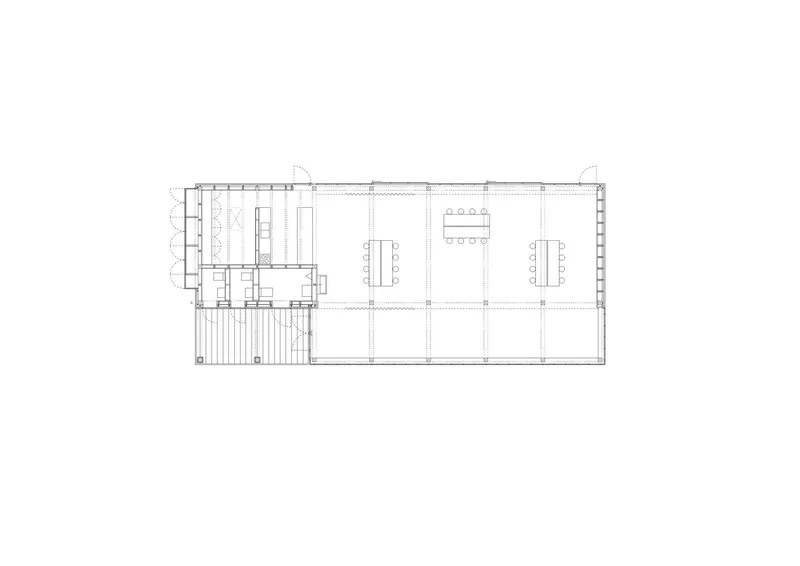
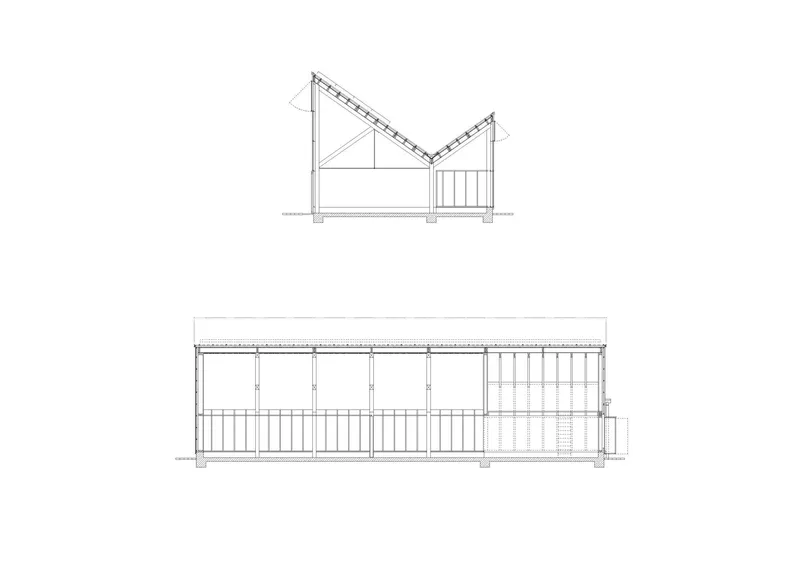
The plan and section show how clearly the two volumes are paired. The greenhouse runs the full length of the building on one side, the conditioned timber hall on the other. The structural grid is regular, the openings are generous, and the section reveals where the daylight enters and how the ventilation moves through the building.
Why This Project Matters
Public buildings are where new construction ideas get tested in front of an audience. A private house can experiment quietly. A public pavilion has to convince taxpayers, planners, and visitors that the experiment was worth the money. The House of the Seasons is the rare project that pulls this off without compromising on the architecture.
The lessons are transferable to almost any small public building in a temperate climate. Pair an unconditioned greenhouse with a conditioned interior. Use timber for everything you can. Design the roof to do more than one job. Treat the threshold between inside and outside as a real space. Most of all, accept that the building will change with the seasons rather than pretending it can stay the same all year.
New Architekten and Jutta Albus Architektur have produced a piece of advocacy as much as a piece of architecture, and the photographs by Thilo Rohländer show why the argument is worth listening to.
About the Studios
Share Your Own Work on uni.xyz
If you are working on climate-responsive architecture, public buildings, or low-carbon construction, uni.xyz is a place to publish your work, find collaborators, and enter design competitions.
Project credits: House of the Seasons by New Architekten and Jutta Albus Architektur. Schwerte, Germany. 235 m². Completed 2025. Lead architects: Fritz Keuthen, Michael Weichler. Landscape architecture: Förder Landschaftsarchitekten. Photographs: Thilo Rohländer.




Popular Articles
Popular articles from the community


Co-Life: Senior Housing Design That Reconnects Older Adults With the City
Co-Life reimagines senior housing design through healing gardens, shared streets, workshops, and a sustainable community across generations.

Lunar Spiral: Space Architecture Shaped by the Mathematics of the Universe
Lunar Spiral reimagines space architecture through Fibonacci geometry, lunar regolith, levitating habitats, and self-sustaining Moon living.

The Musturak Paradise: Senior Living Architecture for a Connected Future in Temara, Morocco
The Musturak Paradise reimagines senior living architecture in Temara via private homes, social spaces, culture, community, and shared care.

Co-life: Sustainable Architecture for Age-Friendly Community Living
Co-life reimagines sustainable architecture for seniors through courtyards, rammed earth, shared gardens, and spaces designed for belonging.


Similar Reads
You might also enjoy these articles

Bao Huynh Watercolor Atelier: A Serene Art Retreat in Hội An
Bao Huynh Watercolor Atelier in Hội An blends multifunctional art spaces, sustainable design, local materials, and family-friendly living in a serene environment.

Atelier Macri Concept Store Interior Design by CASE-REAL
Atelier Macri store features a "ko" counter, walnut wood details, cork displays, blending retail, gallery, and seamless customer experiences.

Manuel Vargas Izquierdo Stadium and High-Performance Sports Center: Architectural Excellence in Jalpa de Méndez
The Manuel Vargas Izquierdo Stadium blends sustainable design, inclusive sports facilities, and cultural-inspired architecture, revitalizing Jalpa de Méndez’s public spaces.

KAKR Buluh Awar Hall: Revitalizing Community and Ecology Through Bamboo Architecture
Community built bamboo hall revitalizes Buluh Awar village, empowering youth, restoring ecology, celebrating vernacular craftsmanship through sustainable architecture and culture.


Explore Industrial Building Competitions
Discover active competitions in this discipline



Challenge to design a portable theatre


Challenge to design a portable music platform


Challenge to design an open learning module for the elderly
Comments (0)
Please login or sign up to add comments
No comments yet. Be the first to comment!