

Chaoffice Splits a Nine-Person Family Home into Two Volumes Around a Maple Tree North of Beijing
In Heizhai Village, a 400-square-meter house for three generations uses staggered levels and a central courtyard to echo the mountain slope it sits on.


Most houses designed for extended families default to a single large volume, stacking generations vertically and sorting privacy by floor number. Chaoffice rejected that instinct entirely with House on the Slope, a 400-square-meter residence in Heizhai Village on the mountainous fringe north of Beijing. The home splits into two double-slope volumes, north and south, separated by an open courtyard anchored by a slender maple tree. Nine family members across three generations occupy the house: two elders live here full-time while children and relatives fill the rooms on weekends and holidays. The architecture treats that fluctuation in occupancy not as a problem to solve but as a rhythm to choreograph.
What makes the project genuinely compelling is the way it converts a modest 1-meter site grade change into a spatial argument. Rather than leveling the slope, the architects let it ripple through the interior as staggered floor plates, half-levels, and loft conditions that give each room a distinct vertical position and a different relationship to the courtyard. Chaoffice cites the crowded, narrative-dense compositions of Peter Bruegel as a reference, and the comparison holds: every corner of the house carries its own scene, its own proportion of light, and its own distance from the ground.
Two Volumes, One Courtyard

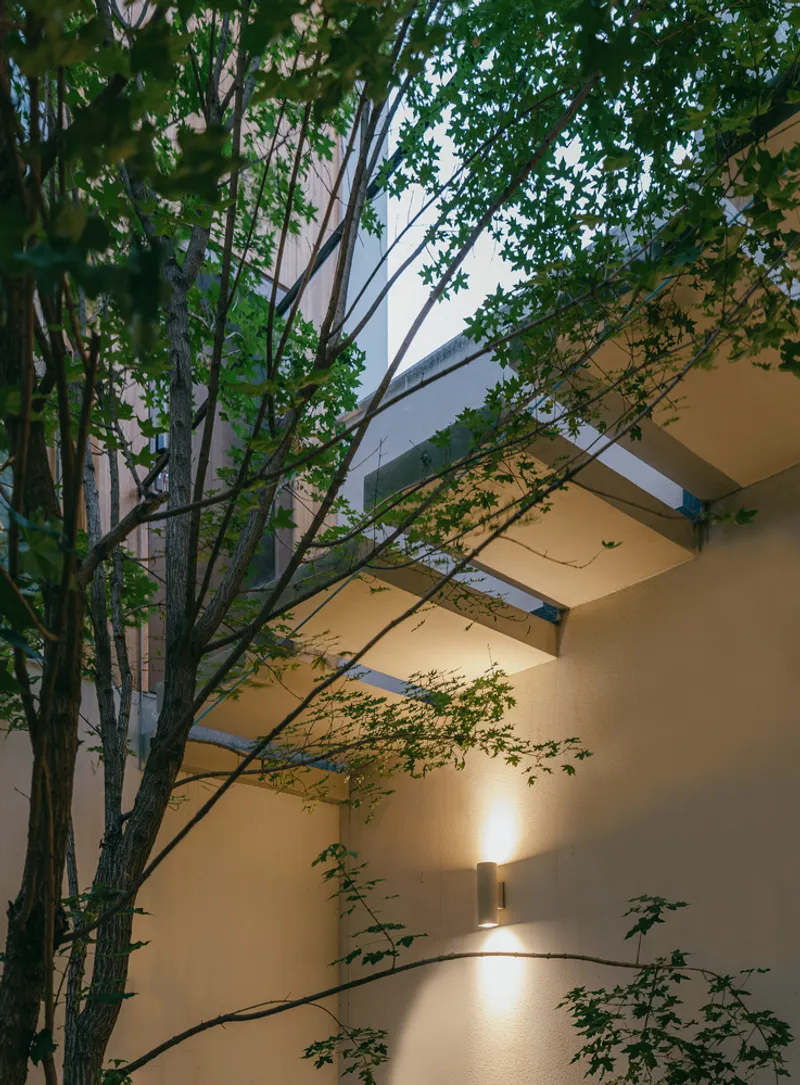
Viewed from the courtyard, the two metal-roofed volumes read as distinct buildings that happen to share a garden. Their pitched profiles echo the rural rooflines of Heizhai Village without mimicking them; the material palette of steel, concrete, and glass signals something more deliberate. The gap between the volumes is not leftover space. It is the organizational spine of the house, a passage that shifts from fully outdoor at ground level to semi-enclosed where the upper floors cantilever overhead.
At dusk the courtyard wall comes alive with recessed uplights that wash the maple tree in warm light, turning an everyday transition zone into something theatrical. The cantilevered upper floors frame the tree from above, compressing and releasing the view depending on where you stand. It is a carefully controlled sequence that makes a 16-meter-wide lot feel far more generous than its dimensions suggest.
Staggered Levels and the Logic of the Slope


The double-height living space is the clearest demonstration of how the slope animates the interior. A floating staircase rises through the void, and a timber bridge at the upper level connects the two volumes, establishing a circulation loop that never dead-ends. The courtyard tree is visible through full-height glazing, which means the planted core of the house is never more than a glance away, no matter which level you occupy.
Dappled sunlight filters through the bridge level, casting shifting patterns on the polished concrete floor below. Potted plants along the bridge railing reinforce the sense that the boundary between inside and outside is more a gradient than a wall. The high ceiling on the south-facing family room maximizes winter solar gain, a straightforward passive strategy that also happens to produce the most dramatic room in the house.
The Kitchen as Social Infrastructure
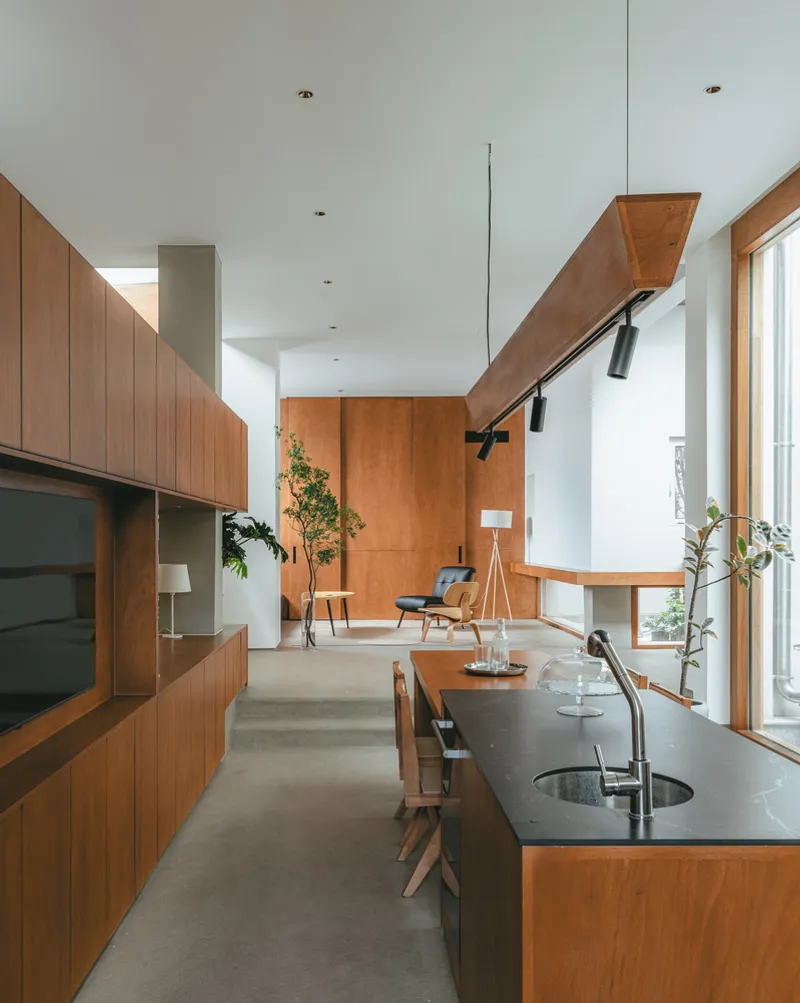

For a nine-person household, the kitchen is not a service room; it is the engine of daily life. Chaoffice gave it open-plan proportions, lining one wall with timber cabinetry and centering a black stone island that doubles as a prep surface and a gathering point. The polished concrete floor runs uninterrupted from the kitchen into the adjacent living zone, erasing any threshold between cooking and socializing.
From the living level, you can see the timber-clad breakfast nook volume rising like a sculptural object from the same concrete plane. The material shift from concrete to warm timber signals a change in intimacy without requiring a door. It is an economical move that keeps the ground floor feeling continuous while still carving out pockets of enclosure.
Intimate Corners: The Breakfast Nook and Quiet Rooms
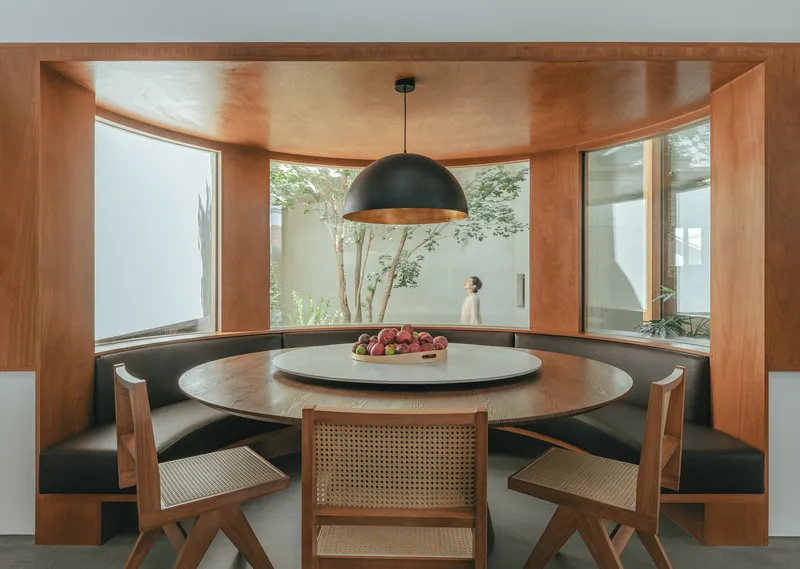

The curved timber breakfast nook is the most concentrated piece of architecture in the house. A built-in banquette wraps around a small table beneath windows that look directly onto the planted courtyard. The geometry is tight, almost boat-like, and deliberately at odds with the open volumes elsewhere. In a home designed for large family gatherings, this alcove provides the counterpoint: a place for two people to have coffee in silence.
A similar quiet register appears in the living room, where corten steel wall panels age alongside a low timber credenza. A single square window frames a cluster of trees, composing the view like a painting. The material restraint here is notable. Chaoffice limits itself to three or four finishes per room, letting texture and proportion do the atmospheric work rather than relying on decorative complexity.
Why This Project Matters
House on the Slope is a quiet rebuke to the standardized rural villa that has proliferated across China's village peripheries. Instead of a single box with uniform floor-to-ceiling heights, Chaoffice built a house that changes dimension room by room, that breathes through a central courtyard, and that turns a negligible slope into the organizing principle of an entire domestic landscape. The Bruegel reference is more than a poetic flourish: the house genuinely rewards close looking, revealing small spatial events at every turn.
More practically, the project demonstrates that multigenerational living does not require either a mansion or a compromise. Four hundred square meters is generous but not extravagant for nine people, and the split-volume strategy distributes privacy and togetherness without forcing anyone to choose a fixed position on that spectrum. The courtyard maple, visible from nearly every room, serves as a shared reference point, a living clock that marks the seasons for all three generations at once.
House on the Slope by Chaoffice, Heizhai Village, Changping District, Beijing, China. 400 square meters. Completed 2023. Photography by Yumeng ZHU.
About the Studio
Share Your Own Work on uni.xyz
If projects like this are the kind of work you want to make, uni.xyz is a place to publish your own, find collaborators, and enter design competitions.




Popular Articles
Popular articles from the community


EW PARK: Sustainable Architecture Reimagines the Future of Urban Parking
EW PARK reimagines city parking as a modular wooden tower combining automation, solar energy, electric mobility, and adaptable urban design.

Hill & Cross Opera: Sculptural Opera House Architecture Shaped by Tallinn’s Landscape and Identity
Hill & Cross Opera reimagines opera house architecture in Tallinn through its sculptural hill, civic plaza, glass wave and a luminous cross.

Conexión: Biophilic Design Reimagines High-Rise Living in Hong Kong
Conexión reimagines high-rise living in Hong Kong through biophilic design, green facades, shared spaces, daylight, water and nature within.

Co-life: Sustainable Architecture for Age-Friendly Community Living
Co-life reimagines sustainable architecture for seniors through courtyards, rammed earth, shared gardens, and spaces designed for belonging.


Similar Reads
You might also enjoy these articles


Hodi-Mandai Geram
Project Function: Preservation and revitalization of the Intangible heritage and socio-spatial identity of the Hodi by Housing, Cultural Memory Center, Sacred Grove, landscape, local tourism economy


Olio Towers: A Mid-Rise for Performers That Fuses Housing, Rehearsal, and Stage
Located blocks from Houston's Theater District, this modular tower stacks living units around a central performance atrium.

Oasis: Modular Green Housing Carved into Dhaka's Urban Fabric
A shortlisted Plugin Housing entry reclaims unauthorized settlements in Dhaka with stepped concrete volumes, green roofs, and ventilation-driven design.

Black Hole: A Floating Megastructure for the Post-Physical Era
Emiliano Mazzarotto envisions a spherical, self-scaling arena where e-sports, digital hotels, and holographic stadiums replace traditional public space.


Explore Architecture Competitions
Discover active competitions in this discipline



Challenge to reimagine the Iron Throne


Photograph architecture without architects


Illustrate the lost glory of Angkor Wat - Render Challenge


Design challenge to reuse E-waste
Comments (0)
Please login or sign up to add comments
No comments yet. Be the first to comment!