
Modersohn & Freiesleben Build a Brick Village House for a Young Family Returning to Rural Germany
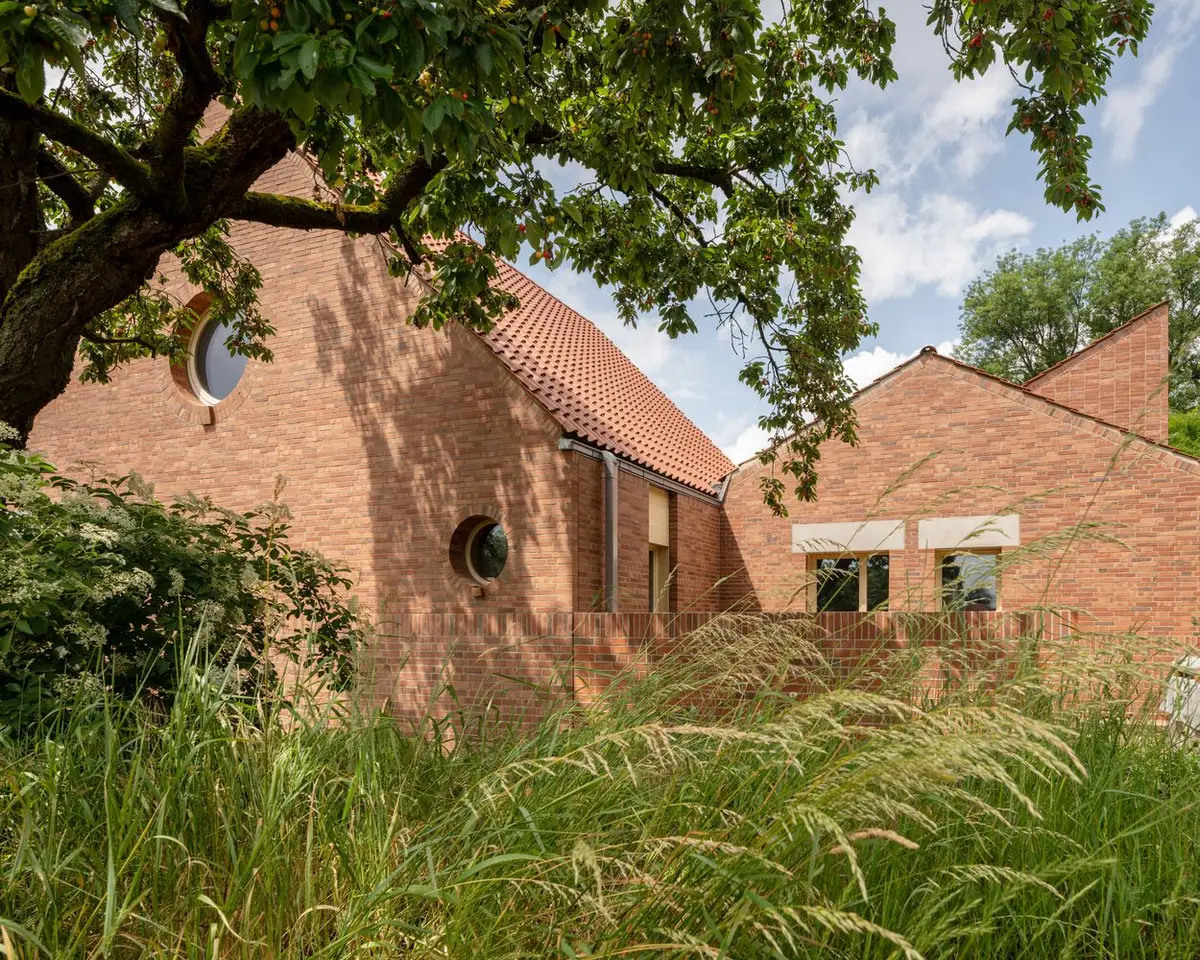
House W in Netra, Hesse, fuses local clinker brick and exposed timber framing into a three-winged home rooted in its red-roofed village.


A young doctor moves back to the village where his grandparents lived, takes over the local practice, and commissions a house. That narrative alone is worth paying attention to: it runs counter to decades of rural depopulation across central Germany. Modersohn & Freiesleben Architekten responded with a building that is neither nostalgic pastiche nor imported urban minimalism. House W, completed in 2023 in the Hessian village of Netra, is a solid brick dwelling organized as three gabled volumes, each serving a distinct domestic function. The clinker comes from the nearby Meißner region, and the roofline slots into a landscape dominated by red tile without mimicking the older buildings around it.
What makes the project genuinely interesting is its commitment to low-tech construction and regional craft at a moment when most new German houses default to prefabricated timber panels or plastered EIFS systems. Insulated brick walls, a visible timber roof structure, and sealed screed floors are straightforward, almost blunt material choices. They let the spatial ambition of the plan, three interconnected wings with double-height galleries and mezzanines, speak without relying on surface novelty. The house was built by a local contractor and a local carpenter, a decision that is as much an economic statement as an architectural one.
Three Gables in a Red Landscape
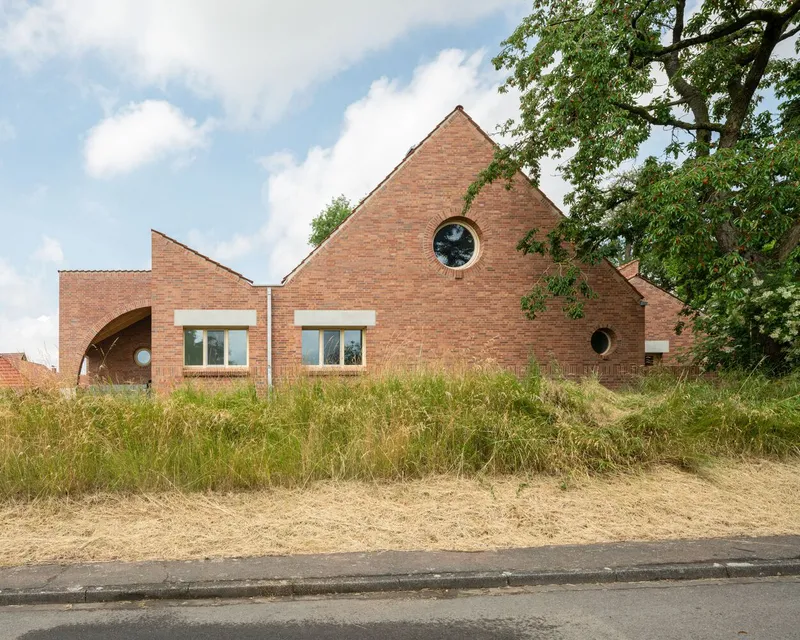
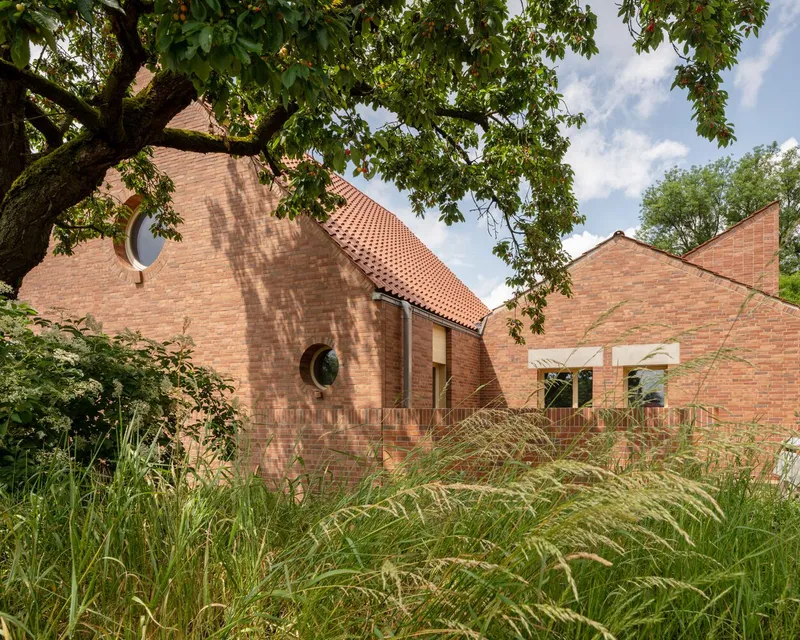
Netra sits in rolling hill country along the former inner-German border, a place of moated castles, crowned stone churches, and hiking trails. The village reads as a sea of red roofs punctuated by timber framing. Modersohn & Freiesleben placed House W on a gently elevated meadow accessed from the east, positioning three interlocking gabled volumes so that each addresses a different slice of the surrounding terrain. The light red clinker brick, laid with clean joints and no render, absorbs the color palette of the existing settlement while its sharper geometry and circular window openings announce something decidedly contemporary.
Tall grasses and mature trees frame the building at its perimeter, softening the transition between the precise brickwork and the organic slope of the meadow. The sloped grass berm at the base further roots the structure into its site, an understated move that avoids the pedestal effect common to new builds in rural settings.
Brick, Arches, and the Weight of Craft
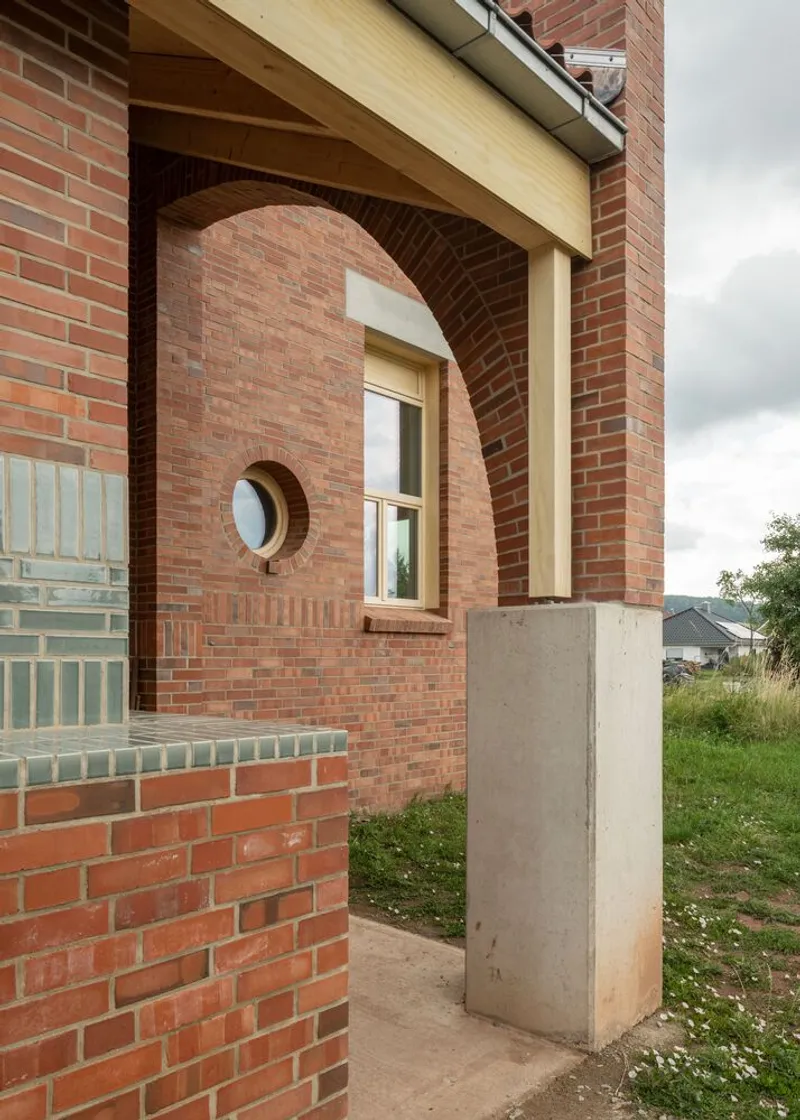
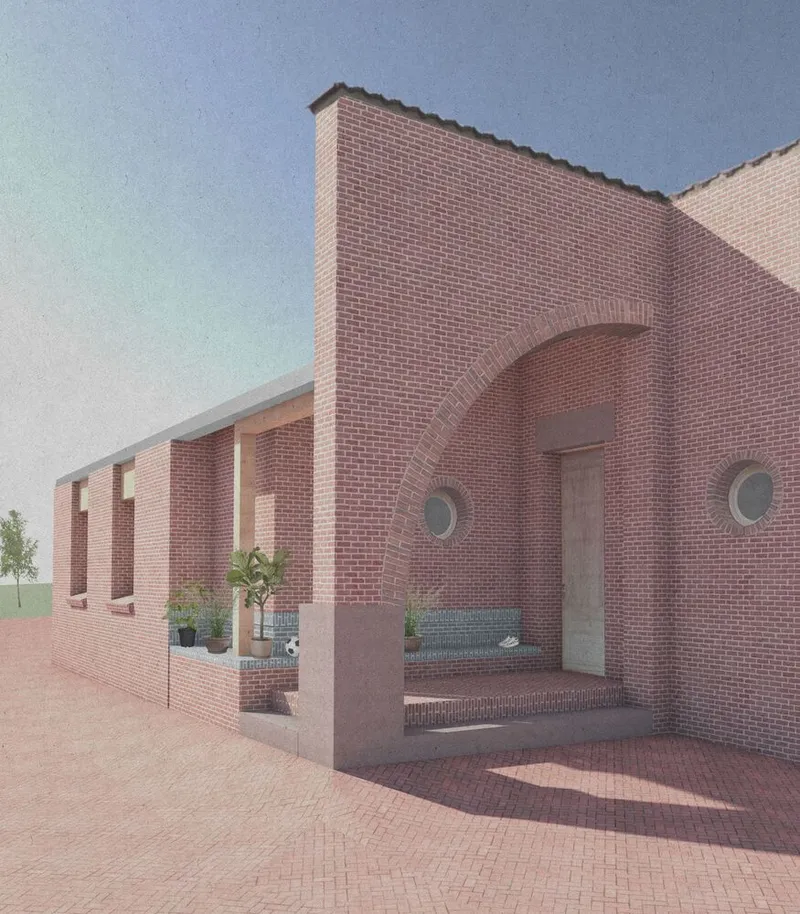
The most striking exterior detail is the arched brick opening, a colonnade of recessed arches supported on a concrete plinth that gives the facade a civic scale unusual for a single-family house. Circular windows punctuate the gable walls, framed in timber and set deep into the thick masonry. These are not decorative gestures. They control light entry, reduce solar gain on the working wing where privacy matters, and give the interior rooms a focused, almost monastic quality of illumination.
The insulating brick system (Dämmziegel) that forms the wall assembly eliminates the need for external insulation layers, which means the clinker surface is the actual building skin rather than a veneer applied over foam. That directness registers visually: the walls look load-bearing because they are, and the arched openings read as genuine structural events rather than appliqué.
Timber Structure as Interior Architecture
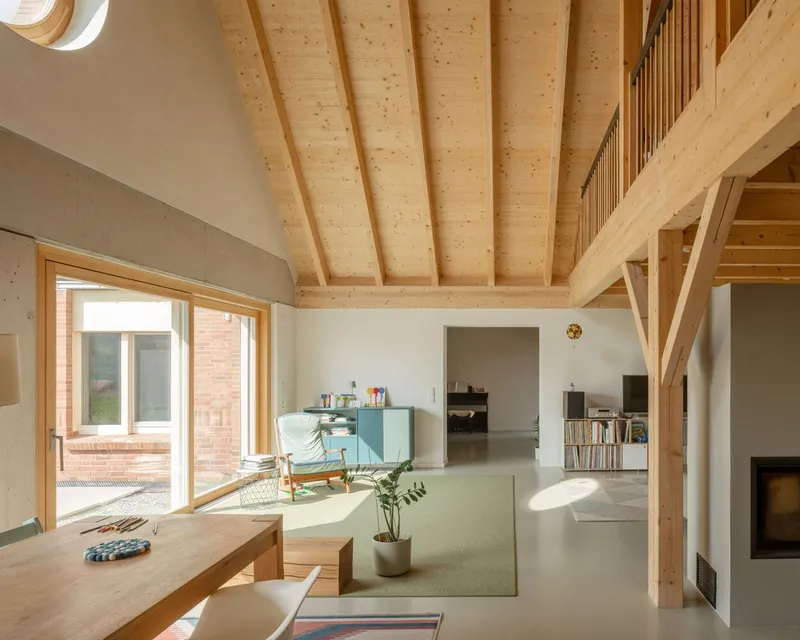
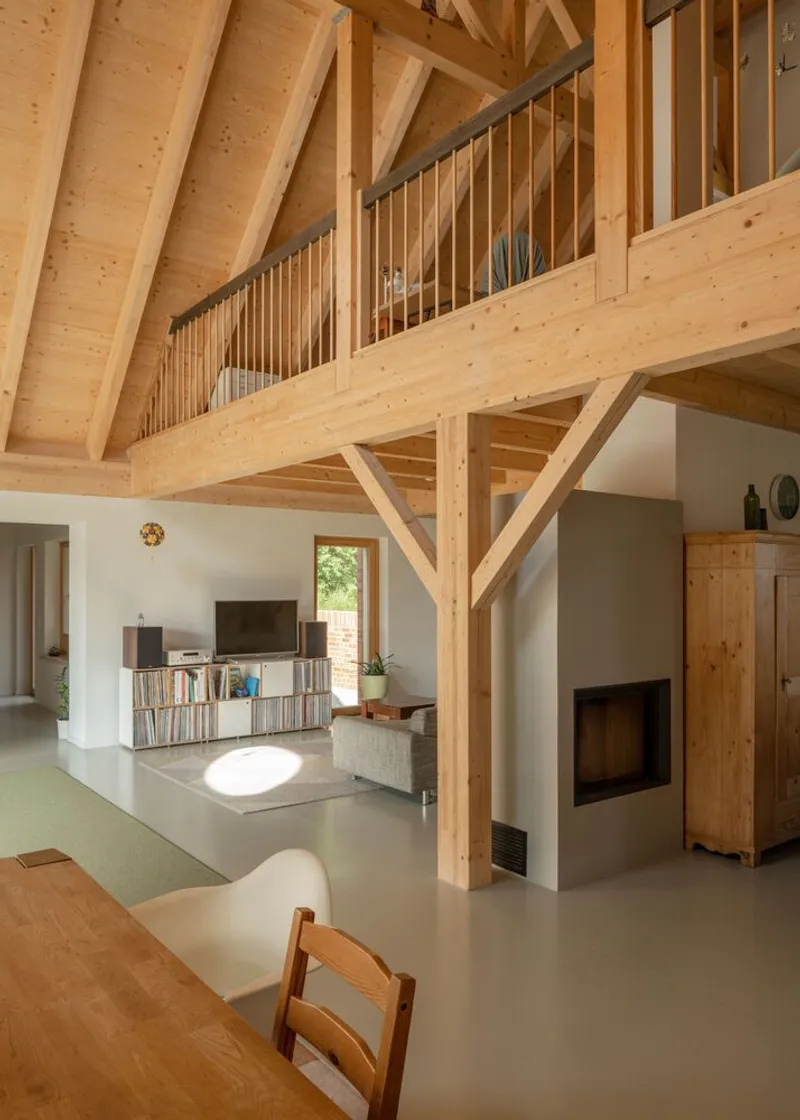
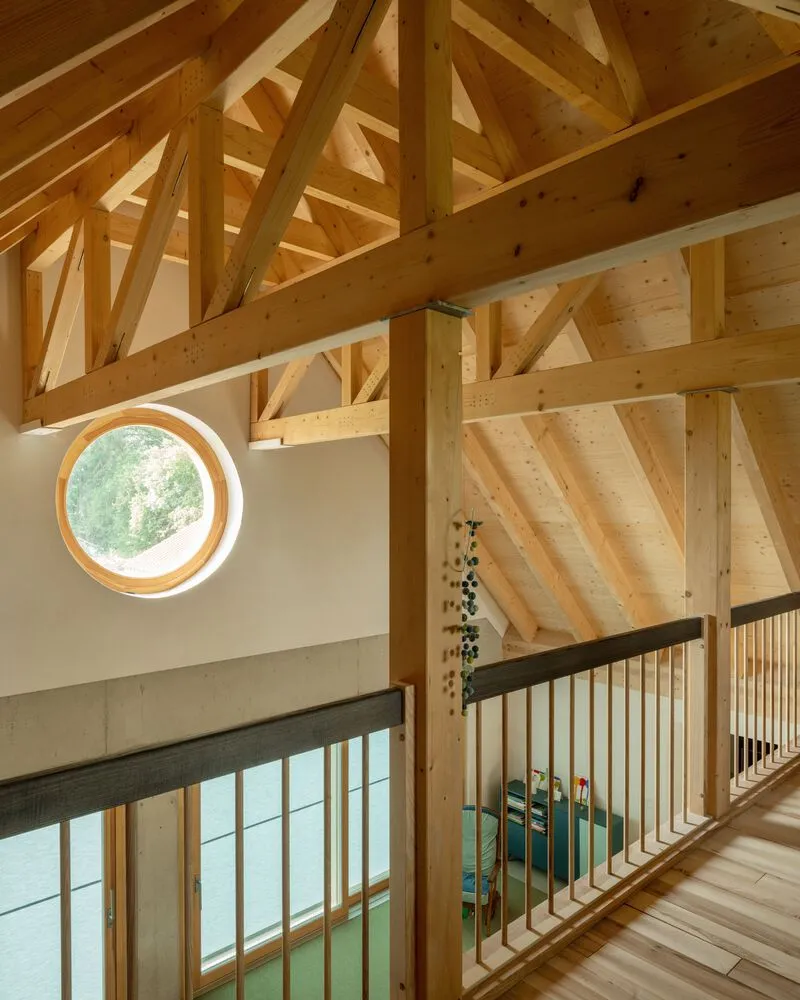
Step inside and the roof takes over. Exposed timber rafters and structural columns define every major interior space, creating a legible framework that organizes the eye as clearly as the walls organize the plan. The central living volume rises to a full double height, with a timber mezzanine gallery overlooking the kitchen, dining, and fireplace zone below. Two trusses frame the hearth, anchoring the social center of the house with an almost barn-like directness.
The vertical balustrade rails on the mezzanine are deliberately simple, letting the heavier structural members dominate. This hierarchy matters. In a project that insists on the visibility of construction, the joinery details, the column-to-beam connections, the way the circular window sits just below the ridge, all become the ornamental program. The carpenter's hand is everywhere, and it is enough.
Rooms Shaped by Light and Aperture
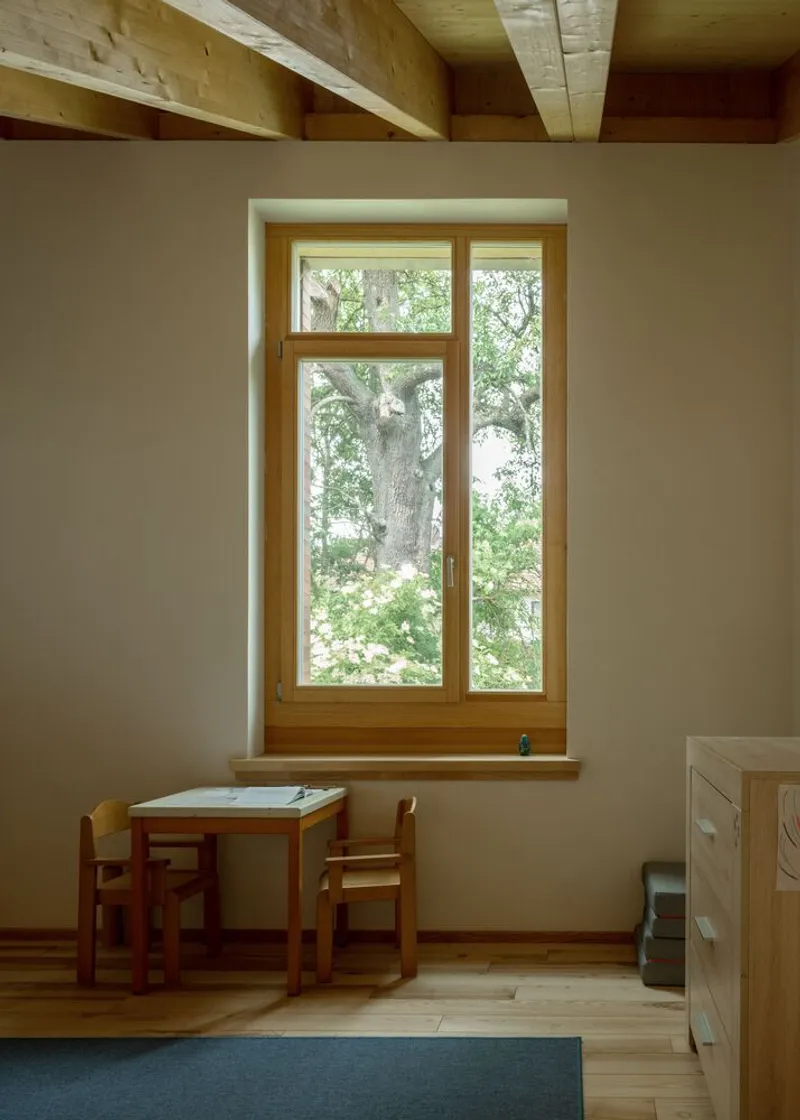
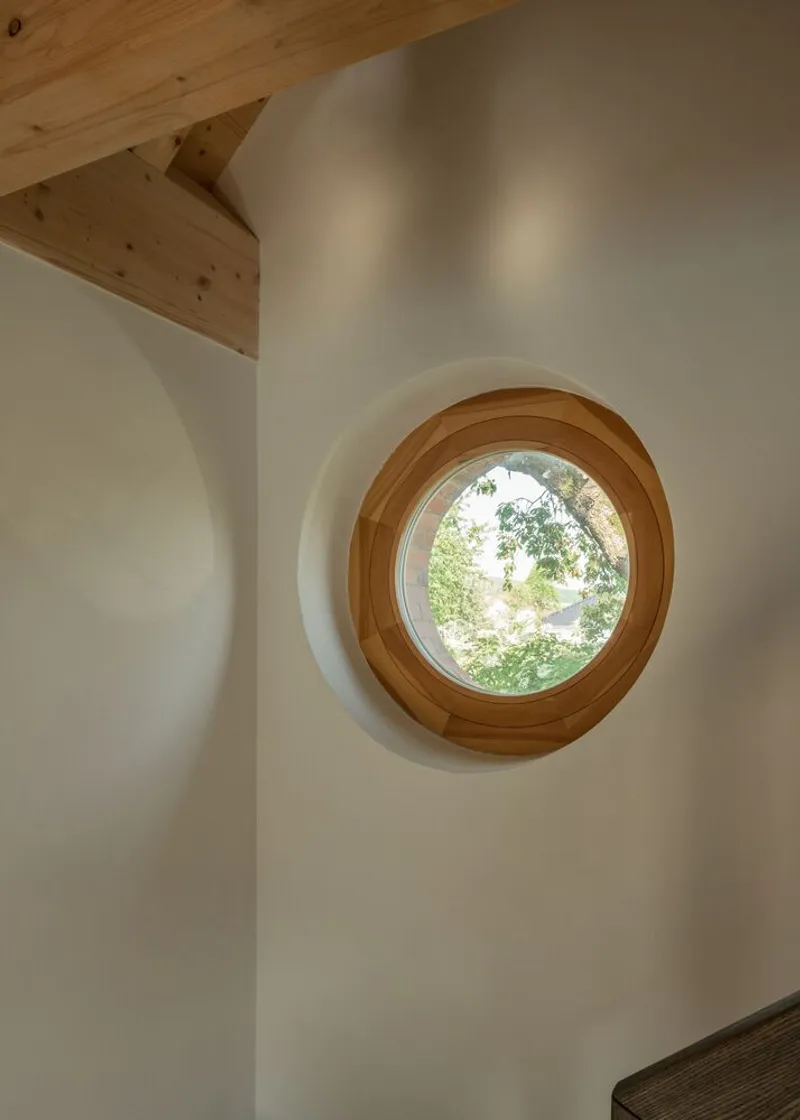
The three wings of House W each manage daylight differently. The working wing, which doubles as the family's supervision and coaching practice, uses smaller rectangular openings facing a close neighbor to secure privacy without sacrificing comfort. The sleeping wing, where children's bedrooms nestle under sloped roofs, gets tall, deep-reveal windows that frame the surrounding trees like vertical landscape paintings. The circular windows, placed high in the gable walls, wash the underside of the rafters with diffused light, turning the exposed timber into a warm, reflective ceiling.
The depth of the masonry reveals is notable. At the tall window in the sleeping wing, the reveal is deep enough to serve as a sill-bench for a child's table. Architecture doubles as furniture when the walls are thick enough to inhabit, a quality that mass-produced lightweight construction simply cannot replicate.
Material Continuity Inside
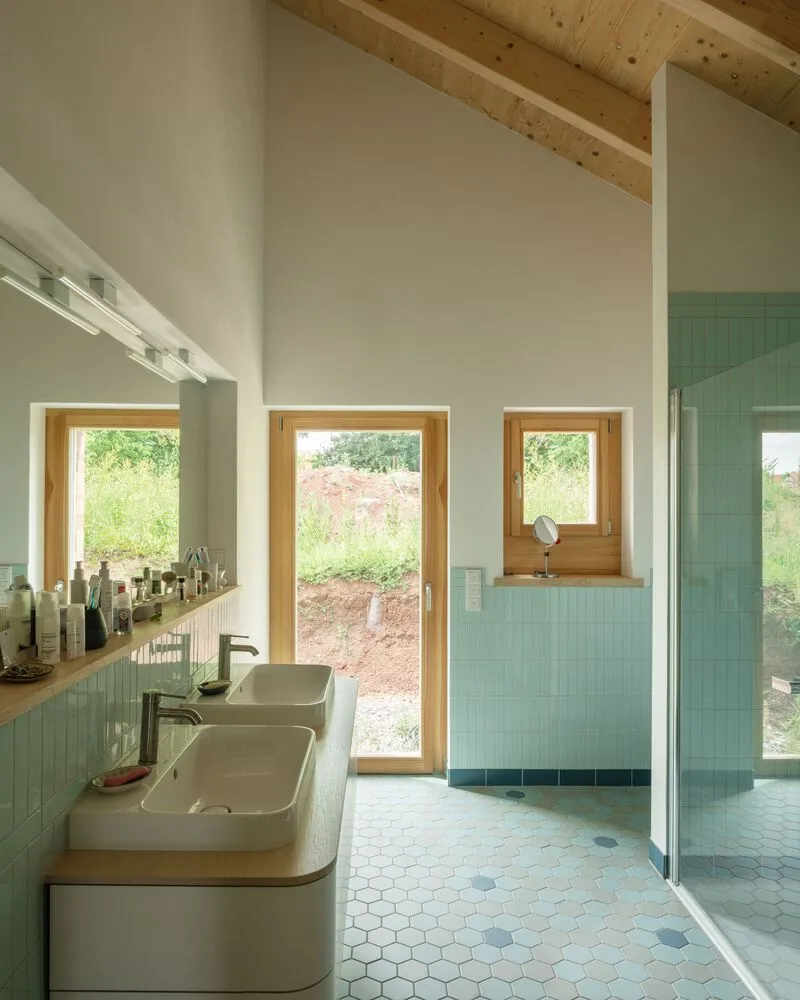
Sealed screed flooring runs continuously through the ground level, binding the flowing sequence of rooms into a single spatial experience. In the bathroom, hexagonal floor tiles and pale green vertical wainscoting introduce a restrained palette shift, but the exposed rafters overhead maintain the structural narrative established elsewhere. Every room in House W shares a visual DNA: timber above, solid mass at the perimeter, and a deliberately limited material count that keeps the eye calm.
The architects describe their approach as "lowtech and raw material," and the interior bears that out. There is no suspended ceiling to hide ductwork, no plasterboard partition to smooth over structure. The house is what it is made of, and the occupants live inside the evidence of its making.
Why This Project Matters
House W is a quiet argument for building slowly, locally, and honestly. In a German housing market increasingly dominated by prefabrication and energy-code compliance theater, Modersohn & Freiesleben chose insulating brick, exposed timber framing, and a local workforce. The result is a house that will age well, both physically and culturally, because its materials were drawn from the same landscape it occupies. The decision to use Meißner clinker and regional carpentry is not romantic regionalism; it is a practical response to supply chains, skill availability, and the specific character of a Hessian village.
More broadly, the project demonstrates that a family home can carry architectural ambition without resorting to formal spectacle. The three-winged plan, the double-height galleries, the arched colonnade: these are genuinely inventive moves, but they derive from program and construction logic rather than from a desire to photograph well. That the house does photograph well is a consequence of its clarity, not the other way around. For anyone interested in how new architecture can reinforce rather than erode a rural settlement pattern, House W is required reading.
House W by Modersohn & Freiesleben Architekten Partnerschaft, Netra (Ringgau), Germany, completed 2023. Photography by Sebastian Schels.
About the Studio
Share Your Own Work on uni.xyz
If projects like this are the kind of work you want to make, uni.xyz is a place to publish your own, find collaborators, and enter design competitions.


Popular Articles
Popular articles from the community


The Ocean Hive: Sustainable Architecture for a Self-Sufficient Civilization at Sea
The Ocean Hive imagines sustainable architecture at sea, where modular habitats, algae, wave power and ocean waste sustain a growing colony.

Hill & Cross Opera: Sculptural Opera House Architecture Shaped by Tallinn’s Landscape and Identity
Hill & Cross Opera reimagines opera house architecture in Tallinn through its sculptural hill, civic plaza, glass wave and a luminous cross.

Lunar Spiral: Space Architecture Shaped by the Mathematics of the Universe
Lunar Spiral reimagines space architecture through Fibonacci geometry, lunar regolith, levitating habitats, and self-sustaining Moon living.

The Musturak Paradise: Senior Living Architecture for a Connected Future in Temara, Morocco
The Musturak Paradise reimagines senior living architecture in Temara via private homes, social spaces, culture, community, and shared care.

Similar Reads
You might also enjoy these articles


Hodi-Mandai Geram
Project Function: Preservation and revitalization of the Intangible heritage and socio-spatial identity of the Hodi by Housing, Cultural Memory Center, Sacred Grove, landscape, local tourism economy


Olio Towers: A Mid-Rise for Performers That Fuses Housing, Rehearsal, and Stage
Located blocks from Houston's Theater District, this modular tower stacks living units around a central performance atrium.

Oasis: Modular Green Housing Carved into Dhaka's Urban Fabric
A shortlisted Plugin Housing entry reclaims unauthorized settlements in Dhaka with stepped concrete volumes, green roofs, and ventilation-driven design.

Black Hole: A Floating Megastructure for the Post-Physical Era
Emiliano Mazzarotto envisions a spherical, self-scaling arena where e-sports, digital hotels, and holographic stadiums replace traditional public space.

Explore Architecture Competitions
Discover active competitions in this discipline

Challenge to reimagine the Iron Throne

Photograph architecture without architects

Illustrate the lost glory of Angkor Wat - Render Challenge

Design challenge to reuse E-waste
Comments (0)
Please login or sign up to add comments
No comments yet. Be the first to comment!