

Hevia García and Poblete Build a Timber Exoskeleton Around a Rainwater Courtyard on Lake Ranco
A 400-square-meter holiday house in southern Chile turns a local shed typology into a courtyard dwelling tuned to heavy rainfall and scarce sun.


In Futrono, a small town on the northern shore of Lake Ranco in Chile's Los Ríos region, a mid-twentieth-century trout smokehouse once caught the eyes of architects Guillermo Hevia García and Catalina Poblete. That shed was notable for one thing: its structural skeleton sat outboard of its cladding, pillars and diagonal braces visible on the facade rather than buried inside the walls. The architects took that single constructive idea and used it to organize an entire holiday house, a 400-square-meter timber pavilion raised on steel columns above a woodland clearing, oriented not toward a single panoramic view but toward a planted courtyard at its center.
What makes House with a Patio genuinely interesting is not the courtyard itself, a typology architects have been borrowing from Mediterranean and Latin American precedents for centuries. It is the way the courtyard performs. Lago Ranco receives roughly 1,800 millimeters of rain a year. Sun is a scarce commodity. By placing the courtyard at the geometric center of a square plan, every room in the house gains a second orientation, pulling daylight from two directions simultaneously. The courtyard doubles as an impluvium, collecting rainwater and turning the region's defining climatic liability into a resource. The structural exoskeleton, meanwhile, allowed the team to erect the shell during the brief dry season, then finish interiors under cover while the rain hammered down outside.
A Pavilion in the Trees
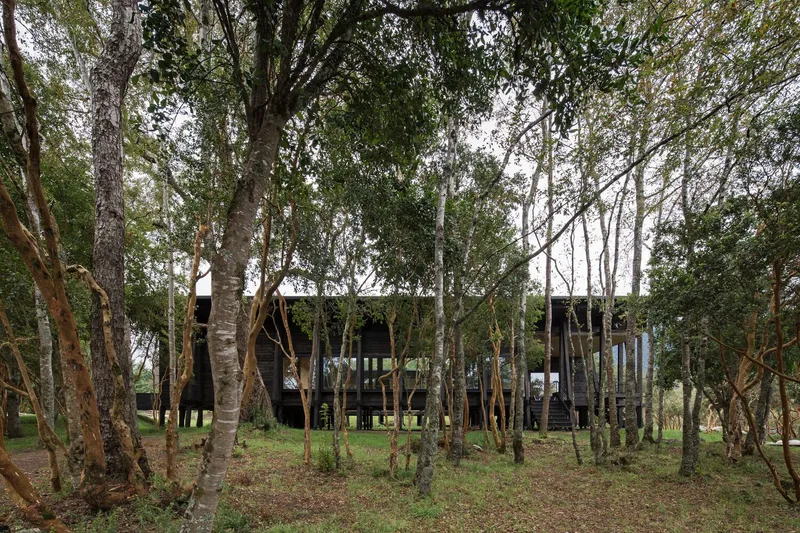
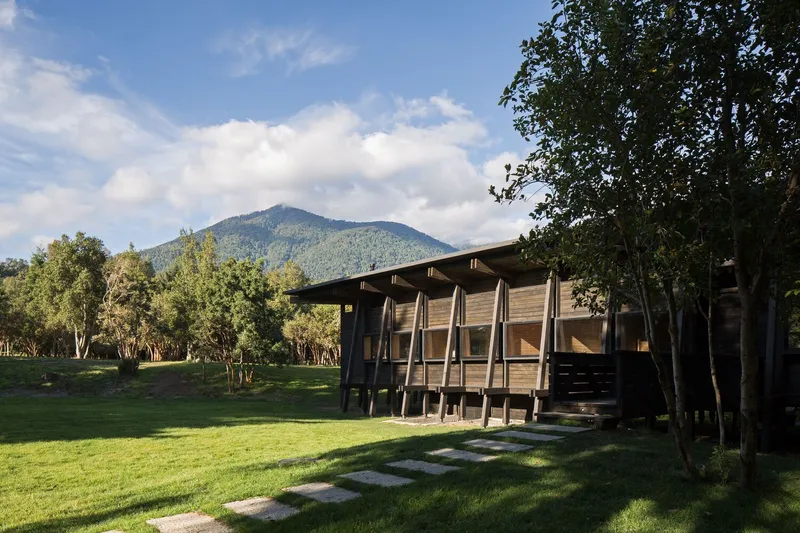
Seen from outside, the house reads as a low, rectangular timber volume floating among birch trunks and evergreens. Black steel columns lift the floor plane off the ground, clearing the way for moisture management and for the undergrowth to continue uninterrupted beneath the building. The diagonal braces that define the exoskeleton are left fully exposed on the facade, creating a rhythmic pattern of triangulated supports that owes more to agricultural construction than to residential convention.
The absence of a single dominant facade reinforces the architects' stated goal of multidirectionality. From any vantage point in the surrounding woodland, you see the same structural logic repeating: pillar, brace, beam, clad panel. The CUTEK oil finish on the wood gives it a water-repellent skin that will silver over time, drawing the house closer to the bark tones of the surrounding forest.
The Courtyard as Climate Machine
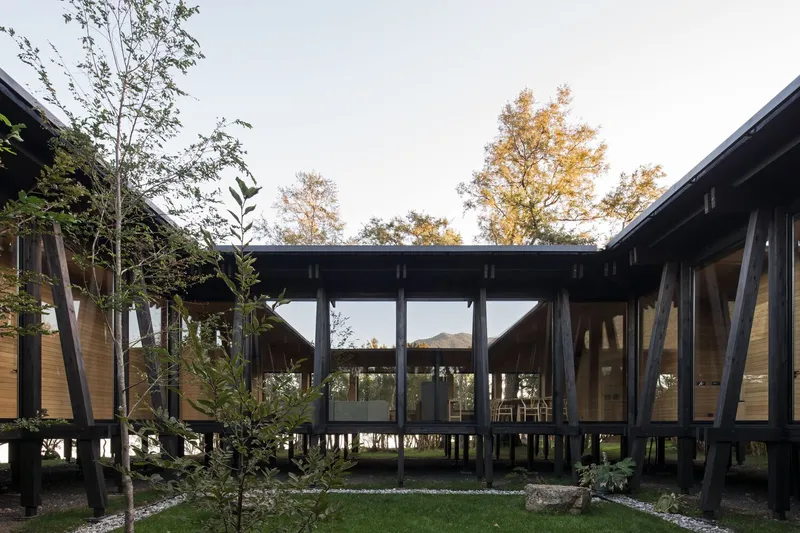
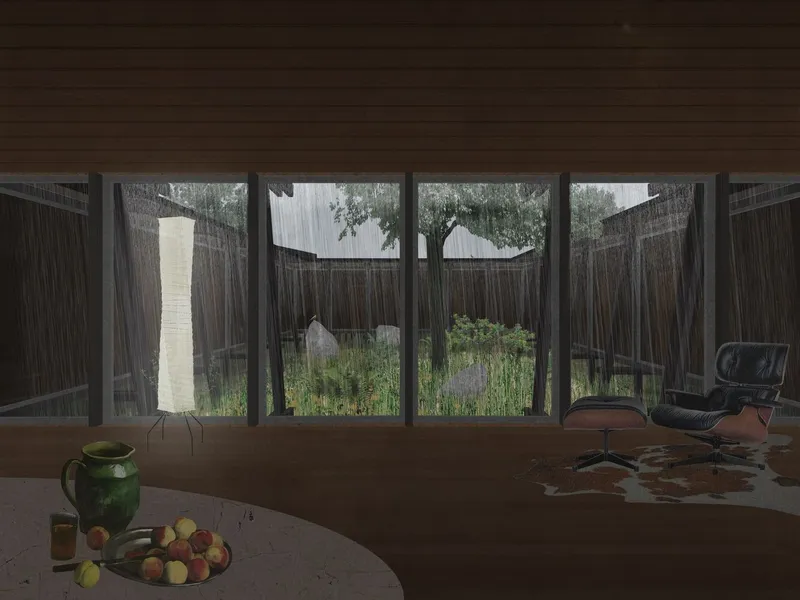
The central courtyard is enclosed on all four sides by a continuous glass corridor that forms the house's primary circulation route. Native plantings and a mature tree occupy the open-air space, establishing a microlandscape that mediates between the wild forest outside and the controlled domestic environment within. The courtyard's proportions are tuned to maximize solar penetration at the latitude of Lake Ranco, where the sun tracks low across the sky for much of the year.
Functionally, the impluvium principle is elegant. Rather than battling the 1,800 mm of annual rainfall with increasingly complex waterproofing, the house channels water inward toward the courtyard, where it nourishes the planting and can be collected. The glazed corridor surrounding the courtyard creates a thermal buffer zone: sunlight warms the glass-enclosed path, which in turn pre-heats air before it enters adjacent rooms. In summer, the courtyard acts as a stack-ventilation chimney, pulling warm air upward and drawing cooler forest air through the rooms.
The Glass Corridor
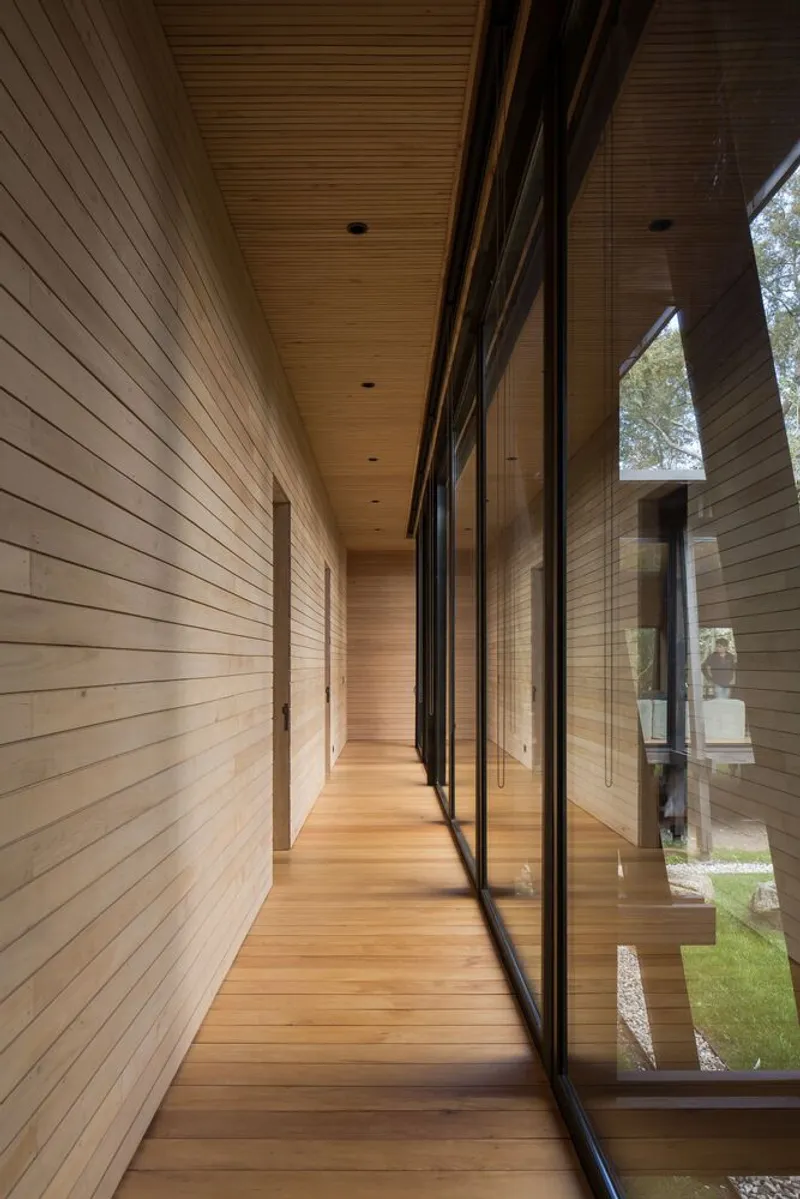
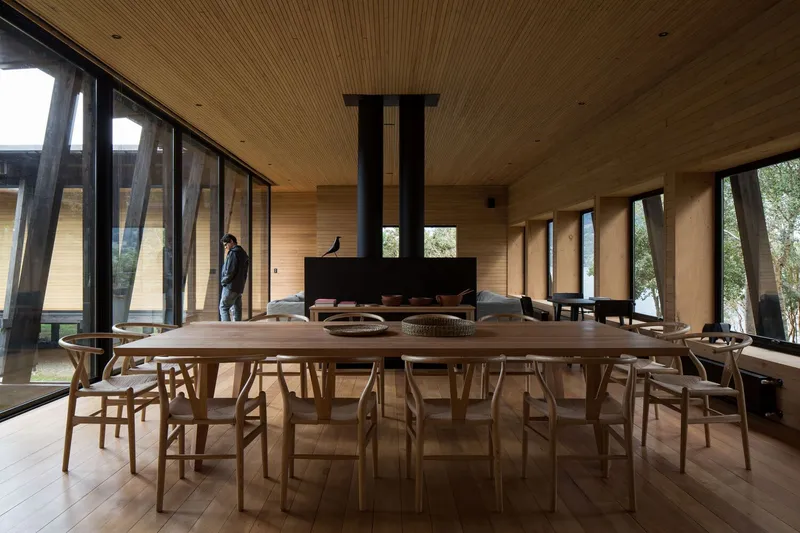
Walking through the house, the glass-lined circulation loop is the dominant spatial experience. On one side, full-height glazing faces the courtyard garden. On the other, rooms open to views of forests, meadows, and the lake beyond. The corridor transforms what could be dead hallway space into the most luminous room in the building, a kind of inhabited threshold between two landscapes: one curated, one wild.
The open living and dining area extends this transparency to its logical conclusion. A long timber table runs beneath angled glazing, and a freestanding fireplace anchors the room without closing off sightlines. The spatial sequence from courtyard glass to exterior glass gives the social heart of the house an almost greenhouse quality, bathed in light from multiple directions even on overcast days.
Timber Rooms, Lake Views
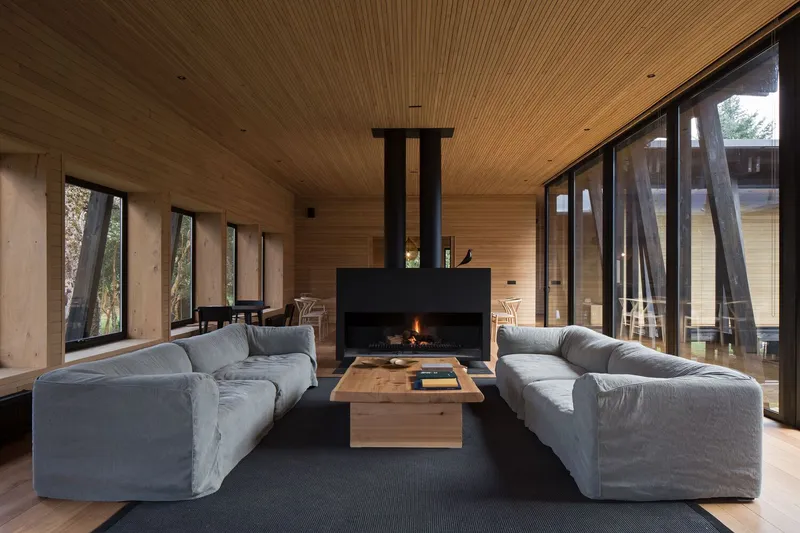
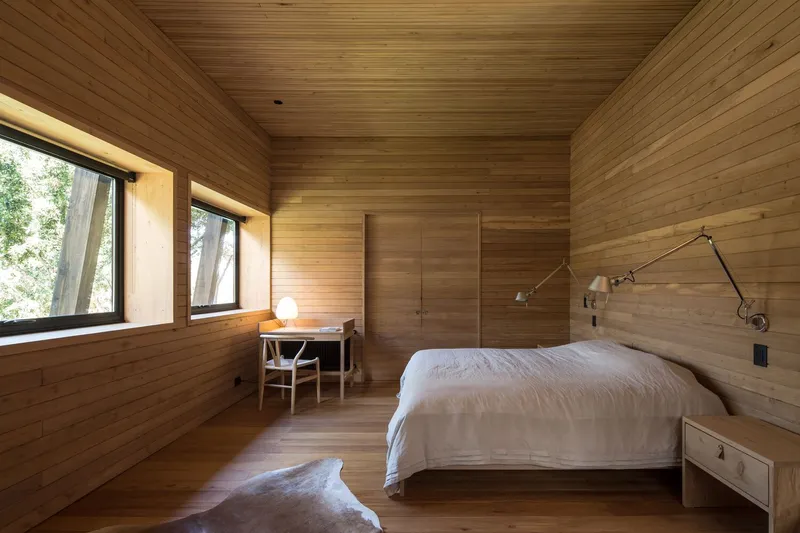
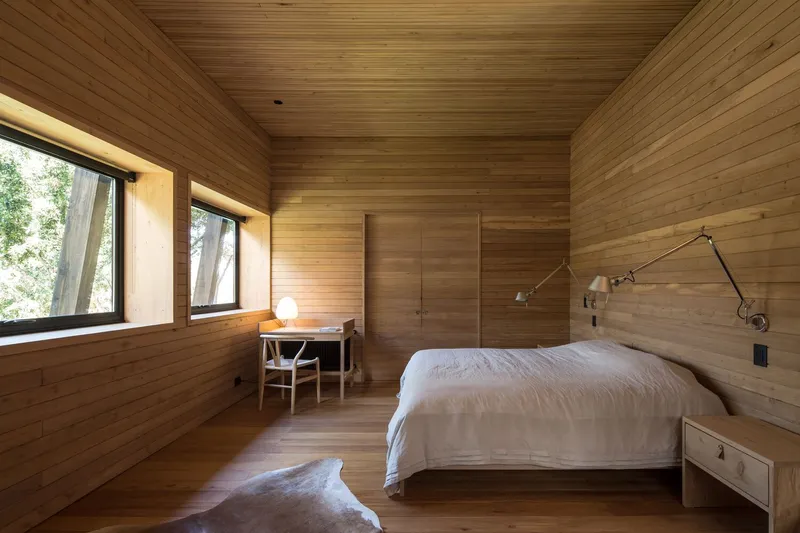
The private rooms follow a hotel-like layout: a series of bedrooms, each with its own bathroom, alternating with communal zones along the perimeter. Horizontal timber planks line walls and ceilings without interruption, creating warm, enveloping interiors that feel more like refined cabins than conventional bedrooms. The consistency of material is total. Wood is structure, finish, and atmosphere all at once.
Window placement in the bedrooms is calibrated to three scales of landscape that Hevia García and Poblete identified during site analysis: the immediate context of tree trunks, grasses, and rocks; the intermediate layer of forests and meadows; and the distant panorama of the lake, its islands, and the surrounding hills. Angled windows in some rooms frame specific tree canopies, while others open more broadly to the middle distance. The effect is that no two rooms offer the same view, even though the structural module repeating around them is identical.
Why This Project Matters
House with a Patio is a case study in how vernacular intelligence, taken seriously, can produce architecture that outperforms most technology-dependent sustainability strategies. The exoskeleton system borrowed from a roadside trout smokehouse solves multiple problems at once: it makes structure legible, it separates the load-bearing frame from the weatherproofing skin (extending the life of both), and it enables a construction sequence that sidesteps the region's punishing rainy season. The courtyard, meanwhile, converts the site's worst climatic feature into a design asset.
In a discipline increasingly crowded with parametric facades and smart-building rhetoric, there is something bracing about a house that achieves climate responsiveness through plan geometry, material honesty, and a well-placed hole in the middle. Hevia García and Poblete demonstrate that passive design does not require passive architecture. The building is assertive in its form, rigorous in its logic, and quietly radical in its refusal to privilege spectacle over performance.
House with a Patio, designed by Guillermo Hevia García and Catalina Poblete, Lago Ranco, Los Ríos Region, Chile. 400 m². Completed 2019. Photography by Nicolás Saieh.
About the Studio
Share Your Own Work on uni.xyz
If projects like this are the kind of work you want to make, uni.xyz is a place to publish your own, find collaborators, and enter design competitions.




Popular Articles
Popular articles from the community


Riyadh For All: Intergenerational Urban Design for Active Aging in Rabat
Riyadh For All reimagines urban design in Rabat with intergenerational co-living, adaptive courtyards, and Moroccan cultural exchange today.

Play: Fragments of Their World
Familiar architecture becomes modular playground design, creating safe spaces where displaced children can learn, connect, imagine and play.

The Ocean Hive: Sustainable Architecture for a Self-Sufficient Civilization at Sea
The Ocean Hive imagines sustainable architecture at sea, where modular habitats, algae, wave power and ocean waste sustain a growing colony.

Co-Life: Senior Housing Design That Reconnects Older Adults With the City
Co-Life reimagines senior housing design through healing gardens, shared streets, workshops, and a sustainable community across generations.


Similar Reads
You might also enjoy these articles


Hodi-Mandai Geram
Project Function: Preservation and revitalization of the Intangible heritage and socio-spatial identity of the Hodi by Housing, Cultural Memory Center, Sacred Grove, landscape, local tourism economy


Olio Towers: A Mid-Rise for Performers That Fuses Housing, Rehearsal, and Stage
Located blocks from Houston's Theater District, this modular tower stacks living units around a central performance atrium.

Oasis: Modular Green Housing Carved into Dhaka's Urban Fabric
A shortlisted Plugin Housing entry reclaims unauthorized settlements in Dhaka with stepped concrete volumes, green roofs, and ventilation-driven design.

Black Hole: A Floating Megastructure for the Post-Physical Era
Emiliano Mazzarotto envisions a spherical, self-scaling arena where e-sports, digital hotels, and holographic stadiums replace traditional public space.


Explore Housing Competitions
Discover active competitions in this discipline



Challenge to reimagine the Iron Throne


Photograph architecture without architects


Illustrate the lost glory of Angkor Wat - Render Challenge


Design challenge to reuse E-waste
Comments (0)
Please login or sign up to add comments
No comments yet. Be the first to comment!