

Housing NOW by Blue Temple: Modular Bamboo Homes for Crisis-Resilient Living in Myanmar
Housing NOW / Blue Temple delivers modular, bamboo-based, disaster-resilient homes in Myanmar, empowering displaced communities with rapid, sustainable, and participatory construction.


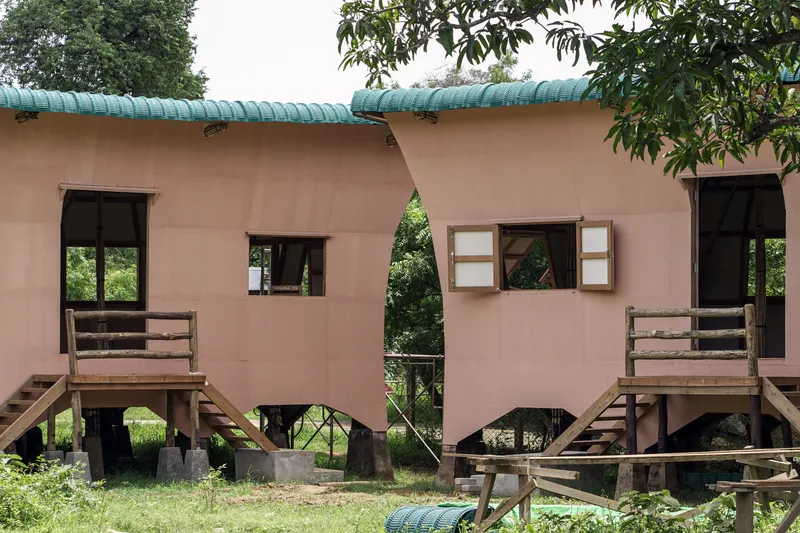
Transforming Low-Value Bamboo into Resilient Housing
Since the military coup in February 2021, Myanmar has faced severe social and humanitarian crises, with tens of thousands displaced due to conflict, cyclones, floods, and earthquakes. Addressing these urgent needs, Housing NOW and Blue Temple have pioneered a modular bamboo housing system engineered for emergency, post-disaster, and conflict-affected contexts.
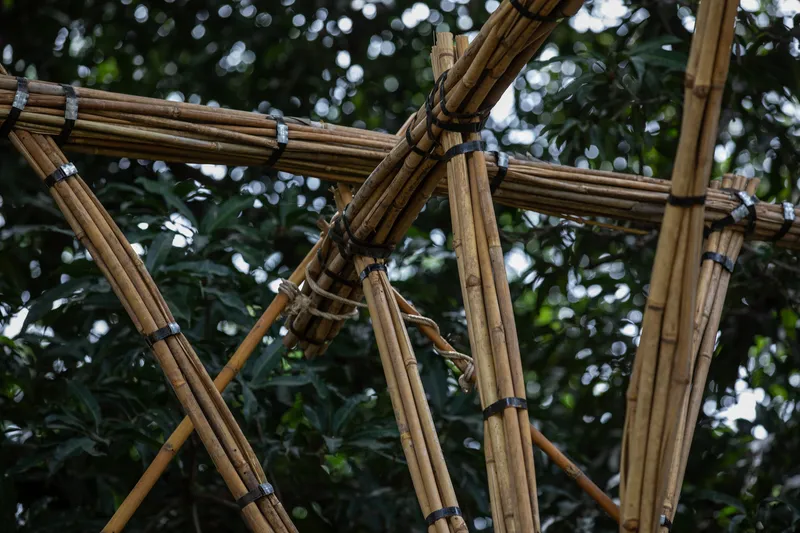
Myanmar is home to hundreds of bamboo species, traditionally used in construction, agriculture, and fencing. While large-diameter bamboo culms fetch high market prices, smaller culms are abundant, inexpensive, and largely underutilized. Housing NOW recognized the potential of these small-diameter culms, bundling and reconfiguring them into robust structural frames to create a highly adaptable, cost-effective, and sustainable housing solution.
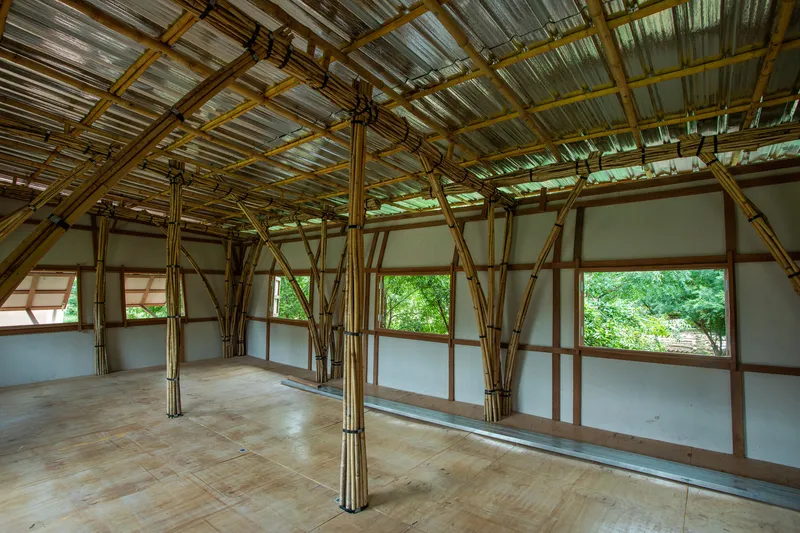
Innovative Structural Design
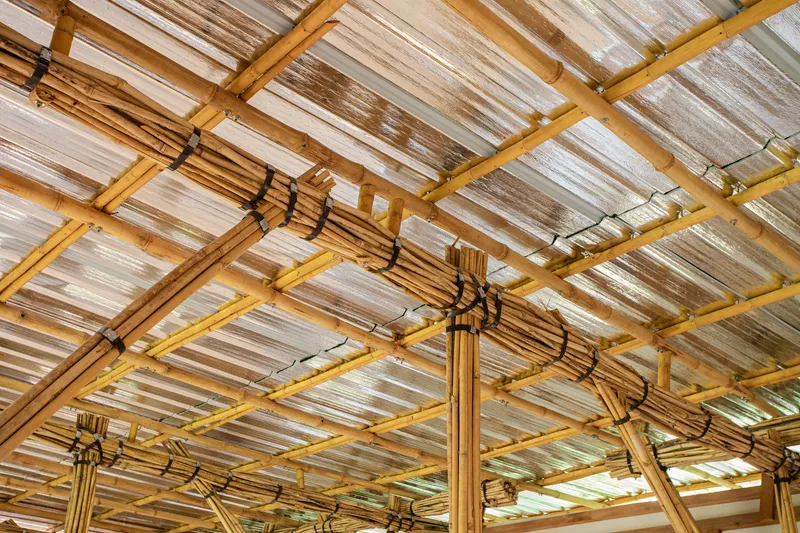
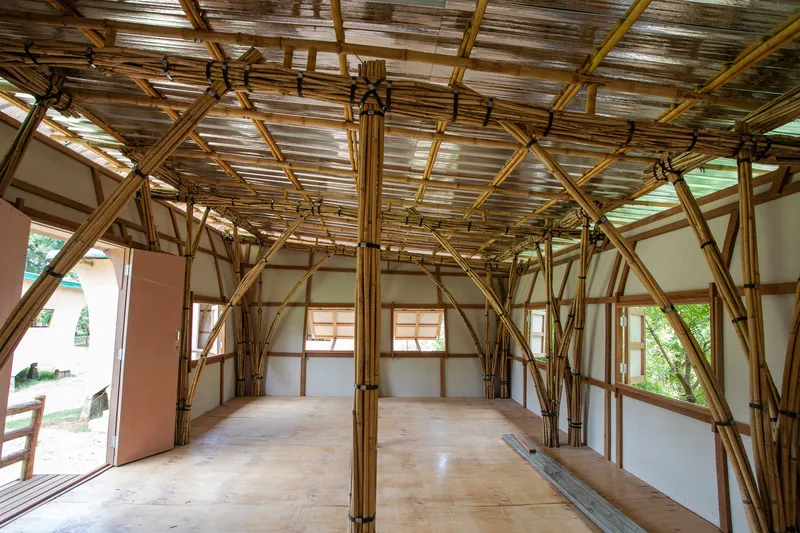
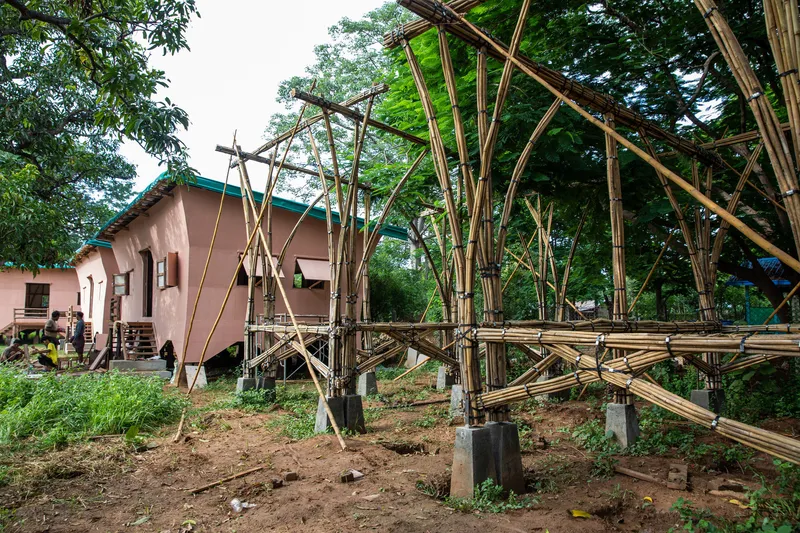
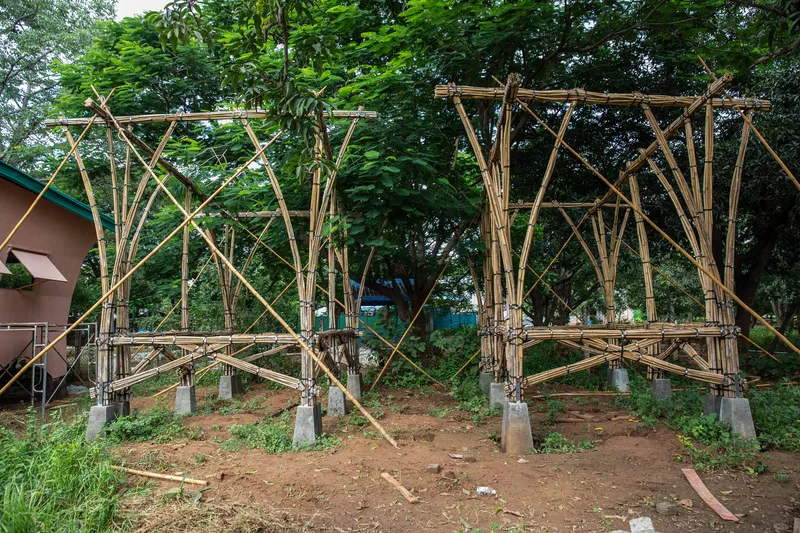
Each housing frame integrates vertical columns, floor beams, roof beams, and diagonal bracing into a single monolithic assembly. Four frames interlock to form a rigid, load-bearing skeleton, upon which walls, floors, and roofs are mounted. The result is a lightweight, modular, and extremely durable system capable of rapid deployment.
To ensure structural reliability, five full-scale prototypes were tested under lateral wind loads using dynamometers. These trials allowed architects to refine the system to withstand extreme weather, confirming its resilience in real-world disaster scenarios.
Pilot Projects: Adaptability Across Contexts
Before large-scale deployment, ten pilot units were built in diverse contexts:
- Hmawbi (Yangon Region): Two preschool units and four orphanage units for children from Chin State.
- Yangon slums: Two single-family houses for displaced women and children living with HIV.
- Kyauktaw (Rakhine State): Two community center units in collaboration with the UNHCR for displaced Arakan families.
These pilots proved that the modular bamboo system adapts seamlessly to rural, peri-urban, and active conflict zones, highlighting its versatility in emergency housing solutions.
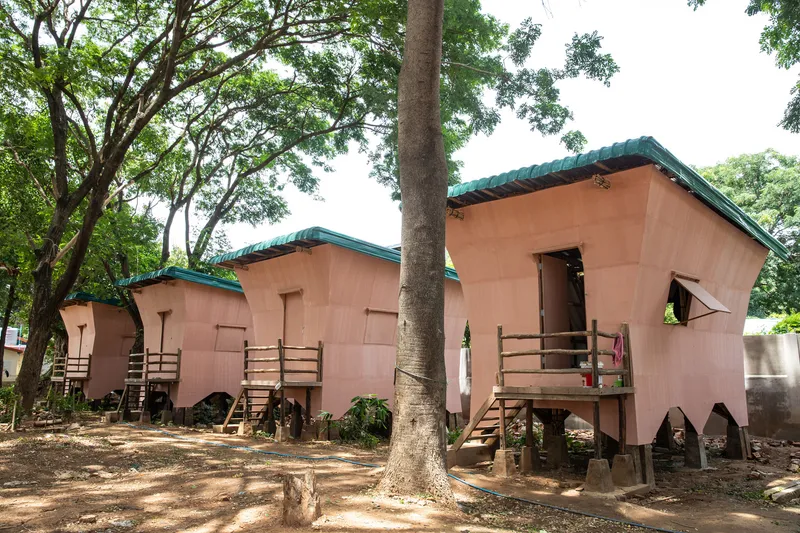
Seismic and Disaster Resilience
The most critical test came with a 26-unit IDP (Internally Displaced People) camp near Mandalay. Shortly after completion, a magnitude-7.7 earthquake struck with its epicenter just 15 km away. Remarkably, all 26 units remained undamaged, providing rare field-based validation for bamboo construction in seismic zones and demonstrating the system’s reliability under extreme disaster conditions.
Community-Driven Construction
Construction in Myanmar poses unique logistical challenges. Transporting prebuilt frames to conflict zones often leads to arrest or confiscation at military checkpoints. Housing NOW adapted by transporting only jigs and raw bamboo, fabricating frames on-site, and deploying mobile bamboo treatment tanks in remote regions.
A participatory construction approach ensures local communities actively contribute to design and assembly. Displaced residents adjust window sizes, partitions, and entrances, while local carpenters create custom bamboo flooring or finishes. This hyper-local approach empowers communities, embeds skills locally, and mitigates risks under current conscription laws.
Responding to Compounding Crises
Myanmar faces overlapping humanitarian emergencies:
- Nearly 110,000 civilian homes destroyed since 2021.
- Cyclone Mocha in 2023 displaced ~360,000 people.
- Typhoon Yagi in 2024 caused severe flooding and displaced millions.
- Ongoing earthquakes and regional conflicts continue to exacerbate housing shortages.
All photographs are work of Aung Htay Hlaing, Raphaël Ascoli


Popular Articles
Popular articles from the community


Cube Design Draws an Ecological Corridor Between Two Shenzhen Hills with the Nankai Building
Beside Shenzhen's container docks, the Nankai Building pairs stacked balconies with a climbing green screen to connect two hillsides across its height.

LT2A and OPEN Architectes Thread a Brick and Glass High School Through a Wooded Belgian Campus
In Braine-l'Alleud, a 3,000 m² wing for Collège Cardinal Mercier pairs pale brick with a glazed colonnade, deferring to a small chapel and a dense wood.

U.GA Architects Wraps an Oval Rooftop Pool in Curved Board-Formed Concrete on Busan's Jeollidan-gil
In Busan's Jeonpo-dong, a 454 m² mixed-use block stacks a neighborhood facility, guest rooms and an oval rooftop pool inside spiraling concrete walls.

longwave studio Reorganizes a 112 m² Tainan Apartment Around the Daily Routines of a Family and Two Cats
In Tainan, Taiwan, birch plywood, rust-red furniture and a freestanding plaster wall link arrival, storage, work and family life in one apartment.

Similar Reads
You might also enjoy these articles


Hodi-Mandai Geram
Project Function: Preservation and revitalization of the Intangible heritage and socio-spatial identity of the Hodi by Housing, Cultural Memory Center, Sacred Grove, landscape, local tourism economy


Olio Towers: A Mid-Rise for Performers That Fuses Housing, Rehearsal, and Stage
Located blocks from Houston's Theater District, this modular tower stacks living units around a central performance atrium.

Oasis: Modular Green Housing Carved into Dhaka's Urban Fabric
A shortlisted Plugin Housing entry reclaims unauthorized settlements in Dhaka with stepped concrete volumes, green roofs, and ventilation-driven design.

Black Hole: A Floating Megastructure for the Post-Physical Era
Emiliano Mazzarotto envisions a spherical, self-scaling arena where e-sports, digital hotels, and holographic stadiums replace traditional public space.

Explore Bamboo Construction Competitions
Discover active competitions in this discipline

Challenge to reimagine the Iron Throne

Photograph architecture without architects

Illustrate the lost glory of Angkor Wat - Render Challenge

Design challenge to reuse E-waste
Comments (0)
Please login or sign up to add comments
No comments yet. Be the first to comment!