

Hugo’s House by Ian Moore Architects: A Modern Extension to a Victorian Terrace House in Glebe
Hugo’s House reinvents a Victorian terrace with a modern steel extension, blending heritage sensitivity and minimalist architectural clarity.


Bridging Heritage and Contemporary Design in Sydney
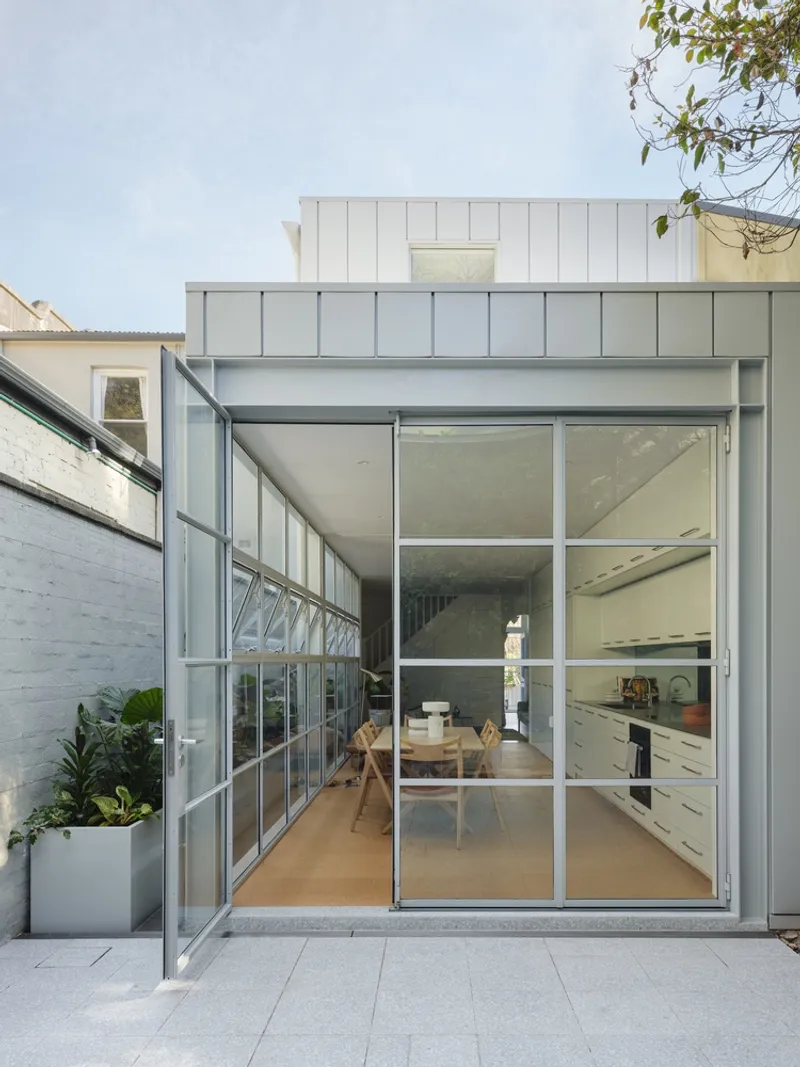
Set within the Heritage Conservation Area of Glebe, Australia, Hugo’s House by Ian Moore Architects presents a striking reinterpretation of a traditional terrace through a modern extension to a Victorian terrace house. The project, completed in 2024, breathes new life into one of a row of six identical historic terraces by carefully contrasting the original masonry structure with a sleek steel-framed addition that introduces openness, light, and spatial clarity.


Respecting History While Reimagining Functionality
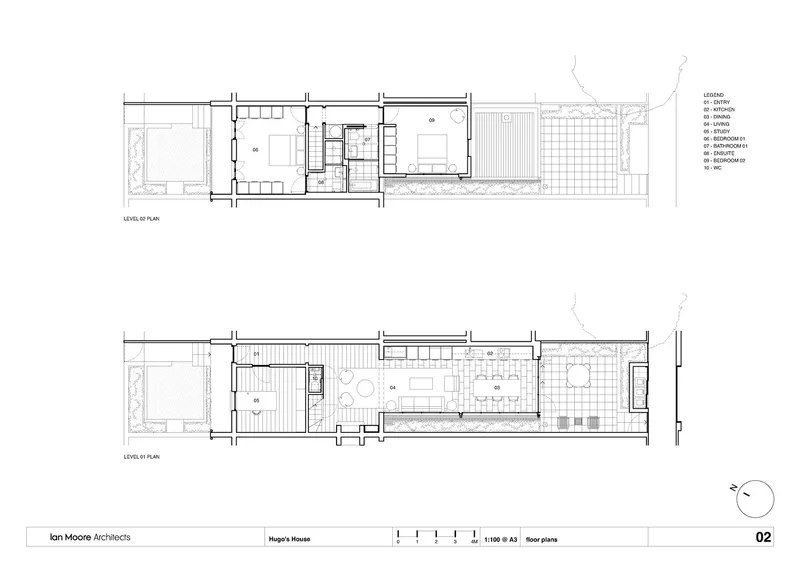
The original house features a typical cross-stair typology, which historically made it difficult to unify the front rooms into a single open-plan space. Rather than disturb the heritage fabric, the design team opted to retain the original volume and instead expand the livable area to the rear. The previous kitchen and laundry spaces in the outdated extension were demolished, paving the way for a lightweight, steel-framed two-storey addition that provides a fluid indoor-outdoor living experience and a new upper-level bedroom.


This strategic choice respects the architectural constraints of the heritage home while enabling a fresh, contemporary lifestyle for its occupants. The new form is clearly legible against the rendered brick of the existing house, ensuring that old and new speak in harmony rather than mimicry.

A Contemporary Language of Steel, Glass, and Light
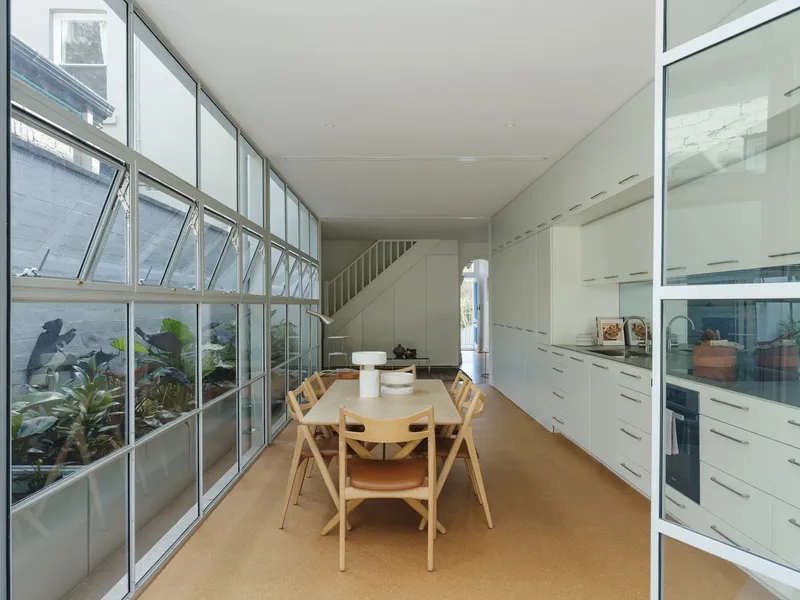
The extension is expressed through a modern material palette—steel cladding, steel-framed glazing, and delicate, recessed detailing. New windows and doors open fully to the rear and side courtyards, dissolving the boundaries between interior and exterior. Along the side, a concrete boundary wall footing prevented excavation, prompting the architects to employ elevated grey aluminium planters for landscaping. These linear interventions provide greenery without disrupting the existing site conditions, maintaining continuity throughout the narrow courtyard.
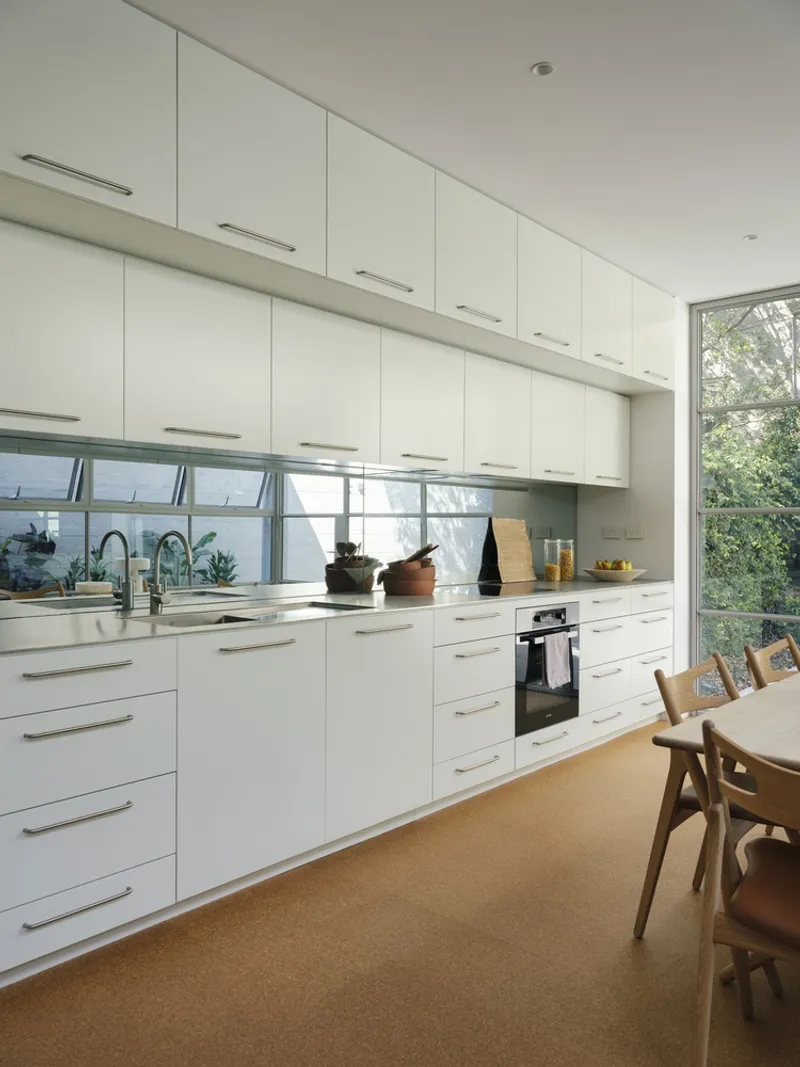
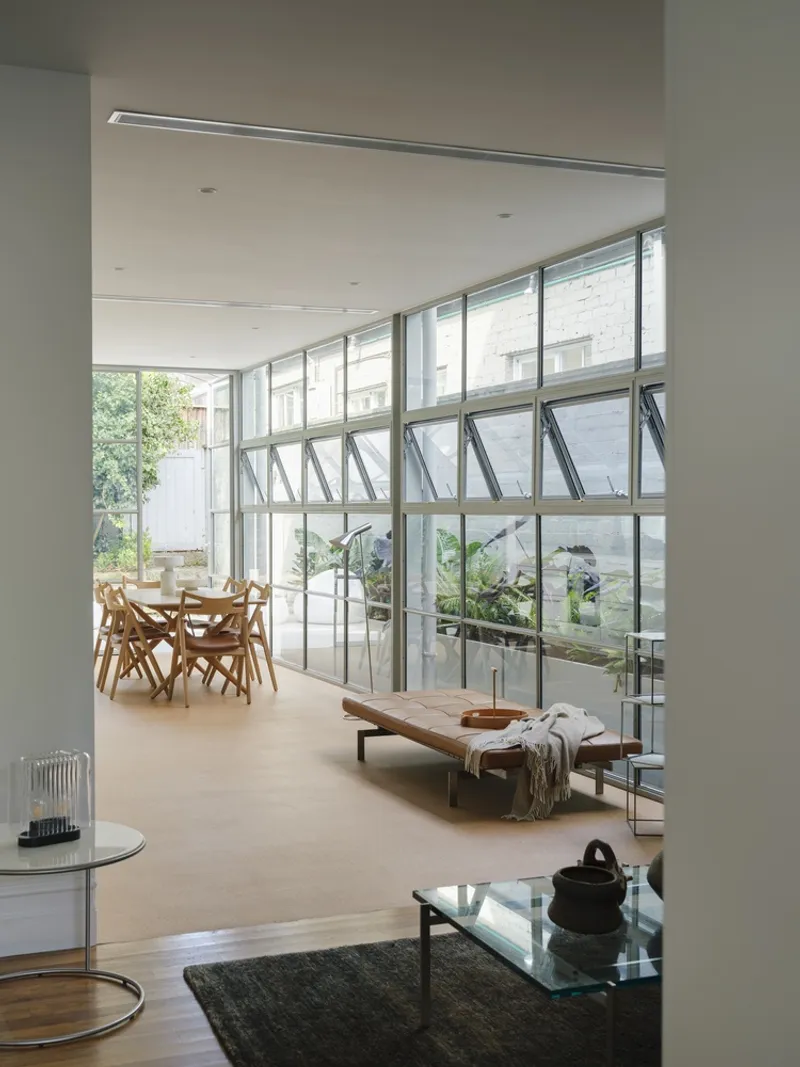
Internally, the material choices echo this quiet contrast. Cork flooring is used in the new lower level to visually warm and relate to the timber tones of the original structure. The kitchen, clad in pale grey joinery to match the exterior steelwork, features a mirrored splashback that bounces light and reflects courtyard plantings, creating a sense of depth in the compact footprint.


Skylit Interiors and Thoughtful Transitions
Upstairs, the reorganization of rooms maximizes utility and enhances livability. The previous rear bedroom becomes two new bathrooms, including a skylit ensuite. The skylight draws daylight into the heart of the windowless space, turning the ensuite into a luminous, serene retreat. Bathrooms are finished in terrazzo tiles and Japanese finger tiles, extending a textured, crafted quality across all wet areas.
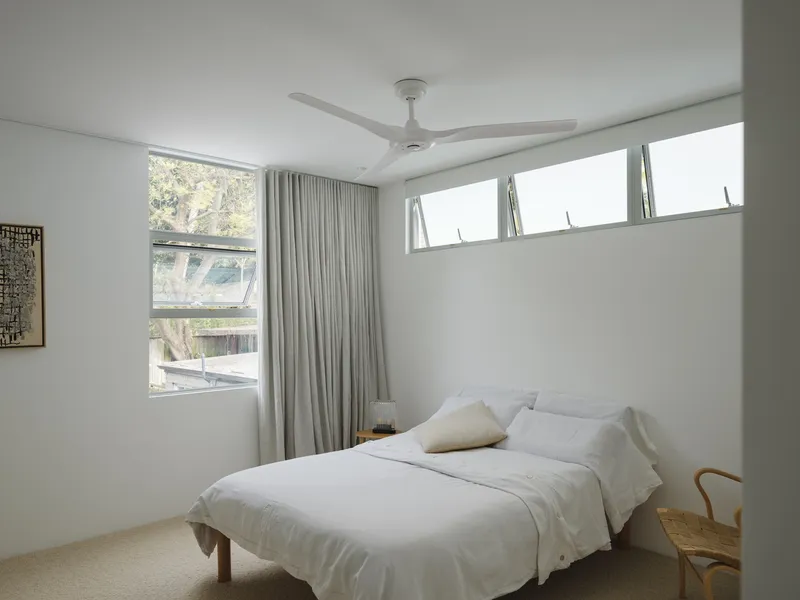
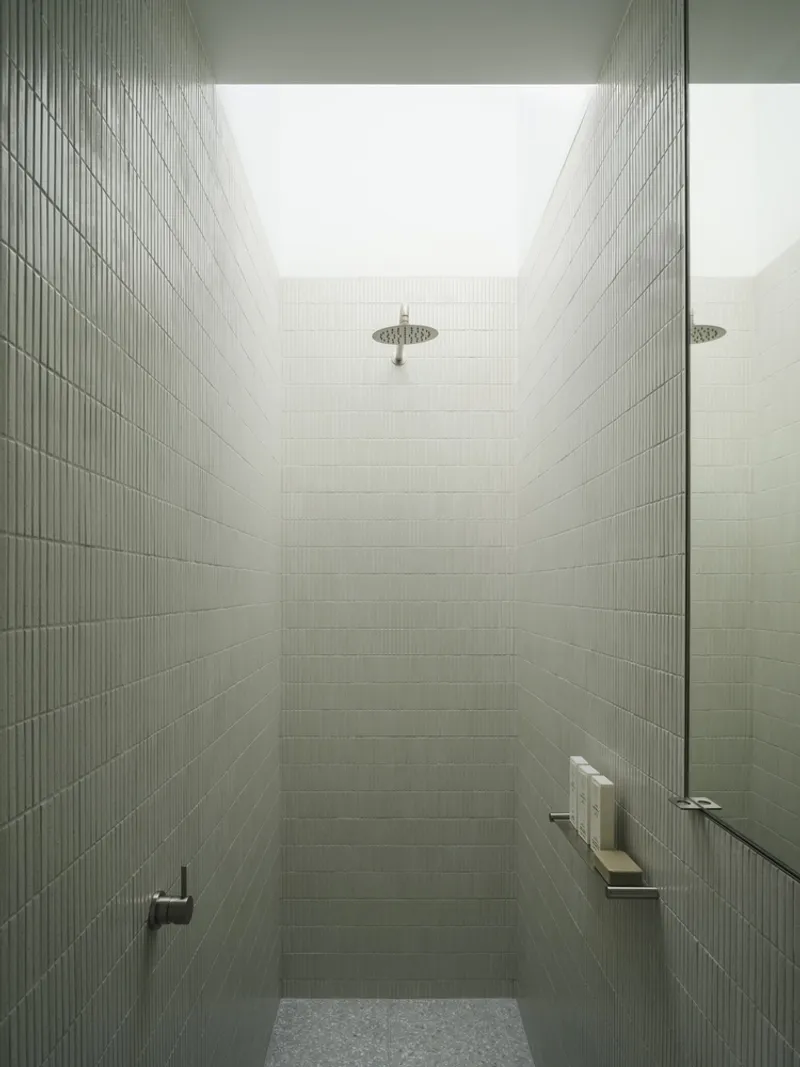

The rear courtyard uses the same terrazzo paving as the bathrooms, ensuring material continuity and a calm transition from interior to exterior. Every surface and interface is designed with sensitivity to light, material resonance, and architectural rhythm.


An Elegant Balance of Past and Present
In Hugo’s House, Ian Moore Architects achieves an elegant balance between heritage preservation and modern expansion. By embracing contrast rather than camouflage, the new extension creates clarity in spatial organization and a tangible connection to landscape and light. It celebrates the house's past while enhancing its future with adaptable living spaces, efficient planning, and timeless material expression.


This project is a model for architectural restraint and innovation within heritage contexts—an urban extension that does not overpower but complements, that updates without erasing, and that expresses modernity through material honesty and spatial generosity.


All Photographs are works of Clinton Weaver


Popular Articles
Popular articles from the community


David Macias Steps a Doorless Stone and Plaster House Down a Tropical Colombian Hillside
In the humid hills of Colombia, Threshold House replaces the front door with an open void and terraces its 850 m² down the slope instead of fighting it.

Architekt Andreas Gruber Scatters 23 Dark Timber Chalets Across a South Tyrolean Forest Edge
In Molini di Tures, Amonti Chalets breaks a resort into a hamlet of gabled timber houses, with parking, storage and services pushed into the slope.

GROUP A Strips a 1969 Rotterdam Harbor Headquarters to Its Frame and Wraps It in Timber Louvers
In Rotterdam's M4H harbor district, Ferro Offices reuses a 1969 frame, adds one timber storey and reaches BREEAM-NL Outstanding.

LT2A and OPEN Architectes Thread a Brick and Glass High School Through a Wooded Belgian Campus
In Braine-l'Alleud, a 3,000 m² wing for Collège Cardinal Mercier pairs pale brick with a glazed colonnade, deferring to a small chapel and a dense wood.

Similar Reads
You might also enjoy these articles

Gil Mello Arquitetura Tilts a Single Roof Toward the Waterfalls on a Plateau Above Aiuruoca, Brazil
In Aiuruoca, Minas Gerais, a 200 m² house of local labor and reclaimed poles pairs a low valley veranda with a tall mountain one.

U.GA Architects Wraps an Oval Rooftop Pool in Curved Board-Formed Concrete on Busan's Jeollidan-gil
In Busan's Jeonpo-dong, a 454 m² mixed-use block stacks a neighborhood facility, guest rooms and an oval rooftop pool inside spiraling concrete walls.

Felipe Hess Arquitetos Turns a Blind Stone Wall to the Street and Opens a Brazilian House onto a Courtyard and Canal
A canal-front house in Brazil hides behind painted stone and planting, then opens to an olive-tree courtyard, a reed-ceilinged porch and a curving pool.
David Macias Steps a Doorless Stone and Plaster House Down a Tropical Colombian Hillside
In the humid hills of Colombia, Threshold House replaces the front door with an open void and terraces its 850 m² down the slope instead of fighting it.

Explore Architecture Competitions
Discover active competitions in this discipline

Challenge to reimagine the Iron Throne

Photograph architecture without architects

Illustrate the lost glory of Angkor Wat - Render Challenge

Design challenge to reuse E-waste
Comments (0)
Please login or sign up to add comments
No comments yet. Be the first to comment!