

HuLa Village: Sustainable Architecture for a Shared Future Between Humans and Koalas
A sustainable architecture vision where humans and koalas coexist through modular habitats, ecological restoration, and shared futures.

Organizer's Choice Award Entry of Haven 2020
Project byDuc Chu, Ánh Maii, Kiên Tố Nguyễn, and Son Au
As climate change, urban expansion, and habitat destruction continue to threaten wildlife populations worldwide, architects are increasingly exploring new ways to create environments where humans and nature can coexist.HuLa Village presents an inspiring vision of sustainable architecture that addresses one of Australia's most pressing ecological challenges: the conservation of koalas and their natural habitat.
Recognized as the Organizer's Choice Award entry of Haven 2020, HuLa Village proposes a future where human development and wildlife preservation are no longer competing interests. Instead, the project creates a dynamic ecosystem where people actively participate in conservation efforts while learning to share space with one of Australia's most iconic species.
Rethinking the Relationship Between Humans and Wildlife
For decades, urban development has fragmented natural habitats, forcing wildlife populations into increasingly isolated environments. Koalas, which depend heavily on eucalyptus forests, have been particularly vulnerable to habitat loss, bushfires, and environmental degradation.
HuLa Village challenges the traditional approach of separating humans from wildlife. Rather than creating isolated conservation zones, the proposal introduces a shared environment where ecological restoration and human activity support one another.
The project asks a simple but powerful question: What if architecture could become a bridge between human communities and endangered ecosystems?
Through a carefully designed framework of modular structures, ecological networks, and community-based programs, HuLa Village demonstrates how sustainable architecture can contribute directly to environmental recovery.
Sustainable Architecture Inspired by Nature
At the heart of HuLa Village is an integrated design strategy that combines built environments with living ecosystems. The project studies the natural development patterns of eucalyptus forests and translates them into an architectural system capable of growing and evolving over time.
The architecture is not imposed upon the landscape. Instead, it emerges from it.
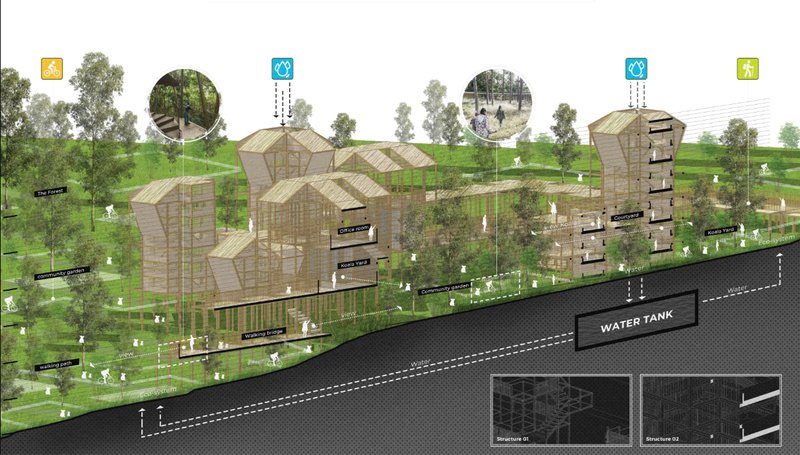
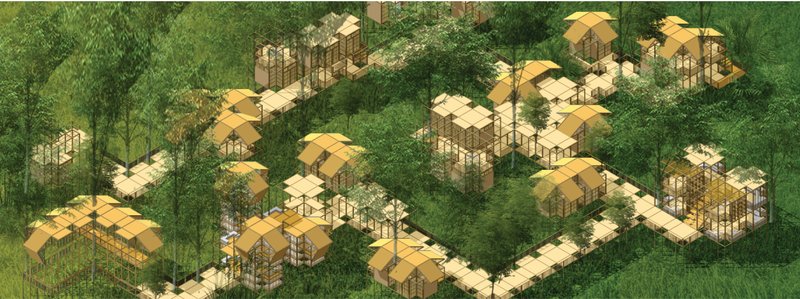
Lightweight modular structures are elevated among trees, allowing vegetation, wildlife corridors, and ecological processes to continue beneath and around the buildings. The result is an environment where architecture becomes part of the ecosystem rather than an interruption to it.
Wooden frameworks, open circulation paths, and adaptable modules create a village-like atmosphere that encourages interaction while maintaining respect for the surrounding environment.
A Modular System That Evolves in Stages
One of the project's most innovative features is its staged development strategy. Instead of constructing a complete village immediately, HuLa Village grows alongside the ecosystem it seeks to protect.
Phase One: Establishing the Foundation
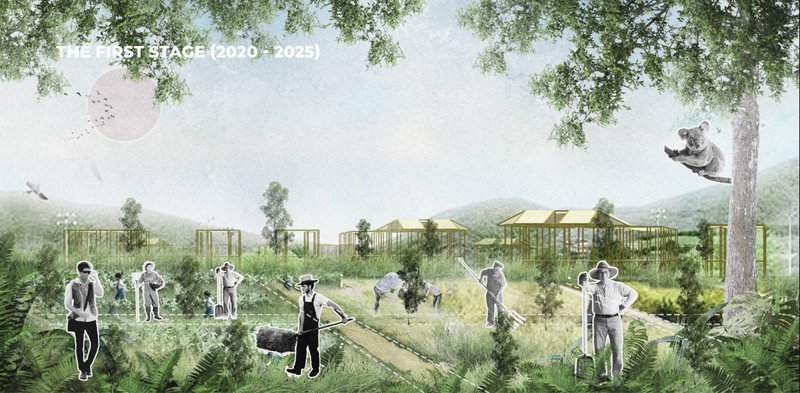
The initial stage focuses on ecological restoration and koala rehabilitation. Essential facilities are introduced, including research spaces, rehabilitation centers, laboratories, and agricultural zones. Simultaneously, extensive planting programs help establish new eucalyptus habitats and strengthen biodiversity.
This phase creates the environmental conditions necessary for long-term conservation.
Phase Two: Expanding Community Functions
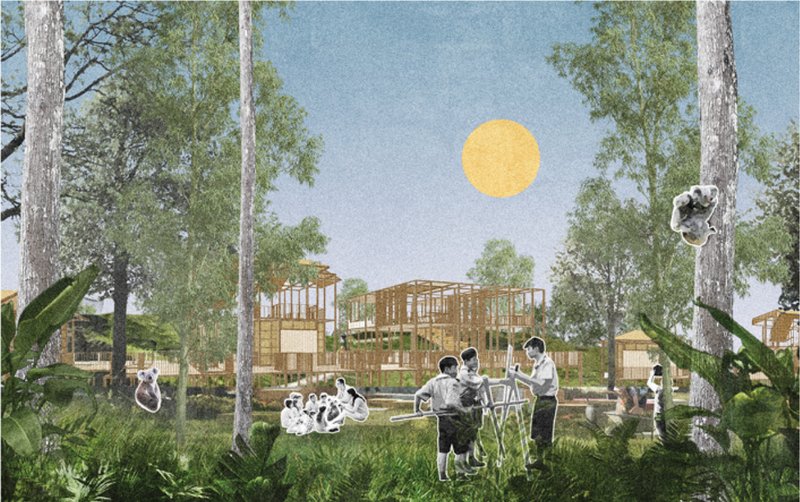
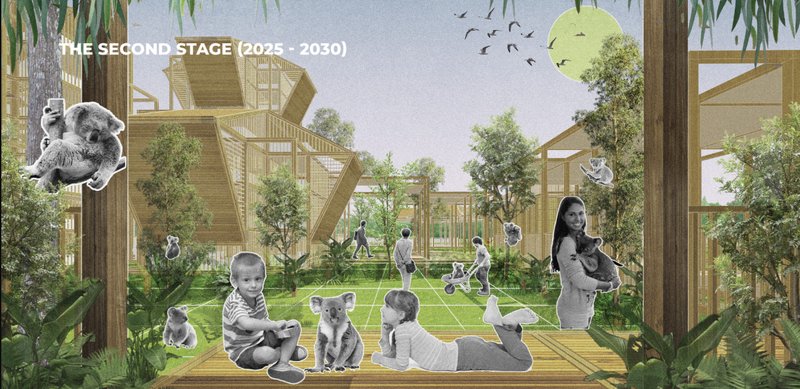
As the ecosystem matures, additional modules are introduced to support education, tourism, and community engagement. Libraries, workshops, classrooms, museums, and cultural facilities provide opportunities for visitors to learn about koala conservation and environmental stewardship.
The architecture becomes both a conservation tool and an educational platform.
Phase Three: A Self-Sustaining Ecological Community
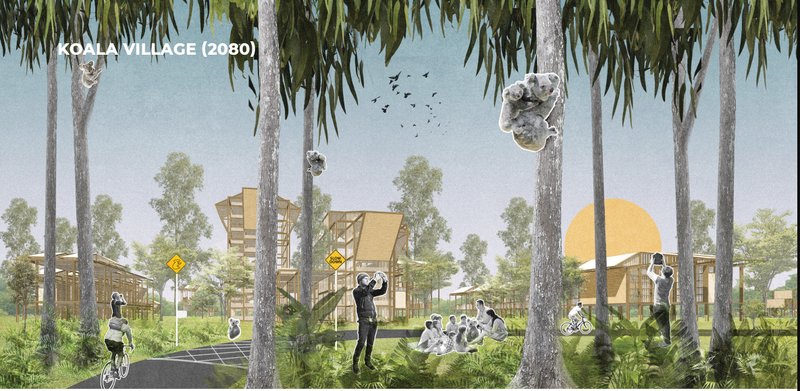
In its final stage, HuLa Village evolves into a fully functioning ecological settlement where economic, social, and environmental systems work together.
Homestays, restaurants, community gardens, agricultural facilities, and cultural spaces generate sustainable economic activity while supporting ongoing conservation efforts. The village becomes a living example of how sustainable architecture can create lasting relationships between people and nature.
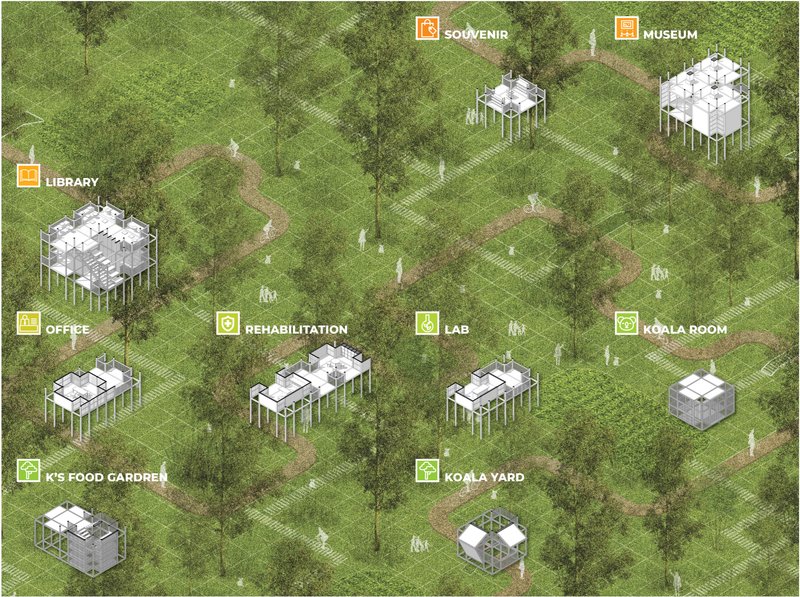
The Human and Koala Ecosystem
A defining characteristic of HuLa Village is its focus on creating mutual benefits for both humans and koalas.
The project establishes interconnected systems that support ecological health, community engagement, and economic sustainability simultaneously. Conservation activities are integrated directly into daily life, transforming residents and visitors into active participants in protecting wildlife.
Educational programs help people understand the needs of koalas, while agricultural initiatives promote sustainable land management practices. Research facilities contribute valuable knowledge to conservation efforts, and tourism programs generate resources that support environmental protection.
This integrated approach creates a circular relationship where every component contributes to the well-being of the larger ecosystem.
Architecture Rooted in the Queensland Landscape
The design draws inspiration from traditional Queensland housing typologies and the ecological characteristics of Australian forests.
Elevated structures improve ventilation, reduce environmental impact, and allow natural water flow and wildlife movement beneath buildings. Modular construction enables flexibility while minimizing disruption to the landscape.
The use of repetitive structural elements allows the village to expand gradually while maintaining visual consistency and environmental sensitivity.
This approach demonstrates how sustainable architecture can learn from local traditions while responding to contemporary ecological challenges.
Building with Nature Instead of Against It
The project's forest modules are designed as living systems rather than decorative landscapes. Multiple vegetation layers, including canopy trees, understory species, shrubs, and ground cover, replicate the complexity of natural ecosystems.
As these habitats mature, they provide food, shelter, and movement corridors for wildlife while improving environmental performance through carbon sequestration, soil regeneration, and biodiversity enhancement.
The architecture and ecology grow together, creating a resilient environment capable of adapting over time.
A Model for Future Conservation Communities
HuLa Village offers more than a solution for koala conservation. It presents a broader vision for the future of sustainable architecture and environmental design.
By combining modular construction, ecological restoration, community participation, and economic sustainability, the project demonstrates how architecture can become an active force for environmental regeneration.
In a world where urban growth often comes at the expense of natural habitats, HuLa Village proposes an alternative path. It shows that human development and ecological preservation do not have to exist in conflict. Through thoughtful design, they can support one another and create a shared future that benefits both people and wildlife.
HuLa Village reimagines conservation through the lens of sustainable architecture. Rather than isolating endangered species from human activity, the project creates an evolving environment where coexistence becomes possible.
Through modular design, ecological restoration, and community engagement, the proposal establishes a framework for a future in which humans and koalas thrive together. As environmental challenges continue to reshape our world, HuLa Village stands as a powerful example of architecture's potential to reconnect people with nature and create meaningful, lasting change.



Popular Articles
Popular articles from the community


Vagaries of Life: Sustainable Urban Architecture for a Self-Sufficient Community in Singapore
Vagaries of Life reimagines Singapore housing as a tropical urban sanctuary for farming, resource cycles and collective community living now
Shinkō Komyuniti: Public Space Architecture Reimagining Sport, Culture and Community in Tokyo
Shinkō Komyuniti transforms sports spectatorship into public space architecture that reconnects play, culture, community and Tokyo life now.
Community Library in Girona: A Replicable Model for Inclusive Library Architecture
A modular community library in Girona transforms learning, culture, and climate-responsive design into a shared civic network for all users.
POP ART: Adaptive Reuse Architecture as a Cultural Intervention in Sydney
POP ART reimagines an unused Sydney warehouse through adaptive reuse architecture, creating a bold cultural landmark above the city streets.


Similar Reads
You might also enjoy these articles

Eco Chapel: A Green Architecture Pavilion Designed in Symbiosis with the Forest
Eco Chapel uses green architecture to weave prayer, learning and reuse into a forest pavilion shaped by modular hexagonal canopies for life.
Kaffeebühnen: Coffee Shop Architecture Designed as a Civic Stage Between Vienna’s City and Park
Kaffeebühnen turns coffee shop architecture into a civic stage, linking Vienna’s park edge, urban life, warm timber yards, and coffee craft.
Healing Façade: Sustainable Architecture for Reforestation, Community, and Sacred Ecology in Ethiopia
Healing Façade reimagines sustainable architecture as a living wall that restores soil, catches water and renews Ethiopia's forest churches.


Urban Forest: A Vertical Ecosystem for 5,000 Workers in Singapore's Changi Business Park
Radially stacked pods and layered green decks turn a 7-acre plot into 47 acres of ecological workspace projected for 2040.

Explore Architecture Competitions
Discover active competitions in this discipline




The International Standard for Design Portfolios


The Global Benchmark for Architecture Dissertation Awards

The Global Benchmark for Graduation Excellence


Challenge to reimagine the Iron Throne
Comments (0)
Please login or sign up to add comments
No comments yet. Be the first to comment!