

HUMAN NATURE SYNERGY
Returning back to the roots, living in the nature and trying to perceive the time in it's natural habitat, but in a contemporary way, is the thing that our project approaches.

● What was the concept behind the project?
The concept behind the project was to address the problem of living in a very condensed city, which in our opinion becomes more stressful by each day. The overcrowding city makes the human life to be perceived like it is flowing away too fast. Pollution is also another problem made by this way of living in a crowded city, which leads to global warming, a problem which gets only worse as the time passes. Returning back to the roots, living in the nature and trying to perceive the time in it's natural habitat, but in a contemporary way, is the thing that our project approaches.
Since the beginning of the project, we wanted to make a house right in the heart of nature and also above the trees, in a place where you can admire the true beauty of the natural horizon.
The organic shape of the house, was inspired by the natural elements found in a forest, such as the trees, tree hollows, mushrooms, leaves and many others.
● What was the intent behind the organization of elements across various levels (Architectural, Site,Urban)?
As mentioned above, we chose the site an natural environment, in a forest on top of the mountains. Even tho the site doesn’t have a precise location, the building can be place in any location of the world, because it designed to integrate in the natural landscape, without losing it’s contemporary essence.
About the levels, the house is made of 2 levels connected by a transition area. The access is marked by a tree hollow-like entrance, which leads you to the stairs/elevator. Once arrived at the top level, you arrive in a hallway that will lead you the desired area of the house. The night area, and the day area are all placed on the same level, in a circular shape which allows you to enjoy the beautiful panorama that you have when you are above the trees.
The house also gives you the opportunity to spend some time on the terrace, which is surrounding all the rooms of the house.
● How many iterations were tried to arrive at the final outcome?
Upon reaching this design for the house, we had various number of attempts, all trying to respond to the problems that we mentioned above, and in the same time to follow an organic shape.
Firstly we tried to make a tree house, with all the rooms being individually positioned on a stem, each of them being at a different level.
In the end we didn’t do a tree house, but we designed a house that has it’s own structure, inspired by the tree stem. In this creative process , we also had an idea to separe the day and the night areas, on separate levels that are connected by this structural steam that we just mentioned. The image of that type of building, for us seemed a bit too much for the natural habitat that we wanted our house to fit in. This is why we ended up with this much simpler form
● Which methods of design investigation?
The key words for our design is balance, inspired by nature and the organic shapes of it. In order to obtain that effect, we studied nature and the architectural design that contemporary architects approach when building in a natural environment.
● How was the programme condensed into final?
As mentioned above, the final result of the building is made by the synergy of architecture and the natural environment that is built for.
● What/How were the materials chosen?
The structure is made by reinforced concrete pillars, arrayed in a circular shape that tries to imitate the tree stem. The house has no exterior walls. All the exterior closings are made of glass so that you can experience the natural views from every “corner” of the house.
We used white colors for the exterior finishing to obtain this elegant look and for feeling the presence of the house in this forest, as a symbol of escaping the overcrowded city.
For the interior, we used a polished concrete floor that helps to bring more light inside the house. The other finishes, are made of neutral colors, such as grey, black and white so that the only color that you see is the color of the natural environment.
● How was a specific objective attempted to be met?
As mentioned above, the project is inspired by nature, uses contemporary materials and addresses a contemporary philosophy : escaping from the overcrowded city and returning to the natural habitat.
● What is the expansion plan of the project?
The expansion plan of the project is simple: you can duplicate this house over the forest, without making any changes on the shape of the building. The only thing that you could change may be the interior partitioning. The house doesn’t have a defined site, for it is a module that can be multiplied many times even forming small communities inside the natural habitat , but not in the way that our cities became.
● How will the project transform with the passing time? etc.
With the passing time, the project aims to never get old, for the human life will always need to detach from the urban environment and be reunited with the nature. Also, living in this covid times, changes the way that our homes should be like, People should not live between four walls, in a “match box” placed on top of the other. People, just like animals, should not live in a cage.

Popular Articles
Popular articles from the community


Opera on the Sea: Driftwood Logic Shapes a Timber Opera House on Estonia's Coast
Trevor Orgill's opera house translates the entangled drift of floating timber into a civic building where wood, water, and music converge.

The Amber Palace Opera: A Geological Fiction Surfaces on Tallinn's Baltic Waterfront
Pierre Brillard reimagines a Baltic legend as a public landscape, opera house, and waterfront promenade rooted in Tallinn's coastal identity.

Manzana Morphosis: Stretching Barcelona's Grid into a Living Landscape for 2050
A radical reworking of the Eixample manzana turns density into a tool for generous public space, vertical ecology, and environmental performance.

Singing Woman: Contemporary Architecture Inspired by Estonia’s Voice and the Sea
Singing Woman turns Estonia’s song culture into flowing opera house architecture, blending public life, landscape, sea, and national memory.

Similar Reads
You might also enjoy these articles

Day and Night Park: A Time-Based Urban Newsstand in Beijing
A temporary urban newsstand in Beijing blending travel, light, and reading through poetic colors, compact form, and community-focused design.

Modernist Patio Renovation in El Masnou, Barcelona by Oliver Segura Arquitectura + Cebrià Arquitectura
Modernist patio renovation blending tradition and innovation with a movable pool, leveled floors, and Catalan materials in El Masnou.

Alto Residencial Coop: Cooperative Housing Development in Santiago de Compostela by Carbajo Barrios Arquitectos
A linear cooperative housing complex blending white volumes and perforated metal façades, enhancing community living, natural light, privacy, and urban integration.
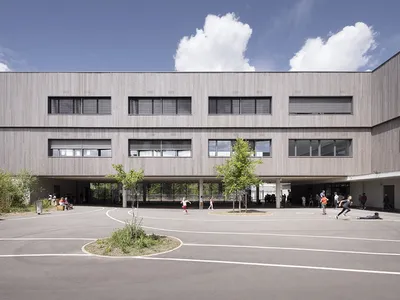
Vil Genis School by BPA ARCHITECTURE – Massy, France
Vil Genis School in Massy, France, features sustainable design, south-facing classrooms, community integration, accessible spaces, and modern educational architecture.

Comments (0)
Please login or sign up to add comments
No comments yet. Be the first to comment!