

Hustle Hub: Co-Living as Social Infrastructure
A co-living complex for migrants and urban workers where housing, employment, markets, and community occupy four stacked layers in one building.


Co-living is usually designed for people who have choices. Young professionals who could rent alone but prefer community. Digital nomads who want flexibility. Hustle Hub: LIVE.WORK.PLAY, a project by Ahmad Wasi, B.M Tahammul Kabir, Rahat, and Rakesh Sharma, designs co-living for people who need it. Migrants, informal workers, and urban poor who need shelter, employment, and community in one place.
Shortlisted in the Hustle Hub '19 competition on uni.xyz, this entry reframes the co-living brief as a social infrastructure problem rather than a lifestyle product. The building does not just house people. It employs them, feeds them, and connects them to the city around them.
The Section: Four Layers of Programme
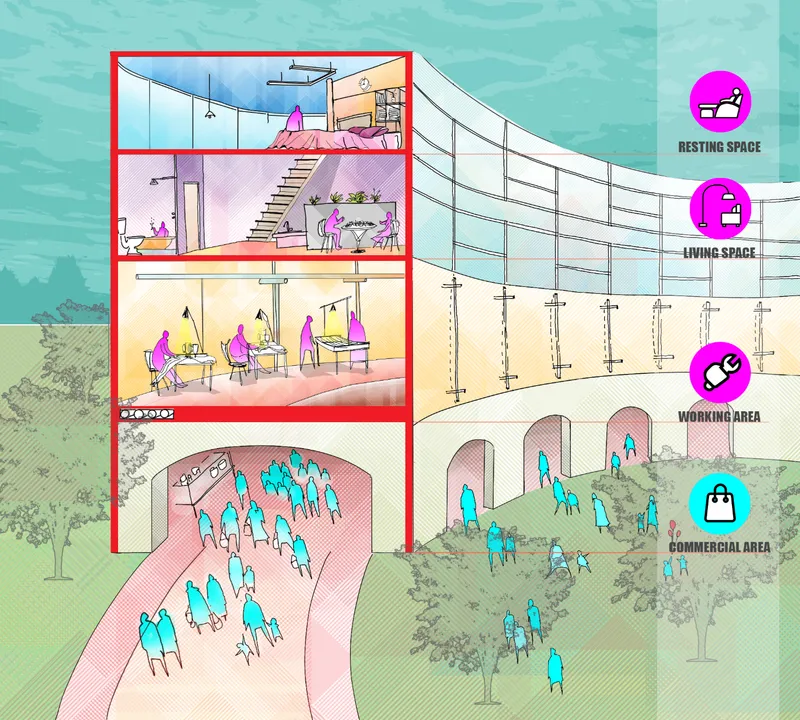
The section collage shows the building's vertical logic in a single image. At the top, resting spaces: quiet rooms for sleeping and retreat. Below, living spaces: shared kitchens and communal dining. Below that, working areas: workshops, maker spaces, and co-working. At the base, commercial zones: shops, markets, and services that face the street. People gather on curved outdoor paths between the layers.
This four-layer stack is the project's organising principle. Rest at the top (quietest). Commerce at the bottom (most public). Living and working in between. The gradient from private to public runs vertically. Every resident moves through all four layers daily, which means every resident encounters every programme. The building does not allow isolation.
The Atrium: Where Everything Meets
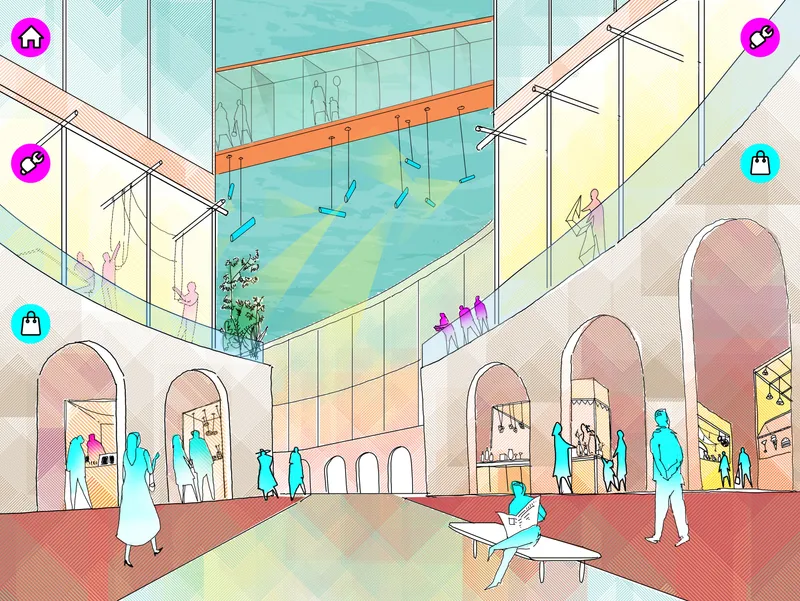
The interior render shows a multi-level atrium with arched openings, hanging swings, shop fronts, and people moving between levels. Programme icons identify living, retail, work, and play zones. The atmosphere is busy, colourful, and deliberately dense. This is not a quiet courtyard. It is a market hall that happens to have housing above it.
The arched openings give the atrium a civic quality. They read as a public building rather than a residential lobby. This is intentional. The project is designed for people who may be new to a city and need the building to function as their first public space: a place to find work, buy food, meet neighbours, and learn how the city works.
LIVE.WORK.PLAY: The Collage
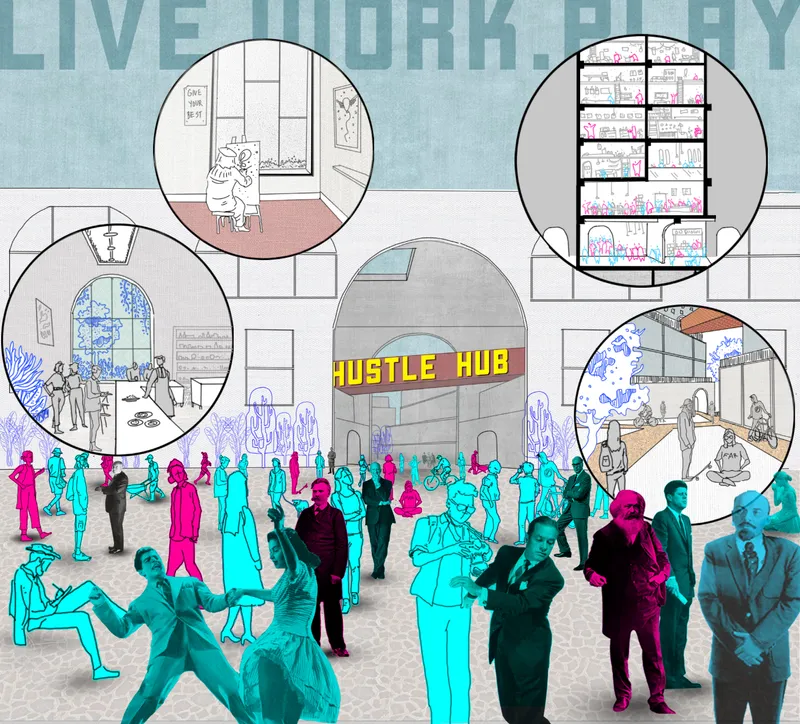
The signature collage shows a crowd of coloured figures gathered in front of the Hustle Hub entrance. Vignette bubbles illustrate the life inside: an artist working in a studio, stacked modular units viewed in section, a co-working space with people at desks, and a communal cafe. The crowd is diverse in age, dress, and activity. The building serves all of them.
The collage style matters. It is not a polished render. It is a populated diagram. The people are the subject, not the architecture. This is the project's values made visible: the building exists for the people in front of it, not for the camera behind it.
The Units: 90 to 240 Square Feet
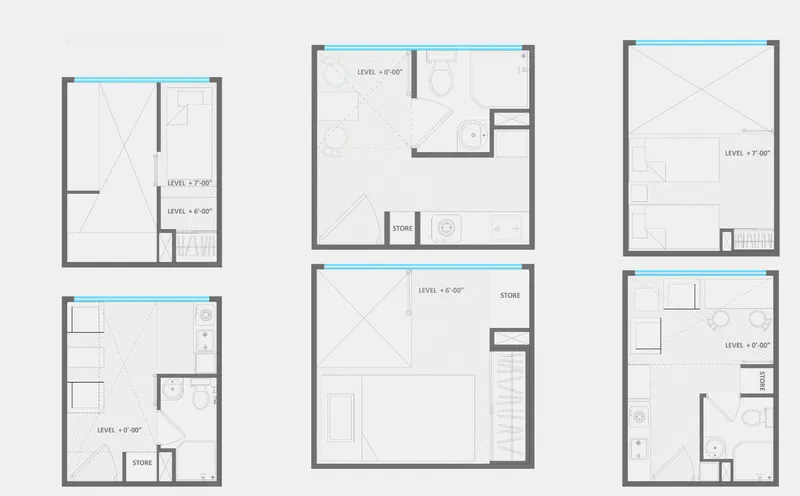
Six modular dwelling plans show the unit range. The smallest is 90 square feet: a bed, a bathroom, and storage. The largest is 240 square feet: a bed, a bathroom, a kitchen, and a small living area. Every unit has a blue highlight strip at the top (a ventilation or service zone) and a compact layout where nothing is wasted.
These are not luxury co-living pods. They are minimum viable dwellings. The project does not pretend that 90 square feet is generous. It acknowledges that 90 square feet with access to a shared kitchen, a workshop, and a market is more livable than 90 square feet alone. The shared programme compensates for the private compression. The building is honest about this trade-off.
Why This Project Matters
The Hustle Hub competition asked for co-living. Most entries designed for millennials with laptops. This entry designed for migrants with suitcases. The distinction matters because it changes every assumption: the unit sizes are smaller, the shared spaces are more essential, the commercial programme is not a cafe but a livelihood, and the atrium is not a lounge but a public hall.
For anyone studying co-living as social infrastructure rather than lifestyle product, this project demonstrates that the building type has a much wider application than the market currently serves. Co-living is not just for people who want community. It is for people who need it.
View the Full Project
Hustle Hub: LIVE.WORK.PLAY
View the full shortlisted entry with all project boards on uni.xyz.
uni.xyzAbout the Designers
Designers: Ahmad Wasi, B.M Tahammul Kabir, Rahat, Rakesh Sharma
Enter a Design Competition on uni.xyz
If social housing, co-living for vulnerable populations, or architecture as employment infrastructure is the kind of work you want to pursue, uni.xyz runs competitions year-round that reward proposals with real social ambition.
Project credits: Hustle Hub: LIVE.WORK.PLAY by Ahmad Wasi, B.M Tahammul Kabir, Rahat, Rakesh Sharma. Shortlisted, Hustle Hub '19 (uni.xyz).


Popular Articles
Popular articles from the community


Manzana Morphosis: Stretching Barcelona's Grid into a Living Landscape for 2050
A radical reworking of the Eixample manzana turns density into a tool for generous public space, vertical ecology, and environmental performance.

Opera on the Sea: Driftwood Logic Shapes a Timber Opera House on Estonia's Coast
Trevor Orgill's opera house translates the entangled drift of floating timber into a civic building where wood, water, and music converge.

Extended Shell: Retrofitting Kolkata's Balconies as Living Urban Thresholds
A modular retrofit system recovers the social and environmental intelligence of Kolkata's historic verandas for contemporary Park Street residents.

The Amber Palace Opera: A Geological Fiction Surfaces on Tallinn's Baltic Waterfront
Pierre Brillard reimagines a Baltic legend as a public landscape, opera house, and waterfront promenade rooted in Tallinn's coastal identity.

Similar Reads
You might also enjoy these articles

Day and Night Park: A Time-Based Urban Newsstand in Beijing
A temporary urban newsstand in Beijing blending travel, light, and reading through poetic colors, compact form, and community-focused design.

Modernist Patio Renovation in El Masnou, Barcelona by Oliver Segura Arquitectura + Cebrià Arquitectura
Modernist patio renovation blending tradition and innovation with a movable pool, leveled floors, and Catalan materials in El Masnou.

Alto Residencial Coop: Cooperative Housing Development in Santiago de Compostela by Carbajo Barrios Arquitectos
A linear cooperative housing complex blending white volumes and perforated metal façades, enhancing community living, natural light, privacy, and urban integration.
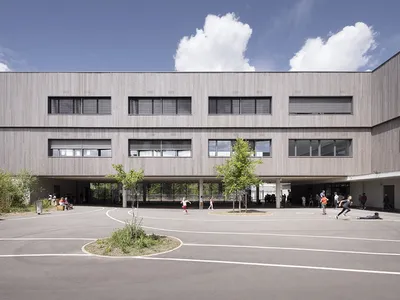
Vil Genis School by BPA ARCHITECTURE – Massy, France
Vil Genis School in Massy, France, features sustainable design, south-facing classrooms, community integration, accessible spaces, and modern educational architecture.

Comments (0)
Please login or sign up to add comments
No comments yet. Be the first to comment!