
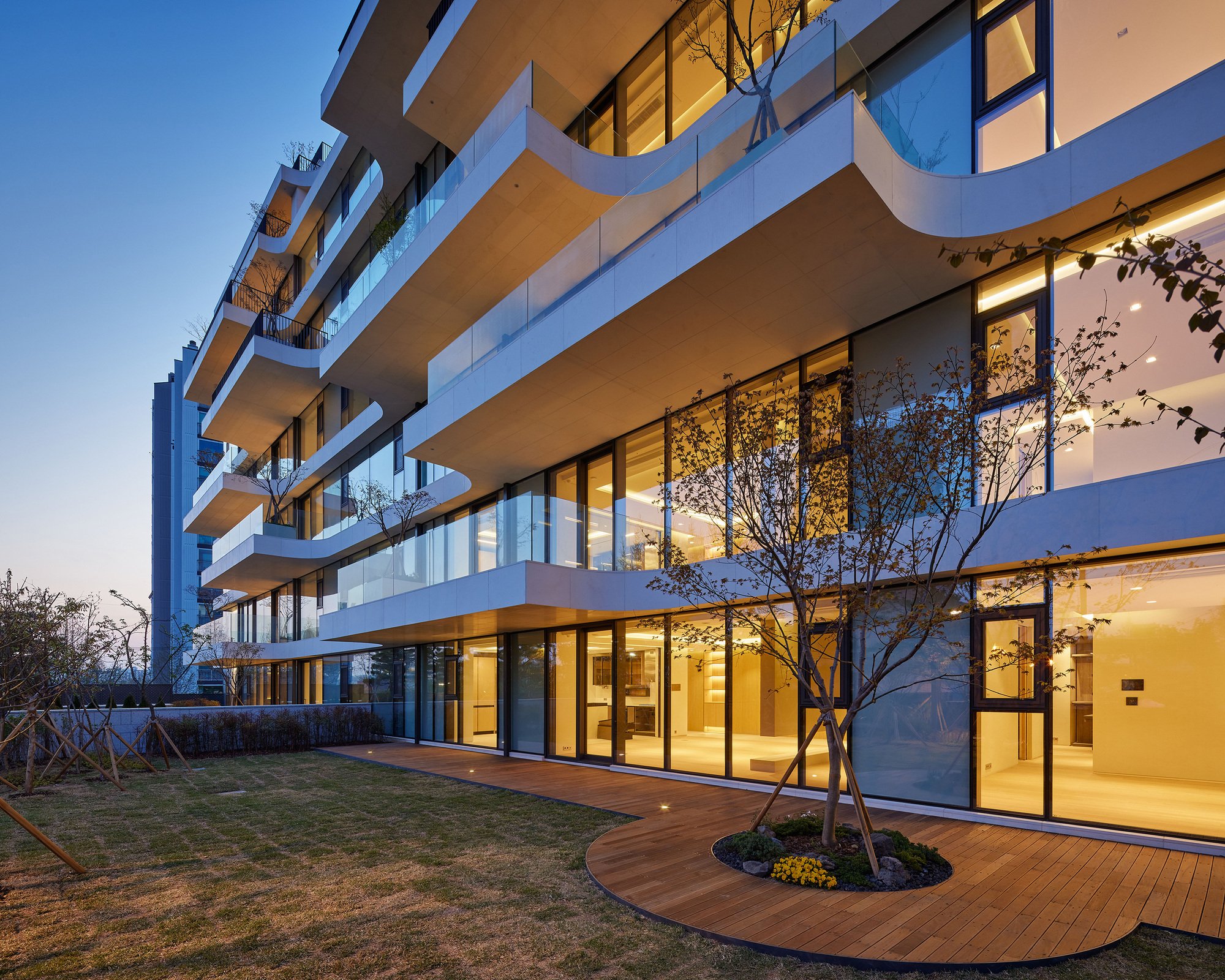
Hyunjoon Yoo and Partners Stack 26 Luxury Units into a Terraced Acropolis on Seoul's Han River
AFER Hangang transforms setback regulations into a cascading residential landmark in Yongsan-gu, Seoul, South Korea.

Regulations are usually the enemy of architectural ambition. In Seoul's Yongsan-gu district, on a narrow site between Namsan's foothills and the Han River, Hyunjoon Yoo and Partners faced a particularly unforgiving set of constraints: height limits, setback requirements, solar access rules. Instead of fighting them, the architects absorbed them into the building's fundamental shape, producing a 10-story, 26-unit residential tower that steps back as it rises, turning bureaucratic compliance into something genuinely compelling.
AFER, meaning "rare" in Spanish, is the right name. The 16,028 m² building reads less like a typical Seoul apartment block and more like a hillside village compressed into a single structure. The architects invoke the Acropolis of Athens as a conceptual reference, and while that comparison does heavy lifting, it points to a real strategy: treating each floor plate as a plateau, each terrace as a threshold between private life and the landscape beyond. With five underground levels and ten above, the building buries its parking and services to liberate the surface for gardens, courtyards, and south-facing living rooms that open directly onto the Han River.
Turning Setbacks into Architecture
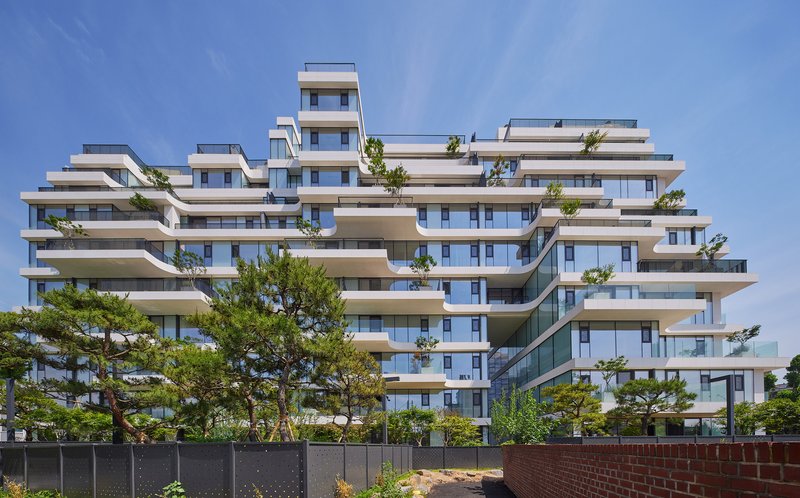
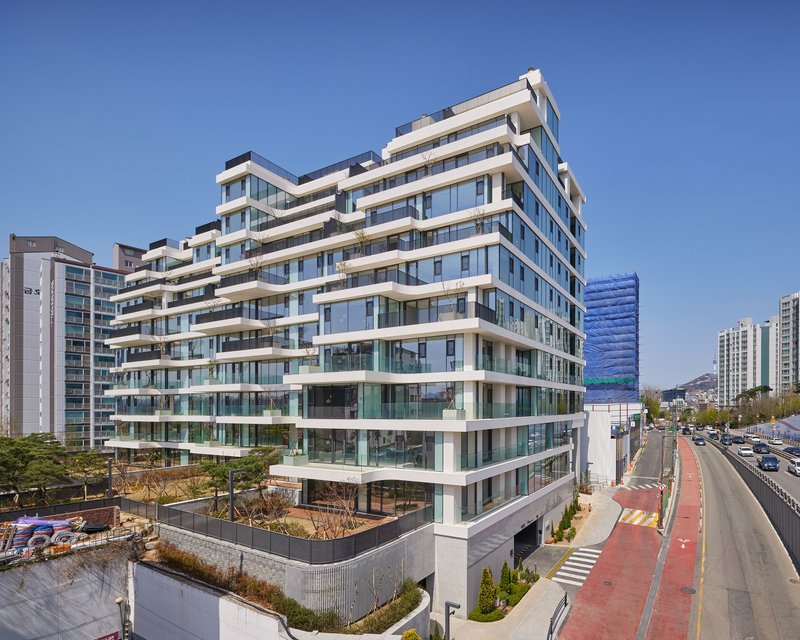
The most distinctive move here is the stepped massing. Seoul's setback regulations require buildings to pull back from neighboring properties at upper floors, which typically produces awkward, saw-toothed profiles that architects try to disguise. Hyunjoon Yoo and Partners instead made the recession the whole point. Each floor plate is smaller than the one below, creating a cascade of terraces that face south toward the river. The white balcony slabs, cantilevered with softly curved soffits, give the facade a layered horizontality that shifts in appearance depending on your vantage point: monolithic from the street corner, almost geological from a distance.
At dusk, the building transforms. Floor-to-ceiling glazing behind the terraces glows warm against the cool white concrete, and the stacked platforms read like illuminated shelves against the darkening sky. The mature pines at street level anchor the composition, providing a necessary counterweight to the ascending geometry above.
Courtyard Logic and the Hanok Reference
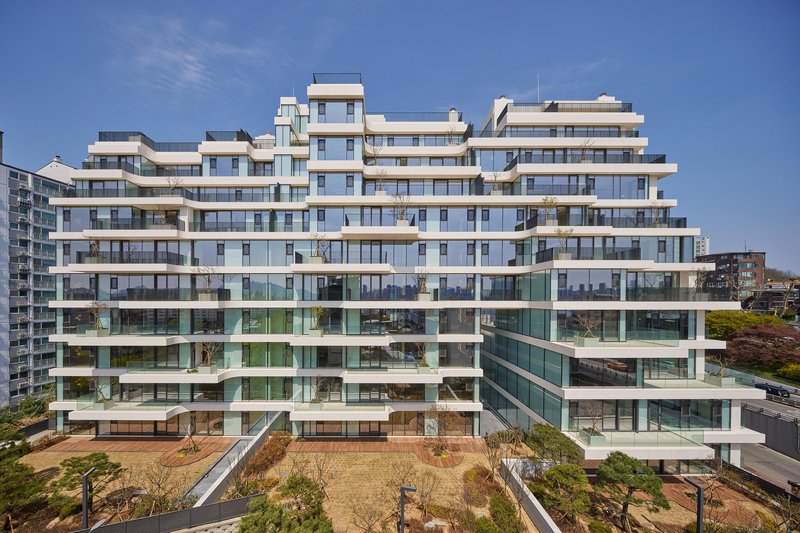
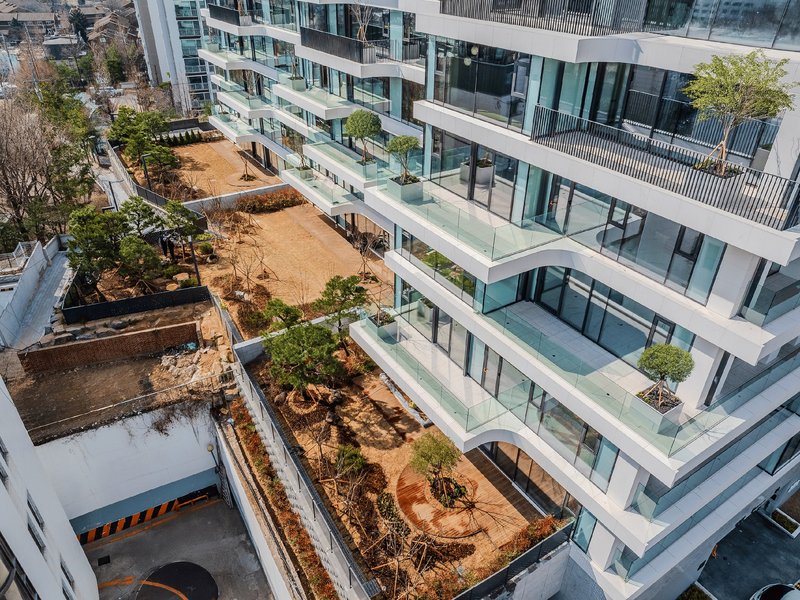
At ground level, the building organizes itself around planted courtyards that the architects describe as reinterpretations of the traditional Korean hanok courtyard. Freshly planted beds, young trees, and carefully graded soil fill the spaces between the two building volumes. It is a landscape that will mature over time, and the design clearly anticipates this: the courtyard proportions are generous enough that in a decade, the canopy will create a genuinely shaded, enclosed garden at the building's heart.
The site also follows Baesanimsu principles, the Korean application of Feng Shui that calls for a mountain at the back and water at the front. Namsan sits to the north, the Han River flows to the south, and the building's orientation places every living room facing the water. Whether you read this as cultural sensitivity or pragmatic solar design, the result is the same: south light floods the interiors, and every resident looks out over one of Seoul's defining geographical features.
Terraces as Extended Living Rooms
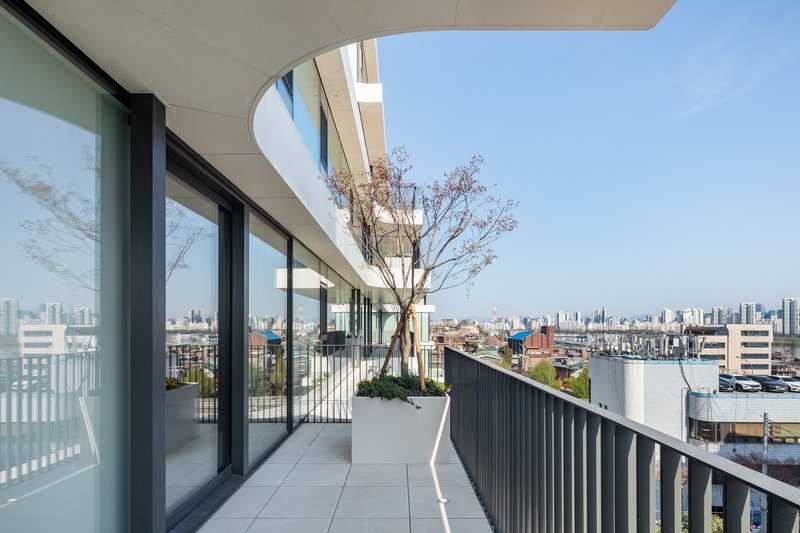
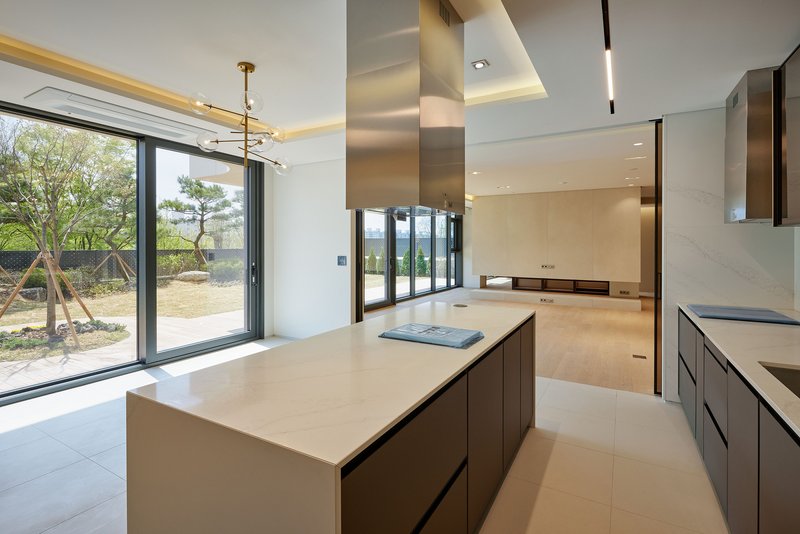
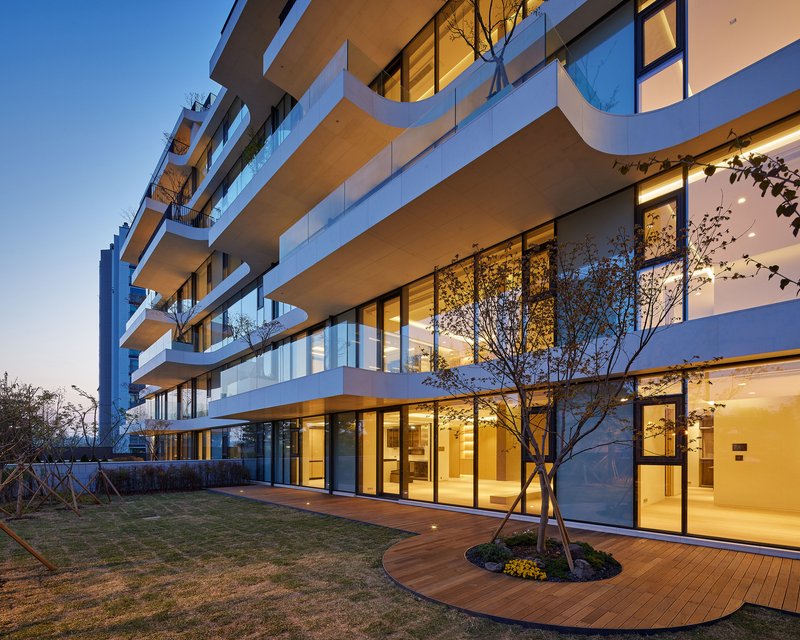
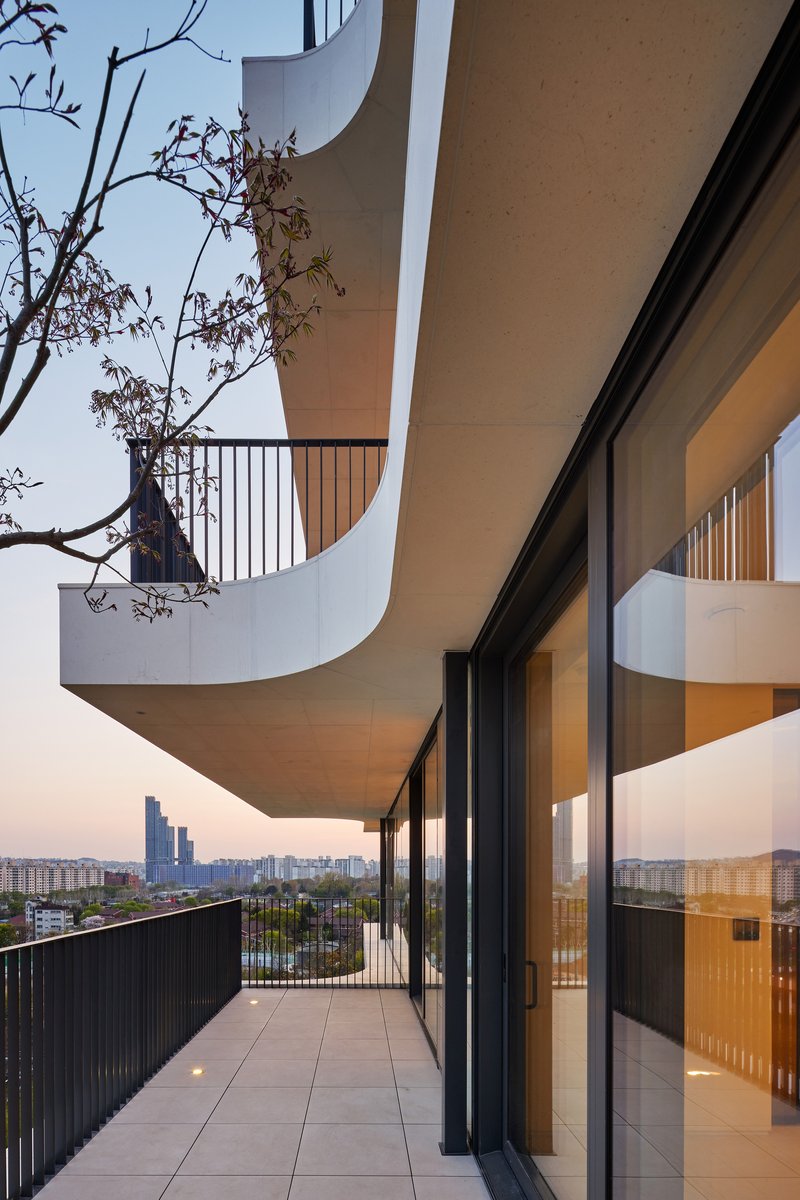
With unit sizes ranging from 206 to 274 m², these are not small apartments. But the terraces effectively double the usable area of each home. The architects propose that residents might configure their outdoor space as a home cafe, a personal garden, or even a mini camping site. That last suggestion sounds like marketing copy, but the terrace dimensions actually support it: they are deep enough to accommodate furniture, planters, and circulation without feeling like narrow balconies dressed up as outdoor rooms.
The interiors, designed by DAEHYE, are restrained. Pale wood floors, cove lighting recessed into smooth ceilings, and full-height sliding glass doors that blur the boundary between inside and out. The kitchen in one model unit features an island that looks directly through the glass onto a garden terrace, collapsing the distance between cooking and landscape. Windows are positioned not just for views but between interior spaces, creating sight lines that extend through the apartment and connect to the exterior on both sides.
Materiality and Detail
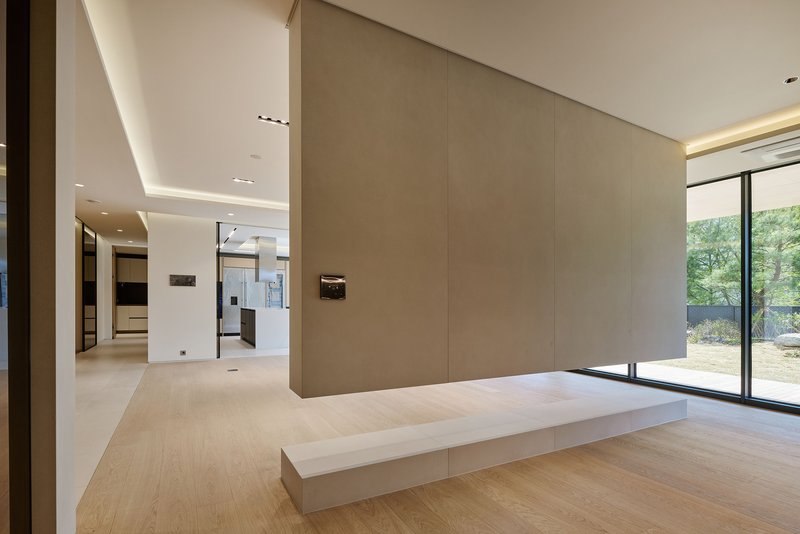
The palette is deliberately limited: white concrete for the structural terraces, glass railings that keep sightlines open, and timber decking on the outdoor platforms. The curved soffits beneath each cantilevered balcony are the most refined detail, softening what could be a harsh series of right angles into something more fluid. At the entry level, the transition from exterior landscape to interior is handled through a generous glazed threshold space with pale wood flooring and recessed cove lighting that draws you inward without any dramatic gestures.
Construction was handled by Hyundai E&C with structural engineering by WONWOO ENG, and the building's clean lines suggest a high level of execution. The collaboration with landscape designer Studio HYMH is evident in the care given to ground-level planting, where the hard geometry of the architecture meets an intentionally organic arrangement of trees and garden beds.
Plans and Drawings
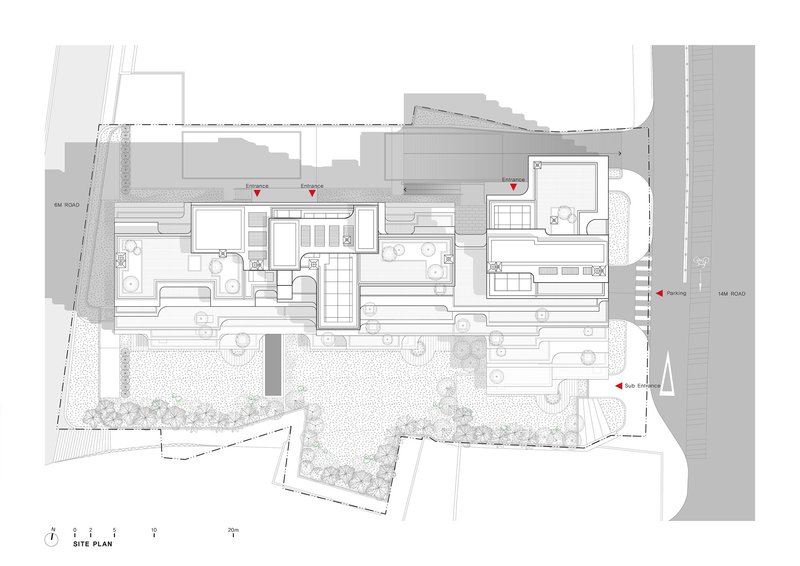
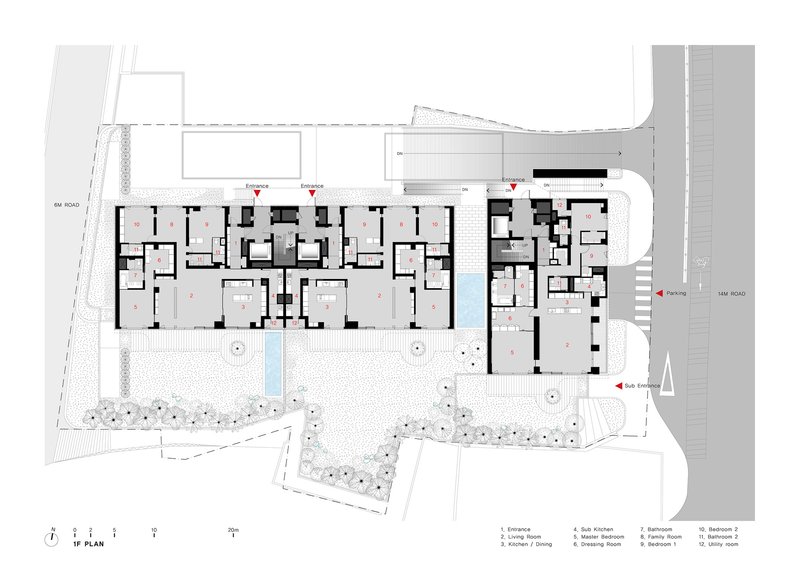
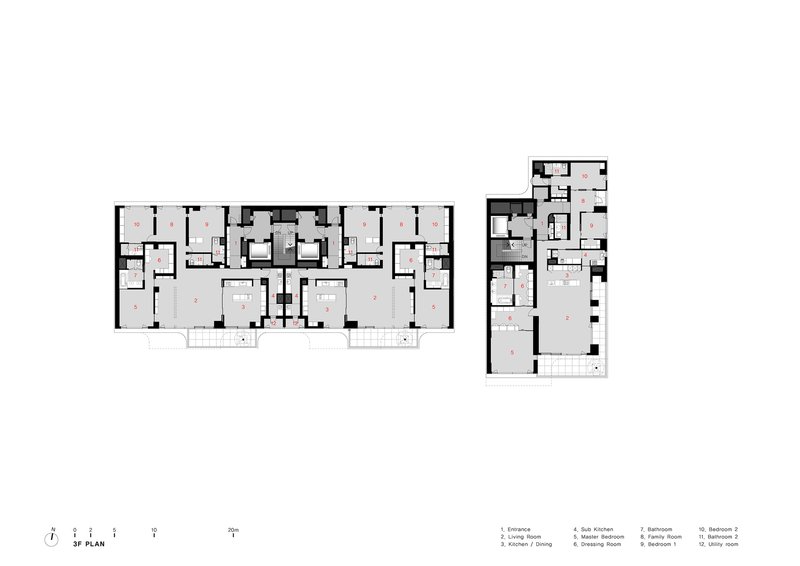
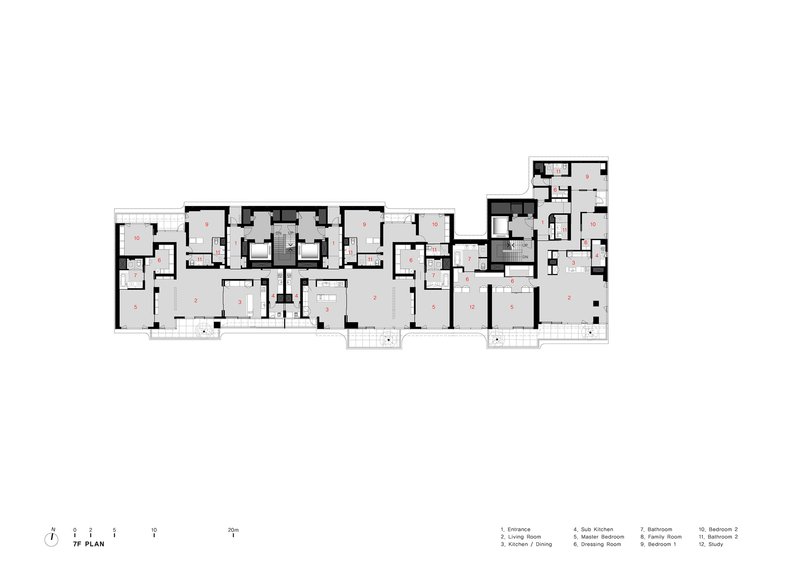
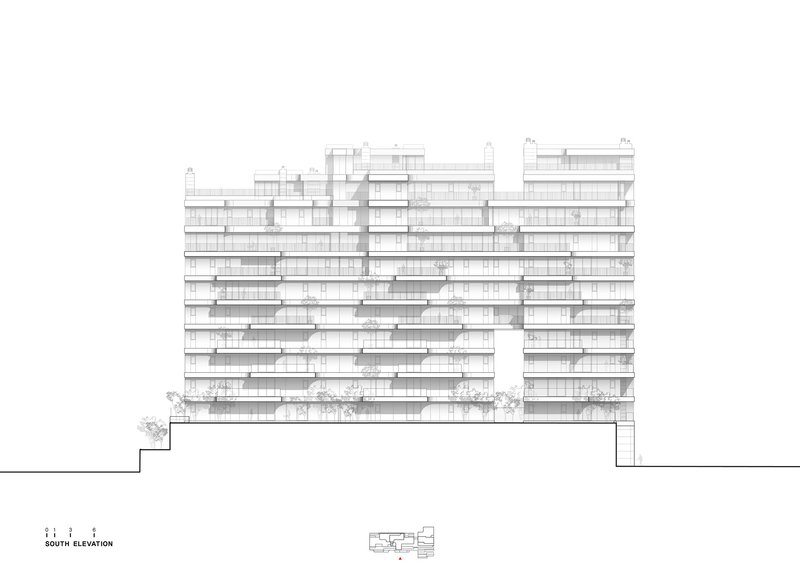
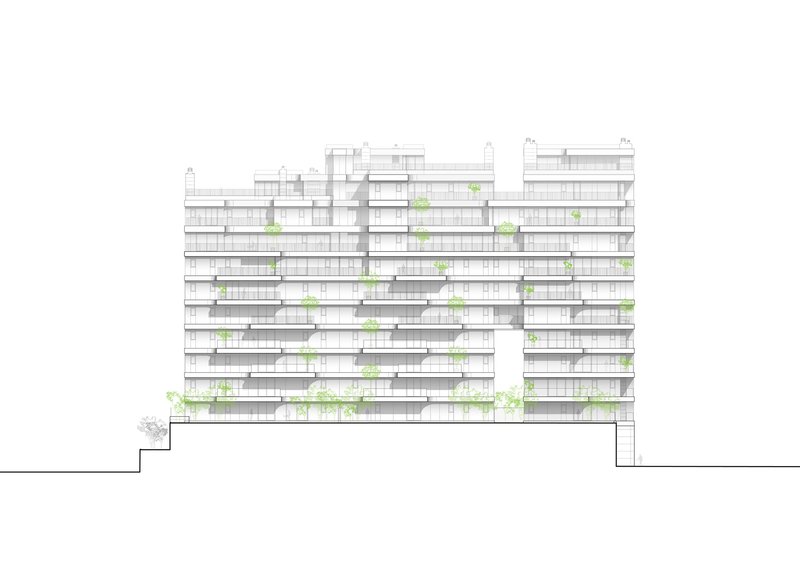
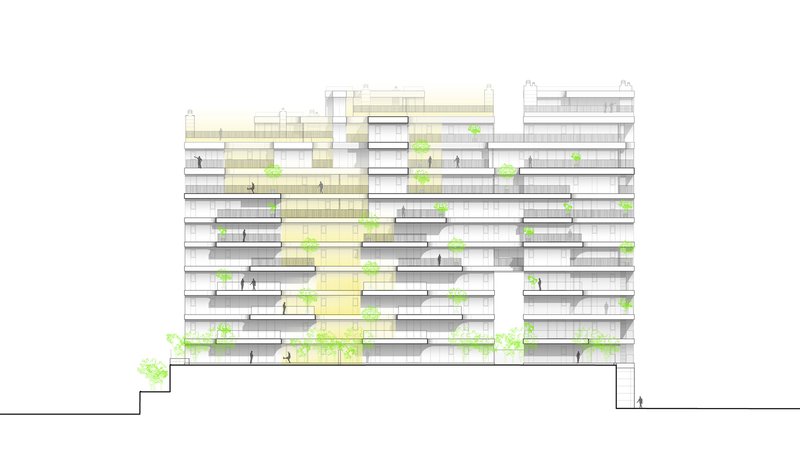
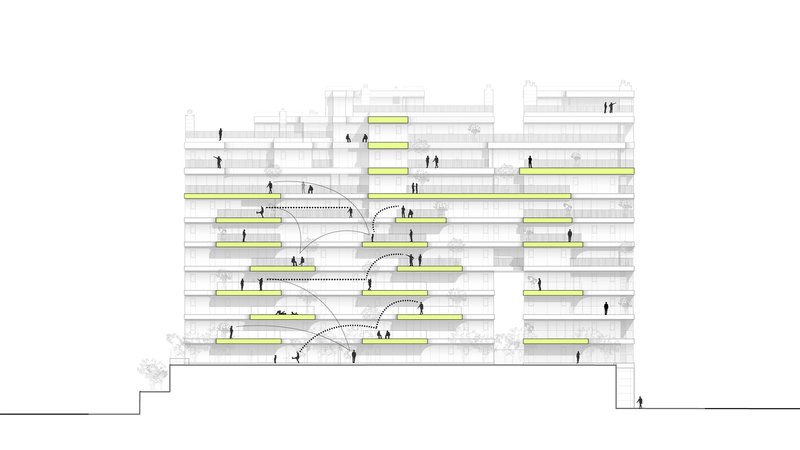
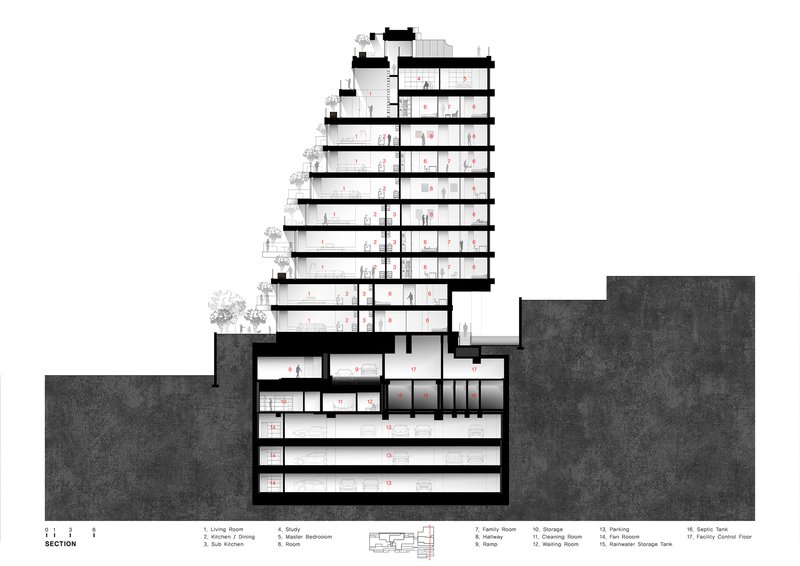
The site plan confirms the tight urban context: the building sits on a compact footprint bounded by roads, with landscaped buffers on all sides. The floor plans reveal two building volumes organized around central cores, with units arranged to maximize south-facing exposure. At the first floor, a pool occupies the space between the two volumes, adding a communal amenity at the courtyard level. As you move up through the plans, the stepped configuration becomes legible: each floor sheds area, and the lost floor plate becomes the terrace of the unit below.
The south elevation drawings are the most revealing documents. They show the full cascade of terraces with planted trees at each level, occupants visible on their balconies, and diagrammatic arrows tracing the circulation paths that connect staggered floor levels. The section drawing cuts through the entire building from the five underground parking levels up through the residential floors, making clear just how much of the building's volume is hidden beneath grade to preserve the airy, open character above.
Why This Project Matters
Seoul's residential market has long been dominated by repetitive tower blocks that treat regulations as problems to be minimized rather than opportunities to be exploited. AFER Hangang offers a counter-argument. By internalizing setback rules as the project's primary formal strategy, Hyunjoon Yoo and Partners produced a building that is both more interesting and more livable than the towers around it. The stepped form is not a compromise; it is the architecture.
The broader lesson is about constraint as a creative catalyst. When you cannot build a simple extrusion, when every floor must be smaller than the last, you are forced to think about what each level gains by losing area. Here, the answer is outdoor space, light, and views of the Han River. Twenty-six households now live in apartments where the terrace is not an afterthought but the defining spatial experience. That is a worthwhile trade.
AFER Hangang, designed by Hyunjoon Yoo and Partners with co-architect AA archigroup, located in Seobinggo-dong, Yongsan-gu, Seoul, South Korea. 16,028 m², completed in 2024. Interior design by DAEHYE. Landscape design by Studio HYMH. Construction by Hyundai E&C. Photography by Kyung Roh, Kyungsub Shin, and Hyunjoon Yoo + Partners.
About the Studio
Share Your Own Work on uni.xyz
If projects like this are the kind of work you want to make, uni.xyz is a place to publish your own, find collaborators, and enter design competitions.




Popular Articles
Popular articles from the community

OUALALOU+CHOI Root a Regional Sports Campus in Moroccan Earth and Timber
A 10,230 square meter athletic complex in Ben Guerir uses rammed earth walls and timber screens to anchor sport in the arid landscape.
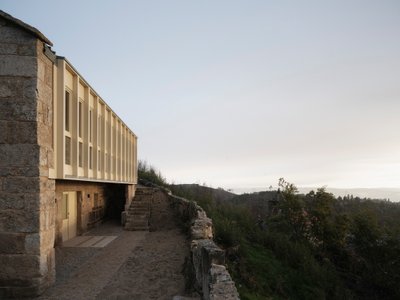
Three Architects Stitch a Social Center into a Crumbling Galician Hamlet
In Muimenta, Spain, timber and plywood volumes graft onto granite ruins to anchor a rural revitalization effort.
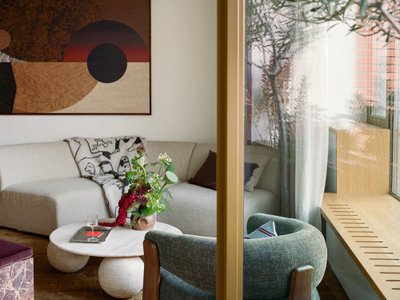
OMAMBO and DORON Atelier Weave Two Cultural Identities into an 80 m² Bucharest Apartment
Rather Two layers Romanian and Angolan heritage through stucco, recycled plastics, and deliberate spatial contrasts in central Bucharest.
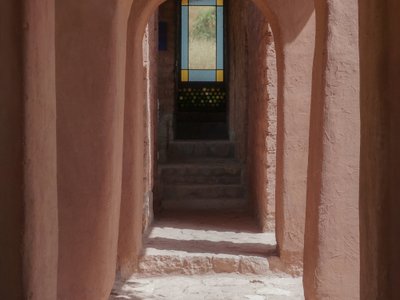
Taller MACAA Weaves Adobe Lodging into the Sacred Valley at 3,100 Meters Above Sea Level
Dormis Donata bridges permanent and temporary inhabitation through earthen construction in the agricultural highlands of Taray, Peru.


Similar Reads
You might also enjoy these articles

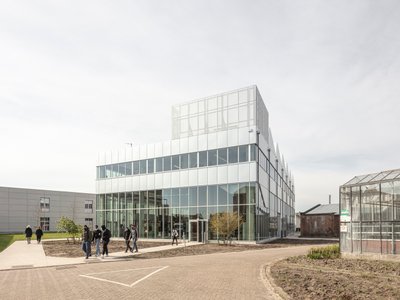
STEM School Mechelen by LAVA Architecten: A Future-Ready Educational Architecture in Belgium
Flexible, sustainable STEM school in Mechelen featuring modular classrooms, acoustic innovation, and energy-efficient design supporting future-focused collaborative learning environments.
Marvila Apartment Renovation in Lisbon: A Bright Minimalist Attic Transformation by KEMA Studio
Bright attic transformed into minimalist Lisbon apartment with skylights, sustainable materials, open plan layout, and industrial-inspired interior design elements.

20 Most Popular Commercial Architecture Projects of 2025
From sustainable market concepts to heritage factories, the commercial buildings and proposals that drew the most attention on uni.xyz this year.
Mantiqueira House by SysHaus and M Magalhães Estúdio
A linear modular house embedded in Serra da Mantiqueira, integrating panoramic views, sustainable prefabrication, minimal terrain impact, and contemporary interiors.


Comments (0)
Please login or sign up to add comments
No comments yet. Be the first to comment!