

ICC House by CODA Arquitetura: A Contemporary Home Inspired by Brasília’s Modernist Legacy
A compact modernist-inspired home in Brasília, integrating exposed concrete, terracotta tones, and fluid indoor-outdoor living around a central courtyard.


Located in Brasília, Brazil, ICC House is a compact yet expressive residential project designed by CODA Arquitetura in 2023. Conceived for a growing family, the house translates emotional memory and architectural heritage into a contemporary domestic space, where structure, materiality, and spatial fluidity come together in a carefully balanced composition.


The project draws its conceptual foundation from one of Brasília’s most iconic modernist structures: the Central Institute of Sciences (ICC), also known as Minhocão, designed in the 1960s by Oscar Niemeyer and João Filgueiras Lima (Lelé). An emblem of experimental precast concrete architecture, the ICC building provided both formal and philosophical inspiration for the house, reflecting the clients’ deep appreciation for Brasília’s architectural legacy.

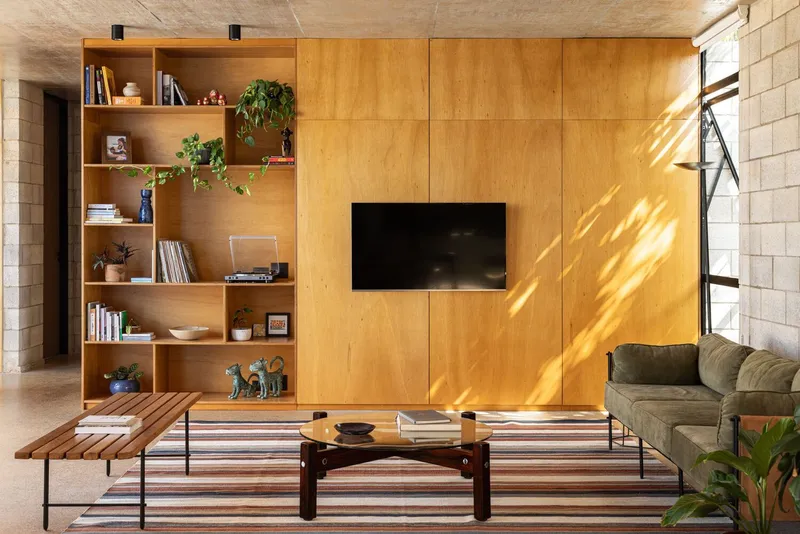

Modernist References and Architectural Concept
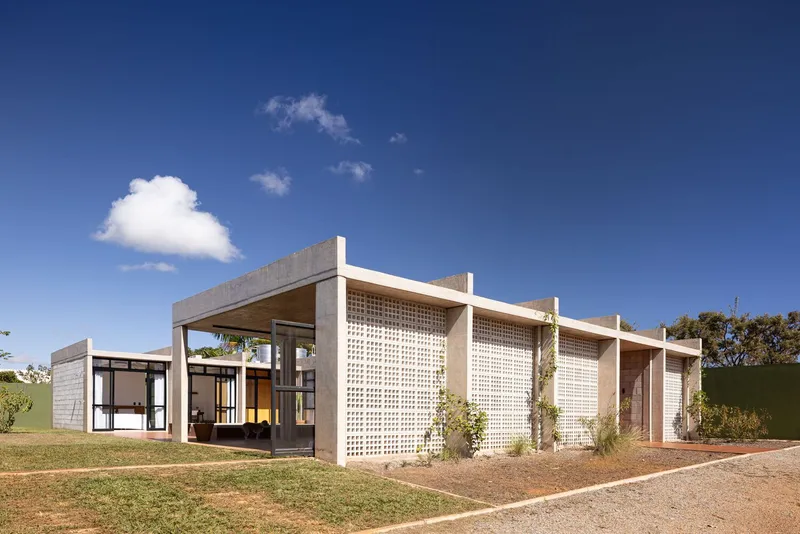
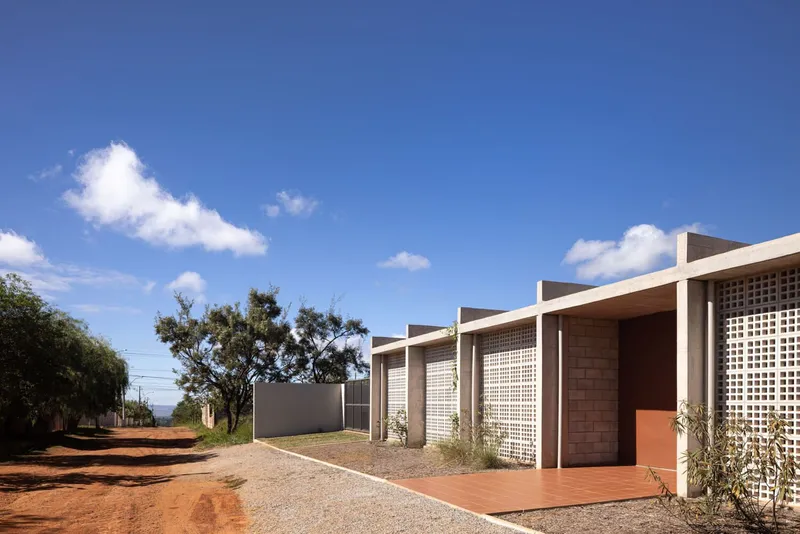
The influence of Niemeyer and Lelé is evident in the use of exposed concrete, large horizontal openings, and a rhythmic structural system that defines the house’s plastic identity. Rather than replicating historical forms, CODA Arquitetura reinterprets modernist principles through a contemporary lens, adapting them to a domestic scale and the specific needs of family life.
The house is organized around a clear modular logic, where structure and space are closely intertwined. This approach reinforces spatial continuity while allowing flexibility and visual permeability throughout the interior.
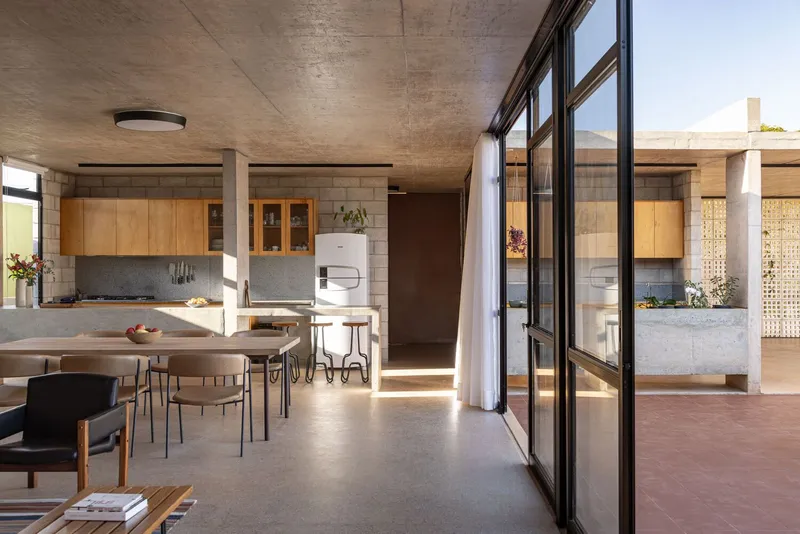

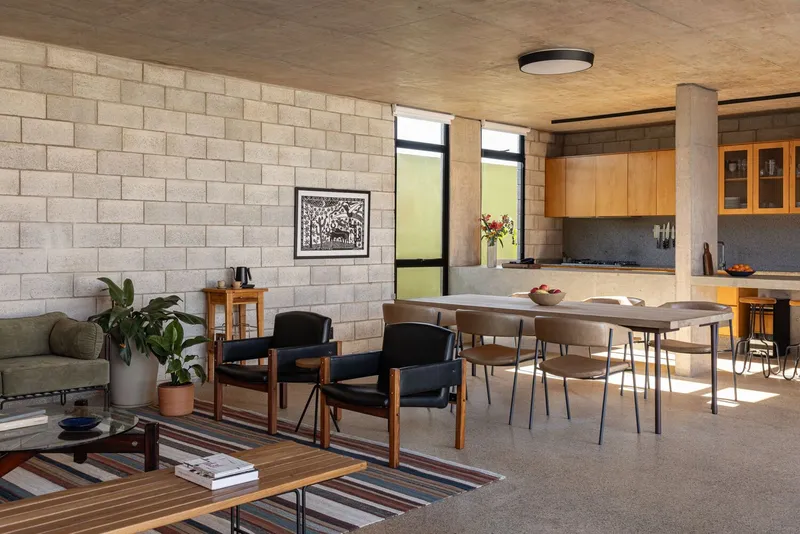
Integrated Living Spaces and Programmatic Clarity
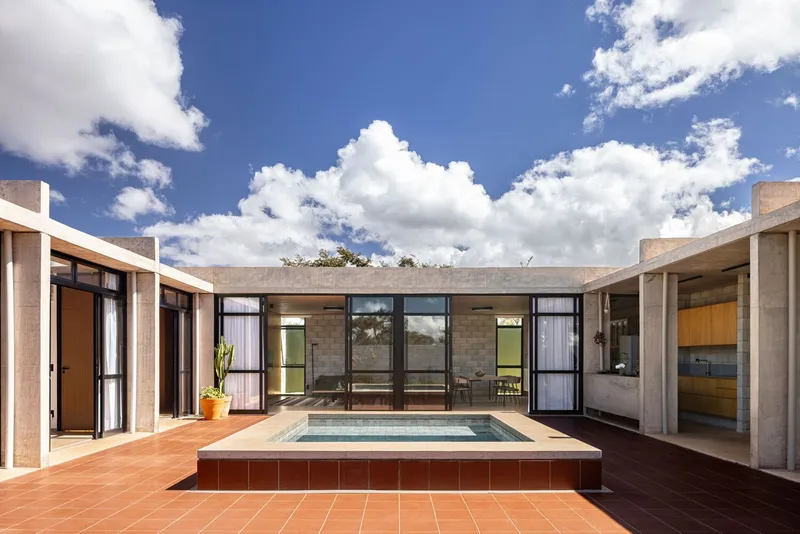
Responding to the clients’ request for a compact house with a fully integrated social area, the ground floor unifies the living room, kitchen, and barbecue space into a single, generous environment. This central social zone acts as the heart of the home, encouraging everyday interaction and shared experiences.
Large sliding windows open the interior toward a central patio, establishing a seamless relationship between indoor and outdoor spaces. The patio functions as an organizing element of the house, with all main rooms oriented toward it, and a pool positioned at its core. This inward-facing configuration enhances privacy while maintaining constant visual and spatial connections.
In addition to the social areas, the program includes bedrooms for the couple’s daughters, guest rooms, a home office, and a ceramics and crafts studio, reflecting the family’s lifestyle and creative interests.
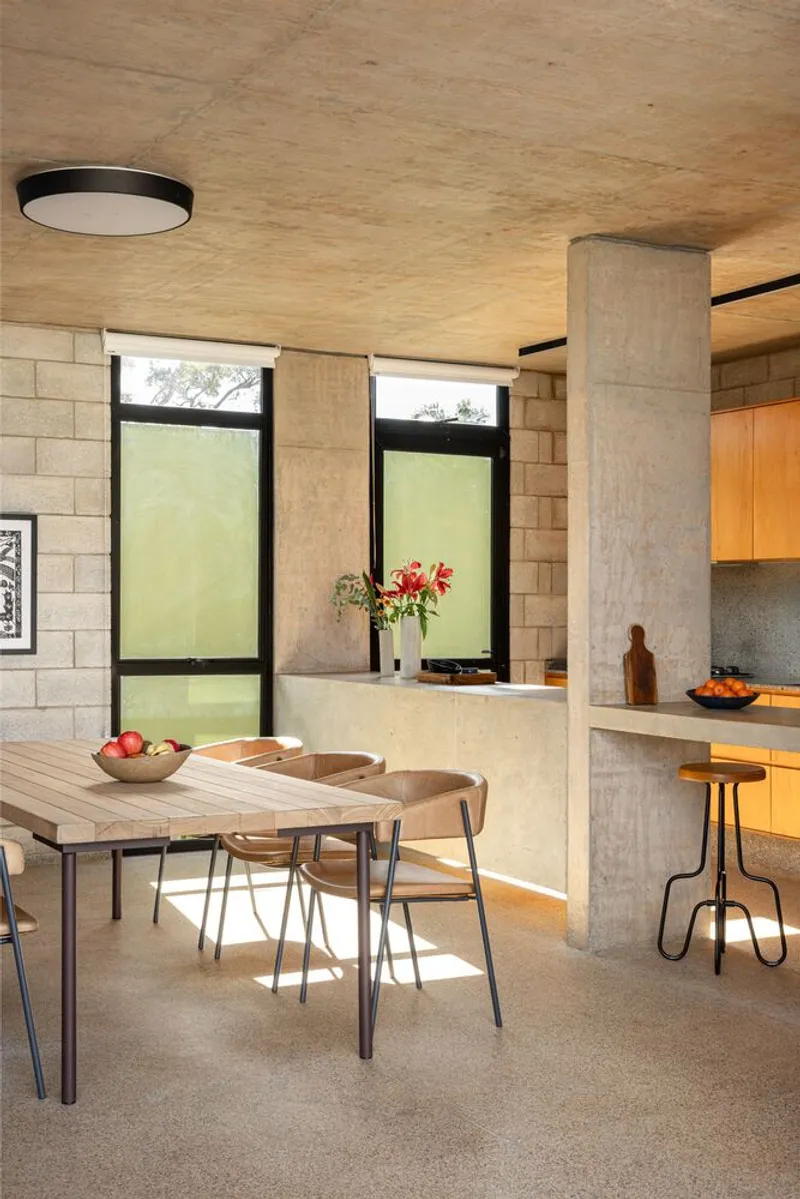
Materiality, Color, and Connection to the Cerrado Landscape
Material choices play a key role in anchoring the project to its context. The color palette is directly informed by the surrounding landscape of the Brazilian Cerrado, characterized by arid terrain and red earth. A warm terracotta tone is used throughout the house, harmonizing with the exposed concrete structure and natural wood finishes.
This chromatic strategy not only reinforces the building’s relationship with the site but also creates a dialogue with the modernist references that inspired the project. The result is a tactile and visually cohesive environment, where architecture, interior design, and landscape are closely intertwined.

A House Shaped by Memory and Modernity
ICC House is more than a functional family residence; it is a thoughtful architectural response to Brasília’s modernist heritage and the emotional narratives of its inhabitants. By combining structural clarity, material honesty, and spatial fluidity, CODA Arquitetura delivers a contemporary home that celebrates memory, context, and everyday life in equal measure.

All photographs are works of Joana França


Popular Articles
Popular articles from the community

Cloaked Colonization: A Mobile Underwater Habitat That Moves Like a Fish
Micah Abaya's shortlisted EHC Pacific entry reimagines ocean settlement as a dispersed network of self-sustaining architectural organisms.
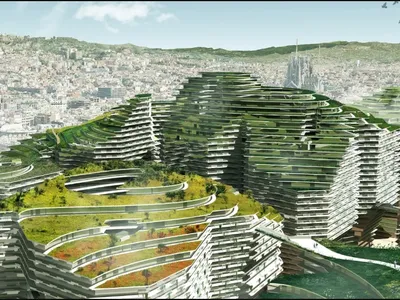
Manzana Morphosis: Stretching Barcelona's Grid into a Living Landscape for 2050
A radical reworking of the Eixample manzana turns density into a tool for generous public space, vertical ecology, and environmental performance.
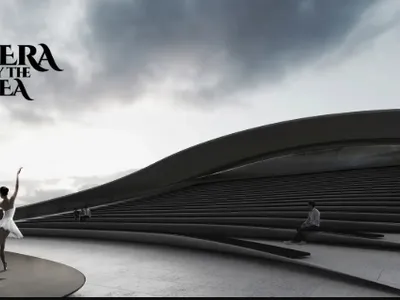
Opera by the Sea Estonia: Three Shells Dissolving Architecture into Tallinn's Coastline
A winning opera house proposal replaces monumental form with interconnected shells that blur the boundary between building, park and Baltic Sea.
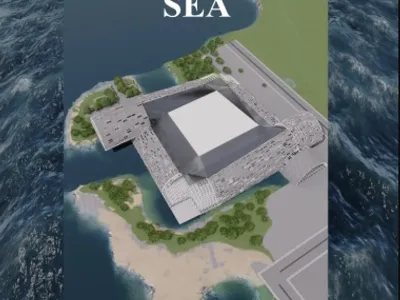
Opera on the Sea: Driftwood Logic Shapes a Timber Opera House on Estonia's Coast
Trevor Orgill's opera house translates the entangled drift of floating timber into a civic building where wood, water, and music converge.

Similar Reads
You might also enjoy these articles


Hodi-Mandai Geram
Project Function: Preservation and revitalization of the Intangible heritage and socio-spatial identity of the Hodi by Housing, Cultural Memory Center, Sacred Grove, landscape, local tourism economy


Olio Towers: A Mid-Rise for Performers That Fuses Housing, Rehearsal, and Stage
Located blocks from Houston's Theater District, this modular tower stacks living units around a central performance atrium.

Oasis: Modular Green Housing Carved into Dhaka's Urban Fabric
A shortlisted Plugin Housing entry reclaims unauthorized settlements in Dhaka with stepped concrete volumes, green roofs, and ventilation-driven design.

Black Hole: A Floating Megastructure for the Post-Physical Era
Emiliano Mazzarotto envisions a spherical, self-scaling arena where e-sports, digital hotels, and holographic stadiums replace traditional public space.

Explore Architecture Competitions
Discover active competitions in this discipline

Challenge to reimagine the Iron Throne

Photograph architecture without architects

Illustrate the lost glory of Angkor Wat - Render Challenge

Design challenge to reuse E-waste
Comments (0)
Please login or sign up to add comments
No comments yet. Be the first to comment!